



In many organizations, especially startups and growing small businesses, sales and business development are used interchangeably or rolled into a single role. This overlap can create confusion, misaligned expectations, and missed opportunities for both short‑term revenue and long‑term growth.

At a high level, sales focuses on converting qualified leads into paying customers, while business development focuses on identifying and cultivating new opportunities, markets, and relationships that can create long‑term value. Both functions contribute to revenue, but they do so at different stages of the funnel and with different measures of success.
The goal of this guide is to define sales and business development clearly, compare them side by side, explain why separating them matters, and outline how they can work together to build a stronger, more scalable growth engine.
What Is Sales?

Sales is the function responsible for converting leads and opportunities into paying customers by guiding them through the buying process and closing deals. It is typically more short‑term, target‑driven, and focused on measurable revenue outcomes over weeks, months, or quarters.
Core Definition
In simple terms, sales is the process of generating revenue by selling products or services to customers within an established market or channel. Sales teams work with prospects who have already been identified or qualified to some degree and focus on moving them from interest to commitment.
This function is often described as transactional and execution‑oriented, because it involves direct interactions with prospects, handling objections, and negotiating terms to finalize the purchase.
Key Sales Responsibilities
Sales responsibilities can vary by company size and model, but they usually include the following activities:
- Managing and following up with inbound or outbound leads that are already in the pipeline.
- Conducting product demos or presentations that show how the offering solves the prospect’s specific problems.
- Handling objections about price, features, implementation, or risk and addressing doubts that block the sale.
- Negotiating terms, pricing, and contracts to reach mutually acceptable agreements.
- Closing deals and ensuring all paperwork, signatures, and next steps are completed.
- Maintaining ongoing relationships with customers to encourage renewals, upsells, and referrals in many B2B settings.
These tasks place sales teams at the later stages of the customer journey, where decisions are made and revenue is realized.
Sales Team Objectives & Metrics
Sales teams are measured primarily on short‑term, tangible outcomes that tie directly to revenue. Common objectives and metrics include the following:
- Hitting monthly or quarterly revenue quotas.
- Increasing conversion rates from opportunity to closed‑won.
- Managing deal velocity, such as reducing the average time to close.
- Growing average deal size or contract value.
- Controlling customer acquisition cost relative to revenue.
Because of these metrics, sales teams are naturally oriented toward immediate wins and efficient deal execution.
Skills Required in Sales
Effective sales professionals typically rely on a blend of soft skills, process discipline, and product knowledge:
- Strong communication and active listening to understand customer needs and articulate solutions clearly.
- Negotiation and persuasion to navigate pricing, terms, and competitive alternatives.
- Objection handling and problem‑solving to address concerns and remove friction from the buying process.
- Relationship‑building skills to create trust, particularly in higher‑value or long sales cycles.
- Deep product or service knowledge to confidently match features and benefits to customer pain points.
These capabilities enable sales teams to move prospects through the final stages of the funnel and secure commitments.
What Is Business Development?
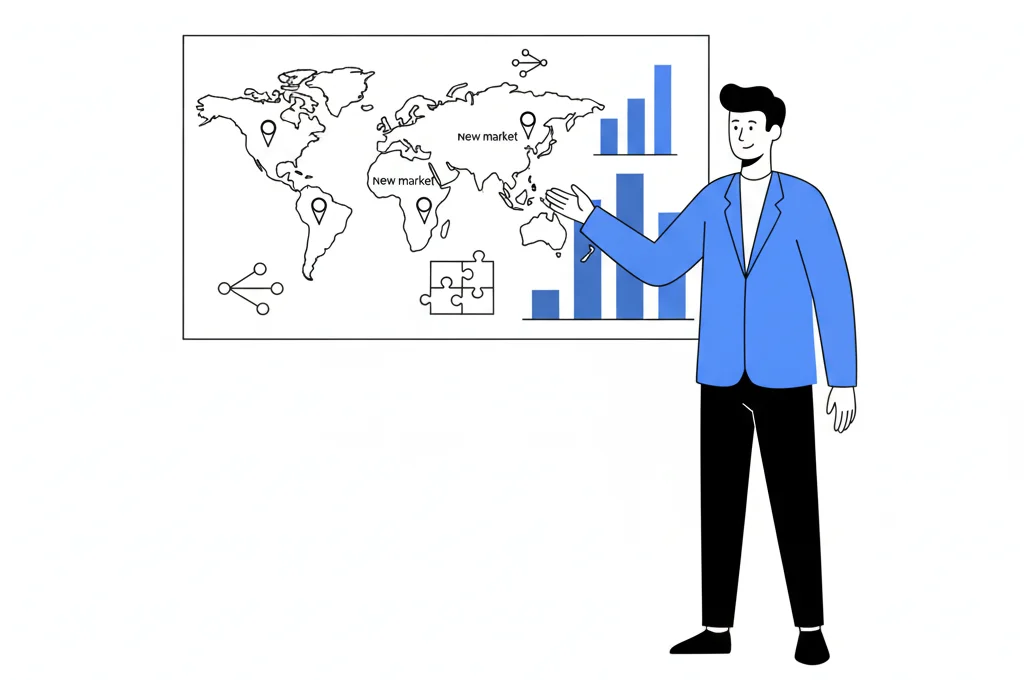
Business development (BD) is the function focused on creating long‑term value for the organization by identifying new opportunities, markets, partnerships, and strategies for growth. It is more strategic, exploratory, and future‑oriented than day‑to‑day sales execution.
Core Definition
Business development can be defined as the process of identifying and pursuing opportunities that create long‑term value from customers, markets, and relationships. Rather than focusing on closing individual deals, BD looks at where the business should go next and what relationships or initiatives will enable that growth.
This may involve expanding into new segments, building partnerships, shaping new offerings, or opening up new channels, often before direct revenue is realized.
Key Business Development Responsibilities
BD responsibilities cover a broad, strategic set of activities that support company growth:
- Conducting market research to identify new customer segments, industries, or regions with potential demand.
- Analyzing competitors and trends to find gaps, differentiators, and emerging opportunities.
- Building strategic partnerships and alliances with other companies, distributors, or platforms.
- Exploring new product or service opportunities and feeding insights into product development teams.
- Designing and testing new go‑to‑market approaches or channels.
- Generating and qualifying early‑stage leads or accounts to pass on to sales or sales development once they are ready.
- Networking at events, conferences, and industry forums to build high‑value relationships.
These actions are less about immediate deal closure and more about expanding the company’s reach and potential.
Business Development Objectives & Metrics
Because BD is focused on long‑term growth, its metrics are typically more strategic and leading‑indicator‑oriented than those of sales:
- Number and quality of strategic partnerships formed.
- Entry into new markets or segments and performance in those areas over time.
- Volume and quality of opportunities or accounts generated for sales teams.
- Growth of the qualified pipeline attributable to BD initiatives.
- Long‑term revenue or margin impacts from new initiatives and relationships.
These metrics may take longer to show results, but they help ensure the company has a strong future pipeline and competitive position.
Skills Required in Business Development
BD roles often require a mix of strategic, analytical, and relationship‑oriented skills:
- Strategic thinking to evaluate markets, opportunities, and competitive dynamics.
- Analytical ability to interpret data, trends, and financial implications of growth initiatives.
- Strong networking and relationship‑building skills, particularly with partners and senior stakeholders.
- Industry knowledge to understand where the market is heading and where the business can play.
- A consultative, advisory mindset when engaging with partners or early‑stage prospects.
Because BD decisions shape the trajectory of the business, these roles often sit close to leadership or strategy teams.
Sales vs Business Development: Direct Comparison
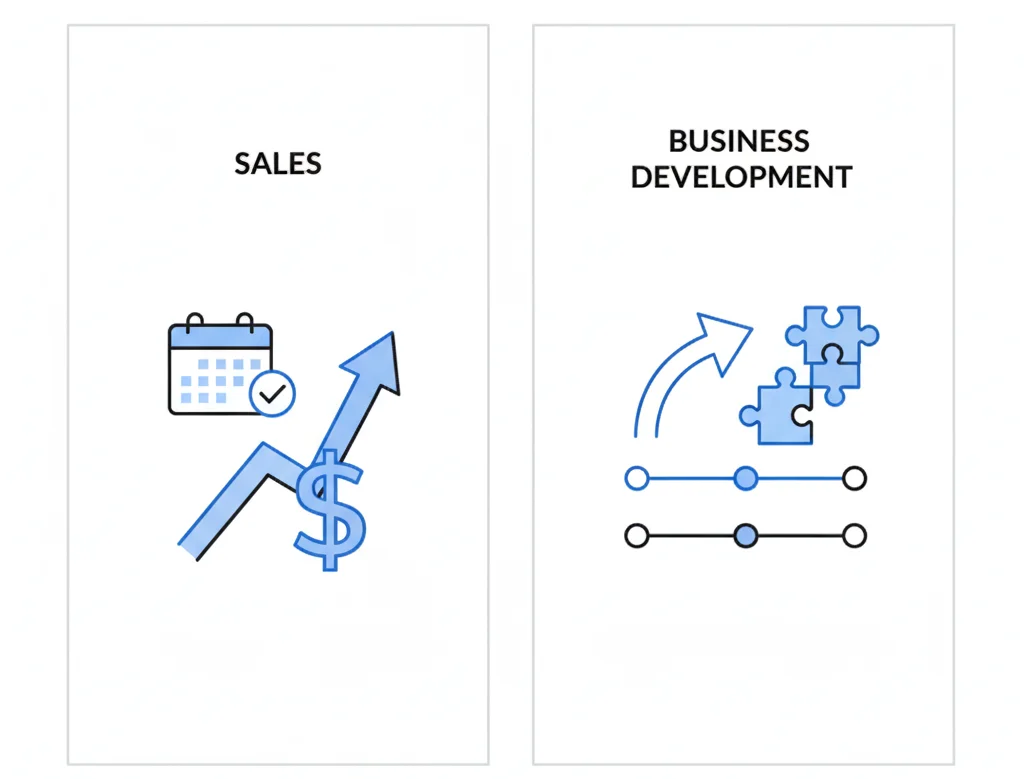
Sales and business development share a common goal of driving growth, but they work at different stages of the funnel, on different time horizons, and with different toolsets. Comparing them directly helps clarify where each function fits.
Comprehensive Comparison Table
A typical comparison between sales and business development can be summarized along several dimensions:
| Dimension | Sales | Business Development |
| Primary focus | Closing deals and generating immediate revenue. | Identifying opportunities and building long‑term growth paths. |
| Main activities | Demos, proposals, negotiations, and closing. | Market research, partnerships, new markets, and early opportunity creation. |
| Time horizon | Short‑term targets (months/quarters). | Long‑term strategic outcomes (months/years). |
| Stage in funnel | Later stages: working with qualified leads and opportunities. | Earlier stages: discovering and shaping opportunities. |
| Orientation | More transactional and execution‑oriented. | More strategic and relational. |
| Typical metrics | Revenue, conversion rate, deal velocity, average deal size. | New markets, partnerships, pipeline value, long‑term revenue impact. |
This structure reflects how many organizations and practitioners describe the relationship between the two functions.
Timeframe Differences
Sales typically operates on short‑term cycles aligned with monthly or quarterly targets, which can include quotas for revenue, number of deals, or units sold. Business development, on the other hand, focuses on initiatives that may take months or years to fully mature, such as entering new regions or building partnerships that produce recurring revenue streams.
Because of this, sales teams emphasize speed and efficiency in closing, while BD accepts longer timelines in exchange for larger or more strategic outcomes.
Approach & Methodology
Sales uses a more transactional, process‑driven approach: following a defined sales process, working through stages such as discovery, proposal, negotiation, and close. Business development typically uses a more exploratory methodology, including research, testing, and iterative relationship‑building to determine which markets or partners are worth deeper investment.
Both functions may involve direct contact with potential customers, but the nature of those conversations differs: sales talks are oriented around specific deals, while BD discussions often revolve around possibilities, alignment, and mutual value creation.
Revenue Impact
Sales contributes to revenue directly by converting opportunities into paying customers and booking recognized revenue. Business development influences revenue more indirectly and over a longer period, by creating new channels, markets, and relationships that feed future sales opportunities.
When both functions are working well, BD fills and expands the pipeline with quality opportunities, while sales efficiently converts those opportunities into measurable revenue.
Also Check: Top 10 Salesforce Alternatives And Competitors In 2025
Why Sales and Business Development Should Be Separate Roles
As organizations grow, combining sales and BD into a single role often leads to conflicting priorities and suboptimal performance in both areas. Separating them helps each function focus on what it does best.
Different Skill Sets Required
Sales roles emphasize persuasion, negotiation, and deal management, while BD roles emphasize strategy, research, and relationship development with partners or early‑stage opportunities. Expecting one person to excel at both deep strategic work and high‑frequency closing activity can dilute effectiveness in each area.
Specialization enables professionals to build depth in the skills most relevant to their function, improving outcomes for the business over time.
Competing Priorities & Conflicting Incentives
When one person is responsible both for finding long‑term opportunities and hitting monthly sales quotas, immediate revenue needs usually win. This can lead to under‑investment in BD activities like exploring new markets or building partnerships, because these efforts rarely pay off within the same reporting period.
Separating roles allows organizations to design incentive structures that match each function’s objectives: sales compensation tied to closed revenue, and BD performance evaluated on strategic milestones and pipeline development.
Operational Efficiency
Clear division of responsibilities between BD and sales creates more predictable workflows and handoffs. BD can focus on generating and shaping opportunities until they reach a defined level of readiness, at which point sales takes over to drive them through the closing stages.
This reduces confusion about who owns which stage of the funnel and minimizes duplication of effort or gaps in prospect engagement.
Focus and Performance
By giving BD and sales teams distinct mandates, organizations help each group concentrate on the activities that most directly drive their success metrics. Over time, this specialization usually leads to improved pipeline quality, higher conversion rates, and more consistent growth.
It also reduces burnout and role ambiguity, since team members have clearer expectations and more consistent daily work.
Sales Development vs Business Development
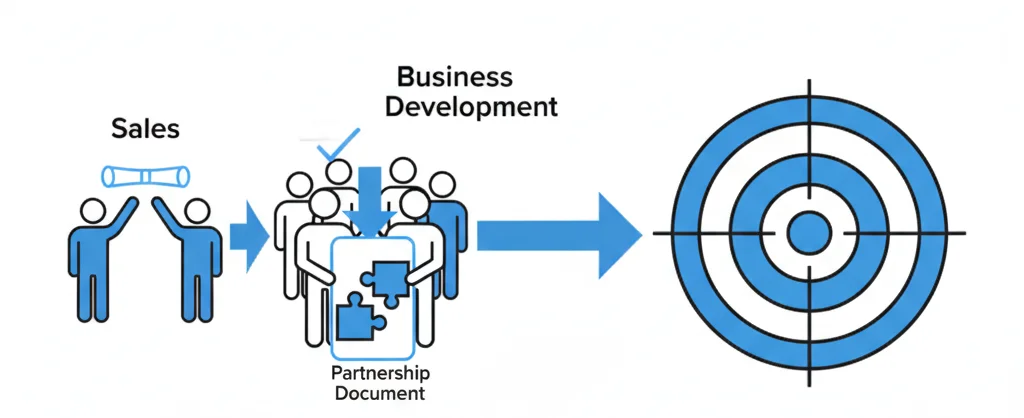
In many companies, especially in B2B, there is an additional layer called sales development, which can be confused with business development. Clarifying the distinction helps avoid overlapping responsibilities.
What Is Sales Development (SDR)?
Sales development typically refers to roles like Sales Development Representatives (SDRs) or similar positions focused on prospecting and qualifying leads. These roles bridge marketing and sales by contacting prospects, running initial discovery, and determining whether they are worth passing to account executives.
Sales development focuses on the early stages of the sales cycle, including outreach, basic needs analysis, and scheduling deeper conversations for closing reps.
Relationship Between Sales Development and Business Development
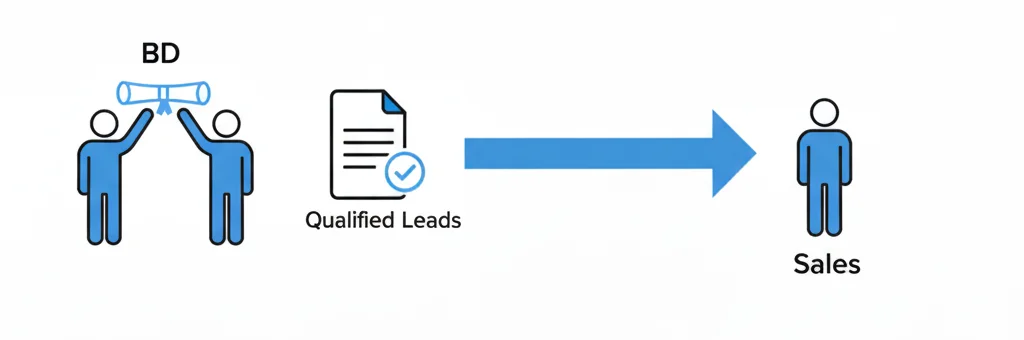
In some organizations, people use the terms “BDR” (Business Development Representative) and “SDR” interchangeably for outbound prospecting roles, but conceptually BD is broader than individual contributor prospecting. At a strategic level, BD involves market and partnership decisions, while sales development handles day‑to‑day lead generation and qualification.
Practically, BD may define which markets and accounts to pursue, while SDRs execute campaigns to reach those targets and surface qualified opportunities for the sales team.
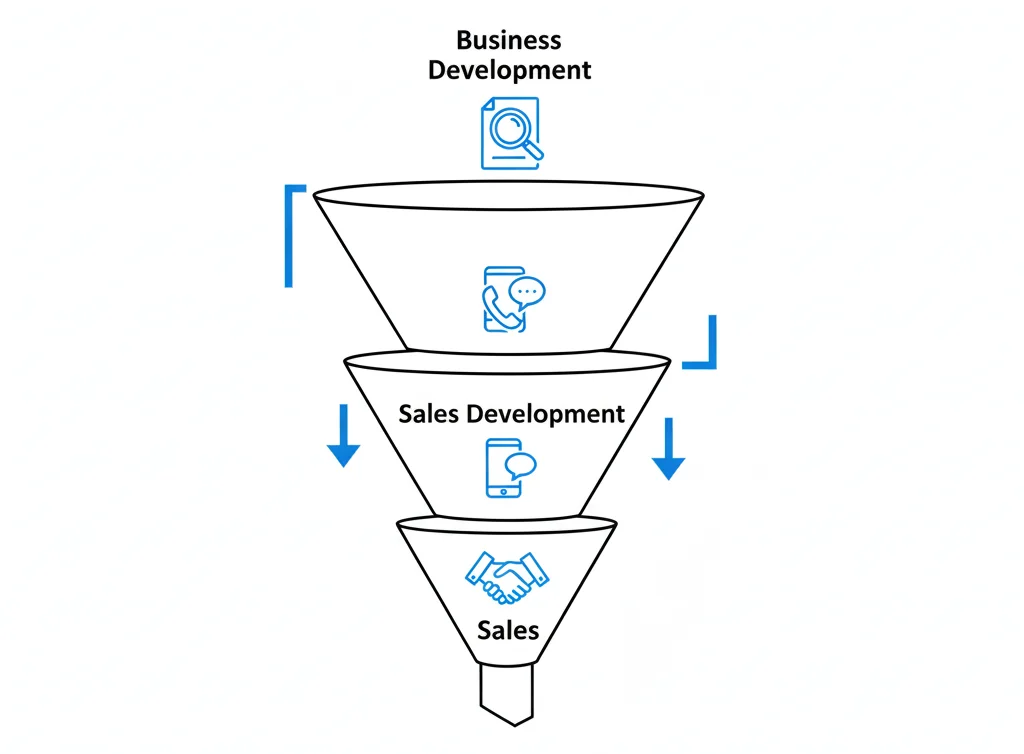
The Three‑Stage Funnel
When roles are clearly defined, the growth funnel often looks like this:
- Business development identifies markets, segments, and strategic accounts or partners that represent promising opportunities.
- Sales development engages these targets through outreach, discovers needs, and qualifies interest based on agreed criteria.
- Sales accepts qualified opportunities and focuses on progressing them through the pipeline to closed‑won.
This structure ensures that higher‑cost sales resources spend more time on high‑value, sales‑ready opportunities.
How Sales and Business Development Work Together
Even though their responsibilities differ, sales and BD must work in close alignment to build a strong growth engine. Misalignment leads to frustration on both sides and wasted opportunity.
The Importance of Alignment
Alignment starts with agreeing on target markets, ideal customer profiles, and what constitutes a qualified opportunity. When BD and sales share this understanding, BD can prioritize the right initiatives, and sales can trust that incoming opportunities are worth their time.
Regular communication and shared planning cycles help both teams coordinate efforts and avoid working at cross‑purposes.
Lead Handoff Process
A clear lead handoff process defines when BD or sales development passes opportunities to sales, and what information must be included. This usually involves agreed‑upon criteria such as budget, authority, need, and timeline or other qualification frameworks.
A structured handoff reduces the risk of leads going cold due to unclear ownership and enables sales reps to pick up conversations with sufficient context.
Collaboration Best Practices
Effective collaboration between BD and sales often includes the following practices:
- Joint planning sessions to define quarterly priorities and target segments.
- Shared use of a CRM to track activity, stages, and ownership without ambiguity.
- Regular pipeline reviews where BD and sales discuss opportunity quality and feedback.
- Cross‑training so each team understands the other’s processes and constraints.
These practices help ensure that BD efforts are grounded in what closes successfully, and that sales benefits from BD insights.
Common Mistakes When Not Separating Sales and Business Development
When sales and BD are not clearly separated, several recurring issues tend to appear. These can hinder both short‑term performance and long‑term growth.
Missed Growth Opportunities
If salespeople are fully occupied with hitting their quotas, they have limited capacity to explore new markets, partnerships, or strategic initiatives. As a result, opportunities that require longer‑term nurturing or experimentation may be postponed indefinitely in favor of immediate closing activities.
Over time, this can cause the business to fall behind competitors who invest in dedicated BD resources.
Pipeline Quality Issues
Without a distinct function responsible for qualification and early‑stage opportunity shaping, sales teams may receive inconsistent, poorly qualified leads. This reduces productivity as reps spend time chasing prospects that are not a good fit or not ready to buy.
A clear BD or sales development layer helps ensure that only leads meeting agreed criteria move into the sales pipeline.
Team Performance Degradation
Blurring roles can lead to unclear expectations about what success looks like, which is demotivating for team members. It also increases context switching between strategic tasks and high‑intensity closing work, which can reduce effectiveness in both.
In contrast, well‑defined roles let leaders set specific KPIs and coaching plans tailored to each function.
Revenue Unpredictability
If nobody is focused on feeding the future pipeline, revenue can become highly volatile, with strong quarters followed by unexpected slowdowns. Dedicated BD roles help smooth this pattern by continuously developing new sources of demand that sales can tap into later.
This makes forecasting more reliable and supports more stable growth.
When to Hire Dedicated Business Development Teams
Deciding when to create or expand a BD function depends on company size, growth stage, and the complexity of the market. There is no universal threshold, but certain patterns are common.
Company Size & Growth Stage
In very early‑stage startups, it is common for founders or early sales hires to combine BD and sales simply because the team is small. As the company gains traction and the pipeline fills, those same people often struggle to balance closing with exploring new opportunities.
Growth‑stage and mid‑market companies are more likely to benefit from a distinct BD team that can systematically work on new segments, partnerships, or geographies while sales focuses on efficiently closing existing demand.
Scaling Indicators
Certain signals often indicate it is time to formalize BD as its own function:
- Sales teams report they spend too much time qualifying and not enough time selling.
- The business sees potential opportunities in new markets or partnerships but lacks capacity to pursue them.
- Revenue becomes inconsistent because there is no structured effort to build future pipeline.
- Competitors begin to outpace growth by launching new partnerships or entering markets more quickly.
When these patterns emerge, dedicated BD resources can help unlock stalled growth.
Budget Considerations
Hiring BD professionals is an investment that may take time to pay off, but it can generate significant long‑term returns by opening high‑value segments or partnerships. Organizations should weigh salary and tool costs against potential pipeline value and strategic advantages gained from better market positioning.
Over time, improved pipeline quality and new opportunities can also increase sales efficiency, effectively raising the ROI of both functions.
Sales and Business Development Tools & Technology
Technology plays a key role in enabling alignment and efficiency between sales and BD teams. Shared systems and data help keep everyone on the same page.
CRM Platforms for Alignment
Customer Relationship Management (CRM) systems are often the central source of truth for both BD and sales. They allow teams to track contacts, accounts, activities, and deal stages in a consistent way and maintain visibility into the entire pipeline.
By using the same CRM, BD and sales can manage handoffs, avoid duplicate outreach, and analyze performance across the full funnel.
Tools for Each Function
While both teams share core systems, they may use different specialized tools:
- Business development often uses tools for market research, prospecting, and partnership outreach, including professional networks and data providers for firmographic and technographic information.
- Sales teams commonly rely on sales engagement platforms, proposal or quoting tools, and demo or meeting software to streamline interactions and closing processes.
These tools support the distinct workflows and priorities of each function while still feeding data into shared systems.
Integration & Workflow
Integrations between CRMs, outreach tools, and analytics platforms make it easier to automate lead routing, scoring, and notifications when opportunities move from BD to sales. Dashboards that span both functions help leaders see where bottlenecks occur and where each team is most effective.
Well‑designed workflows ensure that technology reinforces the intended division of labor rather than creating new silos.
Key Takeaways & Action Steps
Understanding the distinction between sales and business development is only useful if it informs how you structure teams and processes. This section brings together the main insights and suggests practical next steps.
What You’ve Learned
Sales focuses on short‑term revenue by converting qualified opportunities into customers, while business development focuses on long‑term value by discovering and shaping new opportunities, markets, and partnerships. The two functions require different skills, operate on different timelines, and are measured by different metrics, yet both are essential to sustainable growth.
Clear separation and alignment between sales and BD typically lead to better pipeline quality, more predictable revenue, and a stronger strategic position.
Assessing Your Organization
Organizations can begin by evaluating how clearly sales and BD responsibilities are currently defined. Questions to ask include whether sales teams are overloaded with prospecting, whether future markets are being actively explored, and whether there is a structured handoff between opportunity creation and closing.
Answers to these questions help determine whether the existing structure supports or hinders growth goals.
Next Steps for Growth
If gaps are identified, leaders can start by clarifying role definitions, setting distinct KPIs, and improving collaboration processes before making new hires. Over time, introducing dedicated BD roles and refining technology support can further strengthen the alignment between opportunity generation and revenue capture.
Taking these steps ensures that both sales and business development contribute fully to the organization’s long‑term success.
FAQ
1. Is business development the same as sales?
No, business development focuses on creating long‑term value through new markets, relationships, and opportunities, while sales focuses on converting existing opportunities into revenue.
2. When should we hire a dedicated business development team?
Dedicated BD roles become valuable when sales teams are stretched between prospecting and closing, or when there are clear but under‑explored opportunities in new markets or partnerships.
3. How do we measure business development success?
BD success is typically measured by strategic metrics such as new partnerships, market entries, qualified pipeline generated, and long‑term revenue impact, rather than immediate closed‑won deals.
5. What’s the difference between BDR and SDR?
In many organizations, BDR and SDR titles are used for similar prospecting roles, but conceptually business development is broader and more strategic, while sales development focuses on lead outreach and qualification.
6. How can we improve alignment between sales and BD?
Alignment improves through shared definitions of qualified opportunities, regular joint planning, clear handoff criteria, and common visibility via a CRM system and shared dashboards.
Conclusion
Sales and business development are distinct but complementary pillars of a healthy growth strategy, with sales driving short‑term revenue and business development creating the conditions for long‑term success. By clearly defining each role, aligning incentives and processes, and investing in the right tools and talent, organizations can build a more powerful and predictable engine for growth.

Passionate about blogging and focused on elevating brand visibility through strategic SEO and digital marketing. Always tuned in to the latest trends, I’m dedicated to maximizing engagement and delivering measurable ROI in the dynamic world of digital marketing. Let’s connect and unlock new opportunities together!