


Salesforce is one of the most well-known CRM platforms in the world, but it’s not always the best fit for every business. Many companies find Salesforce too complex, resource-intensive, or simply more than they need for their current stage of growth. In 2026, the CRM landscape is rich with capable alternatives that offer modern features, easier onboarding, and better alignment with specific business models.
This guide explores the top 10 Salesforce alternatives and competitors in 2026, explains why businesses look beyond Salesforce, and helps you match each alternative to your needs and use cases.
Why Businesses Look For Salesforce Alternatives
Salesforce has long been recognized as a leader in CRM, but that leadership comes with trade-offs that push some businesses to consider alternatives. Common reasons include complexity, implementation overhead, and the challenge of getting teams to fully adopt the system.
Many smaller and mid-sized businesses discover that they only use a fraction of Salesforce’s extensive capabilities, yet still have to deal with its setup demands and administrative work. Others prefer tools that are more specialized for sales, marketing automation, or collaborative work management, with a simpler interface and faster time-to-value.
Key Factors To Consider When Choosing A Salesforce Alternative
When evaluating Salesforce alternatives, it helps to look beyond brand recognition and focus on practical fit. The most important factors typically include:
- Ease of use: How quickly can new team members get productive without extensive training or admin support?
- Feature set: Does the CRM cover your core needs such as pipeline management, automations, email, and reporting, without becoming bloated?
- Customization: Can you tailor stages, fields, and workflows to your sales and marketing processes?
- Integrations: Does it connect cleanly with the tools you already use, like email, calendar, chat, help desk, or marketing platforms?
- Scalability: Will the platform still serve you well as you add users, teams, or more complex processes?
With these factors in mind, let’s walk through ten of the strongest Salesforce alternatives in 2026.
The 10 Best Salesforce Alternatives In 2026
1. HubSpot CRM
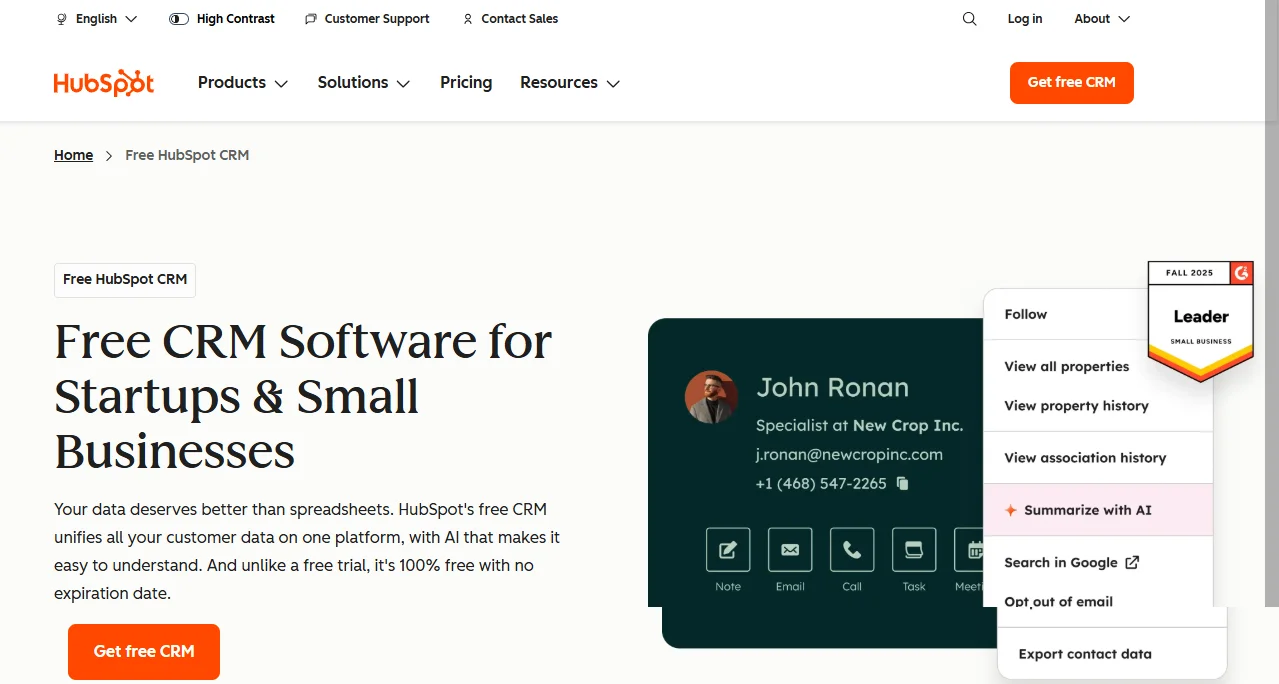
HubSpot has evolved from a marketing automation platform into a full customer platform that includes marketing, sales, service, and content tools in one ecosystem. Its CRM sits at the center and is widely recognized for its clean interface and low barrier to entry.
HubSpot is especially attractive to growing businesses that want a single environment for capturing leads, nurturing them with campaigns, and managing deals through the pipeline. The CRM is tightly integrated with HubSpot’s marketing, service, and CMS tools, making it easier to work across departments without stitching together multiple systems.
Key strengths
- Intuitive interface that sales and marketing teams can learn quickly.
- Built-in email tracking, deal management, contact timelines, and meeting scheduling.
- Deep marketing features such as workflows, forms, and landing pages via the same ecosystem.
- Extensive integration marketplace with popular business apps.
HubSpot stands out as a Salesforce alternative for teams that want powerful functionality wrapped in a more approachable, unified product experience rather than a highly modular platform.
2. Zoho CRM
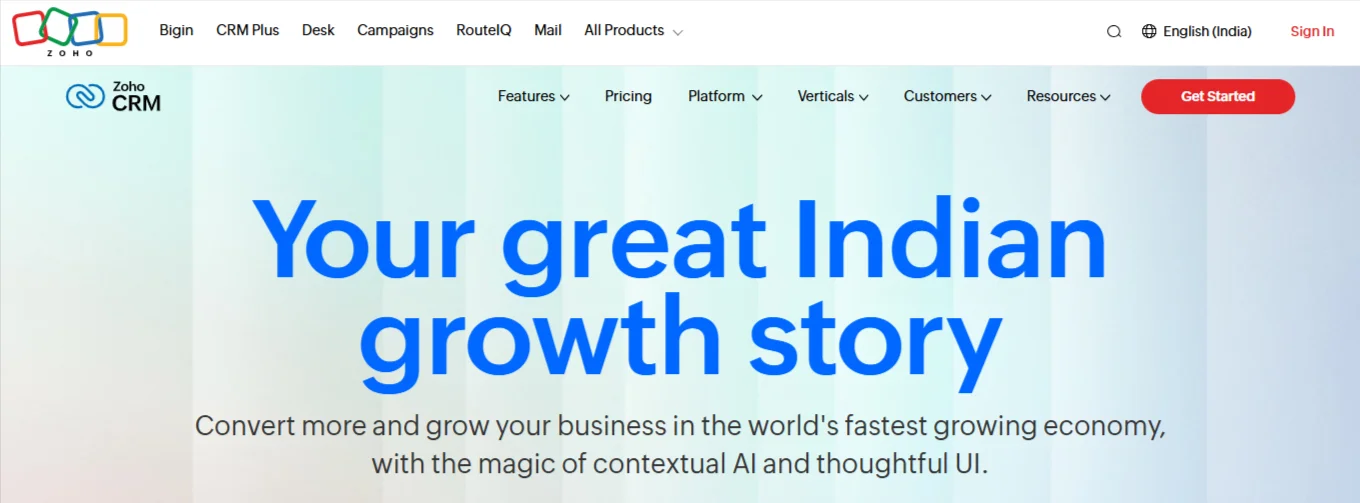
Zoho CRM is part of the broader Zoho suite, which offers dozens of business applications for everything from email and accounting to analytics and customer service. The CRM has become a popular Salesforce alternative because it balances breadth of features with accessible configuration.
Zoho CRM supports sales automation, lead and contact management, deal tracking, and multi-channel communication, along with AI-driven insights that can help teams prioritize actions. It is particularly appealing to small and midsize businesses that want flexibility and room to grow without committing to a heavy enterprise stack.
Key strengths
- Strong sales force automation tools for leads, contacts, accounts, and deals.
- AI assistance for forecasting and identifying high-value opportunities.
- Tight connections to other Zoho apps for finance, support, and marketing.
- Customization options for fields, layouts, and workflows.
Zoho CRM is a solid choice if you want a capable, configurable CRM that can expand into a larger business platform over time.
3. Pipedrive
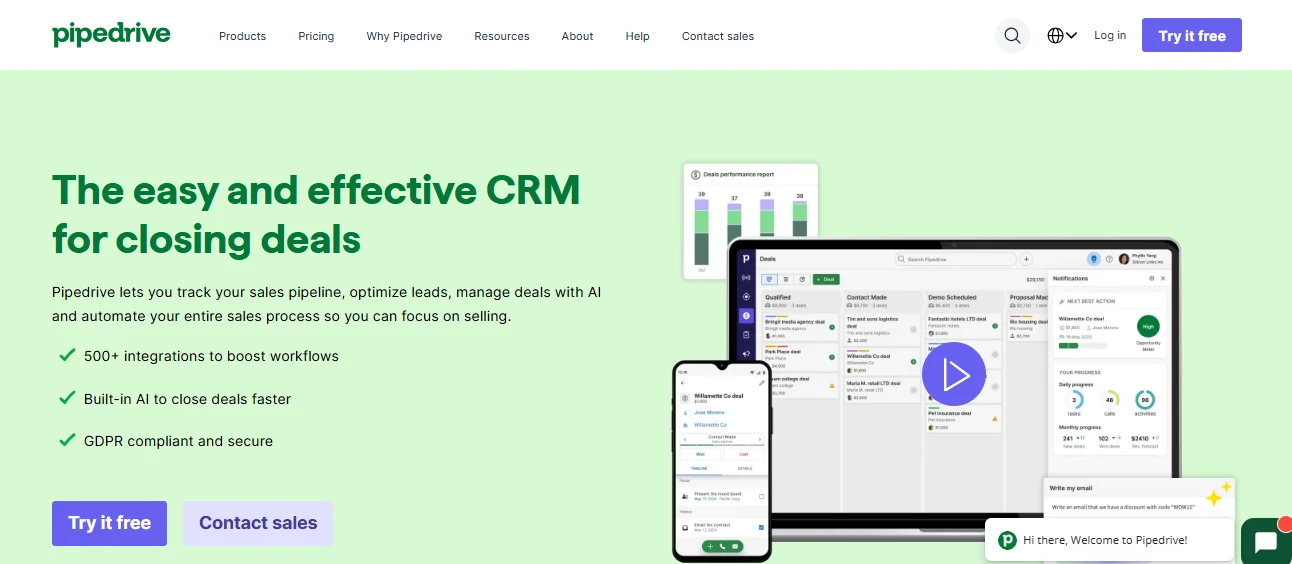
Pipedrive is a sales-focused CRM built around a highly visual pipeline interface. It is designed for teams that want to manage deals with clarity and momentum, focusing on moving opportunities from one stage to the next.
The platform makes it easy to see which deals need attention, which activities are pending, and how close you are to revenue targets. Its drag-and-drop board style is familiar to anyone who has used Kanban-style tools, which shortens onboarding and encourages regular use by sales reps.
Key strengths
- Visual, drag-and-drop deal pipeline that keeps the focus on next actions.
- Activity and task management tied directly to deals and contacts.
- Simple customization for pipelines and stages to match your sales process.
- Integrations with email, calendar, and many sales productivity tools.
Pipedrive is a strong Salesforce alternative for teams that primarily need a straightforward, sales-first pipeline system without the overhead of a larger CRM suite.
4. ActiveCampaign
ActiveCampaign started as an email marketing and automation platform and has expanded into a combined marketing automation and CRM solution. It is heavily centered on intelligent automations that help teams send timely, personalized messages and manage deals in parallel.
The CRM component is closely tied to contact records and behavioral data, enabling sales and marketing alignment. Automations can be built visually to respond to user actions, lifecycle stages, or internal triggers, which makes it a compelling option for businesses that lean on lifecycle marketing and nurture journeys.
Key strengths
- Powerful visual automation builder for email, SMS, and in-app messaging.
- Integrated CRM that syncs contacts, deals, and engagement data.
- Lead scoring and segmentation based on behavior and attributes.
- Strong fit for businesses that combine outbound sales with automated nurture campaigns.
ActiveCampaign works particularly well as a Salesforce alternative when automation is central to your strategy and you want CRM and marketing flows in a single environment.
Also Check: Top 15 Contact Management Software to Boost Your Sales Pipeline
5. Nutshell
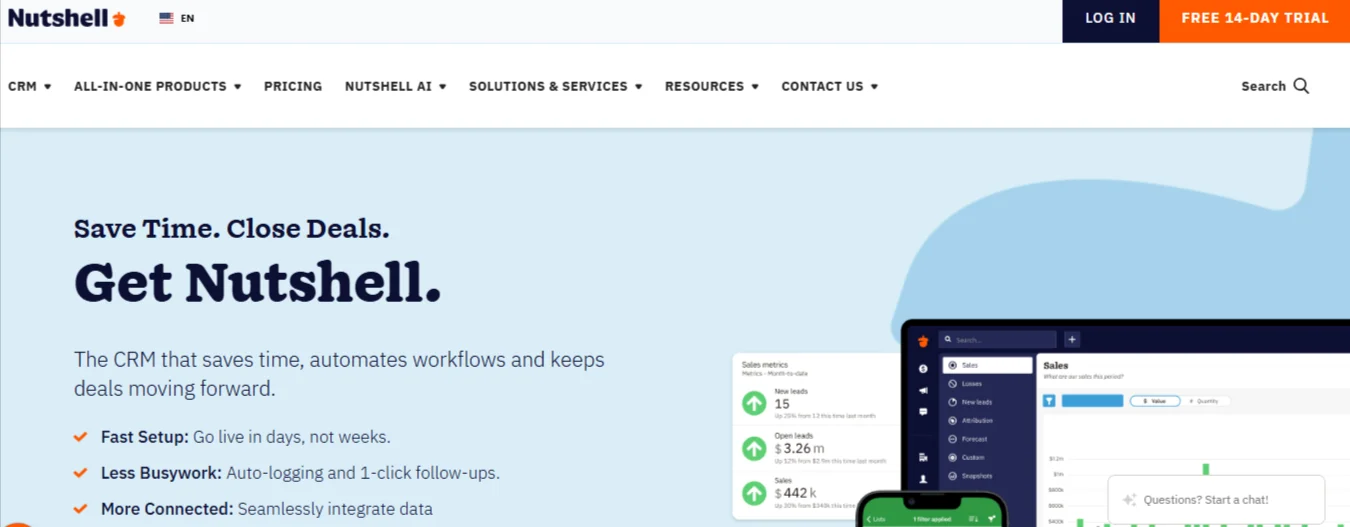
Nutshell is designed as a simple, effective CRM for busy sales teams that want structure without friction. It positions itself as an all-in-one sales solution, combining pipeline management, contact organization, email templates, and reporting in a user-friendly package.
The platform emphasizes quick setup and ongoing support, which is especially valuable for businesses that don’t have a dedicated CRM administrator. With features like tailored pipelines, automated tasks, and connected email, Nutshell focuses on helping teams close more deals with less manual effort.
Key strengths
- Clean, approachable interface geared toward small and mid-sized businesses.
- Flexible pipelines and customizable stages that mirror real-world sales processes.
- Built-in email tools such as sequences, templates, and tracking.
- Reporting and dashboards that surface team and individual performance.
Nutshell is a solid Salesforce alternative if you want a leaner, more approachable CRM that still covers core sales workflows end-to-end.
6. Freshsales (Freshworks CRM)
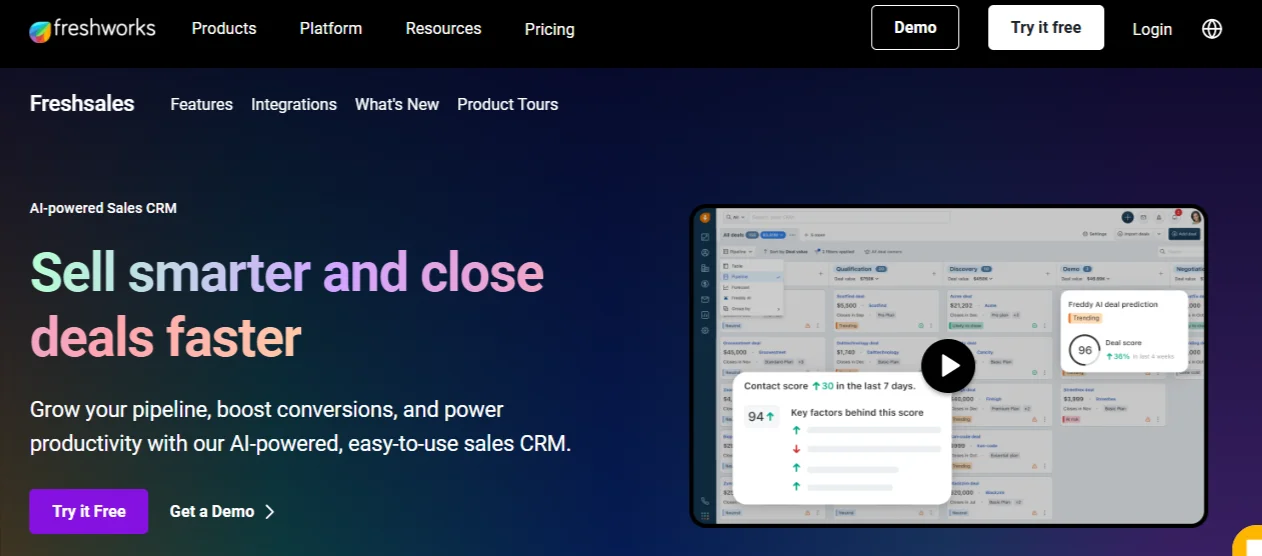
Freshsales, part of the Freshworks suite, is a CRM built to support modern, digital-first sales and marketing teams. It offers contact and account management, deal tracking, activity timelines, and engagement tools, along with AI features to highlight promising leads and next steps.
Because Freshsales belongs to the same family as products like Freshdesk (support) and Freshchat, it can serve as the hub of a broader customer operations stack. Its interface is designed to be straightforward, helping teams ramp up quickly and maintain consistent use.
Key strengths
- 360-degree view of contacts with activity timelines and communication history.
- Automation capabilities for assigning leads, creating tasks, and following up.
- AI-assisted insights to identify high-intent prospects and prioritize work.
- Native connections to other Freshworks products for support and messaging.
Freshsales is particularly compelling as a Salesforce alternative for teams that want a modern CRM that integrates naturally with their service and messaging tools.
7. SugarCRM
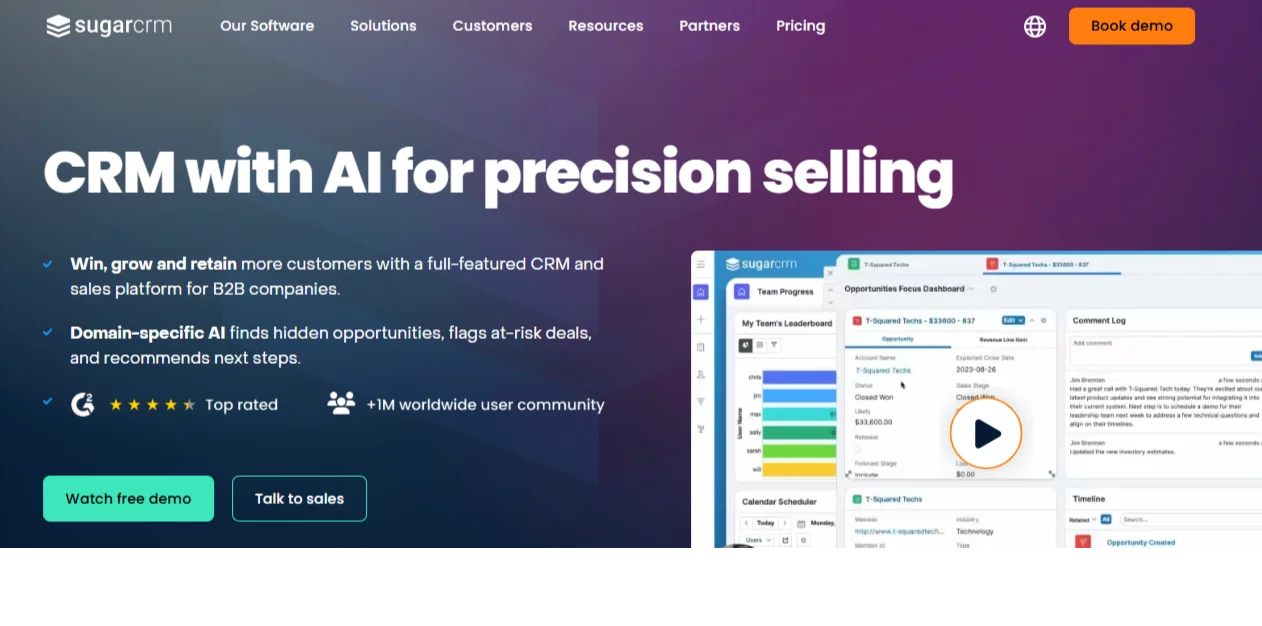
SugarCRM has a long history in the CRM space and has developed into a flexible platform with strong capabilities in sales, marketing, and service. Its focus is on providing a complete customer view and enabling organizations to run data-driven campaigns and processes.
The platform offers customizable modules, workflows, and dashboards, giving businesses control over how information is structured and presented. SugarCRM is often favored by teams that want more control and are willing to invest in configuration to get an environment tailored to their operations.
Key strengths
- Comprehensive customer lifecycle coverage from marketing to support.
- Deep customization for fields, page layouts, modules, and automations.
- Reporting and analytics tools for understanding performance and trends.
- Deployment flexibility in some editions, depending on product choices.
SugarCRM makes sense as a Salesforce alternative for organizations that want a powerful, configurable CRM with strong data and process capabilities, but prefer a different ecosystem.
8. Keap
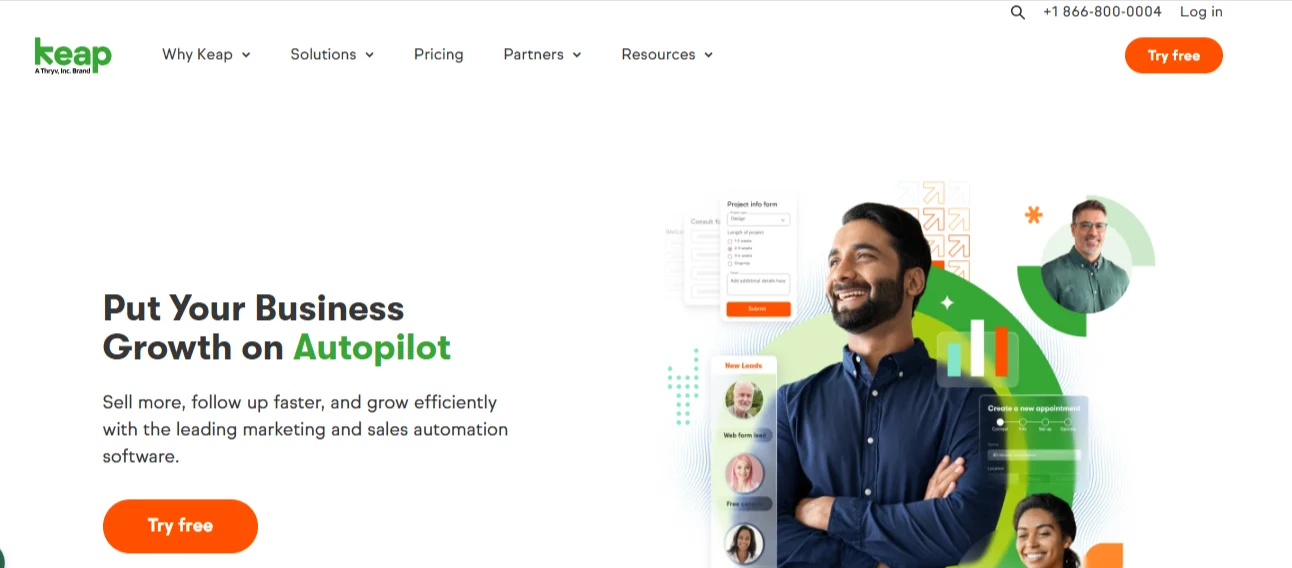
Keap is a CRM and marketing automation platform with a strong focus on small businesses and service providers that want to streamline repetitive tasks. It combines contact management, automated follow-ups, appointment scheduling, invoicing, and basic sales pipeline tools in one system.
The goal of Keap is to reduce manual work by automating routine communications and workflows, helping teams respond quickly and consistently to leads and customers. Its interface and templates are designed to help smaller businesses implement automation even if they don’t have a dedicated marketing ops team.
Key strengths
- Automation of follow-up emails, reminders, and nurture sequences.
- Integrated tools for appointments, quotes, and basic billing.
- Simple pipelines for tracking opportunities and projects.
- Strong fit for service businesses that rely heavily on appointments and follow-ups.
Keap stands out as a Salesforce alternative for small and growing businesses that want practical, automation-first workflows more than a complex enterprise CRM.
9. Monday.com (CRM Workspaces)
Monday.com began as a work management platform and has developed dedicated CRM templates and products that leverage its flexible boards, views, and automations. Many teams use Monday to manage deals, accounts, and projects in a single environment.
The CRM setups within Monday.com can be tailored through columns, statuses, automations, and dashboards, making it attractive to teams that value visual workflows and cross-functional collaboration. Rather than a traditional CRM-only product, it’s more of a customizable operational hub.
Key strengths
- Highly visual boards and dashboards for tracking deals and activities.
- Flexible customization of fields, views, and automations.
- Ability to manage sales, projects, and operations in one system.
- Integrations with email, calendar, and many productivity tools.
Monday.com is a compelling Salesforce alternative for teams that want CRM capabilities embedded into a broader work management environment instead of a standalone CRM silo.
10. Insightly
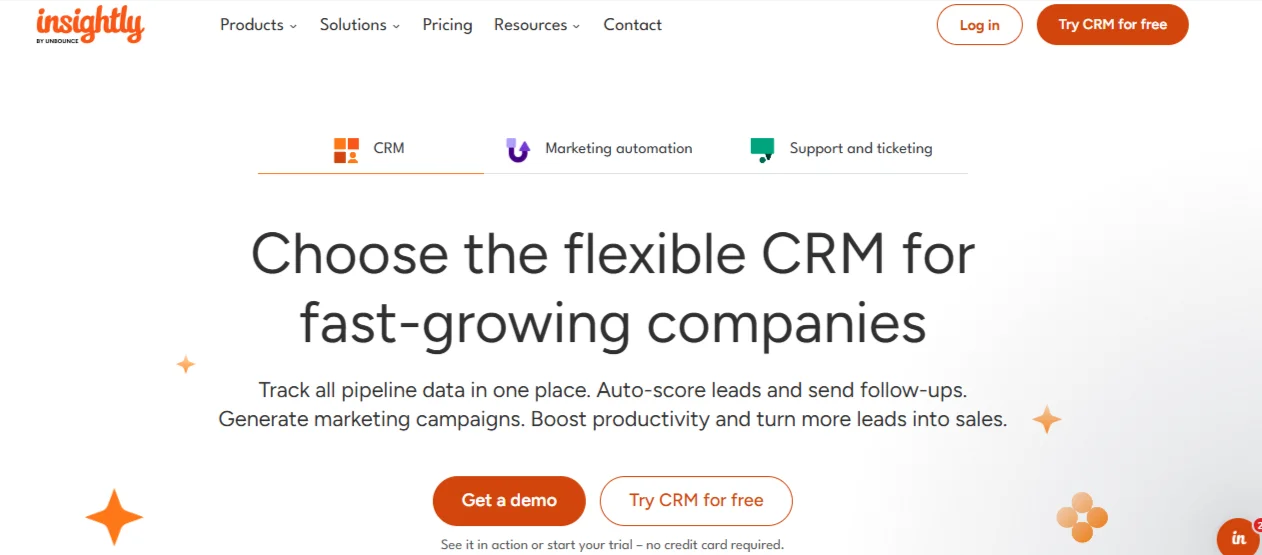
Insightly offers CRM and project management capabilities in a single platform, making it a good fit for organizations that want to track both customer relationships and delivery work. It includes contact and opportunity management, pipelines, workflow automation, and analytics.
The project features allow teams to turn closed deals into projects, track tasks and milestones, and maintain visibility from initial contact through delivery. This linkage helps keep client work aligned with what was promised during the sales process.
Key strengths
- Connected CRM and project management features in one system.
- Pipelines for both sales opportunities and post-sale work.
- Custom fields, layouts, and workflow automations.
- Reporting tools that help monitor performance across sales and projects.
Insightly is a strong Salesforce alternative for service-oriented businesses that want their CRM closely tied to project execution and ongoing client work.
Feature Comparison By Use Case
Different Salesforce alternatives shine in different scenarios. Rather than looking for a single “best” tool, it’s more helpful to think in terms of use cases and priorities.
For SMBs On A Budget
For smaller teams that prioritize simplicity, ease of use, and quick time-to-value, platforms like HubSpot’s free CRM tiers, Zoho CRM, Nutshell, Freshsales, and Keap are usually the most approachable. These tools are designed with smaller and midsize organizations in mind, and they generally emphasize straightforward configuration over heavy customization.
Such platforms typically provide ready-made pipelines, email tools, and basic automations that can be set up without specialist staff, making them ideal for growing businesses that need structure but not complexity.
For Sales-Driven Teams
If your primary focus is pipeline visibility and closing deals, Pipedrive, Nutshell, and Insightly tend to be strong candidates. Their pipeline views and sales-centric workflows help reps stay organized while reducing time spent on admin.
These platforms highlight activities, tasks, and next steps in a way that keeps sales execution at the center, which is especially valuable for outbound or deal-heavy teams.
For Marketing Automation
Teams that combine CRM with sophisticated lifecycle marketing often gravitate to ActiveCampaign and HubSpot. Both products offer powerful automation builders, segmentation, and communication tools that tie closely into contact and deal data.
This alignment between marketing and sales data helps businesses design consistent journeys from first touch to closed-won and beyond, making these platforms stand out for automation-heavy strategies.
For Enterprise Scalability And Flexibility
Organizations with more complex structures, multi-region operations, or strict process requirements might find SugarCRM and Zoho CRM better aligned with their needs. These platforms tend to offer more extensive customization, advanced reporting, and broader ecosystems.
They are often a fit for companies that require tailored modules, complex approval flows, and detailed role/permission models, while still looking for an alternative to Salesforce’s ecosystem.
For Ease Of Use And Speed
If fast onboarding and minimal training are top priorities, Pipedrive, Monday.com, Nutshell, and Freshsales are attractive options. Their interfaces are clean and familiar, and workflows are often designed so that non-technical users can build and adjust pipelines or automations.
This can significantly improve adoption rates, which is often a core challenge when teams have struggled with a heavier platform like Salesforce.
How To Choose The Right Salesforce Alternative
With so many capable tools available, selecting the right alternative comes down to aligning the platform with your business context and goals.
Step 1: Assess Your Requirements
Start by listing your must-have features and workflows: pipeline stages, communication channels, reporting needs, required integrations, and collaboration patterns. This requirements list helps you quickly rule out platforms that don’t support critical capabilities.
Step 2: Map Your Team Size And Growth Plans
Consider how many users will need access today and how that might change in the next one to three years. Some CRMs are better suited to smaller, more agile teams, while others are built with multi-team, multi-division setups in mind.
Step 3: Evaluate Ease Of Use Versus Customization
There is often a trade-off between simplicity and depth of customization. Decide whether your priority is rapid adoption with minimal configuration, or a highly tailored system that may take more time and effort to implement properly.
Step 4: Test With Real Workflows
When possible, run a short trial where a subset of your team uses the CRM in a real-world scenario: managing live deals, sending follow-ups, and updating records. This practical test will surface friction points that don’t show up in marketing pages or demos.
Step 5: Consider Support And Ecosystem
Look into documentation quality, support options, and community resources. A vendor with strong onboarding materials, responsive support, and an active ecosystem can significantly reduce the effort required to get and keep your CRM running smoothly.
Conclusion
There is no one-size-fits-all “best” Salesforce alternative in 2026; the right choice depends on your size, sales model, and internal capabilities. Sales-first teams often gravitate to Pipedrive, Nutshell, or Freshsales for their pipeline clarity and ease of use. Automation-focused organizations frequently choose ActiveCampaign or HubSpot to unify marketing and CRM. Businesses needing broader platform flexibility may prefer Zoho CRM or SugarCRM, while operationally minded teams benefit from Monday.com and Insightly’s project and work management features.
The key is to match each platform’s strengths with your priorities, test it against real workflows, and choose the system that your team will actually use every day.
Frequently Asked Questions (FAQs)
1. Why would a business look for a Salesforce alternative?
Many businesses look for Salesforce alternatives because they find the platform more complex than they need, difficult for non-technical users to adopt, or resource-intensive to configure and maintain. Others discover that they only use a small portion of its extensive feature set and prefer a CRM that is simpler, more focused, or better aligned with their existing workflows.
2. What should I look for in a Salesforce alternative?
When evaluating alternatives, focus on ease of use, feature relevance, and long-term scalability. Look for a CRM that supports your core needs—such as contact and deal management, pipeline visibility, automation, and reporting—without overwhelming your team with unnecessary complexity. It is also important to consider how well the platform integrates with your existing tools and how quickly your users can become productive.
3. Which Salesforce alternative is best for small and medium-sized businesses (SMBs)?
SMBs often do well with tools that emphasize simplicity and quick onboarding, such as HubSpot CRM, Zoho CRM, Nutshell, Pipedrive, or Freshsales. These platforms typically provide intuitive interfaces, straightforward pipeline setups, and built-in communication or automation features that help smaller teams stay organized without needing dedicated admins. The best option will depend on whether your priority is sales execution, marketing automation, or broader work management.
4. Which Salesforce alternative is best if I care most about marketing automation?
If marketing automation is central to your strategy, platforms like ActiveCampaign and HubSpot are strong contenders. Both combine CRM capabilities with powerful automation builders, allowing you to design personalized journeys, trigger campaigns based on behavior, and keep sales and marketing aligned within a unified system.
5. Are there Salesforce alternatives that are easier to use for sales reps?
Yes, several Salesforce competitors focus heavily on user experience for sales teams. Pipedrive, Nutshell, Freshsales, and Monday.com’s CRM workspaces are known for clean, visual interfaces that make it easy for reps to see their pipeline, track activities, and understand next steps without sifting through complex configuration layers.
6. Can I migrate data from Salesforce to another CRM?
Most established CRM platforms provide import tools, templates, or services to help migrate data from Salesforce. Typically, you export data such as contacts, companies, deals, and activities from Salesforce and then map those fields into the new system. It is important to review field structures and clean your data before migration to avoid inconsistencies and duplicates in the new CRM.
7. Are there Salesforce alternatives that combine CRM and project management?
Yes, some tools combine CRM and project or work management in one environment. Insightly connects sales with project delivery so teams can manage client work after deals close, while Monday.com can be configured to handle both pipelines and projects on customizable boards. These platforms can be a good fit for service-based or project-based businesses that want sales and delivery tightly linked.
8. Is it realistic for an enterprise to move away from Salesforce?
It is possible for an enterprise to move away from Salesforce, but it requires careful planning, stakeholder alignment, and a phased implementation. Larger organizations typically start with a clear requirements analysis, select an alternative that can match or improve on critical workflows, and run parallel systems for a period to ensure data accuracy and user adoption. While the process is more complex at enterprise scale, it can be worthwhile if the new platform better matches strategic and operational needs.
9. How long does it usually take to implement a Salesforce alternative?
Implementation timelines vary based on the complexity of your processes and the platform you choose. For smaller teams with straightforward pipelines, setup can often be completed in days or a few weeks, especially with tools designed for quick onboarding. For larger organizations with custom workflows, multiple integrations, and detailed permissions, implementation can take several months, including configuration, testing, training, and phased rollout.