


Public relations and marketing are often used interchangeably, but they play very different roles inside a business. Many teams discover too late that blending them together can blur goals, confuse messaging, and weaken overall results. Public relations is primarily concerned with shaping how stakeholders perceive the brand, while marketing focuses on generating demand and driving revenue from customers and prospects.

When leaders clearly understand where these functions differ—and how they can work together—they can set better objectives, allocate budgets more effectively, and build strategies that are both trustworthy and results-driven. This blog unpacks those differences, explores the overlap, and shows how combining PR and marketing thoughtfully can strengthen both brand reputation and business performance.
Definitions and Fundamentals
This section builds a foundation by defining public relations and marketing in simple terms. It also clarifies why both are critical for a healthy, sustainable business.
What is Public Relations (PR)?

This subsection explains PR as a discipline centered on reputation and relationships across multiple stakeholder groups. It highlights PR’s long-term nature and its focus on credibility instead of direct sales.
- PR is the practice of managing how an organization is perceived by its stakeholders, including media, investors, employees, communities, and the general public.
- The primary focus of PR is building and protecting a positive reputation over time, especially during sensitive or high-visibility moments.
- PR relies heavily on earned media, such as news coverage, interviews, reviews, and third-party mentions, which can boost trust because the message comes from external sources.
- Typical PR activities include media relations, thought leadership, events, internal communications, and crisis communication.
What is Marketing?

This subsection defines marketing as a revenue-oriented function focused on customers and prospects. It shows how marketing uses campaigns, data, and paid channels to drive measurable business results.
- Marketing is the process of promoting and selling products or services by understanding customer needs and creating offers that meet them.
- Its core focus is on attracting, converting, and retaining customers to increase revenue and market share.
- Marketing often uses the 4 Ps framework: product, price, place, and promotion, which together define how an offer is positioned and delivered to the market.
- Common marketing activities include advertising, content marketing, email campaigns, social media promotion, and performance tracking across channels.
Why Both Matter for Business Success
This subsection explains why treating PR and marketing as complementary, not competing, functions makes organizations more resilient and effective.
- Marketing helps brands reach customers and drive sales, but those efforts are much more effective when people already trust the company.
- PR builds that underlying trust and credibility by shaping perception among media, communities, and other stakeholders who influence customer decisions.
- Companies that invest in both tend to withstand crises better and maintain stronger customer loyalty over time.
Five Key Differences Between PR and Marketing
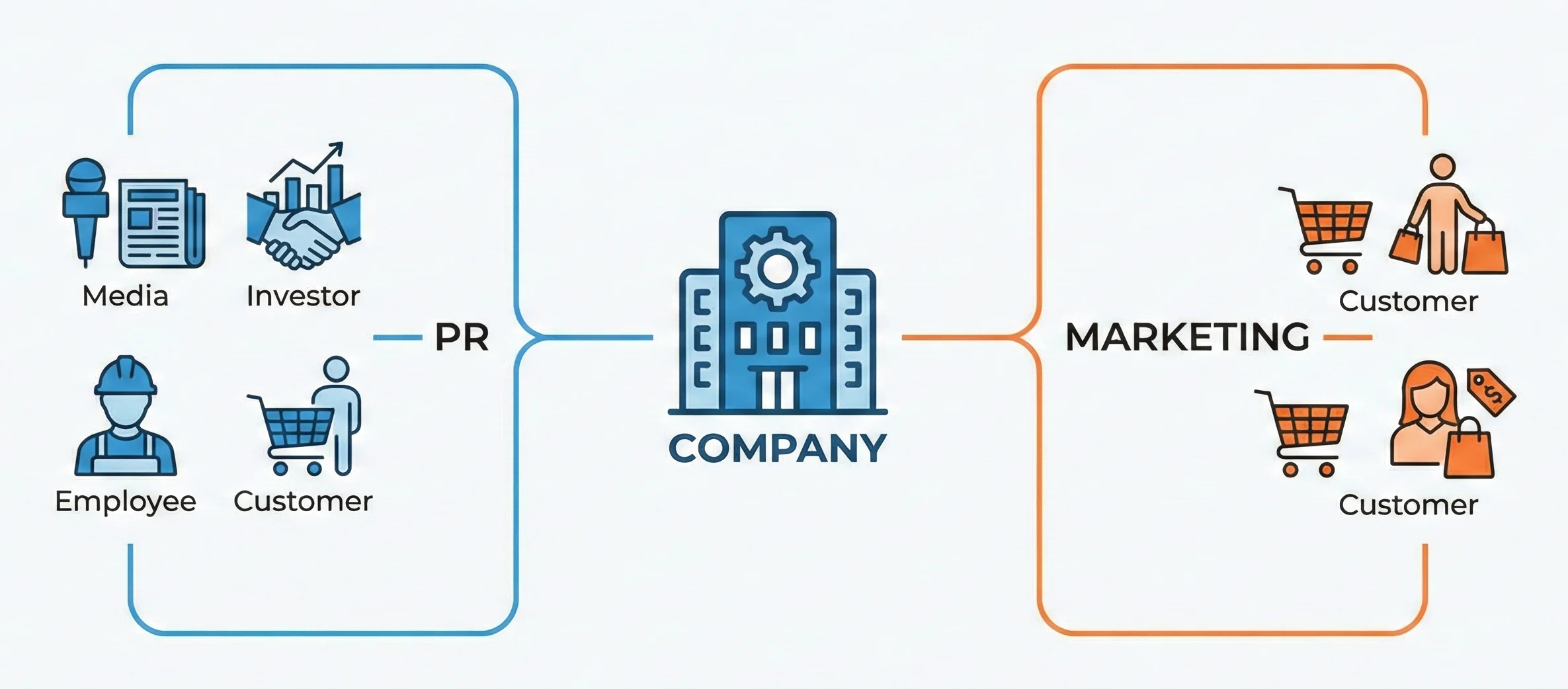
This section dives into the practical differences between PR and marketing, organized around audiences, goals, activities, media types, and measurement. It shows how these functions operate differently day to day.
1. Target Audience
This part explains how PR and marketing prioritize different groups of people, which influences their strategies and messaging.
- Marketing typically targets current and potential customers, focusing on people who can directly purchase products or services.
- PR has a broader audience that includes media, influencers, investors, regulators, employees, and local communities in addition to customers.
- Because PR touches more stakeholder groups, its messaging often centers on values, trust, and reputation rather than specific offers or discounts.
2. Primary Goals and Objectives
This part highlights how the main success criteria for PR and marketing differ, even when they support the same brand.
- Marketing objectives typically revolve around metrics like leads generated, conversions, sales volume, and campaign ROI.
- PR objectives focus on brand perception, awareness quality, trust, and long-term reputation with diverse stakeholder groups.
- Marketing is often tasked with short- to medium-term revenue goals, while PR is tasked with shaping how people talk and feel about the brand over time.
3. Daily Activities and Execution
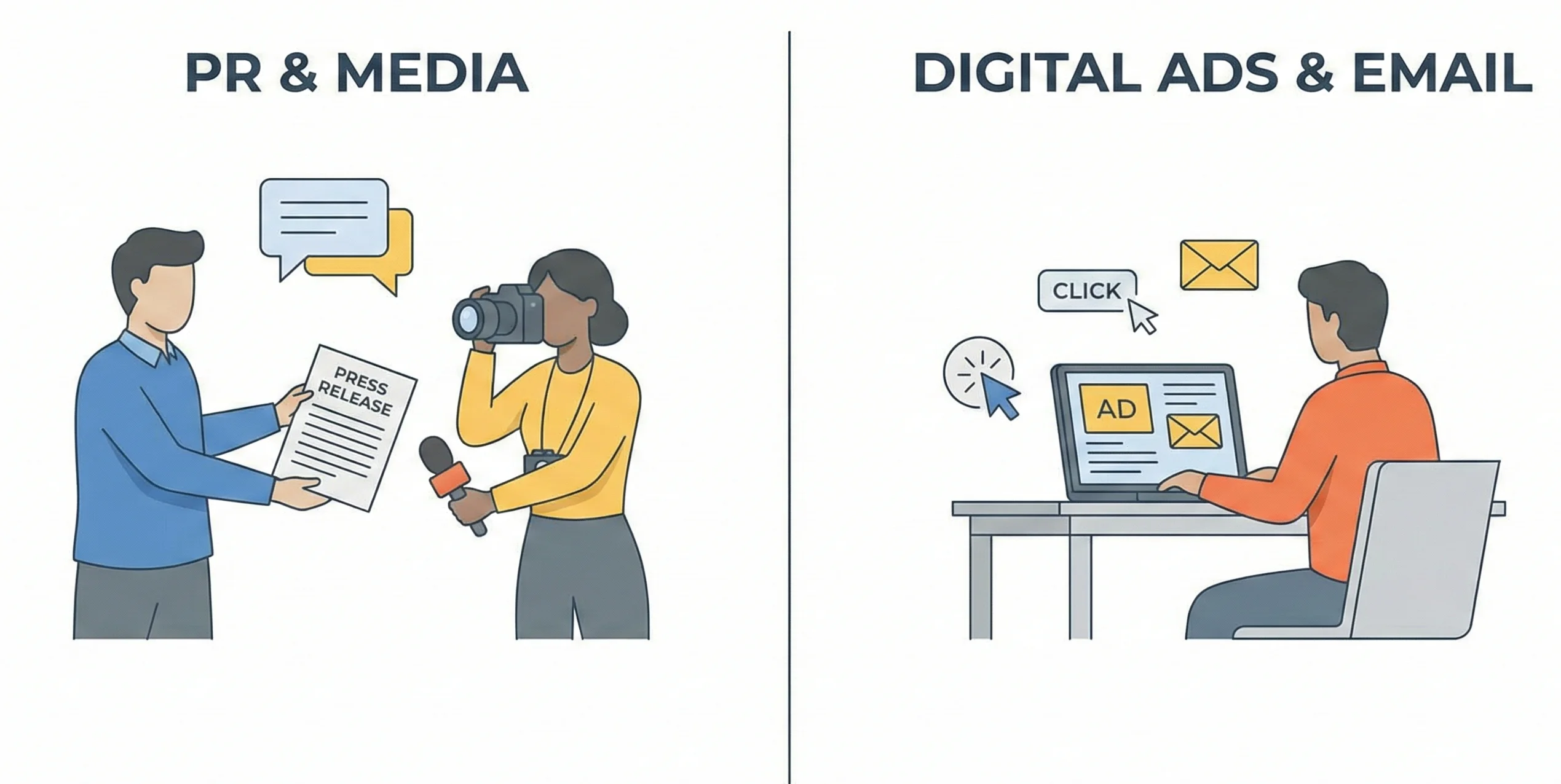
This part walks through what PR and marketing teams actually do on a typical day, showing how their tasks reflect different priorities.
- PR daily activities often include writing press releases, pitching stories to journalists, coordinating interviews, handling media inquiries, preparing spokespersons, managing crises, and maintaining relationships with influencers and stakeholders.
- Marketing daily activities often include planning and launching campaigns, managing ad budgets, optimizing targeting, creating and scheduling content, analyzing performance data, and coordinating with sales teams.
- While both create content, PR content is usually designed for credibility and context (for example, news or thought leadership), whereas marketing content is optimized to drive specific actions like sign-ups or purchases.
4. Media Type: Earned vs. Paid vs. Owned

This part explains how each discipline typically uses different media types and why that matters for cost, control, and credibility.
- PR leans heavily on earned media, such as editorial coverage, interviews, reviews, and organic mentions, which cannot be bought directly and often carry higher perceived neutrality.
- Marketing relies more on paid media, including digital ads, sponsored posts, and other paid placements that provide guaranteed visibility but must overcome audience skepticism.
- Both functions use owned media like websites, blogs, and brand social channels, but PR uses them to communicate stories and positions, while marketing uses them to drive traffic and conversions.
5. Measurement of Success and KPIs
This part compares how PR and marketing teams measure impact and why those metrics look different.
- Common PR metrics include media mentions, share of voice, sentiment analysis, quality and relevance of coverage, influencer mentions, and reputation indicators.
- Common marketing KPIs include click-through rate, conversion rate, customer acquisition cost, return on ad spend, and revenue attributed to campaigns.
- PR results are often more qualitative and long-term, while marketing metrics are typically more immediate and tied directly to transactions.
6. Timeframe and Impact
This part clarifies how quickly each function is expected to deliver visible results and why organizations must manage expectations accordingly.
- Marketing efforts such as promotions and ads are often designed to deliver quick spikes in traffic, leads, or sales within a defined campaign period.
- PR initiatives, especially those focused on thought leadership and reputation, may take months or years to fully translate into measurable business benefits.
- Because of these differences, PR is often treated as a long-term investment, while marketing is managed as a short- to medium-term performance engine.
Also Read: How to Use Sales Analysis Reports to Optimize Your Sales Process
Similarities Between PR and Marketing
This section balances the discussion by showing how PR and marketing overlap. Understanding these similarities makes it easier to integrate both functions.
1. Shared Objectives
This part shows that PR and marketing ultimately support the same big picture, even though they use different methods.
- Both PR and marketing aim to increase brand visibility and support business growth.
- Both functions seek to influence how people think and feel about the brand, whether the immediate goal is reputation or revenue.
- Both must align with the company’s mission, values, and strategic priorities to be effective.
2. Overlapping Functions
This part highlights tasks and responsibilities that can sit in either team depending on company size and structure.
- Both PR and marketing create and distribute content, including blog posts, social media updates, and email communications.
- Both participate in brand storytelling, using narratives about the company’s history, mission, and impact to connect with audiences.
- Both rely on audience insights and data (even if in different forms) to refine messaging and channel choices.
3. The Importance of Consistent Messaging
This part emphasizes why misalignment between PR and marketing hurts brand perception, and why consistency is critical.
- When PR and marketing use inconsistent language or positioning, audiences receive mixed signals that weaken trust and recognition.
- Consistent messaging across press coverage, ads, social media, and owned content reinforces what the brand stands for.
- Many organizations address this by aligning on a shared brand story, core messages, and tone guidelines that both teams follow.
How PR and Marketing Work Together

This section explains how PR and marketing can reinforce one another rather than compete. It focuses on practical collaboration.
1. Complementary Roles
This part breaks down how each function contributes unique strengths that, when combined, create stronger outcomes.
- PR builds credibility and third-party validation that make marketing messages more believable and persuasive.
- Marketing creates sustained promotional activity that keeps products and services in front of target customers, providing more opportunities for PR stories to resonate.
- Together, they help audiences both hear and trust what the brand communicates.
2. Adding Trust to Marketing Efforts
This part shows how PR can make marketing feel less like pure promotion and more like proof-backed communication.
- Media coverage, expert quotes, and thought leadership pieces can all be integrated into marketing campaigns as evidence that supports claims.
- Reviews, testimonials, and independent mentions generated through PR can be reused in ads, landing pages, and email campaigns to reduce skepticism.
- This combination often improves conversion rates because audiences see both branded messages and external validation.
3. Reaching Audiences in Multiple Ways
This part explains how integrated efforts allow brands to meet stakeholders across many channels and contexts.
- Marketing ensures regular touchpoints with customers and prospects through paid and owned channels.
- PR extends reach by securing coverage in outlets and communities that the brand does not directly control, such as news sites and industry platforms.
- Coordinated timing across PR and marketing increases the chance that stakeholders encounter the brand message from multiple credible directions.
4. Building Long-Term Customer Loyalty
This part connects reputation and relationship-building with sustained business performance.
- Marketing helps acquire customers, but long-term loyalty depends heavily on how people perceive the brand’s integrity, reliability, and impact.
- PR efforts that highlight community involvement, responsible practices, and transparent communication can deepen emotional connections with customers.
- Over time, loyal customers often become advocates who amplify both marketing and PR messages.
5. Strategic Alignment for Maximum Impact
This part explains how to make PR and marketing work as a unified system rather than separate silos.
- Joint planning sessions, shared calendars, and common launch timelines help both teams support major initiatives like product launches or events.
- Agreeing on shared KPIs—such as brand awareness plus conversions—encourages collaboration instead of competition for credit.
- During crises, coordinated messaging across PR and marketing prevents conflicting narratives and protects trust.
Practical Guidance: When to Prioritize Each
This section helps decision-makers understand when PR or marketing should take the lead, while still recognizing that both remain important.
1. Focus on PR When:
This part covers scenarios where reputation and trust must come before aggressive promotion.
- Launching a new brand or entering a market where awareness and credibility are low.
- Managing public crises, controversies, or reputation damage that could undermine customer confidence.
- Establishing thought leadership in a complex or highly regulated industry where expert perception matters.
2. Focus on Marketing When:
This part covers scenarios where demand generation and revenue are the primary drivers.
- Launching new products or services that need rapid market adoption and clear sales targets.
- Running seasonal or time-bound campaigns with specific revenue or lead goals.
- Testing new customer segments or channels where performance data is needed quickly to guide decisions.
3. Best Practice: Balanced Approach
This part reinforces that most organizations benefit from maintaining both functions instead of choosing one.
- Overinvesting in marketing without PR can lead to visibility without trust, which limits long-term impact.
- Overinvesting in PR without marketing can build awareness and goodwill without enough direct conversion activity.
- A balanced approach allocates resources so that marketing drives measurable growth while PR protects and amplifies the brand’s reputation.
Key Metrics Dashboard
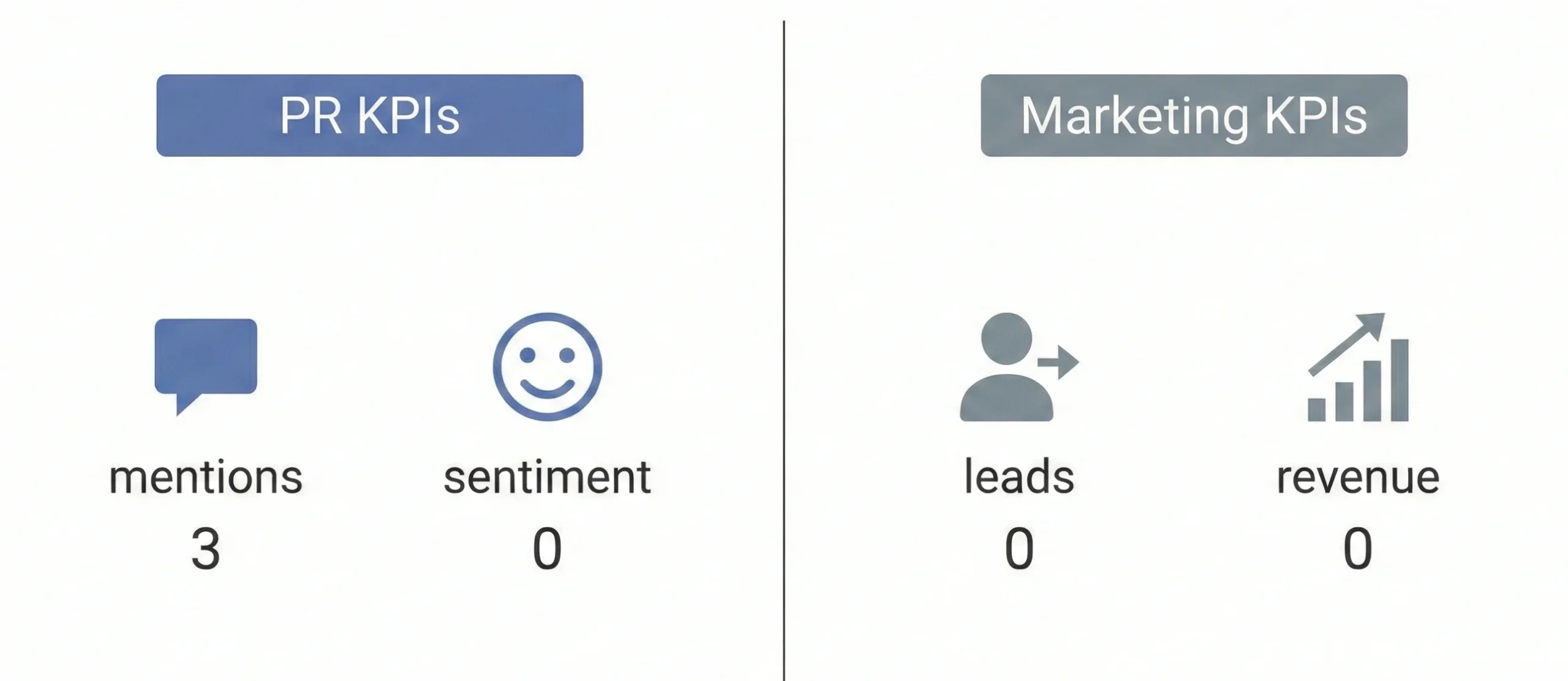
This section summarizes how leaders can track both PR and marketing performance in a simple, combined view.
- A PR dashboard commonly includes metrics like media mentions, share of voice, sentiment scores, and earned media value.
- A marketing dashboard commonly includes metrics like traffic, leads, conversion rate, customer acquisition cost, and revenue generated.
- Reviewing both sets of metrics together makes it easier to see how reputation (PR) and performance (marketing) are interacting over time.
Conclusion
Public relations and marketing may share the same ultimate destination—supporting brand and business growth—but they take different routes to get there. PR concentrates on building trust, credibility, and long-term reputation with a wide range of stakeholders, while marketing turns attention and interest into measurable demand, leads, and sales. Treating them as competing functions or collapsing them into one role usually leads to missed opportunities and mixed messages. Organizations that intentionally align PR and marketing—through shared planning, consistent messaging, and complementary metrics—are better positioned to earn attention, convert it into results, and sustain loyalty over time. Instead of asking whether to invest in PR or marketing, the smarter question is how to let each do what it does best in a coordinated, integrated way.

Passionate about blogging and focused on elevating brand visibility through strategic SEO and digital marketing. Always tuned in to the latest trends, I’m dedicated to maximizing engagement and delivering measurable ROI in the dynamic world of digital marketing. Let’s connect and unlock new opportunities together!