



Sales management is the discipline of building and leading a sales team, designing the processes they follow, and implementing strategies that enable the organization to hit or exceed its revenue targets. Effective sales management creates clarity for sales reps, aligns sales with broader business goals, and turns selling from a reactive activity into a predictable growth engine.

When sales management is done well, everyone in the organization understands how leads move through the pipeline, what is expected from the sales team, and which activities drive revenue. When it is neglected, teams often struggle with inconsistent performance, poor forecasting, and missed opportunities.
This blog explains what sales management is, breaks down its core components, walks through practical strategies and best practices, and highlights the benefits and common challenges organizations face. The goal is to give a structured, actionable guide that leaders can use to strengthen their sales function.
What Is Sales Management?

Sales management is the process of building a sales team, overseeing sales operations and processes, and implementing strategies to reach or exceed sales targets. It covers everything from hiring and training sales reps to defining the sales process, setting quotas, and tracking performance against goals.
Sales management is closely related to, but distinct from, sales operations. Sales operations focuses more on the infrastructure, tools, and support that enable reps to sell efficiently, while sales management encompasses both these operational elements and the leadership, strategy, and performance oversight needed to drive outcomes.
For modern businesses, sales management is critical because it turns a group of individual sellers into a coordinated team working toward clear, measurable goals. Sales managers act as the bridge between company leadership and the sales reps, translating business objectives into targets, processes, and day‑to‑day coaching.
The 3 Key Components of Sales Management
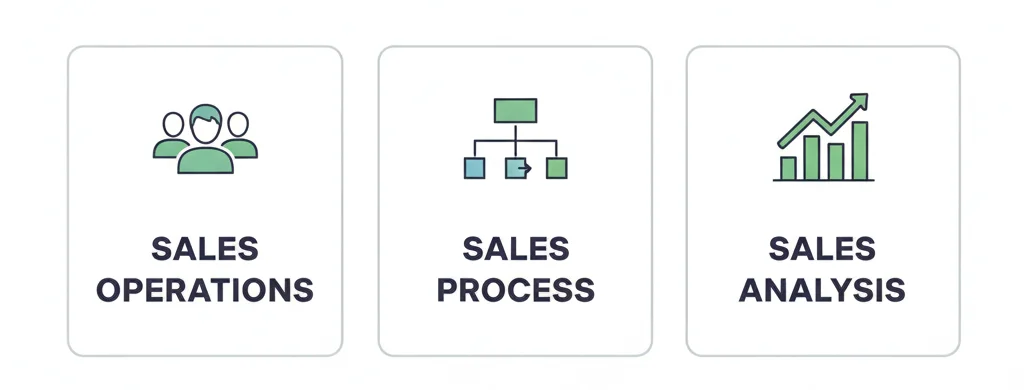
Sales management typically includes three core components: sales operations, sales process and strategy, and sales analysis and reporting. Each component supports the others, creating a complete system that helps teams sell more effectively and predictably.
At a high level, sales operations focuses on the people and roles, sales process and strategy guide how selling happens, and sales analysis and reporting ensure data‑driven decisions and continuous improvement. Together, they form the backbone of a robust sales management system.
1. Sales Operations
Sales operations in this context refers to hiring, training, managing, and retaining sales talent in the roles needed to execute the company’s sales strategy. It often starts with working closely with human resources to write effective job descriptions and source candidates who fit the organization’s sales culture and requirements.
Once team members are hired, sales operations covers their ongoing development and performance management. Three core activities are especially important:
- Training: Regular training and professional development equip reps with up‑to‑date product knowledge and sales techniques, which keeps them effective and motivated.
- Establishing and measuring targets: Leaders set ambitious but realistic targets, often aligned with territories or segments, and then track progress so they can step in with support when needed.
- Mentoring: Beyond numbers, reps need guidance, feedback, and encouragement from managers or senior colleagues to refine their approach and stay engaged.
The aim of sales operations is to make sales reps both experts at selling the company’s products and strong collaborators that customers enjoy working with. When this component is strong, the team has the skills, clarity, and support needed to perform at a high level.
2. Sales Process and Strategy
The sales process and strategy describe how the team sells: the sequence of actions reps take during a sales cycle to move leads from initial contact to closed business. A clearly defined, step‑by‑step process acts like a user manual or playbook, giving reps a roadmap to follow so deals advance through the pipeline consistently.
This process typically includes stages such as prospecting, qualifying leads, presenting solutions, handling objections, and closing, although the specific steps vary by business. The key is that the process is documented, repeatable, aligned with the buyer’s journey, and understood by the whole team.
Strategy, in turn, determines how the organization will compete and prioritize opportunities within this process. It may guide how reps segment accounts, which messages they emphasize, or how they position the product against alternatives, all with the aim of improving win rates and deal quality.
3. Sales Analysis and Reporting
Sales analysis and reporting provide the data and insights needed to evaluate how well the team, process, and strategy are working. By tracking key metrics and reviewing them regularly, managers can see whether they are on track to hit targets and where friction or underperformance is occurring.
Common metrics used in sales analysis reports include:
- Number of deals in the sales funnel: Indicates the overall health and volume of the pipeline.
- Average deal size: Helps track business growth and supports revenue forecasting by showing typical order values.
- Close ratio: Shows the percentage of deals won and helps assess the effectiveness of reps and strategies, informing training and best‑practice sharing.
Managers can use this data to answer questions such as whether they need more sales reps, whether the sales process is too complex, or which stages cause prospects to drop out. They can also identify which strategies or individuals are contributing most to success and replicate those approaches across the team.
Also Read: Sales vs Business Development: What Are The Key Differences?
The 5 Sales Management Strategies

Five practical sales management strategies translate these components into concrete actions: creating a compensation plan, setting goals and targets, building an onboarding and growth plan, creating sales analysis reports, and regularly evaluating the sales process. These strategies form a repeatable management rhythm for the sales organization.
Each strategy helps align the team, reinforce desired behaviors, and ensure that management decisions are guided by data, not guesswork. Applied together, they support consistent, scalable sales performance.
1. Create a Compensation Plan
A clear compensation plan sets expectations among sales reps by detailing how salary and commission will be structured. It specifies how much of their income is fixed versus variable and what outcomes drive bonuses or commissions.
Ideally, compensation is designed in a way that rewards both new customer acquisition and customer retention. Incentivizing only new deals can push reps to ignore existing clients who could be upsold or cross‑sold, while adding rewards for renewals and account growth encourages long‑term relationship building.
A well‑designed compensation plan therefore supports the company’s strategic priorities and gives reps a clear financial reason to focus on the right mix of activities. It also reduces confusion or dissatisfaction by making earning potential transparent.
2. Set Clear Goals and Targets
Setting specific goals and targets clarifies what the sales team must accomplish within a given time frame. These goals usually exist at both the team and individual level and are often tied to metrics like revenue, number of deals closed, or activity volume.
Communicating these goals clearly is essential so every rep understands what is expected of them and how their work contributes to overall business performance. In parallel, investing in sales enablement—data, tools, and content that help reps qualify, nurture, and close deals more effectively—makes those goals more achievable.
With defined goals and strong enablement, managers can better coach reps, recognize achievement, and step in early when someone is falling behind. This structure supports accountability and continuous performance improvement.
3. Create an Onboarding and Growth Plan
An onboarding and growth plan gives new hires a structured roadmap for integrating into the sales team and building their careers. It typically covers processes, systems, tools, and best practices, helping new reps understand how things work and what good performance looks like.
Beyond initial onboarding, a growth plan outlines opportunities for skill development and career progression. This motivates team members to perform because they can see a clear path forward and understand how current results link to future roles or rewards.
Including both onboarding and long‑term growth in the sales operations process also helps reduce turnover. Reps who feel supported and see their development taken seriously are more likely to stay and grow with the organization.
4. Create Sales Analysis Reports

Sales analysis reports organize and present the key data that shows how the team performed over a particular period. They give managers and reps a shared view of what is happening in the pipeline and where adjustments might be needed.
Common types of sales reports include:
- Sales pipeline report: Shows deals at each stage of the funnel and helps assess future revenue potential.
- Conversion rate report: Tracks how effectively leads move from one stage to the next.
- Won vs. lost deals analysis report: Highlights win rates and reasons for lost deals to inform strategy changes.
- Customer churn report: Monitors the rate at which customers stop doing business with the company.
- Average sales cycle length report: Measures how long it typically takes to close a deal, which can inform forecasting and process optimization.
- Revenue report: Summarizes the revenue generated over a given period, often broken down by segment, rep, or product line.
These reports are useful not only for the sales department but also for marketing and senior management. Marketing can use them to understand whether campaigns are attracting the right audience, while leadership can use revenue and forecasting data to plan growth.
5. Regularly Evaluate and Improve Your Sales Process
The sales process should not be treated as a one‑time project; it needs to evolve with the business and the market. Regular evaluation ensures that the process remains aligned with customer expectations, competitive dynamics, and internal capabilities.
Reviewing the sales process with the team and maintaining a live document that reflects the latest changes keeps everyone aligned and ensures new best practices are captured and shared. This collaborative approach also surfaces issues that might not appear in the numbers alone.
By looking at where prospects encounter friction and brainstorming improvements, managers and reps can continuously remove obstacles that slow deals down or cause them to be lost. This ongoing refinement supports higher win rates and a better buyer experience.
The Key Benefits of Sales Management
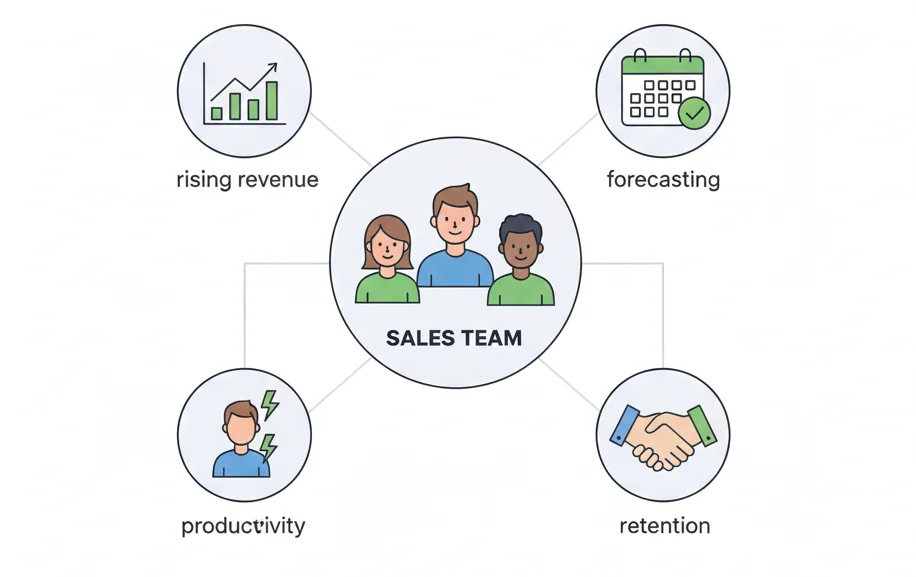
A robust sales management system can significantly boost team productivity and guide the sales department toward consistent success. The benefits span financial outcomes, operational efficiency, and people‑focused gains such as morale and retention.
These benefits reinforce one another: better processes support better performance, which improves results and satisfaction, which in turn supports further improvement. Over time, this creates a virtuous cycle of growth.
1. Higher Sales Revenue
Effective sales management typically leads to higher sales revenue because it aligns people, process, and strategy toward clear targets. Trained and motivated reps following a defined process and working under data‑driven leadership are more likely to close deals and grow accounts.
By removing friction in the process, providing the right tools, and focusing on the right metrics, management gives reps the conditions needed to maximize their selling time and effectiveness. Over time, this translates into more closed deals and larger average deal sizes.
2. Accurate Sales Forecasting
When sales analysis and reporting are built into management routines, forecasting becomes more accurate. Metrics like pipeline volume, conversion rates, average deal size, and sales cycle length all help predict future revenue.
Accurate forecasts support better budgeting, resource allocation, and strategic planning at the organizational level. Leadership can make more confident decisions because they have a clearer view of likely sales performance in upcoming periods.
3. Increased Customer Retention
Sales management that emphasizes both acquisition and retention encourages reps to nurture existing customers, not just chase new ones. Compensation plans that reward renewals and upsells, along with processes that support ongoing relationship management, improve customer stickiness.
Over time, higher retention rates mean more recurring revenue and more opportunities to cross‑sell or upsell additional products or services. This is often more efficient than constantly replacing churned customers with new ones.
4. Improved Sales Rep Productivity
Clear processes, training, and tools remove guesswork and inefficiencies from reps’ daily work. When reps know exactly what is expected at each stage of the sales cycle and have enablement content and systems that support those activities, they can spend more time selling and less time figuring out what to do next.
Sales analysis also highlights where reps may need additional coaching or where bottlenecks in the process are slowing them down. Addressing these issues increases overall productivity and helps the team achieve more with the same headcount.
5. Increased Job Satisfaction
Sales management that includes realistic targets, mentoring, clear growth plans, and fair compensation contributes to higher job satisfaction among sales team members. Reps who feel supported and see a path for advancement are more engaged and less likely to burn out or leave.
Higher job satisfaction benefits the organization through lower turnover, stronger team culture, and the retention of experienced sellers who understand the company’s products and customers deeply. This continuity further strengthens performance and customer relationships.
Sales Management Best Practices

Beyond the core strategies already discussed, there are widely recognized best practices that reinforce effective sales management. Many of these are closely tied to training, culture, technology, customer focus, and continuous improvement.
The following practices give sales leaders concrete levers to pull as they refine their sales management approach.
Invest in Regular Training
Regular training ensures that sales reps stay current on product updates, industry changes, and evolving sales techniques. It also signals that the organization is committed to their growth, which supports motivation and retention.
Training can cover topics such as handling objections, using new tools, understanding new pricing or packaging, and refining discovery questions. When training is built into the sales management process, it becomes a routine source of performance improvement rather than an occasional event.
Build a Strong Sales Culture
A strong sales culture emphasizes collaboration, ethical selling, accountability, and recognition of success. Mentoring and ongoing support are key ingredients, helping reps feel that they are part of a team rather than left to succeed or fail entirely on their own.
Celebrating wins, sharing best practices among reps, and encouraging open communication with managers all contribute to a healthier, more productive sales environment. This cultural foundation makes it easier to implement new processes or tools because the team trusts leadership.
Use Technology and Tools
Modern sales management relies heavily on technology. Tools like customer relationship management (CRM) systems, analytics platforms, and sales enablement solutions help organize data and streamline workflows.
With the right tools, managers can more easily track metrics, generate reports, and provide insights to the team, while reps can manage their pipelines, access content, and log activity efficiently. This reduces manual work, improves data quality, and supports more accurate reporting and forecasting.
Focus on Customer‑Centric Selling
Customer‑centric selling aligns the sales process with the needs and preferences of buyers rather than forcing all prospects through a rigid internal script. Understanding the buyer’s journey and the points where they typically encounter friction helps teams adjust conversations and content to be more helpful.
By focusing on solving customer problems and tailoring solutions to their context, sales teams make it easier for buyers to make decisions. This often leads to higher satisfaction, better‑fit deals, and stronger long‑term relationships.
Monitor and Adapt
Continuous monitoring of performance and regular process evaluation help ensure that the sales organization stays aligned with market and internal changes. This includes reviewing metrics, gathering feedback from reps, and revisiting the sales process documentation.
Adapting based on what the data and the team are telling you—whether that means adjusting quotas, refining messaging, changing qualification criteria, or revising stages—keeps the sales function from becoming stagnant. In dynamic markets, the ability to course‑correct quickly is a competitive advantage.
Common Sales Management Challenges and Solutions
Even with good intentions, many organizations encounter similar challenges in sales management. Recognizing these issues and addressing them proactively is a key part of a manager’s role.
Below are some common challenges and practical ways to respond:
- Challenge: Low sales rep productivity
This often stems from unclear processes, insufficient training, or lack of tools. Clarifying the sales process, investing in training, and providing sales enablement resources help reps focus on high‑value selling activities instead of guesswork. - Challenge: High turnover among sales reps
Without clear growth paths, fair compensation, and support, reps may leave for other opportunities. Creating structured onboarding and growth plans, offering mentoring, and designing balanced compensation plans can improve retention. - Challenge: Inconsistent or poorly followed sales process
If the process is undocumented or outdated, reps may all work differently, making performance hard to manage. Keeping a live, shared sales process document and reviewing it regularly with the team reduces inconsistency and keeps everyone aligned. - Challenge: Poor forecasting and limited visibility
When metrics are not tracked or reports are inconsistent, leaders lack a clear view of performance. Building regular sales analysis reports—such as pipeline, conversion, and revenue reports—gives the organization the data it needs for accurate forecasting.
Conclusion
Sales management brings together people, process, and data to ensure that an organization not only hits its revenue targets but does so in a repeatable and scalable way. By understanding the definition of sales management, its core components, and the strategies that support it, leaders can design a system that serves both the business and the sales team.
From thoughtful compensation and goal setting to structured onboarding, rigorous reporting, and continuous process improvement, each element discussed contributes to higher revenue, better forecasting, stronger customer relationships, and more satisfied reps. When everyone in the organization understands and participates in the sales management process, the result is a more resilient and productive sales function.
FAQs
1. What is sales management in simple terms?
Sales management is the process of building and leading a sales team, defining how they sell, and overseeing the activities and strategies that help the business reach or exceed its sales targets. It covers hiring and training sales reps, setting goals and quotas, designing the sales process, and measuring performance. In simple terms, it is how a company plans, organizes, and directs its sales efforts to drive revenue.
2. What is the main goal of sales management?
The main goal of sales management is to create a predictable, scalable system for generating revenue. This means not only closing more deals, but doing so in a consistent way by aligning people, processes, tools, and data. A good sales management system aims to increase revenue, improve forecasting accuracy, boost sales rep productivity, and build strong, long‑term customer relationships.
3. How is sales management different from sales operations?
Sales management is the broader discipline that includes leadership, strategy, coaching, and performance oversight for the sales team. Sales operations is a subset focused more on the infrastructure and support that make selling efficient, such as tools, reporting, process documentation, and territory planning. In practice, sales operations builds the foundation, while sales management uses that foundation to guide the team and deliver results.
4. What are the three key components of sales management?
The three key components commonly associated with sales management are:
- Sales operations: Hiring, training, mentoring, and retaining sales talent, as well as setting and tracking targets.
- Sales process and strategy: Defining the step‑by‑step process reps follow and the strategic approach they use to win deals.
- Sales analysis and reporting: Tracking metrics and creating reports that show performance, pipeline health, and areas for improvement.
Together, these components create a system that supports consistent, data‑driven selling.
5. Why is having a defined sales process important?
A defined sales process gives reps a clear roadmap for moving prospects from initial contact to closed business. Without it, each rep may work differently, making results inconsistent and hard to manage. With a documented process, managers can coach more effectively, spot bottlenecks, and test improvements, while reps know exactly what activities are expected at each stage of the funnel.
6. Which sales metrics should managers track?
Common and useful sales metrics include the number of deals in the pipeline, average deal size, close ratio (win rate), sales cycle length, churn rate, and overall revenue. These metrics help managers understand pipeline health, rep effectiveness, and how long it takes to close deals. With this data, leaders can forecast more accurately, identify training needs, and refine the sales process.
7. How does sales management affect revenue growth?
Sales management affects revenue growth by ensuring that the right people, processes, and tools are in place and aligned with clear goals. When reps are properly trained, compensated, and supported, they tend to close more and better‑quality deals. Structured processes reduce friction and lost opportunities, while data‑driven decisions help focus effort on the activities that have the biggest impact on revenue.

Passionate about blogging and focused on elevating brand visibility through strategic SEO and digital marketing. Always tuned in to the latest trends, I’m dedicated to maximizing engagement and delivering measurable ROI in the dynamic world of digital marketing. Let’s connect and unlock new opportunities together!