



A digital marketing plan structure defines how goals, strategies, and activities connect, who is responsible, and how performance is measured. When properly structured, it reduces chaos, improves speed to market, and compounds results over time. This guide follows an 8-step framework across foundation, strategy, tactics, execution, and optimization.

What is a digital marketing plan?
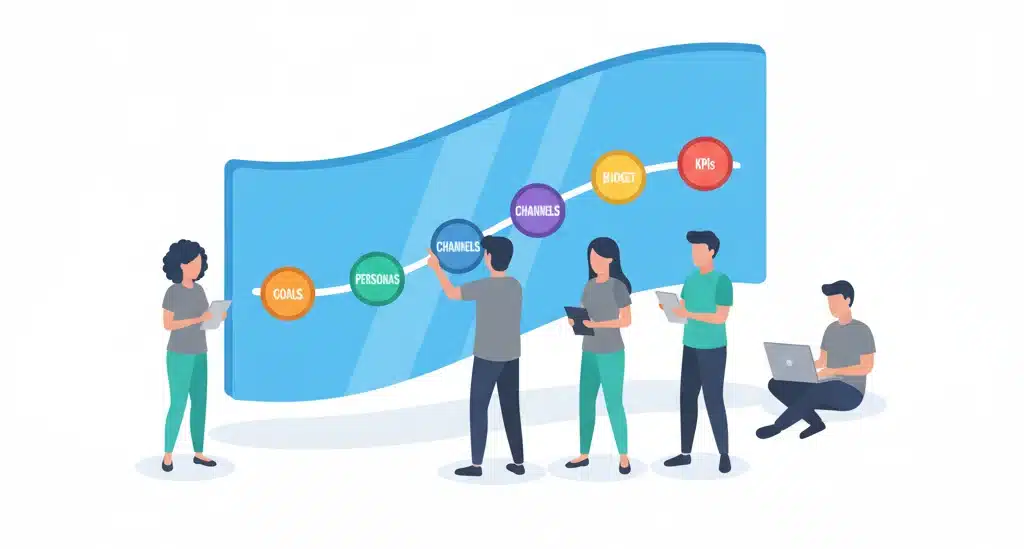
A digital marketing plan is a structured document that outlines how a business will achieve specific goals through online channels using clearly defined strategies, timelines, budgets, responsibilities, and performance metrics. It connects high-level business objectives to day-to-day tactics across channels like search, social, email, content, and paid media, ensuring every activity has a purpose, owner, and KPI attached.
A strong plan includes audience definitions and buyer personas, a channel mix with messaging and offers for each journey stage, and a measurement system with targets, dashboards, and an attribution approach. In practice, it functions as both a roadmap and an operating system, guiding prioritization, budgeting, execution workflows, testing, and continuous optimization.
Phase 1: Foundation Structure
Step 1: Establish Your Strategic Framework
A robust plan starts with a clear strategic hierarchy and operating model.
- Strategic hierarchy: Business goals → Marketing objectives → Strategies → Tactics → Tasks.
- Planning infrastructure: Define documentation (briefs, calendars, playbooks), approval workflows, and governance rules.
- Roles and responsibilities: Create a RACI (Responsible, Accountable, Consulted, Informed) matrix for planning, production, distribution, and reporting.
- Decision cadence: Weekly sprint stand-ups, monthly performance reviews, quarterly strategy resets.
Deliverables:
- Marketing strategy doc (1–2 pages)
- RACI matrix
- Operating cadence calendar
Step 2: Conduct Comprehensive Situational Analysis
Understand where you are and where you can win.
- Internal analysis: Audit website, analytics, SEO, content, creative assets, automation, CRM, and data quality.
- External analysis: Competitor mapping (positioning, messaging, channels, spend levels), category trends, SERP landscape, and customer conversations.
- SWOT: Identify strengths, weaknesses, opportunities, and threats to focus your plan.
Deliverables:
- 360° digital audit
- Competitor matrix
- SWOT summary and top 5 strategic priorities

Phase 2: Strategic Structure
Step 3: Define Target Audience Architecture
Translate your market into actionable segments and journey stages.
- Segmentation: Demographic, firmographic, psychographic, and behavioral cohorts.
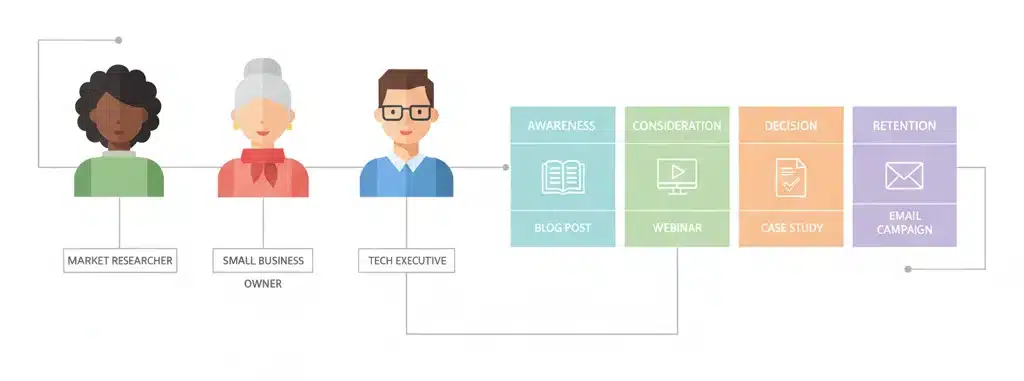
- Buyer personas: Pain points, triggers, objections, information needs, value drivers.
- Journey mapping: Awareness → Consideration → Decision → Post-purchase/Retention; define content types, offers, and CTAs per stage.
Deliverables:
- 2–5 persona one-pagers
- Journey maps with content/offer mapping
- Messaging frameworks by persona and stage
Step 4: Establish Goal Hierarchy and Measurement Structure
Align goals and measurement before tactics begin.
-
- SMART goals: Specific, Measurable, Attainable, Relevant, Timely (e.g., increase MQLs by 30% in Q1 at ≤₹X CPL).
- KPI architecture:
-
- North Star metric (e.g., pipeline or revenue influenced)
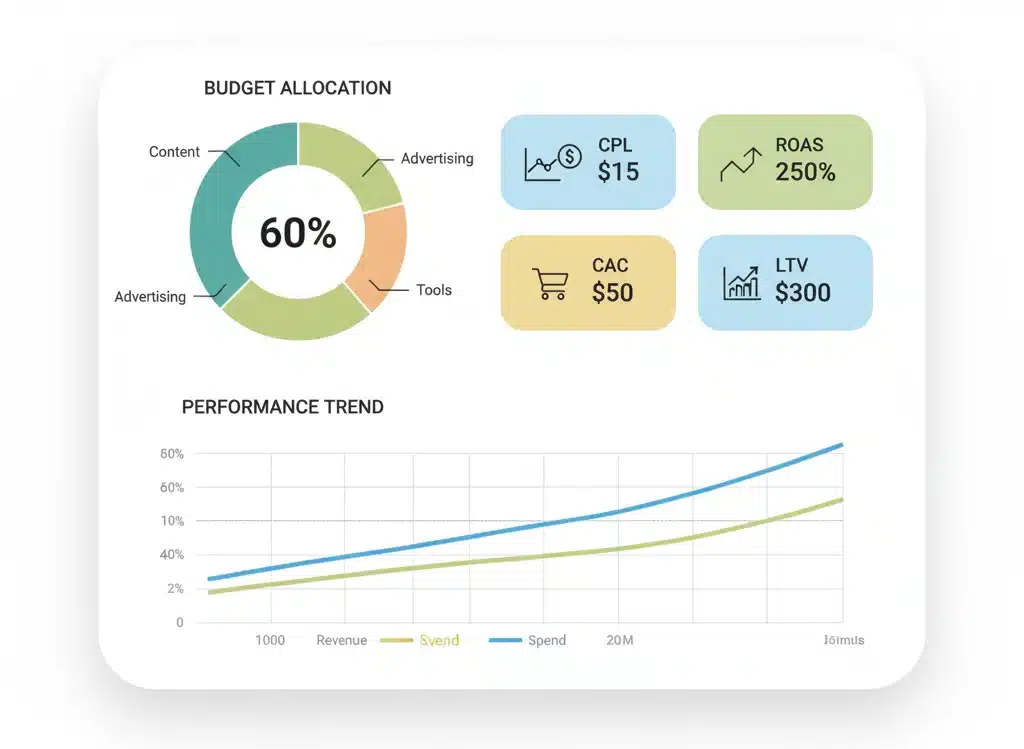
- Leading indicators (CTR, CVR, CPL, SQL rate)
- Lagging indicators (CAC, LTV, ROAS, ROMI)
- Attribution approach: Define model (first-touch, last-touch, data-driven), tracking plan, and dashboards.
Deliverables:
- Goal tree (business → marketing → channel)
- KPI dictionary and targets
- Tracking & attribution plan
Phase 3: Tactical Structure

Step 5: Design Your Channel Strategy Matrix
Choose channels with purpose and integrate them into a cohesive system.
-
- Channel mix: Owned (site, email, SMS), Earned (PR, SEO, UGC), Paid (search, social, display, video, partnerships, affiliates).
- Selection criteria: Audience fit, intent level, cost, ramp time, measurability, and synergy with other channels.
- Content strategy:
-
-
- Pillars and clusters aligned to personas and journey stages
- Signature formats (guides, calculators, case studies, webinars)
- Distribution playbook (channel-by-channel repurposing)
-
- Budget allocation:
-
- 70/20/10 model (proven/beta/experimental)
- Guardrails per channel (target CPL/CPA/ROAS)
- Reallocation rules based on performance thresholds
Deliverables:
- Channel matrix (objective, audience, offers, KPIs, budget)
- Content pillar map and 90-day editorial plan
- Budget and reallocation playbook
Step 6: Create Campaign Structure and Workflows
Operationalize campaigns for consistency and speed.
- Campaign architecture: Brand → Product → Feature → Offer → Creative/Ad sets.
- Automation: Lead scoring, nurturing sequences, win-back flows, onboarding and activation journeys.
- Asset governance: Naming conventions, versioning, brand kits, modular creative for rapid iteration.
Deliverables:
- Campaign taxonomy and folder structure
- Automation workflows and triggers
- Creative and copy templates
Also Read: Importance of Digital Marketing: 8 Reasons Why It Matters for Business Growth
Phase 4: Execution Structure
Step 7: Develop Implementation Timeline and Calendar
Plan work across annual, quarterly, and monthly cycles.
- Calendars:
-
- Annual: Big bets, launches, seasonal windows
- Quarterly: Campaign themes, channel targets
- Monthly/weekly: Production sprints, release schedules
- Resource planning: Capacity by role, vendor roster, SLAs.
- Project management: Briefs, task templates, QA checklists, and approvals.
Deliverables:
- Master marketing calendar
- Sprint plan and resourcing map
- Production checklist and QA flow
Step 8: Establish Monitoring and Optimization Structure
Create a closed loop from data to decision to deployment.
- Dashboards: Real-time for channels, weekly for campaigns, monthly for business outcomes.
- Optimization: A/B and multivariate testing roadmaps for ads, landing pages, emails, and offers.
- Learning system: Post-campaign reviews, hypothesis backlog, playbooks updated with insights.
Deliverables:
- Dashboard suite and reporting cadence
- Testing roadmap with success criteria
- Quarterly review template and action log
Phase 5: Advanced Structuring Concepts

Integration with Business Operations
- Sales alignment: Lead definitions (MQL/SQL), routing rules, feedback loops, revenue dashboards.
- CS alignment: Onboarding content, expansion plays, referral and advocacy programs.
- Product integration: Insight sharing from market conversations to roadmap.
Scaling Your Structure
- Process scalability: Standard operating procedures (SOPs), modular assets, and reusable components.
- Team evolution: Hub-and-spoke model across regions/products; clear handoffs.
- Technology stack: Interoperability, data hygiene standards, and a single source of truth.
Risk Management and Governance
- Brand compliance: Messaging guardrails, regulatory checks, accessibility standards.
- Crisis playbook: Monitoring, escalation paths, response templates.
- Privacy and consent: Clear data policies, cookie management, opt-in hygiene.
Example 90-Day Plan (Template)
- Month 1: Audit, strategy, tracking, quick-win SEO/content, paid search foundation, lead nurture v1
- Month 2: Multi-channel rollout (SEO clusters, LinkedIn/Meta, remarketing), CRO sprints, webinar or lead magnet launch
- Month 3: Scale best performers, expand automation, advanced attribution, QBR and roadmap refresh
Metrics That Matter
- Efficiency: CPL, CPA, CAC payback period
- Effectiveness: CVR by stage, SQL-to-close rate, pipeline/revenue influenced
- Growth quality: LTV, cohort retention, expansion revenue
- Channel health: Share of voice, ranking velocity, creative fatigue, frequency caps
Common Pitfalls to Avoid
- Jumping to tactics without goals and tracking
- Overextending across channels without depth
- Under-defining personas and offers
- Neglecting post-click experience and sales alignment
- Not reallocating budget based on performance
- Treating reporting as a summary, not a decision engine
Quick-Start Checklist
- Strategic hierarchy and RACI defined
- Full-funnel audit and SWOT completed
- Personas and journey maps finalized
- SMART goals, KPIs, and attribution set
- Channel matrix, content pillars, and budget allocated
- Campaign taxonomy, automation, and assets prepared
- Calendars, sprints, and QA ready
- Dashboards live, testing roadmap approved
Conclusion
Structure is the multiplier in digital marketing. By organizing strategy, channels, content, budgets, workflows, and measurement into a cohesive system, teams move faster, learn quicker, and scale smarter. Use this framework to build a plan that’s not just documented—but operationalized, measurable, and continuously improving.
FAQs
1. What should a digital marketing plan include?
Clear SMART goals, defined personas and journeys, channel strategy and content pillars, campaign calendar, budget and guardrails, KPI targets, tracking and attribution, QA and approvals, and an optimization/testing roadmap.
2. How is a plan different from a strategy?
Strategy defines where to play and how to win; the plan operationalizes it with channels, timelines, resources, budgets, and measurement so teams can execute consistently.
3. How often should it be updated?
Review performance weekly for tactical tweaks, monthly for channel-level shifts, and quarterly for strategic reallocation; refresh the full plan annually or after major market changes.
4. Which channels should be prioritized?
Align to intent and audience: SEO and paid search for demand capture, social and video for demand creation, email and automation for nurturing, and partnerships/PR for authority and reach.
5. What KPIs matter most?
Use a hierarchy: North Star (pipeline/revenue influenced), efficiency (CPL/CPA/CAC), effectiveness (CVR by stage, SQL rate), and value (LTV, ROAS/ROMI, payback period).
6. How big should the budget be?
Tie spend to growth targets and CAC/LTV guardrails; use a 70/20/10 split across proven, beta, and experimental initiatives with rules for reallocating based on performance.
7. Do small businesses need a formal plan?
Yes—smaller teams benefit even more from focus and cadence; a concise one-page plan with goals, personas, channels, offers, KPIs, and a 90‑day calendar can be highly effective.
8. What are common mistakes to avoid?
Jumping to tactics without goals and tracking, thin personas, spreading too thin across channels, weak post-click experiences, no sales alignment, and reporting without decisions.

Passionate about blogging and focused on elevating brand visibility through strategic SEO and digital marketing. Always tuned in to the latest trends, I’m dedicated to maximizing engagement and delivering measurable ROI in the dynamic world of digital marketing. Let’s connect and unlock new opportunities together!