
Here is a number that should bother anyone studying the marketing mix of BSNL. In 2010, the company held roughly 16 percent of India’s mobile market. By 2020, its debt was above Rs 32,000 crore and its share was stuck in single digits. Same brand, same government backing, same network in half the country. So what went wrong? Nobody forgot how to run a telecom tower. The mix of product, price, place and promotion slowly stopped matching what customers wanted, and the private operators noticed that gap long before BSNL did.
That is exactly why this is such a good case study. Most marketing mix examples you find online are about winners, like Apple or Nike or Amul. BSNL is messier, and honestly more useful. It has a product that works well in some places and badly in others. It has prices that are often the lowest in the market. It has a distribution network that reaches villages Jio needed years to get to. And for a very long time, it had promotion that was close to invisible. When one P is strong and the others lag, you get BSNL.
This guide walks through every part of the mix with real plans, real numbers and straight opinions. You will see how the 4G rollout changed the product, why the July 2024 tariff hikes handed BSNL its best marketing moment in a decade, and where the brand still fumbles. It is written for students, beginners and small business owners, so every term gets explained in plain language the first time it shows up. By the end, you should be able to write a proper marketing mix analysis of BSNL for an assignment, a presentation, or just your own curiosity.
What You Will Learn in This Guide
This guide is long on purpose, because a thin summary of BSNL’s marketing would not teach you much. Here is what you will walk away with, in the order it appears below.
- What the marketing mix actually means and how the 4Ps and 7Ps apply to a telecom company
- The history that explains BSNL’s current position, from its 2000 launch to the revival packages
- How BSNL’s product range works, from prepaid SIMs to Bharat Fiber and enterprise leased lines
- How BSNL prices its plans, why it did not raise tariffs in 2024, and where cheap pricing backfires
- How BSNL reaches customers through retailers, service centres, apps and rural networks
- How BSNL promotes itself, from old-school hoardings to the 2025 logo refresh and social media
- The extended mix: people, process and physical evidence
- A SWOT analysis, a head-to-head comparison with Jio and Airtel, and the mistakes worth learning from
- Ten plus FAQs you can quote in exams, interviews and presentations
TL;DR
Short on time? These six points capture the whole story before the detail starts. Read them first, then come back to the sections that matter for your assignment or project.
- Product: BSNL sells mobile, broadband, landline and enterprise services, and its indigenous 4G network of roughly 1 lakh sites is now the core product.
- Price: BSNL positions itself as the budget option, with long-validity plans and festival offers, and it skipped the 2024 tariff hikes that Jio, Airtel and Vi made.
- Place: Its biggest edge is rural and remote reach, backed by service centres, franchisees and retailers, but SIM and recharge availability is patchy.
- Promotion: Advertising was weak for years, and the 2025 logo refresh and social media push are the first serious attempts to fix that.
- Extended mix: People, process and physical evidence are the weakest links, mainly because of slow service and uneven network quality.
- Verdict: BSNL wins on price and reach, loses on consistency and brand perception, and its next five years depend on fixing the experience, not the tariff.
What Is the Marketing Mix of BSNL? A Plain-Language Definition
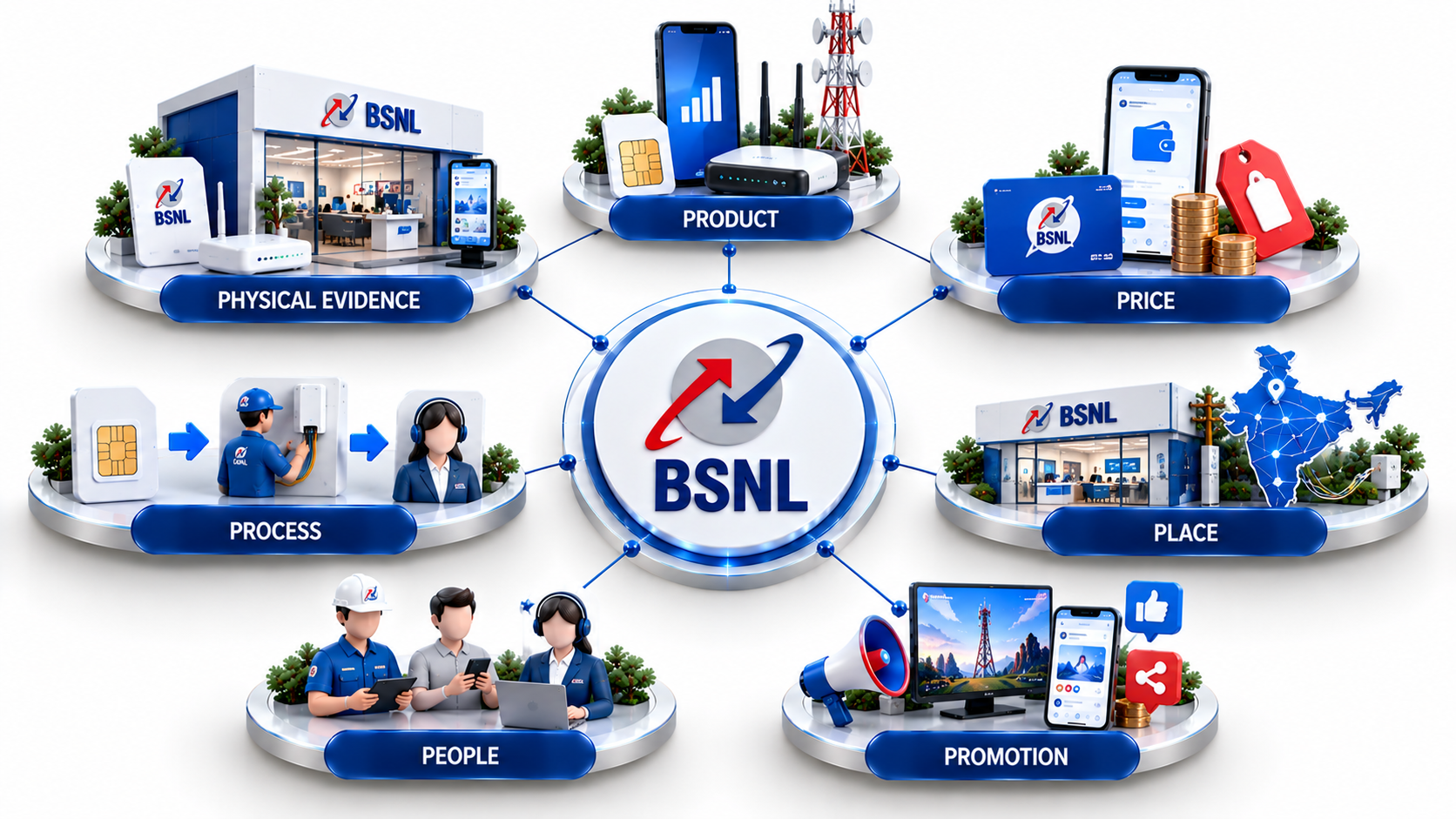
The marketing mix of BSNL is the set of decisions the company makes about what it sells, what it charges, where it sells it and how it tells people about it. Add people, process and physical evidence, and you get the full seven-part version. It is simply a checklist for studying how a business wins or loses customers.
The 4Ps in One Minute
The 4Ps are product, price, place and promotion. Product is what the customer gets: a SIM card, a broadband connection, a leased line. Price is what they pay for it, including recharge plans and installation fees. Place is how and where they can buy it, from a retail counter to an app. Promotion is every way the company tells people it exists, from TV ads to a WhatsApp message.
The idea comes from E. Jerome McCarthy in the 1960s and was popularised by Philip Kotler. It is old, but it still works because every marketing problem eventually traces back to one of these four decisions. If sales are falling, either the product is wrong, the price is wrong, people cannot find it, or people do not know about it. Usually it is a mix of two.
Why the 7Ps Fit a Telecom Company Better
Telecom is a service business, and services need three more Ps: people, process and physical evidence. People means the staff who deal with customers, from the engineer who installs your fiber line to the person at the customer care desk. Process means how things actually happen, like how long it takes to get a new connection or resolve a complaint. Physical evidence means anything customers can see or touch that signals quality, such as the shop, the SIM packaging, the app, even the router.
For a telecom brand, these three often matter more than the original four. A customer will forgive a plan that costs Rs 20 more. They will not forgive waiting nine days for a broken line to be fixed. That is why a proper analysis of the marketing mix of BSNL has to cover all seven, not just the textbook four.
Why BSNL Is Such a Useful Case Study
BSNL gives students something rare: a company where you can see each P pulling in a different direction. The price is excellent. The reach is unmatched in remote India. The product was dated for years and is now being rebuilt. The promotion was nearly absent. The service experience varies wildly from one circle to another. You do not need to invent examples to explain concepts like positioning, brand perception or distribution. They are all sitting in the real BSNL story.
It is also a live case. The 4G rollout is still unfolding, 5G is still ahead, and the numbers change every month when TRAI (the Telecom Regulatory Authority of India) publishes subscriber data. If you want to build your analysis skills on current examples, the digital marketing learning hub has more case-style breakdowns like this one.
BSNL Background You Need Before Studying the Marketing Mix
You cannot judge a marketing mix without knowing where the company came from. BSNL’s story has three phases: a confident launch, a long slide, and a government-funded revival that is still being tested. Each phase left marks on how BSNL prices, sells and promotes today.
Born in 2000 as a Government Company
Bharat Sanchar Nigam Limited was formed on 1 October 2000, when the Department of Telecom Services and the Department of Telecom Operations were corporatised into a single public sector company. It is wholly owned by the Government of India, with its headquarters in New Delhi. At the start, it inherited the country’s entire landline network, which made it the default telecom brand for most Indian households.
That inheritance shaped its culture. BSNL did not start as a scrappy challenger fighting for every customer. It started as the incumbent, with a captive base, government contracts and a name everyone already knew. Incumbents tend to underinvest in marketing because they never had to learn it. That habit hurt BSNL badly once private players arrived with sharper offers.
The Slide Between 2010 and 2020
BSNL’s mobile share was around 16 percent in 2010 and had dropped to about 10 percent by 2016. Then Reliance Jio launched in September 2016 with free data and voice, and the whole market reset. BSNL’s 3G network could not compete, it had no 4G to offer, and its subscribers drifted away. By 2020, the company was carrying debt above Rs 32,000 crore and posting heavy losses.
A big part of the damage was self-inflicted. Spectrum for 4G was not allotted to BSNL when private operators got it, staff costs were very high, and decisions moved slowly. Around 78,000 employees took the voluntary retirement scheme in 2020 to cut costs. That fixed a balance sheet problem but also drained experience from the field.
Revival Packages and the 4G Bet
The government has put in revival packages since 2019, with the total crossing Rs 3 lakh crore according to BofA Global’s estimate reported by Business Standard. The money went into 4G spectrum, equity support, debt relief and merging BharatNet’s fiber assets. The biggest technical bet was building an indigenous 4G stack with TCS, C-DoT and Tejas Networks instead of buying from foreign vendors.
By 15 January 2026, BSNL had installed 97,672 4G sites, of which 95,511 were on air. Subscribers rose from 8.86 crore in March 2024 to 9.28 crore by December 2025. That is real progress, but still only around 8 percent of the national market. So the revival is working, just slowly, and the marketing mix has to carry more of the weight from here.
Product Strategy
Product is where the marketing mix of BSNL has changed the most in the last two years. For a long time the product was ageing: 2G and 3G in a 4G world. Now the company sells a broader range of services on a mostly new network, and the real question is whether the quality matches the promise.
Mobile Services: Prepaid, Postpaid and the 4G Network
Mobile is BSNL’s biggest consumer business. It sells prepaid and postpaid SIMs across GSM, 3G and now 4G, with the 4G stack rolling out circle by circle. Most subscribers are prepaid, which is true for the whole Indian market, so plan design matters more than anything else. Voice, data, SMS and validity are packaged in dozens of vouchers, from tiny top-ups to annual plans.
The network itself is the product, and that is where BSNL’s story gets complicated. In towns with fresh 4G towers, users report decent speeds. In others, coverage drops indoors or 3G fallback kicks in. Data users count more than SIM numbers: BSNL’s share of active mobile broadband users was only about 3.2 percent in 2025, against more than 50 percent for Jio. Plenty of BSNL SIMs sit in phones as secondary numbers.
Bharat Fiber and Landline Broadband
Bharat Fiber is BSNL’s fiber-to-the-home broadband brand, and it is probably the most underrated part of the product line. Plans start at entry prices around Rs 400 to 500 a month, with speeds scaling up from 30 Mbps to a gigabit in some cities. Because BSNL already owns copper and fiber ducts into millions of buildings, it can reach places where private ISPs find the economics hard.
The weakness is the same old one: installation delays and inconsistent support. A good plan means little if the technician takes two weeks to show up. Landline voice, still part of the portfolio, is shrinking every year, but it remains useful for offices, government departments and areas with weak mobile signals. BSNL also still runs a large base of copper broadband connections that are slowly being migrated to fiber.
Enterprise, Leased Lines and Government Contracts
The quiet part of BSNL’s product range is enterprise. It sells leased lines, MPLS VPNs, internet leased connectivity, data centre and cloud services, and managed networks to banks, railways, defence units and state governments. This is where BSNL’s old advantage as a government company still helps: ministries and public sector units often prefer a public sector provider for secure, long-term connectivity.
These contracts bring steady, high-value revenue, but they also hide a weakness. They depend on relationships and tenders, not on brand pull from the public. If private operators win more enterprise tenders on service quality, BSNL cannot fall back on consumer loyalty. That is why the company is pushing its enterprise portfolio harder in recent years, including managed Wi-Fi and IoT connectivity.
Newer Services Around the 2025 Rebrand
Alongside its new logo in mid-2025, BSNL announced a batch of additions: a spam-blocking layer on the network, Wi-Fi roaming between BSNL hotspots, an intranet TV service over fiber, and pilots such as direct-to-device satellite connectivity and SIM-vending kiosks. Some of these are still early and not available everywhere, so any claim about them needs checking against BSNL’s current announcements.
Still, the intent is clear. BSNL is trying to move from being the cheap plain-connectivity brand to being a bundle: mobile, fiber, TV and security from one provider. That bundling idea is what Jio does well with JioFiber and JioTV, and Airtel does with Xstream and Black. Whether BSNL can deliver the bundle reliably is the open question.
Where the Product Actually Falls Short
Look, the honest gap is not features, it is consistency. A product feels good when it works every time, and BSNL’s still does not in many places. Call drops, slow data indoors, delayed 4G upgrades in some circles, and the lack of a widely available 5G service all weigh on perception. The company has said its equipment is 5G-upgradable, but upgradable is not the same as launched.
There is also the app problem. BSNL’s Selfcare app does the basics, but it has not felt as smooth as the MyJio or Airtel Thanks apps that millions use daily. In a marketing mix analysis, that counts as product too, because the app is how most prepaid users interact with the brand every month.
Pricing Strategy
Price has always been the strongest P in the marketing mix of BSNL. The company has built its identity as the affordable choice, and that has been its most reliable weapon against Jio and Airtel. But pricing only works when the product justifies the saving, and that is the tension running through this whole section.
Low-Price Positioning as the Default Strategy
BSNL’s pricing is built around being the cheaper option. Across most comparable plans, its prices sit below Jio and Airtel, often by a wide margin. This is a classic penetration-style approach: keep the price low to attract price-sensitive users, especially in smaller towns and villages where monthly budgets for mobile are tight.
The logic works well for the right customer. A farmer, a daily-wage worker or a student who just needs calls and basic data for Rs 150 to 200 a month will notice a Rs 50 difference. But low price also signals low quality to some buyers, and that perception sticks. When a brand is always the cheap one, it becomes hard to charge a normal price even after the product improves.
Long-Validity Plans and Voucher Design
BSNL’s plan menu leans heavily on validity. Instead of focusing only on 28-day cycles, it offers 30, 60, 70, 150 and 365-day plans, some of which work out to a much lower monthly cost. Plans in the Rs 100 to 200 band with long validity have been a core draw for people who want a backup SIM alive without paying every month.
Plan prices and benefits change often, so always check BSNL’s current price list before quoting numbers in an assignment. The pattern, though, is stable: low entry price, generous validity, modest data. It suits customers who treat BSNL as a second SIM, and it quietly builds a base of users who may upgrade once the 4G experience earns their trust.
The July 2024 Tariff Hike Moment
In early July 2024, Jio, Airtel and Vi raised mobile tariffs by roughly 11 to 25 percent. BSNL held its prices. That single decision became its best marketing moment in years, because it required no ad budget at all. Social media filled with users asking how to port to BSNL, and TRAI data showed BSNL adding about 2.94 million mobile subscribers in July 2024 while Airtel lost around 1.69 million.
Here is the part most guides skip. Many of those new users arrived with a negative gap in experience: patchy coverage, limited 4G, slow activation. A good number drifted back or kept BSNL only as a secondary SIM. So the hike gave BSNL a window, and the pricing P did its job. The product and process Ps could not hold the customers it brought in.
Festival Offers and Entry-Level Hooks
BSNL regularly runs promotional pricing around festivals and launches. A well-known example was a Rs 1 plan for new customers during Diwali 2025, offering a month of basic voice and data to get new SIMs into hands. Offers like this work as a trial mechanism: the price is almost symbolic, the goal is to get people to experience the network and, ideally, stay.
This is a smart tactic when the product has improved but perception has not. People who would never pay for BSNL based on its reputation will try it for one rupee. The risk is that trial users who have a poor first month never come back, so the offer only pays off when the network quality is solid at the exact moment of trial.
Why Cheap Alone Does Not Win
Marketing students sometimes treat low price as a winning strategy. BSNL is the counterexample. For years it was cheaper than the competition and still lost millions of users, because customers pay for outcomes, not for price tags. A plan that costs Rs 199 and drops calls is worse value than a Rs 249 plan that works.
The lesson is simple. Price has to sit inside a promise the product can keep. BSNL’s pricing is strong, but its overall revenue share was reported by BofA Global to have dropped to about 4 percent for BSNL and MTNL combined in FY25, even as subscriber numbers stabilised. That gap tells you low prices bring users in, but they do not by themselves bring revenue.
Place and Distribution
Place is the P where the marketing mix of BSNL looks strongest on paper and weakest in daily practice. The company has an enormous physical footprint, built over decades, but a footprint is not the same as convenience. Customers judge place by how quickly they can buy, recharge or get help.
Physical Presence: Exchanges, Service Centres and Franchisees
BSNL inherited one of the largest telecom infrastructures in the country: telephone exchanges in towns and blocks, customer service centres, and field offices across all 22 telecom circles. This legacy network is the backbone of its place strategy. In many district towns, the BSNL office is still the most visible telecom building in the market.
On top of that, BSNL sells through franchisees and authorised retailers who handle new SIMs, recharges and basic paperwork. This hybrid of company-owned centres and local partners works in the Indian market because most prepaid buyers want a shop around the corner, not a website. The catch is that retailer enthusiasm depends on margins and stock, and BSNL has not always matched what Jio and Airtel offer their channel partners.
Rural and Remote Reach: BSNL’s Real Moat
If there is one place where BSNL beats everyone, it is remote India. In parts of the Northeast, Jammu and Kashmir, Ladakh, the Andaman and Nicobar Islands, tribal belts and border villages, BSNL is often the only operator, or the only one with a signal that holds. The company has reported adding around 1 million rural subscribers in August 2025 alone as its 4G towers reached smaller places.
This matters for marketing because rural users are the segment private operators serve least profitably. They have low average revenue and high network cost. BSNL, backed by government funding and the BharatNet fiber project, can afford to serve them. In a way, this is a social mission and a market position at the same time, and it is the most defensible piece of BSNL’s distribution.
Digital Channels: Website, Selfcare App and Online Recharge
BSNL sells and services through its website, the BSNL Selfcare app, and third-party payment apps like Paytm, PhonePe and Google Pay. Users can recharge, check balance and data usage, raise complaints and manage broadband accounts online. In theory, this takes pressure off physical outlets and makes the service available around the clock.
In practice, adoption has been uneven because the apps feel less polished than the competition and because search visibility is weak. When someone searches for a mobile plan or a fiber connection in their city, private operators dominate the results. A good local search presence, built on the kind of fundamentals covered in the SEO learning hub, would help BSNL capture people who are actively looking to switch.
SIM and Recharge Availability: The Everyday Problem
The most common complaint in forums and social media about BSNL is simple: you cannot always get a SIM when you want one. Retailers run out of stock, activation takes longer than promised, and KYC steps sometimes bounce between the shop and the service centre. When the 2024 tariff hikes sent thousands of people to BSNL at once, many of them hit exactly this wall.
That is a distribution failure, not a product failure. The company has been testing SIM-vending kiosks and eSIM options to ease this, which would be a smart fix if they spread widely. Until then, the lesson for students is blunt: demand you cannot serve is demand you lose.
Promotion
Promotion is the P that BSNL neglected longest, and it shows. For years the brand relied on its name and its government identity instead of active communication. The marketing mix of BSNL is now catching up, with a refreshed identity, more digital activity and sharper offers, but it still spends far less on promotion than Jio or Airtel.
Traditional Advertising: Hoardings, Print and Television
BSNL’s older promotion leaned on newspaper ads, outdoor hoardings, wall paintings in small towns and the occasional television campaign. Its tagline, Connecting India, was consistent for a long time but rarely felt alive. Compare that to Airtel’s famous jingle or Jio’s launch blitz and you see the gap: BSNL’s communication was informative, but forgettable.
That approach is not useless in rural markets, where hoardings and wall ads still get noticed. But when most of your competition is running emotional, memorable, celebrity-led campaigns, plain announcements disappear. For anyone writing an assignment, this is a good example of how weak brand storytelling can drain a company even when its product has real strengths.
The 2025 Logo Refresh and Brand Reset
In mid-2025, BSNL unveiled a new logo and a fresh tagline direction, Connecting Bharat, framed around being safe and secure. The new look was paired with a set of service announcements so that the visual change came with something tangible. This is how a rebrand should work: the identity changes because the product changed, not the other way around.
A logo alone does not rebuild trust, though. Rebranding helps most when customers already feel an improvement. The risk is a mismatch where the brand promises modern, secure, fast service and the user’s experience in their own street is the old one. Fixing perception is slow, and every dropped call undoes a bit of the work.
Digital and Social Media Marketing
BSNL now runs active accounts on X (formerly Twitter), Facebook, Instagram and YouTube, mostly for announcements, customer replies and offers. Its X handle does a lot of customer service work, replying to complaints and routing them to circle teams. When done well, this turns a social channel into a service tool, which is the most practical use of social media for a telecom brand.
What is missing is creativity and consistency. Jio and Airtel run campaigns that people share. BSNL’s posts are mostly functional. The company could learn from how brands plan content in the social media marketing section, with a regular calendar, local-language content and short videos showing real network improvements in real towns.
Sales Promotion: Offers, Cashbacks and Referral Hooks
Sales promotion is where BSNL does its best short-term work. Festival offers, extra validity, bonus data, free months on fiber plans and new-connection discounts all show up regularly. The July 2024 moment, when price became the story by itself, was a promotion win that cost almost nothing.
The weakness is that these offers are often announced quietly. A discount nobody hears about does not move sales. Private operators push every offer through SMS, in-app banners and retailer posters. BSNL tends to rely on press releases and social posts, which reach a small part of the audience. Better promotion here would not mean bigger offers, just louder delivery.
Public Relations and Government Events
BSNL gets something private brands cannot buy: government-level publicity. Launch events for the indigenous 4G network were fronted by the Prime Minister and the Telecom Minister, and news coverage of the rollout has been steady. This builds credibility and a sense of national pride around the brand, especially for the swadeshi technology angle.
That said, political attention is a double-edged tool. It makes BSNL’s performance a public scorecard, and any delay or outage becomes news. PR can open the door, but only service quality can keep people inside. For marketers, BSNL is a reminder that earned attention is valuable only if the product can survive it.
People, Process and Physical Evidence
The extended marketing mix of BSNL is where the brand wins or loses repeat customers. These three Ps cover how staff behave, how services are delivered and what tangible signals customers see. For a telecom company, they often decide whether a user stays for a year or ports out in a month.
People: Employees, Engineers and Customer Care
BSNL’s workforce shrank sharply after the 2020 voluntary retirement scheme, when around 78,000 employees left. What remains is a smaller team with deep technical knowledge, especially in network operations and rural field work. Many of these engineers have kept villages connected through floods, cyclones and mountain winters, and that experience is a real asset.
The weak spot is customer-facing service. Training in communication, empathy and sales is uneven, and staff incentives are not tied to customer satisfaction the way they are at private operators. A brand can have excellent engineers and still lose customers if the person at the counter shrugs. People is the P that needs the quickest improvement.
Process: Activation, Complaints and Billing
Process means how things happen step by step. For BSNL, that includes getting a new SIM activated, shifting a landline, installing fiber, resolving a fault, and handling billing. Customers regularly report slow turnaround, multiple visits for one problem and unclear escalation paths. These friction points matter more than any ad campaign.
BSNL has been digitising parts of the process, with online KYC options, app-based complaint tracking and faster port-in support. But the gap between the process on paper and the process at the district office is wide. A useful way to test any telecom brand is to time how long it takes to fix a basic fault. If the answer changes from town to town, the process is broken.
Physical Evidence: Offices, SIM Kits, Apps and Network Signals
Physical evidence is everything tangible that signals quality. For BSNL, this includes the look of service centres, the SIM packaging, the router given with fiber, the app interface, the signal bars on your phone and even the logo. Customers read these small cues as proof of how competent the company is.
Some BSNL offices still look dated, with queues and old furniture, while Jio and Airtel stores feel like modern retail. The 2025 rebrand is meant to refresh this, and new 4G towers are visible evidence of progress in smaller towns. But the strongest physical evidence will always be a phone showing full 4G bars at home. Nothing else convinces customers as fast.
SWOT Analysis Through the Marketing Mix of BSNL
A SWOT analysis (strengths, weaknesses, opportunities, threats) turns the marketing mix of BSNL into a decision tool. It shows where the company can press its advantage and where it needs urgent repair. Each point below links back to one of the Ps so the analysis stays practical.
Strengths: Price, Reach and Government Backing
BSNL’s biggest strengths are its low prices, its presence in remote regions, its government ownership and its indigenous 4G technology. It also has a loyal base of older users, strong enterprise relationships and fiber infrastructure that competitors would need years to replicate. Its debt is also low compared with some rivals, since the government has absorbed a large part of it.
These strengths map directly to price and place. A student writing this up should note that none of them is a brand-experience strength. They are structural advantages, which is useful but fragile when the service itself disappoints.
Weaknesses: Service Quality, Brand Image and Slow Execution
The weaknesses are consistent and well known: patchy network quality, a dated brand image, slow decisions, weaker digital apps, limited 5G readiness and a small share of data users. BSNL’s mobile broadband share of around 3 percent, against Jio’s 50 plus, tells you the quality gap is real.
There is also a perception problem. Many people still think of BSNL as the slow government telecom, even where service has improved. Changing that image takes years of consistent delivery, plus sharper communication than the company has historically managed.
Opportunities: 4G Saturation, 5G and Rural Digital Growth
The biggest opportunity is the 4G network itself. With nearly 1 lakh sites on air, BSNL can finally compete for data customers instead of only voice. The upgrade path to 5G, rural digital programmes, BharatNet integration, enterprise IoT, and satellite pilots all add room to grow. A price-sensitive market that is tired of tariff hikes is also fertile ground.
There is another opening in trust. Many users worry about spam calls, privacy and data security. BSNL’s position as a domestic, government-owned operator with an indigenous network gives it a credible story on safety, if it can back it with real features and clear communication.
Threats: Jio, Airtel, Vi and Customer Churn
The main threat is the competition itself. Jio and Airtel have deeper pockets, faster 5G rollouts, richer bundles and sharper marketing. Vi is struggling, but even a weakened rival can drop prices to defend its base. Private operators may also respond to BSNL’s cheap plans with targeted offers in the very circles where it is growing.
The second threat is churn. Users who come for a promotional price leave if the network disappoints. And third, there is the risk of policy and funding dependence. If government support slows, BSNL’s capacity to invest in 5G and marketing will slow too. Each of these threats ties back to a P: price pressure, product quality and promotion budget.
[Screenshot: A simple SWOT grid built in Canva with the four BSNL SWOT headings and one-line points filled in]
Marketing Mix of BSNL vs Jio vs Airtel: Side-by-Side Comparison
A marketing mix only makes sense when you put it next to the competition. Here is how the marketing mix of BSNL stacks up against Reliance Jio and Bharti Airtel, the two operators it fights hardest for customers. The numbers and plans move quickly, so treat this as a snapshot of positioning, not a price list.
The Comparison Table
This table sums up how the three operators differ on each P. Use it as a quick reference for exams or presentations, then read the notes underneath to see why the differences exist.
| Element | BSNL | Jio | Airtel |
|---|---|---|---|
| Product | 4G on indigenous stack, Bharat Fiber, enterprise; 5G still ahead | 4G and 5G, JioFiber, JioTV, JioCloud | 4G and 5G, Xstream Fiber, Airtel Thanks app, Black bundles |
| Price | Lowest in most categories, long validity | Mid to high after 2024 hike, many bundles | Highest of the three, premium positioning |
| Place | Strong in rural and remote areas, uneven retail | Largest retail and digital reach | Strong in cities and premium segments |
| Promotion | Low spend, offers and PR driven | Heavy, celebrity and event led | Consistent, emotional, bundle focused |
| People and process | Skilled field engineers, slow service | Digital-first service | Strong customer care reputation |
| Physical evidence | Dated offices, improving network | Modern stores and apps | Premium stores and polished app |
What the Table Tells You
BSNL wins on price and remote reach. Jio wins on scale and ecosystem. Airtel wins on perceived quality and premium customers. Each operator picked a lane, and BSNL’s lane is the value-for-money one. That is a legitimate position, but it carries a ceiling unless the service experience catches up.
Notice also where BSNL is almost absent: bundles and brand story. Jio sells you an ecosystem. Airtel sells you a premium experience. BSNL sells you a plan. That is a big reason why its revenue share stays below its subscriber share.
Positioning: Who Each Brand Is Really For
Positioning is the place a brand holds in the customer’s mind. Jio is the everyone, everywhere, everything brand. Airtel is the dependable, premium choice. BSNL sits as the affordable, national, rural-friendly alternative. A customer deciding between them is basically choosing between convenience, prestige and savings.
If you are writing a case study, this is the sharpest way to explain the competition. Instead of listing features, describe what each brand stands for in one line. For deeper examples of how brands win positioning battles, the case studies section of the learning hub is a good next stop.
Mistakes in BSNL’s Marketing Mix and What You Can Learn From Them
BSNL’s marketing missteps are not secrets, and they make some of the best learning material in Indian business. Each mistake below is tied to a P and comes with a simple lesson that applies to any business, not just telecom. Look at what actually happened, then think about what you would have done differently.
Missing the 4G Wave
The single biggest product mistake was being late to 4G. When private operators rolled out 4G between 2015 and 2017, BSNL had no spectrum allotment and no network plan. By the time Jio crossed 100 million users in 2017, BSNL was still selling 3G. Customers moved for data, and they did not come back for years.
The lesson is brutal and simple: when customer needs shift, your product has to shift with them. Waiting for permission, budget or perfect timing costs more than the investment you were delaying. Companies lose ground in quiet months, not on dramatic days.
Under-Investing in Brand and Communication
For most of the 2010s, BSNL spent very little on brand building. It assumed that name recognition and low prices would do the work. Meanwhile Jio and Airtel built emotional brands and trained customers to expect more than a plan. When the market changed, BSNL had no brand loyalty to fall back on.
A brand is a reserve of trust you build when things are fine, so you can draw on it when things get hard. BSNL arrived at the hard part with an empty account. The lesson for small businesses is just as sharp: marketing in good times is insurance, not luxury.
Treating Price as the Only Weapon
As covered earlier, BSNL leaned on low pricing even when the product did not justify it. That attracted customers who were mostly looking for a secondary SIM, so average revenue per user stayed low. A discount is a hook, not a strategy.
Marketers sometimes call this the race-to-the-bottom trap. The cheapest brand in a market can easily become the one with no pricing power at all. Once you train customers to expect the lowest price, it becomes very hard to charge more for anything you improve later.
Letting Service Quality Slip While Chasing Subscribers
In July 2024, BSNL added nearly 3 million mobile users in a single month. Impressive, until you look at the follow-up: not enough SIM stock, slow activation, and uneven 4G in many circles. Some of those users left in weeks. Winning customers and keeping them are two separate jobs.
The lesson is that growth without capacity is a leak. If a campaign works better than expected, the operations team needs to be ready. Otherwise, the marketing budget is just paying for complaints.
How BSNL Can Strengthen Its Marketing Mix From Here
Good analysis ends with a recommendation. Based on the gaps above, here is what a smart marketer would suggest to improve the marketing mix of BSNL over the next two to three years. These are not magic fixes. They are specific moves that match the strengths BSNL already has.
Fix the Experience Before Raising the Volume
The first priority is network quality and service reliability in the circles where subscribers are growing. Advertising a better network that is not yet better is a fast way to burn trust. BSNL should focus on call drop rates, indoor coverage and data speed in its top 50 towns, and publish its own progress openly.
Once those numbers improve, the story becomes easy to tell. Real data, such as speed tests and uptime figures, beats a slogan. People remember the day their phone worked in a place it never did before, and they tell their friends. That is the cheapest advertising there is.
Build a Proper Customer Journey for New Users
BSNL should treat the first 30 days of a new subscriber as a designed experience. That means a welcome message in the local language, quick activation, a first-week check-in call or message, and a simple way to report problems. Many new users are trying the brand for the first time in years, so they deserve a smooth start.
This is standard in private telecom but patchy in BSNL. The fix is not expensive: clear scripts, a dedicated helpline for new SIM issues, and tracking how many new users are still active after 30 and 90 days. If that number is low, no amount of promotion will help.
Tell a Sharper Brand Story: Swadeshi, Safe and Reliable
BSNL has a real story that competitors cannot copy: an indigenous 4G network, built in India, owned by the public, serving the remotest corners. That story can carry emotion, pride and trust, but it needs good storytelling, not only government announcements. Short films about a village getting its first reliable signal would do more than a hundred hoardings.
The story also needs proof points that matter to normal users: spam-call blocking, data security, and reliable service during floods or disasters. When the brand promise is specific and tested, people repeat it. When it is vague, they ignore it.
Win the Digital Side: App, Search and Social
BSNL should invest in a simpler, faster Selfcare app, with one-tap recharge, easy complaint tracking and a clean plan comparison. It should also show up in local search, with accurate Google Business Profiles for every service centre and franchisee, plus a content library that answers real questions like how to port to BSNL or how to check 4G coverage.
These are low-cost, high-return moves. They also match how customers decide today: they search, compare and read reviews before switching. If BSNL does not appear in that moment, someone else does.
Prepare for 5G Without Ignoring 4G Customers
Five-G is coming, and competitors have a big head start. But a premature 5G announcement while 4G users struggle would hurt more than help. The smarter sequence is to finish 4G saturation, fix quality, then launch 5G in a few strong circles with a clear value story. Equipment designed to be 5G-upgradable gives BSNL that option.
Meanwhile, 4G and fiber bundles are the nearer-term revenue opportunity. A family bundle of two mobile connections plus Bharat Fiber at a sensible price could appeal to value-focused households that are tired of paying three bills.
Marketing Mix of BSNL: Lessons for Students, Founders and Marketers
The marketing mix of BSNL is more than an exam answer. It is a live lesson in how brands rise, slide and rebuild, and it applies to almost any business you might run or study. A few takeaways stand out whether you are writing a project or planning a real campaign.
What Students Should Remember for Exams and Projects
When you write about BSNL’s marketing mix, structure your answer around the 7Ps, add one or two real numbers for each, and end with a SWOT and recommendations. Teachers and interviewers notice specifics: 97,672 4G sites, 92 million subscribers, the July 2024 tariff hike, the 2025 logo refresh. These make your answer sound researched instead of copied.
Also keep your sources dated. Telecom numbers change monthly, and a figure from 2022 can look careless in 2026. Quote TRAI, BSNL press releases or the Department of Telecommunications for the latest data.
What Founders and Small Businesses Can Borrow
You do not need a Rs 1 lakh crore revival package to learn from BSNL. The takeaway is to keep your four or seven Ps in balance. A great price with a weak product fails. A great product with no promotion fails. A strong brand with slow service fails slowly. Check each P every quarter and fix the weakest one first.
Also, never treat a competitor’s mistake as a plan. BSNL got a huge boost from private tariff hikes, but it could not keep the customers because it was not ready. Luck gives you a window. Operations decide whether you walk through it.
Where to Go Next If You Want to Learn Marketing Properly
If this analysis got you curious about how brands plan their mix, the next step is learning the full toolkit: research, positioning, campaigns, analytics and funnels.
Pair that with regular reading and live examples. Pick a brand every week, write its 7Ps in one page, and compare notes with a friend. After ten brands, you will see patterns that most beginners miss.
Conclusion
The marketing mix of BSNL tells a simple story with a complicated ending. Its price is strong, its rural reach is real, its 4G network is finally growing, and its government backing gives it room to rebuild. But promotion, people, process and physical evidence are still behind, and those are the Ps that turn trial customers into loyal ones.
So here is your next step. Pick one P from this guide, say place or promotion, and research how BSNL is doing on it in your own city this month. Check the plans, visit a service centre, read local reviews. A single honest field observation will make your analysis better than any copied summary.
Frequently Asked Questions
These are the questions students and beginners ask most about BSNL’s marketing. Each answer stands on its own, so you can copy the idea into your notes or use it for quick revision.
What is the marketing mix of BSNL?
The marketing mix of BSNL is the combination of product, price, place and promotion it uses to attract and keep customers, extended with people, process and physical evidence for its service business. BSNL offers mobile, broadband, landline and enterprise services at competitive prices, sells through service centres, retailers and apps, and promotes through offers, public relations and a growing digital presence.
What are the 4Ps of BSNL?
The 4Ps of BSNL are product (mobile, Bharat Fiber, landline, enterprise services), price (low-cost plans and long validity), place (rural reach, service centres, franchisees and online channels) and promotion (offers, advertising, social media and government events). Together they describe how BSNL positions itself as the affordable, widely available telecom provider.
What are the 7Ps of the marketing mix of BSNL?
The 7Ps add three service-specific elements to the standard four: people (employees and engineers), process (activation, complaint handling and billing) and physical evidence (offices, apps, SIM kits and network signal quality). For a telecom company, these three often decide customer satisfaction and retention more than price alone.
What is BSNL’s pricing strategy?
BSNL follows a value-based, low-price strategy. It generally prices plans below Jio and Airtel, offers long-validity vouchers, and runs festival promotions such as a Rs 1 trial offer for new users in Diwali 2025. It also did not raise tariffs when private operators did in July 2024, which helped it attract new subscribers.
Why did BSNL lose market share to Jio and Airtel?
BSNL lost share mainly because it launched 4G years after private operators, had weaker network quality, slower decision-making and very limited brand investment. When Jio arrived in 2016 with free data, BSNL had no competitive data product, so subscribers moved. Heavy debt and staffing costs made it harder to respond quickly.
How many subscribers does BSNL have?
BSNL had roughly 92 million wireless subscribers by August 2025, which was about 7.9 percent of the market, and its overall subscriber base was reported at around 9.28 crore in December 2025. Figures change every month, so check the latest TRAI subscription report for current numbers.
What is BSNL’s biggest strength in marketing?
BSNL’s biggest strength is its combination of low prices and unmatched reach in rural and remote areas, supported by government ownership. In many border, tribal and hill regions it is the most dependable or only operator. Its indigenous 4G network also gives it a strong national-pride story.
What is BSNL’s biggest weakness in marketing?
The biggest weakness is the gap between promise and experience. Inconsistent network quality, slow customer service, weaker digital apps and low promotion spending hurt brand perception. BSNL also has a very small share of active data users, around 3 percent, compared with Jio’s majority share.
Is BSNL’s 4G network indigenous?
Yes. BSNL’s 4G network runs on an indigenous stack developed with TCS, C-DoT and Tejas Networks. By January 2026, BSNL had installed more than 97,000 4G sites across India, with the equipment designed to be upgradable to 5G in future.
Has BSNL launched 5G?
BSNL has said its 4G equipment can be upgraded to 5G, but a wide commercial 5G launch had not happened as of the latest reports available. Since telecom news moves quickly, check BSNL’s official announcements and the Department of Telecommunications for the current status.
How does BSNL promote its services?
BSNL uses offers and discounts, newspaper and outdoor ads, social media accounts on X, Facebook, Instagram and YouTube, retailer networks and government-led launch events. A new logo and the tagline Connecting Bharat were introduced in 2025 as part of a broader brand refresh.
How is BSNL different from Jio and Airtel in marketing?
Jio focuses on scale and ecosystem, Airtel on premium service and bundles, and BSNL on affordability and reach. BSNL spends much less on advertising and relies more on pricing, rural presence and public relations. Its main challenge is delivering the same service consistency that private operators have built.
What should students include in a BSNL marketing mix answer?
A strong answer defines the 7Ps, gives a specific example for each, adds recent numbers such as 4G site counts and subscriber share, includes a SWOT analysis, compares BSNL with Jio and Airtel, and ends with practical recommendations. Citing TRAI data and BSNL announcements makes the answer more credible.
Can small businesses learn from the marketing mix of BSNL?
Yes. BSNL shows that low price and wide reach are not enough without a reliable product, good service and clear communication. Small businesses can use the same 7P checklist to find which part of their own mix is weakest and fix it first.