


You rank on page one of Google. Your technical SEO is clean. You publish consistently. And ChatGPT still doesn’t cite you. That’s not a coincidence. AI search doesn’t read your page the way Google does. When a user types a question into ChatGPT, Perplexity, or Google AI Mode, the system breaks that single question apart, fires off a dozen behind-the-scenes searches, and reassembles an answer from whatever ranks well across all of them. That process has a name: query fan-out. And if your content strategy hasn’t accounted for it yet, you’re already invisible in the channel that’s rapidly eating traditional search traffic.

What Is Query Fan-Out?
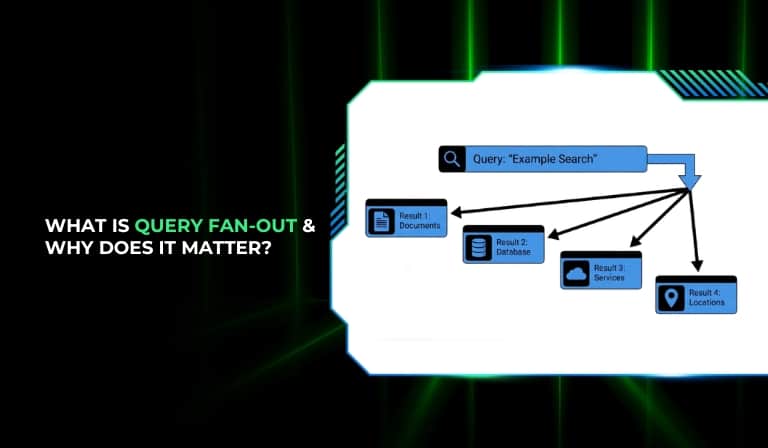
Query fan-out is the process by which an AI search system takes a single user query and generates multiple related sub-queries, each of which is searched independently, with the combined results synthesized into one final response.
The term comes from a visual: a single point (the user’s original question) “fanning out” into multiple branches of investigation. Each branch represents a distinct angle, sub-topic, or related question that the AI determines is necessary to fully answer the original prompt. The user sees one clean response. What happened underneath it was anything but simple.
The technical grounding for this is not speculative. Google’s patent US11663201B2 describes a system that takes a single search query and generates multiple related query variants using a trained generative model. Each variant is issued separately, and the combined results are used to produce the final response. That patent was granted. It describes the architecture that powers the AI search experiences hundreds of millions of people are using right now.
Here’s the core gap that most marketers miss: there is a significant difference between what the user types and what the AI actually searches. The user asks one question. The AI might run eight to fifteen sub-queries to answer it. Every one of those sub-queries pulls from whichever pages rank well for that specific angle. If you only rank for the parent question, you get included in one out of fifteen retrievals. If a competitor ranks for eight of those sub-queries, they appear in eight. The final synthesized response will reflect that difference.
A Plain-Language Example
Consider a user who types this into ChatGPT: “What’s the best LinkedIn outreach strategy for SaaS companies in 2026?”
A traditional Google search would return ten blue links about LinkedIn outreach strategies. The user would then click through several, manually cross-reference the advice, and piece together an answer over the course of twenty minutes.
ChatGPT doesn’t do that. Instead, it fires off sub-queries like:
- “LinkedIn connection acceptance rates SaaS 2026”
- “best LinkedIn message templates for SaaS outreach”
- “how to personalize LinkedIn messages at scale”
- “LinkedIn outreach vs cold email conversion rates B2B”
- “LinkedIn automation tools for SaaS companies”
- “LinkedIn outreach reply rate benchmarks”
Each of those sub-queries retrieves top-ranking pages. The AI then reads across all of them and generates one synthesized answer, with citations pulled from whichever sources provided the most direct, reliable information for each angle.
This is query fan-out in action. The user asked one question. The AI ran six to twelve searches. Only the brands that appeared across multiple sub-queries made it into the final answer.
Why “Fan-Out” Is the Right Mental Model
The tree trunk metaphor that circulates in SEO content is fine as a starting image, but it’s too passive to be useful. A better mental model is a research analyst running parallel investigations simultaneously, each feeding back into a single final report. The analyst assigns one team to pricing, another to safety records, another to use cases, another to head-to-head comparisons, and another to recent case studies. Each team reports back. The analyst synthesizes.
That’s what AI search does. And the implication is direct: to appear in the final report, you need to be the most credible source in as many of those parallel investigations as possible. One excellent page about LinkedIn outreach strategy is not enough. You need to be the authoritative source on the angles that fan-out from that strategy question.
How Query Fan-Out Actually Works (The RAG Pipeline)
Query fan-out sits inside a broader architectural framework called the RAG pipeline, short for Retrieval-Augmented Generation. Understanding where fan-out fits in that pipeline is what separates a surface-level content response from a strategy that actually moves your AI citation rate.
RAG is the mechanism by which AI language models reach outside their training data to retrieve current information from the web before generating a response. The model doesn’t just answer from memory. It searches, retrieves, reads, and then writes. Fan-out is what happens at the “search” stage of that process: instead of running one search, the model runs many.
The key detail that most content about query fan-out skips is that fan-out doesn’t trigger for every query. It’s conditional. Three factors determine whether an AI system fans out or answers from training data alone.
- Intent complexity: Simple factual queries don’t trigger fan-out. If someone asks “what year was LinkedIn founded,” the AI already knows the answer (2002) and has no reason to run additional searches. Complex, multi-dimensional queries, especially those involving comparisons, evaluations, current best practices, or recent data, consistently trigger fan-out because the AI can’t synthesize a complete answer from parametric knowledge alone.
- Recency requirements: Queries that include signals like “latest,” “current,” “in 2026,” or “right now” trigger web grounding, which activates fan-out. The model recognizes that its training data may be stale for time-sensitive topics and reaches out to the web to fill the gap.
- Confidence score threshold: When a model’s internal confidence in its own training data drops below a defined threshold, it triggers a retrieval pass. For Google’s Gemini models, this threshold is configurable via the dynamic_retrieval_config with a dynamicThreshold parameter. Set it to 0.7, and the model only fans out when its confidence drops below 70%. This is not a theoretical detail. It’s a documented part of the Gemini API that reveals how retrieval decisions are made under the hood.
When all three conditions align (a complex query, about a current topic, where the model isn’t confident), you get aggressive fan-out. That’s when the number of sub-queries is highest, and the spread of sources retrieved is widest.
Platform-by-Platform Breakdown
Fan-out behavior is not identical across every AI search platform. The underlying mechanism is similar, but the implementation differs. Here’s how each major platform handles it.
ChatGPT (SearchGPT)
ChatGPT breaks a complex user query into multiple sub-queries and runs web searches for each one independently. It scrapes the top-ranking pages for each sub-query and merges the retrieved information into a single generated response, with cited sources. The sub-queries ChatGPT runs are not visible to the user by default, but they can be observed using browser extensions like the Keyword Surfer Chrome extension, which reveals which searches the model ran behind the scenes. The sub-queries tend to follow natural tangents: a cost question, a comparison question, a use-case-specific question, and a recency-focused question are common branches from a single complex prompt.
Google AI Mode
Google AI Mode’s fan-out behavior was officially confirmed and described by Elizabeth Reid, Head of Search at Google, at Google I/O 2025. She stated: “AI Mode isn’t just giving you information. It’s bringing a whole new level of intelligence to search. What makes this possible is something we call our query fan-out technique. Under the hood, Search recognizes when a question needs advanced reasoning. It calls on our custom version of Gemini to break the question into different subtopics, and it issues a multitude of queries simultaneously on your behalf.” The simultaneous issuance is the key operational difference from ChatGPT’s more sequential approach. Google AI Mode fires multiple sub-queries in parallel, which is faster and allows it to process a wider set of angles before synthesizing the response.
Perplexity
Perplexity uses real-time web search as a core part of its architecture, not a supplementary feature. Fan-out is aggressive by default. Users can see a partial view of this in the “Sources” panel, which lists the pages retrieved to generate the response. For complex queries, Perplexity typically retrieves from five to fifteen distinct sources, each corresponding to a different angle of the original question. Perplexity also shows follow-up questions it generates automatically, which are close proxies for the sub-queries it used internally.
Gemini
Gemini’s retrieval behavior integrates more tightly with Google’s search index than any other AI platform, which gives it access to a wider range of current sources. Its fan-out is configurable at the API level for developers, using the dynamicThreshold parameter described earlier. In consumer-facing Google products, this threshold is managed automatically based on query type. Gemini’s fan-out behavior tends to be more contextually calibrated, meaning it runs fewer but more targeted sub-queries compared to Perplexity’s wider sweep.
Why Query Fan-Out Changes Everything About Your SEO Strategy
Query fan-out means you can rank number one for a target keyword and still not appear in the AI-generated answer for that topic. That is not a theoretical risk. It’s the default outcome if your content only addresses the parent query without covering its satellite angles.
Surfer SEO analyzed 173,020 URLs and found a direct, measurable relationship between ranking for fan-out queries and appearing in Google’s AI Overviews. Pages that ranked for fan-out queries were 161% more likely to be cited in Google’s AI Overviews than pages that only ranked for the primary query. That’s not a marginal difference. It’s the difference between appearing in AI responses and being absent from them entirely, regardless of where you rank on the traditional SERP.
The practical implication is this: the traditional model of targeting one primary keyword per page and building content to rank for that single term is a pre-fan-out strategy. It was designed for a search environment where Google served ten blue links and users clicked through to find what they needed. In that environment, ranking number one for your target keyword meant you captured traffic. In an AI search environment, ranking number one for your target keyword while ignoring the surrounding query space means you might capture a traditional click but you’re still absent from the AI response that’s increasingly where buyers start their research.
The basic unit of SEO has shifted. It’s no longer a keyword. It’s a topic cluster with genuine depth across every major angle, structured so that AI systems can retrieve your content confidently for any sub-query that branches from the parent topic.
The Citation vs. Ranking Distinction
Most SEOs conflate ranking on Google with being cited in AI. They are related, but they’re not the same measurement, and the gap between them matters for how you build content.
You can rank on page two of Google for a specific sub-query and still get cited in an AI response if you’re the clearest, most direct source on that angle. You can rank number one on Google for your target keyword and not be cited at all if your page only covers the surface of the topic and doesn’t address the fan-out angles the AI is also retrieving. The AI doesn’t necessarily default to the number one result. It retrieves from whichever pages give it the most complete, authoritative, and directly useful information for the specific angle it’s investigating.
This means your content strategy has two distinct objectives that can and should be pursued simultaneously:
- Ranking objective: Appear in positions one through ten on the traditional SERP for your primary keyword and its main variants.
- Citation objective: Be the most direct, factually specific, and well-structured source for the satellite queries that fan-out from your primary keyword, so that AI systems retrieve and cite you when assembling responses to complex prompts.
These objectives reinforce each other, but they’re not identical. Ranking gets you in the candidate pool for AI retrieval. Being the clearest and most specific source gets you cited in the final answer.
What “AI Mentions” vs. “AI Citations” Actually Mean for Your Brand
When your brand shows up in an AI-generated response, it can show up in two distinct ways, and understanding the difference changes how you measure AI visibility.
- An AI mention is when your brand name or product name appears in the text of the generated response, but without a linked reference. The AI is drawing on information about you from its training data or from retrieved content, but it doesn’t cite a specific page. You’re referenced, not linked.
- An AI citation is when a linked reference to a specific page on your domain appears alongside the AI response. The user can click through. This is the outcome that drives traffic, not just brand recognition.
Both matter, but for different reasons and different goals. AI mentions affect brand perception and are counted in “share of voice” metrics across AI platforms. They indicate that your brand is being recognized as relevant to a topic. AI citations affect traffic and conversion. They indicate that your content is being trusted as a source, not just your brand as an entity.
Tools like Semrush’s AI Visibility Toolkit, Goodie, and BrightEdge allow you to track both. Semrush’s tool shows your share of voice across multiple AI platforms for non-branded queries, including whether your brand is mentioned first, second, or further down in response to specific prompts. It also shows how your brand is portrayed in those responses, which is useful for identifying whether AI systems are describing your product accurately.
How to Optimize for Query Fan-Out (Without Wasting Your Time)
Optimizing for query fan-out is not about a new set of tactics. It’s about applying the right level of depth and structure to content that already should be your best work. Here’s what that looks like in practice.
Step 1: Map the Topic, Not Just the Keyword
Before writing a single word, map every question a user could reasonably have around your core topic. This is not keyword research in the traditional sense. Keyword research tells you what people search for. Topic mapping tells you what they need to know in order to fully understand the subject, even if they haven’t yet thought to search for those specific angles.
Ask: if a thorough human researcher wanted to completely understand this topic, what would they search for across all their sessions? What would they Google on day one of their research? What would they follow up on in week two? What comparison questions would they ask once they had a shortlist? Those searches form your fan-out map.
The practical output is a list of core sub-topics, each of which represents a distinct angle from the parent query. Each one should be covered either within your primary page or in a dedicated spoke page, depending on the depth of content it requires.
Step 2: Structure Content So AI Can Extract Clean Answers
Query fan-out optimization is, in large part, a formatting problem. AI systems extract the first clean, self-contained sentence from each section when generating a synthesized response. Write those sentences deliberately. Every H2 section should open with a direct, complete answer to the question implied by the heading, before expanding into detail, examples, or nuance.
Concrete formatting requirements for AI-extractable content:
- Answer-first structure: The first one to two sentences of every section answer the question the heading implies. Directly. No preamble.
- Short, focused paragraphs: Three to five sentences per paragraph. AI systems process paragraph-length chunks. Long, dense blocks are harder to extract from cleanly.
- Clear heading hierarchy: H2 for major topic angles. H3 for sub-points within those angles. The heading hierarchy should be interpretable as a table of contents on its own.
- FAQ sections with standalone answers: Each FAQ answer should be fully self-contained. It should make complete sense to a reader (or an AI) who has read nothing else in the article.
This structure serves both the AEO layer (Answer Engine Optimization, for AI assistants like ChatGPT and Perplexity) and the AIO layer (AI Overview Optimization, for Google’s AI Overviews), which both reward answer-first content with clear, machine-readable formatting.
Step 3: Build Topical Clusters with Genuine Internal Depth
Don’t create a hub page and link to thin spokes. Each spoke page should cover its sub-topic as thoroughly as the hub covers the parent topic. The signal AI retrieval is evaluating is: does this domain have deep, trustworthy coverage of this entire topic space? Thin spokes reduce the credibility of the entire cluster.
The structure that works:
- Hub page: Comprehensive coverage of the parent topic, with clear sections addressing each major sub-topic at a summary level, and internal links to spoke pages for deeper coverage.
- Spoke pages: Each spoke page covers one sub-topic in full depth, with its own structure, its own fan-out map, and its own internal links back to the hub and to related spokes.
- Interlink density: Every spoke should link to the hub and to at least two related spokes. This signals to both traditional crawlers and AI retrieval systems that the content exists within a structured, intentional topic cluster.
Step 4: Use Entity-Rich Language
Every paragraph should contain at least one verifiable, named entity. This means specific tool names, platform names, real statistics with their sources, named frameworks, and named people where relevant. Vague generalities, passive constructions, and unnamed attributions are the content patterns AI systems skip when assembling cited responses.
Compare these two sentences:
“Research shows that AI search is becoming more important for brand visibility.”
“Surfer SEO’s analysis of 173,020 URLs found that pages ranking for fan-out queries are 161% more likely to appear in Google’s AI Overviews.”
The second sentence contains a named source (Surfer SEO), a specific dataset size (173,020 URLs), and a precise finding (161% more likely). An AI assembling a response about query fan-out will extract the second sentence. It will not extract the first.
Write like an analyst who has to put their name on every claim.
Step 5: Track AI Visibility, Not Just Rankings
Traditional rank tracking tells you where your pages appear in blue-link results. It tells you nothing about whether you’re being cited or mentioned in AI-generated responses. Those are different measurements, and as AI search takes a larger share of the research process, the latter matters more for brand discovery than the former.
Add AI visibility tracking to your reporting stack. The key metrics to track are:
- Citation rate: The percentage of tracked prompts where your content is cited in an AI-generated response. A target of 15 to 25% citation rate for relevant prompts in your category is a reasonable benchmark based on data from Goodie’s research.
- Share of voice: Your citations as a percentage of total citations across all sources in an AI response for your category. A target of 20% or above in your core topic category is a meaningful threshold.
- Citation position: Where in the AI response your source is referenced. First and second citations carry more weight both in terms of user attention and in terms of how AI systems tend to weight sources they’ve relied on heavily.
- AI mention rate: How often your brand name appears in generated responses, even without a direct link. Track this separately from citation rate, as it measures brand recognition rather than content trust.
Tools that support this tracking include Semrush’s AI Visibility Toolkit, Goodie, and BrightEdge’s AI Search tracking functionality.
Query Fan-Out and the Future of B2B Visibility
More than half of consumers now start research with AI systems rather than traditional search engines. For B2B buyers, the shift is even more pronounced for high-consideration decisions like tool selection, vendor shortlisting, and budget justification. These are exactly the decision points where query fan-out determines who gets considered and who doesn’t.
Consider what happens when a B2B buyer asks ChatGPT: “What LinkedIn automation tool should I use for my agency?” That question fans out. The AI runs sub-queries about safety records and LinkedIn compliance, multi-account management capabilities, pricing tiers and contract structures, head-to-head comparison reviews, and real agency case studies. Each of those sub-queries pulls from whichever pages rank well for that specific angle.
A brand that has published thoroughly on all of those angles, with entity-rich, answer-first content structured for AI retrieval, will appear across multiple sub-queries. A brand that has one well-optimized homepage and a thin blog will appear in one, if any.
The B2B implication is direct: your presence in AI-generated answers is becoming a discovery channel. A prospect who asks ChatGPT for a LinkedIn automation tool recommendation and sees your brand cited across multiple angles of that question has already encountered your brand through a trusted source before they ever visit your website. That’s a fundamentally different kind of brand introduction than a paid ad or a cold connection request. The research is done for them, and your brand is already in the shortlist.
Companies that built topical authority around their core use cases in 2024 and 2025 are already being cited in these responses. Companies that relied on keyword-targeted landing pages and thin blog content are invisible in AI answers, even when they rank on the traditional SERP.
For outreach teams and agencies running high-volume LinkedIn campaigns, this has a concrete operational meaning. Your prospects are researching tools with AI before booking demos. If your brand appears in those AI-generated comparisons, you’re in the conversation before the conversation starts. If you’re not, you’re being filtered out at the research stage, before you’ve had a chance to make your case.
Conclusion
Query fan-out changes the math of search visibility in a specific, measurable way. Ranking for one keyword is no longer enough to appear in the AI response to a question about that keyword’s topic. The brands that get cited are the ones that treated their content as a complete answer to a topic space, covering the parent question and the full set of angles that branch from it, structured so that AI systems can retrieve and trust specific sections independently.
The action here is concrete: take your highest-priority content and audit it against the fan-out map for that topic. List every sub-question a user could reasonably have around that topic. Ask honestly whether your current content answers each one, specifically and directly, with named entities and verifiable claims. The gaps in that audit are your next content briefs.
Frequently Asked Questions
1. What is query fan-out in simple terms?
Query fan-out is when an AI search engine takes one question from a user and runs multiple related sub-searches behind the scenes to gather information from different angles. It then combines everything it finds into a single generated response. The user sees one answer; the system ran ten or more searches to produce it.
2. Which AI search platforms use query fan-out?
ChatGPT (SearchGPT), Google AI Mode, Perplexity, and Gemini all use query fan-out. Google AI Mode’s use of the technique was officially confirmed by Google’s Head of Search, Elizabeth Reid, at Google I/O 2025. Perplexity makes it partially visible through its “Sources” panel. ChatGPT’s sub-queries can be observed using the Keyword Surfer Chrome extension.
3. How is query fan-out different from traditional keyword search?
Traditional keyword search takes the user’s query and returns a ranked list of pages that are relevant to that single query. Query fan-out takes the user’s query, generates a set of related sub-queries, searches for each one independently, and synthesizes the results into one response. Traditional search delivers a list. AI search with fan-out delivers an answer assembled from multiple sources across multiple angles of the topic.
4. Does query fan-out mean I need to create more content pages?
Not necessarily more pages, but deeper pages. Publishing more thin pages to target individual fan-out queries doesn’t work because those sub-queries are dynamically generated and change constantly. What works is building content that thoroughly covers a topic and its key sub-angles, either in one comprehensive page or through a well-structured cluster of genuinely deep spoke pages. The goal is completeness, not volume.
5. How do I know which sub-queries an AI is using for my topic?
You can get partial visibility into this using the Keyword Surfer Chrome extension, which shows the searches ChatGPT runs when generating a response. Perplexity’s Sources panel lists the pages it retrieved, which are proxy indicators of the sub-queries it ran. For Google AI Mode, sub-queries are not directly visible to end users. The most scalable approach is to build a topic map manually by asking what angles a thorough researcher would investigate around your core topic.
6. What’s the difference between being cited and being mentioned in an AI response?
An AI citation is a linked reference to a specific page on your domain that appears alongside the AI-generated response. An AI mention is when your brand name appears in the generated text without a direct link. Citations drive traffic because users can click through. Mentions drive brand awareness and are counted in share-of-voice metrics. Both matter, but they require different measurement approaches and often reflect different types of content performing well.
7. Does traditional SEO still work if AI search uses query fan-out?
Yes. Traditional SEO and query fan-out optimization are complementary, not competing. Ranking well on Google’s traditional SERP is the prerequisite for being retrieved by AI systems in the first place, since most AI platforms use Google’s index or similar web indexes as their retrieval layer. The difference is that ranking well for one keyword is no longer sufficient. You need to rank well across the fan-out query space around your topic, which requires deeper topical coverage than a single keyword-optimized page provides.
8. How does topical authority connect to query fan-out?
Topical authority means your domain is recognized as a credible, comprehensive source on a specific subject, not just a single keyword. It’s built by publishing deeply on all major angles of a topic, with clear internal linking between related pages. This is directly what query fan-out rewards: a domain with deep, well-structured topical coverage will naturally rank for the sub-queries an AI generates, because those sub-queries are simply asking about the angles a topically authoritative domain already covers. According to Surfer SEO’s research, 90% of SEOs agree that topical authority is important for SEO, and query fan-out is a key reason why.
9. Can small websites or new blogs compete in AI search if they optimize for query fan-out?
Yes, with realistic expectations. A newer domain won’t displace high-authority competitors across all fan-out angles immediately, but it can establish citation-worthy depth on specific sub-topics within a larger topic space. AI retrieval systems evaluate content quality and specificity at the page level, not solely at the domain authority level. A highly specific, entity-rich page on a niche sub-topic can be cited in AI responses even if the domain doesn’t rank broadly, because AI systems prioritize the most direct and reliable source for each individual sub-query.
10. What tools can I use to track my AI search visibility and citation rate?
Three tools currently support structured AI visibility tracking. Semrush’s AI Visibility Toolkit shows your share of voice across multiple AI platforms for non-branded queries, including mention position and brand portrayal within AI responses. Goodie provides citation rate tracking, share-of-voice measurement, and citation position data. BrightEdge’s AI Search tracking functionality monitors AI Overview appearances and citation frequency at scale. These tools track different dimensions of AI visibility, and using more than one gives a more complete picture.
11. How does query fan-out affect B2B companies and SaaS brands specifically?
For B2B brands, query fan-out is particularly consequential because B2B buyers use AI search to research vendors, compare tools, and shortlist options before ever visiting a vendor’s website or booking a demo. When a B2B buyer asks an AI “what’s the best CRM for a 20-person sales team,” the AI fans out into sub-queries about pricing, integrations, onboarding complexity, user reviews, and industry-specific use cases. If a SaaS brand doesn’t have content that ranks well across those sub-queries, it’s absent from the AI’s response and therefore absent from the buyer’s shortlist, regardless of where it ranks for its primary target keyword.
12. Is query fan-out the same as semantic search?
No. Semantic search refers to a search engine’s ability to understand the meaning and intent behind a query, rather than just matching exact keywords. Query fan-out is a specific mechanism that happens after semantic understanding: once the AI understands what the user wants, it generates and runs multiple sub-queries to gather information from different angles. Semantic search improves how queries are understood. Query fan-out is what the system does with that understanding to retrieve a complete set of relevant information.
13. What does “RAG pipeline” mean, and how does it relate to query fan-out?
RAG stands for Retrieval-Augmented Generation. It’s the architecture that allows AI language models to reach outside their training data and retrieve current information from the web before generating a response. The RAG pipeline has three main stages: retrieval (searching for relevant information), augmentation (adding the retrieved information to the prompt context), and generation (producing the final response). Query fan-out happens at the retrieval stage: instead of running one retrieval search, the system runs multiple. Understanding the RAG pipeline explains why content structure and specificity matter so much for AI citations. The AI is retrieving and reading your content before it writes. How your content is structured determines how much of it gets used.
14. How often do AI systems generate the same fan-out queries for the same topic?
Fan-out queries are dynamically generated and are not deterministic. Two users asking the same question may trigger different sets of sub-queries depending on their session context, previous conversation history, and the specific phrasing of their prompt. The sub-queries also vary across platforms: ChatGPT, Perplexity, and Google AI Mode use different models and different retrieval architectures, so they don’t generate identical sub-queries even for identical input prompts. This is precisely why chasing specific fan-out queries doesn’t scale as a strategy. The fan-out map is probabilistic, not fixed. Building deep topical coverage is the only approach that works regardless of which specific sub-queries get generated on any given session.