


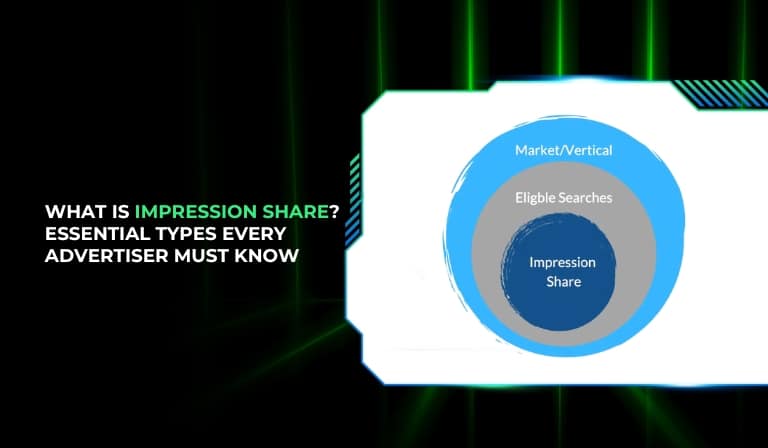
In the competitive world of digital advertising, every impression counts. Did you know that many advertisers lose anywhere between 30% to 40% of potential ad impressions simply because they don’t optimize their impression share? Understanding impression share gives advertisers the insights they need to capture a larger slice of their market and improve campaign success. This guide breaks down the concept of impression share and dives into the three essential types every advertiser must know to maximize their ad visibility and ROI.

What Is Impression Share?
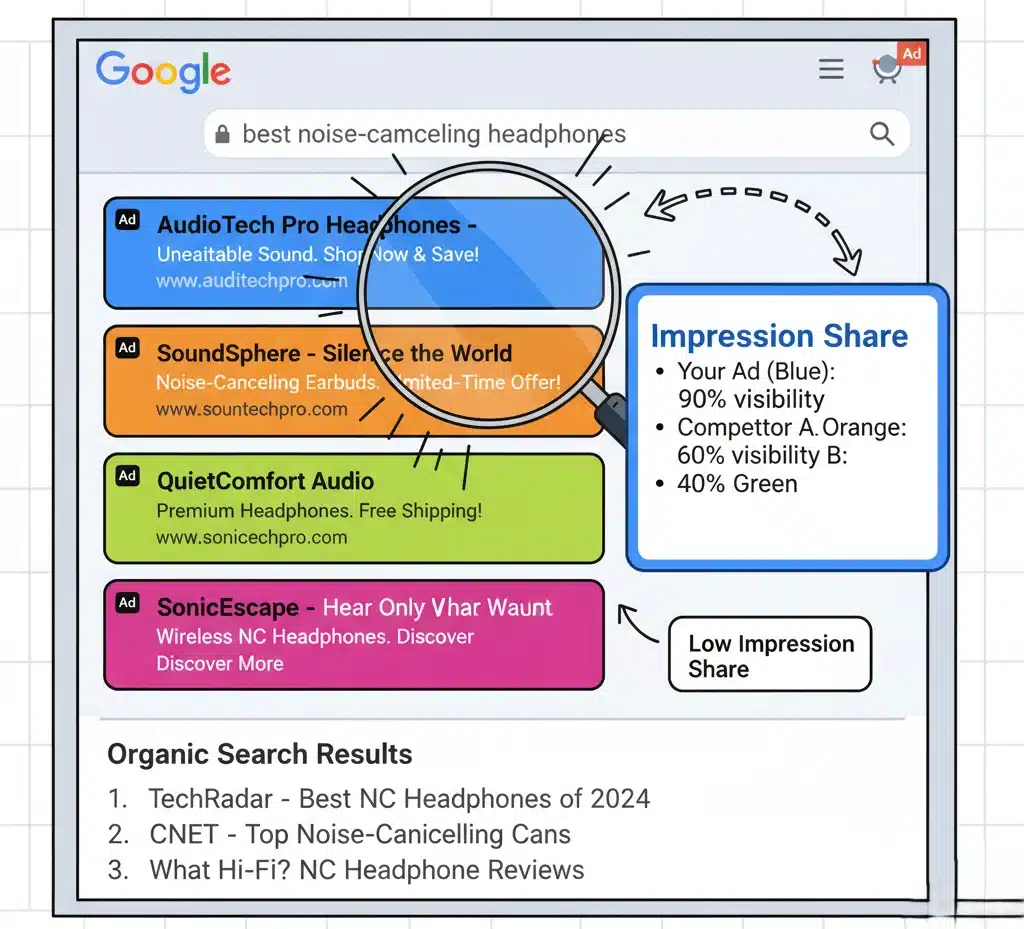
Impression share is the percentage of times your ad is shown compared to the total number of times it could have appeared. Imagine your ad had the opportunity to appear 1,000 times in relevant auctions but was actually shown only 500 times — your impression share is 50%. It quantifies how much of the available audience your ads are reaching.
Impression Share Formula
The formula to calculate impression share is straightforward:
Impression Share = Impressions/Total Eligible Impressions ×100
Eligible impressions depend on factors like your targeting settings, bids, ad quality, and Ad Rank.
Why It Matters for Advertisers
A higher impression share means your ads get more visibility, likely leading to increased clicks, conversions, and revenue. Conversely, a low impression share signals missed opportunities to reach potential customers, which competitors can capitalize on.
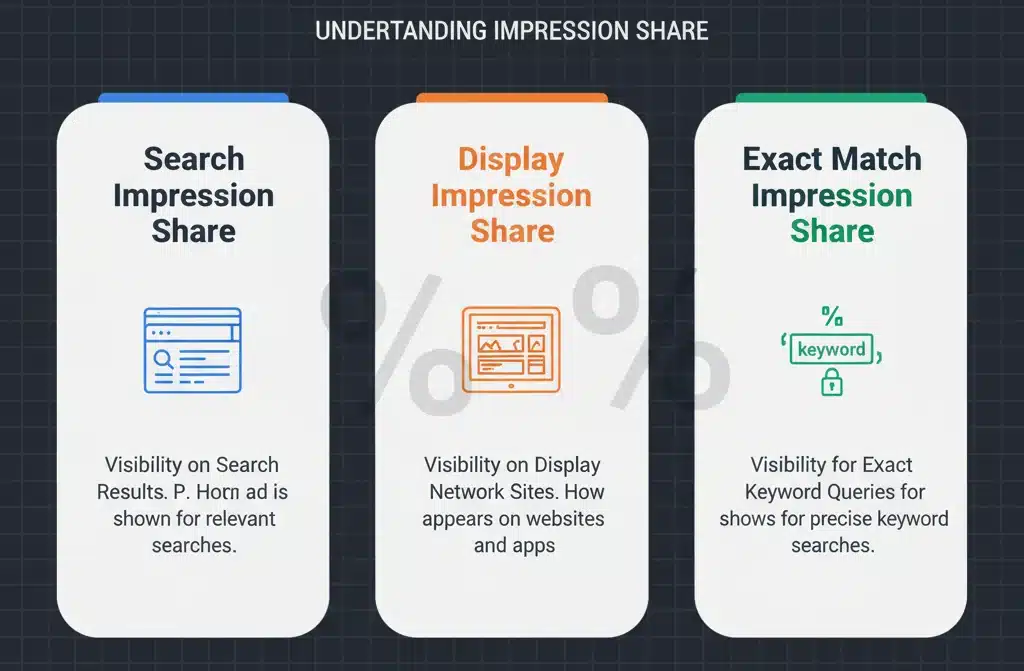
3 Essential Types of Impression Share
Type 1: Search Impression Share
Definition and Scope
Search impression share represents the percentage of impressions your ads receive on Google’s Search Network, which includes search results, Maps, Shopping, and partner sites.
How Search IS Works
Your Search impression share is calculated based on all search auctions where your ad could have appeared, excluding those where bids are too low or quality is insufficient.
Benchmarks and Goals
- For low-competition keywords, aim for 90-95% impression share.
- For highly competitive keywords, 60% is a solid benchmark.
- For branded keywords, strive for 100% impression share.
Quick Tips to Improve
Boost your campaign budget if limited and improve bids and keyword targeting to capture more impressions in search auctions.
Type 2: Display Impression Share
Definition and Scope
Display impression share measures your ad impressions on the Display Network, which places ads on third-party websites, apps, and alongside content.
How Display IS Differs
Unlike search ads triggered by keywords, display ads rely more on placements and audience targeting parameters.
Optimization Strategies
Expand your audience targeting, refine placement selections, and improve your display ad creatives to increase your display impression share.
Type 3: Exact Match Impression Share
Definition
Exact match impression share focuses on the impressions your ads receive when exact keywords (rather than broad or phrase matches) trigger your ads.
When to Track This Metric
This metric is particularly useful for precision campaigns focusing on high-intent or branded keywords.
Use Cases
Ideal for campaigns where matching the searcher’s query exactly is critical—such as premium products or brand campaigns.
Other Important Impression Share Metrics
- Lost Impression Share: Represents impressions lost due to budget or low Ad Rank.
- Top Impression Share: The percentage of impressions that occurred in top ad positions.
- Absolute Top Impression Share: Times your ad appeared in the #1 spot.
Factors That Influence Impression Share
- Ad Rank and Quality Score: Ad relevance, bid amount, and landing page experience affect your eligibility and rank in auctions.
- Budget Constraints: Running out of daily budget leads to lost impressions.
- Targeting Settings: Geographic, demographic, and device targeting filter which auctions your ad enters.
How to Improve Impression Share

- Increase campaign budgets to avoid limited spend issues.
- Use bidding strategies such as target impression share bidding to meet visibility goals.
- Refine keywords by pausing underperformers and expanding high-performing audiences.
- Improve ad quality through better copy, creative, and landing pages.
- Adjust placements in display campaigns to favor high-performing sites.
Common Mistakes to Avoid
- Ignoring lost impression share causes, such as insufficient bids or budget.
- Over-expanding targeting without correlating budget increases.
- Focusing on impression share alone without measuring conversions and ROI.
- Neglecting Quality Score improvements that impact ad ranking.
Conclusion
Impression share is a powerful yet often overlooked metric that reveals how much of your potential ad audience you’re reaching. By understanding and optimizing the three essential types—Search, Display, and Exact Match impression shares—you can maximize your brand’s visibility and campaign effectiveness. Start by auditing your current impression share data and adopt the strategies outlined here to capture more market share and outpace your competition.
FAQs
1. What is impression share in advertising?
Impression share is the percentage of times your ad was shown compared to the total number of times it could have been shown in eligible auctions. It reflects how visible your ads are to your target audience.
2. Why is impression share important for my PPC campaigns?
Impression share helps you understand how much of the available market your ads are capturing. A higher impression share usually leads to more clicks, conversions, and a better overall return on investment.
3. What are the main types of impression share?
The three essential types are Search Impression Share (ads shown on search networks), Display Impression Share (ads shown on display network sites), and Exact Match Impression Share (impressions from exact keyword matches).
4. How is impression share calculated?
Impression share is calculated by dividing the number of impressions your ads receive by the total eligible impressions, then multiplying by 100 for a percentage.
5. What is a good impression share percentage?
For low-competition keywords, aim for 90-95%. For competitive keywords, around 60% is acceptable. For branded keywords, the goal should be as close to 100% as possible.
6. Can a 100% impression share be a bad thing?
Not necessarily, but chasing 100% all the time can be costly and inefficient. It’s better to focus on gaining impression share for the most relevant and profitable keywords.
7. How can I improve my impression share?
Increasing your campaign budget, optimizing your bids, improving ad quality and relevance, expanding or refining audience targeting, and adjusting placements can all help boost impression share.
8. Does impression share affect organic search rankings?
Indirectly, yes. A high impression share in paid search can lead to increased sales velocity, which can positively influence organic rankings, particularly in platforms like Amazon.
9. What is lost impression share?
Lost impression share refers to the percentage of impressions you missed due to factors like insufficient budget or low ad rank.

Passionate about blogging and focused on elevating brand visibility through strategic SEO and digital marketing. Always tuned in to the latest trends, I’m dedicated to maximizing engagement and delivering measurable ROI in the dynamic world of digital marketing. Let’s connect and unlock new opportunities together!