


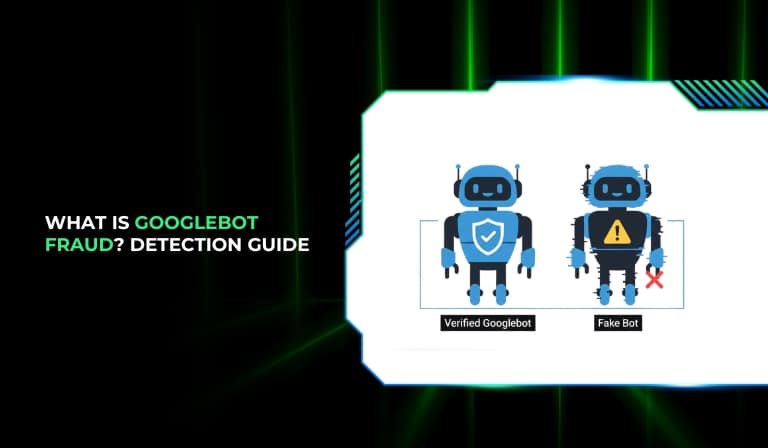
Googlebot is Google’s official web crawler. It is responsible for discovering, crawling, rendering, and indexing web pages so they can appear in Google Search results. Website owners rely on Googlebot because proper crawling and indexing directly affect visibility, rankings, and organic traffic.

Googlebot fraud happens when malicious actors impersonate Googlebot. They modify their bots to send requests that claim to be from “Googlebot” in the user-agent string. Because many servers allow Googlebot to crawl freely, attackers try to exploit that trust.
This fraud is not theoretical. Any server that logs traffic will eventually see requests claiming to be Googlebot that do not originate from Google-owned infrastructure. The core problem is simple: user-agent strings can be easily forged. If verification is not performed, attackers can bypass filters designed to block suspicious traffic.
Googlebot fraud matters because it affects:
- Website performance
- Security posture
- Crawl budget management
- Analytics accuracy
- Infrastructure costs
Understanding how impersonation works is the first step toward defending against it.
Why Attackers Impersonate Googlebot
Attackers impersonate Googlebot because many systems treat it as a trusted crawler. This creates an opportunity to bypass restrictions.
Common motives include:
- Bypassing firewalls or rate limits that allow search engine bots
- Scraping content without triggering anti-bot protections
- Mapping site architecture to discover vulnerabilities
- Testing endpoints for misconfigurations
- Conducting ad fraud or manipulating traffic metrics
- Avoiding IP-based blocking by pretending to be legitimate search traffic
Because Googlebot is expected to crawl aggressively and access many pages, malicious bots hide within that expected behavior.
The Real-World Impact: How Fake Googlebots Damage Your Business
Fake Googlebots do more than create noise in logs. They can cause measurable business harm.
Performance Degradation and Service Disruption
When impersonating bots crawl aggressively, they consume server resources.
Impacts may include:
- Increased CPU usage
- Higher memory consumption
- Bandwidth spikes
- Slower response times
- Degraded user experience
If the traffic volume is large enough, it can cause service instability or downtime. On cloud infrastructure, this may also increase hosting costs due to auto-scaling.
SEO Confusion and Crawl Budget Waste
Crawl budget refers to the number of pages Googlebot can and wants to crawl within a given time frame. While fake Googlebot does not affect Google’s internal crawl allocation, it can create confusion in analysis.
Issues include:
- Log files showing high “Googlebot” activity that is not real
- Misdiagnosis of crawl issues
- Incorrect assumptions about indexing problems
- Difficulty distinguishing legitimate crawl behavior from malicious scraping
This can lead to incorrect SEO decisions.
Security Vulnerabilities and Data Breaches
Fake Googlebots may attempt to access:
- Admin panels
- API endpoints
- Staging environments
- Hidden directories
- Backup files
If security rules trust user-agent strings, attackers may gain access to areas intended only for trusted crawlers. In severe cases, this can expose sensitive data or create entry points for further attacks.
Financial Losses and Compliance Risks
Infrastructure strain and scraping can create financial consequences:
- Increased hosting bills
- Loss of proprietary content
- Exposure of regulated data
- Potential compliance violations
For organizations subject to data protection regulations, failing to secure endpoints can lead to legal and financial consequences.
Verification Methods: How to Identify Fake Googlebots
Verifying authenticity requires technical validation. User-agent strings alone are not reliable.
Reverse DNS Lookup (rDNS) and Forward-Confirmed Reverse DNS (FCrDNS)
Reverse DNS lookup checks the hostname associated with an IP address. For legitimate Googlebot traffic:
- The IP address should resolve to a hostname ending in googlebot.com or google.com
- A forward DNS lookup of that hostname should resolve back to the same IP address
This two-step validation is known as forward-confirmed reverse DNS (FCrDNS).
Process:
- Perform reverse DNS lookup on the IP
- Confirm the domain belongs to Google
- Perform forward lookup on that hostname
- Verify it maps back to the original IP
If any step fails, the crawler is likely fake.
IP Range Validation Against Google’s Published Lists
Google publishes IP ranges used by its crawlers. Verification involves:
- Extracting the IP address from server logs
- Comparing it against officially published Google IP ranges
- Confirming the IP belongs to Google infrastructure
If the IP is not within Google’s documented ranges, it should not be treated as Googlebot.
User Agent String Analysis (Preliminary Check Only)
User-agent strings may look like:
“Mozilla/5.0 (compatible; Googlebot/2.1; +http://www.google.com/bot.html)”
However, attackers can copy this exactly. Therefore:
- Use user-agent inspection only as an initial filter
- Never trust user-agent alone for allowlisting
User-agent analysis should always be combined with DNS and IP validation.
Cross-Reference with Google Search Console
Google Search Console provides crawl statistics and indexing data. If logs show heavy Googlebot traffic but Search Console does not reflect corresponding crawl activity, that discrepancy may indicate impersonation.
Cross-referencing helps detect anomalies between:
- Logged crawl frequency
- Reported crawl stats
- Indexing patterns
Mismatch signals require further investigation.
Detection Tools and Technologies for Identifying Fake Googlebots
Manual verification is possible, but automation improves reliability.
Log Analysis Platforms
Log analysis tools help:
- Filter traffic by user-agent
- Identify unusual crawl patterns
- Detect spikes in “Googlebot” requests
- Analyze geographic distribution of IPs
They allow pattern recognition across large datasets.
Web Application Firewalls and CDN Services
WAFs and CDNs provide:
- Bot classification
- IP reputation scoring
- Automated rate limiting
- DNS-based validation rules
These systems can automatically verify known search engine bots.
Specialized Bot Detection Services
Dedicated bot management platforms use:
- Behavioral fingerprinting
- Machine learning models
- Request pattern analysis
- JavaScript execution checks
They differentiate between human traffic, legitimate crawlers, and malicious automation.
Open Source and Custom Solutions
Organizations may implement:
- Server-side scripts for real-time DNS verification
- Scheduled IP validation checks
- Custom firewall rules
- Automated alerts for suspicious patterns
Custom solutions allow deeper integration with internal monitoring systems.
Protection Strategies: Blocking Fake Googlebots Safely
Blocking must be precise to avoid harming legitimate crawling.
IP Allowlisting: The Most Reliable Approach
Allowlisting involves:
- Validating official Google IP ranges
- Explicitly permitting only verified Googlebot IPs
- Blocking or challenging unverified claims
This reduces reliance on user-agent strings.
Real-Time DNS Verification at the Server Level
Servers can be configured to:
- Automatically perform reverse DNS checks
- Validate hostnames against Google domains
- Confirm forward resolution before allowing unrestricted access
This ensures verification occurs before granting crawler privileges.
Behavioral Analysis and Rate Limiting
Legitimate Googlebot behavior typically:
- Follows logical crawl paths
- Respects robots.txt
- Does not repeatedly hammer single endpoints
Suspicious behavior may include:
- High-frequency requests
- Rapid enumeration of parameterized URLs
- Access to restricted directories
Rate limiting reduces impact even if verification fails.
Honeypot URLs for Detection
Honeypots are hidden URLs not linked publicly. Legitimate crawlers generally do not access them if they are disallowed or undiscoverable.
If a “Googlebot” accesses a honeypot:
- It may indicate malicious automation
- It can trigger automated blocking rules
This technique helps detect deceptive crawlers.
CAPTCHA and Challenge Systems
For suspicious traffic:
- Present challenge-response tests
- Apply progressive rate limits
- Require JavaScript validation
Search engine bots typically do not execute arbitrary interactive challenges unless misconfigured.
Best Practices: Building a Comprehensive Defense Strategy
A single method is not enough. Defense must be layered.
Continuous Monitoring and Alerting
Implement systems that:
- Monitor crawl patterns
- Detect sudden traffic anomalies
- Alert teams to unusual spikes
Early detection limits damage.
Regular Security Audits
Periodic audits should review:
- Firewall configurations
- DNS verification logic
- Log retention policies
- Access controls
Audits ensure controls remain effective.
Optimize Crawl Architecture
Improve site structure to:
- Reduce unnecessary crawlable URLs
- Prevent infinite URL spaces
- Control parameter handling
- Maintain clean internal linking
A controlled crawl environment limits attack surface.
Documentation and Team Alignment
Security, SEO, and DevOps teams should:
- Agree on verification procedures
- Document allowlisting rules
- Maintain shared monitoring dashboards
Alignment reduces operational confusion.
Stay Current on Threat Intelligence
Bot tactics evolve. Organizations should:
- Track industry security updates
- Monitor changes in crawler infrastructure
- Update IP validation lists regularly
Staying informed strengthens resilience.
The AI Crawler Explosion: New Threats on the Horizon
Automated crawling is expanding rapidly due to AI training and data collection.
Dramatic Growth in AI Crawler Traffic
Large-scale automated systems collect web data for model training and analysis. This increases overall bot traffic across the internet.
Consequences include:
- Higher baseline crawl activity
- Increased competition for server resources
- Greater complexity in distinguishing bots
AI Crawler Impersonation: A Growing Problem
As more automated agents emerge, impersonation tactics may expand. The same method used to fake Googlebot can be used to impersonate other well-known crawlers.
The underlying technique remains:
- Forging user-agent strings
- Exploiting trust rules
- Avoiding detection
The Pattern Repeats: Same Fraud Tactics, New Targets
Historically, attackers have impersonated trusted services to bypass filters. As new crawler brands become trusted, impersonation tactics follow.
The pattern includes:
- Trust exploitation
- Infrastructure probing
- Resource consumption
Verification methods must remain consistent regardless of crawler name.
Verification for AI Crawlers
The same principles apply:
- Validate DNS ownership
- Confirm IP range authenticity
- Monitor behavior patterns
- Avoid trusting user-agent strings
Strong verification frameworks scale across all crawler types.
Future-Proofing Bot Security
Future-proofing involves:
- Automated IP validation
- Adaptive rate limiting
- Machine learning-based anomaly detection
- Infrastructure scaling safeguards
A flexible system can respond to new bot identities without major redesign.
Taking Control of Your Bot Security Posture
Googlebot fraud is not just an SEO issue; it is a security and infrastructure challenge. Effective control requires:
- Technical verification
- Layered defenses
- Cross-team collaboration
- Continuous monitoring
By combining DNS validation, IP verification, behavioral analysis, and defensive configuration, organizations can confidently distinguish real crawlers from impersonators. This ensures legitimate search visibility while protecting performance and data integrity.
Conclusion
Googlebot fraud is a growing technical and security concern that no website owner should ignore. Because user-agent strings can be easily forged, relying on surface-level checks is no longer enough. The only reliable approach is structured verification through reverse DNS checks, IP validation, behavioral analysis, and layered protection strategies. When monitoring, detection, and blocking mechanisms work together, you can protect server resources, maintain accurate analytics, preserve crawl clarity, and reduce security risks without interfering with legitimate search engine crawling. Taking a proactive, defense-in-depth approach ensures your site remains visible to real search engines while staying protected from impersonation and bot abuse.
Frequently Asked Questions (FAQ)
What is Googlebot fraud?
Googlebot fraud occurs when malicious bots impersonate Google’s crawler by forging the Googlebot user-agent string to bypass security controls.
How can I verify a real Googlebot?
Use reverse DNS lookup, forward-confirmed reverse DNS validation, and IP range comparison against Google’s published infrastructure.
Is checking the user-agent enough?
No. User-agent strings can be forged easily and should never be used as the sole verification method.
Can fake Googlebots affect SEO rankings?
They do not directly influence Google’s ranking systems, but they can create confusion in log analysis and performance diagnostics.
Should I block all Googlebot traffic?
No. Blocking legitimate Googlebot traffic can prevent your site from being indexed. Verification is required before blocking.
Why is this becoming more common?
As automation and AI-driven crawling expand, impersonation techniques become more widespread, increasing the need for strong validation systems.