


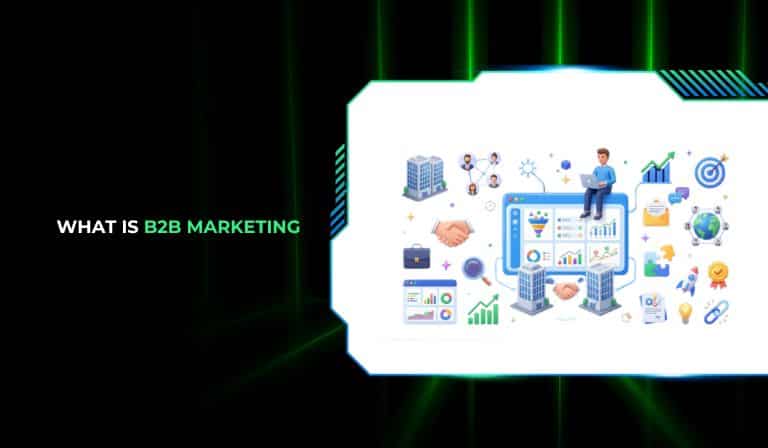
Picture two completely different sales conversations. In one, a mom walks into a store and buys a pair of running shoes in fifteen minutes because they looked comfortable and were on sale. In the other, a procurement manager at a manufacturing company spends eight months evaluating three different software vendors, loops in her IT director, her CFO, and two department heads, requests custom pricing, negotiates contract terms, and finally signs a deal worth $180,000 a year. Same basic idea, someone buying something, but these are two entirely different worlds. The second one is B2B. And if you’re trying to market to that procurement manager using the same playbook that sells running shoes, you’re going to fail, badly, and probably burn through a marketing budget doing it.
B2B marketing, business-to-business marketing, is the practice of promoting products or services from one company to other companies rather than to individual consumers. It sounds simple when you say it that fast. It is not simple in practice. B2B buying decisions involve more people, longer timelines, higher price tags, and way more rational, ROI-driven thinking than most consumer purchases. Nobody’s buying enterprise software on impulse because of a catchy jingle. They’re building a business case, comparing vendors on a spreadsheet, and asking their boss’s boss for sign-off.
That difference changes everything about how marketing actually works in this space. Your content can’t just be entertaining, it has to be genuinely useful and specific enough that a skeptical, busy professional trusts you know their industry. Your sales cycle isn’t measured in minutes, it’s measured in months, sometimes over a year for complex enterprise deals. Your “customer” isn’t one person, it’s a buying committee, often five to eleven people according to research from Gartner, each with different priorities, different levels of technical knowledge, and different reasons to say yes or no.
This guide breaks down what B2B marketing actually is, how it’s different from B2C, the core strategies that make it work, and the specific channels and tactics that matter most right now. Whether you’re new to B2B entirely or you’ve been doing it for years but feel like your results have gone flat, there’s something in here worth your time.
What You Will Learn in This Guide
- What B2B marketing actually means and how it fundamentally differs from consumer marketing
- Why the B2B buyer’s journey is longer, more complicated, and involves way more people than most marketers plan for
- The core strategies, content, SEO, ABM, email, that actually drive B2B pipeline
- How B2B and B2C marketing overlap and where they genuinely diverge
- Common mistakes companies make when they try to market to businesses the same way they’d market to consumers
- How to measure whether your B2B marketing is actually working, not just generating activity
What is B2B marketing, exactly?
B2B marketing means marketing your products or services to other businesses instead of to individual consumers. Think software companies selling to IT departments, industrial equipment manufacturers selling to factories, consulting firms selling to executive teams, or a payroll company selling to HR departments at other companies. The buyer isn’t purchasing for personal use or personal satisfaction. They’re purchasing on behalf of an organization, which means the purchase has to make business sense, solve a real operational problem, and usually get approved by more than just the person doing the research.
That last part is the whole ballgame, honestly. A B2B purchase almost never comes down to one person’s gut feeling. It goes through a buying committee, people from different departments with different stakes in the outcome, and often different opinions about which vendor is actually best. Your marketing has to speak to all of them, not just the person who first found your website through a Google search at 11pm while trying to solve an urgent problem.
The stakes are also just higher. A consumer buying the wrong pair of headphones is out fifty bucks and mildly annoyed. A company buying the wrong CRM system is out tens of thousands of dollars, months of implementation time, and possibly their job if it doesn’t work out. That risk aversion shapes everything about how B2B buyers research and make decisions, and smart B2B marketing acknowledges and addresses that risk directly instead of ignoring it.
Why B2B marketing looks so different from B2C
B2C marketing often leans on emotion, impulse, and immediate gratification. B2B marketing leans on logic, evidence, and long-term trust-building, because the buyer isn’t just answering to themselves, they’re answering to their boss, their finance team, and sometimes their entire organization if the purchase goes badly. That’s why you’ll see B2B companies producing detailed white papers and ROI calculators while a consumer brand is running a thirty-second emotional video ad. Different audiences need fundamentally different kinds of persuasion.
The sales cycle length is another massive difference. Consumer purchases often happen in a single session, someone sees an ad, clicks, buys, done. B2B deals, especially anything above a few thousand dollars, typically take weeks or months, sometimes over a year for enterprise-level software or major equipment purchases. That means your marketing can’t just chase a single conversion. It has to nurture someone through a genuinely long relationship before they’re ready to buy anything.
Understanding the B2B buyer’s journey
The B2B buyer’s journey typically breaks into three phases: awareness, consideration, and decision, similar in name to B2C but wildly different in practice. In the awareness stage, someone at a company realizes they’ve got a problem, maybe their current software keeps crashing, maybe their manual process is costing too much time, and they start researching what’s even out there. This is where educational content, blog posts, industry guides, tends to matter most, because the buyer isn’t ready to talk to sales yet, they’re just trying to understand their own problem better.
In the consideration stage, the buyer’s narrowed things down to a shortlist of possible solutions and started comparing vendors seriously. This is where case studies, comparison pages, webinars, and detailed product content come into play, because now they’re trying to figure out which specific option actually fits their situation. By the decision stage, they’re often looping in other stakeholders, requesting demos, negotiating pricing, and checking references before finally signing anything.
The buying committee problem most marketers underestimate
Here’s what trips up marketers who came from a B2C background: in B2B, you’re rarely marketing to just one decision-maker. Research consistently shows the average B2B purchase involves somewhere between six and ten people with a stake in the decision, IT evaluating technical fit, finance evaluating cost, the end users who’ll actually use the product day to day, legal reviewing contract terms, and an executive sponsor who ultimately signs off.
Each of those people cares about different things. The IT director wants to know about security and integration. The finance person wants to see cost projections and ROI. The end user just wants to know it’ll actually make their job easier and not create more headaches. If your marketing only speaks to one of these personas, you’ll lose the deal when it hits someone else on the committee who wasn’t convinced. That’s why strong B2B marketing programs build content and messaging for multiple stakeholder types, not just the one person who happened to fill out your contact form first.
Why the sales cycle takes so long, and why that’s actually normal
New B2B marketers sometimes panic when a lead doesn’t convert within a few weeks, assuming something’s broken. Nope, that’s often just how B2B works. A complex software purchase might take six to twelve months from first contact to signed contract, especially at the enterprise level where budget approvals, security reviews, and legal negotiations all add time. Smaller, simpler B2B purchases move faster, sometimes just a few weeks, but anything involving real organizational change or significant spend is going to take time regardless of how good your marketing is.
The mistake is treating a long sales cycle as a marketing failure instead of building a marketing strategy that actually supports that longer timeline. That means consistent, patient nurturing, staying in front of a prospect through email and retargeting over months, not just chasing an immediate conversion and giving up when it doesn’t happen in week two.
Core B2B marketing strategies that actually work
There’s no single tactic that makes B2B marketing succeed. It’s a combination of channels working together, content that builds trust, SEO that gets you found, targeted outreach that reaches the right accounts, and consistent follow-up that keeps your company top of mind through a long buying process. Let’s go through the pieces that matter most.
Content marketing for B2B audiences
Content is arguably the backbone of most successful B2B marketing programs, and it’s different in a meaningful way from B2C content. Nobody’s sharing your blog post about supply chain optimization because it’s funny or emotionally moving. They’re reading it because it genuinely helps them solve a problem or understand their industry better. That means B2B content needs real substance, specific data, genuine expertise, and clear, practical takeaways, not fluff dressed up to hit a word count.
Formats that tend to perform well in B2B include in-depth guides and how-to content, original research and data reports (which also tend to earn backlinks and media coverage), case studies showing real results with real numbers, and comparison content that helps buyers evaluate options honestly. Whitepapers still have a place too, particularly for more technical or complex products where a buyer genuinely needs deep information before making a decision.
The trap to avoid: writing content that’s really just a thinly disguised sales pitch. B2B buyers, especially technical ones, can smell that instantly and it damages trust fast. The best B2B content genuinely helps the reader whether or not they ever become a customer, and that generosity is exactly what builds the credibility that eventually turns them into one.
Search engine optimization (SEO) for B2B companies
SEO matters just as much in B2B as anywhere else, arguably more, because B2B buyers do an enormous amount of independent research before they ever talk to a salesperson. Studies on B2B buying behavior consistently show buyers complete a significant chunk of their research, sometimes over half of it, before they ever reach out to a vendor directly. If you’re not showing up in that research phase, you’re not even in the running by the time they’re ready to talk.
B2B SEO differs from consumer SEO in a few important ways. Search volumes are often much lower for B2B keywords, since you’re targeting a narrower professional audience rather than millions of general consumers, but the intent behind those searches tends to be much higher value. Someone searching “enterprise inventory management software” is a far more qualified lead than someone searching “best running shoes,” even though the second term gets way more monthly searches.
Keyword strategy in B2B needs to account for the buying committee too. You need content targeting the technical evaluator’s search terms, the financial decision-maker’s search terms, and the end user’s search terms, since they’re all searching differently based on what they personally care about. Technical SEO fundamentals still apply the same way they do everywhere, site speed, mobile usability, clean site structure, but the content and keyword targeting layered on top needs to reflect this longer, more complex buyer journey.
Account-based marketing (ABM)
Account-based marketing flips traditional marketing on its head. Instead of casting a wide net and hoping the right people find you, ABM identifies specific, high-value target accounts, companies you really want as customers, and builds highly personalized marketing campaigns aimed directly at the decision-makers within those specific organizations. It’s a more surgical approach, and it’s become a major strategy in B2B marketing over the past several years, particularly for companies selling higher-priced, enterprise-level products where landing even a handful of the right accounts can be worth more than hundreds of smaller deals combined.
ABM requires tight coordination between sales and marketing, since you’re often targeting specific named accounts and specific people within those accounts with personalized content, ads, and outreach. That might mean a custom landing page referencing a target company’s specific industry challenges, direct mail sent to a key decision-maker, or LinkedIn ads targeted specifically at employees of that one company. It’s resource-intensive per account, which is exactly why it’s usually reserved for your highest-value target accounts rather than applied broadly across your entire market.
Done well, ABM tends to produce higher win rates and larger deal sizes than broader inbound marketing alone, because the personalization signals real understanding of that specific company’s situation rather than a generic pitch. Done poorly, without real personalization or sales alignment, it’s just expensive advertising dressed up with a trendy name.
Email marketing and lead nurturing
Given how long B2B sales cycles run, email becomes one of the most important tools for staying present in a prospect’s mind through months of research and internal deliberation. Someone who downloaded a guide about your product category six months ago might not be ready to buy yet, but a consistent, genuinely useful email nurture sequence keeps your company in their consideration set for when they finally are ready.
Good B2B email nurturing isn’t just a string of “check out our product” emails. It mixes educational content, relevant case studies, invitations to webinars, and occasional, well-timed product-focused messaging, gradually building trust and moving someone further along their buying journey rather than pushing hard for an immediate sale before they’re ready. Segmentation matters enormously here too. A prospect in the awareness stage needs different content than one who’s already requested a demo and is comparing vendors seriously.
Marketing automation platforms make this scalable, triggering specific email sequences based on someone’s behavior, what pages they’ve visited, what content they’ve downloaded, how engaged they’ve been, rather than sending the same generic blast to your entire list regardless of where each person actually sits in their buying journey.
LinkedIn and social media for B2B
LinkedIn has become the dominant social platform for B2B marketing, and it’s not particularly close. It’s where professionals actually go to research companies, follow industry conversations, and, increasingly, where B2B buying decisions get influenced through thought leadership content from company leaders and employees. A well-crafted LinkedIn post from your CEO breaking down an industry trend often reaches and influences buyers more effectively than a formal company blog post ever could, simply because it feels more personal and less like polished corporate messaging.
Company pages matter, but personal profiles of your leadership and sales team often drive more genuine engagement, since people generally trust and engage with other people more than they engage with faceless brand accounts. LinkedIn ads also allow for extremely precise B2B targeting, by job title, company size, industry, and seniority level, which makes it one of the more efficient paid channels for reaching a genuinely relevant B2B audience, even though the cost per click tends to run higher than platforms like Facebook.
Other platforms play smaller, more situational roles in B2B. Twitter (X) can work for industry conversation and thought leadership in certain sectors, particularly tech. YouTube works well for product demos and educational video content. But for most B2B companies, LinkedIn earns the lion’s share of social media attention and budget, and for good reason given where the actual buyers spend their professional time online.
Pay-per-click (PPC) advertising for B2B
PPC works in B2B, but the economics look different than in consumer advertising. B2B keywords, particularly in competitive industries like software or professional services, often carry a high cost per click, sometimes tens of dollars for a single click on the most competitive terms, because the value of a single converted lead can be enormous. A software company willing to pay $50 for a click makes complete sense if that click has a real shot at turning into a $40,000 annual contract.
Google Ads remains the primary platform for B2B search advertising, capturing people actively searching for solutions with clear commercial intent. LinkedIn Ads, despite generally higher costs than Google or Facebook, offers targeting precision that’s hard to match elsewhere, letting you reach people by specific job function, seniority, and company attributes that matter enormously in B2B, where you genuinely need to reach the right person at the right company, not just anyone remotely interested.
Landing pages matter enormously for B2B PPC success. Sending a paid click to a generic homepage instead of a dedicated page that directly matches what the ad promised, and that speaks specifically to that visitor’s likely role and pain points, wastes expensive clicks. Given how much B2B clicks cost, that mismatch gets expensive fast.
Webinars and events
Webinars occupy a unique, valuable spot in B2B marketing because they let you demonstrate real expertise in a live, interactive format that builds trust faster than most written content can. A well-run webinar on a genuinely useful topic, not a thinly veiled product pitch, positions your company as a credible authority and generates leads who’ve already spent thirty to sixty minutes engaging with your brand before ever talking to sales.
In-person events, whether industry conferences or your own company-hosted events, still matter significantly in B2B, especially for building the kind of personal relationships that support larger, more complex deals. Face-to-face conversations at a trade show booth or a hosted dinner can move a stalled deal forward in ways that digital touchpoints alone often can’t, particularly in industries where relationships and trust play an outsized role in the final decision.
The key with both webinars and events is genuine value over promotion. Attendees can tell immediately when a webinar is just a sales pitch stretched to forty-five minutes, and that erodes trust rather than building it. The best B2B webinars teach something real, whether or not the attendee ever buys anything from you.
How B2B marketing overlaps with B2C marketing
Despite all these differences, B2B and B2C marketing aren’t entirely separate universes. They share more common ground than people sometimes assume, and understanding that overlap actually helps clarify what’s genuinely unique about B2B versus what’s just good marketing generally.
Both need a genuine understanding of their target audience’s actual problems and motivations, not assumptions based on guesswork. Both benefit enormously from strong branding and consistent messaging across channels. Both rely on data and testing to improve results over time rather than just running on gut instinct. And here’s something that surprises people: B2B buyers are still human beings making emotional decisions too, just constrained by rational, business-justified frameworks. A procurement manager still wants to feel confident, look good to their boss, and avoid the anxiety of a bad decision, even while building a spreadsheet full of ROI calculations to justify that choice on paper.
That’s actually a useful reframe for anyone doing B2B marketing. You’re not marketing to a faceless “business.” You’re marketing to an actual person who happens to be making a purchase decision on behalf of their employer, and that person still responds to trust, clarity, and feeling understood, the same fundamental human things that drive consumer purchasing decisions too, just wrapped in a more formal, evidence-based decision-making process.
Where B2B and B2C genuinely diverge
The real divergence shows up in a few specific places. Purchase size and complexity, obviously, B2B deals tend to be larger and involve more variables. Decision-making structure, one person versus a whole committee. Sales cycle length, minutes or days versus weeks or months. And the fundamental buying motivation: B2C often optimizes for personal desire or immediate need, while B2B optimizes for organizational outcomes, will this actually make our company more efficient, more profitable, less at risk.
Marketing channels differ too, though this is shifting somewhat. B2C leans harder into channels like Instagram, TikTok, and influencer marketing where visual appeal and emotional connection drive quick decisions. B2B leans more heavily on LinkedIn, industry publications, and long-form educational content, since the buyer needs to build genuine confidence over time rather than making an impulse decision.
How to Measure Whether Your B2B Marketing Is Actually Working
Given how long B2B sales cycles run, measuring success requires patience and the right metrics, not just watching for immediate conversions the way you might with a consumer ad campaign. Vanity metrics like website traffic or social media followers feel good to report but don’t actually tell you whether marketing is contributing to real revenue.
Focus instead on metrics tied to pipeline and revenue: marketing qualified leads (MQLs) that actually convert into sales qualified leads (SQLs), pipeline generated and influenced by marketing activities, and ultimately, closed-won revenue that traces back to specific marketing channels or campaigns. Cost per lead matters, but cost per customer acquisition, factoring in your actual close rate, tells a much more honest story about efficiency.
Given the length of B2B sales cycles, multi-touch attribution matters more here than in most consumer marketing, since a single deal often involves a prospect touching your brand through a blog post, then a webinar, then an email sequence, then a sales conversation, over the course of several months before ever converting. Crediting the entire outcome to just the last touchpoint, or just the first one, gives you a distorted, incomplete picture of what actually drove that deal.
Conclusion
B2B marketing isn’t harder than B2C marketing, it’s just different, and treating it like a smaller, more boring version of consumer marketing is where most companies go wrong. You’re talking to skeptical, busy professionals who need to justify their decision to other people, sometimes a whole room of other people, before they’ll ever sign anything. That means your marketing has to earn trust with real substance, not slogans, and it has to stick around patiently through a sales cycle that might stretch on for months.
The companies that do this well aren’t necessarily the ones with the biggest budgets. They’re the ones who genuinely understand who’s actually involved in their buyer’s decision, who build content and messaging that speaks honestly to each of those people’s real concerns, and who stay consistently present through however long that buying journey actually takes, instead of giving up after a few weeks because the results didn’t come fast enough.
Start by mapping out who actually sits on your typical buying committee and what each of them cares about. That single exercise will tell you more about where your current marketing is falling short than almost anything else on this list.
Frequently Asked Questions
What’s the main difference between B2B and B2C marketing?
B2B marketing targets other businesses and involves longer sales cycles, larger purchase amounts, and multiple decision-makers evaluating a purchase together. B2C marketing targets individual consumers, usually involves shorter, more emotionally-driven purchase decisions, and typically just one person making the final call.
How long does a typical B2B sales cycle take?
It varies enormously based on price point and complexity. Smaller B2B purchases might close within a few weeks, while enterprise-level software or major equipment purchases can take six months to over a year, given the number of stakeholders and approval steps typically involved.
Who are the key people involved in a B2B buying decision?
Research generally shows an average buying committee of six to ten people, often including technical evaluators, financial decision-makers, end users, legal or procurement staff, and an executive sponsor who gives final approval. The exact makeup varies by company size and purchase type.
Is content marketing really worth the investment for B2B companies?
Yes, and often more so than in B2C, because B2B buyers do extensive independent research before ever contacting a vendor. Genuinely useful, specific content builds the credibility and trust needed to make it onto a buyer’s shortlist before sales ever gets involved.
What is account-based marketing, and is it right for every B2B company?
Account-based marketing means identifying specific high-value target accounts and building personalized campaigns for them, rather than casting a wide net broadly. It works best for companies with higher-value deals and a defined list of ideal target accounts, and it’s resource-intensive, so it’s usually not the right fit for companies selling lower-priced, high-volume products.
Does SEO matter for B2B companies, or is that mostly a consumer thing?
SEO matters enormously in B2B, since buyers do so much independent research before reaching out to sales. B2B keywords typically have lower search volume than consumer keywords, but the intent behind those searches tends to be much higher value, since B2B searchers are often actively evaluating solutions to a real business problem.
Why is LinkedIn so dominant in B2B marketing compared to other social platforms?
LinkedIn is where working professionals actually go to research companies, follow industry news, and engage with thought leadership relevant to their job. Its targeting options also let advertisers reach people by specific job title, seniority, and company attributes, which matters enormously in B2B where reaching the right person at the right company is everything.
How is success measured differently in B2B marketing compared to B2C?
B2B marketing generally focuses on pipeline and revenue-based metrics, marketing qualified leads, sales qualified leads, and closed-won revenue, over vanity metrics like traffic or social followers. Given long sales cycles, multi-touch attribution matters more too, since a single deal often involves several marketing touchpoints over months before it closes.
What’s the biggest mistake companies make when they start B2B marketing?
Treating it like consumer marketing with different branding. B2B buyers respond to specific evidence, genuine expertise, and clear answers to real business problems, not flashy, emotion-driven messaging that lacks real substance behind it.
Can small B2B companies compete with larger, better-funded competitors?
Yes, particularly through genuine expertise, specific niche positioning, and authentic content that a larger, more generic competitor often can’t replicate as convincingly. Smaller companies can also move faster and personalize outreach more easily than larger organizations bogged down by more bureaucratic marketing processes.
How much should a company budget for B2B marketing?
It varies widely by industry, deal size, and growth goals, but many B2B companies land somewhere between two and five percent of revenue for marketing generally, with companies in aggressive growth mode or competitive industries often spending more. Deal size matters enormously here too, since higher-value B2B products can typically justify higher marketing spend per lead.
Does email marketing still matter for B2B companies, or has it been replaced by other channels?
It still matters a great deal, particularly for nurturing leads through long B2B sales cycles. A well-segmented, genuinely useful email sequence keeps a company in a prospect’s mind over months of research and internal deliberation, which is exactly the kind of patient, consistent presence B2B buying decisions require.