


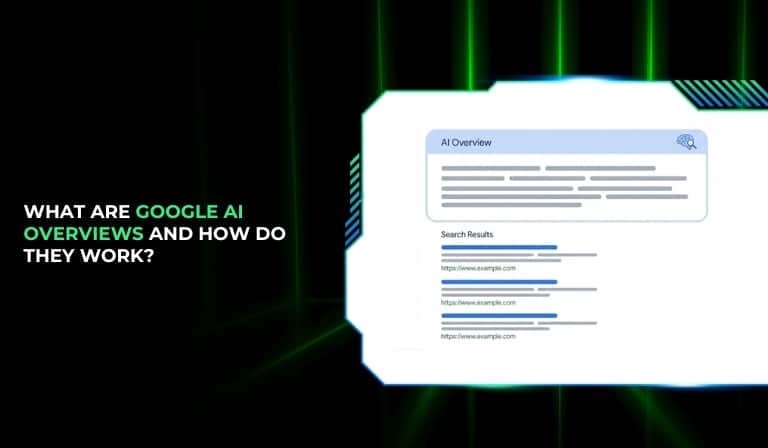
Something has shifted at the top of Google — and most businesses haven’t caught up yet. Before a user reads a single blog post, watches a video, or clicks your link, Google now hands them a machine-written answer. Not a list of results. An answer. Synthesized from multiple sources, formatted for instant consumption, sitting above every organic result on the page.
Google AI Overviews are now appearing on a meaningful share of searches — and according to data from Advanced Web Ranking, that figure crossed 60% of U.S. queries as of November 2025. For anyone relying on organic search to drive awareness, inbound leads, or content-driven pipeline, this is not a minor update. It changes who controls the first impression a prospect gets about your category, your competitors, and your brand.
This article explains what Google AI Overviews are, how they select their sources, what they mean for B2B and sales-driven businesses, and what you can do today to get cited rather than bypassed.
What Are Google AI Overviews? (The Actual Definition, Not the PR Version)
Google AI Overviews are AI-generated text blocks that appear at the top of certain Google search results pages, summarizing an answer drawn from multiple indexed sources before a user sees any organic results. The AI synthesizes content from websites Google has already crawled, presents it in a conversational format, and links to the sources it used at the bottom of the box.
They are not ads. They cannot be bought. They are not Featured Snippets, though the two are often confused. They are a distinct product with their own source selection logic, their own formatting, and their own impact on user behavior.
Here is where most explanations stop. But the definition alone does not tell you why this matters or how the system actually works. Let’s go deeper.
AI Overviews vs. Google’s Other SERP Features
Google’s search results page has accumulated a lot of features over the years. Featured Snippets, Knowledge Panels, People Also Ask boxes, Local Packs — each pulls information differently and serves a different purpose. AI Overviews are distinct from all of them.
- Featured Snippets pull a direct excerpt from a single page and display it verbatim or near-verbatim. They cite one source and link to it directly. AI Overviews synthesize content from multiple sources and rewrite it in conversational language.
- Knowledge Panels display structured entity information (a person, company, or place) pulled from Google’s Knowledge Graph. They do not summarize external web content the way AI Overviews do.
- People Also Ask boxes surface related questions with expandable answers from individual pages. They are reactive to user exploration. AI Overviews are proactive — they appear before a user takes any additional action.
- AI Overviews synthesize from multiple sources, produce original text, and appear at the very top of the SERP before any organic listings. A single AI Overview typically cites between 6 and 14 sources, with 9 being the most common number according to SE Ranking’s analysis of 141,507 AI Overviews.
The distinction matters because optimizing for a Featured Snippet and optimizing for an AI Overview require different approaches. You can win a Featured Snippet with a single well-structured paragraph. Getting cited in an AI Overview requires your content to pass through a multi-stage filtering pipeline — which we will cover in the next section.
How Google AI Overviews Work (The Technical Reality)
Google AI Overviews are powered by Gemini, Google’s large language model, grounded in live indexed web content through a process called retrieval-augmented generation (RAG). The system does not generate answers from a static training dataset. It retrieves content from pages Google has already crawled, filters those pages through multiple quality signals, and then uses Gemini to synthesize a coherent answer from the surviving sources.
This is an important distinction. Unlike a standalone AI chatbot that draws from training data, Google AI Overviews are anchored to pages that exist in Google’s index right now. That means your SEO still matters — but it is no longer sufficient on its own.
According to reverse-engineering research published by ZipTie.dev, the source selection process moves through five distinct stages:
- Stage 1: Semantic retrieval. Google runs the user’s query and generates between 200 and 500 candidate documents from its index using semantic relevance signals. This stage favors pages that address the topic comprehensively, not just pages that contain the exact keyword.
- Stage 2: Query fan-out. Google expands the original query into related subtopics to assemble a more complete answer. A search for “best LinkedIn automation tools” might fan out into subtopics like “LinkedIn automation safety,” “multi-account LinkedIn tools,” and “LinkedIn outreach reply rates.” Pages that address these subtopics are pulled into the candidate pool even if they don’t rank for the original query.
- Stage 3: E-E-A-T filtering. The system applies a binary pass/fail gate based on Experience, Expertise, Authoritativeness, and Trustworthiness signals. Pages from low-authority domains, or pages without clear signals of genuine expertise, are eliminated at this stage. This filter cannot be bypassed with good formatting alone.
- Stage 4: Gemini re-ranking. Gemini evaluates surviving pages at the passage level, not the page level. It looks for sections that contain self-contained, extractable answers. Research from ZipTie.dev identifies the optimal passage length for citation as 134 to 167 words — short enough to be extractable, long enough to be complete.
- Stage 5: Data fusion. Gemini synthesizes the retained sources into a coherent AI Overview. Not every source that survives to this stage receives a visible citation link. Sources that most directly answer specific components of the query get the inline citations.
What Content Signals Influence AI Overview Citations?
Understanding the pipeline above, the content signals that improve your chances of citation become clear. These are not guesses. They are patterns consistently observed across cited pages:
- Answer-first structure at the passage level. Gemini extracts passages, not whole pages. Each major section of your content needs to open with a direct, complete answer in the first one to two sentences before expanding into detail.
- Entity density. ZipTie.dev’s research identifies 15 or more recognized Knowledge Graph entities per 1,000 words as a signal associated with cited pages. This means naming specific tools, platforms, people, companies, and concepts rather than writing in generalities.
- Structural clarity. Pages using descriptive H2 and H3 headings, short focused paragraphs, and FAQ sections in Q&A format are consistently more likely to be cited. According to SE Ranking’s data, 78% of AI Overview responses feature either ordered or unordered lists, and 61% specifically use unordered lists.
- Schema markup. Structured data implementation (FAQ, HowTo, Article schema) has been shown to boost AI Overview selection probability by 73%, according to ZipTie.dev’s analysis. Schema makes content machine-readable in an unambiguous way, which reduces the risk that Gemini will misinterpret your content.
- Content freshness. Ahrefs found that AI platforms cite content that is 25.7% fresher than traditional organic results. Pages with visible update dates on time-sensitive topics outperform static content from earlier periods.
Does Google Disclose Which Pages It Uses?
Google does not publish a list of criteria for AI Overview source selection, and the citation links shown beneath each AI Overview are the primary public signal available. However, those citation links reveal a meaningful pattern: only about 38% of AI Overview-cited pages now rank in the organic top 10 according to ZipTie.dev’s current data, down from 76% less than a year ago. This is the most important number in this section. It means that ranking well in traditional search and appearing in AI Overviews are increasingly separate games with separate optimization paths. A page on page two or three of organic results can be cited prominently in an AI Overview if it is structured well and passes the E-E-A-T filter.
Why Google AI Overviews Matter for B2B and Sales-Driven Businesses
Most writing about AI Overviews focuses on publishers, bloggers, and e-commerce sites. That is the wrong lens for B2B operators. The implications for sales-driven businesses — agencies, SaaS companies, SDR teams, and outbound-focused organizations — are distinct and increasingly urgent.
Here is the core issue: AI Overviews are forming your prospects’ opinions before they ever reach your website. When a decision-maker searches “best LinkedIn automation tools” or “HeyReach vs Expandi” or “how to scale outbound on LinkedIn,” they may now receive a full synthesized answer from Google before they click anything. If your brand is not cited in that answer, you did not exist in that moment of research. That is not hyperbole. It is the functional reality of how AI Overviews work.
Research from ROAST, covering tracked keyword data across both B2B and B2C clients, found that AI Overviews appear for an average of 54% of tracked B2B keywords versus only 22% for tracked B2C keywords. B2B search is more affected by this shift than most categories, not less.
The B2B technology vertical has seen AI Overview coverage reach 82% of tracked queries according to BrightEdge data from February 2025 to February 2026. For sales automation, LinkedIn outreach, and SaaS comparison queries — exactly the searches that drive pipeline — AI Overviews are now the default first layer of information a prospect encounters.
Which B2B Query Types Are Now Affected?
The expansion of AI Overviews into commercial intent has accelerated. According to Semrush’s analysis of over 10 million keywords, the percentage of commercial queries triggering AI Overviews grew from 8.15% to 18.57% in a single year. Navigational queries moved from 0.84% to 10.33% over the same period. These are not informational queries. These are the queries that signal buying intent.
Specific query types now frequently triggering AI Overviews in B2B contexts include:
- Tool comparison queries (“LinkedIn automation tool comparison,” “HeyReach vs Dripify vs Expandi”) — where prospects form vendor shortlists before any sales conversation begins
- How-to workflow queries (“how to set up a LinkedIn outreach sequence,” “how to manage multiple LinkedIn accounts”) — where prospects build their methodology before evaluating tools
- Evaluation queries (“best LinkedIn automation tool for agencies,” “what to look for in outbound automation software”) — where buying criteria are shaped by whoever Google cites
- Problem-identification queries (“why are my LinkedIn connection requests not being accepted,” “LinkedIn outreach response rates”) — where prospects diagnose issues and simultaneously discover solution categories
The Pew Research Center’s controlled study of 68,000 real search queries found an 8% click rate when AI Overviews appeared, versus 15% without — a 46.7% relative decline in clicks. For queries where you are not cited in the AI Overview, that traffic loss is structural, not recoverable through bid adjustments or technical SEO fixes. You have to earn the citation.
How to Get Your Content Cited in Google AI Overviews
This is the section most competing articles skip, hand-wave through, or fill with generic SEO advice. The following guidance is drawn from observed patterns in cited pages and the source selection research described above. None of it is speculation.
Answer-first structure is the single most important change you can make. Every major section of your page needs to open with a direct, complete answer in one or two sentences before expanding into detail or examples. Gemini extracts passages at the section level. The first sentence of each H2 section is the sentence most likely to be pulled into an AI Overview. Write those sentences as if they are the only thing a reader will see — because for AI Overviews, they often are.
Heading hierarchy signals topic structure to the retrieval system. Use descriptive, specific H2 and H3 tags. A heading that reads “More Information” tells Gemini nothing. A heading that reads “How Google AI Overviews Select Sources” gives Gemini a labeled answer unit it can extract and cite. The more precisely your headings match the phrasing of real user queries, the stronger your passage-level relevance signal.
Paragraph length affects extractability. Research from ZipTie.dev identifies 134 to 167 words as the optimal passage length for AI Overview citations. Paragraphs that run to 300 words or more are less likely to be pulled cleanly. Each paragraph should carry one idea, stated plainly, with no buried lead.
FAQ sections are a direct pipeline into AI Overviews. Q&A structured content with self-contained answers (meaning each answer makes complete sense without the surrounding article) is one of the most reliable formats for earning citations. This is not a formatting preference — it matches exactly how Gemini’s extraction logic works at Stage 4 of the source selection pipeline described earlier.
Schema markup improves machine-readability without replacing content quality. Adding FAQ schema, HowTo schema, and Article schema signals content structure to Google’s crawlers and Gemini’s retrieval system. According to ZipTie.dev, structured data implementation boosts AI Overview selection probability by 73%. However, schema on weak or thin content does not produce citations. The markup helps Gemini parse well-structured content. It does not rescue content that lacks substance.
Content freshness matters more for AI Overview citations than for traditional rankings. Pages with visible, recent update dates on time-sensitive topics outperform static content. If your top-traffic pages have not been reviewed and updated in the last two quarters, that is the first place to look when diagnosing why you are not appearing in AI Overviews for relevant queries.
Building topical authority through content clusters increases your citation surface area. Google’s “fan-out” mechanism (described in Stage 2 of the source selection pipeline above) retrieves pages that address subtopics of the user’s original query, not just pages that match the exact query. A content cluster covering your core topic from multiple angles — use cases, comparisons, how-to guides, FAQs, data — gives you more passages that can surface across a wider range of fan-out queries.
The Page Structure That Gets Cited Most Often
Based on the patterns in cited pages, here is what a well-optimized page looks like from top to bottom:
- H1: Matches the exact phrasing of the target query or a close variant
- First paragraph (under the H1): One to two sentence direct answer to the page’s core question, followed by a brief description of what the rest of the page covers
- H2 sections: Each opens with a direct, complete answer (one to two sentences), followed by supporting detail, examples, or data. Ideal section length: 300 to 500 words. Individual paragraphs within sections: 100 to 150 words maximum.
- H3 subsections: Used to break down complex sub-points within an H2. Each H3 should be specific enough to match a subtopic that the fan-out mechanism might retrieve independently.
- FAQ section (placed after the main body, before the conclusion): Minimum 8 to 10 questions. Each answer self-contained in two to five sentences. Questions drawn from People Also Ask, Google Autocomplete, and real forum discussions in your niche.
- Update date: Visible and accurate. Especially important for topics where information changes (tool comparisons, pricing, platform policies).
What Kills Your Chances of Being Cited
The following are consistent failure patterns observed in pages that do not get cited despite ranking well organically:
- Dense, unbroken paragraphs. A 400-word paragraph with the answer buried in sentence seven is not extractable. Gemini will skip it.
- Generic headings. “Key Takeaways,” “Important Points,” “Overview” — these give the retrieval system nothing to match against user queries.
- Content hidden behind accordion menus or JavaScript-rendered elements. If Googlebot cannot reliably render and extract the content, Gemini cannot cite it.
- Thin pages padded with filler. Word count alone does not earn citations. A 3,000-word page filled with restated points is less likely to be cited than a well-structured 1,200-word page where every paragraph earns its place.
- Vague attributions without named sources. Claims like “experts say” or “studies show” without a named source reduce trust signals. Gemini favors content with factually dense, attributable writing.
AI Overviews, AEO, GEO, and AIO: Understanding the Four-Layer Optimization Model
Most content teams still optimize for one thing: traditional search engine rankings. Get to page one, earn clicks. That model is not wrong. It is just no longer complete. In 2026, content that reaches the right people travels through at least four distinct retrieval systems — and each has different requirements.
Here is what each layer means in plain terms:
- SEO (Search Engine Optimization) is what most teams know: creating content that Google can crawl, understand, and rank. It covers technical infrastructure (page speed, crawlability, indexation), on-page signals (keyword relevance, heading structure, internal linking), and off-page authority (backlinks, brand mentions). SEO is the prerequisite for everything else. If your pages are not indexed and ranked, they will not be retrieved by any of the systems below.
- AEO (Answer Engine Optimization) is the practice of structuring content so that AI assistants — ChatGPT, Perplexity, Gemini in standalone mode — can extract and cite it when generating direct-answer responses. AEO focuses on answer-first structure, complete standalone answers, and content that makes sense when a single passage is lifted out of context. The goal is to be the source an AI cites when a user asks a question outside of a Google search.
- GEO (Generative Engine Optimization) is about writing with enough factual density, named entities, and authoritative specificity that large language models treat your content as a trustworthy source when generating summaries. Vague, hedged, or generic content gets skipped by LLMs during synthesis. Content that names specific tools, cites specific data, and makes direct claims gets picked up and referenced. GEO is about earning trust from AI systems as well as human readers.
- AIO (AI Overview Optimization) is the most Google-specific layer: structuring your content for inclusion in Google’s on-SERP AI summaries. AIO optimization focuses on heading hierarchy, answer-first paragraphs at the section level, FAQ sections with self-contained answers, schema markup, and content freshness — the signals described in the previous section.
These four layers interact and reinforce each other. A page built correctly for AIO will largely satisfy the requirements for AEO and GEO as well. Answer-first structure, descriptive headings, self-contained FAQ answers, and factually dense writing serve all four systems simultaneously. The key insight is that the optimization lives in how you write every paragraph and structure every section — not in a dedicated block appended at the end of an article.
If your content team is still writing purely for a human reader scrolling a blog, they are producing content for a distribution model that is being rebuilt around them. The readers are still there. The retrieval systems sitting between your content and those readers have multiplied.
What Google AI Overviews Mean for SEO Strategy Going Forward
Google AI Overviews are a confirmed product, not an experiment in retreat. The trajectory is clear even accounting for the volatility seen in 2025, when AI Overview coverage peaked at just under 25% of queries in July before pulling back to under 16% in November according to Semrush’s analysis of 10 million keywords. That pullback was not a sign that Google was abandoning AI Overviews. It was Google calibrating the feature based on user behavior data before expanding it again — particularly into commercial queries.
The data on what happens to sites that earn citations versus those that do not is not ambiguous. According to Seer Interactive’s September 2025 study covering 3,119 informational queries across 42 organizations, organic CTR dropped 61% on queries where AI Overviews appeared. For sites not cited in those AI Overviews, that loss is structural. For sites that are cited, the same research found brands earn 35% more organic clicks and 91% more paid clicks — a halo effect that extends beyond the AI Overview itself.
For content teams, the immediate action is an audit of existing high-traffic pages against the structural criteria described in this article. The pages already ranking in positions three through eight for your target queries are the fastest wins. They have cleared the E-E-A-T filter (otherwise they would not be ranking). The gap between ranking and being cited is usually a structural one — passages that are not self-contained, headings that are too generic, or FAQ sections that are absent.
For B2B sales and outreach teams, the implication runs deeper than content strategy. Your prospects are forming opinions about your category — about what matters in a LinkedIn automation tool, what differentiates good outreach from bad, and which vendors are worth talking to — before they ever reach your website. The AI Overview is the zero-click touchpoint that precedes everything else. Your content is no longer just for SEO. It is a brand impression that happens before you ever know the prospect exists.
For agencies managing search and content for clients, AI Overview visibility needs to become a tracked metric now. Platforms like Ahrefs and Semrush have begun incorporating AI Overview citation tracking. The clients who ask for this data in six months will be behind the ones building the reporting framework today.
The standard for content quality has moved. Writing a complete, well-sourced article that answers a question thoroughly is still the foundation. The difference now is that the structure of that article — how each section opens, how headings are labeled, whether FAQs are included and how they are written — determines whether AI systems surface it to your next prospect before they ever click a blue link.
Frequently Asked Questions
What are Google AI Overviews?
Google AI Overviews are AI-generated summaries that appear at the top of certain Google search results pages, synthesizing answers from multiple indexed web sources before any organic listings are shown. They are powered by Gemini and use a retrieval-augmented generation process to pull from live web content rather than a static training dataset.
When did Google AI Overviews launch?
Google AI Overviews launched officially in the United States in May 2024, following an earlier experimental phase called the Search Generative Experience (SGE) that began in mid-2023. By October 2024, they were available in over 100 countries without requiring a Search Labs opt-in. European markets received the feature in late March 2025.
How does Google decide which pages to cite in AI Overviews?
Google uses a multi-stage filtering pipeline. It begins with semantic retrieval of 200 to 500 candidate pages, narrows those through E-E-A-T authority filtering, re-ranks surviving pages at the passage level using Gemini, and then synthesizes the final answer from retained sources. Pages with clear answer-first structure, descriptive headings, self-contained FAQ sections, and strong authority signals are most likely to survive all five stages.
Do I need to rank #1 to appear in a Google AI Overview?
No. Research from ZipTie.dev found that only 38% of AI Overview-cited pages currently rank in the organic top 10 — down from 76% less than a year ago. Pages ranking on page two or three can earn citations if they are well-structured, pass the E-E-A-T filter, and contain extractable passages that directly address subtopics in the user’s query.
Are Google AI Overviews the same as Google SGE?
They are the same product at different stages of development. SGE (Search Generative Experience) was the experimental name used during Google’s Search Labs testing phase from mid-2023 to May 2024. When Google made the feature available to all U.S. users in May 2024, it was renamed AI Overviews. The underlying technology is the same, but the product has been refined significantly since SGE testing.
How do AI Overviews affect organic search traffic?
The impact depends heavily on whether your content is cited. Seer Interactive’s September 2025 study found a 61% drop in organic CTR for queries where AI Overviews appeared. Sites that earn citations in those overviews see 35% more organic clicks than pages not cited. Sites that do not appear in the overview on queries where it shows experience the full 61% CTR decline with no offsetting benefit.
What type of content is most likely to be cited in AI Overviews?
Content with answer-first structure at the section level, descriptive H2 and H3 headings, short focused paragraphs (under 150 words each), FAQ sections with self-contained answers, appropriate schema markup, and regular freshness updates. According to SE Ranking, 78% of AI Overview responses include lists, and FAQ-formatted content is consistently among the highest-cited formats.
Can I opt my website out of appearing in Google AI Overviews?
You can block Google from using your content in AI Overviews by adding the “nosnippet” meta tag to relevant pages. However, this also prevents your pages from appearing in Featured Snippets and other snippet-based SERP features. There is no mechanism to opt out of AI Overviews specifically without affecting other search visibility. Google’s guidance to publishers is to continue producing high-quality, structured content rather than opting out.
How are AI Overviews different from Featured Snippets?
Featured Snippets pull a direct excerpt from a single source page and display it with a link to that page. AI Overviews synthesize content from multiple sources (typically 6 to 14) and produce original text written by Gemini. Featured Snippets require ranking in the top 10. AI Overviews can cite pages that do not rank in the top 10. The content signals for each feature also differ: Featured Snippet optimization focuses on exact-match answers in a single passage, while AI Overview optimization focuses on passage-level extractability across the entire page.
What is the difference between AEO, GEO, and AIO?
AEO (Answer Engine Optimization) focuses on structuring content for AI assistants like ChatGPT and Perplexity that generate direct-answer responses. GEO (Generative Engine Optimization) focuses on writing with enough factual density and named entities that LLMs treat your content as a trustworthy source during synthesis. AIO (AI Overview Optimization) is Google-specific and focuses on the heading hierarchy, answer-first paragraphs, FAQ structure, and schema signals that get content cited in Google’s on-SERP summaries. The three overlap significantly in their requirements — pages built for AIO generally satisfy AEO and GEO standards as well.
Do AI Overviews appear for B2B and commercial search queries?
Yes, and the share is growing fast. According to Semrush’s analysis of over 10 million keywords, the percentage of commercial queries triggering AI Overviews grew from 8.15% to 18.57% in a single year. Research from ROAST found AI Overviews appear for 54% of tracked B2B keywords on average, compared to 22% for tracked B2C keywords. B2B technology searches specifically now trigger AI Overviews on 82% of tracked queries according to BrightEdge.
How do I check if my content is being cited in AI Overviews?
Google Search Console does not currently break out AI Overview citations separately from regular organic clicks. To track AI Overview citations, you need to manually search your target queries in Google and check whether your pages appear in the AI Overview source links. Purpose-built AI search monitoring platforms like ZipTie.dev, Wellows, and SE Ranking now offer automated AI Overview citation tracking alongside traditional rank tracking.