


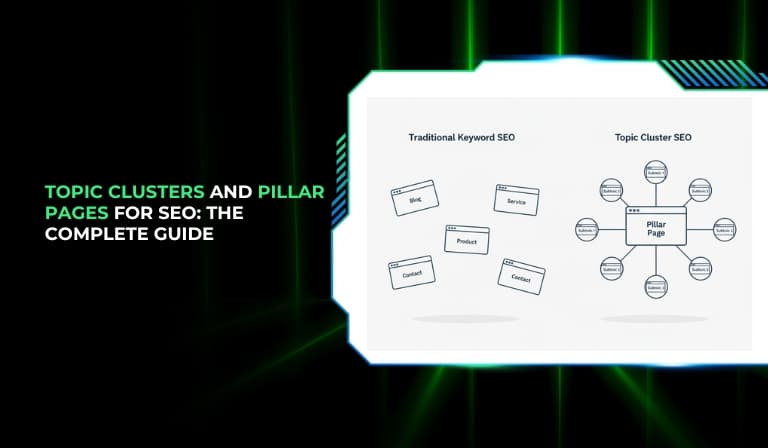
For most of SEO’s history, ranking success depended on targeting individual keywords. You researched a term, created a page around it, built links, and waited for results. That approach worked when search engines relied heavily on keyword matching and link-based authority.

In 2026, that model is no longer enough.
Search engines now evaluate how comprehensively a website covers a topic, not just whether a page includes a specific phrase. Google’s recent core updates and the expansion of AI-powered search features have made one thing clear: isolated keyword-focused pages struggle to compete against sites that demonstrate topical authority.
This shift is driven by three forces:
- Search intent has become more complex Users expect complete, connected answers — not fragmented blog posts that only address part of a problem.
- Search engines now rely on entity understanding Google interprets concepts, relationships, and subject matter depth, not just strings of text.
- AI-powered search experiences favor structured knowledge AI Overviews and generative search results pull from sources that present cohesive, well-organized coverage of a topic.
Topic clusters and pillar pages are the structural response to these changes.
Rather than publishing dozens of disconnected articles, this approach organizes content into:
- A pillar page that broadly explains a topic
- Multiple cluster pages that cover individual subtopics in depth
- A deliberate internal linking structure that connects everything together
The result is not just better rankings, but:
- More consistent organic traffic
- Longer ranking stability
- Clearer authority signals
- Better user experience
- Higher likelihood of being cited in AI-generated answers
In this guide, you’ll learn:
- Why topic clusters outperform traditional keyword strategies
- How pillar pages and cluster pages work together
- How to choose cluster-worthy topics strategically
- How to structure, link, and maintain clusters correctly
- How to measure success beyond vanity metrics
- How to scale this approach for competitive and enterprise environments
This isn’t theory. It’s a practical framework designed for the realities of modern SEO.
Why Topic Clusters Matter: From Keywords to Topical Authority
The Evolution of SEO (2015–2026)
From roughly 2010 to the mid-2010s, SEO revolved around individual keyword targeting. Each page was designed to rank for a specific query, often with exact-match optimization.
This approach created several long-term problems:
- Multiple pages competing for the same keyword (keyword cannibalization)
- Shallow content written to “cover” keywords rather than solve problems
- Weak topical signals across domains
- Difficulty demonstrating real expertise
As search engines evolved, these weaknesses became more visible.
By the early 2020s, Google’s algorithms increasingly emphasized:
- Search intent satisfaction
- Semantic relevance
- Content depth
- Trust and expertise signals
By 2025–2026, the shift became unmistakable. Google began prioritizing:
- Topical authority over isolated page authority
- Entity relevance over keyword frequency
- Content ecosystems over standalone articles
Topic clusters directly address these changes by showing search engines:
- You understand a topic holistically
- You cover it from multiple angles
- Your content is intentionally structured
- Your pages reinforce each other rather than compete
Why Competitors With Newer Sites Are Winning
One of the most confusing trends for established websites is watching newer domains outrank them — even with fewer backlinks.
The reason is rarely technical. It’s structural.
Newer sites often:
- Launch with tightly organized topic clusters
- Build content around a clear topical map
- Avoid years of content sprawl and cannibalization
- Publish fewer but more strategically connected pages
When a site publishes:
- One comprehensive pillar page
- Supported by 8–15 focused cluster pages
- All internally linked with intent
Search engines can immediately understand:
- What the site is about
- Which pages are most important
- How subtopics relate to the main theme
In contrast, older sites often suffer from:
- Hundreds of overlapping posts
- No clear content hierarchy
- Weak internal linking logic
- Pages competing against each other
Topic clusters allow smaller or newer sites to outperform larger competitors by clarity and structure, not brute-force volume.
What Topic Clusters Deliver Beyond Rankings
Topic clusters are not just an SEO tactic. They create benefits across the entire marketing funnel.
- More Sustainable Traffic Clusters tend to rank for dozens or hundreds of related queries rather than a single keyword. This reduces reliance on one ranking and creates traffic stability.
- Longer Ranking Lifespan Because clusters are updated as a system, rankings tend to last longer than standalone posts that decay over time.
- Better User Experience Readers can move naturally from overview to detail, increasing engagement and reducing bounce rates.
- Stronger Trust and Credibility Signals Comprehensive coverage demonstrates expertise in a way isolated posts cannot.
- Higher Visibility in AI-Powered Search AI systems prefer sources that present structured, interconnected knowledge — exactly what topic clusters provide.
The Anatomy of Topic Clusters: Core Components Explained
Topic clusters consist of four essential components. Each one plays a distinct role in establishing authority and usability.
Pillar Pages (The Hub)
A pillar page is the central authority page for a topic.
What a Pillar Page Is
- A comprehensive, high-level resource covering a broad topic
- Designed to answer the majority of questions a user may have
- Serves as the main entry point into a topic cluster
Typical Characteristics
- Length: usually 2,500–4,000 words
- Broad scope without shallow treatment
- Structured for readability and navigation
Purpose
- Establish topical authority
- Signal semantic relevance to search engines
- Provide contextual pathways to deeper content
What a Strong Pillar Page Includes
- Clear overview of the topic
- Logical sectioning of major subtopics
- Table of contents for navigation
- Contextual links to cluster pages
- Author credibility signals
- Structured formatting for both users and crawlers
A pillar page should not attempt to rank for every long-tail query. Instead, it introduces each major subtopic and links out to focused pages that explore those areas in depth.
Cluster Pages (The Spokes)
Cluster pages are focused, intent-driven articles that support the pillar.
Definition
A cluster page covers one specific subtopic related to the pillar’s theme.
Typical Characteristics
- Length: 800–1,500 words (longer for complex topics)
- Narrow scope
- Clear search intent alignment
Common Types of Cluster Content
- How-to guides
- Definitions and explainers
- Comparisons and alternatives
- Use-case articles
- Objection-handling content
- Troubleshooting guides
Critical Rule
Each cluster page must address one distinct search intent.
If two pages target the same intent, they will compete with each other and weaken the cluster.
Relationship to the Pillar
- Every cluster page links back to the pillar
- The pillar links out to each cluster
- Related clusters may link to each other where contextually appropriate
Internal Linking Architecture (The Connective Tissue)
Internal linking is what turns individual pages into a topic cluster.
Without intentional linking, even the best content remains fragmented.
Why Internal Linking Matters
- Distributes authority across related pages
- Signals topical relationships to search engines
- Guides users through logical learning paths
- Improves crawl efficiency
Best Practices
- Pillar links to clusters early and contextually
- Clusters link back to the pillar near the top
- Anchor text is descriptive and varied
- Links appear naturally within content, not in footers or sidebars
Internal links should always exist to serve understanding first, not to satisfy a quota.
Entities and Schema Markup (Machine-Readable Signals)
Search engines don’t just read words — they interpret entities.
Entities are real-world concepts, objects, or ideas that search engines use to understand meaning and relationships.
Why Entities Matter
- They help search engines disambiguate topics
- They allow ranking across related queries
- They support inclusion in AI-generated answers
Schema Markup’s Role
Schema provides explicit signals about:
- Content type
- Authorship
- Organization
- Relationships between concepts
Common schema types used in topic clusters include:
- Article
- FAQ
- HowTo
- Organization
- Person
Schema does not guarantee rankings, but it improves interpretation accuracy, which is critical for modern search systems.
Strategic Framework: Choosing Cluster-Worthy Topics
Choosing the wrong topic cluster is one of the fastest ways to waste months of SEO effort. Topic clusters only work when the topic itself is worth building authority around.
This section explains how to identify, validate, and prioritize cluster opportunities using defensible signals, not assumptions or gut instinct.
Audit Existing Content for Opportunities
Before creating anything new, the first step is understanding what you already have.
Most websites already contain:
- Partial clusters
- Hidden authority signals
- Cannibalization problems
- Missed internal linking opportunities
A content audit reveals where clusters can be built faster and more efficiently.
1. Identify High-Performing Pages
Start by identifying pages that already show strength:
- Pages ranking on page one or two
- Pages generating consistent impressions
- Pages earning backlinks naturally
- Pages with strong engagement metrics
These pages often make ideal pillar candidates or strong cluster anchors.
Use:
- Google Search Console to analyze impressions, clicks, and queries
- Google Analytics 4 to evaluate engagement and conversions
Pages that rank for multiple related queries are especially valuable, as they indicate existing topical relevance.
2. Look for Content Gaps
Next, identify what’s missing.
Content gaps often appear as:
- Queries users search for but you don’t address
- Subtopics competitors cover that you don’t
- Questions repeatedly asked in sales or support conversations
Common gap indicators:
- “People Also Ask” questions with no matching page
- Queries in GSC with impressions but low clicks
- Related searches that don’t map cleanly to existing URLs
These gaps often become cluster page opportunities.
3. Spot Keyword Cannibalization
Cannibalization occurs when multiple pages target the same intent.
Symptoms include:
- Rankings fluctuating between URLs
- Pages ranking lower than expected despite strong content
- Multiple pages appearing for similar queries in GSC
Topic clusters reduce cannibalization by:
- Assigning one page per intent
- Consolidating overlapping content
- Reinforcing hierarchy through internal links
If two pages serve the same purpose, they should usually be merged or repositioned within a cluster.
4. Quick Audit Workflow
A practical audit workflow looks like this:
- Export performance data from GSC
- Group URLs by topic
- Map queries to intent
- Identify overlaps and gaps
- Flag potential pillar candidates
- List missing cluster pages
This audit provides the foundation for every decision that follows.
Intersection of Business Value, Search Intent, and Competition
Not all topics are worth clustering around. The best clusters sit at the intersection of business relevance, search demand, and achievable competition.
1. Start With Business Value (Not Just Volume)
Search volume alone is a weak decision metric.
Instead, start with:
- Products or services you sell
- High-LTV customer use cases
- Core problems your business solves
Assign a business value score (1–5):
- 5 = Direct revenue impact
- 4 = Strong pipeline influence
- 3 = Supporting awareness
- 1–2 = Low commercial relevance
Clusters scoring 4 or 5 should take priority, even if search volume is lower.
2. Pull Intent-Rich Queries From Search Data
Search behavior reveals intent more accurately than keyword tools.
Use GSC + GA4 to:
- Identify queries tied to conversions
- Group related converting queries
- Detect patterns across multiple keywords
When multiple high-intent queries relate to the same theme, that theme is often pillar-worthy.
Example pattern:
- “Best CRM for small business”
- “Affordable CRM software”
- “CRM pricing comparison”
Together, these suggest a broader decision-focused topic rather than isolated posts.
3. Size the Search Opportunity
Once a topic passes the business-value test, assess demand and difficulty.
General guidelines:
- Mid-range search volume often offers the best ROI
- Competition matters more than volume
- Niche specificity increases win probability
Topics with manageable competition and clear intent usually outperform broader, high-volume terms dominated by established brands.
4. Cross-Check SERPs for Winability
Before committing, manually review the search results.
Key questions:
- Are page-one results dominated by mega-brands?
- Are results varied or homogenous?
- Are answers thin, outdated, or fragmented?
- Are SERP features present (PAA, snippets, videos)?
If page one is filled with:
- Wikipedia
- Government sites
- Massive platforms
The topic may require a narrower angle or be deprioritized.
Mine Competitor Blind Spots and Underserved Audiences
Keyword tools reflect what already exists. Blind spots appear where users ask questions competitors haven’t answered well.
1. Reddit Recon
Reddit is a powerful source of late-stage and comparison-driven intent.
Search patterns like:
site:reddit.com “topic” “vs”
site:reddit.com “topic” “worth it”
These threads reveal:
- Objections
- Real-world constraints
- Language users actually use
2. Quora Depth Mining
On Quora, sort by:
- Recent activity
- High view counts
- Credible contributors
Extract:
- Action verbs
- Comparison language
- Decision-making triggers
These often translate directly into cluster topics.
3. Social and Comment Mining
LinkedIn comments, YouTube comments, and niche communities reveal:
- Implementation challenges
- Feature limitations
- Use-case nuances
When users repeatedly ask the same question, it signals unmet demand.
4. SERP Undercoverage
If top-ranking pages:
- Barely address the topic
- Ignore important sub-questions
- Haven’t been updated recently
There is often room for a comprehensive cluster to outperform them.
Validation Techniques Before Committing Resources
Before investing heavily, validate that a cluster is structurally sound.
1. Content Mapping
For each potential cluster page, define:
- Unique intent
- Distinct angle
- Internal links it will receive
- Relationship to the pillar
If you can’t articulate how a page differs, it’s likely redundant.
2. Search Intent Segmentation
Classify keywords by intent:
- Informational
- Commercial
- Transactional
- Navigational
Each intent typically requires its own page. Mixing intents leads to poor engagement and ranking instability.
3. Opportunity Scoring
Score each topic across:
- Demand
- Difficulty
- Strategic fit
- SERP winability
Higher total scores indicate stronger cluster candidates.
This creates objective prioritization, reducing bias and guesswork.
4. Fast Signal Testing
Before full rollout:
- Publish a short but focused page
- Internally link from relevant content
- Monitor impressions and CTR over 2–3 weeks
Early signals often predict long-term potential.
Know When to Deprioritize
Not every idea deserves execution.
Deprioritize when:
- Topic is too broad to cover adequately
- Competition is entrenched and well-maintained
- Differentiation feels forced
- Content would duplicate existing pages
Choosing not to build a cluster is often a strategic win.
Architecture Patterns: From Hub-and-Spoke to Enterprise Models
Once topics are selected, architecture determines whether the cluster performs or fails.
Hub-and-Spoke Model (Most Common)
The hub-and-spoke model is the foundation of topic clustering.
Structure
- One pillar page
- 8–15 supporting cluster pages
- Clear internal linking between hub and spokes
URL Organization
- Pillar at a clean, top-level path
- Clusters nested logically beneath it
This structure helps both users and crawlers understand hierarchy.
Best Use Cases
- Small to mid-sized businesses
- Focused niches
- Clear topical boundaries
Advantages
- Simple to implement
- Easy to maintain
- Clear authority signals
- Shallow crawl depth
For most sites, this model delivers the best balance of effort and results.
Four-Tier Enterprise Model
Highly competitive industries often require deeper architectures.
Tier 1: Pillar
- Broad overview
- High-level strategy
- Foundational concepts
Tier 2: Category Pages
- Major subtopics
- Strategic depth
- Intent segmentation
Tier 3: Tactical Pages
- How-to guides
- Process documentation
- Use-case specifics
Tier 4: Assets
- Checklists
- Templates
- Tools
- Supporting resources
This model:
- Preserves crawl efficiency
- Supports complex buyer journeys
- Allows scale without chaos
It is most effective for:
- Enterprise SaaS
- Financial services
- Highly regulated industries
Accessibility and Navigation Rules
Architecture must support all users, not just search engines.
Key principles:
- Pages accessible without JavaScript reliance
- Important cluster pages within three clicks of homepage
- Pillars linked from primary navigation
- Consistent breadcrumbs
Good navigation improves:
- Crawlability
- Engagement
- Trust
- Conversion paths
Content Depth and Quality Benchmarks: Building Authority
Topic clusters only work when the content quality is high enough to justify authority. Structure alone cannot compensate for shallow or generic writing.
This section defines what “high-quality” actually means for pillar pages and cluster content in 2026 — from depth benchmarks to machine-readable structure and E-E-A-T signals.
Pillar Page Word Count and Coverage
Pillar pages are not standard blog posts. Their role is to function as definitive reference resources.
Ideal Length Range
- Typical range: 2,000–4,000 words
- Competitive industries often require the upper end of this range
Length itself is not a ranking factor, but coverage is. Longer content tends to rank better because it:
- Answers more questions
- Covers more related entities
- Satisfies broader intent
- Reduces the need for users to return to SERPs
Coverage Requirements
A pillar page should address:
- Core definitions
- Strategic context
- Major subtopics
- Common questions
- Practical considerations
- Links to deeper resources
If a reasonable user question about the topic is unanswered, the pillar is incomplete.
Structural Elements for Humans AND Machines
Search engines evaluate how content is structured, not just what it says.
1. Semantic HTML and Heading Hierarchies
Clear structure helps both accessibility tools and search engines interpret content.
Best practices:
- One H1 per page (primary topic)
- H2s for major sections
- H3s for detailed breakdowns
- Logical nesting without skipping levels
Semantic HTML elements such as <article>, <section>, and <nav> help clarify content relationships.
Proper hierarchy:
- Improves scannability
- Enhances crawl interpretation
- Reduces ambiguity in topical coverage
2. Scannable Content Formatting
Even long-form content must be readable.
Effective formatting includes:
- Short paragraphs (2–3 sentences)
- Bullet points for key ideas
- Tables for comparisons
- Clear subheadings
- Clickable tables of contents
- Visual summaries or TL;DR sections
These elements improve:
- Engagement
- Time on page
- Comprehension
- Accessibility
They also help AI systems extract concise answers more reliably.
3. Schema Markup Strategy
Schema markup does not directly increase rankings, but it improves interpretability and eligibility for enhanced SERP features.
Common schema types for clusters:
- Article (pillar pages)
- FAQ (question-based sections)
- HowTo (step-by-step content)
- Organization and Person (credibility)
Schema should:
- Match actual content
- Be validated before deployment
- Be updated as content evolves
Testing should be done using the Schema Markup Validator to ensure accuracy.
E-E-A-T Demonstration Through Content
E-E-A-T (Experience, Expertise, Authoritativeness, Trustworthiness) is not a checkbox. It is demonstrated through content signals.
Experience
Demonstrated by:
- First-hand explanations
- Real-world workflows
- Screenshots or examples
- Descriptions of implementation challenges
Experience signals distinguish original insight from generic summaries.
Expertise
Shown through:
- Clear explanations of complex processes
- Accurate terminology
- Depth that reflects real understanding
- Avoidance of vague or overgeneralized advice
Expertise increases confidence for both users and evaluators.
Authoritativeness
Built through:
- Named authors
- Detailed author bios
- Transparent revision histories
- Consistent topical coverage over time
Authority accumulates when content ecosystems reinforce each other.
Trustworthiness
Established by:
- Accurate citations
- Clear methodology
- Honest limitations
- Up-to-date information
Trust is reinforced when content is maintained and revised as knowledge evolves.
AI and Content Quality Standards (2026 Update)
Search engines evaluate usefulness, not authorship method.
AI-assisted content is acceptable when:
- Used to support research or drafting
- Enhanced with human experience
- Fact-checked and cited
- Structured clearly
Problems arise when:
- Content is generic
- No original insight is present
- Claims lack evidence
- Pages are mass-produced without differentiation
Best practice:
- Use AI for outlines and synthesis
- Add human insight, examples, and judgment
- Maintain editorial oversight
Quality standards apply regardless of how content is created.
Internal Linking Mastery: The Connective Tissue
Internal linking is what transforms individual pages into a cohesive topical system.
Without it, clusters fail to communicate authority.
Linking Principles
Internal links should serve context and clarity, not quotas.
Context Over Quota
There is no ideal number of internal links. What matters is relevance.
A link should:
- Make sense in context
- Help the reader understand or explore
- Reinforce topical relationships
Forced links weaken credibility.
Avoid Over-Linking
Excessive linking:
- Dilutes link equity
- Creates visual clutter
- Feels manipulative
A broad guideline:
- Natural editorial links scale with content length
- Over-optimization signals should be avoided
In-Body Placement
Contextual links placed within paragraphs carry more value than:
- Footer links
- Sidebar links
- Navigation-only links
Placement matters because it indicates topical relevance.
Hub-and-Spoke Linking Pattern
The hub-and-spoke model relies on two-way reinforcement.
Pillar → Cluster Links
The pillar should:
- Link to every cluster page
- Use descriptive anchor text
- Introduce links early where relevant
These links signal the breadth of coverage.
Cluster → Pillar Links
Each cluster page should:
- Link back to the pillar near the top
- Use varied but relevant anchor text
- Reinforce the pillar as the central resource
This establishes hierarchy.
Cross-Spoke Linking
When two cluster pages are closely related:
- Linking between them improves context
- Creates semantic triangles
- Strengthens topical depth
Cross-links should always be logical and user-focused.
Anchor Text Diversity
Anchor text communicates meaning.
Overuse of exact-match anchors can:
- Appear manipulative
- Reduce naturalness
- Limit semantic breadth
Best practice is variation:
- Exact match (sparingly)
- Partial match
- Synonyms
- Descriptive phrases
Diversity mirrors natural language and supports broader rankings.
Automation and Editorial Oversight
Internal linking tools can scale discovery but should never replace judgment.
Tools can:
- Surface opportunities
- Identify orphaned pages
- Highlight weak link paths
Editors should:
- Review relevance
- Adjust anchor phrasing
- Prevent over-linking
- Maintain consistency
Automation assists — it does not decide.
Common Implementation Mistakes and How to Avoid Them
Topic clusters fail far more often due to execution mistakes than flawed strategy. Most failures are predictable, repeatable, and preventable.
This section breaks down the most common structural, content, and maintenance errors, explains why they hurt performance, and outlines how to correct them systematically.
Structural Failures
Mistake 1: Weak or Orphaned Internal Linking
The problem Pages exist in isolation with no clear internal pathways connecting cluster pages to the pillar or to each other.
Why it happens
- Content published incrementally without planning
- Internal links added inconsistently
- No ownership over internal linking maintenance
Impact
- Search engines struggle to understand topical relationships
- Link equity becomes trapped
- Pages fail to reinforce authority signals
How to fix it
- Ensure every cluster page links back to its pillar
- Add 2–5 contextual internal links per cluster page
- Audit for orphaned pages using crawl tools and Search Console coverage reports
- Treat internal linking as a recurring maintenance task, not a one-time setup
Mistake 2: Low Spoke-to-Pillar Ratio
The problem A pillar page exists, but it is supported by too few cluster pages.
Why it happens
- Pillar pages published prematurely
- Content teams underestimate depth required
- Resources spread across too many topics
Impact
- Pillar fails to demonstrate comprehensive coverage
- Authority signals remain weak
- Rankings stagnate despite quality writing
How to fix it
- Aim for 8–15 supporting cluster pages per pillar
- Prioritize depth over breadth
- Delay publishing a pillar until multiple supporting pages exist or are scheduled
A pillar without spokes looks incomplete to both users and search engines.
Mistake 3: Overlapping Subtopics Cause Cannibalization
The problem Multiple pages target the same or very similar search intent.
Why it happens
- Keyword-based planning without intent segmentation
- Separate teams producing content independently
- Legacy blog posts left unaddressed
Impact
- Pages compete against each other
- Rankings fluctuate unpredictably
- Authority is split instead of concentrated
How to fix it
- Perform intent-based content audits
- Consolidate overlapping pages into one authoritative resource
- Redirect deprecated URLs
- Assign one page per intent, not per keyword
Cannibalization is a structural problem, not a content quality issue.
Mistake 4: Content Buried Too Deep
The problem Important cluster pages are several clicks away from the homepage and poorly linked.
Why it happens
- Poor navigation design
- Over-reliance on category pages
- Legacy URL structures
Impact
- Reduced crawl frequency
- Lower perceived importance
- Poor user discovery
How to fix it
- Keep critical cluster pages within three clicks of the homepage
- Link pillar pages from primary navigation when appropriate
- Use breadcrumbs to clarify hierarchy
Visibility within the site matters almost as much as visibility in search.
Content Quality Gaps
Mistake 5: Pillar Pages That Are Too Thin
The problem A page labeled as a pillar is only marginally longer than a standard blog post.
Why it happens
- Confusion between “pillar” and “cornerstone”
- Time or resource constraints
- Fear of long-form content
Impact
- Fails to establish authority
- Doesn’t support cluster depth
- Underperforms competitively
How to fix it
- Expand coverage to address all major subtopics
- Add FAQs, process explanations, and examples
- Ensure the page functions as a reference, not an article
Pillars must earn their role structurally and substantively.
Mistake 6: Missing E-E-A-T Signals
The problem Content lacks clear authorship, experience, or trust indicators.
Why it happens
- Anonymous publishing
- Overreliance on generic summaries
- No content governance process
Impact
- Reduced trustworthiness
- Lower competitive resilience
- Weaker performance in sensitive or YMYL-adjacent topics
How to fix it
- Add named authors and bios
- Include revision histories
- Incorporate first-hand insights
- Cite reputable sources consistently
Authority must be visible, not implied.
Mistake 7: Over-Reliance on AI Without Originality
The problem Content is generated quickly but lacks unique perspective or insight.
Why it happens
- Pressure to scale content output
- Misunderstanding of AI’s role
- Lack of editorial oversight
Impact
- Content blends into the SERP
- Limited differentiation
- Reduced likelihood of citations
How to fix it
- Use AI for structure and synthesis, not final authority
- Add original frameworks, examples, and judgment
- Treat AI as a drafting assistant, not an author
Search engines reward usefulness, not speed.
Maintenance Oversights
Mistake 8: “Set It and Forget It” Mentality
The problem Clusters are published and never revisited.
Why it happens
- Teams focus on creation, not maintenance
- No update cadence defined
- Performance monitoring neglected
Impact
- Content becomes outdated
- Competitors surpass with fresher resources
- Rankings decay gradually
How to fix it
- Schedule quarterly reviews for pillar pages
- Refresh data, examples, and internal links
- Expand coverage as new subtopics emerge
Authority compounds only when maintained.
Mistake 9: Content Decay and Query Deserves Freshness (QDF)
The problem Topics that require freshness are left unchanged.
Why it happens
- No freshness classification
- Assumption that evergreen content doesn’t age
Impact
- Gradual ranking loss
- Declining click-through rates
- Reduced relevance
How to fix it
- Identify QDF-sensitive topics
- Update content proactively
- Display clear “last updated” signals
Freshness is a relevance signal, not a cosmetic one.
Mistake 10: Cluster Bloat Without Pruning
The problem Clusters grow unchecked, accumulating thin or outdated pages.
Why it happens
- Additive content strategy without audits
- Fear of deleting content
- No performance thresholds
Impact
- Diluted authority
- Poor crawl efficiency
- Confusing user experience
How to fix it
- Audit clusters biannually
- Consolidate redundant pages
- Remove or redirect underperforming content
Pruning strengthens clusters — it doesn’t weaken them.
Measurement and Optimization: Beyond Vanity Metrics
Traffic alone does not measure success in a topic cluster strategy. The goal is authority, coverage, engagement, and conversion impact.
This section outlines meaningful metrics and how to track them systematically.
Key Performance Indicators (KPIs) for Topic Clusters
1. Entity Visibility and Relevance
What it measures How strongly search engines associate your brand with key concepts in a topic.
Why it matters Entity recognition expands ranking potential across semantically related queries.
How to observe
- Branded mentions in top SERP results
- Consistent association with core topics
- Knowledge panel appearances where applicable
Entity visibility reflects topical authority maturity.
2. Keyword Breadth Per Cluster
What it measures The number of unique queries a cluster ranks for.
Why it matters Breadth indicates real topical coverage, not dependence on a single term.
Benchmarks
- Healthy clusters often rank for 50–200+ related queries
How to track
- Use Google Search Console
- Filter performance by page or folder
- Count unique queries over 28–90 day windows
3. Organic Share of Voice (SOV)
What it measures Your visibility relative to competitors across a defined keyword set.
Why it matters SOV captures presence even when traffic fluctuates due to SERP features.
How to track
- Monitor rankings and impressions across cluster keywords
- Compare trends over time rather than absolute values
SOV growth signals authority expansion.
4. Engagement Depth (Cluster-Level)
What it measures
- Scroll depth
- Time on page
- Internal link click-through rate
Why it matters Engagement reflects intent satisfaction and content usefulness.
Benchmarks
- Scroll depth >60%
- Time on page >2 minutes
- Internal CTR >5%
How to track
- Use Google Analytics 4
- Segment by cluster paths
- Monitor trends, not single sessions
5. Answer Inclusion Rate (AI + SERP Features)
What it measures How often your content is cited or surfaced in:
- Featured snippets
- AI-generated answers
- Rich result panels
Why it matters These placements drive visibility even without traditional clicks.
How to track
- Manual SERP monitoring
- Brand mention tracking
- Feature ownership tools where available
Inclusion signals trust and clarity.
6. Conversion Lift From Organic
What it measures Revenue or pipeline influenced by cluster traffic.
Why it matters This validates SEO investment beyond rankings.
How to track
- Attribute conversions to organic sessions
- Track assisted conversions
- Compare pre- and post-cluster baselines
SEO value compounds across the funnel.
7. Technical Health (Enablement Metric)
What it measures
- Crawlability
- Indexation
- Page experience signals
Why it matters Technical issues can block authority signals entirely.
How to track
- Coverage and enhancements reports
- Performance metrics
- Crawl diagnostics
Content cannot perform if it cannot be accessed.
90-Day Optimization Timeline
Days 0–30: Establish Baseline and Stabilize
- Map cluster URLs to analytics
- Fix crawl and indexing issues
- Improve internal linking consistency
Expected outcome
- Foundation stabilized
- Minimal immediate lift
Days 31–60: Refresh for Coverage and Depth
- Expand pillar coverage
- Address missing subtopics
- Improve internal pathways
Expected outcome
- Increased keyword breadth
- Early visibility gains
Days 61–90: Expand or Consolidate
- Expand clusters showing momentum
- Consolidate underperforming pages
- Refine internal architecture
Expected outcome
- Sustainable growth trajectory
- Clear direction for scaling
Illustrative Benchmarks
- Share of voice growth: 10–25% in 60–90 days
- Branded search lift: 10–25%
- CAC reduction on SEO-influenced leads: 30–50% range
Benchmarks vary by industry but provide directional guidance.
Tools for Measurement and Refresh
- Measurement: Search Console, GA4, rank tracking tools
- Research: Topic research and SERP analysis tools
- Auditing: Crawl diagnostics and internal link analysis
Tools support decisions — they don’t replace strategy.
Advanced Topic Cluster Strategies
Once foundational clusters are working, advanced strategies allow organizations to scale authority without losing clarity or crawl efficiency. These approaches are especially relevant for competitive niches, multi-product businesses, and enterprise websites.
Topical Maps for Enterprise Scale
Enterprise websites often operate across multiple adjacent topics, making single clusters insufficient.
A topical map:
- Defines how multiple clusters relate
- Prevents overlap and cannibalization
- Establishes hierarchy across large content ecosystems
Multi-Cluster Architecture
Instead of one pillar supporting all content, enterprise models often use:
- One mega-pillar (broad category)
- Several secondary pillars (subcategories)
- Supporting clusters beneath each
Example pattern:
- Mega topic → category-level pillars → tactical clusters
This structure allows:
- Independent ranking for subtopics
- Shared authority across related areas
- Controlled crawl depth
This approach is particularly useful for large SaaS platforms, marketplaces, and publishers covering expansive domains.
Vertical-Specific Cluster Patterns
Topic cluster strategy adapts to business model and industry.
Service-Based Clusters
Service businesses benefit from clusters organized around service categories and processes.
Structure:
- Pillar: Core service category
- Clusters: Individual services, procedures, outcomes, or use cases
This pattern:
- Educates users at different awareness stages
- Supports local and transactional intent
- Aligns content with buyer journeys
Product and Feature Clusters
Product-led businesses often build clusters around:
- Product categories
- Feature sets
- Integrations
- Use cases
Structure:
- Pillar: Product category overview
- Clusters: Features, comparisons, setup guides, limitations
This approach:
- Supports commercial and transactional intent
- Reduces reliance on comparison keywords alone
- Reinforces product authority through education
Cross-Cluster Linking for Mega-Authority
As clusters mature, cross-cluster linking strengthens authority across the site.
When Cross-Cluster Links Make Sense
- Shared audience
- Overlapping use cases
- Logical progression in user journey
These links:
- Reinforce entity relationships
- Improve discovery of related solutions
- Expand semantic coverage
Cross-cluster linking should be intentional and limited, ensuring clarity remains intact.
Conclusion
Topic clusters and pillar pages are no longer optional techniques—they are the foundation of sustainable SEO in an AI-driven search landscape. As search engines move beyond keywords toward entities, intent, and topical authority, disconnected content simply cannot compete with structured, comprehensive ecosystems. By building one authoritative pillar supported by clearly defined cluster pages, reinforcing them with strategic internal linking, and maintaining them through ongoing updates, you create compounding visibility that grows stronger over time. You don’t need to execute everything perfectly from day one. Start with one well-researched topic cluster, measure its impact, refine the structure, and scale deliberately. That systematic approach is what turns content into authority—and authority into long-term organic growth.
Frequently Asked Questions (FAQs)
1. What is a topic cluster in SEO?
A topic cluster is a content structure where a central pillar page covers a broad topic, and multiple cluster pages cover related subtopics in depth. All pages are internally linked to signal topical authority to search engines and improve user navigation.
2. What is a pillar page?
A pillar page is a comprehensive resource page that provides a high-level overview of a core topic. It links out to supporting cluster pages and acts as the main authority hub for that subject within a website.
3. How are topic clusters different from traditional keyword targeting?
Traditional keyword targeting focuses on optimizing individual pages for specific keywords. Topic clusters focus on topical authority, organizing content by search intent and subject relationships rather than isolated keywords, which aligns better with modern search engine algorithms.
4. Do topic clusters still work for SEO in 2026?
Yes. Topic clusters are even more important in 2026 because search engines prioritize entity understanding, topical depth, and content relationships, especially in AI-powered search results and answer-based SERP features.
5. How many cluster pages should support one pillar page?
Most effective topic clusters include 8 to 15 cluster pages supporting one pillar page. The exact number depends on topic complexity, search demand, and competition, but too few clusters can weaken authority signals.
6. What is the ideal length of a pillar page?
A pillar page typically ranges between 2,000 and 4,000 words. The goal is not length alone, but comprehensive coverage of all major subtopics related to the main topic.
7. Can a cluster page rank without a pillar page?
A cluster page can rank on its own, but its performance is usually stronger when linked to a relevant pillar page. The pillar helps reinforce topical relevance and distributes authority across the cluster.

Passionate about blogging and focused on elevating brand visibility through strategic SEO and digital marketing. Always tuned in to the latest trends, I’m dedicated to maximizing engagement and delivering measurable ROI in the dynamic world of digital marketing. Let’s connect and unlock new opportunities together!