


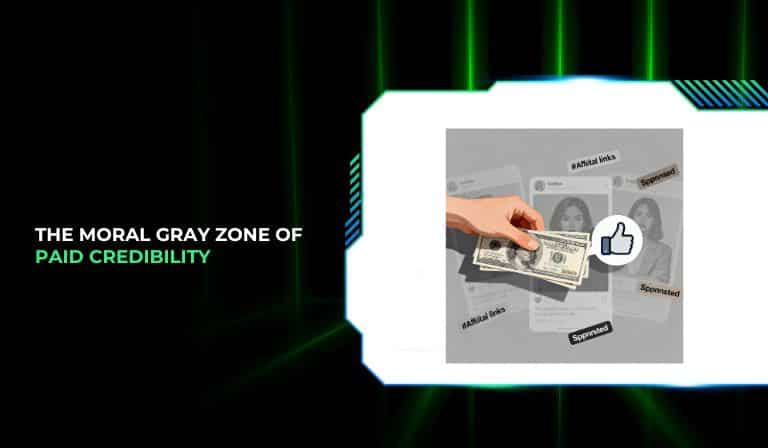
In an era where a single endorsement can sway millions, the boundary between genuine influence and purchased praise is increasingly difficult to discern. Paid credibility — whether through influencer sponsorships, incentivized reviews, or subtle commercial partnerships — sustains entire digital economies. But when credibility becomes something that can be bought, the trust that underpins those economies begins to erode.

The issue is not simply that persuasion has become transactional. It is that persuasion has become opaque. And when audiences can’t tell what is genuine and what is sponsored, skepticism becomes the default.
Where Ethical Lines Begin to Blur
Much of modern marketing takes place in a gray zone. Influencers reference brands without clearly disclosing compensation. Product reviewers accept discounts or perks that shape their opinions. Affiliate links are embedded in content framed as “honest recommendations.” These practices are not always malicious, but they are not entirely transparent either.
A 2021 Journal of Business Ethics analysis found that a majority of marketers operate in this ambiguous space because it delivers measurable gains. And yet, those gains come at the cost of long-term trust: when audiences feel misled, even indirectly, credibility does not simply diminish — it collapses.
From an ethical perspective, utilitarianism might defend these tactics to produce desirable outcomes, such as sales growth. Deontological ethics criticizes them for withholding material truth. Virtue ethics emphasizes that credibility only has meaning if it is earned and aligned with character. All three perspectives point toward the same conclusion: opacity in credibility-building is corrosive.
How Manufactured Credibility Spreads
Paid credibility appears in several familiar forms.
Influencer endorsements continue to shape consumer perception, but disclosure remains inconsistent across platforms. A notable portion of sponsored posts still omit clear disclosure language, making it difficult for audiences to evaluate authenticity.
Online reviews are also vulnerable. Incentivized or fraudulent reviews can artificially inflate product ratings, distort competitive dynamics, and undermine trust in digital marketplaces. When consumers cannot rely on other consumers, the system of collective authentication breaks down.
Astroturfing — the creation of staged or purchased “public consensus” — further complicates matters by manufacturing the appearance of organic support or criticism. Rather than reflecting public sentiment, it manipulates it.
These practices do not simply mislead individuals. They reshape the informational environment people rely on to form beliefs and make decisions.
The Cost of Collapsed Trust
When people can no longer distinguish genuine credibility from purchased credibility, they begin to question everything. Endorsements seem strategic. Reviews feel engineered. Even positive experiences are discounted, because the surrounding environment feels contaminated by influence without clarity.
This loss of trust carries financial consequences. Acquisition costs rise. Brand loyalty weakens. And once credibility is lost, restoring it is significantly more expensive — not only in resources, but in time, transparency, and accountability.
Where Reputation Management Fits In — and Why It’s Different
This is where the conversation must shift.
Not all work that involves “reputation” is manipulative. There is a meaningful ethical distinction between:
- Buying influence to create an image you have not earned
- Repairing reputation when public information is misleading, distorted, outdated, or weaponized.
Individuals and organizations often seek reputation help not to fabricate credibility, but to correct a narrative that no longer reflects who they are. This can include outdated news that remains searchable long after circumstances have changed, mugshots tied to dismissed charges, defamatory content, viral rumors, or mistakes amplified far beyond their actual significance.
The goal in these situations is not to inflate credibility — it is to restore fairness and context. Ethical reputation work focuses on accuracy, not concealment. It acknowledges the past but also growth, change, and proportionality.
In that sense, the moral question is not whether someone is trying to look better. It is whether they are trying to be seen as they truly are.
The Bottom Line
Buying credibility purely for advantage corrodes trust, both individually and socially. But working to correct misleading or incomplete public information is fundamentally different. It is an attempt to ensure that one’s reputation reflects reality rather than distortion.
As the digital environment continues to blur the line between authenticity and influence, the most valuable form of credibility will not be the kind that can be bought, but the kind that can be verified, explained, and sustained.
In the end, credibility does not come from appearing trustworthy — it comes from being consistently, transparently, and demonstrably worthy of trust.