


Every few months, someone asks the same question in a different tone. A finance student wants to know if Wipro stock is worth holding. A fresher preparing for an interview wants to sound smart about “one of India’s big IT companies.” A small business owner comparing vendors wants to know if Wipro can actually deliver or if it’s just another logo on a slide deck. All three are really asking the same thing: what is Wipro good at, where does it struggle, and what’s coming next for it.

That’s exactly what a SWOT analysis is supposed to answer, and honestly, most SWOT write-ups online are lazy. They copy four bullet points from a textbook, slap “innovative” and “cutting-edge” next to Wipro’s name, and call it a day. That’s not useful to anyone. Wipro is a 80-year-old company that started by making vegetable oil in Amalner, Maharashtra, and somehow ended up running IT services contracts for banks in London and hospitals in Ohio. That journey deserves a proper breakdown, not a template.
This guide digs into the real numbers: FY26 revenue, headcount, attrition, margins, what CEO Srini Pallia is actually betting on, and how Wipro stacks up against TCS, Infosys, and HCLTech. No fluff, no vague “experts say” lines, just what’s actually happening inside the company right now and what it means depending on who you are.
And look, none of this is about picking a side. Wipro isn’t the villain some Twitter threads make it out to be, and it isn’t the flawless AI-transformation story its own press office would love you to believe either. It’s a big, complicated, 80-year-old business trying to reinvent itself in real time while still paying dividends, hitting margin targets, and keeping 240,000-plus employees on payroll. That tension between “keep the old business steady” and “build the new AI business fast enough” runs through basically every section below, so keep that in mind as you read.
What You Will Learn in This Guide
- What Wipro actually does today, beyond the “IT services company” label everyone repeats
- The four strengths that genuinely separate Wipro from smaller competitors
- The weaknesses that show up clearly in its own quarterly numbers, not guesswork
- Where the real opportunities sit in 2026, especially around AI and vendor consolidation
- The threats that keep Wipro’s leadership up at night, from currency swings to client budget freezes
- A clean summary table pulling the whole SWOT analysis of Wipro together in one place
- How Wipro compares to TCS, Infosys, and HCLTech on revenue, margins, and positioning
- What all this means practically if you’re an investor, a client, or someone job hunting in this space
- Answers to the questions people actually type into Google about Wipro
Wipro at a Glance: Company Overview

Before jumping into strengths and weaknesses, it helps to know what kind of company Wipro even is today, because the “IT services giant” label hides a lot of nuance. Wipro isn’t a startup chasing one product. It’s a sprawling services business that touches banking, healthcare, manufacturing, retail, and telecom, spread across dozens of countries, with revenue north of ₹928,000 million for fiscal year 2026.
History and Origins
Wipro started in 1945 as Western India Vegetable Products Limited, selling cooking oil and soap. Yeah, soap. It wasn’t until the 1980s, under Azim Premji, that the company pivoted hard into computing hardware and then software services. That pivot is honestly one of the more underrated business bets in Indian corporate history. Premji took a regional consumer goods company and turned it into a global tech player over roughly two decades, and Wipro rode the same offshoring wave that built TCS and Infosys into giants. The company’s roots explain a certain conservatism you still see in its culture today: careful capital allocation, a strong balance sheet, and a reluctance to overextend on debt.
That soap-to-software story matters more than it sounds like it should, because it shaped how Wipro thinks about risk. Companies that grew up purely as tech businesses, born in the dot-com era or later, tend to move fast and accept messier balance sheets along the way. Wipro didn’t grow up that way. It grew up as a manufacturing and consumer goods company first, which is probably why even decades later, its financial discipline looks more like an old-school conglomerate than a Silicon Valley startup. That’s not a criticism. In a downturn, that discipline is exactly what keeps a company solvent while flashier competitors scramble.
Current Leadership and Structure
Srini Pallia took over as CEO and Managing Director, and his public comments have been consistent on one theme: AI is reshaping how clients buy services, and Wipro needs to move from selling people-hours to selling outcomes. Under his watch, Wipro launched an AI Native Business & Platforms unit, essentially betting that the old “staff augmentation” model of IT services is going to shrink, and the money is going to flow toward companies that can package AI into repeatable, sellable platforms. Whether that bet pays off is one of the more interesting threads running through this whole analysis.
Beyond Pallia, the leadership bench has also been shifting, with new board additions bringing digital and AI-focused experience from outside the traditional IT services world. One recent board appointment came from someone who helped shape digital and data strategy at Macy’s and held global leadership roles at InterContinental Hotels Group and First Data. That’s a telling hire. It signals Wipro wants outside perspective on AI and digital transformation, not just people who’ve spent their whole careers inside the IT services bubble, because sometimes the best way to avoid groupthink is bringing in someone who’s seen how a completely different industry solved the same problem.
Business Segments
Wipro organizes its business primarily around IT Services, which made up the overwhelming majority of FY26 revenue at roughly ₹921,153 million, and a much smaller IT Products segment that resells security, packaged, and SaaS software, which came in around ₹6,940 million but actually grew 157.8% year over year off a small base. On top of that, Wipro tracks revenue by sector too: Banking, Financial Services and Insurance sits as the largest chunk, followed by Health and Consumer-facing industries. That sector mix matters a lot when you get to the weaknesses section, because BFSI clients are notoriously cautious with tech budgets whenever there’s economic uncertainty.
It also helps to understand how Wipro actually attributes revenue internally, since it isn’t always as simple as “this client is in this country.” For strategic global clients operating across multiple countries, Wipro attributes the total revenue to a single Strategic Market Unit based on where the client’s key decision makers sit geographically, rather than splitting it up by every location work gets delivered from. That detail matters if you’re ever comparing Wipro’s regional revenue figures against a competitor, since not every company attributes multinational client revenue the same way, and small differences in accounting convention can make apples-to-apples comparisons trickier than they first appear.
Why a SWOT Analysis of Wipro Matters Right Now
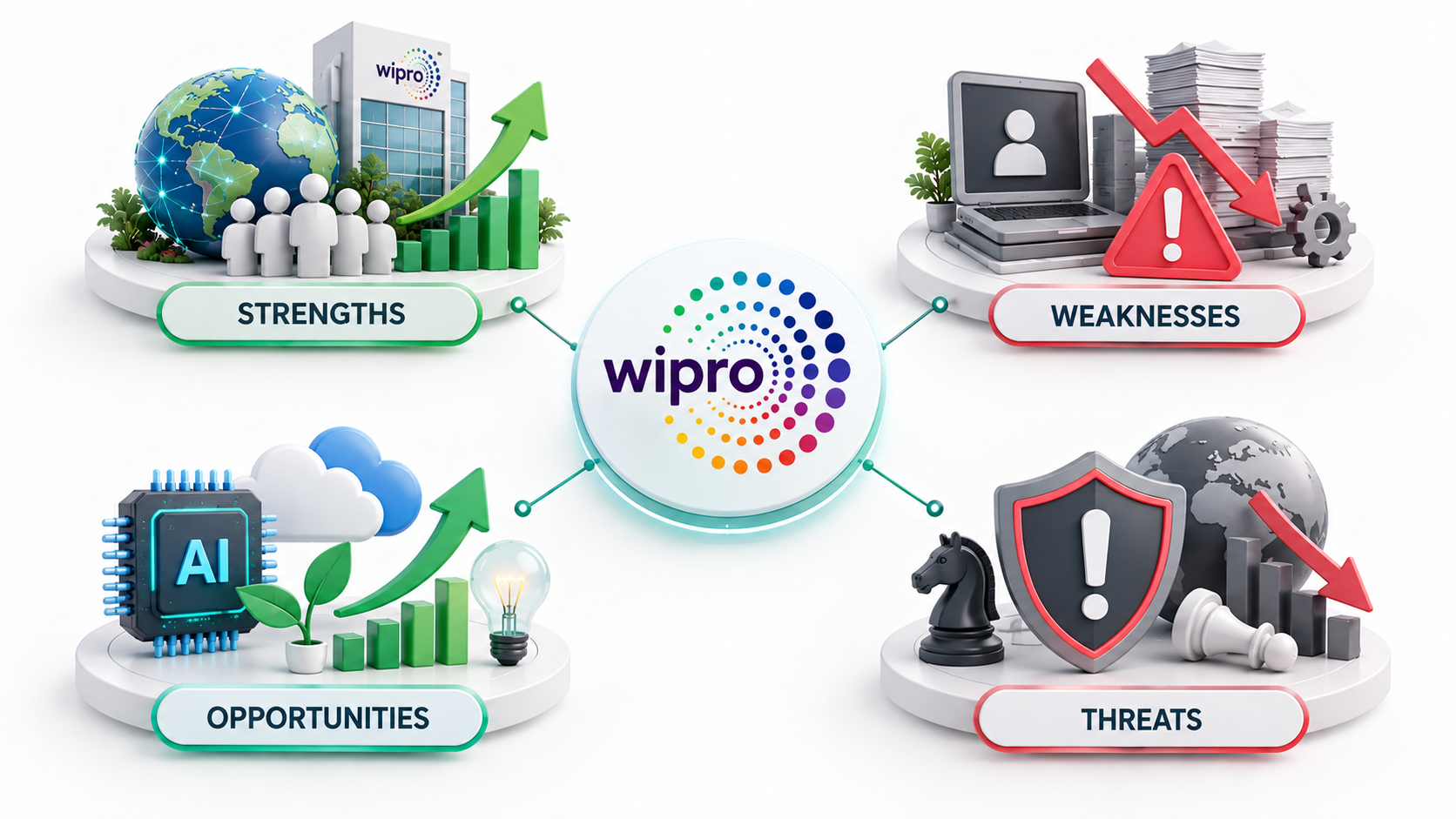
Here’s the thing. A SWOT analysis of Wipro done in 2021 would look completely different from one done today, because the entire IT services industry has been turned upside down by generative AI. Back then, growth was about headcount. More engineers, more billable hours, more revenue. That model is breaking down fast, and Wipro’s own management has said so publicly.
So doing this analysis now isn’t academic. Wipro just posted Q1 FY27 hiring numbers where fresher hiring basically stalled, not because business is bad, but because AI tools are quietly eating into the entry-level coding and testing work that used to require armies of junior engineers. That’s a structural shift, not a temporary dip. If you’re trying to figure out whether Wipro is a buy, a reliable vendor, or a good place to build a career, you need to understand this shift, because it’s rewriting every assumption the old SWOT frameworks were built on.
Strengths
Strengths are where most SWOT write-ups get generic and boring, throwing around words like “strong brand” without saying why it’s strong. Let’s actually get specific about what Wipro has going for it.
Diversified Revenue Base
Wipro doesn’t bet its entire business on one industry or one geography, and that matters more than people realize. Revenue splits across Banking, Financial Services and Insurance, Health, Consumer, and other sectors, and geographically across Americas, Europe, and APMEA. When one sector slows down, like BFSI clients pulling back discretionary spend, other sectors can pick up the slack. This diversification doesn’t make Wipro immune to downturns, but it does mean a single bad client relationship or a single struggling industry can’t tank the whole quarter. Compare that to a smaller IT vendor that’s overly dependent on two or three clients, and you’ll see why size and spread genuinely count as a strength here, not just a talking point.
Financial Muscle and Cash Reserves
Wipro’s balance sheet is honestly one of its quieter strengths. Net worth stood around ₹887,877 million in FY26, and net cash position after subtracting total debt came in at roughly ₹383,935 million. That’s a company sitting on a serious pile of cash relative to its debt. Why does that matter? Because it gives Wipro room to acquire companies, invest heavily in AI infrastructure, and ride out a rough quarter or two without panicking. A lot of smaller competitors don’t have that luxury. When a downturn hits, cash-rich companies survive and even go shopping for acquisitions while leveraged competitors scramble to cut costs.
There’s another angle here too. Reserves excluding revaluation sat around ₹859,206 million, which gives Wipro room to keep paying dividends even in a slower growth year, something income-focused shareholders actually care about a lot. Honestly, in an industry where quarterly headlines obsess over growth percentages, the balance sheet strength is the boring, unglamorous number that actually protects long-term shareholders when the growth story hits a rough patch. Nobody writes exciting news articles about “company maintains healthy net worth,” but it’s often the thing separating a survivor from a cautionary tale five years down the line.
Global Delivery Network
Wipro runs delivery centers across dozens of countries with offshore revenue percentage sitting around 59-61% of services delivered, meaning it can flex costs by shifting work to lower-cost locations while still maintaining onshore presence for client-facing work. This hybrid delivery model isn’t unique to Wipro, TCS and Infosys do the same thing, but Wipro’s scale, over 240,000 employees as of mid-2026, gives it enough bench strength to staff large, complex, multi-year contracts that smaller players simply can’t handle. Large deal bookings, even when they’ve dipped year over year, still run in the hundreds of millions of dollars per quarter, which tells you clients still trust Wipro with big, long-term commitments.
Net utilization, meaning how much of the workforce is actively billed to client work versus sitting on the bench, has run in the 83-84% range in recent quarters. That’s a reasonably efficient number for a company this size, and it shows Wipro isn’t carrying an enormous unbilled bench the way some smaller vendors do during slow periods. Delivery networks like this take years, sometimes decades, to build properly. You can’t just open an office in a new country and expect clients to trust you with a five-year, multi-million-dollar transformation contract overnight. That earned trust, built city by city and contract by contract, is exactly why Wipro’s global footprint counts as a genuine competitive strength rather than just a line item on a company overview slide.
Legacy and Brand Trust
There’s something to be said for a brand that’s been around since before Indian independence and has weathered every major tech shift since, from mainframes to the cloud to now AI. Enterprise clients, especially in conservative industries like banking and healthcare, don’t switch vendors casually. They want a partner who’ll still be around in ten years, has weathered previous downturns, and has institutional knowledge of their systems. Wipro’s decades-long relationships with large global banks and healthcare systems aren’t easy for a newer competitor to replicate, no matter how flashy their pitch deck looks.
Customer concentration data backs this up. The top single client accounts for only around 4.4% to 4.7% of total revenue, and the top ten clients together make up roughly 23-24%. That spread means Wipro isn’t over-reliant on keeping any one account happy, and it also means those relationships have been built and rebuilt across enough clients that the trust isn’t concentrated in a handful of fragile partnerships. When a bank has trusted the same vendor with its core banking systems for over a decade, switching that vendor becomes a genuinely risky, expensive decision, and that switching cost works entirely in Wipro’s favor.
AI and Digital Investment
Say what you want about whether the payoff is proven yet, but Wipro isn’t sitting on the sidelines of the AI shift. Wipro Intelligence, WINGS, and WEGA are internal platforms the company has been pushing hard, and management has openly credited these tools with contributing to several deal wins in recent quarters. The company is also willing to pay a premium for scarce AI talent even while keeping overall hiring conservative, which tells you where the real investment priority sits. This isn’t marketing spin, it shows up directly in the numbers, with continued investment weighing on margins even as leadership insists the long-term payoff justifies the short-term cost.
What’s genuinely interesting is how leadership frames this trade-off. CFO Aparna Iyer has been upfront that lowering utilization was a deliberate move to free up capacity for upcoming AI-related deals, not a sign of weak execution. That’s a bet on future demand, basically choosing to eat a short-term margin hit now in exchange for being ready when bigger AI-driven contracts materialize. It’s a risky call. If those deals don’t show up fast enough, the company just took a margin hit for nothing. But if they do show up, Wipro will be one of the few players with spare, trained capacity ready to go, instead of scrambling to hire and train after the fact like some competitors will be forced to do.
Weaknesses
Now the part companies don’t put in their investor decks. Every strength above comes with a corresponding weakness, and Wipro’s quarterly filings are honest about most of these if you actually read past the headline numbers.
Slower Growth Compared to Peers
Look, revenue grew 4.17% in FY26. That’s not nothing, but it’s not exactly thrilling either, especially when you consider IT Services specifically only grew 3.71%. Some of that growth wasn’t even organic. It came from currency depreciation of the rupee against the dollar, euro, and pound, plus contribution from acquisitions completed during the year. Strip those out and organic constant-currency growth looks a lot thinner. Compared to some peers posting stronger double-digit growth in specific quarters, Wipro has spent recent years playing catch-up rather than setting the pace, and that gap shows up clearly whenever analysts compare the big four Indian IT firms side by side.
Total bookings actually fell 5.7% year over year in constant currency terms in one recent quarter, and large deal bookings specifically dropped 8.4%. Those two numbers together are honestly a bigger warning sign than the headline revenue growth figure, because bookings are a leading indicator. Revenue reported today reflects deals signed months or years ago. Bookings reflect what clients are committing to right now, and a decline there suggests the growth challenge isn’t just a rearview mirror problem, it might get harder before it gets easier unless the pipeline picks back up in the next couple of quarters.
Margin Pressure
IT services operating margin sat around 17.6% in a recent quarter, and management has openly acknowledged operating margins declining by around 120 basis points in another quarter due to a client-specific deal and ongoing AI investment costs. Margins are the lifeblood of a services business, and when they compress because of rising costs from scarce AI talent, sub-contracting fees, and software license expenses, it puts real pressure on profitability even when revenue is technically growing. This isn’t a one-quarter blip either, it’s been a persistent theme across several recent earnings calls, with CFO Aparna Iyer directly addressing why utilization has been deliberately lowered even though that hurts near-term margins.
Gross margin itself dropped from 30.66% in FY25 to 29.30% in FY26, a decline of roughly 136 basis points. That might sound small if you’re not used to reading financial statements, but on a revenue base north of ₹928,000 million, every single basis point of margin translates into real money, tens of millions of dollars across a full year. Part of that squeeze came from a new labor code implementation in India adding costs, and part came from ongoing investment in AI capabilities. Neither of those costs is going away soon, which means margin recovery depends entirely on revenue growth outpacing cost growth, something that hasn’t consistently happened over the last few quarters.
Attrition and Talent Gaps
Voluntary attrition has hovered in the 13.8% to 14.2% range across recent quarters, which sounds manageable on paper but represents a real ongoing cost. Every employee who leaves takes institutional knowledge with them and needs to be replaced, retrained, and ramped up on client projects, and that’s expensive at a company with over 240,000 people. On top of that, there’s a newer and honestly more interesting problem: AI-related skills are described by Wipro’s own leadership as “rare” and “coming at a premium,” meaning the company is stuck paying up for scarce specialized talent while simultaneously slowing down entry-level hiring. That’s a talent pipeline squeeze from both ends at once.
There’s a longer-term risk buried in here too. When you slow down fresher hiring for a few years running, you’re not just saving money today, you’re also thinning out the pipeline of mid-level engineers you’ll need five years from now. Companies that lived through similar hiring freezes in past downturns have talked about “talent gaps” showing up years later, where there simply aren’t enough experienced mid-career employees because the company didn’t hire enough freshers during the lean years. Wipro isn’t at that point yet, but if the current cautious hiring approach continues for several more years, that’s a real structural risk worth watching, not just a short-term cost-saving measure.
Heavy Dependence on a Few Markets
Even with diversification across sectors, Wipro’s geographic revenue mix still leans heavily on the Americas, which represents a large chunk of the Strategic Market Unit split, alongside Europe and APMEA. That concentration means any economic slowdown, tariff dispute, or client budget freeze in the US specifically has an outsized effect on Wipro’s topline. Management itself flagged that revenue from one of its Americas segments actually declined during FY26 due to macroeconomic challenges and geopolitical dynamics, while Europe and APMEA still grew. Relying that much on a handful of Western economies is a real exposure, not a hypothetical one.
It’s worth pointing out that this isn’t unique to Wipro among Indian IT firms, the whole sector has this same concentration problem baked in, since the US and Europe have historically been where the biggest technology transformation budgets sit. But knowing it’s an industry-wide issue doesn’t make it less real for Wipro specifically. A trade dispute, a US recession, or tighter immigration and outsourcing policy in any one of these key markets could hit Wipro’s numbers noticeably harder than it would hit a company with a genuinely even geographic spread. That’s the trade-off that comes with chasing the biggest, richest markets instead of spreading bets more evenly.
Opportunities
Weaknesses aside, there’s a reason Wipro isn’t just sitting still. The IT services industry is genuinely being reshaped right now, and that creates real openings for a company with Wipro’s resources.
AI-Led Services and Agentic Delivery
This is the big one, and it’s not just buzzword bingo. NASSCOM’s own industry projections point to enterprises moving beyond simple AI pilots toward what’s being called phased GenAI and agentic scaling, meaning companies want AI systems that can actually take actions and complete workflows, not just generate text summaries. Wipro’s pivot toward a “services-as-a-software” model through its AI Native Business & Platforms unit is a direct attempt to capture this shift before competitors lock in the best clients. If this bet plays out, Wipro could sell higher-margin, repeatable AI platforms instead of pure headcount-based services, which would meaningfully change its margin profile for the better.
Srini Pallia himself has said advancements in AI are reshaping client priorities and creating new opportunities to partner more deeply with clients around value-driven outcomes rather than just staffing projects. That’s not just corporate talk dressed up for an earnings call, it reflects a genuine shift in how enterprise buyers are approaching technology spending right now. Clients increasingly want to pay for outcomes, like reduced processing time or fewer customer complaints, rather than paying by the hour for a team of consultants. Wipro building products and platforms around that outcome-based pricing model, if executed well, could unlock a fundamentally more profitable business than the traditional time-and-materials contracts the industry grew up on.
Vendor Consolidation Trend
Large enterprises are increasingly trying to work with fewer, deeper vendor relationships instead of juggling a dozen mid-sized IT partners. Wipro’s scale and broad service portfolio, spanning cloud, cybersecurity, application development, and business process services, positions it well to be one of those “consolidated” primary vendors for a client rather than getting squeezed out. Customer concentration data actually shows Wipro’s top 10 clients making up around 23-24% of revenue, which suggests a healthy mix of large accounts without dangerous overreliance on any single one, and there’s room to deepen those existing relationships further as clients cut down their vendor lists.
Think about it from the client’s side for a second. Managing fifteen different IT vendors means fifteen different contracts, fifteen different security reviews, fifteen relationship managers to keep happy. That’s an administrative nightmare for a large enterprise’s procurement and vendor management teams. Cutting that down to three or four trusted, broad-capability partners genuinely makes life easier for the client, and it means whoever survives that consolidation round gets a bigger share of the pie without necessarily having to win a brand new competitive bid every single time. Wipro’s breadth across cloud, cybersecurity, application development, and business process services makes it a natural candidate to be one of those surviving “core” vendors rather than getting cut in the consolidation wave.
Expansion in GCCs and Emerging Markets
Global Capability Centers, essentially in-house tech and operations hubs that multinational companies set up in India and other lower-cost markets, are expanding fast, and NASSCOM has explicitly flagged GCC growth as a driver of the broader Indian IT sector’s expansion. Wipro can position itself as a partner that helps enterprises set up, staff, and run these GCCs rather than just competing against them, turning what could be a threat to traditional outsourcing into a services opportunity instead. There’s also real room to grow in markets outside the traditional US and UK strongholds, particularly as APMEA revenue has already shown stronger growth momentum than the Americas in recent periods.
NASSCOM’s own industry outlook explicitly calls out GCC expansion as one of the key drivers behind Indian IT sector growth going forward, alongside enterprise-wide AI adoption and data center investments. That’s an important signal, because it means the industry body tracking this space isn’t treating GCC growth as a side story, it’s treating it as one of the main engines for the next few years. Wipro positioning itself as the partner that helps set up and run these centers, rather than treating them purely as a competitive threat stealing work away from traditional outsourcing, is the smarter long-term play, and there are early signs the company is leaning into exactly that strategy.
Strategic Acquisitions
Wipro’s cash reserves aren’t just sitting idle for no reason. The IT Products segment growth of 157.8% in FY26 was driven partly by revenue from acquisitions completed during the year, showing the company is actively using M&A to add capabilities rather than relying purely on organic growth. In an industry where NASSCOM itself flags “selective M&A” as a growth strategy across the sector, Wipro’s strong net cash position gives it real optionality to acquire niche AI, cybersecurity, or domain-specific consulting firms that would take years to build organically. That’s a meaningful advantage over smaller rivals who don’t have the same balance sheet flexibility.
Acquisitions in this industry aren’t just about buying revenue either, they’re often about buying speed. Building a specialized AI capability, a niche cybersecurity practice, or deep domain expertise in something like healthcare compliance from scratch can take years of hiring and training. Buying a smaller company that already has that expertise and an established client base can shortcut that timeline dramatically. Given how quickly the AI landscape is moving right now, that speed advantage might matter more than it ever has before, since waiting two or three years to build something organically could mean missing the window entirely while a competitor who acquired the capability gets there first.
Threats
No SWOT analysis of Wipro is complete without being honest about what could genuinely hurt the business, and some of these threats are already visible in the numbers rather than hypothetical risks.
Intense Competition
TCS, Infosys, HCLTech, Cognizant, Accenture, and a wave of smaller specialized AI consultancies are all fighting for the same client budgets. This isn’t a market where Wipro can coast on legacy relationships forever. Large deal bookings actually declined 5.7% year over year in constant currency in one recent quarter, and while that’s partly a macro demand story, it’s also a sign that competitors are winning some deals Wipro would have wanted. When every major player is pitching similar AI transformation stories to the same Fortune 500 clients, differentiation gets harder, and pricing pressure becomes a real risk to margins across the whole industry, Wipro included.
Global players like Accenture bring massive scale and deep consulting relationships at the very top of the enterprise pyramid, while smaller, nimble AI-native consultancies can undercut on price for specific, narrowly scoped projects without the overhead of a 240,000-person organization behind them. Wipro is fighting a two-front battle here: staying credible against the giants for the biggest, most complex transformation deals, while also not getting picked apart on smaller, faster-moving AI projects by leaner competitors who can move quicker and price more aggressively. That’s a genuinely tough position to defend from, and it’s exactly why bookings numbers deserve close attention every single quarter going forward.
Macroeconomic Headwinds
Wipro’s own filings directly cite “macroeconomic challenges and geopolitical dynamics” as a factor that reduced client discretionary spending during FY26. When companies in banking, retail, or manufacturing get nervous about the economy, the first budget line they freeze is often big, multi-year technology transformation projects, exactly the kind of contracts Wipro depends on. This isn’t unique to Wipro, the entire sector feels it, but Wipro’s heavy BFSI exposure makes it particularly sensitive to interest rate worries and financial sector caution in its core Western markets.
There’s a psychological element to this too that doesn’t show up in a spreadsheet but matters a lot in practice. Client CIOs and CFOs facing budget uncertainty tend to freeze new project approvals first, even before they cut anything currently running, simply because delaying a decision feels safer than committing to a new multi-year contract during uncertain times. That means Wipro’s pipeline of new deals can dry up faster than its existing revenue drops, creating a lag effect where the pain shows up first in bookings and only later in reported revenue. Watching bookings trends closely tends to tell you what’s coming a couple of quarters before it actually hits the topline numbers.
Currency Volatility
A meaningful chunk of Wipro’s reported rupee revenue growth in FY26 came from the depreciation of the Indian rupee against the US dollar, euro, pound, Australian dollar, and Canadian dollar, not from actual underlying business growth. That’s a double-edged sword. Currency moves can flatter results in some quarters and hurt them badly in others, and Wipro has to actively manage exchange rate assumptions in its own quarterly guidance, explicitly stating specific GBP/USD, Euro/USD, and USD/INR rates it’s planning around. Any sharp reversal in currency trends could expose just how much of recent “growth” was really a rupee story rather than a demand story.
This is where it pays to be a little skeptical of headline growth percentages in general, not just for Wipro but for the whole Indian IT sector. When a company reports revenue growth in rupee terms, always check whether that growth holds up in constant currency terms too. If the rupee number looks healthy but the constant currency number is flat or even negative, that’s the market telling you the underlying demand story is weaker than the headline suggests. Wipro’s own quarterly guidance already builds in specific currency rate assumptions for GBP, Euro, and INR precisely because management knows how much these swings can distort the real picture if you’re not paying attention.
Automation Disrupting the Traditional IT Services Model
This is the threat that should worry Wipro’s leadership the most long-term, and to be fair, they’ve said as much publicly. The entire outsourcing business model, built on billing clients for large teams of engineers doing coding, testing, and maintenance work, is under direct pressure from AI tools that can now do a meaningful chunk of that routine work. Wipro’s own Q1 FY27 numbers showed almost no fresher hiring, explicitly attributed to AI absorbing junior-level tasks. If AI keeps improving at this pace, the traditional headcount-driven revenue model that built Wipro into a multi-billion dollar company could shrink faster than the AI-platform revenue can grow to replace it. That transition risk is real, and it’s not a five-year-away problem, it’s happening in the hiring numbers right now.
Think about the math here honestly. If AI tools can do the work of three junior developers with one senior developer supervising them, that’s fantastic for margins in theory, less headcount cost for the same output. But it’s brutal for a business model that has spent decades charging clients based on the number of people staffed on a project. If clients realize they need fewer billable hours to get the same result, and they will realize this fast, they’re going to negotiate contracts down accordingly. Wipro’s challenge is proving it can charge for outcomes and expertise instead of hours before clients force that renegotiation on their own terms. That race, outcome-based pricing versus client-driven cost cutting, is arguably the single most important storyline for the entire Indian IT sector over the next three to five years, and Wipro is right in the middle of it.
Complete SWOT Analysis of Wipro: Summary Table
Pulling everything together, here’s the full SWOT Analysis of Wipro in one place so you don’t have to scroll back up and re-read every section.
| Strengths | Weaknesses |
|---|---|
| Diversified revenue across BFSI, Health, Consumer sectors | Slower organic growth versus some peers |
| Strong net cash position (~₹383,935 million) | Persistent margin pressure from rising AI talent costs |
| Large global delivery network (240,000+ employees) | Attrition running 13.8%-14.2%, plus AI-skills scarcity |
| Decades-long enterprise brand trust | Heavy revenue dependence on Americas market |
| Active AI platform investment (Wipro Intelligence, WINGS, WEGA) | AI Native unit still unproven at scale |
| Opportunities | Threats |
|---|---|
| Agentic AI and services-as-a-software shift | Intense competition from TCS, Infosys, HCLTech, Accenture |
| Vendor consolidation favoring larger players | Macroeconomic caution cutting discretionary client spend |
| Growth in Global Capability Centers | Currency volatility distorting real growth signals |
| Cash-funded strategic acquisitions | Automation eroding the traditional headcount-billing model |
This table format is honestly the easiest way to compare Wipro against any other IT services company too, since the same four categories apply whether you’re evaluating TCS, Infosys, or a smaller mid-cap IT vendor.
How Wipro Compares to TCS, Infosys, and HCLTech
A SWOT analysis in isolation only tells half the story. Numbers mean more when you see them next to a company’s actual competitors.
Revenue and Scale
TCS remains the clear revenue leader among Indian IT firms, generally posting figures well above Wipro’s roughly $10-11 billion IT services run rate. Infosys sits in a similar band to Wipro, sometimes ahead depending on the quarter, while HCLTech has been growing aggressively in engineering and products revenue alongside its core services business. Wipro is not the biggest player in this group anymore, and honestly hasn’t been for years, but it’s still comfortably one of the top five Indian IT services companies by scale, which matters when clients are choosing vendors capable of handling massive, multi-year global contracts.
Margins
This is genuinely where Wipro has lagged. TCS and Infosys have historically run higher operating margins than Wipro’s 17-18% range, sometimes by several percentage points. That gap isn’t small when you’re talking about a business with a $10+ billion revenue base, since even a couple of margin points translate into hundreds of millions of dollars in operating profit. Wipro’s management has been open about margin being a core focus area, which tells you this isn’t a hidden weakness, it’s the number one thing analysts grill Wipro’s CFO about on every single earnings call.
Market Positioning
Where Wipro arguably holds its own is in specific verticals like healthcare and certain engineering services niches, alongside its historical strength in BFSI. HCLTech has carved out a stronger identity in engineering R&D and products. Infosys has leaned into its Cobalt cloud platform branding. TCS trades heavily on being the safest, largest, most predictable option for massive enterprise clients. Wipro’s positioning under Srini Pallia seems to be betting that the AI Native Business unit becomes its next real differentiator, essentially trying to leapfrog rather than just compete on the old playing field. Whether that works depends entirely on execution over the next few years, not just the pitch.
What This Means for Investors, Clients, and Job Seekers
A SWOT analysis is only useful if it actually changes how you think or act. So here’s what it practically means depending on where you’re sitting.
For Investors
Wipro isn’t a high-growth story right now, and pretending otherwise would be dishonest. Revenue growth in the low single digits, margin pressure, and a rocky transition toward AI-led services means this looks more like a value and stability play than a momentum stock. The strong balance sheet and consistent cash generation offer some downside protection, and the dividend history matters to income-focused investors, but anyone expecting rapid re-rating should watch the AI Native unit’s actual contribution numbers closely over the next several quarters rather than just trusting management commentary on earnings calls.
For Clients
If you’re evaluating Wipro as a vendor for a large transformation project, the diversified delivery network and financial stability are genuine reasons to trust they’ll still be around to support you in year five of a contract. That said, be direct in negotiations about how much of the “AI-led delivery” pitch is proven versus aspirational, and ask for specific case studies rather than accepting platform names like Wipro Intelligence at face value. Every major vendor is making similar claims right now, so the real differentiator is asking pointed questions about actual measurable outcomes on comparable past projects.
For Employees and Job Seekers
This is probably the most immediately relevant section for a lot of readers. Fresher hiring has genuinely slowed, and that’s tied directly to AI absorbing entry-level coding and testing work. If you’re trying to break into Wipro or the IT services industry broadly right now, the smarter move is building actual AI and automation fluency rather than just traditional coding skills, since that’s exactly where the company says it’s willing to pay a premium even while cutting back elsewhere. For existing employees, upskilling toward AI-adjacent roles looks less like an optional career move and more like a necessity given where the hiring data is clearly pointing.
Wipro’s Stock and Market Sentiment Heading Into FY27
Numbers on an earnings call are one thing, but how the market actually prices Wipro tells its own story too, and it’s worth spending a minute on this before wrapping up.
What the Share Price Has Been Signaling
Wipro’s market price per share moved from around ₹240.1 to ₹262.3 to ₹187.6 across recent fiscal years, a noticeably bumpy ride rather than a smooth climb. That kind of volatility usually reflects exactly the tension described throughout this whole analysis, investors trying to price in slower growth and margin pressure against the promise of the AI transformation eventually paying off. When a stock trades in that kind of range, it tells you the market hasn’t fully made up its mind yet about which story wins out, the cautious near-term numbers or the longer-term AI bet.
Analyst and Investor Caution
Coverage around Wipro’s recent quarters has repeatedly focused on utilization cuts, muted demand, and guidance ranges that sometimes point to sequential declines rather than growth. One widely discussed quarter guided for IT Services revenue between roughly $2,597 million and $2,651 million, translating to sequential guidance of negative 2% to flat in constant currency terms. Guiding for a potential sequential decline isn’t something companies do lightly, and it tells you management itself isn’t overpromising right now, which arguably is a healthier sign than false optimism, even if it doesn’t feel great to shareholders in the short term.
Why Sentiment Matters for the SWOT Picture
Market sentiment isn’t a separate thing from the strengths and weaknesses discussed earlier, it’s really just those same fundamentals getting priced in real time by people betting real money. When bookings decline, margins compress, and guidance turns cautious, the stock reflects that. When AI platform wins start showing up in a more meaningful, quantifiable way, expect sentiment to shift accordingly. Watching how the share price reacts to specific earnings call details, not just the headline revenue number, is honestly one of the better ways to track whether Wipro’s turnaround story is gaining real traction or just staying a talking point.
Mistakes People Make When Reading Wipro’s SWOT Analysis
Before wrapping up, it’s worth calling out a few ways people misread this kind of analysis, because getting these wrong leads to bad conclusions.
Treating Currency-Driven Growth as Real Growth
This one comes up constantly. Someone sees “revenue grew 4.17%” and assumes the business is expanding at that pace organically. As covered earlier, a meaningful chunk of that growth came from rupee depreciation against major currencies, not from winning more work. Always dig one layer deeper into constant currency numbers before drawing conclusions about actual business momentum, because the headline figure alone can genuinely mislead you into either excessive optimism or excessive pessimism depending on which direction the currency happened to move that quarter.
Assuming Slower Growth Means the Company Is Failing
Slower growth compared to a couple of years ago doesn’t automatically mean a company is in trouble. The entire IT services sector, per NASSCOM’s own projections, is expected to grow around 4.1% in FY26, meaning Wipro’s growth roughly tracks the broader industry rather than falling dramatically behind it. Context matters. Comparing Wipro only against its own best historical years, without checking what the whole sector is doing, gives a distorted, overly harsh picture that doesn’t reflect what’s actually a fairly normal industry-wide slowdown tied to global demand conditions.
Ignoring the Difference Between Bookings and Revenue
A lot of casual readers focus purely on reported revenue and skip past bookings numbers entirely, but bookings are the better forward-looking indicator. A quarter with flat revenue but strong bookings growth is actually a more encouraging sign than a quarter with modest revenue growth but declining bookings, since the latter suggests the pipeline feeding future quarters is thinning out. Anyone doing a serious read of Wipro’s, or any IT services company’s, quarterly numbers should always check both figures side by side rather than fixating on the one that made the headline.
Conclusion
So where does this leave things? Wipro is neither the disaster some critics make it out to be nor the AI-transformation success story its own press releases suggest. It’s a financially solid, historically significant company going through the same identity crisis every traditional IT services firm is facing right now: figuring out how to survive a shift from selling human hours to selling AI-powered outcomes.
The strengths are real. Cash reserves, diversification, scale, and brand trust aren’t going anywhere soon. But the weaknesses aren’t cosmetic either. Margin pressure and slower growth compared to some peers are structural issues that need actual strategic wins to fix, not just talking points on an earnings call. The opportunities around agentic AI and vendor consolidation are genuinely exciting if Wipro executes well, and the threats, especially automation eating into the traditional services model, are already showing up in hiring data rather than sitting somewhere in the distant future.
Whatever side of this you’re looking at it from, investor, client, or someone building a career, the honest takeaway is the same: watch the next few quarters closely, because this is one of those periods where the direction a company takes right now determines what it looks like for the next decade.
One last thing worth keeping in mind. SWOT frameworks tend to get treated like a fixed, permanent verdict, as if once you’ve listed the strengths and weaknesses, that’s the final word. That’s not really how it works with a company moving through a transition this big. The weaknesses section here, slower growth, margin pressure, attrition, could look completely different a year from now if the AI Native unit starts contributing meaningfully to revenue. Equally, the opportunities section could shrink if a competitor moves faster and locks up the best AI-services clients first. Treat this analysis as a snapshot of where things stand right now, not a permanent scorecard, and revisit it every couple of quarters as new earnings data comes in, because that’s really the only honest way to track a company going through this kind of structural shift.
Frequently Asked Questions
1. What is the biggest strength in Wipro’s SWOT analysis?
Financial stability is arguably the strongest card Wipro holds. A net cash position of roughly ₹383,935 million combined with a diversified revenue base across BFSI, Health, and Consumer sectors means the company isn’t overly exposed to any single client, industry, or economic shock, giving it real staying power compared to smaller, more concentrated competitors.
2. What is Wipro’s biggest weakness right now?
Margin pressure stands out as the clearest ongoing weakness. Operating margins have faced repeated compression due to rising costs for scarce AI talent, sub-contracting fees, and continued technology investment, and management has openly acknowledged this on multiple earnings calls rather than hiding behind vague language.
3. Is Wipro growing slower than TCS and Infosys?
Generally yes, in recent periods Wipro’s overall revenue growth of around 4.17% for FY26 has trailed some competitors, and a portion of that growth even came from currency depreciation rather than pure organic demand, which is a distinction worth understanding rather than glossing over.
4. How is AI affecting Wipro’s business model?
AI is reshaping Wipro from two directions at once. It’s creating new revenue opportunities through platforms like Wipro Intelligence and the AI Native Business & Platforms unit, while simultaneously reducing the need for traditional entry-level coding and testing roles, which is exactly why fresher hiring has slowed sharply in recent quarters.
5. Who is the current CEO of Wipro?
Srini Pallia serves as CEO and Managing Director, and he’s been vocal about pivoting the company toward a services-as-a-software model built around AI, positioning this transition as central to Wipro’s next growth phase.
6. What is Wipro’s approximate revenue for FY26?
Wipro reported gross revenue of approximately ₹928,093 million for fiscal year 2026, with IT Services contributing the vast majority at around ₹921,153 million and the smaller IT Products segment growing sharply off a low base.
7. How many employees does Wipro have?
Wipro’s total headcount stood at around 243,044 employees as of the quarter ended June 30, 2026, following a modest net addition of 888 employees, reflecting a cautious, demand-linked hiring approach rather than aggressive scaling.
8. What is Wipro’s current attrition rate?
Voluntary attrition has hovered around 13.9% on a trailing twelve month basis in recent quarters, a level management considers relatively stable compared to the sharper attrition spikes the broader IT industry saw a few years back.
9. What are the biggest threats facing Wipro?
Intense competition from TCS, Infosys, HCLTech, and global players like Accenture, combined with macroeconomic caution reducing client discretionary spending, and longer term, the risk that AI-driven automation erodes the traditional billable-hours services model faster than new AI-platform revenue can replace it.
10. Is Wipro a good stock to invest in? That depends entirely on your investment goals, and this isn’t financial advice, just context. Wipro currently looks more like a stability and dividend-oriented holding than a high-growth momentum stock, given its low single-digit revenue growth and ongoing margin pressure, so anyone considering it should weigh that against their own risk tolerance and time horizon.
11. How does Wipro’s IT Products segment differ from IT Services?
IT Services covers the core consulting, application development, cloud, and business process work that makes up the bulk of Wipro’s revenue, while IT Products involves reselling security, packaged, and SaaS software along with hardware delivered under certain outsourcing contracts, a much smaller but faster-growing segment recently boosted by acquisitions.
12. What industries does Wipro serve the most?
Banking, Financial Services and Insurance represents Wipro’s largest sector by revenue, followed by Health and Consumer-facing industries, giving the company meaningful diversification even though its BFSI concentration does create some sensitivity to financial sector spending cycles.
13. Why has Wipro slowed down fresher hiring?
Company executives and industry commentary have directly tied this to AI tools now handling a meaningful share of routine coding, testing, and support work that used to require large numbers of junior engineers, pushing Wipro and the broader sector toward hiring fewer freshers while investing more in specialized AI skill upskilling.