


Walmart rings up more revenue in a single year than the GDP of most countries. That’s not an exaggeration, that’s a fact you can check on any financial data site. A company with over 10,500 stores across 19 countries and roughly 2.1 million employees on payroll doesn’t get that big by accident, and it doesn’t stay that big without a serious set of internal weaknesses and external threats pulling at it from every direction. That tension, between scale and vulnerability, is exactly why a SWOT analysis of Walmart is such a useful exercise for anyone studying business, marketing, or retail strategy.

Most people who search for this topic land on articles that list four generic bullet points under each heading and call it a day. “Strong brand.” “Global reach.” “Competition.” That kind of surface-level breakdown doesn’t actually teach anything. It doesn’t explain why Walmart’s low-price model creates margin pressure that Amazon doesn’t face the same way, or why its labor practices keep showing up in lawsuits and union drives, or why its advertising business, Walmart Connect, quietly turned into one of the fastest growing revenue lines in the entire company.
This guide goes deeper. It walks through Walmart’s actual business model first, because a SWOT analysis without context is just guesswork, then breaks down every strength, weakness, opportunity, and threat with real numbers, named examples, and the kind of detail a business student, a marketing professional, or a case study writer actually needs. By the end, you’ll understand not just what Walmart’s SWOT looks like, but why each factor matters and how it connects to the others.
What You Will Learn in This Guide
- What a SWOT analysis actually measures and why Walmart is one of the best real-world companies to practice it on
- Walmart’s core business model, revenue streams, and global footprint before diving into the analysis
- Five major strengths driving Walmart’s dominance, from purchasing power to its private label strategy
- Four structural weaknesses that limit Walmart’s flexibility and brand positioning
- Four growth opportunities Walmart is actively chasing right now, including its advertising and e-commerce push
- Four threats that could genuinely hurt Walmart’s business over the next decade
- How Walmart’s SWOT compares against Amazon, Target, and Costco
- Common mistakes people make when writing a SWOT analysis of Walmart, and how to avoid them
- Practical lessons marketers and students can pull from this case study for their own work
What Is a SWOT Analysis of Walmart and Why It Matters
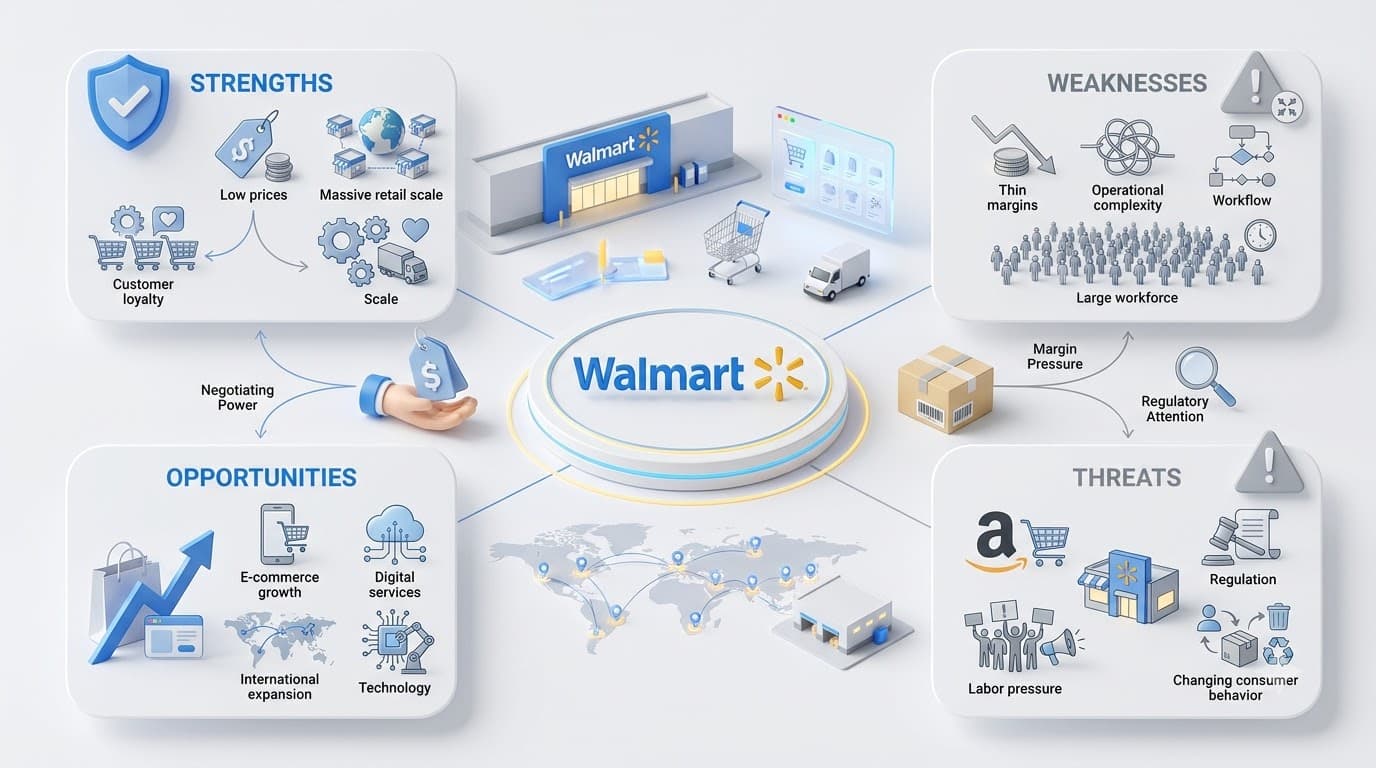
A SWOT analysis of Walmart is a structured breakdown of the company’s internal strengths and weaknesses alongside the external opportunities and threats shaping its future. It’s a framework, not a fixed checklist. Strengths and weaknesses come from inside the company, things like operations, culture, and financial position. Opportunities and threats come from outside, things like competitors, regulation, and consumer behavior. Walmart is one of the most instructive companies to run this exercise on because almost every factor connects to another. Its low prices create loyalty, but that same pricing model squeezes margins. Its scale gives it negotiating power, but that scale also makes it a bigger target for regulators and labor organizers.
How SWOT Analysis Works as a Business Framework
The framework was developed at Stanford in the 1960s, and it survived this long because it forces you to separate what a company controls from what it doesn’t. Strengths and weaknesses sit inside the business, think supply chain efficiency, employee turnover, or brand reputation. Opportunities and threats sit outside, think new markets, competitor moves, or changing laws. The mistake most people make is listing a factor under the wrong quadrant, like calling “competition from Amazon” a weakness when it’s actually a threat, since Walmart doesn’t control what Amazon does. Getting that distinction right matters because it changes how a company responds. You fix weaknesses internally. You manage threats externally, usually through strategy, partnerships, or diversification.
Why Walmart Is a Perfect Case Study for SWOT
Walmart works so well as a teaching example because it has genuine, well-documented strengths and genuine, well-documented weaknesses sitting side by side, not the kind of sanitized case study you’d find in a textbook written by the company itself. Its scale is real and measurable. Its labor controversies are real and public record, from wage lawsuits to unionization pushes at individual stores. Its e-commerce growth against Amazon is an ongoing, unresolved fight you can track quarter by quarter through earnings calls. That mix of hard data and open questions is exactly what makes a SWOT analysis of Walmart useful practice instead of a memorization exercise.
Walmart Company Overview

Walmart was founded by Sam Walton in Rogers, Arkansas, in 1962, built on a simple idea: buy in bulk, negotiate hard with suppliers, and pass the savings to customers through everyday low prices instead of relying on sales and discount events. That founding philosophy still shapes how the company operates today, more than six decades later, and it’s the thread that runs through nearly every strength and weakness in this analysis.
Walmart’s Business Model and Revenue Streams
Walmart’s core business model is high volume, low margin retail. It makes a small profit on each item, but it sells an enormous number of items, so the total profit adds up. For the fiscal year ending January 2024, Walmart reported total revenue of roughly $648 billion, with net income around $15.5 billion. That’s a net margin of about 2.4 percent, which sounds thin until you realize it’s applied across nearly $650 billion in sales. Revenue comes from three main segments: Walmart U.S. (the largest by far), Walmart International (stores across Mexico, Central America, China, and other markets), and Sam’s Club (the membership warehouse chain). Layered on top of physical retail is a fast growing digital layer: e-commerce sales, Walmart+ membership, and Walmart Connect, the company’s retail media advertising arm, which crossed $3.4 billion in global ad revenue in fiscal 2024.
Walmart’s Global Footprint
Walmart operates more than 10,500 stores and clubs under 46 different banners in 19 countries. In the U.S. alone, that includes Walmart Supercenters, Walmart Neighborhood Markets, and Sam’s Club locations, giving the company a physical presence within 10 miles of roughly 90 percent of the U.S. population. Internationally, Walmart’s biggest markets outside the U.S. are Mexico (through Walmex), Central America, Canada, and China, where it also holds a majority stake in the e-commerce platform JD.com’s rival, though its most significant international digital bet has been in India through Flipkart and PhonePe, acquired through its Flipkart Group holding. That footprint matters for this analysis because it explains both the scale strength and the international weakness discussed further down. Being everywhere gives Walmart leverage. It also means Walmart is exposed to currency swings, local regulation, and competitive dynamics in dozens of markets at once.
Strengths in the SWOT Analysis of Walmart
The strengths section of a SWOT analysis of Walmart is where the company’s scale really shows up in the numbers. These aren’t soft advantages, they’re structural ones, built over decades and genuinely hard for competitors to replicate. Here’s the thing though: each of these strengths also plants the seed for a weakness discussed later, so read this section with that connection in mind.
Massive Scale and Purchasing Power
Walmart’s sheer buying volume gives it negotiating leverage that almost no other retailer on earth can match. When Walmart orders inventory from a supplier, it’s often ordering enough to fill hundreds or thousands of stores at once, which lets it demand lower per-unit prices than a regional chain ever could. Suppliers frequently restructure their own production and packaging just to meet Walmart’s specifications, because losing a Walmart contract can mean losing a huge chunk of total revenue overnight. This dynamic is sometimes called the “Walmart effect,” and it’s been studied extensively because it doesn’t just affect Walmart, it resets pricing expectations across entire industries. A supplier that cuts a deal with Walmart at rock-bottom margins often has to offer similar pricing to other retailers just to stay competitive, which means Walmart’s negotiating power ripples outward into the whole supply chain.
Supply Chain and Logistics Network
Walmart runs one of the most sophisticated private logistics networks of any retailer in the world, built around a hub-and-spoke distribution model where regional distribution centers feed stores within a tight radius. The company operates over 200 distribution centers in the U.S. alone and uses its own trucking fleet, one of the largest private fleets in the country, to keep goods moving without relying entirely on third-party carriers. What most people miss is that Walmart invested heavily in this system decades before “supply chain” became a buzzword after COVID disruptions. That early investment is why Walmart was able to keep shelves stocked more reliably than many competitors during the 2020 to 2022 supply shocks. The company also uses data from every single checkout scan to forecast demand at the store level, which reduces overstock and understock problems that eat into margins for less data-driven retailers.
Everyday Low Price Strategy
Walmart’s pricing philosophy, everyday low prices instead of temporary sales events, is a genuine competitive moat because it trains customer behavior. Shoppers don’t wait for a Walmart sale the way they might wait for a department store clearance, they just assume the price is already competitive, which drives consistent foot traffic rather than spikes tied to promotional calendars. This matters more than it sounds like on paper. Retailers that rely on discount cycles have to manage inventory around those spikes, which adds complexity and cost. Walmart’s steady pricing model, backed by its purchasing power, lets it maintain consistent margins across the year instead of riding a rollercoaster of markdowns. It’s also a major reason Walmart performs well during economic downturns. When inflation squeezes household budgets, price-conscious shoppers who might normally go to a mid-tier department store trade down to Walmart, which is exactly what happened during the 2022 to 2023 inflation spike.
Omnichannel Retail and E-commerce Growth
Walmart’s e-commerce business used to be a genuine weakness relative to Amazon, but that’s changed fast. Global e-commerce sales crossed $100 billion for fiscal 2024, growing at a double digit rate, and a huge part of that growth comes from a strategy competitors can’t easily copy: using existing stores as mini fulfillment centers. Because Walmart already has thousands of physical locations close to where customers live, it can offer same-day delivery and curbside pickup without building an entirely new logistics network from scratch, the way a pure e-commerce player would have to. This is the same reason Walmart+ membership, its answer to Amazon Prime, has grown steadily since launching in 2020, offering free delivery, fuel discounts, and Paramount+ streaming bundled together. The combination of physical stores plus digital ordering, often called omnichannel retail, meaning customers can move between online and in-store shopping seamlessly, gives Walmart a flexibility Amazon has spent billions trying to replicate through Whole Foods acquisitions and physical store experiments.
Private Label Brands
Walmart’s private label portfolio, brands like Great Value, Equate, and Sam’s Choice, gives the company two advantages competitors relying purely on national brands don’t have. First, higher margins, since Walmart cuts out the branded manufacturer’s markup and controls production costs directly. Second, pricing leverage against national brands themselves, because Walmart can always point to a comparable Great Value product at a lower price if a supplier pushes back on wholesale terms during negotiations. Private label penetration across U.S. grocery retail has grown steadily for years, and Walmart’s Great Value line alone spans thousands of SKUs across food, household goods, and personal care. What most competitor analyses miss is that private label isn’t just a budget play anymore, Walmart has pushed some private brands, like its Bettergoods food line launched in 2024, upmarket to compete directly with premium grocery chains on quality perception, not just price.
Weaknesses in the SWOT Analysis of Walmart
Every one of Walmart’s strengths comes with a cost, and this section is where that cost shows up. Weaknesses in a SWOT analysis are internal, meaning they’re things the company itself has the power to change, even if change is slow or expensive. Walmart’s weaknesses are less about what it can’t do and more about tradeoffs baked into the business model it chose decades ago.
Thin Profit Margins
Walmart’s net margin sits around 2 to 2.5 percent, which is razor thin compared to specialty or premium retailers that can run margins of 10 percent or higher on far smaller revenue bases. This isn’t a flaw exactly, it’s the direct result of the everyday low price strategy discussed as a strength above, but it creates real fragility. A small increase in operating costs, whether from wage hikes, fuel prices, or tariffs on imported goods, eats through Walmart’s margin far faster than it would for a higher margin competitor. Thin margins also limit how much Walmart can invest in any single initiative without it showing up clearly in quarterly earnings, which is part of why the company moves cautiously and incrementally rather than making huge, risky bets the way some tech-driven competitors do.
Labor Practices and Employee Relations
Walmart has faced criticism and legal action over wages, scheduling practices, and working conditions for over two decades, and it remains one of the most scrutinized employers in the U.S. retail sector. The company raised its minimum starting wage multiple times in recent years, reaching an average hourly wage above $18 for U.S. store associates, but it still faces periodic unionization pushes, most notably at individual Sam’s Club and Walmart locations, and ongoing debate over how it uses part-time and variable scheduling. This matters for a SWOT analysis because labor disputes create reputational risk and operational risk at the same time. Reputational, because negative press around labor practices affects how younger, socially conscious consumers perceive the brand. Operational, because unionization efforts, if successful at scale, would change Walmart’s labor cost structure in a business model that depends heavily on keeping costs low.
Brand Perception in Premium Markets
Walmart’s brand identity is built entirely around value and low prices, which is a strength in mass market retail but a genuine weakness when the company tries to move upmarket. Attempts to sell higher end fashion, premium groceries, or lifestyle products under the Walmart name have historically underperformed compared to how the same products sell at Target, which has built a “cheap chic” reputation Walmart has never quite matched. This is a classic brand positioning problem: once a company owns a specific perception in the customer’s mind, in Walmart’s case “the lowest price,” it’s extremely hard to also own “trendy” or “premium” without confusing that core identity. Walmart’s answer has mostly been to acquire or partner rather than rebrand, for example through partnerships with fashion labels sold under separate sub-brands, but the core Walmart name still struggles to shake its discount store image in markets where shoppers care about status and design.
Overdependence on the US Market
Roughly 70 percent of Walmart’s total revenue still comes from its U.S. operations, which makes the company heavily exposed to U.S. specific risks: domestic inflation, U.S. labor law changes, tariff policy, and shifts in American consumer spending habits. Walmart International has grown, but it hasn’t grown fast enough to meaningfully rebalance that ratio, and some international markets, like Walmart’s exit from the UK’s Asda chain years ago and its retreat from certain European and Japanese markets, show that international expansion hasn’t always worked for the company. This concentration is a real vulnerability. A U.S. recession or a major domestic policy shift, like a significant minimum wage increase or new tariff structure, hits Walmart’s bottom line far harder than it would hit a more geographically diversified competitor like Amazon, which draws a larger share of revenue from cloud computing and international operations outside pure retail.
Opportunities in the SWOT Analysis of Walmart
Opportunities are external factors Walmart can capitalize on, growth areas that exist because of market shifts, technology changes, or gaps competitors haven’t filled yet. This is where Walmart’s strategy over the next five to ten years is genuinely interesting to watch, because the company is making real moves in each of these directions right now, not just talking about them in investor decks.
International Expansion in Emerging Markets
Emerging markets like India, parts of Southeast Asia, and Africa represent long-term growth potential Walmart hasn’t fully captured yet, mostly because retail infrastructure and e-commerce adoption in these regions are still maturing. Walmart’s biggest bet here is Flipkart, India’s leading e-commerce platform, which Walmart acquired a majority stake in for roughly $16 billion in 2018, along with PhonePe, India’s dominant digital payments app that Flipkart later spun off. India’s e-commerce market is projected to keep growing at a rapid pace through the rest of this decade as internet penetration and smartphone adoption climb in smaller cities, and Walmart is positioned early through Flipkart rather than trying to build a presence from scratch. The opportunity here isn’t just sales growth, it’s data and market position in a country of over 1.4 billion people before competitors lock in dominant share.
Growth in E-commerce and Walmart Plus
Walmart+ membership and the broader e-commerce push represent Walmart’s clearest opportunity to close the gap with Amazon on recurring, high-margin digital revenue. Subscription revenue behaves differently than transactional retail revenue, it’s predictable, it builds loyalty, and members who pay for delivery tend to shop more frequently across categories once they’re already paying for the service. Walmart has leaned into this by bundling Walmart+ with fuel discounts and a Paramount+ streaming subscription, directly mirroring Amazon Prime’s playbook of stacking perks that make cancellation feel like a bigger loss. The opportunity is scale: Walmart already has more physical locations than Amazon has fulfillment centers, which means its cost to deliver a same-day order from a nearby store can be lower than Amazon’s cost to ship from a regional warehouse, if Walmart executes the last-mile logistics well.
Advertising Business Walmart Connect
Walmart Connect, the company’s retail media advertising network, might be the single most underrated growth story in Walmart’s entire business right now. It lets brands pay to advertise directly on Walmart’s website, app, and even in-store digital screens, targeting shoppers using Walmart’s own purchase data, similar to how Amazon Ads works. Global advertising revenue for Walmart crossed $3.4 billion in fiscal 2024 and continues to grow at a rate far faster than the core retail business, because advertising revenue carries dramatically higher margins than selling physical goods. This is the opportunity every retail analyst is watching closely: if Walmart can grow Walmart Connect the way Amazon grew Amazon Ads into a multi-billion dollar profit engine, it gives Walmart a way to boost overall company margins without raising a single price tag in its stores.
Health and Wellness Services
Walmart has been quietly building out in-store health clinics, pharmacy services, and telehealth partnerships, positioning itself to capture a share of the massive U.S. healthcare spending market by making basic care more accessible and affordable in communities that are otherwise underserved by traditional healthcare providers. Walmart Health clinics, offering primary care, dental, and mental health services at transparent flat rates, launched in several states as a direct experiment in this space, though the company scaled back some clinic operations in 2024 after finding the economics tougher than expected. Even with that pullback, the underlying opportunity remains real: Walmart’s pharmacy network already serves millions of prescriptions a year, and bundling health services with existing store visits taps into the same everyday low price positioning that built the rest of the company, just applied to a completely different category.
Threats in the SWOT Analysis of Walmart
Threats sit outside Walmart’s direct control, but that doesn’t make them any less serious. This is the section where Walmart’s future looks the least certain, because these four factors could genuinely reshape the competitive landscape over the next decade regardless of how well Walmart executes internally.
Competition from Amazon and Discount Retailers
Amazon remains Walmart’s single biggest competitive threat, particularly in e-commerce, where Amazon still commands a larger share of total U.S. online retail sales despite Walmart’s growth. But the threat isn’t just Amazon at the top, it’s also discount retailers squeezing from below, chains like Dollar General, Dollar Tree, and fast-growing international entrants like Temu and Shein, which undercut Walmart on price for specific product categories using direct-from-manufacturer shipping models that skip traditional retail markup almost entirely. Walmart is caught in a pincer: Amazon competes on convenience and selection, discount chains compete on rock-bottom price, and Walmart has to defend both flanks at once without losing its core “everyday low price” identity in the middle.
Regulatory and Legal Challenges
Walmart’s scale makes it a constant target for regulatory scrutiny, ranging from antitrust concerns given its market share in specific regions, to labor law enforcement, to opioid-related litigation tied to its pharmacy operations, which resulted in a settlement of over $3 billion in 2022 related to its role in the opioid crisis. Tariff policy is another live threat: Walmart sources a significant share of its private label and general merchandise inventory from overseas manufacturing, particularly in China, which means shifts in U.S. trade policy directly affect its cost structure. Because Walmart’s margins are already thin, as covered in the weaknesses section, it has far less room to absorb sudden regulatory or tariff-driven cost increases without either raising prices, which risks its core positioning, or eating the cost, which risks its already slim profitability.
Economic Downturns and Inflation
It might seem strange to call economic downturns a threat when Walmart typically gains customers during recessions, as price-conscious shoppers trade down from pricier retailers. But the relationship is more complicated than that. Persistent inflation raises Walmart’s own operating costs, transportation, wages, and goods procurement, faster than it can always pass those costs on through prices without contradicting its everyday low price brand promise. During the 2022 to 2023 inflation period, Walmart actually saw a shift in customer spending toward lower margin essentials like groceries and away from higher margin discretionary categories like electronics and home goods, which hurt overall profitability even as total revenue and store traffic grew. In other words, more customers walking through the door doesn’t automatically mean more profit if they’re only buying the cheapest items on the shelf.
Supply Chain Disruptions
Walmart’s supply chain is a major strength, as covered earlier, but that same complexity makes it a real threat when things go wrong. Global shipping disruptions, port congestion, and geopolitical instability in manufacturing regions, particularly Southeast Asia and China, where a huge share of Walmart’s imported goods originate, can create ripple effects across the entire network. The 2021 to 2022 global shipping crisis, with container costs spiking several times over and ports backed up for weeks, showed how even a company with Walmart’s logistics sophistication can face stockouts and delayed shelves. Climate related disruptions add another layer, extreme weather events increasingly disrupt both manufacturing regions overseas and Walmart’s own domestic distribution routes, and that risk is only expected to grow, not shrink, over the coming years.
SWOT Analysis of Walmart Compared to Amazon, Target, and Costco
Looking at Walmart’s SWOT in isolation only tells half the story. What actually clarifies the picture is putting it next to its closest competitors, because Walmart’s strengths and weaknesses only mean something relative to what Amazon, Target, and Costco bring to the table.
| Factor | Walmart | Amazon | Target | Costco |
|---|---|---|---|---|
| Core strength | Physical scale, low prices | E-commerce, cloud (AWS) | Brand and design appeal | Membership loyalty, bulk pricing |
| Core weakness | Thin margins, U.S. dependence | Lower physical footprint density | Smaller scale, inventory misses | Limited product variety |
| Revenue model | Retail plus growing ad business | Retail plus AWS plus ads | Retail plus loyalty program | Membership fees plus retail |
| Biggest threat | Amazon and discount chains | Regulatory antitrust pressure | Walmart and Amazon on price | Sam’s Club (Walmart) directly |
The table makes something clear that a list of bullet points never quite captures: Walmart and Costco are locked in a direct rivalry through Sam’s Club, Walmart and Amazon are locked in a direct rivalry over e-commerce and advertising, and Target competes on a completely different axis, design and brand experience, rather than trying to out-price Walmart at all. Amazon’s threat to Walmart is existential in the sense that it questions whether physical retail scale still matters in a digital-first world. Costco’s threat is narrower but sharper, it proves that a smaller, curated inventory with a membership model can out-earn Walmart on margin percentage even with a fraction of the store count.
Mistakes People Make When Doing a SWOT Analysis of Walmart
Writing this kind of analysis sounds simple until you actually sit down and try to do it well. A few mistakes show up constantly in student papers, case study assignments, and even some published business articles, and they’re worth naming directly.
Confusing Strengths With Opportunities
The most common error is listing something like “growing e-commerce” as a strength when it’s really an opportunity Walmart is actively pursuing, not something it already fully owns the way it owns its physical store network. A strength is something the company has already built and controls today. An opportunity is something the company could capture in the future if it executes well. Walmart’s e-commerce infrastructure, existing stores used as fulfillment hubs, is the strength. Growing that e-commerce share to match or beat Amazon is the opportunity. Keeping that distinction straight changes how useful the analysis actually is.
Treating Competitors as Weaknesses
A related mistake is writing “Amazon” or “competition” directly under the weaknesses column. Competitors are external, which makes them threats, not weaknesses, no matter how much pressure they apply. The weakness is whatever internal factor makes Walmart vulnerable to that competitor, for example, its slower historical e-commerce infrastructure or its thinner margins that limit how aggressively it can price-match. Getting this right isn’t just semantics, it changes the entire recommendation section of a business analysis, because you fix weaknesses through internal investment and you respond to threats through strategy and positioning.
Ignoring How Factors Interact
The weakest SWOT analyses treat all four quadrants as separate, disconnected lists. The strongest ones show how a strength creates a weakness, and how a weakness creates exposure to a threat. Walmart’s everyday low price strategy, a strength, is directly responsible for its thin profit margins, a weakness, which is directly responsible for its limited ability to absorb tariff and inflation shocks, a threat. Writing a SWOT analysis of Walmart without tracing those connections misses the entire point of the framework, which exists to help you think through cause and effect, not just categorize facts.
Key Lessons From the SWOT Analysis of Walmart for Marketers and Students
Beyond the academic exercise, there’s real strategic value in what Walmart’s case teaches, whether you’re studying for a business class or actually working in marketing and strategy right now.
Positioning Discipline Is a Long-Term Asset
Walmart has stayed relentlessly consistent on one message, everyday low prices, for over six decades, and that consistency is exactly why the brand is so hard to dislodge from customers’ minds even when competitors match or beat individual prices on specific items. Most companies chase every trend and end up standing for nothing specific. Walmart’s discipline is a lesson in what focused positioning actually looks like over the long run, and it’s the same principle covered in more depth in a structured digital marketing course if you want to study positioning strategy beyond a single case.
Scale Creates Its Own Vulnerabilities
Every advantage Walmart has, its size, its supply chain, its pricing power, also creates a corresponding weakness or exposure. That pattern isn’t unique to Walmart, it shows up in almost every large organization, and recognizing it early is genuinely useful whether you’re analyzing a Fortune 500 company or building your own small business. Growth without an honest look at the tradeoffs it creates tends to catch companies off guard later, which is a theme that comes up constantly in real case studies across industries, not just retail.
Diversifying Revenue Protects the Core Business
Walmart’s push into advertising through Walmart Connect and its expansion into health services both point to the same underlying strategy: reduce dependence on thin-margin core retail by building higher margin revenue streams around it. This is a pattern worth studying regardless of company size, because the underlying logic, protect a low margin core business by layering higher margin services on top, applies just as well to a small business owner thinking through new revenue streams as it does to a $650 billion retailer.
Conclusion
A SWOT analysis of Walmart isn’t just a business school exercise, it’s a genuinely useful way to understand how a company this large stays competitive while carrying real structural weaknesses at the same time. Walmart’s scale, supply chain, pricing discipline, and private label strategy built the empire. Its thin margins, labor tensions, brand ceiling in premium markets, and heavy U.S. dependence keep that empire from being invincible. The opportunities in international markets, e-commerce, advertising, and health services show where Walmart is placing its bets for the next decade, and the threats from Amazon, regulation, inflation, and supply chain risk show exactly what could slow those bets down. If you’re studying this case for a class, a job interview, or your own curiosity about how giant retailers actually work, the real skill isn’t memorizing the four boxes, it’s understanding how each one feeds into the next.
Frequently Asked Questions
What is a SWOT analysis of Walmart?
A SWOT analysis of Walmart is a structured evaluation of the company’s internal strengths and weaknesses, like its purchasing power and thin profit margins, alongside external opportunities and threats, like international expansion and competition from Amazon. It helps explain why Walmart succeeds in certain areas and struggles in others.
What are Walmart’s biggest strengths?
Walmart’s biggest strengths are its massive purchasing power, its efficient supply chain and distribution network, its everyday low price strategy, its growing omnichannel retail presence, and its private label brand portfolio. Each of these has been built over decades and is difficult for competitors to replicate at the same scale.
What are Walmart’s main weaknesses?
Walmart’s main weaknesses include razor thin profit margins around 2 to 2.5 percent, ongoing labor and wage related criticism, a brand image that struggles to compete in premium or trend-driven retail segments, and heavy revenue dependence on the U.S. market, which accounts for roughly 70 percent of total sales.
Is Amazon a threat or a weakness in Walmart’s SWOT analysis?
Amazon is a threat, not a weakness, because it’s an external company outside Walmart’s control. The actual weakness is whatever internal factor makes Walmart vulnerable to Amazon’s pressure, such as historically slower e-commerce infrastructure or thinner margins that limit aggressive price matching.
How does Walmart make money besides selling products?
Walmart earns additional revenue through Walmart+ membership subscriptions, Sam’s Club membership fees, and its fast-growing advertising business, Walmart Connect, which lets brands pay to advertise on Walmart’s website, app, and in-store screens. Walmart Connect alone generated over $3.4 billion in fiscal 2024.
Why does Walmart struggle in premium retail markets?
Walmart struggles in premium markets because its brand identity is built entirely around low prices and value, which makes it hard for customers to also see it as trendy or high quality. Competitors like Target have built a stronger reputation for design and style, positioning that’s difficult for Walmart to claim without confusing its core low price message.
What is Walmart Connect and why does it matter?
Walmart Connect is Walmart’s retail media advertising network, allowing brands to target ads to shoppers using Walmart’s own purchase data, similar to Amazon Ads. It matters because advertising revenue carries much higher margins than physical retail sales, giving Walmart a way to grow profitability without raising prices.
How is Walmart different from Costco in a SWOT comparison?
Walmart competes on broad retail scale and everyday low prices across general merchandise and groceries, while Costco competes through a membership fee model with a smaller, curated inventory and famously thin markups. Costco often earns a higher margin percentage despite operating far fewer locations than Walmart.
What opportunities is Walmart currently pursuing?
Walmart is currently pursuing growth in emerging markets like India through its Flipkart and PhonePe holdings, expanding Walmart+ membership and e-commerce delivery, scaling its Walmart Connect advertising business, and testing in-store health and wellness services, including pharmacy and telehealth expansion.
What are the biggest threats facing Walmart right now?
The biggest threats facing Walmart include intensifying competition from Amazon and low-cost entrants like Temu and Shein, regulatory and legal risk tied to its scale and pharmacy operations, inflation and economic downturns that shift customer spending toward lower margin essentials, and ongoing global supply chain disruption risk.
Why do Walmart’s low prices also count as a weakness?
Walmart’s low price strategy is a strength for driving customer loyalty and store traffic, but it’s also the direct cause of its razor thin profit margins, since the company deliberately keeps prices low rather than maximizing markup. That thin margin limits how much financial cushion Walmart has to absorb rising costs from inflation, tariffs, or wage increases.
Can a small business use the same SWOT framework as Walmart?
Yes, the SWOT framework works at any company size because it’s based on the same four questions regardless of scale: what do you do well, where are you exposed, what growth is available, and what could hurt you from the outside. A small business can run the exact same exercise Walmart’s leadership team runs, just with smaller numbers attached to each factor.