


Walk into any mobile shop in a small Indian town, tier two or tier three, and there is a very good chance the first poster you see on the wall is a Vivo poster. Not Samsung. Not Apple. Vivo. That single observation tells you more about how this company built its business than any annual report ever could. While Samsung was fighting Apple for headlines in metro cities, Vivo was quietly signing up thousands of local retailers, training them, giving them margins that made them loyal, and turning tier two and tier three India into its fortress.

That strategy is exactly why a SWOT Analysis of Vivo is worth doing properly, not as a textbook exercise but as a real look at how a company most people underestimate has ended up leading India’s smartphone market for seven straight quarters. Vivo shipped 32.1 million units in India in 2025 alone and has held the number one spot with somewhere between 20 and 24 percent market share through most of 2025 and early 2026, depending on which research firm’s numbers you trust, Counterpoint or Omdia. That is not a fluke. That is distribution, positioning, and pricing discipline working together.
But this is not a company without scars. Vivo has been through a brutal fight with India’s Enforcement Directorate over alleged tax evasion running into thousands of crores, it carries a brand image many consumers still associate more with selfie cameras than serious performance, and it operates in a market where margins get thinner every single quarter. A proper SWOT Analysis of Vivo has to hold both of these realities at once: a company that dominates shipment charts and a company that is constantly one regulatory headline away from a serious setback.
Most people who write about smartphone brands stop at the product. Which chipset, which camera sensor, which display panel. That is the least interesting part of Vivo’s story. The interesting part is how a company nobody expected to win, competing against Samsung’s global reputation and Apple’s aspirational pull, ended up owning the exact segment of buyers that actually decides most of India’s smartphone volume: people buying their second or third phone, walking into a local shop, asking the guy behind the counter what he’d recommend.
This guide is not going to give you a generic four-box SWOT chart and call it a day. I want to actually explain the mechanics behind each strength, each weakness, each opportunity, and each threat, the way I would break down any brand case study for a student trying to understand how real companies actually compete. If you are studying marketing, working in retail or brand strategy, or you just want to understand why Vivo phones are everywhere in India while a “better” phone on paper sits unsold, this is for you.
What You Will Learn in This Guide
- How Vivo’s offline retail network became its single biggest competitive weapon, and why competitors still can’t copy it fast enough.
- The real story behind Vivo’s camera-first brand positioning and why it is both a strength and a limitation at the same time.
- What the Enforcement Directorate case against Vivo actually alleges, and how it has shaped the company’s operations in India since 2022.
- Where Vivo’s genuine growth opportunities sit right now, from the premium segment to its sub-brand iQOO.
- Which competitors pose the sharpest threat to Vivo’s lead, and why the smartphone market’s shrinking margins matter more than any single rival.
- The practical lessons marketers and business students can pull from Vivo’s playbook, good and bad.
Understanding the SWOT Analysis of Vivo Before We Go Deeper
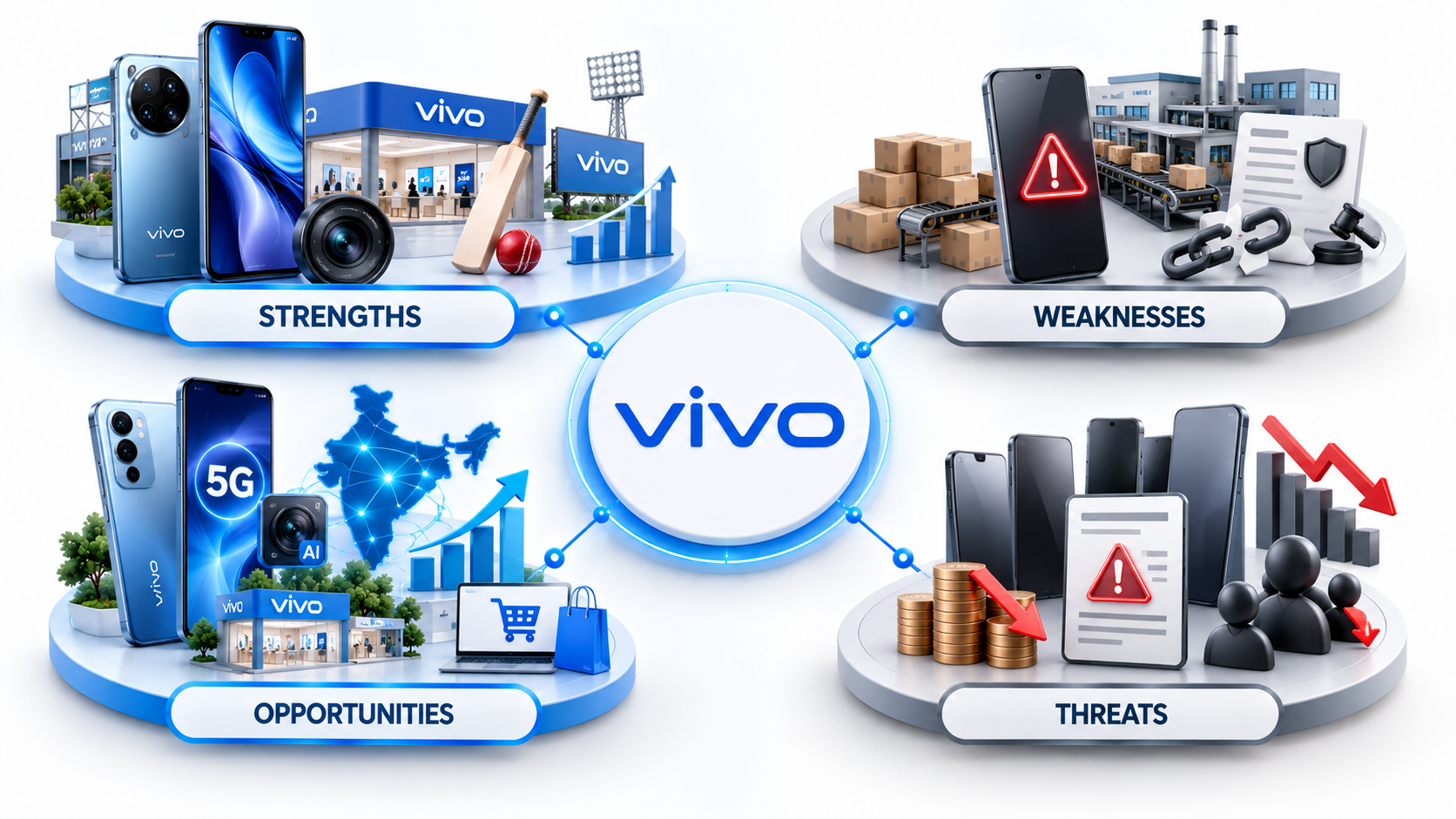
Before breaking down the individual strengths, weaknesses, opportunities, and threats, it helps to be clear on what this framework is actually doing and why Vivo is such a rich company to run it on.
What a SWOT Framework Actually Does
SWOT stands for Strengths, Weaknesses, Opportunities, and Threats. Strengths and weaknesses are internal, they are things the company controls directly: its factories, its retail relationships, its product design choices, its brand reputation built over a decade. Opportunities and threats are external, things happening in the market that the company does not control but has to react to: government policy, competitor moves, shifts in what consumers want to spend money on. A lot of people flatten this distinction and just list “good things” and “bad things” under each box, which misses the entire point. The internal versus external split is what makes SWOT useful for actually deciding what to do next, not just describing a company.
For a business case study to be useful, you cannot stop at listing four boxes. You have to explain why each point exists, what caused it, and what it means for the company’s next move. That is the standard I am holding this article to. If I write “strong brand” without telling you what specifically makes the brand strong and where that strength came from, I have wasted your time.
Why Vivo Specifically Deserves a Full Case Study
Most SWOT analyses you find online for smartphone brands read the same way whether they are about Samsung, Apple, or Xiaomi: “innovative products, strong brand, faces competition, currency risk.” That tells you nothing. Vivo is genuinely different from its rivals in how it built market share, and that difference is what makes this worth studying properly.
Vivo did not win India by outspending Samsung on advertising or by having the best chipset on paper. It won by building the deepest offline retail network of any Chinese smartphone brand in the country, by sponsoring cricket at a scale almost no other phone brand has matched, and by pricing its camera-heavy phones exactly where value-conscious buyers in smaller cities could stretch their budget to reach. At the same time, it has been dragged through one of the most serious financial crime investigations any consumer electronics company in India has faced. That combination of retail genius and regulatory chaos is rare, and it is exactly the kind of case that teaches you more about real-world strategy than a clean textbook example ever could.
Vivo Company Background
You cannot judge Vivo’s strengths and weaknesses in a vacuum. You need to know where the company came from and how it actually operates today.
How Vivo Built Its India Business From Scratch
Vivo is a Chinese electronics company under the BBK Electronics umbrella, the same parent group that owns Oppo, OnePlus, and Realme, which itself tells you something important: a huge chunk of the phones you see in Indian shops trace back to one holding structure competing with itself across different price points and brand names. Vivo entered India in 2014, at a time when Samsung and Micromax were the names everyone knew and Chinese brands were still seen as unreliable knockoffs by a lot of Indian buyers.
Instead of trying to win in metro cities first, Vivo made an early bet on offline retail in smaller towns, a bet almost nobody else was making with the same intensity at the time. It opened its own manufacturing facility in Greater Noida, Uttar Pradesh, in 2015, one of the earliest large-scale “Make in India” commitments from a Chinese smartphone brand, well before it became a political talking point. That factory now produces the overwhelming majority of the phones Vivo sells in India, which matters for cost control, import duty exposure, and its ability to say, with some legitimacy, that it is manufacturing locally rather than just assembling imported components.
Where Vivo Stands in the Market Today
By 2025 and into 2026, Vivo was not just competing in India, it was leading it. According to Omdia’s year end report, Vivo shipped 32.1 million smartphones in India in 2025, holding roughly 21 percent market share for the full year and finishing ahead of Samsung, Oppo, Xiaomi, and Apple. Counterpoint Research’s quarterly tracking shows a similar pattern through late 2025 and early 2026, with Vivo’s share moving between 20 and 24 percent depending on the quarter, and Omdia specifically noted Vivo held the number one position for seven consecutive quarters heading into 2026, driven heavily by its volume-focused Y and T series alongside stronger performance from its V and X series in the mid-premium segment.
That leadership is not limited to India either. Vivo, together with its BBK sibling brands, competes seriously in Southeast Asia, parts of Africa, and increasingly in Europe and the Middle East, though India remains its single largest and most strategically important market outside China itself. Understanding that India-first weighting is essential to the rest of this SWOT Analysis of Vivo, because almost every strength, weakness, opportunity, and threat below plays out most intensely on Indian soil.
Strengths
Here is the thing about Vivo’s strengths: none of them are flashy in the way “revolutionary chipset” or “best display technology” sound flashy. They are operational. They are boring in the way that actually matters for winning a mass market, and that is exactly why competitors have struggled to copy them fast enough to matter.
An Offline Retail Network Almost No Rival Can Match
Vivo’s biggest strength, by a wide margin, is its offline retail presence. The company has spent over a decade building relationships with tens of thousands of local mobile retailers across India, from major electronics chains down to single-counter shops in towns most marketing case studies never mention. It does not just sell phones to these retailers, it trains their staff, provides in-store branding material, runs retailer incentive schemes, and keeps margins attractive enough that a shopkeeper in a small town has real financial reasons to push a Vivo phone over a competitor sitting right next to it on the same shelf.
This matters enormously in a market where a huge share of first-time and repeat smartphone buyers still walk into a physical shop, ask the shopkeeper “which phone is good,” and trust the answer they get. Online research and reviews matter more every year, sure, but for a massive segment of India’s population, especially outside the top eight cities, the retailer’s word still closes the sale. Samsung and Apple have strong retail too, but Vivo’s network reaches deeper into smaller towns with more density than almost anyone except its own BBK siblings Oppo and Realme. That depth is the direct reason Vivo could lead the market for seven consecutive quarters even while facing serious regulatory pressure at the same time, something almost no other major consumer brand in India has managed to survive without visible damage to sales.
Camera and Design Positioning That Actually Resonates
Vivo built its entire consumer identity around camera quality and design, particularly selfie camera performance, long before “camera phone” became a crowded marketing claim every brand makes. Its V series in particular has been marketed almost exclusively around portrait photography and selfie performance, targeting younger buyers who care more about how they look in a photo posted to Instagram than about benchmark scores in a tech review.
This is not just a marketing claim, it is backed by real product decisions: dedicated front camera hardware investment, partnerships with imaging technology firms, and design choices like slimmer bodies and premium finishes even on mid-range phones. When a 22-year-old in a tier two city is choosing between two phones at a similar price, and one has a noticeably better selfie camera with visibly softer skin tones and better low light selfies, that decision often gets made on the spot in the shop, phone in hand, comparing selfies side by side. Vivo built its whole mid-range strategy around winning exactly that moment.
Deep Local Manufacturing Through the Greater Noida Facility
Vivo’s Greater Noida manufacturing plant is not a token gesture, it is one of the largest smartphone manufacturing facilities in India, employing tens of thousands of workers and producing the vast majority of the phones Vivo sells domestically. That local manufacturing base gives Vivo two very real advantages. First, it reduces exposure to import duties that hit fully assembled imported phones far harder than locally assembled ones, which directly protects Vivo’s pricing power in the price-sensitive segments where it competes hardest. Second, it gives the company political cover during a period when the Indian government has been actively scrutinizing Chinese-owned businesses, since Vivo can point to thousands of Indian jobs and a genuine domestic manufacturing footprint rather than being purely an importer.
This matters more than it might seem on the surface. Government policy toward Chinese companies operating in India tightened sharply after the 2020 border tensions, and brands without a credible local manufacturing story have found it much harder to defend themselves politically and reputationally. Vivo’s factory gives it a real answer, even while it is simultaneously fighting a massive regulatory case, which we will get into under weaknesses.
Cricket Sponsorship That Bought Massive Brand Visibility
Vivo’s sponsorship of the Indian Premier League, one of the most watched sporting events in the country, gave the brand a level of visibility that money alone rarely buys this efficiently. For several years Vivo’s logo was on the front of every player’s jersey in the IPL, appeared on every boundary board, and got mentioned by commentators dozens of times per match across a tournament watched by hundreds of millions of people. That kind of repeated exposure, tied to a sport that genuinely obsesses a huge share of the Indian population, builds brand familiarity that is very hard to replicate through digital advertising alone.
Cricket sponsorship also did something subtler: it made Vivo feel like an Indian brand to a lot of consumers, even though it is a Chinese company. Seeing a logo on the jersey of the Indian cricket team, match after match, year after year, creates a kind of emotional association that pure advertising rarely achieves. This is exactly the kind of brand-building play I’d point students toward when talking about <a href=”https://admeducation.com/learn/digital-marketing/”>broader digital marketing strategy</a>, because sponsorship of this scale is really an offline-to-online funnel: it drives search volume, retail footfall, and word of mouth all at once, not just passive brand awareness.
Weaknesses
Strengths get you to the top. Weaknesses are what put you at risk of staying there or falling off it fast, and Vivo has some serious ones that any honest case study has to cover in full, not gloss over.
The Enforcement Directorate Case Is a Genuine Existential Risk
This is the single biggest weakness in any honest SWOT Analysis of Vivo, and frankly most case studies online skip over it or mention it in one throwaway line. Since July 2022, Vivo India has been under investigation by India’s Enforcement Directorate on allegations that it illegally remitted roughly Rs 62,476 crore, close to 50 percent of its total sale proceeds in India, mainly to China, in order to avoid paying taxes here. The ED conducted raids at 44 to 48 locations across multiple states, seized bank balances, gold bars, and cash, and later filed a formal charge sheet under the Prevention of Money Laundering Act naming Vivo India along with a network of 23 associated shell companies.
The case escalated over the following two years. The ED arrested several senior Vivo India executives, including at one point the company’s interim CEO and CFO, on charges connected to illegal remittances and the alleged creation of shell companies used to move money out of the country. Vivo’s bank accounts were frozen at one point, and the company only regained access after Delhi High Court intervention, conditional on depositing a bank guarantee running into hundreds of crores and maintaining a minimum balance while submitting full remittance data to the ED. Vivo has consistently maintained it firmly adheres to legal compliance and ethical principles, and the case remains under judicial process rather than concluded, but the reputational and operational damage of years of raids, arrests, and frozen accounts cannot be waved away as background noise. A company that leads its market can still be one adverse court ruling away from a genuinely disruptive setback, and that risk sits over every other line item in this analysis.
Brand Perception Stuck at “Camera Phone, Not Performance Phone”
The same positioning that made Vivo strong in the mid-range mass market has become a limitation as it tries to move upmarket. A huge segment of Indian consumers, particularly the tech-literate crowd that reads reviews and compares benchmark scores, still associates Vivo primarily with selfie cameras and stylish design rather than raw performance, gaming capability, or software polish. This perception was earned honestly through years of consistent marketing, but it now works against the brand when it tries to sell its premium X series or push into segments where buyers care more about chipset performance and sustained gaming benchmarks than portrait mode quality.
Compare this to how OnePlus, a sibling brand under the same BBK umbrella, built its identity around performance and “flagship killer” value from day one. That contrast is not accidental, it reflects a deliberate brand architecture decision by BBK to let different sub-brands own different consumer perceptions, but it does mean Vivo specifically has to work much harder and spend much more to convince performance-focused buyers to even consider it, even when the underlying hardware in a given generation is genuinely competitive on paper.
Software Experience and After-Sales Service Gaps
Vivo’s Funtouch OS and its newer Origin OS software layer have historically trailed the polish and update consistency offered by Samsung’s One UI or even some of its closest Chinese rivals. Pre-installed bloatware, inconsistent update timelines across different phone models, and occasional software bugs have been recurring complaints in user reviews and forums for years. For a company that has built its identity around a premium feeling design and camera experience, a clunky or bloated software layer undercuts that positioning the moment a buyer actually starts using the phone daily rather than just looking at it on a store shelf.
After-sales service is a related weak spot. While Vivo has expanded its authorized service center network significantly, especially in the tier two and tier three towns where it dominates sales, actual customer experience with repair turnaround times and spare parts availability still varies a lot depending on location. In a market as price-sensitive and word-of-mouth driven as India’s smaller towns, a single bad repair experience travels through a local community fast, and it directly undercuts the retail trust Vivo worked so hard to build in the first place.
Heavy Reliance on Offline Retail Margins Squeezes Profitability
The retail network that is Vivo’s greatest strength also creates a structural cost problem. Maintaining loyalty across tens of thousands of independent retailers requires meaningful margin sharing, retailer incentive payouts, and continuous in-store marketing spend, none of which shows up as a flashy line item but all of which eats directly into profitability on every single unit sold. Online-first competitors like Xiaomi, at least in their earlier growth years, and even Realme to some extent, built leaner cost structures by skipping large chunks of this offline overhead.
As India’s online smartphone buying share keeps climbing, especially among younger, urban, and increasingly even semi-urban buyers, Vivo’s cost structure built around offline retail dependency becomes a harder balancing act. It cannot simply abandon the retail network that built its market leadership, but it also cannot ignore the fact that leaner online-first rivals can undercut it on price in categories where offline retail margin sharing is not part of the cost equation at all.
How Vivo Compares to Its Closest Rivals
No SWOT Analysis of Vivo is complete without putting the numbers next to the two rivals it actually fights hardest, Samsung and its own sibling brand Oppo, because the story changes a lot depending on which one you are measuring against.
Vivo vs Samsung: Retail Reach Against Global Brand Trust
Samsung has held second place in India’s smartphone market through most of 2025 and early 2026, generally sitting somewhere between 15 and 17 percent share against Vivo’s 20 to 24 percent. On paper that gap looks like Vivo simply outselling Samsung, but the more useful way to read it is that the two brands are winning different kinds of trust. Samsung carries global brand equity that Vivo does not have, decades of being the default “safe” Android choice, a reputation for longer software support, and stronger performance in the premium segment through its Galaxy S and Z Fold lines. Vivo does not really compete there yet, and it does not need to, because its win condition is volume in the mid-range and budget segments where Samsung’s own A-series has to fight hard just to hold its ground.
The interesting shift to watch is Samsung’s late-quarter momentum from new Galaxy S26 launches and refreshed A-series models pushing its share back up in Q1 2026 after a period of decline. That tells you Samsung is not conceding the volume segment quietly, it is using flagship halo effect to pull buyers down into its budget lineup too. If Samsung keeps closing that gap, Vivo’s response will almost certainly be to push its own mid-premium X and V series harder rather than compete purely on price, which is exactly the kind of segment-by-segment battle a real case study needs to track quarter over quarter, not just glance at once and assume the picture is static.
Vivo vs Oppo and the Internal BBK Competition
Here is a detail most surface-level SWOT breakdowns miss entirely: one of Vivo’s fastest-growing threats is not an outside competitor at all, it is Oppo, a brand controlled by the very same BBK Electronics parent group. Oppo posted the fastest year-on-year growth of any major brand in Q1 2026, jumping from 12 to 15 percent share on strong demand for its A6x, K14, and Reno 15 series, essentially eating into the exact budget and mid-range territory Vivo has always considered its home turf.
This internal competition is not necessarily a coordinated strategy from BBK’s side, sibling brands under the same parent group often do compete somewhat independently for market share, sourcing similar components and occasionally even similar designs, but it does mean Vivo cannot treat its BBK relationship as a safety net. If anything, the fact that Oppo is closing the gap using nearly identical playbook moves, aggressive mid-range specs, strong camera marketing, and local retail investment, proves how replicable parts of Vivo’s own strategy actually are once a well-funded rival decides to copy it seriously. That is a threat worth taking as seriously as any external one, maybe more, because Oppo already has access to a lot of the same supply chain and manufacturing efficiencies Vivo relies on.
Opportunities
Now to the part of this SWOT Analysis of Vivo that gets less attention than the drama around the ED case, but honestly matters just as much for where the company goes from here.
India’s Growing Premium and Mid-Premium Smartphone Segment
For years the Indian smartphone market was defined almost entirely by the budget and entry-level segments, phones priced under Rs 15,000 accounting for the bulk of shipments. That is changing. The premium segment, phones priced above Rs 30,000, and the mid-premium band in between, have both been growing faster than the overall market for several consecutive years, driven by rising incomes, easier financing options through EMI schemes, and a first generation of smartphone buyers now upgrading for the second or third time with more money to spend and higher expectations.
This shift plays directly to an opportunity Vivo has been actively chasing through its X series and its V-series’ push upmarket, backed by Counterpoint’s own observation that Vivo’s Q1 2026 share gains came partly from stronger traction in the mid-premium segment specifically, not just its usual budget volume plays. If Vivo can convert even a modest share of its enormous existing customer base, people who bought a budget Vivo phone five years ago and are now ready to spend more, into premium segment buyers, that alone represents a meaningful revenue upgrade without needing to win a single new customer from a competitor.
5G Expansion and the Next Wave of Network Upgrades
India’s 5G rollout has moved from early adopter novelty to mainstream expectation extremely fast, and phone buyers increasingly treat 5G capability as table stakes rather than a premium feature, even in the budget segment. Vivo has been aggressive here, and its own market commentary specifically credits 5G-capable models in its Y and T series for driving volume in recent quarters. As 5G network coverage keeps expanding beyond metro cities into smaller towns, the exact geography where Vivo’s retail network is strongest, demand for affordable 5G phones in those markets is likely to keep climbing.
This is a genuine first-mover advantage opportunity, because Vivo’s retail relationships in smaller towns mean it can get 5G-capable budget phones onto physical shelves in places where competitors without the same retail depth simply cannot match its distribution speed. Being the phone people can actually walk into a shop and buy, rather than the phone they have to order online and wait for, matters enormously the moment 5G becomes a genuine draw rather than a marketing buzzword in these markets.
iQOO’s Growth as a Performance-Focused Sub-Brand
Vivo created iQOO specifically to solve its own weakness: the perception problem around performance and gaming that its main brand struggles to shake. iQOO has carved out real traction among younger, more tech-savvy buyers by leaning hard into gaming performance, high refresh rate displays, and aggressive price-to-spec positioning, essentially running the “flagship killer” playbook that made OnePlus’s early reputation, but under a name Vivo controls entirely.
The opportunity here is straightforward but significant: iQOO lets Vivo compete for the performance-focused buyer segment without diluting or confusing the camera and design identity the main Vivo brand has spent a decade building. Every rupee of iQOO’s growth is, in a sense, Vivo’s parent group defending against exactly the weakness described earlier in this SWOT Analysis of Vivo, and as iQOO’s brand recognition keeps climbing among students and young professionals, it becomes an increasingly important second engine of growth rather than a side experiment.
Capturing India’s Growing Online-First Buyer Segment
Even as Vivo’s core strength remains offline retail, ignoring the online channel entirely would be a mistake, and to its credit the company has not ignored it. India’s e-commerce smartphone sales, driven by Flipkart and Amazon sales events in particular, now account for a substantial and growing share of total shipments, especially among younger urban buyers comparing specs and reviews before ever walking into a store. Vivo has started running online-exclusive models and sale-event-specific pricing to capture this segment without cannibalizing its offline retail relationships.
The real opportunity is in getting this balance right rather than treating online and offline as competing channels. A buyer who researches a Vivo phone online, reads reviews, watches a comparison video, and then walks into a local shop to actually see and buy the phone in person, represents the exact hybrid buying journey that defines most of India’s smartphone market today. Brands that understand and design for that hybrid journey, rather than picking one channel and starving the other, are the ones set up to keep growing as buyer habits keep shifting. This is exactly the kind of channel strategy thinking I’d point anyone studying <a href=”https://admeducation.com/learn/case-studies/”>real brand case studies</a> toward, because the theory only becomes useful once you see how a specific company actually executed it.
Threats
Every strength Vivo has built sits next to a threat trying to erode it. Here is what actually keeps this leadership position fragile.
Intense Competition From Samsung, Xiaomi, Oppo, Realme, and OnePlus
Vivo’s lead is real but it is not comfortable. Samsung has consistently held the second position through 2025 and early 2026, backed by a globally trusted brand and its own aggressive push into the A-series budget lineup specifically to compete for the same price-sensitive buyers Vivo has traditionally owned. Oppo, Vivo’s own BBK sibling, posted the fastest year-on-year growth of any major brand in Q1 2026, jumping from 12 to 15 percent market share on the back of strong A6x, K14, and Reno 15 series sales, which means Vivo is now facing serious internal competition from within its own parent group, not just external rivals.
Xiaomi remains a persistent budget segment threat even after some recent share softness, Realme continues to chase the same younger, value-conscious buyer that Vivo’s Y series targets, and OnePlus, again a BBK sibling, keeps pulling performance-focused buyers away from anyone without a genuinely competitive chipset story. When four or five serious competitors are all fighting for overlapping segments of the same market at the same time, even a market leader has to keep innovating and pricing aggressively just to defend the position it already holds, and there is no version of this competitive landscape that gets easier for Vivo in the next few years.
Regulatory Scrutiny of Chinese-Owned Companies in India
The ED case against Vivo did not happen in isolation, it happened as part of a much broader tightening of Indian government scrutiny toward Chinese-owned businesses following the 2020 border tensions with China. Xiaomi has faced its own FEMA-related seizure of over Rs 5,500 crore, Oppo has been hit with a customs duty evasion notice worth thousands of crores, and the pattern across the industry suggests this is not a one-off targeted action against Vivo specifically but a sustained policy stance that any Chinese-owned smartphone brand operating in India has to navigate for the foreseeable future.
This threat matters because it is not something Vivo’s marketing team or retail network can solve. It sits at the level of government policy and bilateral relations between India and China, both of which can shift with little warning based on factors that have nothing to do with how good Vivo’s next camera phone is. A brand that built its entire India strategy around deep local manufacturing and retail investment is still fundamentally exposed to geopolitical decisions made far outside its control, and that is a threat every serious analyst covering this space has to keep front and center rather than treating as a footnote.
Shrinking Margins in a Price War That Never Really Ends
India’s smartphone market has been through repeated rounds of price hikes recently, driven by rising memory and component costs alongside currency pressures, and Counterpoint’s own market data shows India’s overall smartphone shipments actually declined 11 percent year on year in Q2 2026, driven specifically by affordability pressure delaying upgrade purchases across the board. When the overall pie is shrinking or growing slowly, competition for market share within it gets sharper, not softer, and that typically means thinner margins for everyone fighting to hold or grow their position.
Vivo’s dependence on the budget and mid-range segments, where price sensitivity is highest and buyers will switch brands over a few hundred rupees of difference, puts it directly in the path of this margin pressure. Unlike Apple, which can protect margins through a premium-only strategy, or a purely online brand with lower distribution costs, Vivo has to defend both its retail relationships and its pricing at the same time, in a market where component costs keep climbing and buyers keep getting more price-conscious rather than less. That squeeze is one of the more underappreciated threats in any honest SWOT Analysis of Vivo, because it does not make headlines the way a regulatory raid does, but it steadily erodes profitability every single quarter it continues.
Currency Depreciation and Rising Component Costs
Market reports covering Q1 2026 specifically flagged rupee depreciation and inflation as contributing factors behind India’s overall smartphone shipment decline, alongside global memory chip shortages that pushed component costs up across the entire industry, not just for Vivo. Because a large share of the components going into even a locally assembled phone, chipsets, memory, camera sensors, display panels, are still priced in dollars or sourced through international supply chains, a weaker rupee quietly increases Vivo’s cost base even when nothing about its retail strategy or product line has changed at all.
This is the kind of threat that rarely gets its own headline the way a regulatory raid does, but it compounds silently every quarter the rupee stays weak. Vivo has managed it so far through phased pricing adjustments rather than sudden price shocks, something Omdia specifically credited for protecting demand in the Rs 10,000 to Rs 20,000 segment during a period of broader affordability pressure. That kind of careful, incremental pricing discipline is a real operational skill, but it only buys time. It does not remove the underlying exposure to currency and component cost swings that sit completely outside Vivo’s control.
What Marketers and Students Can Actually Learn From the SWOT Analysis of Vivo
Here is where I want to step back from Vivo specifically and talk about what this case actually teaches, because a SWOT analysis that does not end in usable lessons is just trivia.
Distribution Can Beat a Better Product
The most important lesson from Vivo’s rise is that owning the point of sale often matters more than owning the best spec sheet. Vivo did not become the market leader in India by making objectively superior phones compared to Samsung or Xiaomi on every metric, it became the leader by making sure its phone was the one physically in front of the buyer, recommended by a retailer with a financial incentive to sell it, at the exact moment that buyer was ready to spend money. Any business student who assumes the best product automatically wins the market has not studied how Vivo actually built its lead, and that assumption gets a lot of otherwise smart strategy wrong.
The practical version of this lesson for anyone building a brand, even outside smartphones, is to think hard about where your actual buying decision gets made and to invest disproportionately in owning that moment, rather than assuming great product quality alone will pull customers toward you. Whether that decision moment is a physical shop counter, a comparison page on Amazon, or a social media ad someone clicks at 11pm, understanding and controlling that specific moment is where real market share gets won.
Sponsorship Only Works When It Builds Repeated, Specific Recognition
Vivo’s cricket sponsorship worked because it was sustained, repeated, and tied to something the target audience already cared about intensely, not because sponsorship in general is a guaranteed brand strategy. A lot of brands treat sponsorship as a one-time visibility purchase, sign a deal, put the logo somewhere, move on. Vivo treated it as a long-term identity investment, staying visible across multiple seasons until the association between the brand and the sport became something audiences absorbed almost unconsciously.
The lesson for anyone building a brand through partnerships or sponsorships, digital or otherwise, is that the value compounds with repetition and consistency far more than with the size of any single placement. One expensive one-off sponsorship rarely builds the kind of familiarity that years of consistent, smaller repeated exposure can achieve, which is exactly the kind of long-game thinking I cover when I talk about structured <a href=”https://admeducation.com/lp/digital-marketing-course-pune/”>digital marketing fundamentals</a> with students who are trying to plan a brand strategy rather than just run isolated campaigns.
A Weak Spot Does Not Have to Be Fixed, It Can Be Isolated Instead
Most brand strategy advice tells you to fix your weaknesses directly. Vivo’s handling of its performance perception problem shows a different, and honestly smarter, option: isolate the weakness inside a separate sub-brand rather than trying to force the main brand to be everything to everyone. Instead of spending years trying to convince gaming-focused buyers that Vivo phones are secretly great for performance too, a message that would have diluted the camera-first identity it had already built, BBK simply created iQOO and let it own that entirely different positioning under its own name.
This only works if the parent company is disciplined about keeping the two identities separate, though. The moment iQOO’s marketing starts blurring into Vivo’s, or Vivo starts chasing gaming credibility directly again, both brands lose clarity in the buyer’s mind. For students building their own brand strategy, the lesson is not “always create a sub-brand,” it is that isolating an unfixable weakness into a separate, clearly defined identity is sometimes a more efficient move than trying to stretch one brand to cover contradictory buyer expectations at once.
A Single Regulatory or Legal Risk Can Undo Years of Market Building
The ED case against Vivo is a reminder that operational excellence and legal compliance are not separate boxes on a checklist, they are both part of the same business risk profile, and ignoring the second while excelling at the first can eventually threaten everything the first one built. A company can have the best distribution network in its industry and still find its bank accounts frozen overnight because of decisions made years earlier around financial structuring and remittances that had nothing to do with how good its products were.
For students and early-stage founders, the practical takeaway is that legal and regulatory compliance deserves the same serious strategic attention as marketing and product decisions, not an afterthought handled by a separate department nobody in leadership pays close attention to until it becomes a crisis. Vivo’s ability to survive this case with its market leadership largely intact so far says something about the depth of its retail moat, but it does not mean every company facing a similar situation would come out the other side in the same position.
Conclusion
A SWOT Analysis of Vivo cannot be reduced to a tidy four-box chart, and honestly, treating it that way would miss what makes this company worth studying at all. Vivo built the deepest offline retail network among Chinese smartphone brands in India, backed it with camera-first positioning that genuinely resonates with younger buyers, and reinforced all of it with cricket sponsorship that made a Chinese company feel local to hundreds of millions of Indians. At the same time, it is fighting one of the most serious financial crime investigations any consumer brand has faced in India, it struggles to shake a brand perception that limits its premium ambitions, and it operates in a market where four or five serious rivals are all chasing the same shrinking-margin segments it depends on most.
If there is one thing to take away, it is this: Vivo’s market leadership is real, earned through distribution and consistency most competitors underestimated for years, but it is also more fragile than the shipment numbers alone suggest. A brand can lead a market for seven straight quarters and still be one court ruling, one currency swing, or one aggressive sibling brand away from a very different next chapter, and that tension is exactly what makes this a genuinely useful case rather than a one-sided success story.
Whether you are studying this as a case for a marketing course or trying to decide what it means for your own brand strategy, the practical next step is the same one I’d give any student: go pull the last two quarters of Counterpoint or Omdia’s India smartphone data yourself, compare Vivo’s segment-by-segment movement against Samsung and Oppo, and see which of the strengths and threats covered here are actually accelerating right now rather than taking any single quarter’s snapshot as the full picture.
Frequently Asked Questions
What is the biggest strength identified in a SWOT Analysis of Vivo?
Vivo’s biggest strength is its offline retail network across India, built over more than a decade with tens of thousands of local retailers who are financially incentivized to recommend the brand. This distribution depth, especially in tier two and tier three towns, is the primary reason Vivo has held the number one position in India’s smartphone market for multiple consecutive quarters.
What is the biggest weakness in Vivo’s business right now?
The biggest weakness is the ongoing Enforcement Directorate investigation into alleged illegal remittances of roughly Rs 62,476 crore to China, which has led to raids, frozen bank accounts, and the arrest of senior executives since 2022. This case represents a genuine operational and reputational risk that sits above every other weakness discussed in this analysis.
Is Vivo actually the top smartphone brand in India?
Yes, according to both Counterpoint Research and Omdia, Vivo held the number one position in India’s smartphone shipment market through most of 2025 and into 2026, with market share generally ranging between 20 and 24 percent depending on the quarter and whether iQOO shipments are counted separately.
Why does Vivo focus so heavily on camera quality in its marketing?
Vivo built its brand identity around camera and selfie performance because it identified an underserved emotional need among younger buyers who prioritize how they look in photos over raw technical specifications. This positioning, especially through the V series, let Vivo win mid-range buyers who might otherwise default to a brand with a stronger overall performance reputation.
How did Vivo become so dominant in tier two and tier three Indian cities?
Vivo invested early and consistently in building relationships with local retailers in smaller towns, offering better margins, in-store training, and marketing support that competitors were slower to match. Combined with locally manufactured phones that kept pricing competitive, this let Vivo win trust in markets where a shopkeeper’s recommendation still heavily influences the final purchase decision.
What is iQOO and how does it fit into Vivo’s overall strategy?
iQOO is a performance-focused sub-brand created by Vivo specifically to compete for gaming and specs-focused buyers, a segment where the main Vivo brand has historically struggled due to its camera-first image. It allows Vivo’s parent group to capture a completely different type of buyer without diluting the identity the core Vivo brand has spent years building.
Is Vivo better than Samsung in the Indian market?
“Better” depends entirely on what you are measuring. Vivo currently outsells Samsung in overall shipment volume and market share in India, largely due to its stronger offline retail presence in smaller towns, while Samsung typically holds an edge in premium segment perception, software update consistency, and global brand trust. Neither claim cancels out the other; they reflect two different competitive strengths.
What caused the Enforcement Directorate case against Vivo?
The case began after Delhi Police filed an FIR alleging that a Vivo-associated company, Grand Prospect International Communication Pvt Ltd, used forged identification documents when it was incorporated in 2014. The Enforcement Directorate’s subsequent investigation alleged Vivo India used a network of 23 associated shell companies to remit close to half its total sale proceeds in India to China in order to avoid paying local taxes.
What are the main threats facing Vivo going forward?
The primary threats are intense competition from Samsung, Xiaomi, Oppo, Realme, and OnePlus for overlapping buyer segments, continued regulatory scrutiny of Chinese-owned companies operating in India, and shrinking industry-wide margins caused by rising component costs and slowing consumer upgrade cycles.
Does Vivo manufacture its phones in India or import them?
Vivo manufactures the vast majority of the phones it sells in India at its own large-scale facility in Greater Noida, Uttar Pradesh, which it established in 2015. This local manufacturing base helps the company manage import duty costs and gives it a stronger political and reputational position during periods of heightened scrutiny of Chinese-owned businesses.
What can other brands learn from Vivo’s marketing strategy?
The clearest lesson is that owning the physical or digital moment where a buying decision actually gets made can matter more than having the single best product on paper. Vivo’s combination of deep retail incentives, consistent camera-focused positioning, and sustained cricket sponsorship shows how distribution and repeated brand association can build market leadership even against rivals with stronger individual product specs.
Is Vivo’s market share sustainable long term?
It is sustainable as long as Vivo can keep defending its retail relationships against rising internal competition from BBK siblings like Oppo, manage the outcome of its ongoing legal case without further operational disruption, and continue adapting to India’s shift toward online buying and the premium segment. None of those factors are guaranteed, which is exactly why this remains an active case worth watching rather than a settled outcome.
How is Oppo different from Vivo if they belong to the same parent company?
Vivo and Oppo are both owned by BBK Electronics but operate as separate, competing brands with their own management, retail networks, and product strategies rather than a single coordinated business. They frequently target overlapping mid-range and budget buyer segments, which means BBK effectively lets its own brands compete against each other rather than presenting one unified smartphone strategy to the market.
What role does pricing strategy play in Vivo’s success in India?
Vivo has generally relied on phased, incremental price adjustments rather than sudden hikes, which has helped it protect demand in sensitive price bands like Rs 10,000 to Rs 20,000 even during periods of rising component costs and rupee depreciation. This disciplined approach to pricing, combined with its retail incentive structure, has been a key reason it has sustained its market share through several difficult quarters for the broader industry.
Does Vivo sell only budget phones, or does it have a premium lineup too?
Vivo sells across a wide range of price points, from its budget-focused Y series to its performance and design-forward V series and its flagship-focused X series aimed at the premium and mid-premium segments. Its overall shipment volume still skews heavily toward budget and mid-range devices, but its push into the mid-premium and premium categories has been a deliberate and growing part of its strategy in recent years.