


TCS pays more dividends to its parent company than most Indian firms make in profit. That single fact tells you almost everything about why a proper SWOT analysis of TCS matters right now, in 2026, when artificial intelligence is rewriting how IT services companies make money. Tata Consultancy Services is not just another IT firm on a stock ticker. It funds a huge chunk of the Tata Group’s other bets, from Tata Motors to Air India, and it does that by staying dominant in an industry that is changing faster than it has in three decades.

So when someone asks for a SWOT analysis of TCS, they are not asking for a textbook exercise. They are asking a real question: is this company still the safe, boring, reliable giant it has been for the last twenty years, or is something shifting underneath it? Clients are experimenting with AI agents that can write code and handle support tickets on their own. Competitors like Infosys and Accenture are chasing the same AI deals. And TCS itself just reshuffled its leadership structure and created five new business units to deal with exactly this disruption.
This guide breaks down TCS the way you’d actually want it broken down if you were deciding whether to invest in the stock, apply for a job there, write a case study for a business school assignment, or just understand how the largest IT services company out of India actually operates. No fluff, no repeating the same point three different ways to sound smart. Just the strengths that are real, the weaknesses that are getting exposed, the opportunities on the table, and the threats that could actually hurt the business.
What You Will Learn in This Guide
Before diving into the four quadrants, here is a quick map of where this article is headed, so you can jump around if you already know parts of the story.
- What a SWOT analysis of TCS actually covers and why the framework fits a company this size.
- A snapshot of TCS as a business: revenue, headcount, segments, and where the money actually comes from.
- The genuine strengths that make TCS hard to displace, backed by real numbers, not vague claims.
- The weaknesses that show up in earnings calls and attrition data, the parts most fan-boy write-ups skip.
- The opportunities TCS is chasing in AI, cloud, and new markets, and how realistic they actually are.
- The threats that could knock this business off its current growth path over the next few years.
- A quick-reference table summarizing the whole SWOT analysis of TCS in one place.
- What all of this means depending on whether you’re an investor, a job seeker, or a student writing a case study.
- More than ten frequently asked questions people search for when researching TCS.
TL;DR: Quick Summary
- TCS crossed $30 billion in annual revenue in FY2025 and kept growing into FY2026, but growth has slowed from the double-digit years of the 2010s.
- Its biggest strength is scale combined with client stickiness: contracts that run for a decade or more with the same banks and retailers.
- Its clearest weakness is how dependent it still is on BFSI (banking, financial services, insurance) clients in North America and Europe, which makes it sensitive to Western interest rate cycles.
- AI is both the biggest opportunity and the biggest threat at the same time, since it can either become a new revenue engine or shrink the traditional staffing-heavy services model TCS built its empire on.
- Visa policy in the US and hiring slowdowns among Western enterprises remain real risks that show up directly in quarterly numbers.
- For investors, employees, and students, the SWOT analysis of TCS tells slightly different stories depending on which seat you’re sitting in.
What Is a SWOT Analysis of TCS and Why It Matters
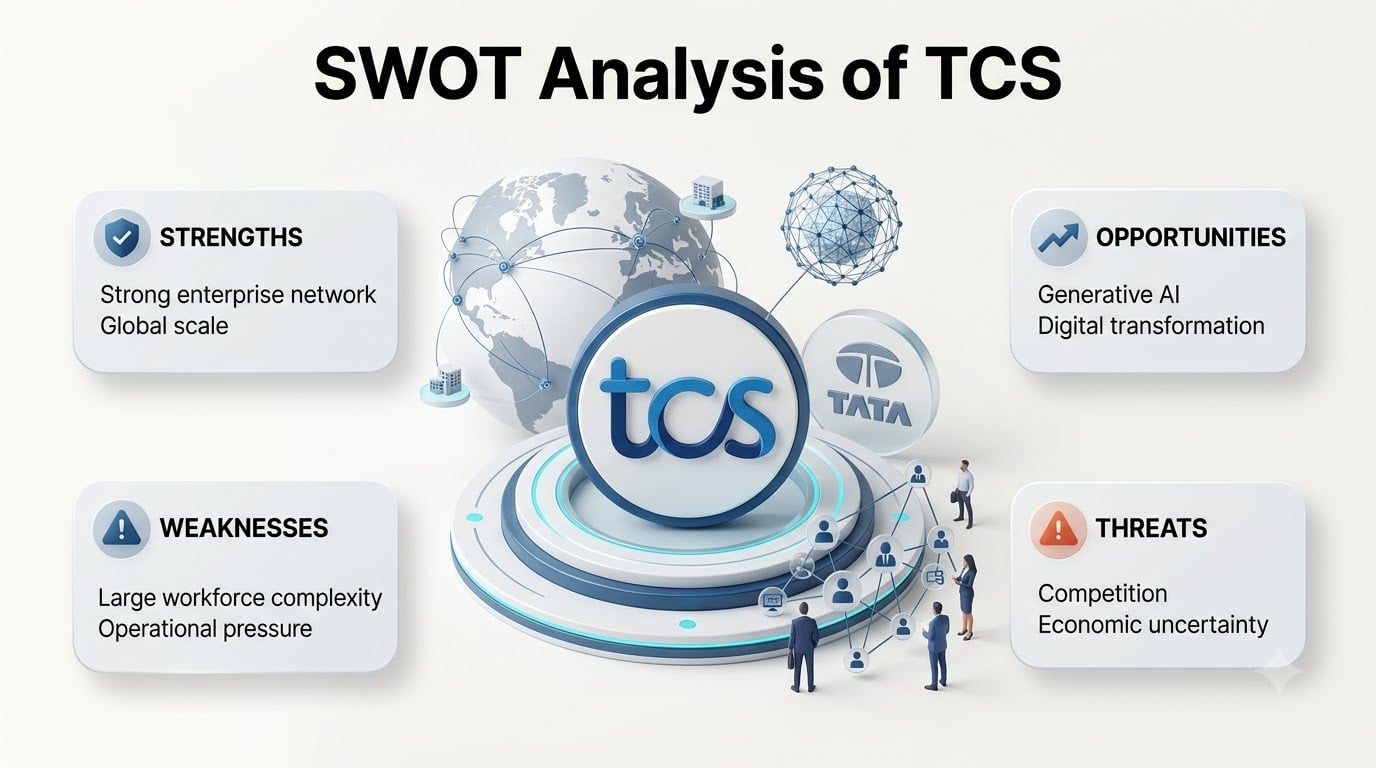
A SWOT analysis of TCS is a structured way to look at the company across four buckets: internal strengths, internal weaknesses, external opportunities, and external threats. It sounds simple because it is simple, but the value isn’t in the framework itself. The value is in what you find when you actually fill in each box with real facts instead of generic statements like “strong brand” or “competitive market.”
For a company like TCS, this exercise matters more than it would for a smaller, newer firm because TCS sits at the intersection of so many moving parts. It employs over 600,000 people across 56 countries. It generates roughly 70% of Tata Group’s total profit. And it operates in an industry, IT services, that is being reshaped by generative AI faster than almost any other sector right now. A SWOT analysis done properly captures all of that tension in one place.
What SWOT Framework Means for a Company Like TCS
The SWOT framework was originally built for smaller businesses trying to figure out strategy, but it scales up surprisingly well for giants like TCS. Strengths and weaknesses are internal, meaning they come from decisions TCS itself has made: how it structures contracts, how it trains staff, how it prices its services. Opportunities and threats are external, meaning they come from the world around TCS: client budgets, competitor moves, technology shifts, government policy.
What makes this useful for TCS specifically is that the company operates at a scale where internal decisions and external forces collide constantly. A decision to invest heavily in AI reskilling (internal, a strength if done right) directly determines whether TCS can capture the AI opportunity (external) before Infosys or Accenture does. You can’t really separate the four boxes cleanly when you’re looking at a company this size, and that’s exactly why walking through them one at a time forces clarity that a single paragraph summary never gives you.
Why Investors and Job Seekers Care About TCS SWOT
Investors read a SWOT analysis of TCS because the stock has historically been treated as a bond-like, defensive holding inside Indian portfolios. It pays consistent dividends, and Tata Sons owns roughly 72% of it, which makes it about as stable an ownership structure as you’ll find on the NSE. But defensive doesn’t mean risk-free, and anyone holding the stock needs to know where the cracks might show up first.
Job seekers care for a completely different reason. TCS hires in massive batches, often tens of thousands of freshers a year through campus placements, and understanding its weaknesses and threats tells you something practical: which business units are growing (where promotions and bonuses happen) and which are under pressure (where layoffs or bench time tend to show up). A software engineering student picking between a TCS offer and a smaller product company benefits from knowing exactly this kind of detail, not just the brand name on the offer letter.
Company Overview: TCS at a Glance Before the SWOT Analysis
Before breaking into the four quadrants, it helps to actually know the business you’re analyzing. TCS was founded in 1968 by the Tata Group, originally to provide computing services to other Tata companies, and it grew into the company that basically invented the Indian IT outsourcing model that Infosys, Wipro, and HCLTech later copied and competed against. It’s headquartered in Mumbai, listed on both the BSE and NSE, and led today by K. Krithivasan (often called KK inside the company) as CEO and Managing Director, with N. Chandrasekaran as Chairman.
The scale is genuinely hard to picture. TCS reported consolidated revenue of over $30 billion for the fiscal year ended March 2026, with a workforce that crossed 600,000 employees globally. It runs 194 delivery centers spread across 56 countries. This isn’t a company with one flagship product. It’s closer to a giant services machine that plugs its people and platforms into other companies’ operations, from core banking systems to retail supply chains to hospital record systems.
TCS Business Segments and Revenue Mix
TCS organizes its business into industry verticals rather than just technology categories, and that structure tells you a lot about where its risk actually sits. The segments include Banking, Financial Services and Insurance (BFSI), Manufacturing, Consumer Business, Communication Media and Technology, Life Sciences and Healthcare, and a catch-all “Others” bucket covering energy, resources, utilities, and government (what TCS calls e-Governance).
BFSI has historically been the single largest chunk of revenue, often close to a third of the total. That concentration is a double-edged sword you’ll see come up again in both the strengths and weaknesses sections. It gives TCS deep, specialized expertise in financial services technology that’s genuinely hard for competitors to match. But it also means when Western banks freeze IT budgets, which happens during rate hikes or recession fears, TCS feels it faster and harder than a more diversified competitor might.
TCS Global Footprint and Client Base
Geographically, North America remains TCS’s largest market by a wide margin, typically bringing in around half of total revenue, followed by Europe and then a mix of India, Asia-Pacific, Latin America, and the Middle East. This Western tilt is by design. That’s where the biggest IT budgets in the world sit, and TCS built its entire delivery model around efficiently serving large enterprise clients in these regions using a global workforce, much of it based in India, working at a lower cost structure than local staffing would allow.
The client list reads like a who’s who of global enterprise: major banks, insurers, retailers, telecom operators, and manufacturers, many of whom have worked with TCS for over a decade. TCS doesn’t disclose most client names publicly due to confidentiality agreements, but it does disclose something more telling: the number of $100 million-plus clients, which has grown steadily over the years and now sits well into the double digits. That metric alone shows how TCS’s growth increasingly comes from going deeper with existing giants rather than just adding new logos.
Strengths in the SWOT Analysis of TCS
The strengths section of any SWOT analysis of TCS has to start with scale, because almost every other advantage the company has flows from being this big. Scale gives TCS pricing power in vendor negotiations, bargaining leverage with clients, and the ability to absorb short-term shocks that would sink a smaller competitor. But scale by itself isn’t a strength if you can’t turn it into something clients actually value, so the real question is what TCS does with that size.
What follows are the strengths that show up consistently across earnings calls, client retention data, and industry rankings, not just marketing copy from the company’s own website.
Massive Scale and Financial Muscle
TCS generated over $30 billion in revenue in FY2026 with an operating margin around 25%, numbers that put it firmly among the largest IT services firms in the world, competing with names like Accenture and IBM’s consulting arm rather than just other Indian firms. That kind of margin, sustained over years, is not typical for a labor-heavy services business. Most staffing-driven companies see margins compressed by wage inflation, but TCS has consistently protected its operating margin through a mix of pricing discipline, automation of internal processes, and a delivery model that balances onshore and offshore staff carefully.
Financial muscle also shows up in how TCS treats cash. The company has minimal debt and returns a large share of its profit to shareholders through dividends and buybacks, funding a meaningful part of Tata Sons’ investments across the rest of the Tata Group. That reliability is exactly why institutional investors, including large pension and mutual funds, treat TCS stock as close to a bond substitute inside Indian equity portfolios. Few IT companies anywhere in the world can say their cash flow effectively subsidizes an automaker, a steel producer, and an airline at the same time.
Tata Brand Trust and Corporate Governance
The Tata name carries weight that money alone can’t buy. Decades of relatively clean corporate governance, conservative financial management, and a public reputation for ethical business practice give TCS an edge in winning long-term enterprise contracts, especially with risk-averse clients like banks and government bodies who care deeply about vendor stability before they care about the lowest bid.
This matters more in IT services than people outside the industry usually realize. When a bank signs a ten-year contract to run its core banking infrastructure, it’s not just buying technology, it’s betting that the vendor will still exist, still be well-run, and still be financially stable a decade from now. TCS’s association with one of India’s oldest and most trusted conglomerates removes a layer of risk that competitors without that backing have to work much harder to overcome. It’s also why TCS attracts government and public sector contracts more easily than some rivals, since public bodies tend to favor vendors with a long, boring, drama-free track record.
Deep Client Relationships and Retention
Look at what actually happens once TCS lands a major client: the relationship rarely stays small. TCS has built a model around expanding within existing accounts, moving from a single IT support contract to running entire business processes, then to strategic digital transformation projects, then to AI-driven initiatives, all with the same client over years. The company’s revenue from existing large clients, those bringing in over $100 million annually, has grown steadily, and that pattern of expansion inside accounts is a stronger signal of quality than new client wins alone.
This kind of retention doesn’t happen by accident. It comes from TCS embedding its teams directly into client operations, often physically co-located, sometimes running client systems so completely that switching vendors would mean rebuilding institutional knowledge from scratch. That switching cost is TCS’s real moat, more than any single technology or patent. A bank that has run its mainframe migration, its cloud transition, and its fraud detection system through TCS for fifteen years isn’t going to switch to a competitor over a modest price difference, because the risk of disruption outweighs the savings.
Talent Pipeline and Employee Base
TCS runs one of the largest corporate training operations in the world, and its campus hiring machine pulls in tens of thousands of engineering graduates from India every year through structured recruitment drives at colleges across the country. This pipeline gives TCS a supply of trainable talent that competitors, especially Western consulting firms without a comparable India presence, simply cannot replicate at the same cost or scale.
The company has also pushed hard into reskilling its existing workforce for AI and cloud skills rather than only hiring externally for new capabilities, training hundreds of thousands of employees on generative AI tools and platforms over the past couple of years. That’s a meaningful strength because it means TCS can redeploy its existing headcount toward higher-value AI projects instead of needing to hire an entirely new, more expensive workforce from scratch. The mistake competitors sometimes make here is assuming AI skills require hiring boutique AI specialists at premium salaries. TCS’s bet is that it can retrain its existing engineers at scale faster and cheaper, and so far that bet has mostly paid off in terms of margin protection.
Weaknesses in the SWOT Analysis of TCS
No SWOT analysis of TCS is honest if it skips straight from strengths to opportunities without sitting in the uncomfortable middle. TCS has real weaknesses, and they show up clearly once you look past the headline revenue numbers into the details analysts actually argue about on earnings calls. Here’s the part most guides skip: these weaknesses aren’t hypothetical risks, they’re already visible in the company’s own reported numbers.
Heavy Dependence on BFSI and North America
TCS’s biggest strength, its deep specialization in banking and financial services clients based mostly in North America, is also its biggest structural weakness. When BFSI clients in the US and UK slow down IT spending, which tends to happen whenever interest rates rise or a recession scare hits Western markets, TCS feels the impact faster and more directly than a more geographically or sector-diversified competitor would.
This showed up clearly in recent quarters, where constant currency revenue growth in some periods actually turned negative year over year, something that would have been almost unthinkable for TCS a decade ago when double-digit growth was the norm. A company this reliant on one region and one industry vertical is essentially making a concentrated bet that Western banking budgets stay healthy, and when that bet goes wrong, there’s no easy internal lever to pull to offset it in the short term.
Attrition and Wage Pressure
For years, TCS managed to keep attrition (the rate at which employees leave) lower than most of its Indian IT peers, and that discipline used to be treated as one of its quiet strengths. But the broader IT labor market has gotten more competitive, salaries for skilled engineers have climbed, and TCS has had to raise compensation and improve retention programs just to hold its position, which puts direct pressure on margins.
The mistake outside observers often make is assuming higher attrition mainly hurts culture or morale. The real cost is financial and operational: every employee who leaves mid-project takes institutional client knowledge with them, and replacing them means retraining costs plus the risk of service quality dips during the transition. TCS has managed this better than most competitors through structured onboarding and heavy investment in training infrastructure, but it’s still a persistent drag on margin expansion that shows up quarter after quarter in the numbers finance teams track closely.
Slower Pivot Compared to Niche Digital Players
TCS is a generalist giant, and giants move carefully. Smaller, more specialized firms focused purely on AI implementation, cloud-native development, or specific niches like fintech infrastructure can often move faster, experiment more aggressively, and win early-mover deals in emerging technology categories before a company the size of TCS finishes its internal approval process.
This isn’t a fatal weakness, because TCS’s scale advantage tends to kick in once a technology matures and clients want a large, reliable partner to roll it out globally rather than a boutique firm to prototype it. But in the earliest, most experimental phase of a new technology wave like agentic AI, TCS has historically been a fast follower rather than the pioneer, and that gap between “fast follower” and “market leader” is exactly where competitors like smaller AI-native consultancies try to carve out space before TCS catches up and out-scales them.
Opportunities Highlighted in the SWOT Analysis of TCS
Here’s the thing about opportunities in a SWOT analysis of TCS right now: almost all of them trace back to one word, AI. That’s not lazy analysis, it’s genuinely where the entire IT services industry’s growth story is being rewritten in real time, and TCS has positioned itself aggressively to capture as much of that shift as possible.
Generative AI and Automation Services
TCS reported annualized AI revenue reaching around $2.6 billion by early FY2027, up from roughly $900 million just two years earlier, which is one of the fastest-growing lines inside the whole company. More strikingly, TCS has said that 130 of its top 139 clients now choose TCS specifically as their AI services partner, meaning the company isn’t just selling AI as an add-on, it’s becoming the default vendor its biggest clients turn to when they want to actually deploy AI at scale rather than just experiment with it.
What makes this opportunity real rather than just marketing spin is the shift from AI pilots to AI production. For the last couple of years, most enterprises were running small proof-of-concept AI projects. TCS’s leadership has pointed to FY2026 as the year clients started moving from experimentation to scaled deployment, meaning actual budget commitments rather than small pilot spend. That’s the moment services companies make real money, because scaled deployment requires the exact kind of large, global, reliable delivery capability that TCS has spent decades building.
Cloud Migration and Digital Transformation Deals
Even setting AI aside, the broader wave of enterprises moving legacy systems to the cloud and modernizing decades-old core infrastructure remains a massive revenue opportunity, and TCS has partnerships with all three major hyperscalers, AWS, Microsoft Azure, and Google Cloud, positioning it as an implementation partner regardless of which platform a client chooses. In August 2026, TCS even opened a joint Gemini Experience Center with Google Cloud, a clear signal it’s trying to be the go-to implementation partner as Google pushes its own AI stack into enterprise accounts.
This matters because cloud migration projects tend to be multi-year engagements that naturally expand into adjacent work: once you’re inside a client’s infrastructure moving their systems to the cloud, you’re perfectly positioned to sell them the AI layer on top of it, then the cybersecurity layer around it, then the ongoing managed services contract to run all of it. TCS’s total contract value (TCV), a metric that tracks new deals signed, hit a record $40.7 billion for FY2026, which shows this pipeline of expansion opportunity is translating into actual signed business, not just talk.
Expansion in Europe and Emerging Markets
While North America remains dominant, TCS has been pushing harder into continental Europe, the Middle East, and select emerging markets to reduce its historical overreliance on a single region. European enterprises, particularly in manufacturing and financial services, have been increasing their outsourcing and digital transformation budgets, partly to catch up on AI adoption relative to US peers, and TCS has been positioning local delivery centers and partnerships to capture that specific wave.
The upside here is diversification that actually protects the business model rather than just adding a new logo on a slide. Every dollar of revenue TCS earns from a European manufacturer or a Middle Eastern government contract is a dollar that isn’t tied to the US Federal Reserve’s interest rate decisions. It won’t fully offset the North American BFSI concentration in the near term, since that shift takes years, but it’s a genuine strategic opportunity TCS is actively working rather than just mentioning in an annual report as an aspiration.
Threats Facing TCS According to This SWOT Analysis
Threats are where a SWOT analysis of TCS earns its keep, because these are the factors TCS genuinely can’t control no matter how well it executes internally. Ignoring them would make this whole exercise a puff piece instead of an honest analysis.
Global Recession Fears and Client Budget Cuts
IT services spending is one of the first corporate budget lines to get cut when Western companies get nervous about a recession, and one of the last to recover. TCS has already lived through a stretch where constant currency revenue growth turned negative in certain periods, driven largely by clients in North America and Europe pulling back discretionary technology spending while economic uncertainty lingered.
This threat is structural, not a one-time event. Every economic cycle, IT services firms like TCS get hit twice: once when clients freeze new project spending, and again a bit later when even existing contracts get renegotiated or delayed as clients try to preserve cash. TCS’s size and diversified client base soften this blow compared to smaller competitors, but they don’t eliminate it, and anyone doing a SWOT analysis of TCS needs to treat this as a recurring risk baked into the business model, not a rare black swan event.
Competition from Infosys, Accenture, and Smaller Niche Firms
TCS competes on two fronts at once, and that’s genuinely tough. On one side sit Infosys, Wipro, and HCLTech, Indian rivals fighting for the exact same large enterprise outsourcing contracts using a similar cost structure and delivery model. On the other side sits Accenture, a Western consulting giant with deeper strategy and boardroom relationships in some markets, plus a growing wave of smaller, AI-native firms that move faster on emerging technology even if they can’t match TCS on scale.
What most competitor comparisons get wrong is treating this as a simple two-player race between TCS and Infosys. The real threat is fragmentation: clients increasingly split large digital transformation programs across multiple vendors rather than handing everything to one partner, meaning TCS has to fight harder to defend its share of each account even when it wins the initial deal. Losing a piece of a client’s AI budget to a specialized boutique firm, even a small piece, chips away at the “one throat to choke” advantage TCS has traditionally sold to enterprise clients.
Visa Policy Changes and Geopolitical Risk
A huge part of TCS’s delivery model depends on being able to move skilled workers between India and client sites in the US and Europe, particularly through visa categories like the American H-1B program. Any tightening of visa policy, whether it’s higher fees, stricter caps, or new local hiring requirements, directly raises TCS’s cost of doing business in its most important market and forces faster (and more expensive) shifts toward local hiring in those regions.
Geopolitical risk extends beyond visas too. Trade tensions, data localization laws that require client data to stay within specific national borders, and shifting government procurement rules in different countries all add friction to a business model built around global delivery flexibility. TCS has responded by increasing local hiring in markets like the US and building out delivery centers closer to clients, but that response itself raises costs, meaning this threat doesn’t just risk revenue, it directly pressures the margins that make TCS such an attractive stock in the first place.
SWOT Analysis of TCS: Quick Snapshot Table
For anyone who wants the whole SWOT analysis of TCS in one glance before deciding whether to read the full detail above, here’s the condensed version.
| Category | Key Points |
|---|---|
| Strengths | $30B+ revenue, ~25% operating margin, Tata brand trust, deep multi-decade client relationships, large trainable talent pipeline |
| Weaknesses | Heavy BFSI and North America concentration, rising wage and attrition pressure, slower to pivot than niche AI-native firms |
| Opportunities | $2.6B+ annualized AI revenue and climbing, cloud and hyperscaler partnerships, expansion into Europe and emerging markets |
| Threats | Recession-driven client budget cuts, intensifying competition from Infosys, Accenture, and boutique AI firms, US visa policy risk |
This table works well as a reference point, but it’s not a substitute for understanding the reasoning behind each entry, since two companies can share the exact same SWOT bullet points on paper and still be in completely different actual positions depending on the specifics underneath them.
Notice how the table rows aren’t neatly separate from each other either. The BFSI concentration listed under weaknesses is the same client base driving the deep relationships listed under strengths. The AI revenue growth listed under opportunities depends directly on the talent pipeline strength holding up as employees get reskilled fast enough to deliver on the AI deals TCS is signing. A table format is useful for a quick scan or a featured snippet on Google, but the real substance sits in the paragraphs above it, where those connections actually get explained instead of just implied by proximity on a page.
If you’re using this table for a presentation or a quick reference sheet, it’s worth pairing it with at least one specific number per row rather than leaving it as pure description. Numbers age better than adjectives. Saying TCS has “strong margins” means very little a year from now if margins move, but saying TCS reported roughly 25% operating margin in FY2026 gives anyone reading it later a clear benchmark to check the current number against.
What This SWOT Analysis of TCS Means for Investors, Employees, and Students
A SWOT analysis of TCS isn’t just an academic exercise, it changes meaning depending on who’s reading it and why. Someone deciding whether to buy the stock needs a different takeaway than someone deciding whether to accept a job offer, and both need something different from a student trying to write a case study that actually says something original.
For Investors
For anyone holding or considering TCS stock, the SWOT points toward a company that’s genuinely stable but no longer growing at the pace it once did. The dividend reliability and low debt make it a defensive holding rather than a high-growth bet, and the AI opportunity is real revenue growth, not just hype, given the actual dollar figures TCS has reported. The risk to watch closely isn’t some dramatic collapse, it’s slow margin erosion from wage pressure combined with client budget cycles in the West, which is exactly the kind of risk that shows up gradually in quarterly numbers rather than all at once.
The practical takeaway: track TCS’s AI revenue growth rate and its BFSI segment performance every quarter more closely than the headline revenue number, since those two figures tell you whether the opportunities are outrunning the weaknesses or the other way around.
For Job Seekers and Employees
If you’re evaluating TCS as an employer, the SWOT tells you where the energy and investment inside the company is actually flowing. Business units tied to AI, cloud, and digital transformation are where TCS is investing in reskilling and where internal mobility and growth are strongest right now. Traditional, legacy-heavy support roles tied to older technology stacks face more pressure as automation and AI tools handle more of that work internally.
The practical move here is to actively seek reskilling opportunities within TCS’s own training programs rather than assuming your initial project assignment defines your career path. TCS’s scale means internal mobility between projects and skill areas is genuinely possible in a way it isn’t at smaller firms, and employees who proactively move toward AI and cloud-focused work tend to have noticeably better trajectories than those who stay in legacy maintenance roles by default.
For Students Studying Business Case Studies
If you’re writing a case study or assignment using TCS as your subject, resist the temptation to just list the four SWOT boxes and stop there. The interesting analytical work is in the tension between them, the BFSI concentration is simultaneously a strength (deep expertise, sticky clients) and a weakness (recession sensitivity) depending entirely on which economic cycle you’re looking at.
A strong case study connects the boxes to each other. Show how the wage pressure weakness is being addressed by the AI reskilling strategy listed under opportunities. Show how the visa policy threat is pushing TCS toward more local hiring, which then affects its historical cost advantage as a strength. That kind of connected reasoning is what separates a genuinely good SWOT analysis of TCS from one that just fills in four boxes with disconnected bullet points pulled from a press release.
How TCS’s SWOT Analysis Has Changed Over the Past Decade
A SWOT analysis of TCS taken today looks noticeably different from one written even five years ago, and that shift itself tells you something important about how fast this industry moves. Looking at what changed and what stayed the same gives a much sharper picture than just reading the current snapshot in isolation.
What Stayed the Same
Some parts of TCS’s SWOT have barely moved in a decade. The Tata brand strength, the deep client retention model, and the reliance on BFSI and North America as the largest revenue pools were all true in 2016 and remain true in 2026. That consistency isn’t a bad thing. It shows TCS built its core moat around relationships and trust rather than around any single technology, which means the moat doesn’t get outdated the way a specific software product eventually does.
The financial discipline has also held steady. TCS has kept debt low and margins healthy through multiple economic cycles, including the 2020 pandemic disruption and the 2022 to 2023 global rate hike period. Very few companies of this size manage that kind of consistency, and it’s a big part of why the stock keeps its defensive reputation among Indian investors year after year regardless of which technology wave is dominating headlines.
What Actually Changed
The biggest shift is obvious: AI moved from a minor opportunity mentioned in passing to the single most important line item in both the opportunities and threats sections. A decade ago, the main opportunity discussion around TCS centered on cloud migration and digital transformation broadly. Now those older opportunities still exist, but they’ve become almost table stakes, the baseline expectation rather than the exciting new growth story.
Competition has also gotten more fragmented. Ten years ago, the competitive threat section of a TCS SWOT analysis would mostly list Infosys, Wipro, and Accenture. Today it has to include a growing list of specialized AI-native firms and even individual client in-house AI teams that sometimes build capabilities internally instead of outsourcing them at all. That’s a genuinely new category of threat that didn’t meaningfully exist in earlier versions of this analysis, and it’s part of why TCS reorganized its leadership structure and created new business units specifically focused on AI delivery.
Common Mistakes People Make When Reading a SWOT Analysis of TCS
Here’s the part most guides skip entirely: a SWOT analysis is only as useful as how carefully you read it, and there are a few recurring mistakes people make when trying to apply this framework to a company as large and complex as TCS.
Treating Strengths as Permanent
The first mistake is assuming that because something is listed as a strength today, it stays a strength forever. TCS’s low attrition used to be an unqualified strength. It still shows up in that box today, but it’s weaker than it was five years ago because industry-wide wage competition has forced TCS to spend more to keep it true. Strengths erode over time if competitors adapt, and a good analysis checks whether a strength is stable, growing, or quietly weakening rather than just listing it once and moving on.
The fix here is simple but requires discipline: whenever you list a strength, ask what would have to happen for it to stop being true. If the answer is “not much,” that’s a durable strength. If the answer involves things that are already happening, like rising wages across the entire IT sector, that’s a strength under active pressure, and it deserves to be framed that way instead of presented as a fixed, permanent advantage.
Ignoring How the Four Quadrants Interact
The second mistake is treating strengths, weaknesses, opportunities, and threats as four separate, disconnected lists instead of one interconnected picture. TCS’s BFSI concentration shows up as both a strength and a weakness depending on the economic cycle, and its scale is simultaneously why it can absorb shocks (a strength) and why it moves slower on emerging technology than boutique competitors (a weakness). Missing these connections means missing the actual story the SWOT analysis is trying to tell.
A better approach is to explicitly draw lines between related points across quadrants after filling them in separately. Ask which strengths help TCS capture which opportunities, and which weaknesses make TCS more vulnerable to which specific threats. That’s where the real analytical insight lives, not in the individual bullet points themselves, but in how they connect to and sometimes contradict each other.
Confusing Company-Wide Numbers With Segment-Level Reality
The third mistake, common among people newer to reading company financials, is treating TCS’s overall revenue and margin numbers as if they apply evenly across every part of the business. In reality, the AI and cloud segments are growing fast while some legacy service lines are flat or shrinking. A single blended growth number can hide a business that’s actually in transition, with strong growth in new areas masking weakness in old ones, or the reverse.
The practical fix is to always check segment and geography breakdowns before drawing conclusions from headline numbers. TCS reports revenue by industry vertical and by geography every quarter, and looking at those breakdowns instead of just the top-line figure gives a much more accurate sense of where the actual strengths and weaknesses are showing up in real time, rather than relying on a single blended average that smooths over the details that matter most.
How to Build Your Own SWOT Analysis of TCS Using Public Data
If everything above sounds useful but you want to build your own version, updated with the latest quarter’s numbers, the good news is that almost all the raw material TCS uses to run its own strategy conversations is publicly available. You don’t need insider access, you just need to know where to look and how to read it.
Start With the Quarterly Earnings Call Transcript
TCS publishes a full transcript of its quarterly earnings call on its investor relations page, and this single document is the richest source for a current SWOT analysis of TCS. Management spends the first ten to fifteen minutes walking through exactly what’s working (strengths and opportunities in their own words) and what pressure points they’re watching (weaknesses and threats, usually phrased more carefully). Pay close attention to the analyst question and answer section that follows, since that’s where sharper questions about margin pressure, attrition, or client budget cuts tend to surface details that don’t make it into the polished opening remarks.
The mistake most people make here is only reading the press release summary instead of the full transcript. Press releases highlight good news by design. The transcript, especially the Q&A, gives a much more balanced picture because analysts are specifically paid to probe for weaknesses and risks that the company itself would rather not emphasize.
Cross-Check Against Competitor Reports
A strength or weakness only really means something in comparison. TCS’s 25% operating margin sounds impressive in isolation, but it means much more once you compare it against Infosys, Wipro, and Accenture’s margins for the same quarter. Pull the equivalent quarterly reports for two or three direct competitors and place the key numbers side by side, revenue growth rate, operating margin, attrition rate, and deal wins (TCV). Patterns jump out immediately once you do this that you’d never notice looking at TCS in isolation.
This cross-checking step is also where you catch industry-wide trends versus TCS-specific issues. If attrition is rising across every major IT services firm at the same time, that’s an industry weakness, not a TCS-specific one, and your analysis should reflect that distinction rather than unfairly penalizing TCS for a trend affecting the whole sector equally.
Track the Same Metrics Every Quarter
The single biggest upgrade you can make to a SWOT analysis of TCS is turning it from a one-time snapshot into a running tracker. Pick four or five metrics that map to each SWOT quadrant, revenue growth by geography (weakness/strength depending on the number), AI revenue run rate (opportunity), attrition rate (weakness), and TCV or deal wins (strength/opportunity), and update them every quarter in a simple spreadsheet.
Over four to six quarters, this turns a static analysis into a trend line, and trend lines tell you far more than any single snapshot ever could. A single quarter of slowing BFSI revenue could be noise. Four consecutive quarters of the same pattern is a real signal worth weighing heavily in your analysis, and you’d only catch that by tracking consistently rather than redoing the exercise from scratch every time you need an update.
Conclusion
TCS in 2026 is a company caught in an interesting spot: still dominant, still profitable, still the financial backbone of one of India’s largest business groups, but genuinely being tested by a technology shift that could either extend its lead for another decade or slowly erode the labor-heavy model that built its fortune in the first place. The SWOT analysis of TCS makes that tension visible instead of hiding it behind a stock price or a revenue headline.
Whether you’re deciding whether to invest, whether to accept a job offer, or just trying to understand how one of the world’s largest IT services companies actually works, the honest answer is that TCS’s strengths and weaknesses are two sides of the same coin, and so are its opportunities and threats. That’s not a weakness in the analysis, that’s just what it looks like to honestly study a company operating at this scale.
The next earnings call will move some of these numbers, up or down, and that’s exactly the point of treating this as a living analysis rather than a fixed conclusion. Come back to the quick snapshot table after TCS reports its next quarter, check whether AI revenue kept accelerating, whether BFSI spending recovered or stayed soft, and whether attrition ticked up or settled down. A SWOT analysis of TCS written today is a starting point, not a final verdict, and the company that shows up in next year’s numbers will almost certainly look a little different from the one described here.
Frequently Asked Questions
What is a SWOT analysis of TCS in simple terms?
A SWOT analysis of TCS is a breakdown of the company’s internal strengths and weaknesses alongside external opportunities and threats. It looks at things TCS controls, like its client relationships and talent pipeline, next to things it doesn’t control, like recession risk or visa policy, to give a full picture of the company’s position.
What are the biggest strengths of TCS?
TCS’s biggest strengths are its massive scale with over $30 billion in annual revenue, strong operating margins around 25%, the trust that comes from being part of the Tata Group, and deep multi-year client relationships that create high switching costs for customers. Its large, trainable talent pipeline from Indian campuses also gives it a cost and scale advantage few competitors can match.
What is TCS’s biggest weakness?
TCS’s most significant weakness is its heavy dependence on BFSI clients based in North America, which makes revenue sensitive to Western interest rate cycles and recession fears. Rising attrition and wage pressure across the IT industry is a second major weakness that puts ongoing pressure on operating margins.
Is TCS a good stock to invest in based on this SWOT analysis?
TCS tends to function as a defensive, dividend-paying holding rather than a high-growth stock, given its low debt, consistent cash flow, and stable ownership under Tata Sons. Whether it’s a good investment depends on individual goals, since it typically suits investors looking for stability more than investors chasing rapid capital appreciation. This is not financial advice, and anyone considering the stock should look at current price levels and their own risk tolerance before deciding.
How is AI affecting TCS according to this SWOT analysis?
AI shows up in both the opportunities and threats sections because it works both ways. TCS has grown its annualized AI revenue to roughly $2.6 billion, making it a real growth driver, but AI-driven automation also threatens to shrink some of the traditional labor-heavy service work TCS built its business model around, which forces the company to keep transforming faster than the disruption catches up to it.
How does TCS compare to Infosys in a SWOT analysis?
TCS is larger than Infosys by revenue and headcount and has historically maintained a stronger operating margin, but both companies compete for the same large enterprise clients using similar delivery models. Infosys has sometimes been viewed as slightly faster at pivoting toward newer technology trends, while TCS leans on its scale and client retention as its core competitive edge.
Why is BFSI such a big part of TCS’s business?
Banking, Financial Services, and Insurance clients require deep, specialized, highly regulated technology work, which historically gave TCS a chance to build expertise that’s hard for generalist competitors to replicate. This became one of TCS’s largest revenue segments over time, though that same concentration is also flagged as a weakness because it makes revenue sensitive to financial sector spending cycles.
What opportunities does TCS have outside of AI?
Beyond AI, TCS has real opportunities in cloud migration projects through partnerships with AWS, Microsoft Azure, and Google Cloud, plus geographic expansion into Europe, the Middle East, and other emerging markets to reduce its historical overreliance on North America. Both of these opportunities tend to create long, multi-year contracts rather than one-time projects.
What threats could hurt TCS’s stock price in the coming years?
The biggest threats include a global recession that causes Western enterprise clients to freeze IT spending, intensifying competition from both large firms like Accenture and smaller AI-native firms, and changes to US visa policy that raise the cost of TCS’s traditional global delivery model. Any of these could pressure both revenue growth and profit margins if they happen at the same time.
Does TCS pay good dividends?
TCS has a long track record of returning a large share of profit to shareholders through dividends and periodic buybacks, funded by strong and consistent cash flow. This reliability is a major reason institutional investors treat the stock as a relatively defensive holding within Indian equity portfolios, though dividend amounts can change year to year based on company performance and board decisions.
Is TCS a good company to work for based on this SWOT analysis?
TCS offers strong job stability, a large structured training system, and genuine internal mobility between projects and skill areas, particularly for employees who move toward AI and cloud-related work. Like any large organization, experience varies a lot by team and project, and roles tied to legacy technology work tend to face more pressure than roles tied to the company’s newer growth areas.
How often should a SWOT analysis of TCS be updated?
Given how quickly the AI landscape and global economic conditions are shifting, a SWOT analysis of TCS is worth revisiting at least once a year, ideally after the company’s annual report and major quarterly earnings calls, since new data on AI revenue, client budgets, and headcount can shift the weight of each quadrant significantly from one year to the next.
What is TCS’s total contract value (TCV) and why does it matter?
Total contract value refers to the total worth of new deals TCS signs with clients over a given period, and it hit a record $40.7 billion for FY2026. TCV matters because it’s a forward-looking indicator, showing what future revenue looks like before it actually shows up in quarterly earnings, which makes it one of the most closely watched numbers by analysts covering the stock.
Does TCS’s SWOT analysis differ much from other Indian IT companies like Wipro or HCLTech?
The broad structure is similar since all major Indian IT firms share exposure to BFSI concentration, North American client bases, wage pressure, and the same AI-driven opportunities and threats. The differences show up in scale and specific strengths, with TCS generally holding a size and margin advantage over Wipro, while HCLTech has carved out relative strength in specific areas like engineering and product services.
Is TCS overly dependent on a few large clients?
TCS reports growth in the number of clients contributing over $100 million in annual revenue, and while this shows healthy expansion inside large accounts, it also means a meaningful share of revenue is concentrated among a relatively small group of major clients. Losing even one or two of these large accounts would have a noticeably bigger impact than losing a similar number of smaller clients, which is a concentration risk worth factoring into any thorough SWOT analysis of TCS.