


Anyone who has run a small business in an Indian city knows the pain of moving goods from point A to point B. You call three local transporters, none of them pick up on the first try, one quotes double the fair price because he thinks you’re desperate, and by the time a truck actually shows up, half your day is gone. That was the exact problem Porter set out to fix, and honestly, it’s still solving it for a huge chunk of India’s small business economy.
This SWOT analysis of Porter is not going to be another generic list of bullet points copied from a company’s About page. We’re going deeper into what actually makes Porter tick as a business, why it has managed to become one of India’s most recognizable logistics tech names, and where the cracks might show as competition heats up. If you’re a student working on a case study, a founder studying the logistics marketplace model, or just someone curious about how a company that started with mini trucks in Bangalore turned into a business processing millions of bookings, this is written for you.
Porter began as a fairly simple idea back in 2014: build a technology layer on top of India’s massive, fragmented, and largely informal intra-city goods transportation market. Instead of owning trucks, Porter built an app that connects people who need something moved with driver-partners who have a vehicle and time to spare. That marketplace model, the same logic behind Uber and Ola but for cargo instead of passengers, is what allowed Porter to scale fast without the capital burden of owning a massive fleet.
Fast forward to today, and Porter isn’t just a mini-truck booking app anymore. It has added two-wheeler goods delivery, packers and movers services, and a full-blown enterprise logistics arm that serves large businesses with recurring shipment needs. It operates across dozens of Indian cities, claims tens of lakhs of customers, and has even started testing international waters. That’s a lot of ground covered in a little over a decade, and it makes Porter a genuinely interesting company to study through a SWOT lens.
What You Will Learn in This Guide
Before we get into the weeds, here’s a quick heads-up on what this article actually covers so you know exactly what you’re getting into.
- A clear breakdown of Porter’s strengths, from its driver network to its enterprise logistics arm
- An honest look at Porter’s weaknesses, including the operational headaches that come with an asset-light model
- The real opportunities sitting in front of Porter, like EV adoption and MSME digitization
- The threats that could genuinely hurt Porter’s growth, from price wars to regulatory shifts
- A look at how Porter stacks up against competitors like Shadowfax, Loadshare, and Borzo
- A breakdown of Porter’s business model and how it actually makes money
- A strategic combination of all four SWOT elements so you understand what they mean together, not just in isolation
- A set of FAQs that answer the exact questions people search for when researching Porter
SWOT Analysis of Porter: Quick Snapshot
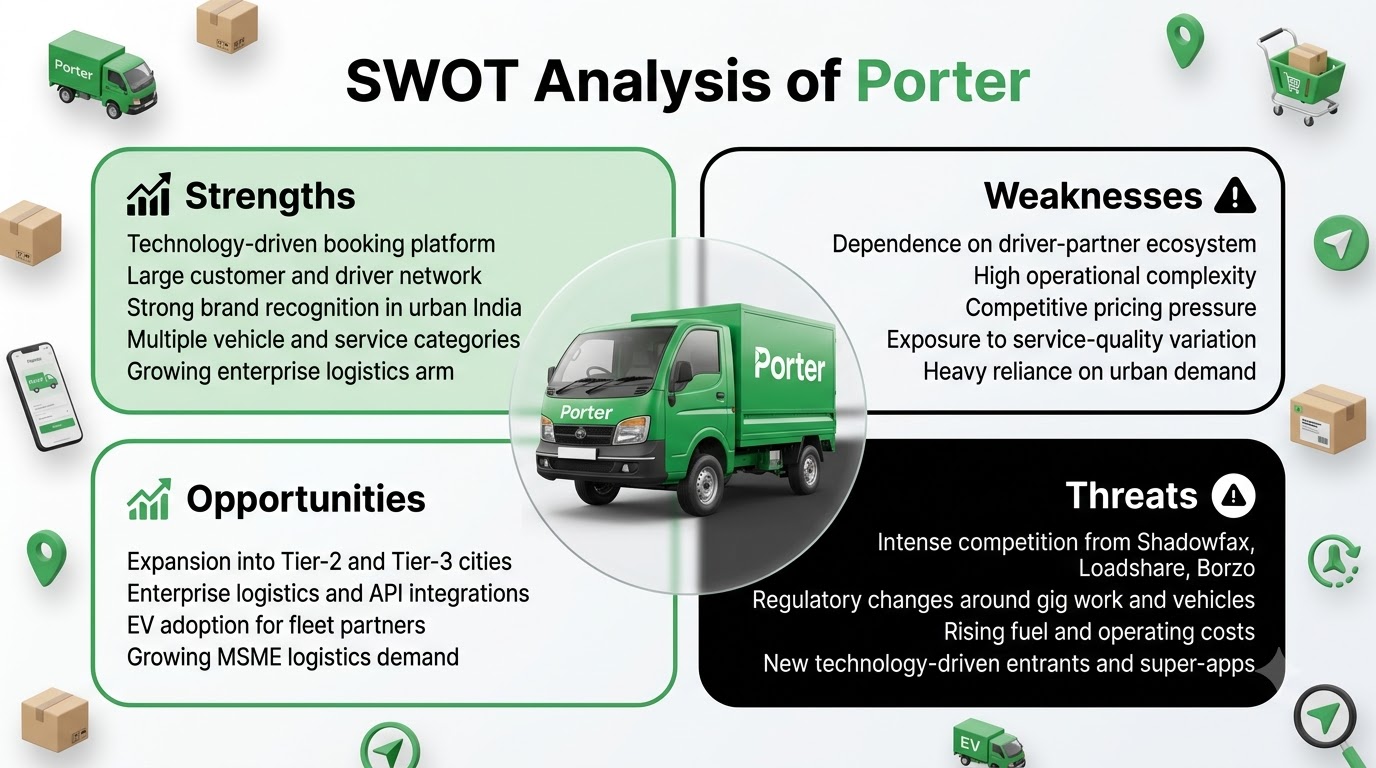
Before diving into the details, here’s the condensed version. Think of this table as the executive summary. Everything after this section builds the evidence behind each point.
| Strengths | Weaknesses |
|---|---|
| Technology-driven booking platform | Dependence on driver-partner ecosystem |
| Large customer and driver network | High operational complexity |
| Strong brand recognition in urban India | Competitive pricing pressure |
| Multiple vehicle and service categories | Exposure to service-quality variation |
| Growing enterprise logistics arm | Heavy reliance on urban demand |
| Opportunities | Threats |
|---|---|
| Expansion into Tier-2 and Tier-3 cities | Intense competition from Shadowfax, Loadshare, Borzo |
| Enterprise logistics and API integrations | Regulatory changes around gig work and vehicles |
| EV adoption for fleet partners | Rising fuel and operating costs |
| Growing MSME logistics demand | New technology-driven entrants and super-apps |
That table gives you the shape of the analysis. Now let’s actually unpack why each of these points matters and what evidence backs them up.
Porter Company Overview
Suggested word count aside, you can’t do a proper SWOT analysis of Porter without understanding where the company came from and how its business actually works. So let’s slow down here for a bit.
History and Founding of Porter
Porter was founded in 2014 by a group of IIT graduates who noticed a genuine gap in the market. Small businesses in Indian cities were stuck relying on word-of-mouth transporters, unpredictable pricing, and zero visibility into where their goods actually were during transit. There was no organized way to book a truck the way you’d book a cab. That gap became the founding thesis.
The initial idea was straightforward: digitize intra-city goods transportation the same way ride-hailing apps had digitized passenger transport. Instead of a customer calling around for a tempo or mini-truck, they could open an app, enter a pickup and drop location, get an instant fare estimate, and have a vehicle assigned within minutes. That’s a massive upgrade from the old system where price negotiation happened on the phone and half the time you had no idea if the truck would even show up.
What’s interesting is how Porter’s early marketplace model wasn’t perfect from day one. Like most logistics startups, it went through rounds of trial and error figuring out driver incentive structures, city-by-city demand patterns, and how to balance customer pricing against driver earnings. That iterative process is honestly what separates companies that survive their first five years from the ones that burn out trying to scale too fast.
Porter’s Evolution Over the Years
Porter didn’t stay a single-category mini-truck app for long. Its evolution tells you a lot about how the company thinks about growth.
Early intra-city transportation was the starting point, focused almost entirely on mini-trucks and pickup vehicles for local goods movement within a city.
Expansion of vehicle categories came next, where Porter added a wider range of commercial vehicles including the Tata Ace, larger trucks, and different tonnage options to serve varied cargo sizes.
Two-wheeler goods transportation was a smart addition because a huge chunk of small parcel and document delivery in Indian cities doesn’t need a truck at all. It needs a bike, and it needs it fast.
Packers & Movers pushed Porter into household and office relocation services, a completely different customer segment with different pricing logic and service expectations.
Porter Enterprise is arguably the most important evolution because it moved Porter beyond one-off bookings into recurring, contract-based logistics relationships with businesses. This is where the real revenue predictability lives.
Geographic expansion took Porter from a single city to dozens of Indian cities, and eventually into international expansion, testing whether the same fragmented-logistics-to-organized-platform model works outside India too.
Porter’s Business Model Explained
Here’s the thing people often get wrong about Porter: they assume it owns a fleet of trucks. It doesn’t. Porter runs a marketplace model, meaning it connects two sides of the market without owning the underlying transportation assets.
On the customer side, a business or individual opens the app, enters shipment details, gets a fare, and books a vehicle. On the driver-partner side, independent vehicle owners register with Porter, get matched with nearby booking requests, and complete the trip in exchange for a fare minus Porter’s platform commission.
The marketplace/platform model is the glue that holds this together. Porter’s technology handles demand-supply matching, pricing, route suggestions, and payment processing so that neither the customer nor the driver has to negotiate manually. Bookings are generated through the app or website, and Porter’s backend algorithms match available driver-partners based on proximity, vehicle type, and current demand load in that specific zone.
Revenue generation mostly comes from the commission Porter takes on each completed trip, along with subscription-style enterprise contracts and value-added services layered on top of the core transportation booking.
Porter’s Target Customers
Porter doesn’t serve just one type of customer, and that diversification is actually part of what makes the business interesting.
- Individual customers who need occasional help moving furniture, appliances, or personal goods
- MSMEs that need regular transportation for inventory, raw materials, or finished goods
- Kirana stores that need small, frequent deliveries from wholesalers or distributors
- Retailers managing stock movement between warehouses and stores
- E-commerce businesses needing last-mile or mid-mile support
- Supermarkets with recurring supply chain needs
- Enterprises running large-scale, contract-based logistics operations
- Manufacturers and distributors who need reliable, repeated goods movement
Porter’s Products and Services
Porter’s service lineup has grown well beyond the basic mini-truck booking that started it all.
Mini-truck booking remains the bread and butter of the platform, serving the bulk of everyday goods transportation requests. Tata Ace and other commercial vehicles give customers options depending on cargo size and weight. Two-wheeler goods transportation covers small parcels and time-sensitive deliveries. Packers & Movers handles full home and office relocations. Enterprise logistics serves large businesses with recurring shipment volumes and dedicated account management. API/integration capabilities let businesses plug Porter’s booking and tracking directly into their own systems, which matters a lot for e-commerce and retail clients running high shipment volumes.
Porter’s official website currently describes multiple goods-transport categories and says it offers vehicles ranging from the Tata Ace to larger commercial vehicles, giving customers flexibility depending on what they’re moving.
Porter’s Current Scale
Numbers help ground a SWOT analysis in reality instead of assumptions. Porter’s own company information states that it serves more than 30 lakh customers, including 20 lakh MSMEs, and operates across 35 Indian cities, while also having expanded internationally. That’s a genuinely large footprint for a company that started with a handful of mini-trucks in one city, and it’s the kind of scale that changes what strategic risks and opportunities actually look like for the business.
SWOT Analysis of Porter at a Glance
Before we dig into each quadrant in detail, it helps to zoom out and understand the strategic shape of Porter’s position. A full SWOT analysis of Porter isn’t just four separate lists, it’s a picture of how a technology-first logistics marketplace behaves in a market that’s still mostly unorganized.
Strengths in Brief
Porter’s core strengths circle around its established brand, its large driver and customer network, its technology backbone, its strong MSME positioning, its diversified service portfolio, its growing enterprise offering, and its ability to scale across cities without owning heavy assets.
Weaknesses in Brief
On the flip side, Porter’s asset-light model creates a real dependency on third-party driver-partners. Service consistency is genuinely hard to standardize across thousands of independent drivers. Operational complexity increases with every new city and service line. There’s also heavy reliance on urban demand, rising customer acquisition costs, and ongoing pressure on margins.
Opportunities in Brief
The opportunities are honestly pretty exciting if you’re bullish on India’s logistics sector. There’s the broader shift toward organized logistics, massive potential in MSME digitization, room to grow enterprise logistics contracts, EV adoption possibilities, expansion into new geographic markets, and the use of technology and AI to squeeze more efficiency out of existing operations.
Threats in Brief
But it’s not all upside. Competitors are aggressive, price competition is real, regulatory changes could reshape gig-work economics overnight, fuel and operating costs keep climbing, driver-partner retention is a constant battle, and economic slowdowns hit MSME shipment volumes hard. New logistics technologies could also disrupt the current playing field faster than people expect.
Strengths of Porter
This is genuinely the part of the SWOT analysis of Porter that explains why the company scaled the way it did. Strengths aren’t just nice things to say about a company, they’re the actual mechanisms that let a business survive competitive pressure and keep growing.
Strong Brand Position in India’s Logistics Market
Porter has built something a lot of logistics startups never manage: actual brand recall. Say “Porter” to a small business owner in Bangalore, Delhi, or Mumbai, and there’s a good chance they know exactly what you’re talking about. That’s not nothing. Brand recognition in a fragmented, trust-dependent industry like local goods transport is genuinely hard to earn.
Part of this comes from Porter being one of the earlier movers in technology-enabled intra-city goods transportation. First-mover advantage matters a lot in marketplace businesses because the first company to build density on both sides of the market, customers and drivers, ends up with a structural edge that’s tough for later entrants to replicate quickly. Porter’s brand is also tied closely to convenience and on-demand availability, the same emotional pull that made ride-hailing apps popular. And critically, MSMEs and repeat business users have grown to trust Porter enough to make it a default choice rather than something they compare every single time.
Large Driver-Partner Network
A marketplace business is only as good as its supply side, and this is where Porter’s driver-partner network becomes a genuine competitive weapon. When you have thousands of registered drivers across dozens of cities, you get network effects that smaller competitors simply can’t match on day one.
More drivers means faster matching between demand and supply, which means shorter wait times for customers. It also means better geographic coverage, since a dense driver network can serve neighborhoods that a thinner network would struggle to reach efficiently. And because Porter supports multiple vehicle categories, from two-wheelers to large commercial trucks, the driver network isn’t just big, it’s varied enough to handle almost any cargo request that comes through the app. In a marketplace business, supply density is basically the moat, and Porter has spent years building exactly that.
Large Customer and MSME Base
MSMEs are the backbone of India’s economy, and Porter has positioned itself squarely as their go-to logistics partner. That’s a smart bet. MSMEs have recurring transportation needs, whether it’s moving raw materials, restocking inventory, or shipping finished goods to retailers, and recurring needs mean recurring revenue for Porter.
Porter says its customer base includes more than 20 lakh MSMEs. That number matters because it points to real customer lifetime value, not just one-off bookings. When a kirana store or a small manufacturer books through Porter every week for months or years, that’s the kind of sticky revenue base that gives a logistics marketplace real stability. It also creates network effects on the demand side, since satisfied MSME customers tend to refer other small business owners in their circle.
Technology-Driven Logistics Platform
Here’s the honest comparison: try booking a truck through a traditional local transporter versus booking one through the Porter app, and the difference is night and day. App-based booking gives you instant fare estimation, automated driver allocation, live tracking, and digital payments, all things that traditional truck brokers and phone-based booking systems simply can’t offer at scale.
Why Technology Is a Strength
Compare Porter’s platform to the alternatives that still dominate a huge chunk of India’s logistics market. Traditional truck brokers rely on personal relationships and phone calls, which means pricing is inconsistent and there’s zero visibility once the truck leaves. Informal transportation providers operate with even less structure, often without any digital record of the transaction at all. Phone-based booking systems, even when they’re organized, still can’t match the speed and transparency of an app that shows you a fare upfront and lets you track the vehicle in real time. Porter’s technology layer, including its operational data collection, gives it a data advantage too. Every completed trip feeds back into better demand forecasting and driver allocation, which compounds over time.
Wide Range of Vehicle Categories
Not every shipment needs the same vehicle, and Porter figured that out early. Offering multiple vehicle types lets the platform serve wildly different transportation requirements without forcing customers into a one-size-fits-all box.
Two-wheelers handle small parcels and urgent document deliveries. Mini trucks and the Tata Ace cover the bulk of everyday goods movement for small businesses. Pickups serve mid-sized cargo needs. And larger commercial vehicles step in for bigger shipments, like bulk inventory transfers or larger relocation jobs. This range means Porter can capture a customer’s entire logistics need, from a single small parcel to a full truckload, without them ever needing to switch platforms.
Diversified Service Portfolio
Diversification is one of those business fundamentals that sounds obvious but is genuinely hard to execute well. Porter’s portfolio spans goods transportation, Packers & Movers, two-wheeler logistics, and Porter Enterprise, and that spread reduces dependence on any single service category.
If demand for household relocations dips during a certain season, enterprise logistics contracts can pick up the slack. If two-wheeler delivery demand softens because of a slow e-commerce quarter, the core mini-truck goods business keeps generating revenue. This kind of built-in balance is what protects a logistics company from getting wiped out by seasonality or category-specific slowdowns.
Porter Enterprise as a B2B Growth Engine
If you’re looking for the single most important strategic bet Porter has made in recent years, it’s Porter Enterprise. This is the B2B arm that serves large businesses with centralized logistics management, multiple-user access for different departments, payment and wallet management, full trip visibility, dedicated enterprise account management, and API integrations that plug directly into a client’s existing systems.
Porter says its Enterprise offering serves more than 10,000 enterprise clients and provides centralized logistics controls and integrations. That’s a serious number of business accounts, and it matters because enterprise contracts tend to be stickier and more predictable than one-off individual bookings. A large FMCG company or a national retailer that integrates Porter’s API into its order management system isn’t going to switch logistics providers on a whim. That switching cost works in Porter’s favor and gives the business a more stable revenue base to build on.
Geographic Network and Scalability
Operating across multiple cities isn’t just about being present in more places, it’s about proving the business model actually replicates. Porter’s multi-city operations show that its platform model, driver onboarding process, and demand-matching technology can be transplanted from one city to another without reinventing the wheel each time.
Density advantages show up in major cities where Porter has been operating longest, since a mature driver network in a city like Bangalore or Mumbai delivers faster matching and better utilization than a newer market still building supply. This geographic scale also opens the door for cross-selling, where a customer who first used Porter for a single goods delivery might later use Packers & Movers for a relocation, or a business might graduate from occasional bookings into a full enterprise contract.
Improving Financial Performance
Growth alone doesn’t prove a business model works. Profitability does. And this is where Porter’s recent numbers matter for anyone doing a serious strategic analysis rather than a surface-level one.
Recent financial reporting indicates that Porter recorded approximately ₹6,649 crore in operating revenue and ₹229 crore in profit for FY26, making financial performance an important strength to examine in the updated SWOT. That’s a meaningful jump from where the company stood just a year or two earlier, and it suggests Porter’s operating leverage is starting to kick in, meaning revenue is growing faster than the costs required to support it. For a company that spent years in classic startup growth-at-all-costs mode, turning a real profit at this scale is a genuine milestone.
Strong Investor Backing
Capital access matters enormously in a business that needs to keep investing in technology, driver incentives, and city expansion. Porter has built a solid funding history with institutional investors willing to back its growth story.
Porter raised $200 million in a Series F round in 2025 at a valuation reported around $1.1 to $1.2 billion. That unicorn status isn’t just a headline number, it’s a signal that sophisticated investors believe in the long-term trajectory of the business. Strong capital availability also gives Porter room to invest in technology upgrades, expand into new cities, and weather competitive price wars without immediately bleeding cash reserves the way a thinly funded competitor might.
Network Effects That Compound Over Time
Every good marketplace business runs on a flywheel, and Porter’s is fairly textbook. More customers lead to more bookings. More bookings attract more driver-partners looking for consistent earning opportunities. More driver-partners mean better vehicle availability and shorter wait times. Better availability improves the overall customer experience. And a better customer experience brings in more customers, which starts the cycle over again.
This kind of network effect is particularly important for logistics marketplaces because unlike, say, a social media app, the value here is directly tied to physical availability. A customer doesn’t care how many drivers are registered nationally, they care whether a vehicle is available near them right now. Porter’s density in its core cities is what makes that flywheel spin faster than it would for a newer competitor still building out supply.
Weaknesses of Porter
No company is without its cracks, and honestly, pretending otherwise would make this a useless analysis. Porter’s weaknesses are mostly structural, meaning they come baked into the marketplace model itself rather than being simple execution mistakes.
Dependence on Driver-Partners
Porter does not own every vehicle operating on its platform, and that’s both its biggest strength and its biggest vulnerability at the same time. The asset-light model lets Porter scale fast without capital-heavy fleet ownership, but it also means the company is fundamentally dependent on third-party supply that it doesn’t fully control.
Strategic implication: driver availability directly affects pricing, delivery time, and customer experience. If drivers in a particular city decide the incentives aren’t good enough and drift toward a competitor, Porter’s service quality in that city takes an immediate hit. Unlike an owned fleet, where a company can mandate standards and schedules, Porter has to rely on incentive design and platform stickiness to keep its supply side engaged and available.
Service Quality Can Be Difficult to Standardize
Here’s a problem every marketplace logistics company faces: you’re only as consistent as your least reliable partner. Different drivers bring different levels of professionalism. Vehicle conditions vary. Loading and unloading practices aren’t uniform. Some drivers are great with customer communication, others aren’t. Delays happen for reasons entirely outside Porter’s direct control, and regional differences in driver behavior and infrastructure mean the experience in one city can feel noticeably different from another.
This inconsistency is a genuine weakness because customers, especially business customers who book regularly, notice when service quality fluctuates. A single bad experience with a careless driver can color a customer’s entire perception of the Porter brand, even if hundreds of other bookings went smoothly.
Operational Complexity
Running a logistics marketplace at Porter’s scale means coordinating an enormous number of moving parts simultaneously. Customers, drivers, vehicles, routes, payments, customer support, enterprise clients, and operations across dozens of cities all have to function together without breaking down.
Complexity increases with scale, and that’s not a cliché, it’s just how operations work. Every new city adds local nuances around traffic patterns, regulatory requirements, and driver behavior. Every new service line, like Packers & Movers or Enterprise, adds a separate operational workflow that needs its own support systems. Managing all of that without letting service quality slip is a genuinely hard operational puzzle, and it only gets harder as Porter keeps growing.
Exposure to Price Sensitivity
MSME customers, who make up a huge chunk of Porter’s user base, are often deeply cost-conscious. For a small business owner, logistics is frequently treated as a variable expense to be minimized, not a service worth paying a premium for. That mindset creates real pricing pressure on Porter.
Customers can and do compare multiple platforms before booking, especially for non-urgent shipments where price matters more than speed. If Porter raises prices even modestly, price-sensitive MSME customers may shift bookings to cheaper alternatives, including informal local transporters who don’t carry the same technology overhead costs. This price sensitivity limits how much pricing power Porter actually has, even with a strong brand.
Urban Concentration
Porter’s business is heavily dependent on city-level logistics demand, and that concentration comes with real risk. The economics look completely different in Tier-2 and Tier-3 markets compared to major metros. Lower demand density in smaller cities can hurt vehicle utilization rates, since drivers might spend more idle time waiting for bookings, which in turn affects driver earnings and retention in those markets.
This urban concentration means Porter’s growth engine is currently tied to a relatively small number of large cities. That’s not necessarily a bad thing today, but it does mean expansion into new geographies carries real execution risk rather than being a simple copy-paste of the existing playbook.
Dependence on Local Network Density
Logistics platforms perform best when demand is concentrated, driver supply is readily available, trips can be matched efficiently, and drivers can pick up return journeys instead of driving back empty. Porter’s unit economics are strongest in dense markets where all of these conditions line up.
Low density directly hurts the numbers. A driver who completes a delivery in a low-demand area might have to wait a long time for the next booking, or drive back empty, both of which eat into their effective earnings per hour. That, in turn, makes it harder for Porter to retain drivers in less dense markets, creating a chicken-and-egg problem where low density leads to driver churn, which leads to even lower service availability.
Brand Reputation Risk
Even though Porter doesn’t directly own or operate every vehicle on its platform, customers don’t separate that nuance in their minds. When something goes wrong, whether it’s a driver behaving unprofessionally, a vehicle breaking down mid-trip, a delayed pickup, or damaged goods during transit, customers associate that experience with the Porter brand as a whole, not with the individual independent driver.
This is a real weakness because reputation damage in a marketplace model is genuinely hard to control. Porter can set standards and run driver training, but it can’t personally supervise every single trip happening across its network at any given moment. A string of bad reviews, even if they represent a small percentage of total trips, can meaningfully hurt trust, especially among new customers doing their first search for a logistics provider.
Margin and Cost Pressures
Running a marketplace at scale isn’t cheap. Driver incentives are necessary to keep supply healthy, especially in competitive or newer markets. Customer discounts and promotions are often needed to win new users away from established habits or competitors. Customer acquisition costs keep climbing as the market matures and competition intensifies. Add in ongoing technology development costs, support infrastructure, insurance obligations, and general operational expenses, and you start to see why margin pressure is a persistent theme for logistics marketplaces, not just Porter specifically.
Expansion Can Increase Complexity Faster Than Expected
Porter’s own growth history offers a useful strategic lesson here. Expanding too quickly into new cities or new service categories can stretch operational resources thin before the demand base is mature enough to support them. New logistics segments, like Packers & Movers compared to standard goods transport, come with entirely different cost structures and customer expectations. Geography alone doesn’t guarantee profitability. A new city needs enough density on both the customer and driver side before it becomes a healthy, self-sustaining market, and rushing that process can create losses that take years to recover from.
Opportunities for Porter
This is where the SWOT analysis of Porter gets genuinely exciting, because the opportunities in front of the company are tied to some of the biggest structural shifts happening in India’s economy right now.
India’s Growing Organized Logistics Market
India’s logistics sector has spent decades dominated by fragmented, unorganized players, small local transporters operating with minimal technology, inconsistent pricing, and no digital record-keeping. That’s changing, and it’s changing fast. Digital adoption is rising across even smaller cities. Smartphone penetration keeps climbing. Businesses increasingly expect transparent, trackable transportation instead of relying on phone calls and guesswork. And MSMEs themselves are formalizing their operations as GST compliance and digital payments become the norm rather than the exception.
Strategic opportunity: Porter is genuinely well positioned to act as infrastructure for this shift. As India’s urban logistics ecosystem digitizes, Porter’s existing technology platform, driver network, and brand recognition give it a real head start over any new entrant trying to build the same thing from scratch.
Expansion Into More Indian Cities
There’s real room for Porter to grow geographically, particularly in Tier-2 and Tier-3 cities where organized logistics options are still thin on the ground. Emerging commercial hubs and industrial clusters outside the major metros represent genuine untapped demand.
Key challenge: this expansion has to be handled carefully. Geographic expansion only works if it’s supported by sufficient demand density, otherwise Porter risks repeating the low-utilization problem we covered in the weaknesses section. The smart play here is likely a measured, data-driven expansion rather than a blanket rollout across every mid-sized city at once.
Growing MSME Demand
Porter’s existing MSME base is already large, but there’s still meaningful room to deepen that relationship rather than just growing it wider. Potential opportunities include dedicated business accounts tailored to recurring shippers, subscription-style plans that give MSMEs predictable logistics costs, recurring delivery packages for businesses with regular shipment schedules, logistics dashboards that give small business owners visibility into their shipment history and spending, credit or payment solutions that ease cash flow for smaller operators, and automated booking tools that reduce the manual effort of scheduling repeat shipments.
Porter Enterprise Expansion
Porter Enterprise has already proven itself as a growth engine, and there’s clear room to push further into large enterprises across FMCG, retail, e-commerce, manufacturing, distribution, and supermarket chains. B2B customers in these categories tend to offer higher booking frequency than individual users, more predictable recurring demand, longer-term relationships that reduce churn, and greater overall revenue predictability compared to one-off consumer bookings. Doubling down on enterprise sales and account management could meaningfully shift Porter’s revenue mix toward more stable, contract-based income.
API and Technology Integrations
The more deeply Porter’s technology plugs into a business’s existing systems, the harder it becomes for that business to switch providers. E-commerce integrations, ERP integrations, inventory management system connections, order management system plugins, automated dispatch tools, and real-time tracking APIs all deepen that stickiness. This is a genuinely underexplored opportunity area, because logistics is increasingly becoming a backend infrastructure decision for businesses rather than a manual booking task, and companies that win the API layer tend to win the long-term relationship.
Electric Vehicle Adoption
EV adoption is one of the more forward-looking opportunities on Porter’s radar, and it comes with real upside. Lower operating costs for fleet partners over the vehicle’s lifetime, sustainability benefits that matter increasingly to enterprise clients with their own environmental commitments, reduced urban emissions, potential fleet partnerships with EV manufacturers, and long-term fuel-cost advantages as fossil fuel prices remain volatile.
That said, this opportunity isn’t without real friction. Charging infrastructure in many Indian cities is still developing. Vehicle availability in the right categories, particularly for heavier cargo, isn’t yet where it needs to be. Battery costs remain a barrier for driver-partners considering the switch. And payload requirements for commercial EVs still lag behind traditional diesel and petrol vehicles in some categories. Porter’s opportunity here is real, but it will take patience and probably some direct investment in partnerships to actually capture it.
AI and Data Analytics
Porter sits on an enormous amount of operational data simply by running thousands of trips every day, and that data is a genuine strategic asset if used well. Potential applications include demand forecasting that predicts booking surges before they happen, smarter driver allocation that reduces idle time and improves matching speed, route optimization that saves time and fuel costs, dynamic pricing that balances supply and demand in real time, fraud detection to catch bad actors on either side of the marketplace, predictive maintenance alerts for partner vehicles, and customer segmentation that lets Porter tailor offerings to different user types more precisely.
Cross-Selling Existing Customers
One of the most underrated growth levers for any diversified platform is simply getting existing customers to use more of what’s already available. A customer who starts with basic goods transportation could later use Packers & Movers for a relocation, then eventually graduate into a full Enterprise logistics relationship with API integration. Each step deepens the customer relationship and increases the total revenue Porter earns from a single acquired user, without the added cost of acquiring a brand-new customer from scratch.
International Expansion
Porter’s Indian playbook, digitizing a fragmented intra-city logistics market, isn’t unique to India. Similar conditions exist across other emerging markets where organized logistics infrastructure is still underdeveloped. There are real lessons Porter can carry over from its domestic experience, but international expansion also comes with genuine localization requirements and regulatory considerations that differ significantly from market to market. This is a long-term opportunity rather than a quick win, and it will require careful market selection.
Sustainability as a Competitive Advantage
As more enterprise clients build sustainability targets into their own operations, having a logistics partner with a genuine EV fleet and carbon-conscious operations becomes a real differentiator, not just a nice marketing angle. Green logistics reporting and sustainable transportation partnerships could become a meaningful factor in winning larger enterprise contracts, especially with multinational clients who face pressure from their own stakeholders to clean up their supply chains.
Financial Services and Value-Added Services
There are potential future opportunities Porter could explore around financial services layered on top of its core logistics platform. This might include driver financing to help partners upgrade or purchase vehicles, vehicle financing options, insurance products tailored to commercial goods transport, fuel or charging partnerships that reduce operating costs for drivers, and working-capital products designed for the business users on the demand side.
It’s worth being clear here: these are potential strategic opportunities based on how similar platform businesses have expanded elsewhere, not necessarily existing Porter services today. But the logic behind them is sound, since deepening the financial relationship with both drivers and customers tends to increase platform stickiness significantly.
Threats Facing Porter
Every strength has a shadow side, and Porter operates in a market where the threats are just as real as the opportunities.
Intense Competition
Porter isn’t operating in a vacuum. It faces competition from Shadowfax, Loadshare, Borzo, Rapido and other delivery platforms, traditional logistics providers, local transport operators, and a steady stream of emerging technology platforms trying to carve out their own slice of India’s logistics market.
Important nuance: these competitors don’t necessarily overlap with Porter across its entire business. Shadowfax leans heavily into e-commerce last-mile delivery. Loadshare focuses more on B2B logistics networks. Borzo competes more directly in the on-demand parcel and courier space. Porter’s competitive exposure varies depending on which specific service line you’re looking at, which makes the competitive landscape more nuanced than a simple “Porter versus everyone” framing.
Price Wars
Switching costs for customers booking through a logistics app are genuinely low. There’s no long-term contract locking most individual and small business customers into Porter specifically, which means promotional pricing, aggressive discounts, driver incentives, and competitive bidding between platforms can quickly erode margins across the entire industry. When one competitor cuts prices to win market share, others often have to follow just to stay competitive, and that dynamic can hurt profitability industry-wide even when overall demand is growing.
Traditional Unorganized Logistics Sector
It’s easy to dismiss local transporters and independent drivers as relics of an outdated system, but that would be a mistake. Small fleet operators with established relationships with local businesses remain a genuine competitive force, especially in price-sensitive segments and smaller towns where technology adoption is slower. These traditional operators often don’t carry the same technology overhead costs, which can let them undercut Porter on price for customers who don’t particularly value the app experience or tracking features.
Fuel Price Volatility
Petrol and diesel costs directly affect driver economics, since fuel is one of the biggest operating expenses for any commercial vehicle owner. Rising fuel prices squeeze driver earnings, which can push drivers toward either raising informal side arrangements outside the platform or simply reducing the hours they spend actively taking bookings. This can eventually translate into higher transportation prices for customers as well, and broader inflationary pressure across the economy compounds the problem further.
Driver-Partner Competition
Porter isn’t just competing for customers, it’s competing for supply too. Every logistics and delivery platform in India is fighting for the same pool of driver-partners, which means driver earnings, incentive structures, and vehicle availability all become competitive battlegrounds. If a competitor offers better incentives or more consistent booking volume in a particular city, drivers can and do switch platforms, sometimes registering on multiple apps simultaneously to maximize their earnings, which dilutes exclusivity and loyalty on the supply side.
Regulatory Risks
Regulation is one of those threats that can shift the entire economics of a business almost overnight, and logistics marketplaces have plenty of exposure here. Potential areas of concern include commercial vehicle regulations that could change operating requirements, driver regulations covering licensing and working conditions, insurance mandates, taxation changes affecting either the platform or its partners, platform-worker regulations around gig economy classifications, environmental regulations pushing faster EV adoption timelines than the market is ready for, and city-level transportation restrictions that could limit vehicle access to certain zones or hours.
Technology Disruption
The same technology advantage that helped Porter disrupt traditional logistics could eventually be used against it. AI-first logistics platforms built from the ground up with more advanced optimization could challenge Porter’s current tech edge. Autonomous vehicles remain a long-term possibility that could reshape the entire industry’s cost structure. Advanced fleet-management platforms, new delivery models, and broader super-app ecosystems that bundle logistics alongside other services all represent genuine long-term disruption risks worth watching.
Economic Slowdown
Logistics demand is tightly linked to broader economic activity. If businesses pull back during a slowdown, the effects ripple through Porter’s entire customer base. Fewer shipments happen overall, transportation demand drops, MSME spending on logistics gets cut as a discretionary expense, and enterprise clients may trim their logistics budgets as part of broader cost-cutting measures. Because MSMEs form such a large chunk of Porter’s customer base, and small businesses tend to be more sensitive to economic downturns than large corporations, this threat carries real weight.
Customer Experience and Reputation Risk
We touched on this in the weaknesses section, but it’s worth calling out as a threat too, because reputation damage can actively drive customers toward competitors. Delayed pickups, damaged goods, poor driver interactions, app glitches, and slow customer support responses all chip away at trust. In a market where switching platforms takes just a few taps, a bad experience doesn’t just cost Porter one transaction, it can cost the entire future relationship with that customer.
Cybersecurity and Data Risks
Because Porter runs on a technology-first platform, it holds a genuinely sensitive pile of data: customer information, payment details, location data tracking where goods and vehicles move throughout the day, enterprise client data from integrated systems, and the security of its own API infrastructure. A breach in any of these areas wouldn’t just be a technical problem, it would be a serious trust problem, especially for enterprise clients who’ve integrated Porter directly into their own operational systems.
Porter’s Competitive Landscape
Understanding Porter’s position only makes sense once you see it against the companies actually competing for the same customers and drivers.
Porter vs Traditional Transport Providers
Traditional local transporters still dominate a meaningful share of India’s goods movement, but the comparison against Porter isn’t close on most dimensions that matter to a modern business customer. Technology gives Porter instant booking and live tracking, versus phone calls and guesswork. Pricing transparency means customers see a fare upfront instead of negotiating blind. Convenience and availability tend to favor Porter in dense urban markets where its driver network is strong, and scalability is simply not something a local transporter with a handful of vehicles can match.
Porter vs Digital Logistics Platforms
Among digital-first competitors, the differences come down to customer segment focus, vehicle category range, geographic coverage, delivery model, and whether a platform leans more B2B or B2C. Some competitors specialize narrowly in e-commerce last-mile delivery, while others focus on B2B freight networks. Porter’s advantage is its breadth across both individual customers and business accounts, backed by a wide vehicle category range that many narrower competitors don’t offer.
Porter vs Shadowfax
Shadowfax has built its business primarily around e-commerce logistics and last-mile delivery infrastructure, which puts it in a somewhat different lane compared to Porter’s broader intra-city goods transportation focus. The overlap exists mainly in delivery use cases involving smaller parcels, but Porter’s strength in larger cargo categories and its Enterprise offering give it a wider net.
Porter vs Loadshare
Loadshare leans more heavily into B2B logistics network models, connecting businesses with logistics capacity at a network level rather than focusing as much on individual consumer bookings. Porter’s geographic breadth across both consumer and business use cases, combined with its established technology platform, positions it differently even where the two companies compete for similar enterprise clients.
Porter’s Competitive Advantage
Pulling this all together, Porter appears strongest in intra-city goods transportation broadly, MSME logistics specifically, its multi-category vehicle range, its growing enterprise logistics business, and its overall technology-enabled booking experience. That combination is genuinely hard for a single competitor to replicate across every dimension simultaneously, which is exactly why Porter has managed to hold a strong position even as competition intensifies.
Porter Business Model Analysis
A SWOT analysis of Porter is stronger when you understand the underlying business model driving all of it.
Customer Segments
Porter serves individual customers with occasional transportation needs, MSMEs with recurring shipment requirements, enterprises running large-scale contract logistics, e-commerce businesses needing consistent delivery infrastructure, and retailers managing stock movement across their supply chain.
Value Proposition
The core value proposition rests on convenience, accessibility, price transparency, reliable vehicle availability, technology-driven booking and tracking, and for business customers specifically, actual logistics management tools rather than just a one-off booking transaction.
Key Resources
Porter’s most important resources are its technology platform, its driver-partner network, its brand recognition, its accumulated customer base, the operational data it collects across millions of trips, and its growing set of enterprise relationships.
Key Activities
Day to day, Porter’s core activities revolve around driver onboarding and management, customer acquisition, marketplace matching between demand and supply, ongoing logistics coordination, continuous technology development, and customer support across both individual and enterprise accounts.
Revenue Model
Broadly, Porter earns revenue through commissions on completed trips booked through its platform, along with contract-based revenue from Enterprise clients and potentially value-added services layered on top of core transportation. It’s worth being careful here not to present unsupported assumptions as confirmed fact, since the exact revenue mix and commission structures aren’t fully public.
Cost Structure
On the cost side, Porter’s major expense categories include technology development and maintenance, day-to-day operations across dozens of cities, driver incentive programs, marketing and customer acquisition, customer support infrastructure, employee costs, and the ongoing investment required to fund geographic expansion.
Porter’s Strategic Position: What the SWOT Reveals
Looking at strengths, weaknesses, opportunities, and threats in isolation only gets you so far. The real strategic insight comes from combining them.
Strengths Meeting Opportunities
Porter’s large driver and customer network positions it well to capture new city expansion opportunities faster than a fresh competitor could. Its existing enterprise capabilities give it a head start in capturing broader B2B logistics growth. Its technology backbone is exactly what’s needed to build out AI-driven demand forecasting and route optimization. And its huge MSME base gives it a natural audience to sell new digital logistics products to as they’re developed.
Strengths Defending Against Threats
Porter’s network scale acts as a real buffer against smaller competitors trying to win market share through aggressive pricing alone, since Porter can absorb pricing pressure longer than a thinly funded rival. Its brand helps it hold ground against local, unorganized providers who compete mainly on price. Its technology edge keeps it ahead of purely traditional logistics operators. And its strong capital access from recent funding rounds gives it more runway to outlast smaller, less capitalized startups in a prolonged price war.
Weaknesses That Could Become Opportunities
Some of Porter’s structural weaknesses have a genuine path toward becoming strengths if addressed well. Driver dependency could be softened through stronger partner technology, better benefits, and more transparent incentive structures that build loyalty. Operational complexity could be reduced through automation and smarter AI-driven coordination tools. Urban concentration could be addressed through carefully selected, data-backed Tier-2 expansion rather than a rushed geographic land grab.
The Most Dangerous Combinations
Some pairings of weaknesses and threats deserve real attention because they compound each other. Price sensitivity combined with active price wars from competitors is a genuine margin risk. Driver dependency combined with aggressive competitor incentives could trigger real supply-side churn in competitive cities. Operational complexity combined with rushed expansion is exactly the kind of combination that has hurt fast-growing logistics startups before. And service inconsistency combined with reputation risk means a handful of bad experiences could do outsized damage to customer trust if left unaddressed.
Porter’s Future Growth Strategy
Short-Term Growth Priorities
In the near term, Porter’s focus is likely to center on improving operational efficiency across its existing city network, strengthening enterprise adoption among mid-sized and large businesses, increasing vehicle utilization rates to improve driver economics, and continuing to refine the customer experience to reduce churn in a competitive market.
Medium-Term Opportunities
Looking a bit further out, expansion into new cities with the right demand density, deeper EV adoption partnerships, expanded technology integrations with business systems, continued enterprise logistics growth, and AI-driven operational optimization all represent realistic medium-term priorities that build on Porter’s existing strengths rather than requiring an entirely new playbook.
Long-Term Strategic Possibilities
Longer term, Porter has room to build a broader logistics ecosystem that goes beyond simple point-to-point transportation, potentially expand internationally using lessons from its domestic playbook, invest in more advanced supply-chain technology, deepen its sustainable transportation credentials, and explore financial and technology-enabled services that extend its relationship with both customers and driver-partners.
What Could Determine Porter’s Future Success?
A handful of factors will likely decide how this plays out. Unit economics need to keep improving as the company scales. Network density has to stay strong in existing markets while expanding carefully into new ones. Driver retention and customer retention both need continued attention, since churn on either side of the marketplace directly hurts the flywheel. Enterprise growth needs to keep accelerating given how much revenue stability it offers. And technology innovation, operational reliability, and competitive differentiation will all matter as the market gets more crowded.
SWOT Analysis of Porter: Key Takeaways
Pulling everything together, here’s the condensed strategic picture.
Strengths: a strong brand, a large driver and customer network, a solid technology platform, deep MSME penetration, a diversified service portfolio, and a genuinely valuable enterprise logistics offering.
Weaknesses: dependency on third-party driver-partners, real operational complexity at scale, service consistency challenges across a fragmented driver base, and exposure to price-sensitive customer segments.
Opportunities: India’s broader shift toward organized logistics, MSME digitization, enterprise logistics growth, EV adoption, AI-driven operational improvements, and expansion into new geographic markets.
Threats: intense competition from multiple directions, ongoing price wars, regulatory uncertainty, rising fuel costs, driver churn, and the long-term risk of newer technology-driven entrants disrupting the current playing field.
Porter’s biggest strategic advantage is its combination of technology, network scale, customer reach, and operational experience built up over more than a decade. Its biggest challenge is converting that scale into consistently superior service and sustainable economics while competition keeps intensifying around it.
Conclusion
Porter has genuinely earned its position as one of India’s most recognizable logistics technology brands. It took a fragmented, unorganized market and built real infrastructure on top of it, connecting millions of customers with a driver network that spans dozens of cities. That’s not a small achievement, and the recent shift toward actual profitability shows the business model has real staying power beyond just growth-stage hype.
Honestly, yes, but with real caveats. Porter has the brand, the network, and the capital to keep growing, and its Enterprise arm gives it a more predictable revenue base than most logistics marketplaces manage to build. That said, the structural weaknesses around driver dependency and service consistency aren’t going away on their own. They need continuous investment and attention, not a one-time fix.
If you had to pick one area with the most upside, it’s the combination of MSME logistics deepening and enterprise logistics expansion, backed by AI and technology integrations that make Porter stickier for both sides of the market. EV adoption adds a longer-term layer of opportunity on top of that.
The most dangerous threat isn’t any single competitor, it’s the combination of intense competition and price pressure landing on top of Porter’s already complex operations. If price wars intensify while Porter is simultaneously trying to manage rapid expansion, that’s the scenario that would test the business model the hardest.
Porter has built something genuinely useful for India’s small business economy, and the fundamentals behind its growth look solid. Whether it stays the dominant technology-enabled logistics player in the country will come down to how well it manages the tension between scaling fast and keeping service quality consistent, because in a marketplace business, that balance is everything.
Frequently Asked Questions
What is the SWOT analysis of Porter?
The SWOT analysis of Porter examines the company’s internal strengths and weaknesses alongside external opportunities and threats in India’s logistics market. Its key strengths include a strong brand, a large driver network, and technology-driven operations, while its main weaknesses involve dependency on driver-partners and operational complexity. Opportunities include MSME digitization and enterprise logistics growth, while threats include intense competition and regulatory risk.
What are the strengths of Porter?
Porter’s strengths include its established brand recognition in India’s logistics market, a large and geographically spread driver-partner network, deep penetration among MSME customers, a diversified service portfolio spanning goods transport, Packers & Movers, and Enterprise logistics, and a technology platform that gives it a real edge over traditional transport providers. Recent financial performance and strong investor backing also add to its overall strength.
What are the weaknesses of Porter?
Porter’s core weaknesses stem from its asset-light marketplace model, which creates dependency on third-party driver-partners it doesn’t fully control. This leads to service quality inconsistencies across different drivers and cities, high operational complexity as the business scales, heavy reliance on urban demand, and exposure to price-sensitive MSME customers who often compare platforms before booking.
What opportunities does Porter have?
Porter has significant opportunities in India’s shift toward organized, technology-enabled logistics, particularly through deeper MSME digitization and expanded Enterprise logistics contracts with large businesses. Other opportunities include EV adoption among driver-partners, AI-driven demand forecasting and route optimization, API integrations with business systems, and careful geographic expansion into Tier-2 and Tier-3 cities.
What are the major threats to Porter?
Porter faces threats from intense competition, including platforms like Shadowfax, Loadshare, and Borzo, along with ongoing price wars that pressure margins across the industry. Additional threats include regulatory changes around gig work and commercial vehicles, rising fuel costs, driver-partner retention challenges, and the long-term possibility of newer technology-driven logistics platforms disrupting the current market structure.
Who are Porter’s major competitors?
Porter’s major competitors include Shadowfax, Loadshare, Borzo, and Rapido, along with traditional unorganized transport operators who still handle a large share of local goods movement in India. Each competitor overlaps with Porter differently depending on the specific service line, whether that’s e-commerce last-mile delivery, B2B freight networks, or on-demand parcel delivery.
What makes Porter different from traditional logistics companies?
Porter differs from traditional logistics providers mainly through its technology-first approach, offering instant fare estimates, app-based booking, live tracking, and digital payments instead of phone-based negotiation and manual coordination. It also runs an asset-light marketplace model, connecting customers with independent driver-partners rather than owning and operating its own fleet of vehicles.
Is Porter a profitable company?
Recent financial reporting indicates Porter recorded approximately ₹6,649 crore in operating revenue and ₹229 crore in profit for FY26, showing the company has moved from growth-stage losses toward genuine profitability. This follows earlier reporting that Porter’s FY25 operating revenue reached roughly ₹4,306 crore, with the company becoming profitable around that period.
What is Porter’s business model?
Porter operates a marketplace model connecting customers who need goods transported with independent driver-partners who own vehicles. Revenue mainly comes from commissions on completed bookings, along with contract-based revenue from its Enterprise logistics arm, which serves large businesses with recurring shipment needs and API integrations into their existing systems.
Why is Porter successful in India’s logistics market?
Porter’s success comes down to solving a genuine pain point, unorganized, unpredictable local goods transportation, with a technology platform that offers transparency, speed, and reliability. Combined with a large driver network, strong brand recognition, and deep penetration among MSMEs, Porter built the kind of network effects that are hard for newer competitors to replicate quickly.
What are Porter’s future growth opportunities?
Porter’s future growth is likely to come from deeper Enterprise logistics adoption, continued MSME digitization, EV fleet partnerships, AI-driven operational improvements, expanded API integrations with business systems, and careful expansion into Tier-2 and Tier-3 Indian cities where organized logistics options remain limited. Longer term, international expansion and financial services layered on top of the core platform are also possibilities.
What challenges could affect Porter’s future growth?
Porter’s future growth could be challenged by intensifying price competition, difficulty maintaining consistent service quality across a large driver network, regulatory changes affecting gig workers and commercial vehicles, rising fuel and operating costs, and the risk of newer, more advanced logistics technology platforms disrupting its current competitive position.
Does Porter own its own fleet of vehicles?
No, Porter does not own the vehicles operating on its platform. It runs an asset-light marketplace model where independent driver-partners register their own vehicles, ranging from two-wheelers to large commercial trucks, and get matched with customer bookings through Porter’s app and technology platform.
How many cities does Porter operate in?
Porter’s own company information states that it operates across 35 Indian cities, serving more than 30 lakh customers including 20 lakh MSMEs, while also having expanded into select international markets. This scale makes it one of the more geographically widespread logistics technology platforms in India.