


Pinterest just posted its eleventh straight quarter of double-digit user growth. Read that again. In an industry where TikTok gets banned in one country and unbanned the next, where Instagram keeps copying whatever feature is trending that week, and where half the “social media platforms” from 2018 don’t even exist anymore, Pinterest quietly crossed 640 million monthly active users and pulled in over $1.1 billion in a single quarter. Nobody talks about this. That’s the whole reason this SWOT Analysis of Pinterest needs to exist right now, because the platform everyone dismissed as “the mood board app” has turned into one of the most commercially interesting properties in digital marketing, and most marketers still haven’t figured out why.

Here’s the thing about Pinterest that trips people up. It gets lumped into “social media” conversations next to Instagram and TikTok, but it doesn’t behave like either. Nobody opens Pinterest to see what their friends are doing. There’s no comment section drama, no influencer beef, no algorithm punishing you for taking a break. People open Pinterest because they’re planning something: a wedding, a kitchen remodel, a birthday party, a career change. That single difference changes everything about how you build a SWOT Analysis of Pinterest, because the usual social media playbook (post consistently, chase engagement, ride trends) doesn’t map cleanly onto a platform built around intent and search, not identity and status.
This guide breaks the platform down the way you’d actually use it, not as a textbook exercise. You’ll get the real strengths that make Pinterest worth a marketer’s time, the weaknesses that keep tripping up brands who treat it like Instagram, the opportunities sitting there mostly untouched, and the threats that could genuinely slow this platform down over the next few years. By the end, you’ll know exactly where Pinterest fits in a content strategy, and where it doesn’t.
What You Will Learn in This Guide
- What Pinterest actually is from a business model standpoint, and why that model matters more than the app’s interface
- The four strengths that give Pinterest a genuine edge over Instagram, TikTok, and even Google Search for certain use cases
- The three weaknesses that explain why Pinterest’s revenue per user still lags far behind Meta’s
- Where Pinterest has real, underexploited growth opportunities in AI shopping and international markets
- The threats that could stall Pinterest’s momentum, including competitors most people aren’t watching closely enough
- How to actually apply this SWOT Analysis of Pinterest to a real content or ad strategy instead of just reading it and moving on
Quick Summary
- Pinterest hit 640 million monthly active users in Q2 2026 and crossed $1.1 billion in quarterly revenue, marking eleven consecutive quarters of double-digit user growth.
- Pins have a shelf life measured in months, sometimes years, compared to a few hours for a tweet or a day for an Instagram post.
- Half of Pinterest’s 80 billion monthly searches carry commercial intent, which is a number almost no other platform can touch.
- Pinterest’s ad revenue per user is still a fraction of Meta’s, and that monetization gap is the single biggest weakness in the business.
- Performance+ and AI-driven visual search are the two areas where Pinterest is betting its next phase of growth.
- TikTok Shop and Instagram’s shopping tools are closing the “visual discovery to purchase” gap that used to belong to Pinterest alone.
What Is Pinterest, and Why a SWOT Analysis of Pinterest Matters Right Now
Pinterest calls itself a visual discovery engine, not a social network, and that distinction is not marketing fluff. It’s the actual product decision baked into every part of the app. When you type “small apartment balcony ideas” into Pinterest, you get a wall of images pulled from blogs, retailers, and other users, ranked the same way a search engine ranks pages, except everything is visual. There’s no friend feed to scroll. There’s no algorithm rewarding whoever posted five minutes ago. It behaves like Google with a Pinterest board attached to the results.
That search-first identity is exactly why a SWOT Analysis of Pinterest can’t be copied from a generic “social media SWOT” template. Instagram and TikTok make money by keeping you scrolling as long as possible so they can sell more ad impressions. Pinterest makes money by helping you find something specific and then pointing you toward buying it. Those are two different businesses wearing similar-looking apps.
How Pinterest Makes Money
Almost all of Pinterest’s revenue comes from advertising, and the ad formats are built around commercial intent rather than attention capture. Standard Pins, Video Pins, Shopping Ads, and Collections Ads all show up inside the same visual search results a user is already scrolling through to find ideas. The company reported revenue crossing $1 billion for three straight quarters in 2026, up 18% year over year, which tells you advertisers are increasingly comfortable putting real budget behind this format.
What makes this model interesting is where the money comes from. A big chunk of that ad spend is direct response, meaning brands aren’t just running awareness campaigns, they’re running Pins tied to actual product catalogs with the expectation that someone clicks through and buys. That’s a fundamentally different advertiser relationship than what Instagram or Snapchat deal with, where a lot of spend is still brand awareness that’s hard to tie to a sale.
Where Pinterest Sits Against Instagram, TikTok, and Google
Look at what actually happens when someone starts planning a home renovation. They don’t open TikTok and search “modern farmhouse kitchen.” TikTok’s search exists, but the content is built for entertainment first, information second. They might Google it, but Google gives them ten blue links and they have to click through five tabs to actually see the aesthetic. Pinterest gives them two hundred images in three seconds, saved into a board they can revisit for the next eight months while they actually plan the remodel.
That’s the gap Pinterest fills. It’s not competing with TikTok for attention, and it’s not really competing with Google for informational search either. It’s sitting in this weird, valuable middle ground: visual, saveable, long-horizon planning. Brands that get this stop trying to make Pinterest content “go viral” and instead treat it like an evergreen visual catalog. That mental shift alone changes campaign results more than any tactical tweak.
If you’re new to how platforms differ in strategy and audience behavior, this is exactly the kind of foundational thinking covered in digital marketing fundamentals, and it’s worth understanding before you build a channel strategy around any single platform.
Strengths
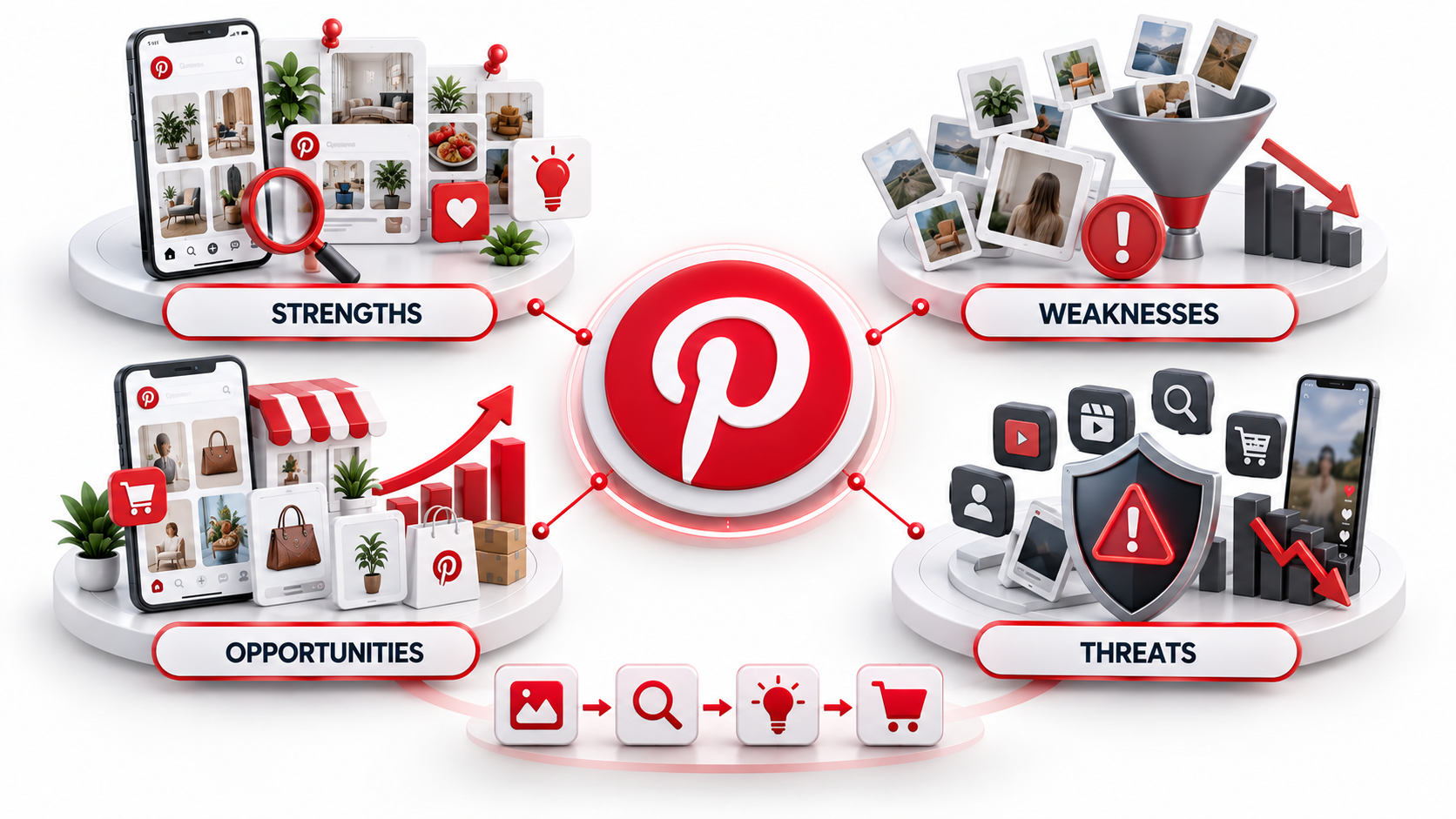
Every SWOT Analysis of Pinterest has to start here, because the strengths explain why this platform survived while dozens of “Pinterest competitors” quietly died. Pinterest has three or four genuinely rare advantages, not just generic “strong brand” filler you’d write about any company.
Visual Search and Real Purchase Intent
Half of Pinterest’s 80 billion monthly searches carry commercial intent. Sit with that number for a second. Most platforms would kill for even a fraction of that. When someone searches “minimalist living room” on Pinterest, they’re not just browsing for entertainment, a huge share of those searchers are actively planning a purchase within the next few weeks or months.
This matters for a very practical reason: ad relevance. When a brand’s Shopping Ad shows up next to organic Pins in a search for “wedding guest dresses under $100,” it doesn’t feel like an interruption the way a mid-scroll TikTok ad does. It feels like part of the same search experience. Pinterest’s own visual search tool, the little magnifying glass icon inside a Pin’s image, lets users click on a specific lamp or chair inside a photo and get shown where to buy that exact item or something close to it. That’s not a gimmick feature. It directly shortens the path between “I like this” and “I bought this.”
[Screenshot: Pinterest visual search tool active on a home decor Pin, showing the “shop similar” product carousel triggered by tapping the lamp inside the image]
Long Content Lifespan Compared to Other Platforms
A tweet dies in a few hours. An Instagram post gets maybe 48 hours of real reach before the algorithm buries it. A Pin from eighteen months ago can still be driving traffic today, sometimes more traffic than it did in its first week. This happens because Pinterest indexes Pins the same way Google indexes web pages, and a well-optimized Pin keeps surfacing in relevant searches for as long as the content stays relevant.
This is the strength that content creators and small business owners undervalue the most. If you run a food blog and publish a recipe Pin optimized around “easy weeknight dinner ideas,” that single Pin can compound in traffic for years with zero additional work. Compare that to a TikTok video, which needs constant feeding of new content just to maintain the same traffic level. Pinterest rewards patience and consistency in a way almost no other platform does anymore, which is why bloggers who got burned by Facebook’s organic reach collapse back in 2018 quietly moved a huge chunk of their traffic strategy to Pinterest and never looked back.
A Growing, Increasingly Global User Base
Growth outside the US and Canada has been the real engine behind Pinterest’s recent numbers. In the most recent quarterly report, the rest-of-world segment grew 15% year over year, faster than any other region, while Europe grew 7% and North America grew a more modest 4%. That international expansion matters because it means Pinterest isn’t squeezing growth out of an already-saturated US market, it’s actually opening new markets where competition for attention is thinner and ad costs are lower.
There’s also a demographic shift that surprised a lot of people. More than half of Pinterest’s user base is now Gen Z, which is not the story most people expect from a platform they associate with millennial moms planning weddings. That shift changes what content performs, what products sell, and how brands should be pitching themselves on the platform, and it’s a strength precisely because most competitors and even most Pinterest advertisers haven’t caught up to it yet.
Every User Is Logged In, and That Data Actually Gets Used
Here’s something most marketers never think about: every single Pinterest user is logged in when using the app. There’s no anonymous browsing mode eating into ad targeting the way it does on other platforms. That logged-in-only structure gives Pinterest cleaner first-party data on what people search for, save, and click, which becomes more valuable every year as third-party cookies keep getting phased out across the ad industry. Advertisers running Pinterest campaigns get targeting precision that’s getting harder to find anywhere else, and that’s not a small thing when the whole ad industry is scrambling to adjust to a privacy-first web.
Weaknesses
No honest SWOT Analysis of Pinterest can skip the weak spots, and Pinterest has some real ones. These aren’t nitpicks, they’re structural issues that show up directly in the company’s financials and in how brands actually experience the platform day to day.
The Monetization Gap Compared to Meta and Google
Pinterest makes real money now, but its revenue per user is still nowhere close to Meta’s or Google’s. Meta pulls in significantly more advertising revenue per monthly active user than Pinterest does, even though Pinterest’s users show clearer purchase intent. Why the gap? Ad inventory and advertiser sophistication. Meta’s ad platform has had over fifteen years to build out targeting, measurement, and campaign automation tools. Pinterest’s ad tools, while improving fast, still don’t have the same depth of third-party integrations, attribution modeling, and self-serve sophistication that big brands expect before they shift meaningful budget.
What most people get wrong here is assuming Pinterest is “behind” because the platform itself is weaker. It’s not. The gap exists because advertiser adoption takes time, and a lot of performance marketers still default to Meta and Google because that’s where their existing playbooks and pixels already live. Closing this gap is less about Pinterest’s product and more about changing advertiser habits, which is a slower, harder problem than shipping new features.
A Weak Engagement Loop Compared to Feed-Based Platforms
Pinterest doesn’t have the addictive engagement loop that keeps people opening TikTok fifteen times a day. Average session length on Pinterest is shorter than on TikTok or Instagram, and there’s no notification system nagging you back every time someone likes your Pin, because Pinterest never built its product around social validation the way those platforms did. That’s actually part of the platform’s strength for users, since nobody’s chasing dopamine hits on a mood board app, but it’s a real weakness for the business, because shorter, less frequent sessions mean fewer total ad impressions to sell.
This is also why Pinterest’s push into video content and its short-lived Idea Pins format struggled to gain the traction TikTok-style content gets elsewhere. Idea Pins were retired in 2023 after failing to build the habitual, feed-scrolling behavior Pinterest hoped for. Users came to Pinterest to search and save, not to be entertained by an endless vertical video feed, and forcing that behavior against the grain of what the platform is actually used for didn’t work.
Creators Don’t Fully Understand Their Role on the Platform
Ask ten content creators to explain their Pinterest strategy and eight of them will give you a vague answer about “pinning consistently.” That confusion isn’t their fault. Pinterest never built as clear a creator economy as YouTube, TikTok, or even Instagram, where monetization paths (ad revenue share, brand deals, tipping, subscriptions) are well understood and heavily promoted. Pinterest’s creator fund and monetization tools exist, but they’re nowhere near as visible or as lucrative, which means fewer full-time creators build their primary business around the platform.
The downside compounds itself. Fewer dedicated creators means less native, platform-optimized content being produced specifically for Pinterest, which means the platform leans more heavily on repurposed content from blogs and e-commerce catalogs. That content works fine for search-driven traffic, but it doesn’t build the kind of creator-driven cultural moments that keep a platform feeling alive and relevant in cultural conversations the way TikTok trends do.
Opportunities
This is where a SWOT Analysis of Pinterest gets genuinely exciting, because the opportunities in front of this company are large and mostly untapped. Pinterest isn’t scrambling to invent a new identity, it’s building on strengths it already has.
AI-Powered Shopping and Visual Search Expansion
Bill Ready has been explicit that AI sits at the center of Pinterest’s growth strategy going forward, and it’s not just marketing language. Pinterest’s AI systems are trained on years of curated human taste data, meaning the platform has a dataset most competitors can’t easily replicate: millions of people manually organizing images by aesthetic, style, and category over more than a decade. That data is exactly what you’d want to train a visual recommendation and search system on.
The practical opportunity here is turning that visual search into a near-frictionless shopping experience. Right now, a user can tap an item inside a Pin and see similar products. The next step, already being tested in parts of the product, is letting a user photograph something in their own home or closet and instantly get shown where to buy matching or complementary items. If Pinterest nails this, it closes the loop between “I found something I like” and “I bought it” faster than any competitor, because no other platform combines this scale of visual taste data with this level of commercial intent from users.
Expanding Performance+ and Automated Ad Tools
Pinterest’s Performance+ suite, its answer to Meta’s Advantage+ and Google’s Performance Max, automates a lot of the campaign optimization work that used to require a dedicated ad manager fiddling with bids manually. Early adoption data from Pinterest’s own reporting shows advertisers using Performance+ tools are seeing meaningfully better return on ad spend than manual campaign setups. That’s the kind of proof point that gets budget moved from other platforms.
The opportunity is scale. As more advertisers, especially mid-size e-commerce brands that don’t have dedicated performance marketing teams, adopt these automated tools, Pinterest’s ad revenue should grow faster than its user base, which is exactly the kind of monetization catch-up the platform needs to close the gap with Meta discussed earlier. Every quarter that Performance+ adoption climbs is a quarter where Pinterest’s per-user ad revenue inches closer to competitors.
Re-Engaging Gen Z Without Losing the Core Audience
More than half of Pinterest’s user base is Gen Z now, and that’s a demographic every other platform is fighting hard to keep engaged as attention spans shrink and platform loyalty gets thinner every year. Pinterest has an opportunity most competitors don’t: it can market itself to Gen Z as the “anti-doomscroll” platform, a place to plan and create instead of endlessly consuming short-form video. That positioning genuinely resonates with a portion of younger users who are increasingly vocal about wanting less addictive, more intentional app experiences.
The mistake would be trying to become TikTok to chase this audience. The opportunity is staying exactly what Pinterest is, search-first, planning-oriented, low-pressure, and marketing that difference directly to a generation that’s grown tired of comparison-driven feeds. Brands building content strategies for younger audiences should study how to position content around intent and planning rather than personality and trend-chasing, which is a very different content calendar approach than what works on social media platforms built around constant posting cadence.
Untapped International Ad Market Growth
Rest-of-world user growth is outpacing every other region, but ad monetization in those markets typically lags user growth by a year or two as local advertiser ecosystems mature. That lag is actually an opportunity in disguise. As Pinterest builds out localized ad sales teams, currency support, and region-specific ad products in fast-growing markets across Latin America, Southeast Asia, and parts of Europe, there’s a multi-year runway of revenue growth sitting in markets where the user base has already arrived but the ad dollars haven’t caught up yet.
Threats
A balanced SWOT Analysis of Pinterest has to be honest about what could genuinely knock this platform off its current trajectory. These aren’t hypothetical risks, they’re already playing out in the market.
TikTok Shop and Instagram Shopping Are Closing the Gap
Pinterest used to have a near-monopoly on “visual discovery that leads to purchase.” That’s no longer true. TikTok Shop has built an entire commerce infrastructure directly inside the app, letting creators tag products in videos and letting users check out without ever leaving TikTok. Instagram has done similar work with Shops and product tagging inside Reels and posts. Both platforms are chasing the exact use case Pinterest built its business around, and both have much larger daily active user bases and stickier engagement loops to work with.
This is the threat that should worry Pinterest the most, honestly. If TikTok and Instagram succeed in training users to discover and buy products natively inside content they were already going to consume for entertainment, Pinterest loses its differentiator. The counterargument is that TikTok and Instagram commerce still feels impulsive and trend-driven, while Pinterest commerce feels planned and considered, and those are genuinely different purchase psychologies. But that distinction only protects Pinterest if the company keeps reinforcing it through product decisions, not just marketing language.
Ad Budgets Are Sensitive to Broader Economic Conditions
Pinterest’s revenue is almost entirely advertising, which means it’s directly exposed to whatever happens with global ad spend during economic downturns. When brands cut marketing budgets, performance channels with clear attribution sometimes get protected while awareness-heavy channels get cut first, but Pinterest sits in an interesting middle zone. Its ad spend leans direct-response, which helps during downturns, but a meaningful chunk still comes from mid-size and small e-commerce brands that are often the first to pull back spending when consumer demand softens.
This isn’t a Pinterest-specific problem, every ad-dependent platform faces it, but it’s worth naming clearly in any SWOT Analysis of Pinterest because the company doesn’t have a second major revenue stream to fall back on the way Google has cloud computing or Amazon has AWS. If advertiser budgets tighten broadly, Pinterest feels it faster and more directly than diversified tech companies do.
Algorithm Dependency and Platform Fatigue
Content creators, bloggers, and small e-commerce brands that built traffic strategies around Pinterest’s algorithm have watched that algorithm shift multiple times over the past several years, sometimes favoring fresh Pins over older ones, sometimes rewarding video content, sometimes deprioritizing content that links off-platform too aggressively. Every algorithm change creates winners and losers among businesses that depend on Pinterest traffic, and that unpredictability is a real threat to advertiser and creator trust over time.
There’s also a broader platform fatigue risk worth naming honestly. Every social and discovery platform eventually faces a plateau where growth slows as the addressable market of new users shrinks. Pinterest has avoided this so far through eleven straight quarters of growth, which is genuinely impressive, but no platform grows forever. The question isn’t if growth eventually slows, it’s whether Pinterest has built enough monetization depth and product differentiation by the time that plateau arrives to keep revenue growing even after user growth flattens out.
How Marketers Can Apply This SWOT Analysis of Pinterest in Real Campaigns
A SWOT Analysis of Pinterest is only useful if it changes what you actually do with a marketing budget or content calendar. Here’s how the four quadrants translate into decisions.
Use the Strengths to Pick the Right Content Format
Because Pins have a long shelf life and commercial intent is baked into search behavior, evergreen content wins on Pinterest in a way it doesn’t on other platforms. Build Pins around searches that stay relevant year-round or that predictably spike seasonally, like “Christmas gift ideas” or “spring wedding trends,” rather than chasing whatever’s trending this week. Optimize Pin titles and descriptions the way you’d optimize a webpage for search, because that’s functionally what you’re doing.
Address the Weaknesses by Setting Realistic Expectations
If a client or stakeholder expects TikTok-level engagement metrics from a Pinterest campaign, correct that expectation early. Pinterest wins on assisted conversions and long-term traffic compounding, not on likes and comments. Track what actually matters: saves, outbound clicks, and attributed purchases through Pinterest’s conversion tracking, not vanity engagement numbers that were never going to be strong on this platform to begin with.
Move on the Opportunities Before Competitors Catch Up
Test Performance+ campaigns now, while adoption is still relatively low and advertisers running them are getting a competitive edge on cost per result. Start building visual search-optimized product photography, since that AI shopping experience is only going to get more central to how Pinterest drives purchases over the next few years. If your business sells physical products, make sure your catalog is properly connected to Pinterest’s shopping tools today, not after competitors have already claimed the search terms in your category.
Watch the Threats and Diversify Accordingly
Don’t build a marketing strategy that treats Pinterest as your only channel, the same way you shouldn’t build one around any single platform. Use Pinterest for what it’s uniquely good at (planning-stage discovery and long-tail search traffic) while running complementary campaigns on platforms better suited for impulse and trend-driven purchases. This kind of channel diversification is exactly the thinking taught in a properly structured digital marketing course, where you learn to match platform strengths to campaign goals instead of running the same playbook everywhere.
If you’re a founder trying to figure out where to actually put limited marketing hours and budget, working through a full channel-by-channel SWOT like this one for every platform you’re considering is one of the most useful exercises you can do before spending a single rupee on ads. Real case examples of brands that got platform selection right, and wrong, are worth studying in case study breakdowns before you commit a strategy to paper.
Conclusion
A proper SWOT Analysis of Pinterest tells a very specific story: this is a platform with genuine, hard-to-replicate strengths in purchase-intent search and content longevity, sitting on top of a monetization gap it’s actively working to close with AI and automated ad tools, facing real competitive pressure from platforms building their own shopping features. None of that is unique to Pinterest, every platform has trade-offs, but few platforms have this combination of strong fundamentals and this much unrealized commercial potential still sitting on the table.
If you’re deciding whether Pinterest deserves a spot in your marketing strategy, the answer depends entirely on what you’re selling and who’s buying it. Physical products, home goods, fashion, food, weddings, anything visual and planning-driven, Pinterest earns its place. Start small, optimize a handful of Pins around real search intent, track saves and outbound clicks instead of vanity metrics, and give the content a few months to compound before judging results.
Frequently Asked Questions
What is a SWOT analysis of Pinterest used for?
A SWOT analysis of Pinterest breaks down the platform’s internal strengths and weaknesses alongside external opportunities and threats, giving marketers and business owners a structured way to decide whether and how to invest in Pinterest as part of their overall strategy.
Is Pinterest still relevant in 2026?
Yes, Pinterest reported 640 million monthly active users and over $1.1 billion in quarterly revenue in 2026, marking eleven consecutive quarters of double-digit user growth. The platform remains especially relevant for e-commerce, home goods, fashion, and lifestyle brands.
What is Pinterest’s biggest strength as a marketing platform?
Pinterest’s biggest strength is the combination of long content lifespan and strong purchase intent. Roughly half of its 80 billion monthly searches carry commercial intent, and individual Pins can keep driving traffic for months or years after publishing, unlike content on most social platforms.
What is Pinterest’s biggest weakness?
Pinterest’s biggest weakness is its monetization gap compared to platforms like Meta and Google. Despite having users with clearer purchase intent, Pinterest generates significantly less advertising revenue per user, largely due to less mature ad tooling and slower advertiser adoption.
How is Pinterest different from Instagram for marketing?
Pinterest functions more like a visual search engine, where users actively search for ideas and products with planning-stage intent. Instagram functions as a social feed built around personal connections, entertainment, and impulse-driven discovery, which means content strategy and success metrics differ significantly between the two.
Does Pinterest work for B2B businesses?
Pinterest works best for B2C businesses selling visual, tangible products or experiences, such as home decor, fashion, food, or events. B2B businesses generally see limited results on Pinterest since the platform’s search behavior is built around personal and lifestyle planning rather than business decision-making.
What industries benefit most from Pinterest marketing?
Home decor, fashion, wedding planning, food and recipes, DIY and crafts, travel, and beauty consistently perform best on Pinterest because these categories align directly with how users search and plan on the platform.
How long does it take to see results from Pinterest marketing?
Pinterest typically takes three to six months to show meaningful organic traffic results because the platform’s search algorithm favors content that builds authority and relevance over time, similar to SEO on a website rather than the immediate reach of a social media post.
Is Pinterest advertising worth it compared to Meta ads?
Pinterest advertising is worth testing for brands selling visual products, especially those already running SEO and content strategies, since Pinterest ads integrate naturally into search-driven discovery. Meta ads generally still deliver more mature targeting and measurement tools, so many brands run both platforms rather than choosing one exclusively.
What is Pinterest’s Performance+ and how does it help advertisers?
Performance+ is Pinterest’s automated advertising suite that uses machine learning to optimize bidding, targeting, and creative delivery with minimal manual input, similar to Meta’s Advantage+ or Google’s Performance Max. Early adopters have reported improved return on ad spend compared to manually managed campaigns.
Why did Pinterest retire Idea Pins?
Pinterest retired Idea Pins in 2023 because the short-form video format failed to generate the level of engagement and habitual usage the company expected. User behavior on Pinterest remained centered on search and saving rather than consuming an endless feed of entertainment content, which didn’t match the format’s design intent.
What threats could slow Pinterest’s growth in the coming years?
The main threats include TikTok Shop and Instagram Shopping closing the gap on visual product discovery, advertiser budget sensitivity during economic downturns since Pinterest relies almost entirely on ad revenue, and the natural risk of user growth eventually plateauing after several years of consistent expansion.