


PhonePe processes more UPI transactions in a single month than most countries process in digital payments across an entire year. That’s not a marketing line, that’s just what the National Payments Corporation of India’s data shows month after month. And yet, the same company has spent most of its life losing money, hand over fist, while sitting on top of the single most valuable payment rail in the country. That contradiction is exactly why a proper SWOT analysis of Phonepe is worth doing right now, not the generic four-box version you find in a hundred recycled blog posts, but one that actually explains why a market leader can be this dominant and this unprofitable at the same time.

I’ve spent years looking at how Indian consumer internet companies build and defend market share, and PhonePe is one of the more interesting case studies out there. It didn’t win by being first. Paytm was first. It didn’t win by having the most cash. Google Pay had Google’s balance sheet behind it. PhonePe won by doing something boring but brutally effective: it went where the other two were slow to go, and it stayed there long enough to become the default.
In this guide, I’m breaking down the strengths, weaknesses, opportunities, and threats that actually matter in a SWOT analysis of Phonepe, not the surface-level stuff you can get from a Wikipedia summary. You’ll see where PhonePe’s moat is real, where it’s thinner than people assume, what growth levers are still on the table, and which threats could genuinely dent its market position over the next few years. If you’re a marketer, a founder, or someone studying fintech as a case study, this is the version that goes past the obvious.
What You Will Learn in This Guide
- Why PhonePe’s UPI market share is both its biggest strength and a regulatory liability
- The real reason PhonePe still isn’t consistently profitable despite processing trillions of rupees in transaction value
- Where PhonePe is placing its next growth bets, and which ones actually have a shot
- The competitive and regulatory threats that could reshape PhonePe’s position faster than most people expect
- What founders and marketers can actually take away from PhonePe’s growth playbook
TL;DR: Quick Summary
- PhonePe holds close to half of India’s UPI transaction volume, making it the single largest player in the world’s biggest real-time payments network.
- Its biggest weakness isn’t demand, it’s monetization. UPI transactions are free to the end user by regulation, so the core product doesn’t generate direct revenue.
- The NPCI’s 30% market share cap on any single UPI app is a live threat that PhonePe has been negotiating around for years without a permanent resolution.
- PhonePe’s real growth story now sits outside payments, in insurance distribution, mutual funds, lending, and its Pincode hyperlocal commerce bet.
- Google Pay and the resurgence of Paytm after its wallet troubles, plus Jio Financial Services entering the fray, are the three competitive fronts to watch.
- The company’s path to sustainable profit depends far more on financial services cross-selling than on payments volume growth alone.
Understanding PhonePe Before You Do a SWOT Analysis of Phonepe

Before you can make sense of any SWOT analysis of Phonepe, you need to understand what PhonePe actually is today, because it’s changed a lot since 2016. It didn’t start as a payments company in the way most people think. Sameer Nigam, Rahul Chari, and Burzin Engineer built it as a UPI-first app at a time when UPI itself was brand new and nobody was sure it would take off. Flipkart acquired PhonePe in 2016, and that acquisition is the single most important fact in this entire analysis, because it gave PhonePe two things a startup rarely gets simultaneously: deep pockets and a built-in merchant and user base to bootstrap from.
PhonePe isn’t just a UPI app anymore. It’s a full financial services stack. Under the same app, you’ve got UPI payments, bill payments, insurance distribution (PhonePe sells term insurance, motor insurance, and more through tie-ups with actual insurers), mutual fund investments through PhonePe Wealth, gold buying, and a lending arm that connects users to NBFC and bank partners. On the merchant side, PhonePe runs one of the largest QR code networks in the country and has pushed into offline retail through devices like Smartspeaker, which reads out payment confirmations to shopkeepers in their own language.
Then there’s Pincode, PhonePe’s separate hyperlocal e-commerce app that’s trying to do for local retail what Amazon and Flipkart did for warehousing-based commerce, and Indus Appstore, its Android app store alternative aimed at reducing dependency on Google Play. Walmart owns the majority stake through Flipkart’s parent structure, which matters because it means PhonePe has patient capital behind it in a way that a standalone Indian startup usually doesn’t.
So when you read “strengths” and “weaknesses” below, keep this bigger picture in mind. This isn’t a SWOT analysis of Phonepe the payments app. It’s a SWOT analysis of Phonepe the financial services super-app that happens to have started with payments and is now trying to build everything else on top of that base.
It also helps to know the timeline, because the pace of expansion tells you something about the strategy. PhonePe launched UPI payments in 2016, crossed 100 million registered users by 2018, and kept adding product lines almost every year after that instead of waiting to perfect one thing before moving to the next. Insurance distribution came in 2020, mutual funds and gold followed soon after, Pincode launched in 2022, and Indus Appstore rolled out in 2023. That’s not a company sitting still and defending a lead. That’s a company that knows a payments-only business model doesn’t survive long term, and it’s been racing to build the next revenue engine before the first one runs out of road. Whether that race is being run fast enough is exactly what the rest of this analysis digs into.
SWOT Analysis of Phonepe
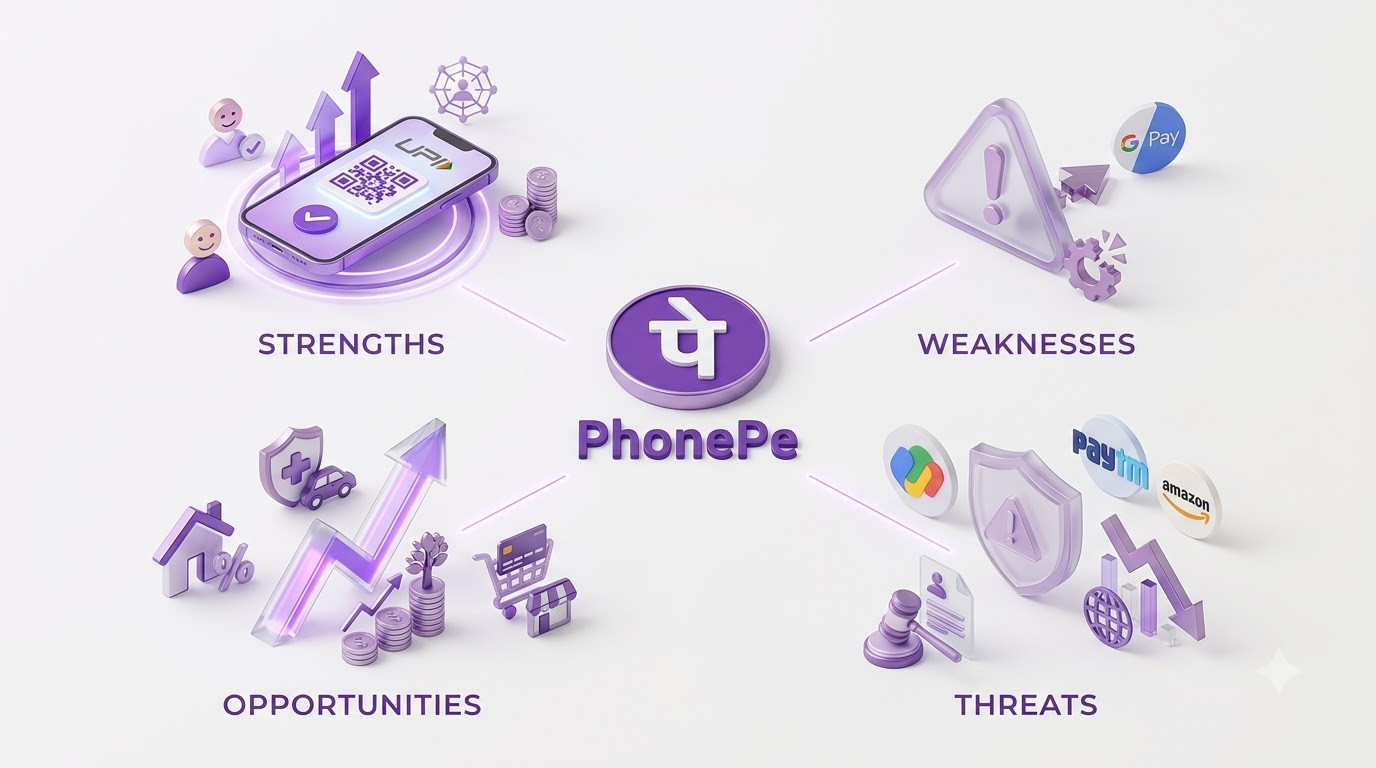
Strengths in the SWOT Analysis of Phonepe
Any honest strengths section in a SWOT analysis of Phonepe has to start with distribution, because that’s the one thing competitors genuinely cannot copy overnight. PhonePe didn’t just build a good app, it built the widest acceptance network in Indian digital payments, and that network effect compounds every single day it stays ahead.
Dominant Market Share in UPI Transactions
PhonePe has consistently held somewhere close to 46 to 48% of UPI transaction volume in India, according to NPCI’s monthly data, which puts it well ahead of Google Pay’s roughly 36 to 37% and everyone else fighting over what’s left. That’s not a small lead, that’s close to half the entire market run by one app. When you’re processing that kind of volume, every merchant who wants to accept digital payments has to support you, which creates a loop: more merchants accept PhonePe because more users have it, and more users keep it because more merchants accept it.
What makes this strength durable rather than accidental is where that volume comes from. A huge chunk of it is small-value, high-frequency transactions, tea stalls, auto rickshaws, kirana stores, vegetable vendors. These are the hardest merchants to onboard because the ticket size is tiny and the sales effort per merchant is high, but once you’ve onboarded them, they rarely switch apps because the QR code sticker is already on their counter and their regular customers already know to scan it. PhonePe went hard after this segment early, sending feet-on-street teams into tier 2 and tier 3 towns when Google Pay was still leaning on its brand recognition to pull users organically.
Look at what actually happens when a company has this kind of lead. Every fintech or e-commerce app launching in India now has to ask “does this work with PhonePe” as a default checklist item, not an afterthought. That’s the difference between being a popular app and being infrastructure. Infrastructure doesn’t get displaced by a slightly better feature set, it gets displaced only when the underlying system it runs on changes, which is exactly why the regulatory threats discussed later in this piece matter so much more for PhonePe than a simple competitor comparison would suggest.
Backing From Walmart and the Flipkart Ecosystem
Being owned by Walmart through the Flipkart Group gives PhonePe something almost no other Indian fintech has: a parent company that can absorb years of losses without blinking, because the strategic value of owning India’s payments layer is worth more to Walmart than short-term profit. This matters enormously in a market where price wars and cashback battles are how you win share, because the company willing to burn cash the longest usually wins the distribution race.
This backing also gave PhonePe access to Flipkart’s existing merchant relationships and technical infrastructure in its early years, which shaved off time it would otherwise have spent building trust and integrations from zero. And when PhonePe raised its own separate funding round in 2023, valuing the company at around $12 billion with investors like General Atlantic and Qatar Investment Authority coming in, it proved the business could attract capital independent of Flipkart too, which reduces the single-parent dependency risk that would otherwise be a weakness.
A Genuinely Diversified Product Stack
Most people still think of PhonePe as “the app I use to pay for chai,” but the product stack underneath is a lot deeper than that. Insurance premiums collected through PhonePe, mutual fund SIPs started on the platform, and gold purchases all represent revenue lines that don’t depend on UPI transaction volume at all. This diversification is a genuine strength because it means PhonePe isn’t betting its entire future on a product category, UPI payments, that generates close to zero direct revenue by regulatory design.
The insurance business alone has grown into a meaningful distribution channel. PhonePe partners with insurers to sell policies directly inside the app, and because it already has hundreds of millions of registered users, the customer acquisition cost for these cross-sold products is close to nothing compared to what a standalone insurance-tech startup would spend on ads and sales teams to get the same customer.
PhonePe Pulse and the Data Advantage
PhonePe launched Pulse, a public data platform showing transaction trends across India by state, district, and even pin code level, and while it looks like a PR exercise on the surface, it’s actually a smart strength play. It positions PhonePe as the authoritative voice on Indian digital payments data, the kind of source journalists, researchers, and even government bodies cite when they talk about UPI adoption. That’s brand equity money can’t buy directly, and it reinforces PhonePe’s image as the market leader even in contexts that have nothing to do with the app itself.
Beyond the PR value, the underlying data asset is real. PhonePe knows spending patterns, seasonal trends, and merchant category performance across the country in a way that helps it decide where to expand its lending and insurance products next, and which regions are ready for premium financial products versus which ones are still building basic digital payment habits.
Brand Trust Built Through Consistency, Not Just Marketing Spend
PhonePe hasn’t relied on flashy celebrity endorsements the way some of its rivals have. Instead, its brand trust has been built the slow way, through years of the app simply working reliably at scale, transaction after transaction, without the kind of high-profile outages or fraud scandals that have hit some competitors. In a category where the entire product is “trust someone else with your money,” that consistency compounds into a genuine strength that’s hard to measure on a spreadsheet but shows up clearly in retention numbers.
This matters more in India than people outside the market sometimes realize, because a huge share of PhonePe’s user base includes first-time digital payment users, people who moved directly from cash to UPI without ever using a credit card or online banking regularly before. For that user, a single bad experience, a failed transaction that doesn’t refund quickly, or a support request that goes nowhere, can push them back to cash permanently. PhonePe’s investment in transaction success rates and customer support responsiveness isn’t glamorous, but it’s arguably done more for long-term retention than any cashback campaign ever did.
Explore more digital business breakdowns like this one in our case studies section, where we look at how real companies actually grow, not just how they say they grow in press releases.
Weaknesses in the SWOT Analysis of Phonepe
Here’s the part most people skip when they talk about PhonePe: being the market leader in UPI doesn’t automatically mean you’re making money, and honestly, it’s kind of the opposite. The weaknesses section of any serious SWOT analysis of Phonepe has to confront the profitability problem head-on, because it’s the single biggest question mark hanging over the company.
UPI Doesn’t Generate Direct Revenue
This is the weakness that surprises people who don’t work in fintech. The NPCI mandates zero merchant discount rate on UPI transactions, meaning PhonePe cannot charge merchants a fee for processing a UPI payment the way a credit card network charges a percentage on every swipe. So the product responsible for close to half of PhonePe’s transaction volume generates essentially no direct transaction revenue at all.
This isn’t a small technical detail, it’s the core structural problem of the entire business model. Compare this to a company like PayPal or Stripe internationally, which take a cut of every transaction they process. PhonePe processes trillions of rupees a year and earns close to nothing on the vast majority of it directly. Whatever revenue PhonePe does earn from UPI comes indirectly, through incentive payouts the government occasionally provides to promote digital payments, and these have been inconsistent and politically dependent rather than a stable revenue line the company can plan around.
Here’s the thing that makes this weakness so stubborn: PhonePe and the rest of the industry have lobbied for years to get some form of merchant discount rate reinstated on UPI transactions, even a small one, arguing that a completely free public payments rail isn’t sustainable for the private companies that built the apps running on top of it. The government has resisted this because free UPI is politically popular and central to its financial inclusion narrative. So PhonePe is stuck in a position where the product driving nearly half its transaction volume is also the product it has the least control over pricing for, and there’s no clear timeline for that to change.
Years of Sustained Losses
For most of its existence, PhonePe posted heavy annual losses, running into thousands of crores of rupees in some years, even as its transaction volume kept climbing. The company has said it’s targeting or has reached profitability more recently on certain metrics, but the historical pattern shows a business that scaled user numbers dramatically faster than it scaled revenue, which only works as long as your parent company or investors are willing to keep funding the gap.
This matters because it exposes the risk in the “grow now, monetize later” playbook that a lot of Indian consumer tech companies followed through the 2010s. It worked when capital was cheap and investors rewarded growth metrics over profit. It’s a much harder sell in a market where investors, including Walmart’s own shareholders, increasingly want to see a credible path to sustainable margins, not just user growth charts that go up and to the right.
What most people get wrong is assuming a company this large must have figured out the money side by now simply because it’s still around. Scale and profitability are two completely different problems, and PhonePe’s history shows a business that solved the first one years before it made real progress on the second. Employee stock option costs tied to its 2022 move of domicile from Singapore back to India also added a one-time tax burden that inflated its reported losses in certain years, which isn’t purely an operational problem, but it does show how expensive it’s been for PhonePe just to get its corporate structure aligned with running an India-first business at this scale.
Heavy Dependence on Incentive and Cashback-Driven Growth
A meaningful part of PhonePe’s user acquisition and retention in its earlier years leaned on cashback offers, scratch cards, and referral bonuses, the same playbook every Indian fintech ran during the 2018 to 2021 period. The problem with cashback-driven growth is that it attracts a segment of users who are loyal to the incentive, not the app, and the moment the cashback dries up, some of that engagement dries up with it.
PhonePe has scaled back aggressive cashback spending compared to its peak years, partly because investors across the industry pushed companies toward more sustainable unit economics, but that pullback also means the company has had to work harder to retain users through genuine product value, like faster transaction speeds, better UI, or bundled financial products, rather than through direct cash incentives. That transition is still ongoing, and it’s not obvious the retention holds at the same level without the old incentive structure.
Overexposure to a Single, Regulator-Controlled Market
PhonePe generates the overwhelming majority of its business from India, and within India, from a payments rail, UPI, that is entirely controlled by NPCI, a body owned by Indian banks and the Reserve Bank of India. That’s a serious concentration risk. If NPCI changes a rule, caps a market share, delays a fee structure, or shifts policy around how UPI apps operate, PhonePe has almost no leverage to push back, because it doesn’t own the rail it depends on.
Compare that to a company like Google, which owns its own ad infrastructure, or Amazon, which owns its own logistics network. PhonePe’s core product runs on infrastructure it doesn’t control and can’t diversify away from easily, at least not within the same timeframe as its competitors are also constrained by. This single point of dependency shows up again in the threats section below, because it’s not a hypothetical risk, it’s already played out once with the market share cap rule.
Thin Margins Even in the “Solved” Cross-Sell Businesses
Even the businesses PhonePe is counting on to fix its monetization problem aren’t easy money. Insurance distribution commissions are regulated and generally modest, mutual fund distribution fees have been under downward pressure across the industry for years as direct plans and low-cost platforms squeeze traditional distributor margins, and lending through NBFC partnerships means PhonePe takes a smaller cut than it would if it held the credit risk itself, which it mostly doesn’t want to do given how capital-intensive that becomes.
So while cross-selling is the right strategic direction, it’s not a business model that flips PhonePe from loss-making to highly profitable overnight. It’s a slow build, commission by commission, policy by policy, SIP by SIP, and it needs enormous scale just to add up to meaningful revenue relative to the size of the company. That’s a weakness worth naming honestly instead of assuming diversification alone solves the profitability question.
Opportunities in the SWOT Analysis of Phonepe
Now here’s where it gets genuinely interesting, because the opportunities in a SWOT analysis of Phonepe aren’t just “grow more users,” they’re specific bets the company has already started placing, some of which look smart and some of which look like they’re still figuring themselves out.
Financial Services Cross-Selling at Scale
PhonePe’s biggest realistic path to profitability isn’t payments, it’s everything it can sell on top of payments. Insurance, mutual funds, gold, and lending are all businesses where PhonePe can actually earn a commission or a spread, unlike UPI transactions themselves. With hundreds of millions of registered users already inside the app, PhonePe has a distribution advantage that a standalone insurance or wealth-tech startup would spend years and enormous ad budgets trying to replicate.
The mechanics here matter. When a user who already trusts PhonePe with their daily payments sees a mutual fund SIP option or a term insurance nudge inside the same app, the conversion friction is dramatically lower than it would be for a cold acquisition from a separate app. This is the same logic behind why WeChat in China became a financial super-app, and why Grab in Southeast Asia pushed hard into lending and insurance once it had payments volume locked in. PhonePe is running the same playbook, and if it executes well, this is where the actual profit engine of the company lives over the next five years, not in payments volume growth.
The part most guides skip is how PhonePe is using its transaction data to make these cross-sell pushes smarter rather than just spraying every product at every user. A user who consistently pays for fuel and vehicle-related expenses through the app is a more relevant target for motor insurance nudges than someone whose spending pattern shows no vehicle-related transactions at all. That kind of targeting, built on real behavioral data rather than demographic guesswork, is what separates a genuinely effective cross-sell strategy from just cluttering an app with banner ads nobody clicks.
Deeper Penetration Into Tier 3 and Tier 4 Towns
India’s tier 1 and tier 2 markets are already saturated with UPI adoption. The real growth headroom left in digital payments sits in smaller towns and semi-urban India, where cash is still dominant for a large share of daily transactions. PhonePe’s early strategy of aggressive on-ground merchant onboarding gives it a structural head start here compared to Google Pay, which has historically relied more on organic and brand-driven growth rather than boots-on-the-ground sales.
This opportunity isn’t just about payments volume either. Users in these markets are also underserved on insurance and credit access, which loops back into the cross-selling opportunity above. A shopkeeper in a tier 3 town who’s been using PhonePe to accept payments for two years is a much easier sell for a working capital loan product than a completely new customer would be, because PhonePe already has transaction history data that can inform underwriting decisions.
There’s also a language and trust dimension to this opportunity that’s easy to underestimate if you’ve never worked on the ground in these markets. A lot of small merchants in tier 3 and tier 4 towns are more comfortable transacting in their regional language and prefer voice confirmation over reading text on a screen, which is exactly why PhonePe’s Smartspeaker device, announcing payment confirmations out loud in the shopkeeper’s own language, has been such an underrated growth tool. It’s not a flashy feature, but it directly addresses a trust gap that a purely app-based competitor without a physical hardware presence at the point of sale struggles to close as effectively.
Pincode and the Hyperlocal Commerce Bet
Pincode is PhonePe’s attempt to build a hyperlocal e-commerce marketplace that connects local kirana stores and small retailers directly to nearby customers, competing in a space that includes Amazon’s own hyperlocal ambitions and the Open Network for Digital Commerce, ONDC, which the Indian government has been pushing as an open, interoperable alternative to closed platform monopolies. This is a genuine opportunity because PhonePe already has relationships with millions of small merchants through its payments business, and Pincode is essentially trying to monetize that existing merchant trust by adding a commerce layer on top.
The risk here, and I’ll be upfront about it, is that hyperlocal commerce is a graveyard of failed Indian startups. Dunzo struggled, several regional players folded, and even well-funded attempts have found it hard to make unit economics work at the last-mile delivery level. PhonePe’s advantage is that it’s not starting from zero on merchant relationships, but building a functioning marketplace is a completely different operational challenge than running a payments app, and it’s too early to call this a proven win.
What most people get wrong about hyperlocal commerce is assuming the hard part is technology. It isn’t. The hard part is logistics density, having enough delivery capacity in a specific pin code to make fulfillment economically viable without subsidizing every order at a loss. PhonePe’s bet here leans on partnering with existing local delivery networks rather than building its own fleet from scratch, which is a more capital-efficient approach than what some failed competitors tried, but it also means Pincode’s success depends heavily on the quality and reliability of partners it doesn’t fully control, which brings the same kind of dependency risk that shows up elsewhere in this analysis.
Indus Appstore and Reducing Platform Dependency
Indus Appstore, PhonePe’s own Android app store, is a smaller but strategically smart opportunity. It’s designed to give Indian app developers, and eventually PhonePe itself, an alternative to Google Play’s commission structure and policies. If it gains even modest traction, it reduces PhonePe’s own dependency on Google’s ecosystem for distribution, and it opens a new advertising and app-discovery revenue line that has nothing to do with payments at all.
This is a longer-shot opportunity than the financial services cross-sell, because building an app store that developers and users actually choose over the default one on their phone is genuinely hard, Samsung and Amazon have both tried and neither has meaningfully dented Google Play’s dominance in India. But even a modest slice of that market, given how many Android phones are sold in India every year, would be meaningful incremental revenue for PhonePe.
If you’re studying how companies build these kinds of adjacent revenue bets, it’s worth spending time in our digital marketing learning hub, where we break down how platforms grow beyond their original core product.
International UPI Acceptance Opening a New Growth Lane
NPCI has been actively pushing UPI acceptance beyond India, striking deals that let Indian UPI apps work in countries like the UAE, Singapore, France, Sri Lanka, and Mauritius, mostly aimed at Indian tourists and the diaspora community. This is still an early and fairly narrow opportunity compared to PhonePe’s domestic scale, but it matters because it’s the first real crack at international relevance for a business that has otherwise been almost entirely India-bound.
For PhonePe specifically, this opens two doors. The first is straightforward, letting existing Indian users pay abroad using the same app they already trust, which strengthens loyalty and reduces the reason to ever consider switching to a competitor. The second is more ambitious, positioning PhonePe’s underlying UPI expertise and infrastructure as something that could eventually be licensed or replicated in other developing markets working on their own real-time payment systems, the way India has already advised several countries on adapting a UPI-style model domestically. That’s a long game, and nobody should expect it to move PhonePe’s revenue needle in the next year or two, but it’s a legitimate long-term optionality play that didn’t exist even five years ago.
[Screenshot: PhonePe Pulse dashboard showing UPI transaction volume trends broken down by state and quarter]
Threats in the SWOT Analysis of Phonepe
No SWOT analysis of Phonepe is complete without a hard look at the threats, and honestly, this is the section where I think most coverage of PhonePe undersells how real the risks are. It’s easy to look at the market share numbers and assume the position is unshakeable. It isn’t.
The NPCI 30% Market Share Cap
This is the single biggest regulatory threat hanging over PhonePe, and it’s not new, but it also hasn’t gone away. NPCI introduced a rule capping any single UPI app’s transaction volume market share at 30%, intended to prevent exactly the kind of concentration PhonePe and Google Pay have created between them, where the two apps combined handle over 80% of all UPI volume. PhonePe currently sits well above that 30% threshold.
The deadline for enforcing this cap has been pushed back multiple times, most recently extended further into the future as NPCI weighs how to implement it without disrupting the payments ecosystem millions of Indians rely on daily. But the threat doesn’t disappear just because the deadline keeps moving. If NPCI ever does enforce it strictly, PhonePe would be forced to actively limit new user growth or transaction volume, which would be an almost unprecedented situation, a market leader being regulated into shrinking its own core product. No amount of product excellence protects against a rule like that.
Honestly, this is the threat I’d be watching most closely if I were advising PhonePe’s strategy team. Every other risk in this analysis is something the company can influence through better execution, sharper products, or smarter marketing. This one it can’t. NPCI could enforce the cap through onboarding restrictions on new users, transaction throttling during peak periods, or a phased reduction timeline, and each of those approaches would hit PhonePe’s growth curve differently. The uncertainty itself is a cost too, because it makes long-term planning harder when you don’t know if your core product will be allowed to keep growing at its current pace two or three years from now.
Renewed Competitive Pressure From Google Pay and Paytm
Google Pay isn’t standing still. It holds a strong second position in UPI market share and has the advantage of being pre-installed or heavily promoted across the Android ecosystem that dominates Indian smartphones, which gives it a distribution channel PhonePe doesn’t have direct control over. If Google decides to push harder on UPI growth through deeper Android integration or aggressive incentive spending, PhonePe’s lead could compress faster than people expect.
Paytm, meanwhile, went through a rough patch after RBI restrictions hit Paytm Payments Bank hard in early 2024, and its UPI market share dipped as a result. But Paytm has been rebuilding, shifting more of its UPI processing to partner banks, and it still has a large existing user base and merchant network built over a decade. Counting Paytm out entirely would be premature, and if it stabilizes, it adds pressure back onto the middle of the market that PhonePe and Google Pay have been splitting largely between themselves.
What’s easy to miss here is that competitive threats in this market rarely show up as a dramatic single event. They show up gradually, a percentage point of market share here, a slightly better merchant incentive there, a feature launch that gets copied within weeks by everyone else. Google Pay’s integration advantages inside the Android operating system and Google’s broader app ecosystem mean it can afford to play a longer, quieter game than a startup would, absorbing losses on incentive spending because the strategic value of owning payments data ties into Google’s advertising business too. That’s a very different kind of pressure than a scrappy new entrant, and it’s the kind that erodes a lead slowly rather than all at once.
Jio Financial Services and Deep-Pocketed New Entrants
Reliance’s Jio Financial Services entering payments and broader financial services is a threat that deserves more attention than it usually gets. Reliance has a track record of entering a market late, undercutting on price using its own deep balance sheet, and using its massive telecom subscriber base to force rapid adoption, which is exactly what happened when Jio disrupted the entire Indian telecom industry starting in 2016. If Jio Financial Services applies even a fraction of that playbook to payments and lending, it changes the competitive dynamics for everyone, including PhonePe.
The reason this threat is different from Google Pay or Paytm is distribution. Jio already has hundreds of millions of telecom subscribers it can cross-sell financial products to directly through its own app ecosystem and retail network, JioMart and Reliance Retail stores included. That’s a pre-built merchant and consumer funnel that took PhonePe years of on-ground effort to build, and Reliance could potentially activate a version of it much faster.
I don’t think Jio Financial Services flips the market overnight, but I’d watch its lending and insurance moves specifically, more than its payments app itself, because that’s where Reliance’s balance sheet and existing retail footprint give it the sharpest edge. If Jio starts bundling attractive loan or insurance products directly into JioMart purchases or Reliance Retail checkout flows, it creates a distribution shortcut that sidesteps the years of merchant-by-merchant trust-building PhonePe had to do the hard way, and that’s the scenario that should worry PhonePe’s strategy team more than a simple payments app comparison would suggest.
Data Security, Fraud, and Regulatory Compliance Risk
Handling the payment data of hundreds of millions of Indians makes PhonePe a high-value target for fraud attempts and cyberattacks, and even a single major security incident could do lasting damage to user trust in a category where trust is the entire product. UPI fraud, including social engineering scams where users are tricked into approving fraudulent payment requests, has been a growing problem across the industry, and while much of it isn’t technically PhonePe’s fault, the app’s brand still absorbs reputational damage whenever these incidents make headlines, because it’s the interface users interacted with when they lost money.
On top of that, PhonePe operates in a regulatory environment that’s still evolving fast. Data localization rules, KYC requirements, and lending guidelines for co-lending partnerships with NBFCs all carry compliance risk, and any tightening of these rules could slow down product launches or add operating costs that squeeze already thin margins further.
The part that doesn’t get talked about enough is how much customer support capacity a fraud incident actually consumes, separate from the reputational hit. When a scam wave hits a specific category, fake customer care numbers, QR code swap frauds at merchant counters, screen-sharing scams, the volume of support tickets and refund investigations spikes fast, and handling that at the scale of hundreds of millions of users requires infrastructure most companies never have to build. PhonePe has invested in in-app fraud warnings and transaction limit controls to reduce this exposure, but the fundamental challenge doesn’t go away as long as scammers keep adapting their methods faster than user education campaigns can keep up.
Smaller, Focused Players Chipping Away at Specific Segments
It’s easy to frame the competitive threat as just Google Pay, Paytm, and Jio, but a full SWOT analysis of Phonepe should also account for the smaller, more focused players nibbling at specific segments rather than trying to compete head-on across everything. Buy-now-pay-later apps, niche wallet products aimed at specific communities like students or gig workers, and even WhatsApp Pay quietly expanding its own UPI feature inside an app most Indians already have open all day, are all forms of competition that don’t need to beat PhonePe on overall scale to matter.
The risk with this kind of fragmented competition isn’t that any single player dethrones PhonePe. It’s death by a thousand cuts, a BNPL app peeling off younger users for a specific use case, WhatsApp Pay capturing casual peer-to-peer transfers because it’s already open in the conversation, a niche wallet winning over a specific merchant category PhonePe hasn’t prioritized. None of these individually move the market share needle much, but together they represent the kind of slow erosion that’s much harder to spot and respond to than a single, obvious competitor gaining ground.
What This SWOT Analysis of Phonepe Teaches Marketers and Founders
Stepping back from PhonePe specifically, there’s a broader lesson here for anyone building or marketing a product in a competitive, low-margin category, and it’s worth pulling out explicitly because it applies well beyond fintech.
Distribution Beats Product in Winner-Take-Most Markets
PhonePe didn’t win UPI by having a meaningfully better app than Google Pay. Both apps do essentially the same core job, scan a QR code, send money, receive money. PhonePe won by out-hustling everyone on merchant onboarding, particularly in the small-ticket, high-frequency segments that are annoying and expensive to serve but create the stickiest usage habits. If you’re building a product in a market where the core feature set is easy to copy, your differentiation has to come from distribution and operational grit, not just interface polish.
This is a lesson I bring up constantly when talking about growth strategy with founders. Everyone wants to talk about product-market fit and elegant UX, and those matter, but in markets that come down to network effects, the company willing to do the unglamorous, unscalable work of onboarding merchant number four thousand in a small town usually ends up owning the category. If you’re mapping out a growth system for your own business, this is exactly the kind of thinking we cover inside Smart Boss Club, where the focus is on building growth systems that don’t depend on outspending competitors.
I’d also add that this lesson cuts against a lot of the advice floating around startup and marketing content today, which tends to obsess over growth hacks, viral loops, and clever acquisition channels. Those things help, but they rarely build the kind of durable moat PhonePe has, because a clever channel can be copied the moment a competitor notices it working. Grinding through merchant onboarding one shopkeeper at a time in a small town nobody else bothered visiting isn’t a hack, it’s just work, and that’s precisely why it’s harder to copy.
Free Products Need a Real Monetization Layer, Not a Hope
PhonePe’s struggle to turn massive scale into consistent profit is a warning for any business built on a free or heavily subsidized core product. Scale alone doesn’t create revenue, it creates cost if you don’t have a clear plan for what you’re going to sell to the people using your free product. The lesson isn’t “don’t build free products,” it’s “know exactly what you’re going to monetize before you scale the free thing to hundreds of millions of users,” because retrofitting monetization after the fact is far harder than designing it in from the start.
PhonePe’s cross-sell strategy into insurance, mutual funds, and lending is essentially a five-years-late answer to a question it should have had a clearer answer to earlier. That’s not a criticism unique to PhonePe, most consumer tech companies globally have made the same mistake, but it’s a pattern worth recognizing early if you’re building something similar.
Regulatory Dependency Is a Business Risk Like Any Other
If your entire revenue model sits on top of infrastructure controlled by someone else, whether that’s a government body, a platform like Apple’s App Store, or an API you don’t own, you need a contingency plan for what happens if the rules change. PhonePe’s exposure to the NPCI market share cap is the clearest version of this risk playing out in real time, and it’s a reminder that even the biggest, best-funded companies aren’t immune to a single rule change reshaping their entire growth trajectory.
If you’re thinking about building a business model around a payments or platform layer you don’t control, it’s worth studying how businesses actually make money in adjacent categories first. Our make money learning hub covers realistic monetization paths that don’t leave you fully exposed to a single regulator’s decision.
Conclusion
A proper SWOT analysis of Phonepe shows a company that won the distribution war in Indian digital payments decisively, but still hasn’t fully solved the harder problem of turning that dominance into sustainable profit. The strengths are real and hard to replicate, the market share, the merchant network, the Walmart-backed balance sheet. But the weaknesses are structural, not cosmetic, UPI simply doesn’t pay the bills on its own, and the threats, especially the NPCI market share cap and Jio’s entry into financial services, aren’t hypothetical risks sitting in a footnote somewhere, they’re live issues the company is actively navigating right now.
If you’re studying PhonePe as a business case, don’t stop at “it’s the UPI market leader.” The more useful question is whether its bet on insurance, lending, and hyperlocal commerce can build a profit engine fast enough to justify the years of losses that got it to this position in the first place. That’s the real story behind the SWOT analysis of Phonepe, and it’s one worth watching over the next few years, not just reading about once and forgetting.
Keep an eye on three specific signals going forward: whether NPCI moves from delaying the market share cap to actually enforcing it, whether PhonePe’s insurance and lending revenue grows fast enough to show up meaningfully in its overall margin, and how much ground Jio Financial Services manages to take in its first couple of years in the market. Those three data points will tell you more about where PhonePe is headed than any single quarter’s transaction volume number ever will.
Frequently Asked Questions
What is a SWOT analysis of Phonepe used for?
A SWOT analysis of Phonepe is used to evaluate the company’s internal strengths and weaknesses alongside external opportunities and threats, giving founders, marketers, students, and investors a structured way to understand why PhonePe leads India’s UPI market and where its business model is exposed to risk.
What is PhonePe’s biggest strength?
PhonePe’s biggest strength is its dominant share of UPI transaction volume in India, consistently sitting close to half of all UPI transactions processed nationally, backed by one of the largest merchant acceptance networks built through years of aggressive on-ground onboarding.
Is PhonePe profitable?
PhonePe has historically posted significant annual losses despite massive transaction volume, largely because UPI payments don’t generate direct merchant fees under Indian regulations. The company has pointed to improving unit economics and stated profitability targets more recently, but its overall financial history shows a long stretch of losses funded by its parent company and investors.
Who owns PhonePe?
PhonePe is majority owned by Flipkart’s parent structure, which is controlled by Walmart, though PhonePe operates as a separately incorporated entity and has raised its own funding rounds from investors including General Atlantic and the Qatar Investment Authority.
Why doesn’t PhonePe earn money directly from UPI transactions?
The NPCI, which governs UPI, mandates a zero merchant discount rate on UPI transactions, meaning payment apps cannot charge merchants a percentage fee the way credit card networks do. This regulatory structure means PhonePe’s core payments product generates little to no direct transaction revenue.
What is the NPCI market share cap and how does it threaten PhonePe?
NPCI introduced a rule capping any single UPI app at 30% of total transaction volume to prevent market concentration. PhonePe currently exceeds this threshold significantly, and while enforcement deadlines have been repeatedly extended, if the cap is ever enforced, PhonePe could be forced to limit its own growth to comply.
Is Google Pay bigger than PhonePe?
No, Google Pay holds the second-largest share of UPI transaction volume in India, generally trailing PhonePe by roughly ten percentage points, though the gap has narrowed and widened at different points depending on incentive campaigns and market conditions.
What is Pincode and why did PhonePe launch it?
Pincode is PhonePe’s hyperlocal e-commerce app that connects local kirana stores and small retailers with nearby customers for quick delivery. PhonePe launched it to monetize its existing relationships with millions of small merchants by adding a commerce and delivery layer on top of its payments infrastructure.
How does PhonePe make money if UPI is free?
PhonePe primarily earns revenue through cross-selling financial products such as insurance, mutual funds, gold, and lending referrals to users already active on the platform, along with merchant services, advertising within the app, and occasional government incentive payouts tied to digital payment promotion schemes.
What are the biggest threats to PhonePe’s market position?
The biggest threats include the NPCI’s 30% market share cap, renewed competitive pressure from Google Pay and a rebuilding Paytm, the entry of Jio Financial Services with Reliance’s deep telecom distribution advantage, and ongoing data security and fraud risks inherent to handling payment data at national scale.
Is PhonePe safe to use for daily transactions?
PhonePe uses standard UPI security protocols including device binding, UPI PIN authentication, and encryption, and operates under RBI and NPCI regulatory oversight like all licensed UPI apps. As with any digital payment app, the main risks come from social engineering scams rather than platform-level security flaws, so users should verify payment requests carefully before approving them.
How is PhonePe different from Paytm?
PhonePe is primarily UPI-driven and financial-services-focused through cross-selling, while Paytm historically built a broader ecosystem including its own payments bank, wallet, and commerce ambitions before facing regulatory restrictions on Paytm Payments Bank in 2024, which pushed it to restructure its UPI processing through partner banks.
What is PhonePe Pulse and why does it matter for this analysis?
PhonePe Pulse is a public data platform launched by PhonePe that shares detailed UPI transaction trends across India by geography and time period. It matters for a SWOT analysis of Phonepe because it reinforces the company’s positioning as the authoritative source on Indian digital payments data, which strengthens brand credibility beyond the app itself.
Can PhonePe lose its market leadership in UPI?
Yes, market leadership in UPI isn’t permanent by default. A combination of stricter NPCI market share enforcement, aggressive competitive spending from Google Pay or Jio Financial Services, or a major trust-damaging incident could all shift transaction volume away from PhonePe over time, even though no single factor looks likely to do it overnight.
Does PhonePe operate outside India?
PhonePe’s core business remains almost entirely India-focused, though UPI acceptance has started expanding to select countries including the UAE, Singapore, and Sri Lanka for cross-border payments by Indian travelers, giving PhonePe limited but growing international relevance beyond its domestic market.