


Oracle closed fiscal 2026 with $67.4 billion in revenue, the biggest year in its history. In the same year, its free cash flow came in at negative $23.7 billion. Read that again. A company can post a record and still burn cash faster than most startups can raise it. That one contradiction is the reason a proper SWOT Analysis of Oracle is worth your time right now.

For years, the picture in most people’s heads was simple: Oracle is the database company, the one with expensive licenses and lawyers who love audits. That picture is out of date. Oracle is now building data centers for OpenAI, Meta and others at a scale that looks more like a utility company than a software vendor. Its backlog of signed contracts hit $638 billion by the end of May 2026 and climbed to $664 billion by the end of August. Its stock, meanwhile, fell from a September 2025 peak of about $346 to around $159 before the September 2026 earnings report. Big promises, big spending, big nerves.
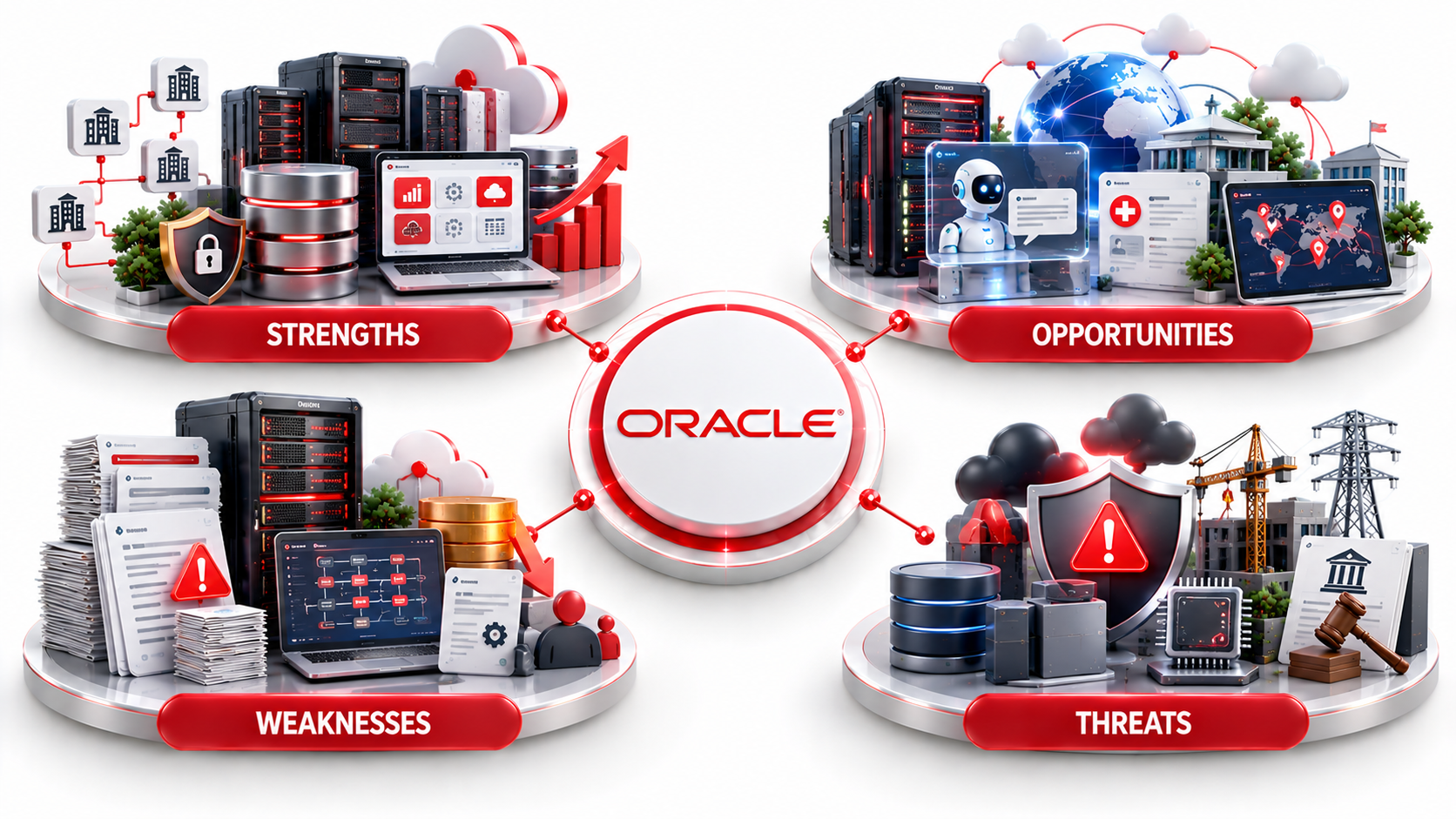
So this guide walks through all four boxes of the SWOT Analysis of Oracle with real numbers, real product names and some honest opinions. Whether you are a student writing a case study, an investor trying to decide if the backlog is real, or someone working in an Oracle shop who wonders what the company’s future means for your job, you should finish this with a clear picture. No jargon without a plain explanation. No consultant fluff. Just what is actually going on.
What You Will Learn in This Guide
- What a SWOT analysis really is, and the mistakes most students make when they write one
- What Oracle sells today, and how the business split looks after fiscal 2026
- The strengths that make Oracle hard to replace, from databases to its $638 billion backlog
- The weaknesses that worry lenders and investors, including negative free cash flow and customer concentration
- The opportunities in AI inference, multicloud databases, sovereign cloud and healthcare
- The threats, from an AI spending slowdown to power shortages and open source databases
- How to use all of this in a case study, an exam answer or an investment discussion
- Answers to 12 common questions people search about Oracle’s strategy
TL;DR
- Oracle’s biggest strength is lock-in: companies that run payroll, finance and core systems on Oracle databases and applications rarely leave.
- Cloud infrastructure revenue grew 93% in the fourth quarter of fiscal 2026 and 121% in the first quarter of fiscal 2027, but it is still a small slice of the whole business.
- The weaknesses are financial: negative free cash flow, $43 billion of new debt in fiscal 2026 and a $20 billion stock sale program.
- The best opportunities sit in AI inference, database services inside AWS, Azure and Google Cloud, sovereign clouds and healthcare software.
- The biggest threat is simple: if AI spending slows, Oracle has built a lot of expensive capacity that somebody still has to pay for.
- A good SWOT Analysis of Oracle ends with a judgment, not a list, and this guide gives one at the end.
SWOT Analysis of Oracle: Company Snapshot and Why It Matters in 2026
Before sorting anything into boxes, you need to know what the company actually looks like today. Oracle in 2026 is a mix of a very old, very profitable software business and a very new, very expensive infrastructure business. This section sets the scene so the strengths, weaknesses, opportunities and threats later on make sense.
What a SWOT Analysis Actually Is
A SWOT analysis is a simple framework that sorts facts about a company into four boxes: Strengths and Weaknesses (things inside the company) and Opportunities and Threats (things outside it). Strengths and weaknesses are about what Oracle controls. Opportunities and threats are about the market around it.
Here is where students go wrong. They write a list of generic points like “strong brand” and “global presence” that could describe any company. A useful SWOT needs numbers and names. “Strong brand” tells you nothing. “Oracle Database sits underneath the payroll and finance systems of thousands of large companies, and moving off it takes years” tells you something real. Keep that standard throughout.
If you want more beginner-friendly breakdowns of business frameworks like this one, the digital marketing learning hub has several that use the same practical approach.
Try this quick test on any point you write. Could it appear in a SWOT for Walmart or Toyota without changing a word? If yes, delete it. Good SWOT points carry a fingerprint that only fits one company. Also remember that the boxes talk to each other: a strength like the backlog quietly creates a weakness like customer concentration, and good analysts point that out instead of treating each box as a separate shopping list.
What Oracle Actually Sells Today
Oracle makes money in four ways, according to its fiscal 2026 results. Cloud services brought in $34.0 billion, split between cloud infrastructure (called IaaS, meaning rented servers and storage) at $18.1 billion and cloud applications (called SaaS, meaning software you rent) at $15.9 billion. Software licenses and support brought in $24.5 billion. Services added $5.7 billion and hardware $3.1 billion.
Notice what that split says. Roughly 36% of revenue still comes from the old model, where customers pay for licenses and yearly support on databases and middleware. That business is shrinking slightly, down 1% in fiscal 2026, because customers keep moving to the cloud. Oracle is trying to move those same customers into its own cloud before somebody else gets them.
Add the acquisitions and the picture gets clearer. Oracle bought PeopleSoft in 2005, Siebel in 2006, Sun Microsystems in 2010 (which brought Java and MySQL along), NetSuite in 2016 and Cerner in 2022. Each purchase added a captive customer base. That habit of buying sticky software and then raising support fees is the old playbook, and it still produces most of the profit that pays for the new AI buildout.
The FY2026 Numbers in Plain English
Total revenue rose 17% to $67.4 billion. Cloud revenue rose 39%. Operating cash flow was $32.0 billion, up 54%. Those are strong numbers for a company this size. Then comes the other side: capital spending was $55.7 billion, up from $21.2 billion the year before, which pushed free cash flow to negative $23.7 billion.
Free cash flow is just cash from operations minus what you spend on buildings and equipment. When it is negative, you are borrowing or selling shares to cover the gap. Oracle raised $43 billion in debt and $5 billion in equity during fiscal 2026. Oracle’s fiscal year ends May 31, by the way, so “fiscal 2026” means June 2025 through May 2026. People mix that up constantly.
One more number matters here. Fourth quarter revenue was $19.2 billion, up 21%, and the first quarter of fiscal 2027 reached $19.3 billion, up about 30%. Growth is speeding up, not slowing. But a few one-time gains, like the sale of the Ampere chip business, flattered fiscal 2026 profit, so smart readers look at operating income and cash flow instead of the headline earnings figure.
The Leadership Handoff From Catz to Magouyrk and Sicilia
In September 2025, Safra Catz stepped back from the CEO role after eleven years and became executive vice chair. Clay Magouyrk, who built Oracle Cloud Infrastructure after joining from Amazon Web Services in 2014, and Mike Sicilia, who ran the industries and applications side, took over as co-CEOs. Larry Ellison stays on as chairman and chief technology officer. Hilary Maxson, formerly of Schneider Electric, joined as CFO in April 2026.
That matters for the SWOT because the new team is betting the company on infrastructure. Magouyrk is an engineer who knows exactly how hard it is to build data centers quickly. Whether a young leadership team can manage a balance sheet this stretched is one of the big open questions.
There is also a split-focus issue. One co-CEO owns infrastructure and the other owns applications and industries, which mirrors the two engines of the company. That can work well when each person has a clear lane. It can also create friction over who gets scarce capital. Watch how Oracle allocates money between data centers and software product teams, because that tells you which co-CEO is winning internal arguments.
Strengths
Strengths are the things Oracle owns that competitors struggle to copy. Some of these are decades old, like the database. Others are brand new, like the fast-growing cloud infrastructure business. Together they explain why lenders keep funding Oracle’s data center plans and why customers keep signing multi-billion-dollar contracts.
The Database Lock-In Nobody Else Has
Oracle shipped one of the first commercial relational databases in 1979 and never stopped selling it. Today, Oracle Database runs inside banks, airlines, telecom carriers, governments and hospitals. These are systems where a failed transaction costs real money, so nobody experiments with them. Replacing one means rewriting applications, retraining staff and testing for a year or more.
That lock-in is the foundation of the whole company. Even when a customer wants to leave, the cost and risk of moving usually beat the savings. Honestly, this is why Oracle can raise prices on support contracts year after year without losing many customers. It is not a love story. It is a switching cost story, and it is one of the strongest moats in enterprise software.
Here is a real-world way to see it. Picture a bank with 15 years of custom code written against Oracle Exadata. Moving to Postgres means rewriting stored procedures, retesting every regulatory report and running both systems side by side for months. The savings on licenses might be a few million dollars. The risk of a failed migration could be a regulator’s fine. Most banks just renew, and Oracle knows it.
A $638 Billion Backlog That Keeps Growing
Oracle’s remaining performance obligations, or RPO, hit $638 billion at the end of fiscal 2026 and $664 billion at the end of August 2026. RPO is the total value of signed contracts that Oracle has not yet recognized as revenue. Think of it as an order book. Most of the jump came from large AI contracts in which customers prepaid for GPUs or supplied the chips themselves.
To put that number in context, it is roughly ten times annual revenue. No other large software company has a backlog like it. The catch, which comes up in the weaknesses section, is that a backlog is a promise, not cash. But as a strength, it gives Oracle revenue visibility that peers can only dream about.
Look at how fast it moved. A year before the fiscal 2026 report, the backlog was around $138 billion. Then it jumped past $450 billion in one quarter after the OpenAI deal, and climbed again to $638 billion and then $664 billion. Even if only part of it turns into revenue on schedule, that is a lot of future sales. Skeptics should still ask which contracts can be cancelled and which cannot.
Cloud Infrastructure Growth of 93%, Then 121%
Oracle Cloud Infrastructure, or OCI, grew 93% in the fourth quarter of fiscal 2026 to $5.8 billion. In the first quarter of fiscal 2027, it grew 121% to $7.4 billion. Those are not normal growth rates for a business already this large. For comparison, the big three cloud providers are growing in the 20s and 30s.
OCI also showed signs of converting backlog into actual revenue, which is the thing skeptics wanted to see. The company reported strong GPU utilization too. A data center full of idle chips is a disaster. A data center that is full and billing is the opposite. So far, the demand side of Oracle’s story looks real.
Think about what 121% growth actually means. A business that made about $3.3 billion in the same quarter a year earlier now makes $7.4 billion. Oracle is adding data center capacity as quickly as power and chips allow. Management has also said the AI contracts signed in the fourth quarter alone were worth around $67 billion, so the pipeline behind these growth rates looks deep.
Database Services Inside AWS, Azure and Google Cloud
Here is a move that surprised many people. Oracle now places its own database hardware inside the data centers of Amazon, Microsoft and Google, so customers can run Oracle Database next to their other cloud workloads. In the fourth quarter of fiscal 2026, multicloud database revenue rose 404% year over year, and cloud database revenue overall grew 29%.
Why is this a strength? Because it removes the biggest objection to Oracle: “We already moved everything to AWS.” Now the answer is “Fine, keep it there, and run Oracle inside it.” It turns competitors into distribution partners, which is clever and not something most rivals could pull off.
The practical details make it more convincing. Customers buy Oracle Database@AWS through the AWS Marketplace and can burn down their existing AWS spending commitments to pay for it. Oracle manages the hardware in AWS data centers, and the customer gets one bill. That convenience removes a lot of procurement friction, which is usually what slows large enterprise deals more than technology does.
Sticky Enterprise Applications: Fusion, NetSuite and Health
Beyond databases, Oracle sells Fusion Cloud applications for finance, HR and supply chain, NetSuite for mid-sized businesses, and Oracle Health, which came from the $28 billion Cerner acquisition in 2022. Cloud applications brought in $15.9 billion in fiscal 2026, and deferred revenue in this segment grew 16% in the latest quarter, a good sign that more contracts are coming.
These products are boring in the best way. Nobody switches payroll systems for fun. Oracle also won an agency-wide Fusion HCM award from the U.S. Office of Personnel Management, which shows the government side is still buying. If you work in marketing, even Oracle’s email marketing tools like Eloqua and Responsys show how deeply the company reaches into corporate software.
A quick comparison helps. SAP and Workday are the closest rivals to Fusion, and both are strong. What Oracle adds is the ability to bundle applications, database and cloud infrastructure under one contract. A chief financial officer who already pays Oracle for the database may as well run finance on Fusion too. The bundle is hard for pure-play software vendors to match.
Founder Control and a Long-Term Mindset
Larry Ellison still owns a huge stake, so Oracle does not have to answer to quarterly investor mood swings the way most public companies do. That is how the company could commit to a $500 billion Stargate partnership with OpenAI and SoftBank and a reported $300 billion compute deal with OpenAI while the market was still nervous.
Control lets leadership think in decades. It also means a single person’s confidence can drive enormous bets. For a strengths section, the point is that Oracle can act decisively and early. Whether that turns out brilliant or reckless is a call for the threats section.
There is a downside to say plainly. Concentrated control means fewer checks when leadership is wrong. Public shareholders can complain, but they cannot easily steer. For a student writing a SWOT, the balanced line is that founder control speeds up big bets and also concentrates the risk of those bets in a very small group of decision makers.
OCI’s Design and Pricing Advantages
OCI was built later than AWS and Azure, which turned out to be a hidden advantage. Engineers designed it from scratch with a fast, flat network meant for high-performance workloads like databases and AI training. Oracle also charges less for moving data out of its cloud, giving customers 10 terabytes of free outbound data every month.
For AI customers who need thousands of GPUs wired together with very low latency, that design matters. It is a big reason OpenAI, Meta and xAI chose Oracle. A newer platform sometimes beats an older one simply because it did not have to carry old decisions. That is the case here.
Pricing is also simpler. Oracle publishes one global price list for most services, so a compute instance costs about the same in Mumbai as in Phoenix. AWS and Azure often vary by region. For a finance team trying to forecast a three-year AI budget, predictable pricing is genuinely attractive, especially when the alternative is a spreadsheet full of regional exceptions.
Weaknesses
Weaknesses are problems inside the company, things leadership could actually fix or at least manage. In Oracle’s case, most of them come from one decision: spending enormous amounts of money at once to build AI capacity. Money, margin, concentration and reputation all get tested at the same time.
Negative Free Cash Flow That Keeps Getting Worse
Oracle’s free cash flow was negative $23.7 billion in fiscal 2026 and negative $5.4 billion in the first quarter of fiscal 2027 alone, even though operating cash flow hit a record $23.1 billion that quarter. Capital spending was $28.5 billion in just those three months. So, the business earns more every quarter and still goes backward on cash.
S&P has projected fiscal 2027 capital spending between $90 billion and $95 billion and a free cash flow deficit of around $42 billion. Those are projections, not Oracle’s own guidance, but they show how analysts see it. A company can run negative cash flow for a while. It cannot do it forever, and the clock starts when lenders get impatient.
A fair counterpoint exists. Oracle argues that this spending is temporary and backed by contracts, so it is closer to a construction loan than a cash leak. That argument holds only if customers pay on schedule. The best thing to watch over the next four quarters is whether operating cash flow grows fast enough to close the gap, and whether capital spending finally levels off.
Heavy Debt and Share Dilution
To pay for all that building, Oracle raised $43 billion in debt and $5 billion in equity in fiscal 2026. It plans to raise about $40 billion more in fiscal 2027, including a $20 billion at-the-market stock program, which means selling new shares gradually on the open market. In the first quarter alone it sold roughly $20 billion of stock.
That dilutes existing shareholders, because each share now represents a smaller slice of the company. Oracle also said it does not plan more bond issuance in calendar 2026, which was meant to calm credit markets. Still, interest payments on this much debt will not shrink anytime soon. It is the price of moving fast.
To judge the risk, compare debt to earning power, not to company size. Interest costs rise just as capacity is being built and before the revenue arrives. Rating agencies look at exactly this timing gap. If Oracle’s credit rating slips toward the lowest investment grade tier, bond buyers will demand higher yields, and every future data center gets pricier to finance.
Customer Concentration Around a Few AI Labs
A huge share of the backlog is tied to a small number of customers, with OpenAI the biggest. The reported $300 billion OpenAI contract alone is nearly half of the total RPO. OpenAI is a company that burns cash and relies on outside funding to pay for its commitments.
That is the weak link. If OpenAI cannot raise enough money, or decides to shift some compute elsewhere, Oracle has built data centers for a customer who may not be able to pay. Contracts help, but they do not guarantee a customer’s survival. Diversification into Meta, xAI and enterprise AI customers is underway, though it is clearly not finished.
Compare this to older Oracle history. The classic Oracle customer was a thousand-employee company or a government agency with a long contract and low risk of failure. AI labs are the opposite: fast-moving, cash-hungry and dependent on investor mood. Mixing the two is not impossible, but a lender looking at Oracle now sees a much more exposed company than a decade ago.
Thinner Margins in AI Infrastructure
Oracle’s gross margin fell in the fourth quarter of fiscal 2026. The company blamed ramping up new data centers and the fast pace of infrastructure growth. Renting out GPUs is a lower-margin business than selling database licenses, because Oracle must buy expensive Nvidia chips, power them, cool them and staff them before earning a dollar.
The old software business had gross margins that most industries would envy. The new one has to prove it can match those at scale. Until it does, every dollar that moves from license revenue to AI infrastructure revenue quietly lowers the average profitability of the whole company. That is the trade Oracle has chosen to make.
There is a partial fix. Oracle says customers who bring their own chips, which the company calls bring-your-own-hardware deals, reduce the upfront bill for Oracle, and those contracts have reached about $75 billion. That helps cash flow, though it also means Oracle earns a smaller slice per deal. Margin versus capital is the trade-off at the center of this whole story.
A Smaller Footprint and Weaker Developer Appeal
Even after all this growth, Oracle’s share of the overall cloud infrastructure market stays in the low single digits, far behind AWS, Microsoft Azure and Google Cloud. Ask a student developer which cloud they are learning, and almost nobody says Oracle. Tutorials, bootcamps and open source communities mostly ignore it.
That matters because tomorrow’s buyers are today’s learners. Oracle does offer a generous free tier, but the mindshare gap is real. Enterprise sales teams can win large deals without developer love, yet over a decade this gap becomes a talent and ecosystem problem, not just a marketing one.
There are practical consequences. Hiring engineers who know OCI is harder than hiring ones who know AWS. Third-party tools and integrations show up for AWS first, and often for Oracle last. Oracle has tried to close the gap with free tier credits and certifications, and the certification path is cheap compared with rivals, but mindshare takes years to build, not quarters.
A Reputation for Licensing Audits and Surprise Bills
Ask almost any IT manager about Oracle licensing and you will get a story. The company’s License Management Services team audits customers for compliance, and mistakes can turn into seven-figure bills. When Oracle changed Java SE pricing in 2023 to charge per employee instead of per user or device, many companies saw costs jump several times over.
This reputation costs Oracle goodwill. Customers stay because they must, not because they want to, and they quietly search for exits. That feeds directly into the open source and multicloud threats later on. It is a weakness built over thirty years and it will not change fast.
The impact is hard to measure and easy to feel. Procurement teams at large companies often add extra legal review time for any Oracle purchase, and consultants make a living helping customers reduce Oracle spending. When a vendor creates an entire industry of people whose job is to defend against it, that is a sign trust is low, even if revenue stays healthy.
Slower Applications Growth and Execution Questions
Cloud applications grew only 10% in the fourth quarter, which is respectable but a fraction of infrastructure growth. Oracle Health, the Cerner business, has also had a bumpy path, with well-publicized problems during the rollout of electronic health records at the U.S. Department of Veterans Affairs.
Reports in 2026 also put layoffs as high as 30,000 employees as Oracle moved money toward data centers. Cutting costs can protect margins, but it can also slow product work in the very businesses that are supposed to supply steady profits. Execution across so many fronts at once is a real risk.
The practical lesson is that Oracle cannot afford to treat applications as a cash machine that runs itself. Fusion and NetSuite still have to compete against SAP, Workday and a wave of AI-native startups. If infrastructure absorbs management attention and money, the application side could lose ground quietly, and the damage would show up in renewal rates two or three years later.
Opportunities
Opportunities come from outside the company. They are trends and gaps in the market that Oracle can chase if it plays well. Several of these are already turning into real revenue, which makes this box the most interesting one in the whole analysis.
Converting a $664 Billion Backlog Into Real Revenue
The single biggest opportunity is the one already signed. Oracle guided to about $90 billion in total revenue for fiscal 2027, and in the first quarter of that year revenue grew 30% to $19.3 billion. If the company delivers capacity on time, a large share of that backlog turns into recognized revenue over the next several years.
Every data center that goes live early is a win. Every one that slips is a risk. So the opportunity is less about finding new customers and more about execution. Oracle’s investor day, scheduled for October 28 in Las Vegas, is where management is expected to lay out how that conversion should unfold.
Break it into steps to see the opportunity clearly. First, secure power and land. Second, buy and install chips. Third, switch capacity on for the customer. Fourth, run it at high utilization so revenue flows. Oracle has cited 97.5% GPU utilization, which suggests the fourth step is working. The hard part is making steps one through three happen faster than rivals can.
AI Inference as the Next Wave After Training
Most of the early AI cloud money went to training giant models. The next wave is inference, which means running those models every time a person or application uses them. Inference is steady, recurring and spread across many customers, so it is a better business than a few big training deals.
Oracle’s combination of databases and AI infrastructure suits inference well, because companies want to run models next to their own private data. A bank that wants an AI assistant answering questions from its own records will not copy everything to a stranger’s cloud. It will look for a provider that already holds its data. That is exactly where Oracle sits.
A real example makes this concrete. A hospital group that wants an AI tool to summarize patient notes needs the model to read private records. Sending that data to a public AI service raises privacy questions. Running the model inside an Oracle environment that already holds the records keeps it all in one place. That kind of enterprise inference workload is what Oracle is aiming for.
More Multicloud Database Partnerships
The 404% jump in multicloud database revenue shows the ceiling is nowhere near. Oracle Database@AWS, Oracle Database@Azure and Oracle Database@Google Cloud are still early, with new regions opening regularly. Every customer who wanted to modernize but could not leave Oracle Database is now a candidate.
There is also a quiet upside: when Oracle runs inside another provider, it earns database revenue without building as many data centers itself. That is capital-light growth, and it helps offset the heavy spending on AI capacity. If Oracle expands this model to more regions and services, margins improve alongside revenue.
Adoption has one natural limit, which is sales capacity. Every new region needs hardware installed and engineers trained. But the incentive is strong for all sides. AWS, Microsoft and Google earn extra spend on their own platforms when Oracle customers migrate workloads next to their databases, so the rivals have reasons to cooperate even though they compete elsewhere.
Sovereign and Regional Cloud Demand, Including India
Many governments and regulated industries want cloud services that keep data inside national borders. Oracle sells dedicated regions, where a full Oracle cloud sits inside a customer’s own data center, and Oracle Alloy, which lets partners resell Oracle’s cloud under their own brand. These products fit countries with strict data rules.
India is a good example. Oracle already runs cloud regions in Mumbai and Hyderabad and has big engineering teams in Bengaluru and Hyderabad. Indian banks, telecoms and government agencies need local data hosting, and the market is growing fast. Sovereign cloud is a slow, relationship-driven business, which is exactly the kind Oracle’s enterprise sales machine handles well.
For readers in India, there is a practical angle. Indian IT services firms like Infosys, TCS and Wipro employ large numbers of Oracle-certified consultants, so growth in Oracle cloud migrations creates jobs and project work. A student who learns Oracle Cloud and Oracle Database today has a real chance at a steady career path in that ecosystem.
Healthcare Software and Public Sector Modernization
Healthcare is stuck on old systems. After buying Cerner, Oracle owns one of the largest electronic health record platforms in the world, and it has rebuilt the product with a new, cloud-native design and AI features like clinical note drafting. If hospitals adopt that, the revenue is sticky and recurring.
Government contracts add to this. Public agencies across the U.S., Europe and Asia are replacing decades-old systems for payroll, benefits and records. The OPM agreement for Fusion HCM is a sign of what can come. These deals take years to sign, but once won, they last for a very long time. Patience pays off here.
Be realistic about timelines, though. Hospital system rollouts take years, and the Veterans Affairs experience showed how painful a failed deployment can be. Winning trust back requires a few clean, visible successes. If Oracle Health can deliver those, the long contract cycles that frustrate buyers become a gift for Oracle, because they keep revenue steady for a decade or more.
AI Agents Inside Oracle’s Business Applications
Oracle has been adding AI agents into Fusion and NetSuite, small programs that can draft invoices, flag exceptions in finance reports or answer HR questions. Because these tools sit inside systems customers already use, adoption can be quick. No new vendor, no new contract, just a switch turned on.
This is a real chance to raise revenue per customer without finding new customers. If Oracle can charge for AI features in a business application base worth tens of billions of dollars, even a modest uplift matters. It is also a way to push cloud apps growth above that 10% mark. Whether customers pay extra is still the unproven part.
The pricing question is the hard one. Microsoft charges extra for its Copilot features, while some vendors bundle AI at no added cost to defend renewals. Oracle has leaned toward including many AI features inside existing subscriptions. That helps retention but may limit direct revenue gains, so the opportunity may show up more in lower churn than in higher invoices.
Threats
Threats are outside forces that can hurt Oracle even if it does everything right. Some are market-wide, like the AI spending cycle. Others are competitive or technical. This section matters most for investors and lenders, because the numbers behind Oracle’s plans leave little room for error.
The AI Bubble Question
The scariest threat is also the simplest. Oracle has committed tens of billions of dollars to build capacity for AI customers whose own businesses are still losing money. If the AI boom slows, those customers may cut orders, renegotiate or fail to pay. Oracle would be left with expensive data centers and fixed debt payments.
The stock’s slide from around $346 to around $159 suggests investors take this seriously. Nobody knows how the cycle will play out. A sensible reading is that Oracle’s bet is large enough that it needs the boom to keep going for years, not months, and has little cushion if it does not.
Compare it with the telecom boom of 1999 and 2000, when companies laid vast amounts of fiber ahead of demand and many went bankrupt. The fiber was eventually used, but the builders often did not survive to see it. AI may follow a different path, yet Oracle’s debt and fixed commitments are the kind of obligations that hurt most when timing goes wrong.
Intense Competition From AWS, Azure and Google Cloud
Amazon, Microsoft and Google have far bigger cloud businesses, bigger developer communities and plenty of cash. All three are building AI capacity too, and all three can cut prices to win large deals. CoreWeave and other specialist GPU clouds add another layer of pressure on the infrastructure side.
In applications, SAP, Workday and Salesforce fight Oracle for every finance and HR contract. Oracle’s counter is price-performance and database integration. That works for some customers and not others. Competition does not need to beat Oracle outright. It just needs to squeeze margins, and in a capital-heavy business, that is painful enough.
Scale gives the big three real advantages in buying chips and power. Microsoft and Amazon each spend well over $100 billion a year on data center capital. Oracle has to compete for the same scarce hardware with a smaller balance sheet. It wins deals by being faster to deliver and more flexible on custom designs, but that advantage is easier to lose than to keep.
Power Shortages, Chip Supply and Construction Delays
AI data centers need huge amounts of electricity, and the grid cannot always deliver it on schedule. Waiting for power connections, transformers and turbines can delay a site by months or years. Oracle also depends on Nvidia and AMD for chips, and on contractors and partners to build its large sites.
Delays hurt twice. Oracle pays for land, equipment and financing while the site produces no revenue, and customers waiting for capacity may lose patience. This is not a threat Oracle can solve with a clever strategy. It is a physical-world problem, and the whole industry is hitting it at the same time.
Oracle has tried to reduce the risk by working with partners on large campuses, including the Abilene, Texas site that supports the Stargate project, and by exploring onsite power generation. Even so, the numbers are daunting. A single gigawatt-scale campus needs power equal to a mid-sized city. Anyone reading Oracle’s results should track delivery dates as closely as revenue.
Open Source Databases Like PostgreSQL
PostgreSQL has gone from a hobbyist choice to a serious enterprise option. Cloud providers offer managed versions that cost a fraction of Oracle licenses, and tools exist to translate Oracle code into Postgres. Every year, more companies try a migration on at least some workloads.
Lock-in slows this down, but it does not stop it. New applications are rarely built on Oracle anymore. They start on Postgres, MySQL (which Oracle also owns, awkwardly) or cloud-native databases. Over decades, that shift erodes the base. Oracle’s multicloud strategy partly exists to fight it by making Oracle easier to adopt where customers already live.
There is a tidy irony here. Oracle’s own MySQL, which it got through the Sun deal, is one of the databases that competes with its flagship product. Oracle has launched MySQL HeatWave to monetize it in the cloud, but the larger point is that cheap, good-enough databases keep getting better, and the gap that justifies Oracle’s premium prices narrows each year.
Cybersecurity and Trust Incidents
When a company holds sensitive data for banks, hospitals and governments, any breach is costly. In 2025, attackers linked to the Cl0p ransomware group exploited a flaw in Oracle E-Business Suite to steal data from many customers. Earlier that year, reports surfaced of stolen login data tied to older Oracle cloud systems, which Oracle disputed.
One incident rarely sinks a vendor, but a pattern can. Customers choosing where to place AI workloads and private data care about trust more than price. Oracle’s pitch to sovereign and regulated buyers depends on being seen as safe. That makes security failures more damaging for Oracle than for a company selling consumer software.
The learning point for beginners is that security is also a sales issue. Regulated customers send long security questionnaires before they sign, and each public incident gives rivals a talking point. Oracle’s best defense is quick patching, clear communication and transparent reports, which are the habits it has historically been slower to show than some cloud peers.
Credit Markets, Interest Rates and Investor Patience
Oracle’s plan depends on cheap and available financing. If interest rates rise, or rating agencies grow more cautious, the cost of every new bond goes up. S&P has already taken a more careful stance on Oracle’s debt. A credit downgrade would make future borrowing more expensive and could force changes to the build plan.
Investor patience is the other half. Oracle’s stock sale program only works if buyers keep showing up at reasonable prices. If sentiment sours and the share price drops sharply, raising $20 billion through stock becomes much harder. Oracle controls its execution, but it does not control how the market feels.
Think of it as a three-legged stool: operating cash flow, debt and stock sales. If any leg weakens, the others have to carry more weight. Right now, operating cash flow is rising and the stock program is running, but a bad quarter or a market shock could make both harder at once. That is why analysts watch Oracle’s credit spreads so closely.
Regulation, Data Rules and Legal Exposure
Oracle’s history includes long legal fights with Google over Java, audit disputes with customers and regulatory attention around data privacy. As AI grows, new rules on energy use, data residency and model safety will add compliance costs. Europe and India are both tightening data regulations.
These rules can also help Oracle, because sovereign cloud demand grows when governments demand local control. Still, regulation is unpredictable. A rule that slows data center permits, limits how personal data can be used in training or targets licensing practices could land directly on Oracle’s biggest bets. Watching policy matters as much as watching earnings.
For beginners, the simple rule is that regulation touches Oracle at three points: where it builds data centers, what data it can store and how it sells software. Each point has its own risks and rewards. A strong analysis picks the regulation that matters most to a specific business line instead of listing everything under one vague heading.
Using the SWOT Analysis of Oracle in a Case Study or Exam Answer
Knowing the four boxes is only half the job. The other half is turning them into an argument that a teacher, a manager or an investor will take seriously. This section gives you a simple method, built around the Oracle facts above, that you can reuse on any company.
Rank Your Points Instead of Listing Them
Most SWOT answers fail because they give ten equal bullets. Pick the two or three points in each box that actually move the outcome. For Oracle, that likely means database lock-in and the backlog on the strengths side, free cash flow and customer concentration on the weaknesses side, AI inference and multicloud on the opportunities side, and the AI spending cycle plus competition on the threats side.
Everything else becomes supporting detail. A ranked SWOT shows that you understand what matters, which is the skill graders and hiring managers are really checking for. A flat list only shows that you can search for facts.
Connect the Boxes With Cause and Effect
Look for links between boxes. The backlog (strength) exists because of a few big AI customers, which creates concentration (weakness). The opportunity to deliver faster depends on power and chips, which is a threat. Pointing out these chains turns a SWOT from a checklist into a story, and stories are what people remember.
Try writing one sentence per link, like this: Oracle’s growth depends on AI labs that are still unprofitable, so its best strength is also its biggest exposure. That single sentence shows more understanding than a page of bullet points.
Finish With a Clear Recommendation
End with a verdict. If you are advising a manager, say whether Oracle is a safe supplier for a five-year AI project and what contract protections to ask for. If you are writing for investors, say what numbers you would watch next quarter, such as free cash flow, capital spending and how much backlog turns into revenue.
Be honest about uncertainty without hiding behind it. A good conclusion says what you believe, why you believe it and what evidence would change your mind. That is how real analysts write, and it is what separates a memorable case study from a forgettable one.
Five Numbers to Watch in the Next Earnings Report
If you want your SWOT to stay fresh, track a short list of numbers each quarter. First, remaining performance obligations: is the $664 billion still growing, and how much converts to revenue? Second, cloud infrastructure growth: can it stay above 100% as the base gets bigger? Third, capital spending: does it level off or keep climbing toward that $90 billion mark?
Fourth, free cash flow: is the negative number shrinking? Fifth, gross margin: do AI contracts start earning closer to the old software margins? Oracle reports these in its quarterly earnings release and the 10-Q filing, both free on its investor relations site. Checking them takes twenty minutes and beats reading ten opinion articles. The next big checkpoint is the October 28 investor day, where management is expected to share its long-term targets.
Conclusion
The honest summary of this SWOT Analysis of Oracle is that the strengths are real, the opportunities are large and the weaknesses are mostly about money. Oracle has locked-in customers, a record backlog and the fastest-growing infrastructure business among large providers. It has also chosen to spend ahead of revenue by a wide margin, so success depends on delivery, on a few big customers and on the AI market staying healthy.
If you are writing a case study, end with a judgment: Oracle is a high-conviction, high-risk bet on AI infrastructure sitting on top of a very durable software business.
Frequently Asked Questions
What is a SWOT analysis of Oracle?
A SWOT analysis of Oracle sorts the company’s internal strengths and weaknesses and external opportunities and threats into four categories. Strengths include database lock-in and cloud infrastructure growth. Weaknesses include negative free cash flow and debt. Opportunities include AI inference and multicloud databases. Threats include an AI slowdown and competition.
What are Oracle’s biggest strengths?
Oracle’s biggest strengths are its enterprise database dominance, a $664 billion backlog of signed contracts, and cloud infrastructure growth of 121% in the first quarter of fiscal 2027. Its applications business also gives customers a hard-to-replace set of finance, HR and supply chain tools.
What are Oracle’s main weaknesses?
The main weaknesses are heavy capital spending, negative free cash flow of $23.7 billion in fiscal 2026, large debt and stock issuance, dependence on a few AI customers like OpenAI, and a reputation for strict licensing audits. Lower margins in AI infrastructure and a small share of the overall cloud market add to the concerns.
How big is Oracle’s backlog and why does it matter?
Oracle reported remaining performance obligations of $664 billion at the end of August 2026, up from $638 billion in May. This number shows how much signed contract value has not yet been recognized as revenue. It matters because it indicates future revenue, though it depends on Oracle delivering capacity and customers continuing to pay.
Is Oracle a good investment right now?
That depends on your risk tolerance, and this guide is not financial advice. The business has strong growth and visibility but also heavy debt, negative free cash flow and dependence on AI demand. Investors should read Oracle’s latest filings, compare the backlog against delivery progress and consider talking to a licensed financial advisor.
Who are Oracle’s main competitors?
In cloud infrastructure, Oracle competes with Amazon Web Services, Microsoft Azure, Google Cloud and specialist GPU providers like CoreWeave. In applications, it faces SAP, Workday and Salesforce. In databases, it also competes with open source options like PostgreSQL and data platforms like Snowflake and Databricks.
Why did Oracle’s stock fall if results were strong?
Oracle’s stock fell from a September 2025 high of about $346 to roughly $159 before its September 2026 report because investors worry about spending, debt and dependence on AI customers. Strong revenue growth did not offset concerns about free cash flow and the risk that AI demand could slow.
What is Oracle Cloud Infrastructure?
Oracle Cloud Infrastructure, or OCI, is Oracle’s service for renting computing power, storage, networking and databases over the internet. It is known for high-performance networking and has become the company’s main growth engine, particularly for AI training and inference workloads.
How does Oracle make money?
Oracle earns revenue from cloud services, software licenses and support, services and hardware. In fiscal 2026, cloud services produced $34.0 billion, software $24.5 billion, services $5.7 billion and hardware $3.1 billion, adding up to $67.4 billion in total revenue.
What is Oracle’s relationship with OpenAI?
Oracle is a partner in the Stargate project with OpenAI and SoftBank, and it reportedly agreed to supply OpenAI with about $300 billion of compute capacity. This makes OpenAI Oracle’s most important AI customer, and also a concentration risk if OpenAI’s funding or plans change.
What does multicloud mean for Oracle?
Multicloud means Oracle places its database technology inside other cloud providers like AWS, Microsoft Azure and Google Cloud so customers can use Oracle Database without leaving their preferred provider. In the fourth quarter of fiscal 2026, multicloud database revenue grew 404% year over year.
Who runs Oracle today?
Clay Magouyrk and Mike Sicilia became co-CEOs in September 2025 after Safra Catz moved to executive vice chair. Larry Ellison remains chairman and chief technology officer, and Hilary Maxson became chief financial officer in April 2026.
How should a student use a SWOT analysis of Oracle in an assignment?
Use specific numbers and names in each box, such as the $638 billion backlog or the $43 billion of debt raised, instead of generic phrases. Then finish with a short judgment explaining which factors matter most and why. Cite Oracle’s earnings releases for every figure.