


Ola used to be the company every other Indian startup wanted to copy. Bhavish Aggarwal and Ankit Bhati started it in 2010 with three cars in Mumbai, and within a decade it had turned into one of the biggest names in Indian mobility, backed by SoftBank, valued in billions, and expanding into cabs, autos, bikes, food delivery, financial services, and eventually electric scooters. That’s the version of Ola most people still have in their head.

The version that actually exists in 2026 is messier. Rapido’s monthly active users have crossed Uber and Ola combined. Ola Electric, once the country’s top-selling electric scooter brand with over a third of the market, has slid to roughly 7% share and fifth place behind TVS, Bajaj, Ather, and Hero’s Vida. At the same time, the company is not folding. It has pushed through a real cost reset, expanded its service network, started shipping its own battery cells, and is now moving into energy storage as a new business line entirely. A SWOT Analysis of Ola in 2026 has to hold both of these truths at once: a company that lost serious ground, and a company that is still restructuring fast enough to matter.
What makes this moment interesting is the timing. Most companies that lose this much ground this fast quietly disappear from the conversation within a year or two, either through acquisition or a slow wind-down of the struggling business unit. Ola hasn’t done either. Instead it’s running two turnaround stories in parallel: fixing the cab business’s driver economics problem while Rapido eats its lunch, and fixing the EV business’s reliability problem while TVS, Bajaj, and Ather eat that lunch too. Running two turnarounds at once, with the same leadership team and overlapping brand equity, is genuinely rare, and it’s exactly why this company is worth studying closely right now instead of writing it off as yesterday’s story.
This piece breaks down Ola’s strengths, weaknesses, opportunities, and threats with real numbers, not vague statements about “brand value” or “market presence.” You’ll see where the company still has a real edge, where it’s genuinely bleeding, where the next growth window is, and which competitors are close enough to end the story early if Ola doesn’t move.
What You Will Learn in This Guide
- What a SWOT framework actually measures and why Ola is a useful company to apply it to right now
- The specific strengths keeping Ola relevant despite two years of market share loss
- The internal weaknesses, from driver complaints to financial losses, that keep showing up in every quarterly report
- The concrete growth opportunities in front of Ola, including Tier 2 expansion, EV manufacturing, and its new energy storage bet
- The threats from Uber, Rapido, Namma Yatri, and government-backed alternatives that could squeeze Ola out entirely
- Answers to the most common questions people search about Ola’s business model and competitive position
TL;DR: Quick Summary
- Ola’s biggest strength is still scale and brand recall built over 15 years, but scale alone hasn’t stopped Rapido from overtaking it in monthly active users.
- Ola Electric’s market share collapsed from around 35% to roughly 7% in 2026, dropping it to fifth place among Indian e-scooter brands.
- Driver dissatisfaction, high cancellation complaints, and a long history of net losses remain the company’s most persistent internal weaknesses.
- The clearest opportunities are Tier 2 and Tier 3 city expansion, in-house battery manufacturing through the Bharat Cell platform, and the new Ola Energy storage business.
- Rapido’s zero-commission, subscription-based driver model is the single biggest external threat, because it directly attacks the commission structure Ola’s entire cab business depends on.
- Regulatory risk around surge pricing, gig worker classification, and state-level EV subsidy changes can move Ola’s numbers overnight, in either direction.
What Is a SWOT Analysis of Ola
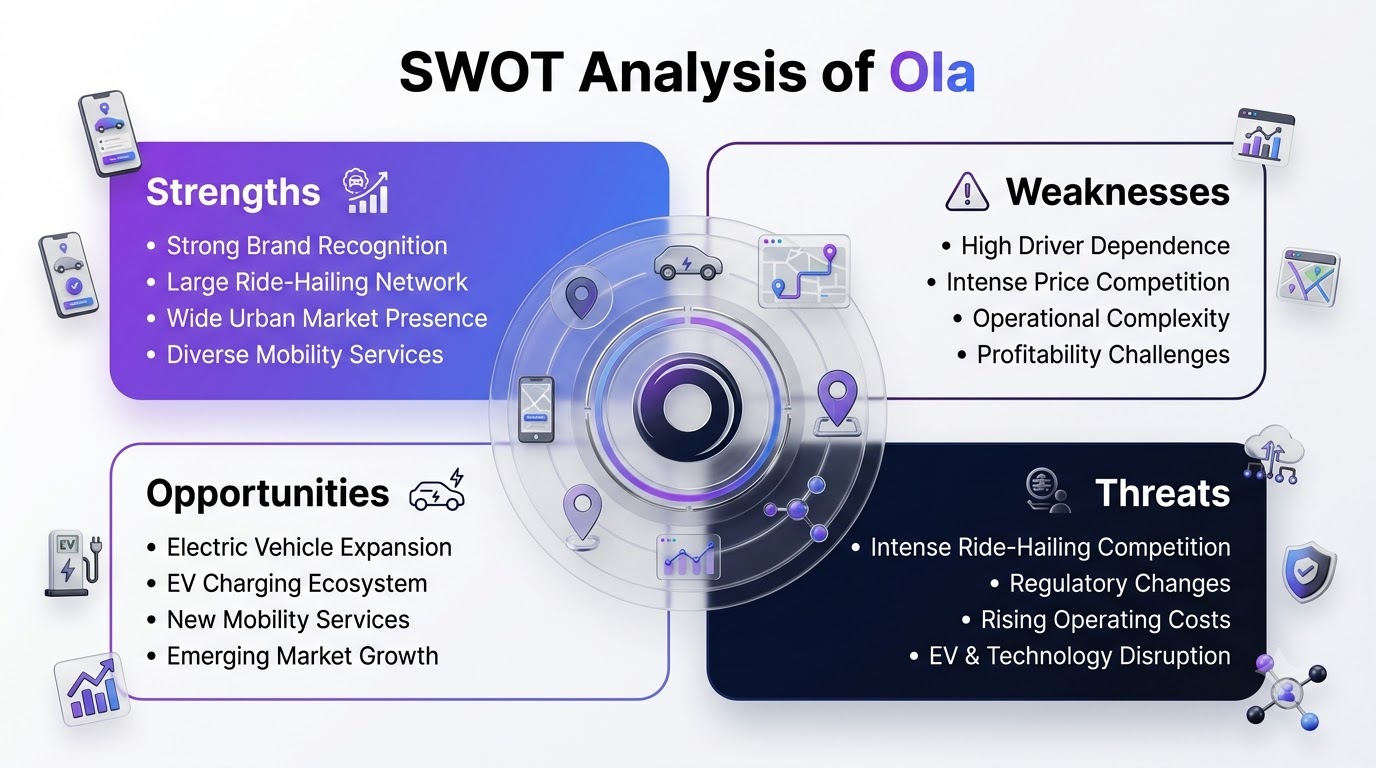
A SWOT Analysis of Ola means laying out the company’s internal strengths and weaknesses next to the external opportunities and threats sitting in front of it, so you can see the full competitive picture in one place instead of just reading isolated news headlines about stock prices or driver strikes.
What Is a SWOT Analysis
SWOT stands for Strengths, Weaknesses, Opportunities, and Threats. Strengths and weaknesses are internal, meaning they come from decisions the company itself made: its fleet strategy, its driver payout structure, its manufacturing setup. Opportunities and threats are external, meaning they come from the market around the company: competitor moves, government policy, changing consumer habits. The framework isn’t complicated, but it only works if you fill it with specific facts instead of generic statements. Saying “Ola has strong brand recognition” tells you nothing useful. Saying “Ola’s app still ranks among the top three most-downloaded mobility apps in India despite losing MAU share to Rapido” actually tells you something you can act on, whether you’re a driver deciding which platform to prioritize, an investor evaluating the stock, or a student studying how ride-hailing economics work.
Why Ola Specifically Deserves This Kind of Breakdown
Most SWOT write-ups you’ll find on Ola online are five years out of date, still talking about it as the unchallenged leader of Indian ride-hailing. That’s no longer accurate. Ola’s combined market share with Uber has fallen from over 90% to somewhere around 60-70% as Rapido has expanded from bike taxis into the four-wheeler cab segment. On the electric vehicle side, Ola Electric went from category leader to a company managing a real turnaround, cutting costs, resetting its retail network, and betting on manufacturing depth (its own battery cells) instead of just marketing spend to win back share. Both businesses, Ola Cabs and Ola Electric, are technically separate corporate entities now, but they share a founder, a brand name, and a reputation, which means weakness in one drags on public perception of the other. A current SWOT Analysis of Ola needs to treat both sides of the business honestly instead of leaning on outdated “Ola is India’s Uber” framing.
How the Numbers in This SWOT Analysis Were Put Together
Every figure used in this breakdown comes from recent company disclosures, exchange filings, or industry tracking reports rather than guesswork, because a SWOT Analysis of Ola built on outdated 2021 statistics is close to useless in a market moving this fast. Market share figures for the cab and auto segments come from recent industry estimates and app analytics data from firms like Sensor Tower and Similarweb, which track monthly active users and daily trip volume across platforms. Ola Electric’s financial and operational numbers, gross margin, registration growth, service center count, come directly from the company’s own investor announcements and quarterly earnings calls, including the Q1 FY27 call held on August 7, 2026, with Chairman Bhavish Aggarwal and CFO Deepak Rastogi. Where estimates from different sources disagreed slightly, this breakdown uses the more conservative or more recently published figure rather than whichever number sounds more dramatic, because the goal here is an accurate picture, not a clickable headline.
Strengths
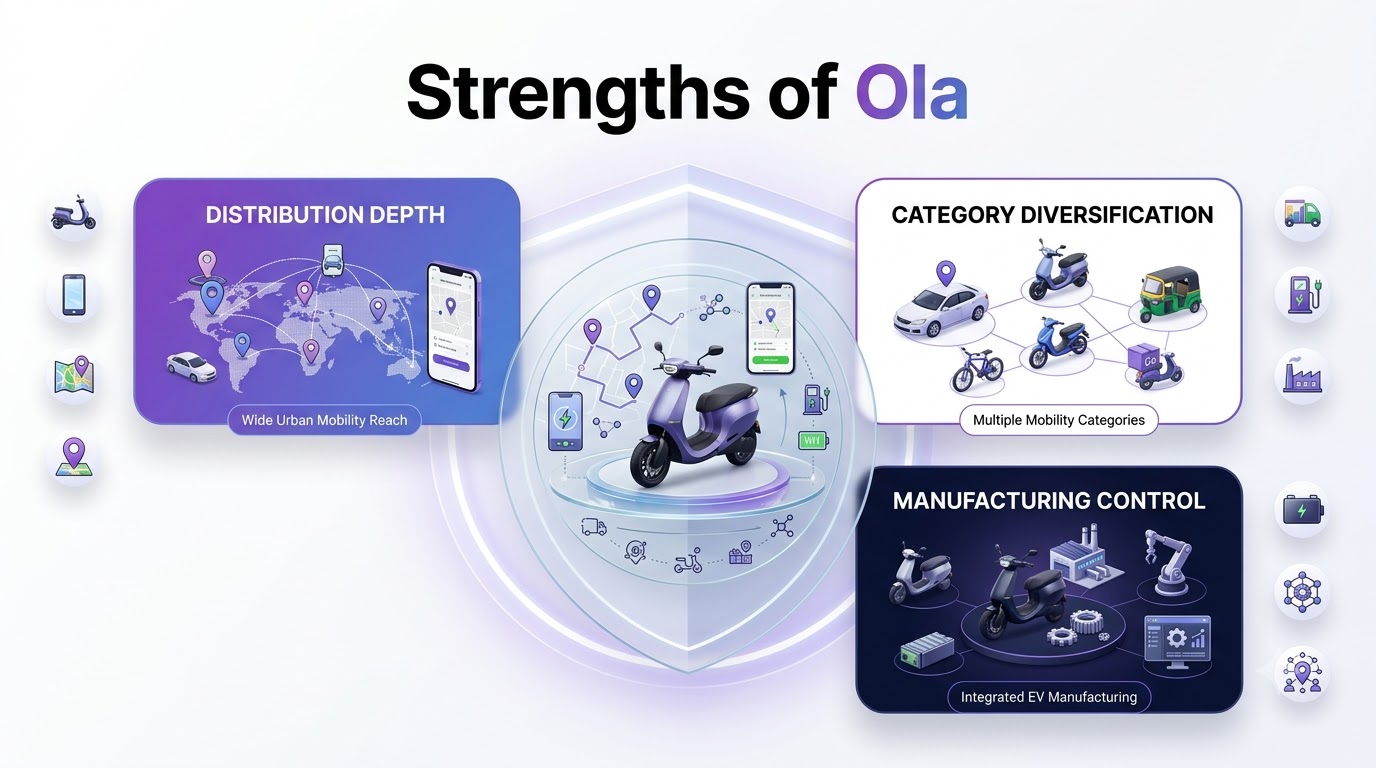
Ola’s core strengths come down to distribution depth, category diversification, and manufacturing control, three things that are genuinely hard for a newer competitor to replicate quickly, even one growing as fast as Rapido.
Brand Recognition and First-Mover Advantage in Indian Ride-Hailing
Ola has been operating since 2010, which makes it one of the oldest and most recognized consumer tech brands in India, right up there with Flipkart and Paytm in terms of name recall. That matters more than people give it credit for. When someone in a smaller Indian city downloads a ride-hailing app for the first time, “Ola” is often the name they already know from television ads, word of mouth, or years of seeing Ola cabs on the street, even before Uber or Rapido built comparable visibility in that same market. This first-mover trust translates into lower customer acquisition cost per new user in markets where the brand is already established, something newer platforms have to spend heavily on paid marketing to overcome. It won’t save Ola on its own, brand recall didn’t stop Rapido from crossing 70+ million monthly active users, but it does mean Ola starts every new city launch or feature rollout with an audience that already trusts the name enough to try it.
Here’s the part most write-ups skip: brand recall also shows up in search behavior, not just app downloads. People searching “book a cab” or typing a generic query into Google in a Tier 2 town are still statistically more likely to land on an Ola listing or ad than a Rapido one, simply because Ola has spent over a decade building organic search presence and local business listings across hundreds of Indian cities. That kind of accumulated digital footprint is exactly the sort of asset that takes years to replicate, which is why newer platforms lean so heavily on paid acquisition instead of waiting for organic discovery to catch up.
Multi-Category Fleet and Service Diversification
Ola doesn’t just run cabs. It runs autos, bikes, rentals, outstation trips, and in many cities, a parcel delivery layer through the same app, and it operates all of this on a single unified platform where a user can switch category selection in seconds. This matters because different vehicle categories serve different price points and different use cases. A student booking a short trip across a college town wants an auto or bike option under fifty rupees. A business traveler landing at an airport wants a reliable outstation cab with a fixed fare. Uber has closed a lot of this category gap in recent years, and Rapido has become the dominant player in bike taxis specifically, but Ola is still one of the few platforms offering genuine breadth across nearly every ground transport category in one app, which keeps users from needing to juggle three separate apps for three separate needs.
The mistake most competitors make when trying to copy this is treating category expansion as a marketing decision instead of an operations one. Adding a “bike” tab to an app is easy. Building the driver supply, the pricing engine, and the dispute-resolution workflow specific to bike taxis, where accidents, helmet policy, and luggage limits all behave differently than they do for a four-wheeler cab, takes years of on-ground iteration. Ola had already worked through most of that operational mess with autos and bikes long before Rapido made two-wheeler mobility its core identity, which is part of why Ola’s category range, even if it’s losing volume, is still functionally deeper than most newer entrants can match on day one. If you’re curious how platforms structure this kind of multi-category rollout from a marketing and positioning angle, it’s a good case study in digital marketing strategy for how a brand sequences new product categories without diluting its core identity.
Ola Electric and the EV Manufacturing Arm
This is Ola’s most underrated structural strength, even after the market share drop. Ola Electric doesn’t just assemble scooters from imported parts like many smaller EV brands do. It has been building vertical manufacturing depth: its own Gigafactory, its own battery cell production under the “Bharat Cell” and 4680 cell platform, and as of mid-2026, trial production of its own cells has actually started at the Gigafactory, a real technical milestone most competitors in the two-wheeler EV space in India haven’t reached. Owning the battery supply chain, instead of buying cells from outside vendors, is what lets a company control cost and margin over the long run rather than being at the mercy of battery price swings. Ola Electric posted a 34.3% gross margin in Q3 FY26 alongside what the company called a “structural reset” aimed at lowering its breakeven point, and that kind of margin number for an EV manufacturer in India is genuinely strong, even while unit sales and market share were both falling in the same period.
Think about why that margin number matters more than the headline share number everyone quotes. A company can be losing share and still be getting healthier internally if it’s cutting the right costs, and that’s actually what happened here. Ola Electric’s “structural reset,” in plain terms, meant closing underperforming experience centers, renegotiating vendor contracts, and shifting spend away from big splashy launch events (the company skipped its usual physical Sankalp launch in 2026 entirely, opting for a digital-only reveal instead) toward engineering and gigafactory ramp-up. That’s the opposite of what a company in genuine decline usually does. Companies that are actually dying keep spending on marketing theatre to mask the numbers. Ola Electric cut the theatre and kept the factory running, which is a meaningfully different signal.
Driver Network Scale Across Tier 1 and Tier 2 Cities
Ola’s driver network reach into smaller cities is still a real advantage over Uber, which has historically concentrated its India operations more heavily in metro and large Tier 1 markets. Ola frequently has deeper penetration in Tier 2 and Tier 3 towns, offering cab, auto, and bike services in cities where Uber has limited or no fleet presence at all. For a company fighting to hold ground against faster-growing competitors in the metros, this smaller-city depth is a genuine moat, because building out driver supply, local partnerships, and city-specific operations in a hundred smaller towns takes years, not months, and it’s not the kind of thing a competitor can replicate just by running more ads in Bengaluru or Mumbai.
This driver network also gives Ola something harder to quantify but just as valuable: on-the-ground knowledge of how each city actually works. Traffic patterns around a specific college campus during exam season, which residential areas get flooded and become unreachable during monsoon months, which local festivals cause demand spikes that need extra driver incentives to cover, none of that shows up in a spreadsheet, but it shows up in service reliability. A driver network that’s been operating in a city for eight or nine years has absorbed all of that local knowledge already, informally, through years of trips, while a newer platform entering the same city has to relearn all of it from scratch, usually by getting complaints wrong the first few times before adjusting.
Cost Structure and City-Level Operational Efficiency
Running a ride-hailing platform profitably in India isn’t primarily a technology problem, it’s a logistics and cost-control problem, and this is an area where Ola’s fifteen years of operating history actually pays off in ways that don’t show up in a simple market share chart. The company has been through multiple cycles of cutting driver incentive spending, renegotiating city-level operational costs, and adjusting its commission structure in response to competitive pressure, which means its finance and operations teams have institutional experience managing exactly the kind of margin-tightening exercise the company is going through again right now with Ola Electric’s structural reset. A newer platform going through its first serious cost-discipline phase is learning this process for the first time, often with painful trial and error. Ola has already made most of those mistakes once before, during its earlier rounds of cost-cutting between 2019 and 2021, which at least in theory should make the current reset faster and less chaotic to execute.
There’s a second layer to this that’s easy to miss if you only look at metro headlines. Rapido is expanding fast into smaller cities too, chasing exactly the same underserved demand for affordable bike and auto rides, and government-backed models like Sahkar Taxi are explicitly designed to reach these smaller markets by eliminating commissions entirely. Ola’s Tier 2 and Tier 3 advantage is real today, but it’s not permanent. It’s a window, not a wall, and the size of that window depends entirely on how fast Ola can convert existing driver relationships in those cities into loyalty before a zero-commission alternative shows up and offers a straightforwardly better deal.
Weaknesses
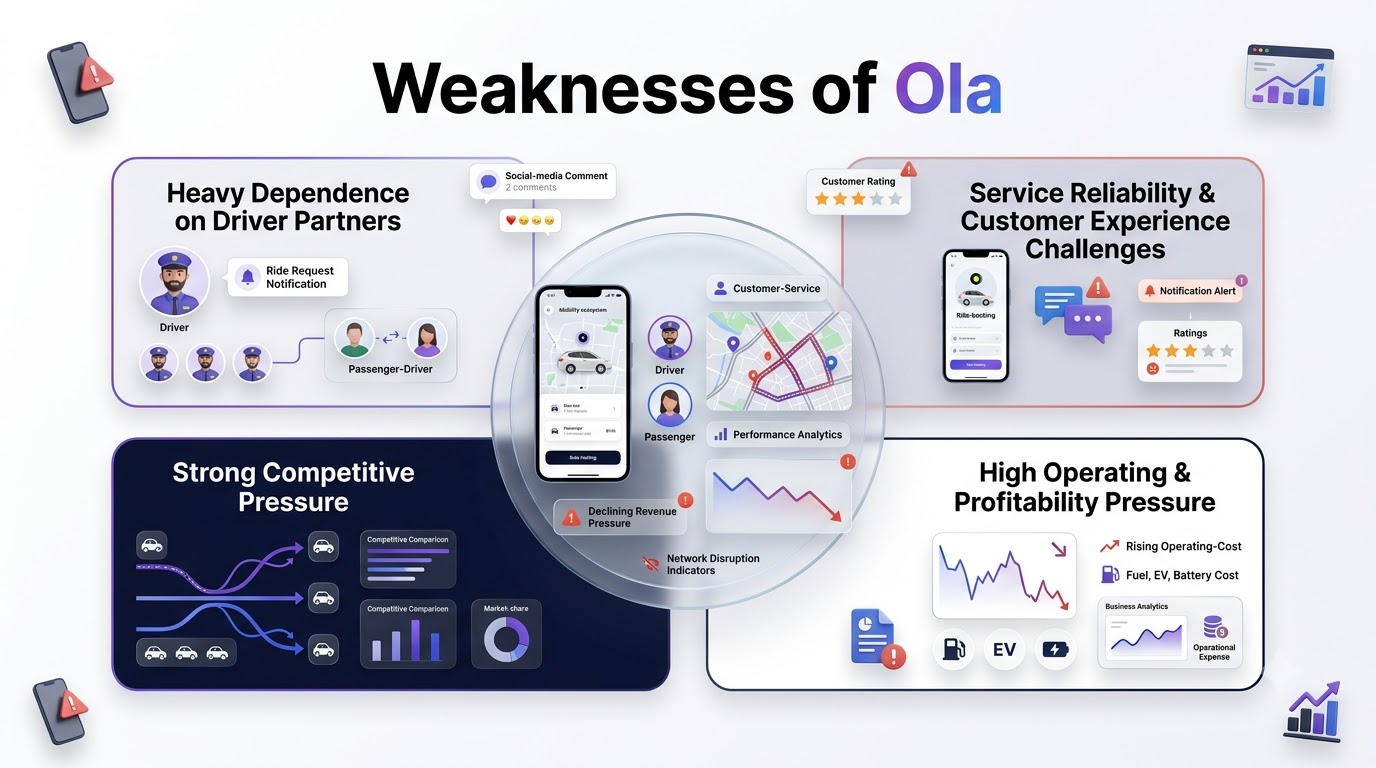
Ola’s weaknesses aren’t secret. They show up constantly on social media, in driver forums, and in the company’s own financial filings, and they’re the reason competitors have been able to take share as fast as they have.
Driver Complaints and Cancellation Rates
Ask any regular Ola user in an Indian metro about their biggest frustration and cancellations come up almost immediately. Drivers cancelling rides after acceptance, drivers asking riders to cancel so they avoid a penalty, and long wait times during peak hours are recurring complaints across cities. Part of this comes from Ola’s commission-based structure, where the platform takes a cut of every completed trip, which pushes some drivers toward selectively accepting only the most profitable rides and cancelling or ignoring the rest. Rapido’s rise is partly built on solving exactly this problem: its subscription model, where drivers pay a flat fee instead of a per-trip commission, lets them keep 100% of the fare, and according to industry estimates cited by Ken’s report, this lets Rapido drivers earn up to 15% more per trip compared to Ola or Uber. That earnings gap is a direct, quantifiable reason drivers migrate away from Ola’s platform toward alternatives.
Here’s the part that makes this weakness hard to fix quickly: Ola’s entire cab and auto business is built around taking a commission on every completed trip, so simply matching Rapido’s payout structure means giving up a meaningful chunk of existing revenue overnight, not tweaking a setting. That’s why Ola has mostly responded with smaller compensating benefits instead, things like driver insurance schemes and fuel or EV charging discounts, rather than a wholesale switch to a subscription model. If you’re trying to understand this from the driver’s side rather than the company’s, it’s worth reading through how gig economy income actually breaks down across different platforms, because the headline commission rate rarely tells the full story once you factor in incentive structures, peak-hour bonuses, and cancellation penalties.
Customer Service Reputation Problems
Ola has struggled for years with a reputation for slow or unhelpful customer support, and this shows up repeatedly in app store reviews, on social media complaint threads, and in formal grievances filed with India’s Central Consumer Protection Authority regarding unfair trade practices around cancellation charges and fare transparency. On the electric vehicle side, the problem was even more visible: Ola Electric owners have publicly complained about long delays in service appointments, parts availability, and after-sales support since the S1 and S1 Pro launches. To its credit, the company responded concretely in 2026 by expanding its service center network to 650 hubs by May, a direct attempt to close this gap rather than just issuing a statement about it. But rebuilding trust takes longer than rebuilding infrastructure, and a lot of customers who had a bad service experience in 2022 or 2023 haven’t come back to check whether things improved.
This is the classic trap fast-scaling consumer companies fall into, and Ola is a textbook example of it. When you’re growing 50% quarter over quarter, adding support staff and service capacity always lags behind adding new users and new vehicles, because hiring and training support teams takes longer than shipping a new city launch. The debt from that gap doesn’t disappear once growth slows down, it just becomes visible, which is exactly what happened to Ola between 2021 and 2023. The 650-hub service network expansion is the right fix, but it’s playing catch-up on a reputation problem that was years in the making, not months.
Financial Losses and Cash Burn History
Both arms of the Ola business have a long history of losses. ANI Technologies, the parent entity behind Ola Cabs, has reported net losses in multiple fiscal years even as revenue grew, a pattern common across India’s ride-hailing sector where driver incentives and rider discounts eat into margins faster than volume growth can offset them. Ola Electric’s stock tells a similar story from the public markets side: shares are still down more than 40% from their IPO price of ₹76, even after a strong rally where the stock jumped 91% off its 52-week low of ₹22.25 touched in March 2026. That kind of volatility isn’t just a stock market curiosity, it directly affects the company’s ability to raise fresh capital on favorable terms, and it puts real pressure on management to hit profitability targets faster than they might in a business with more patient backing.
What’s worth noting here is that the loss pattern itself isn’t unusual for this industry, Uber took over a decade globally to post a consistent annual profit, and Rapido is almost certainly burning cash right now to fund its own aggressive expansion. The difference is timing and patience from capital markets. Ola Electric is a public company now, which means its losses get scrutinized every quarter by analysts and reported in the financial press within hours of the results dropping, a level of pressure a private company like Rapido simply doesn’t face yet. That public spotlight cuts both ways: it forces genuine cost discipline, but it also means every rough quarter becomes a headline that erodes consumer and investor confidence a little further.
Inconsistent App Experience and Ratings
Ola’s app store ratings across Android and iOS have historically trailed both Uber and Rapido, with recurring one-star reviews citing incorrect fare estimates, GPS location mismatches between the rider’s actual pickup point and where the driver is directed, and payment failures during peak-hour surge pricing. None of these are catastrophic bugs individually, but they add up, and app store ratings function as a public trust signal that new users check before downloading a mobility app for the first time in an unfamiliar city. A three-star average next to a competitor’s four-star average is a small thing that compounds every single day across millions of potential first-time downloads, quietly costing the company users it never even gets a chance to win over. Fixing this requires the kind of unglamorous, ongoing engineering investment in app stability and payment reliability that never makes headlines but shows up in retention numbers six months later.
Regulatory and Legal Troubles
Ola has run into regulatory friction on multiple fronts over the years: surge pricing restrictions in states like Karnataka, gig worker classification disputes that affect how drivers are treated under labor law, and more recently, supplier disputes like the ₹40.6 crore vendor litigation Ola Electric had to publicly clarify in mid-2026, stating it caused zero operational or financial impact even as the case highlighted a recurring pattern of vendor-side legal friction that analysts flagged as a metric worth watching going forward. None of these individually threatens the company’s existence, but together they represent a steady drag on management attention and legal cost that a cleaner-run competitor simply doesn’t carry.
The mistake to avoid here is treating each of these incidents as isolated news stories, because the pattern matters more than any single case. A supplier dispute, a labor classification challenge, and a surge pricing crackdown are all different symptoms of the same underlying issue: Ola operates at a scale and speed where cutting corners on contracts, driver treatment, or fare transparency eventually surfaces as a legal or regulatory problem. Competitors growing more slowly, or operating on commission-free models that avoid some of these fare disputes entirely, simply generate fewer of these headlines by design, not necessarily because they’re better run.
Opportunities
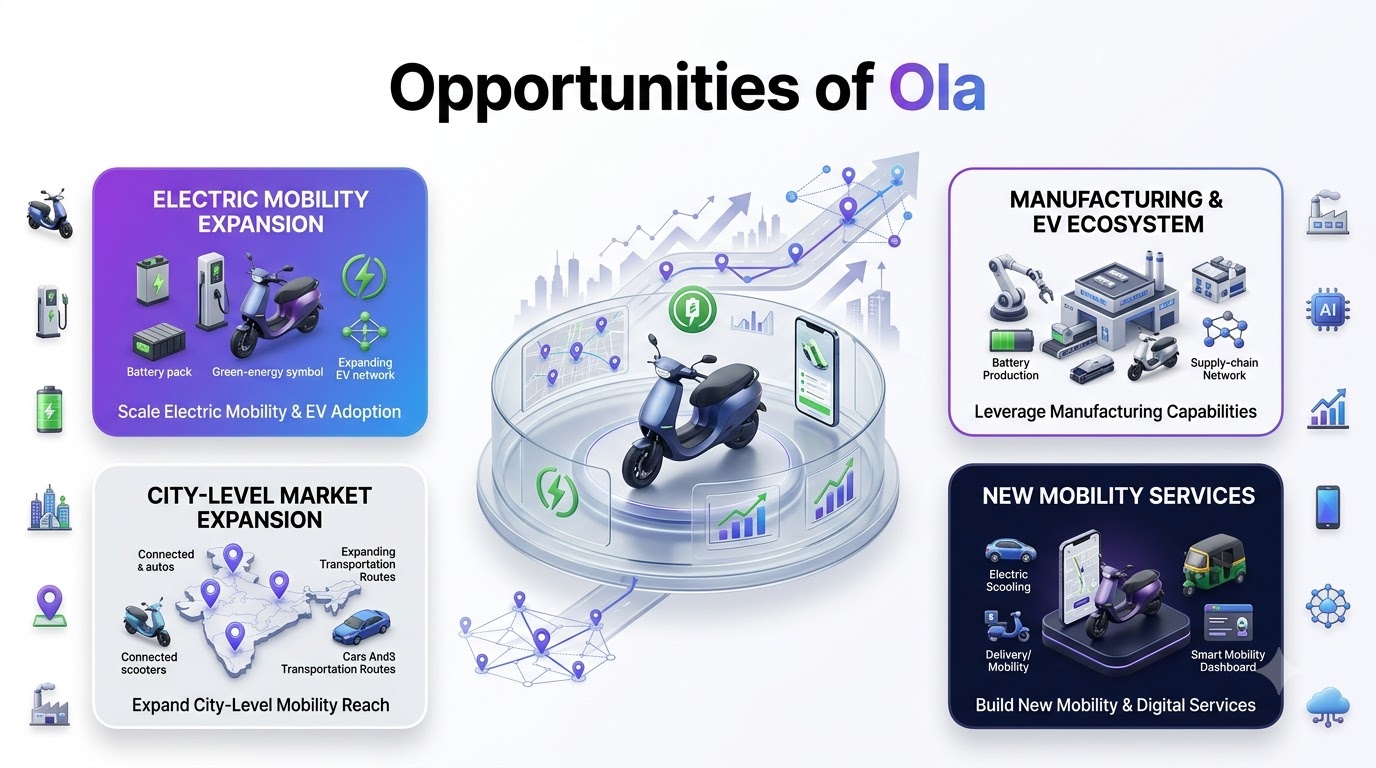
Despite the share losses, Ola isn’t short on real growth paths. The company has assets, manufacturing depth and city-level reach, that most competitors don’t have, and a few specific moves could turn that into actual recovery.
Tier 2 and Tier 3 City Expansion
India’s ride-hailing growth over the next several years is not going to come primarily from Bengaluru, Delhi, or Mumbai, those markets are already saturated with three or four competing apps fighting over the same riders. It’s going to come from cities like Indore, Coimbatore, Nagpur, and dozens of others where app-based mobility adoption is still climbing. Ola already has operational presence in many of these markets ahead of Uber, and that head start is a real opportunity if the company invests in driver supply and local marketing there instead of only defending its metro turf against Rapido. The math is simple: winning a Tier 2 city where you’re already the incumbent costs a fraction of what it takes to win back share from Rapido in Bengaluru, where the competitor already has a loyal driver base built on better payout economics.
The part most competitors will get wrong when they try to copy this is assuming Tier 2 expansion is just Tier 1 operations at a smaller scale. It isn’t. Smaller cities have different peak-hour patterns tied to local work shifts, different vehicle mix expectations (autos matter far more relative to cabs than they do in Mumbai or Delhi), and often stricter local transport union relationships that a platform has to navigate carefully to avoid strikes or blockades. Ola’s existing operational history in these markets means it already has working relationships with local transport unions and municipal transport authorities in a lot of these towns, relationships a brand-new entrant would have to build from scratch, one city council meeting at a time.
Electric Vehicle Market Timing
India’s overall electric two-wheeler market grew about 17% in the quarter ending June 2026, but Ola Electric’s own registrations grew 97% quarter-on-quarter in that same period, nearly six times the category’s growth rate, even while its full-year share remained low compared to 2023-2024 peak levels. That gap between category growth and Ola’s own sequential growth suggests the company’s cost reset and network expansion are starting to convert into real demand recovery, not just headline numbers. If that quarter-on-quarter trend holds for two or three more quarters, Ola Electric has a real shot at clawing back meaningful share from TVS, Bajaj, and Ather, especially with its Gen 3 lineup and the Roadster X positioned to compete more directly on price and range than its earlier S1 models did.
What makes this opportunity worth taking seriously rather than dismissing as a temporary bounce is the underlying cause. A 97% quarter-on-quarter jump right after a service network expansion to 650 hubs isn’t a coincidence, it’s what happens when a company fixes the exact objection that was stopping people from buying in the first place. Most people who skipped Ola Electric in 2023 or 2024 weren’t worried about the scooter’s specs, they were worried about what happens if it breaks down and there’s no service center nearby. Once that objection genuinely gets addressed at scale, pent-up demand tends to convert fast, which is a very different growth story than a company trying to win new customers on features alone.
Financial Services and Super App Ambitions
Ola has repeatedly tried to build a broader financial services and super-app layer around its core mobility business, from Ola Money as a digital wallet to various lending and insurance experiments aimed at both riders and drivers. This remains a real, underused opportunity. A driver who already earns through Ola and has years of transaction history on the platform is a natural candidate for embedded lending products, vehicle financing, or insurance sold directly through the app, the kind of thing that builds a second, higher-margin revenue stream on top of commission income. If you’re studying how platforms build these layered revenue models, it’s worth reading through case studies of how other consumer platforms have executed on this kind of super-app financial layer, since the successful ones consistently start with the highest-trust, highest-frequency user segment first, which for Ola would be its own driver base, not casual riders.
There’s also a defensive angle to this that doesn’t get discussed enough. If Rapido keeps winning on driver economics through its subscription model, Ola can’t necessarily out-compete on the base payout structure without gutting its own commission revenue. What it can do is compete on total value delivered to the driver, insurance, fast vehicle financing, fuel or charging discounts, and a lending track record built on transaction history, none of which Rapido’s leaner platform is positioned to offer at the same depth right now. That’s not a flashy opportunity, but it’s a realistic one, because it plays to an advantage Ola already has (years of driver transaction data) instead of trying to beat a competitor at its own game.
International Market Re-Entry Potential
Ola pulled out of the UK, Australia, and New Zealand in 2022 to cut costs and refocus on the Indian market, a decision that made sense at the time given the cash burn those markets represented. But international re-entry, done selectively rather than broadly, remains an option if the domestic turnaround stabilizes. Southeast Asian and Middle Eastern markets in particular have ride-hailing dynamics closer to India’s price-sensitive, high-density urban structure than the UK or Australia ever did, and Ola’s operational playbook for scaling driver supply cheaply in dense cities is exactly the kind of capability that transfers well to markets like that, assuming the company has the balance sheet to fund another international push once its core business is healthier.
The realistic path here isn’t a dramatic re-launch in five countries at once, and Ola would be smart to avoid repeating that mistake. It’s picking one or two markets with genuinely similar density and price sensitivity to Indian metros, running a small controlled pilot, and proving the unit economics work before scaling further. Companies that rush international expansion to chase a growth headline almost always end up pulling out again within two or three years, which is exactly what happened with Ola’s first attempt at the UK and Australia. A slower, evidence-first approach is less exciting to report on, but it’s the only version of this opportunity that doesn’t repeat the same expensive mistake twice.
Threats
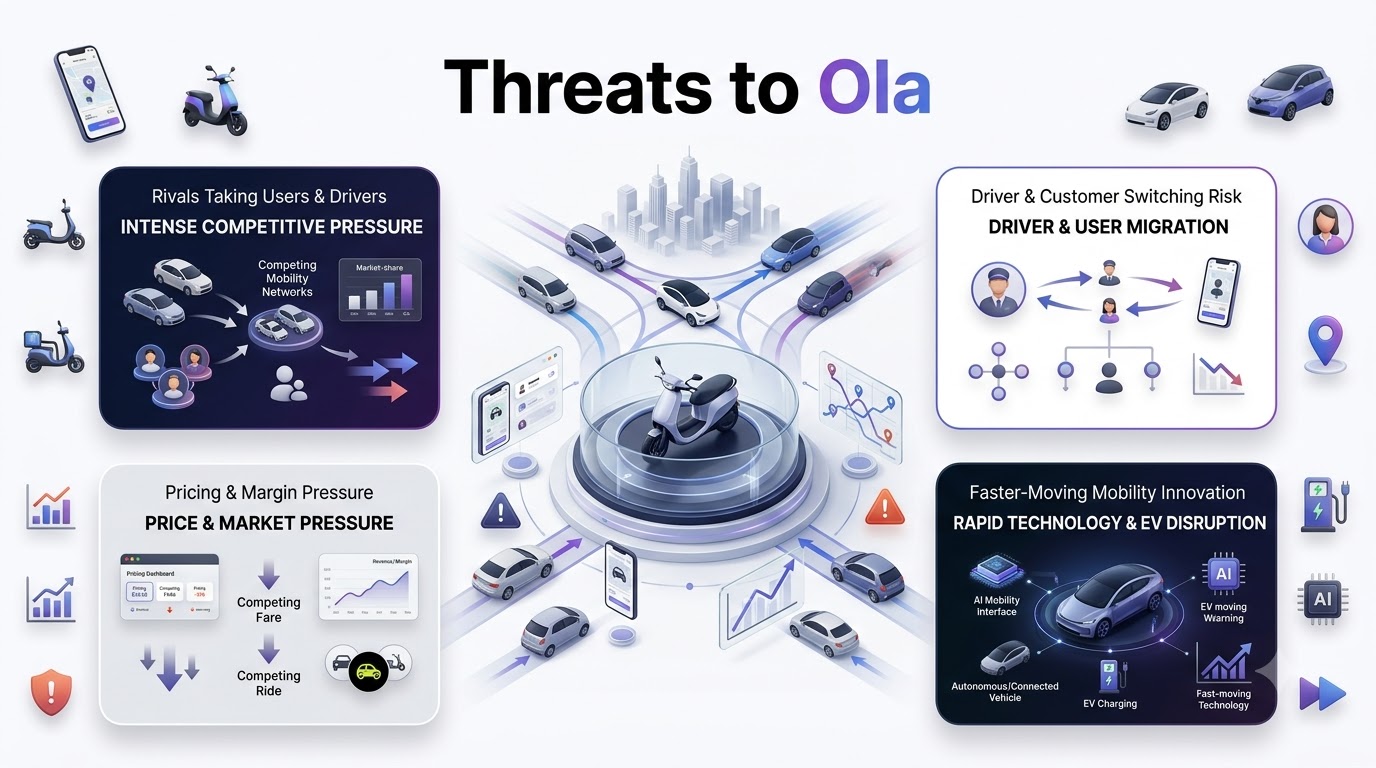
None of Ola’s opportunities matter if the company can’t hold ground against the competitors actively taking its users and drivers right now. This is the section that decides whether Ola’s recovery story actually plays out, and unlike the weaknesses above, none of these threats are things Ola can fix purely through internal decisions. They require Ola to out-execute rivals who, in some cases, are simply moving faster right now.
Uber and Rapido Competition
This is the single biggest threat, and the numbers make it hard to argue otherwise. By early 2026, Rapido’s monthly active users reached roughly 74 million, compared to around 38 million for Uber and only 26-27 million for Ola, meaning Rapido’s user base alone now exceeds Uber and Ola’s combined. In the cab category specifically, Uber holds around 50% market share, Ola sits at roughly 30-34%, and Rapido has climbed to somewhere between 14% and 30% depending on which recent estimate you look at, with its share in the four-wheeler segment reportedly doubling in under a year. Ola’s daily trip volume of around 460,000 is now barely ahead of Rapido’s 320,000, and well behind Uber’s roughly 840,000. That’s not a company under mild pressure. That’s a company that has slipped to third place in user engagement in a market it used to co-dominate, and the gap is widening in Rapido’s favor faster than most analysts expected.
What makes this threat particularly dangerous for Ola is the direction of causality. Uber’s CEO Dara Khosrowshahi has publicly named Rapido, not Ola, as the company’s toughest competition in India, which tells you where industry attention has shifted. When the market leader starts treating your smaller rival as the bigger threat instead of you, that’s usually a signal that you’ve quietly slipped out of the top competitive tier, even if your absolute revenue numbers still look respectable on paper. If you’re comparing these platforms yourself as a rider or driver deciding where to spend your time, it’s worth checking recent side-by-side app reviews rather than relying on brand reputation alone, because the gap between what a platform used to be known for and what it actually delivers today can be wide.
Regulatory Risk and Government Policy Shifts
Beyond the private competitors, Ola also faces a newer kind of threat: government-backed alternatives designed specifically to undercut commission-based platforms. Sahkar Taxi, a cooperative-model service, is entering the market with zero-commission structures aimed at strengthening driver loyalty and pushing fares down for riders, and it has explicit government backing behind it. Namma Yatri, the open-network platform that pioneered the zero-commission approach in Bengaluru, has already raised international funding and is reportedly exploring alliances with driver unions in North America. When government policy actively favors driver-friendly, low-commission models over the traditional aggregator cut that Ola’s entire revenue structure depends on, that’s not a competitor problem anymore, it’s a structural threat to the business model itself, and it’s one that pure product improvements can’t fix.
The uncomfortable truth for Ola here is that these government-backed models exist specifically because riders and drivers have publicly, repeatedly complained about aggregator commissions for years, and policymakers responded to that pressure. That means this isn’t a threat that gets resolved by better PR or a temporary fare discount. It’s a slow-moving structural shift in how Indian mobility platforms are expected to operate, and platforms that don’t adapt their commission model at all over the next few years risk looking increasingly out of step with both public sentiment and government policy at the same time.
Driver Attrition to Competing Platforms
Drivers are rational economic actors, and when a platform’s payout structure is measurably worse than a competitor’s, they switch, especially since most drivers in Indian cities already run multiple apps simultaneously and can shift their primary focus without switching costs. Rapido’s subscription model, letting drivers keep their full fare in exchange for a flat platform fee, has proven attractive enough to pull driver supply and, by extension, rider volume away from both Ola and Uber. If Ola can’t find a way to close that per-trip earnings gap, either by cutting its own commission take or offering compensating benefits like insurance and fuel discounts, driver attrition will keep compounding, because every driver who leaves for a better-paying platform also takes rider trust and availability with them.
This creates a feedback loop that’s hard to reverse once it starts. Fewer active drivers means longer rider wait times during peak hours, which pushes riders to open a competing app instead, which reduces the trip volume available to remaining Ola drivers, which makes the platform even less attractive to drivers deciding where to spend their working hours. Breaking that loop requires a large enough one-time investment in driver incentives to pull supply back before the loop compounds further, not a series of small, incremental fixes spread out over several quarters.
EV Market Competition from Ather, TVS, Bajaj
On the electric vehicle side, Ola Electric’s fall from roughly 26-35% market share to about 7% in 2026 wasn’t caused by one single competitor, it was a combined squeeze from TVS (around 26% share), Bajaj (around 22%), Ather (around 17%), and Hero’s Vida (around 11%), all of whom have been shipping more reliable products with stronger dealer networks while Ola dealt with quality complaints and service backlogs from its earlier S1 generation. Among the top five e-scooter brands in India in the first half of 2026, Ola was reportedly the only one whose volumes actually declined year-on-year over that stretch, even as the broader category kept growing. That’s the clearest sign that Ola’s EV problem in 2026 wasn’t a shrinking market, it was share loss to specific, better-executing competitors, and reversing that requires consistently outperforming those same rivals on reliability and after-sales service for several quarters straight, not just for one good quarter.
Ather in particular is worth watching closely here, because it built its entire brand around reliability and premium build quality from day one, the exact opposite positioning of Ola’s early “move fast, scale faster” approach to EV manufacturing. TVS and Bajaj bring something different but equally dangerous: decades of two-wheeler dealer network relationships across small-town India that Ola simply doesn’t have yet, since Ola Electric launched with a direct-to-consumer experience center model instead of leaning on existing dealership networks. Closing that distribution gap in smaller towns, not just fixing service quality in metros, is arguably the harder problem Ola Electric still has to solve.
There’s also a pricing squeeze building underneath all of this that’s worth watching. As TVS, Bajaj, and Ather scale up their own manufacturing volumes, their per-unit battery and component costs keep falling too, narrowing whatever cost advantage Ola Electric’s in-house cell production was supposed to deliver. If Ola’s Bharat Cell platform doesn’t translate into a real, defensible price advantage on the finished scooter within the next couple of product cycles, the manufacturing depth that looks like a strength on paper right now stops mattering much competitively, because the whole point of owning your battery supply chain is to eventually pass some of that cost saving through to the customer in a way rivals sourcing cells externally can’t match.
[Screenshot: MeraEV or similar EV market tracker showing Q1 FY27 electric two-wheeler market share by brand, with Ola Electric’s position highlighted]
Conclusion
A SWOT Analysis of Ola in 2026 doesn’t land on a clean “buy” or “avoid” verdict, and it shouldn’t, because the company is genuinely split between real strengths and real damage. The manufacturing depth in Ola Electric, the multi-category cab platform, and the Tier 2 city reach are legitimate assets that competitors will take years to replicate. But the driver economics problem, the market share Rapido has already taken, and the government-backed zero-commission alternatives entering the space are not going away on their own. Whether Ola’s current cost reset and product turnaround actually hold depends on execution over the next few quarters, not on brand history from a decade ago.
If you’re studying this as a case study in how a first-mover can lose ground to leaner, faster-moving competitors, or you’re evaluating Ola from a driver, rider, or investor angle, the numbers above are the ones worth tracking quarter over quarter: MAU trends, driver earnings gaps, and EV registration growth. Those three metrics will tell you where this story goes long before any press release does.
None of this means Ola is finished, and it doesn’t mean the recovery is guaranteed either. What it means is that the old shorthand, “Ola is one of India’s two big ride-hailing apps”, stopped being accurate a while ago, and treating it as still true will get you the wrong answer whether you’re a driver picking which app to prioritize, an investor sizing up Ola Electric’s stock, or a student trying to write an accurate case study instead of a dated one. The company that exists now is smaller in relative terms than the one from 2021, but it’s also more disciplined about where it spends money, which is a trade a lot of scaled-up startups never manage to make successfully. Watch the next two or three quarters of registration growth and driver retention numbers, and you’ll know which direction this actually goes.
Frequently Asked Questions
What is the biggest weakness in Ola’s business model?
Ola’s biggest weakness is its commission-based driver payout structure, which pays drivers less per trip than subscription-model competitors like Rapido. This has driven measurable driver attrition and directly contributed to Ola losing market share and daily trip volume in the cab segment.
Is Ola still profitable?
Both Ola Cabs (under ANI Technologies) and Ola Electric have histories of net losses across multiple fiscal years, though Ola Electric reported a strong 34.3% gross margin in Q3 FY26 alongside cost-cutting measures aimed at lowering its breakeven point. Full company-wide profitability has not been consistently achieved by either arm of the business.
Why did Ola Electric’s market share drop so much?
Ola Electric’s e-scooter market share fell from around a third of the market in 2023-2024 to roughly 7% in 2026 because competitors like TVS, Bajaj, and Ather delivered more reliable products and stronger service networks while Ola dealt with quality complaints and after-sales backlogs from its earlier S1 and S1 Pro models.
Is Rapido really bigger than Ola now?
In terms of monthly active users, yes. By early 2026, Rapido’s MAUs reached roughly 74 million, exceeding Uber’s approximately 38 million and Ola’s approximately 26-27 million combined. In raw revenue and total trip volume Ola still holds meaningful share, but user engagement has clearly shifted toward Rapido.
What are Ola’s main strengths compared to Uber?
Ola’s main advantages over Uber are its deeper penetration in Tier 2 and Tier 3 Indian cities, its broader category range within a single app (cabs, autos, bikes, rentals, outstation), and its vertically integrated EV manufacturing arm through Ola Electric, none of which Uber currently matches in India.
What is Ola Electric’s Bharat Cell platform?
The Bharat Cell platform is Ola Electric’s in-house battery cell manufacturing initiative, including its 4680-format cells produced at its own Gigafactory. Trial production began in June 2026, making Ola one of the few Indian EV companies actually manufacturing its own battery cells rather than sourcing them from external vendors.
How is Ola diversifying beyond ride-hailing and scooters?
Ola Electric launched a Battery Energy Storage System (BESS) product portfolio on August 15, 2026, extending its battery manufacturing expertise into residential and utility-scale energy storage. This represents a deliberate move beyond electric mobility into the broader energy storage market.
What regulatory risks does Ola face?
Ola faces risks including state-level surge pricing restrictions, gig worker classification disputes affecting driver labor rights, and government-backed low-commission competitors like Sahkar Taxi, which directly challenge the commission-based revenue model Ola’s ride-hailing business depends on.
Should investors be worried about Ola Electric’s stock volatility?
Ola Electric’s stock remains more than 40% below its IPO price of ₹76 despite rallying 91% off its 52-week low of ₹22.25 in 2026. That volatility reflects genuine uncertainty about the turnaround’s durability, and anyone evaluating the stock should track quarterly registration growth and margin trends rather than short-term price swings alone.
Has Ola tried international expansion before?
Yes. Ola operated in the UK, Australia, and New Zealand for a period before exiting all three markets in 2022 to cut costs and refocus resources on its core Indian business. Any future international push is expected to be smaller and more selective rather than a broad multi-country relaunch.
What is Ola’s opportunity in Tier 2 and Tier 3 cities?
Ola already operates in many smaller Indian cities where Uber has limited or no presence, giving it an incumbent advantage. Expanding driver supply and local marketing in these markets costs far less than fighting Rapido for share in saturated metro markets, making it one of Ola’s clearest paths to volume recovery.
How does Rapido’s driver model threaten Ola specifically?
Rapido charges drivers a flat subscription fee instead of a per-trip commission, letting them keep their full fare. Industry estimates suggest this lets Rapido drivers earn up to 15% more per trip than on Ola or Uber, which pulls driver supply, and by extension rider trust and availability, directly away from Ola’s platform.
Can Ola realistically recover its EV market share?
It’s possible but not guaranteed. Ola Electric’s registrations grew 97% quarter-on-quarter in Q1 FY27, far outpacing the broader e-scooter market’s 17% growth, suggesting real demand recovery. Whether that momentum continues for several more quarters will determine if Ola can meaningfully close the gap with TVS, Bajaj, and Ather.
Who are Ola’s biggest competitors overall?
Ola’s biggest competitors are Uber and Rapido in ride-hailing, and TVS, Bajaj, Ather, and Hero’s Vida in electric two-wheelers. Government-backed and driver-owned alternatives like Namma Yatri and Sahkar Taxi are also emerging as structural competitors because of their zero-commission models.
Does Ola make more money from cabs or from electric scooters?
Ola Cabs, under parent entity ANI Technologies, and Ola Electric are separate corporate entities with different revenue bases. Ola Cabs generates revenue through ride commissions across a far larger existing user base, while Ola Electric earns through vehicle sales and, as of 2026, its expanding battery cell and energy storage business.
What is Ola Energy?
Ola Energy is Ola Electric’s newer business line focused on Battery Energy Storage Systems (BESS), launched on August 15, 2026. It applies the company’s existing battery cell manufacturing expertise from electric scooters to residential and utility-scale energy storage products.
How does Ola compare to Uber in terms of pricing?
Pricing between Ola and Uber is generally competitive and city-dependent, with both platforms using dynamic or surge pricing during peak demand. Riders in most Indian cities report similar fares between the two for comparable trip distances, with the bigger differentiator being driver availability and cancellation rates rather than base pricing.
Is it safe to ride with Ola?
Ola runs standard safety features including driver verification, trip tracking, SOS buttons, and ride-sharing with emergency contacts, comparable to what Uber and Rapido offer. Safety outcomes depend heavily on individual driver behavior and local road conditions rather than the platform itself, so checking driver ratings before a trip remains a sensible habit regardless of which app you use.
Why is Ola Electric’s stock considered risky right now?
Ola Electric’s stock is considered risky because the company remains unprofitable on a net basis, its market share fell sharply through 2025 and 2026, and it operates in a capital-intensive manufacturing business where a single bad product cycle or supply dispute can move the share price significantly. The recent rally off its 52-week low reflects renewed optimism from the cost reset, but the stock still trades well below its IPO price, which signals the market hasn’t fully bought into the turnaround yet.