


Pull out your wallet right now. Chances are good there’s a card sitting in there with that familiar red and yellow overlapping circle logo. Mastercard is one of those companies that’s everywhere and nowhere at the same time. Everywhere because billions of transactions run through its network every single day. Nowhere because most people couldn’t tell you what Mastercard actually does if you asked them on the street. They’d probably say “it’s a credit card company” and leave it at that. That’s not even close to the full picture.

Here’s the thing that surprises people once they dig in: Mastercard doesn’t lend you a single rupee or dollar. It doesn’t issue your card, doesn’t set your interest rate, doesn’t decide your credit limit, and doesn’t call you when you miss a payment. Your bank does all of that. Mastercard just sits in the middle, moving the data and the money between your bank and the merchant’s bank in a fraction of a second, and it charges a small fee every time that happens. Do that a hundred billion times a year across 200-plus countries and you end up with a company worth close to 400 billion dollars.
So why do a SWOT Analysis of Mastercard right now, in 2026? Because the payments world is going through one of the messiest, most interesting periods it’s seen in decades. UPI in India is processing more transactions than Visa and Mastercard combined globally, in terms of pure volume. Buy-now-pay-later companies came out of nowhere and grabbed a chunk of the checkout experience. Central banks from China to Nigeria are testing their own digital currencies that could, in theory, cut card networks out of the picture entirely. And on top of all that, regulators in Europe, India, and the US are actively trying to squeeze the fees Mastercard charges. This is not a boring, stable business anymore. It’s a business fighting on five fronts at once, and it’s mostly winning, but not without some real bruises.
This guide breaks down the strengths, weaknesses, opportunities, and threats facing Mastercard with real numbers, real competitor names, and real opinions on what matters and what’s just noise. No fluff, no vague “experts say” lines. Just a straight look at where this company stands.
What You Will Learn in This Guide
Before jumping into the analysis itself, here’s a quick rundown of what’s covered so you know exactly what you’re getting into and can skip around if you want.
- A quick but honest overview of how Mastercard actually makes its money and where it sits in the payments industry today
- The core strengths that make Mastercard one of the most durable businesses on the planet, backed by actual numbers
- The weaknesses that don’t get talked about enough, including its dependency problems and legal headaches
- The opportunities in digital payments, emerging markets, and crypto that could define its next decade
- The real threats from Visa, fintech startups, regulators, and economic conditions that could slow it down
- A side-by-side comparison of Mastercard and Visa so you understand how these two giants actually differ
- What this SWOT Analysis of Mastercard means practically if you’re an investor, a business owner, or someone building in fintech
- Over 10 frequently asked questions that cover the stuff people usually search for right after reading an analysis like this
Company Overview: Understanding Mastercard Before the SWOT Analysis of Mastercard
You can’t really evaluate strengths and weaknesses of a company without understanding how it makes money in the first place. So let’s get that out of the way first, quickly, before getting into the actual SWOT Analysis of Mastercard.
History and Origin of Mastercard
Mastercard started in 1966 as “Interbank Card Association,” a group of banks in California who banded together because they were tired of watching Bank of America’s BankAmericard (which later became Visa) run away with the market. It went through a few name changes over the decades, becoming Master Charge in the 1970s and finally Mastercard in 1979. For most of its life, it was owned by a cooperative of banks, not shareholders. That changed in 2006 when Mastercard went public on the New York Stock Exchange. That single decision to go public is arguably one of the most important turning points in its history, because it forced the company to think like a growth business instead of a slow-moving bank consortium. Since the IPO, the stock has gone up by well over 100 times, which tells you everything about how the “just process transactions” business model turned out to be far more profitable than anyone expected back in the 1960s.
Business Model and Revenue Streams
Mastercard makes money mainly in two buckets: domestic assessments and cross-border volume fees, plus transaction processing fees. Every time you swipe, tap, or enter your card details online, Mastercard takes a tiny cut, often just a fraction of a percent, but multiply that across hundreds of billions of transactions a year and you get a company reporting revenue north of 28 billion dollars annually as of its recent filings. Beyond the core network fees, Mastercard has built out a huge “value-added services” arm that includes cybersecurity tools, data analytics, consulting, and fraud prevention software sold to banks and merchants. This segment has grown faster than the core payments business in recent years and now makes up a meaningful chunk of total revenue. That diversification matters a lot, and we’ll get into why later in the strengths section.
Where Mastercard Stands in 2026
Right now, Mastercard sits as the second-largest payment network in the world by transaction value, trailing Visa but ahead of everyone else including American Express, Discover, and UnionPay in most Western markets. It operates in over 210 countries and territories and supports more than 150 currencies. It’s also been aggressively pushing into areas that have nothing to do with plastic cards at all, things like open banking infrastructure, identity verification, and even helping governments distribute welfare payments digitally. Honestly, calling Mastercard a “credit card company” in 2026 undersells what it’s actually become. It’s closer to a global financial technology utility that happens to have started with cards.
SWOT Analysis of Mastercard
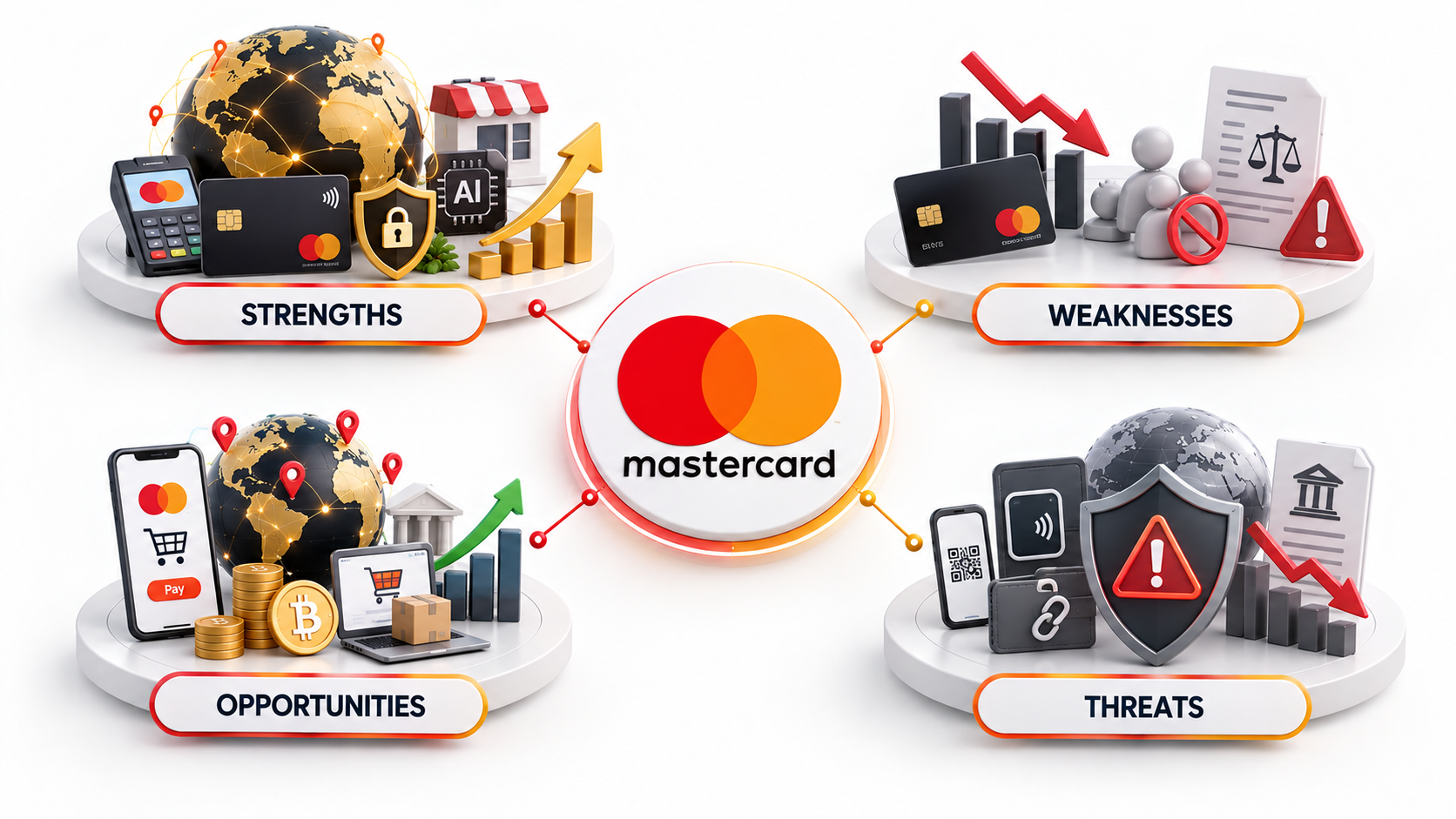
A SWOT analysis of Mastercard provides a structured view of the company’s Strengths, Weaknesses, Opportunities, and Threats within the global payments and financial technology industry. By examining these four areas, businesses can better understand Mastercard’s competitive position, the factors supporting its growth, and the challenges that could affect its future performance. This analysis covers Mastercard’s brand strength, global payment network, technological capabilities, market opportunities, competitive pressures, regulatory risks, and the rapidly changing digital payments landscape.
Strengths
Now let’s get into the actual meat of this SWOT Analysis of Mastercard, starting with what the company does really, really well. And to be clear, some of these strengths are genuinely hard to replicate, which is exactly why Mastercard has survived multiple recessions, a pandemic, and constant fintech disruption without losing its footing.
Global Network and Brand Trust
This is the big one. Mastercard’s network connects roughly 3.4 billion cards to more than 100 million merchant locations worldwide. Building that kind of coverage from scratch would take decades and billions of dollars, which is exactly why new entrants almost never try to compete head-on with a brand-new card network. Instead, they build on top of Visa or Mastercard’s rails, which honestly says more about the strength of this moat than any marketing slide ever could. And it’s not just about pipes and wires. People trust the Mastercard logo. When you’re standing in a shop in a country you’ve never visited before, seeing that logo on the card machine gives you instant confidence your card will work. That trust took sixty years to build and can’t be bought overnight by a startup with a slick app.
Diversified Revenue Streams
Mastercard isn’t a one-trick pony anymore, and that’s by design. Beyond the classic swipe fees, the company earns a growing share of its revenue from cybersecurity products, fraud detection powered by AI, data analytics sold to banks, and consulting services through its Mastercard Data & Services division. This matters because if card usage ever slows down in one region due to a recession or new regulation, the company isn’t sunk. It has other engines running. Look at what actually happens during downturns: transaction volume dips, sure, but banks still need fraud protection, and governments still need identity verification systems. Mastercard gets paid either way, which is a nice position to be in when the economy gets shaky.
Technology and Cybersecurity Investment
Mastercard spends billions every year on technology, and a huge chunk of that goes straight into fraud prevention and cybersecurity. It acquired companies like RiskRecon, Ekata, and Baffin Bay Networks specifically to strengthen this side of the business. Why does this matter so much? Because payment fraud is a genuine arms race. Criminals get smarter every year, and if Mastercard’s systems fall behind even slightly, banks start losing money and, more importantly, start losing trust in the network. The company’s AI-driven fraud detection reportedly analyzes over 160 billion transactions a year to spot suspicious patterns in real time. That’s not a small thing. That’s the kind of infrastructure investment that a five-year-old fintech startup simply cannot match, no matter how much venture capital it raises.
Strong Financial Performance
Numbers don’t lie, and Mastercard’s numbers are honestly kind of ridiculous. Operating margins regularly sit above 55 percent, which is a level most industries can only dream about. Free cash flow generation has been consistently strong, letting the company return billions to shareholders through buybacks and dividends every year while still investing heavily in growth. This isn’t a company burning cash to chase market share like a lot of fintech startups do. It’s profitable at a scale that gives it enormous flexibility, whether that’s acquiring a promising startup, weathering a lawsuit, or absorbing new compliance costs from regulators without blinking.
Partnerships with Banks and Fintechs
Here’s something people underestimate: Mastercard doesn’t see fintech disruptors purely as threats. It’s actually partnered with a long list of them, including Revolut, Klarna, and various neobanks around the world, issuing Mastercard-branded cards for their platforms. Rather than fighting every new entrant, Mastercard often just becomes the plumbing underneath them. That’s a smart move, and honestly, it’s one of the reasons the “fintech will kill Mastercard” narrative hasn’t played out the way some predicted a decade ago. Instead of being replaced, Mastercard found a way to get paid by the companies that were supposed to replace it.
Weaknesses
No company is perfect, and honestly, some of Mastercard’s weaknesses are structural, meaning they’re baked into how the business works and can’t just be fixed with a new marketing campaign or a product launch.
Heavy Dependence on Transaction Volume
Mastercard’s entire revenue model depends on people spending money and doing it through cards. That sounds obvious, but it means the company is directly exposed to consumer confidence and economic cycles. During the early days of the COVID-19 pandemic, cross-border travel volume, which is one of Mastercard’s most profitable segments because of currency conversion fees, basically collapsed overnight. Revenue took a real hit. So then, any global event that keeps people home, cautious with spending, or unable to travel hits Mastercard directly and immediately. That’s a weakness that a diversified tech company with subscription revenue simply doesn’t have to deal with in the same way.
Limited Direct Consumer Relationship
Here’s an odd one. Mastercard processes your payments but has almost no direct relationship with you as a customer. Your bank issues the card, your bank handles customer service, your bank decides your rewards program. Mastercard is invisible in that entire experience except for the logo. This limits its ability to build customer loyalty the way a company like Amazon or Apple can. If your bank decides to switch from Mastercard to Visa for its next card program, you as a cardholder probably won’t even notice or care. That lack of a sticky, direct consumer relationship means Mastercard’s fate is tied heavily to decisions made by thousands of banks, not by millions of individual users choosing Mastercard because they love it.
Regulatory and Legal Exposure
This one is honestly a bit of a mess, and it’s getting messier. Mastercard has faced antitrust lawsuits and regulatory scrutiny across the US, UK, and European Union over the interchange fees it charges merchants. In the UK alone, Mastercard settled a massive class-action style lawsuit related to overcharging fees for over a decade, and the numbers involved run into the billions. The European Commission has also capped interchange fees within the EU, directly limiting how much revenue Mastercard can extract from certain transactions there. And it’s not just Europe. India’s central bank has pushed hard for its own domestic payment network, RuPay, partly to reduce reliance on foreign card networks like Mastercard and Visa. Every region seems to have its own regulatory headache brewing, and that’s a genuine, ongoing drag on growth that isn’t going away anytime soon.
Competitive Pricing Pressure
Merchants have never liked paying interchange fees, and honestly, who can blame them? A small business owner running thin margins doesn’t love handing over 2 to 3 percent of every sale just for the privilege of accepting a card. Over the years, merchant lobbying groups have gotten louder and more organized, pushing governments to cap these fees or force more competition into the space. This creates constant downward pressure on one of Mastercard’s core revenue levers. It’s not an existential threat by any means, but it’s a persistent squeeze that chips away at margins year after year, especially in markets where regulators are sympathetic to merchant complaints.
Opportunities
Alright, enough about problems. Let’s talk about where Mastercard could actually grow from here, because there’s a lot on the table, and the company seems to know it.
Growth in Digital Payments and E-commerce
Cash usage is dropping nearly everywhere, and honestly, it’s not close. Countries that were heavily cash-based just a decade ago, think Southeast Asia, parts of Africa, and Latin America, are leapfrogging straight into digital payments without ever going through a “checkbook phase.” E-commerce continues to grow every year, and every online purchase needs some kind of payment rail behind it. Mastercard is positioned to capture a good chunk of that growth simply by being one of the few networks capable of handling it at global scale, securely, in real time. That’s not a small opportunity. That’s basically the entire multi-decade growth story for card networks summarized in one sentence.
Expansion in Emerging Markets
Markets like India, Indonesia, Nigeria, and Brazil are where a huge chunk of the world’s population still doesn’t have full access to formal banking or card-based payments. As smartphone penetration rises and banking infrastructure improves in these regions, there’s a genuinely massive untapped user base. Mastercard has been actively investing here, partnering with local banks, telecom companies, and even governments on financial inclusion programs. Look, this isn’t charity. It’s smart long-term positioning. Get people using your rails now while they’re building their first financial habits, and you’ve got customers for decades. The company’s partnerships in Africa alone, working with mobile money providers, show it’s serious about not missing this wave the way some other companies missed the shift to mobile internet in these same regions years ago.
Blockchain, Crypto and CBDC Integration
This is the interesting one, and it’s a bit of a two-sided coin. On one hand, crypto and central bank digital currencies could theoretically bypass traditional card networks entirely. On the other hand, Mastercard has chosen to lean in rather than fight it. The company has filed patents related to blockchain payment processing, partnered with several crypto platforms to let users spend crypto-linked cards at regular merchants, and even worked directly with central banks on CBDC pilot programs, including projects in the Eastern Caribbean and Australia. That’s a smart hedge. If digital currencies do become mainstream, Mastercard wants to be the infrastructure layer underneath them rather than getting left behind entirely. Whether this bet pays off fully is still an open question, but the fact that they’re not ignoring it says a lot.
B2B Payments and Value-Added Services
Consumer payments get all the attention, but business-to-business payments are actually a massive, underserved market. Companies still move enormous amounts of money through slow, expensive wire transfers and paper checks, especially for cross-border trade. Mastercard has been building out solutions specifically targeting this space, including its Mastercard Track platform for B2B trade payments. This is a market worth trillions of dollars globally, and honestly, card networks have barely scratched the surface of it. If Mastercard can crack even a modest percentage of global B2B payment flows, that alone could be a multi-billion dollar growth driver over the next decade, separate entirely from consumer spending trends.
Threats
Now for the part that keeps Mastercard’s strategy team up at night. These aren’t small, easily dismissed risks. Some of these threats are already actively reshaping the payments landscape as we speak.
Competition from Visa and Other Players
Visa is bigger. That’s just a fact. In terms of total transaction volume and market share in most Western economies, Visa consistently edges out Mastercard. The two companies compete fiercely for exclusive bank partnerships, merchant deals, and co-branded card programs. Every contract Mastercard loses to Visa, or vice versa, has real financial consequences given how concentrated this duopoly is. Beyond Visa, there’s American Express focusing on premium customers, Discover in the US, UnionPay dominating China, and RuPay growing fast in India with explicit government backing. This isn’t a market where Mastercard can coast. It has to keep winning bank contracts one by one, market by market, forever.
Rise of Fintech and Alternative Payment Methods
Buy-now-pay-later services like Klarna and Afterpay changed how a lot of younger shoppers think about checkout, often bypassing traditional card rails partially or entirely. Digital wallets like Apple Pay and Google Pay, while they still often run on top of Mastercard’s rails behind the scenes, are shifting consumer habits and could eventually push for more direct bank-to-bank payment options that cut card networks out completely. Then there’s account-to-account payment systems like India’s UPI and Brazil’s Pix, which process transactions directly between bank accounts with zero card network involved at all. UPI alone handles tens of billions of transactions a month in India, a market where Mastercard would otherwise want a much bigger presence. That’s a real, structural threat, not a hypothetical one, and it’s already happening at scale right now.
Regulatory Crackdowns Across Countries
This ties back to the weaknesses section, but it deserves its own spot here too because the trend is intensifying, not fading. Governments around the world are increasingly viewing card network fees as an unfair tax on small businesses and consumers. The US has seen renewed legislative pushes around the Credit Card Competition Act, which would force more routing competition and could meaningfully cut into Mastercard’s fee revenue if it ever passes. India continues pushing RuPay aggressively as a national alternative. Europe keeps tightening interchange caps. None of these threats alone is fatal, but stacked together across multiple major economies, they represent a genuine long-term drag on the profitability of the core business model.
Economic Slowdowns and Consumer Spending Risks
Mastercard’s fortunes are tied directly to how much people spend, travel, and shop. A global recession, a spike in unemployment, or a major geopolitical shock that disrupts international travel all hit Mastercard’s revenue almost immediately, since there’s no subscription buffer or long-term contract cushioning the blow like you’d see in software businesses. Inflation squeezing consumer wallets, high interest rates discouraging spending, or another pandemic-style event grounding international travel would all directly translate into lower transaction volumes and, therefore, lower revenue. This sensitivity to macroeconomic conditions is just baked into the business, and there’s no real way around it.
Mastercard vs Visa: A Quick Comparative Look
Since Visa comes up constantly in any honest discussion about Mastercard, it’s worth pausing here for a direct comparison rather than just mentioning it in passing.
Market Share Differences
Visa generally holds a larger share of global card transaction volume, often cited around 50 to 60 percent in various markets compared to Mastercard’s roughly 25 to 30 percent, though exact figures shift by region and year. Visa also tends to have a stronger presence in the US market specifically, while Mastercard has historically pushed harder into Europe, parts of Asia, and emerging markets. Neither company is going anywhere, and honestly, this rivalry has mostly settled into a stable duopoly rather than one side clearly winning.
Strategic Priorities
Where the two companies differ more interestingly is strategy. Mastercard has leaned harder into cybersecurity acquisitions and B2B payment infrastructure in recent years, positioning itself as a broader technology and data company rather than just a card network. Visa has focused more heavily on expanding its Visa Direct real-time payments platform and its own push into value-added services, but its overall brand positioning still leans more traditional. Neither approach is clearly superior, but it does mean Mastercard’s growth story right now is a bit more diversified beyond pure card volume compared to Visa’s.
What This SWOT Analysis of Mastercard Means for Investors and Businesses
A SWOT breakdown is only useful if it actually tells you something you can act on. So here’s what all of this actually means depending on where you’re sitting.
For Investors
Mastercard remains a genuinely strong long-term business with high margins, consistent cash flow, and multiple growth levers beyond just card swipes. That said, the regulatory risk is real and shouldn’t be brushed aside as background noise. Anyone considering this stock should watch legislative developments closely, particularly around interchange fee regulation in the US and India, since these could meaningfully affect future margins even if the core business stays healthy otherwise.
For Merchants and Businesses
If you’re running a business that accepts cards, understanding Mastercard’s fee structure and how it compares to alternatives like UPI or Pix in your region could genuinely save you money. In markets where account-to-account payment rails exist and are gaining consumer trust, offering them as a checkout option alongside cards can reduce your processing costs meaningfully, especially for high-volume, low-margin businesses.
For Fintech Startups
Rather than trying to build a competing card network from scratch, which is basically impossible given the network effects involved, most fintech startups are better off partnering with Mastercard the way Revolut and Klarna have. Building on top of an established, trusted rail gets you global acceptance instantly instead of spending a decade and a fortune trying to build your own from zero.
Final Thoughts on SWOT Analysis of Mastercard
Look, Mastercard isn’t some scrappy underdog and it isn’t some unstoppable monopoly either. It’s a genuinely well-run, hugely profitable company sitting in the middle of a global money-moving system, facing real pressure from regulators, fintech disruptors, and alternative payment rails that didn’t even exist twenty years ago. But it’s also a company that’s adapted before, moving from a bank-owned cooperative into a public tech-adjacent giant, and it’s adapting again right now by leaning into cybersecurity, B2B payments, and even the crypto and CBDC world it could have easily ignored or fought against.
The honest takeaway from this SWOT Analysis of Mastercard is that the company’s biggest strengths, its network, its brand trust, its financial muscle, are also somewhat static advantages that newer competitors can’t easily replicate quickly. But its biggest threats, regulation and alternative payment rails like UPI, are structural shifts happening in real time that even Mastercard’s massive resources can’t fully control. Whether the next decade favors Mastercard’s adaptability or the disruptors’ speed is genuinely an open question, and that’s exactly what makes this such an interesting company to keep watching.
Frequently Asked Questions
1. What is the main purpose of doing a SWOT Analysis of Mastercard?
The purpose is to get a clear, balanced picture of where Mastercard stands today, both internally in terms of its strengths and weaknesses, and externally in terms of opportunities and threats in the payments industry. It helps investors, students, and business owners understand the company beyond just headline revenue numbers.
2. Is Mastercard bigger than Visa?
No, not currently. Visa generally holds a larger share of global transaction volume compared to Mastercard, often estimated in the range of 50 to 60 percent versus Mastercard’s roughly 25 to 30 percent, though this varies by region and by year depending on new bank contracts won or lost.
3. What is Mastercard’s biggest weakness?
Its heaviest weakness is arguably its dependence on transaction volume and its lack of a direct consumer relationship, since banks control the actual card issuance and customer experience. This makes Mastercard’s fortunes tied closely to economic cycles and to decisions made by thousands of banking partners rather than by loyal end users.
4. How does Mastercard make money if it doesn’t issue credit cards?
Mastercard earns revenue through small fees charged on every transaction processed through its network, along with cross-border transaction fees and a growing value-added services business covering cybersecurity, fraud detection, and data analytics sold to banks and merchants.
5. Why is UPI considered a threat to Mastercard?
UPI in India processes payments directly between bank accounts without any card network involved at all, meaning Mastercard earns nothing from these transactions. Given the sheer volume UPI handles in India, one of the world’s largest payment markets, this represents a significant chunk of potential revenue that Mastercard simply cannot access through that particular rail.
6. Does Mastercard have exposure to cryptocurrency?
Yes, Mastercard has partnered with several crypto platforms allowing crypto-linked cards to be used at regular merchants, and it has also worked directly with central banks on digital currency pilot programs. It’s positioning itself as infrastructure for digital currencies rather than fighting against the trend.
7. What regulatory issues has Mastercard faced recently?
Mastercard has dealt with antitrust lawsuits over interchange fees in the UK and EU, along with ongoing scrutiny in the US around legislative proposals like the Credit Card Competition Act. Various countries have also pushed domestic payment alternatives partly to reduce reliance on foreign networks like Mastercard.
8. Is Mastercard a good long-term investment based on this SWOT analysis?
That depends on individual investment goals and risk tolerance, and this isn’t financial advice. What can be said objectively is that Mastercard has strong margins, consistent cash flow, and diversified revenue streams, but it also faces genuine regulatory and competitive pressure that could affect future growth rates.
9. How is Mastercard different from a bank?
Mastercard is not a bank and does not lend money directly to consumers. It provides the network infrastructure that allows banks, merchants, and payment processors to move money and data between each other securely, earning a small fee for facilitating that process.
10. What are Mastercard’s biggest opportunities going forward?
The biggest opportunities lie in continued growth of digital payments in emerging markets, expansion into B2B payment infrastructure, and positioning itself within the evolving world of blockchain and central bank digital currencies rather than being replaced by them.
11. How does Mastercard compete with fintech companies like Klarna or Revolut?
Rather than treating every fintech as a direct competitor, Mastercard has partnered with many of them, issuing Mastercard-branded cards for their platforms. This approach lets Mastercard earn revenue from the growth of fintech companies instead of losing market share to them entirely.
12. What role does cybersecurity play in Mastercard’s business strategy?
Cybersecurity has become a core growth pillar for Mastercard, not just a defensive necessity. Through acquisitions like RiskRecon and Ekata, Mastercard sells fraud prevention and identity verification tools directly to banks and merchants, turning what was once a cost center into an actual revenue-generating business line.