


Here is a number that should bother anyone who thinks LIC is a sure thing. In May 2022, the government sold LIC shares to the public at ₹949 per share, selling only 3.5% and raising nearly ₹21,000 crore. In August 2026, the government went back to the market with a floor price of ₹382 per share. Same company, same brand painted on branch buildings in every district, and the stock lost more than half its value in between.

Now the odd part. In the quarter ending June 2026, LIC’s profit after tax rose 22.81% to Rs 13,492 crore. That is a profit most companies would take a decade to earn. So which LIC is the real one? The struggling stock, or the profit machine?
Both. That’s exactly why a proper SWOT Analysis of LIC is worth your time. LIC is the biggest life insurer in India, a listed company, a government-owned institution, an investor with a portfolio worth lakhs of crores, and a brand your grandparents trusted. It is also a company slowly losing share to private rivals, leaning hard on one sales channel, and facing a 100% foreign-owned competitor set. A quick “LIC is safe” or “LIC is slow” doesn’t cut it.
This guide breaks LIC into strengths, weaknesses, opportunities and threats, using real numbers from the latest results. You’ll see what is actually working, what is quietly going wrong, and how to read all of it whether you hold a policy, own the stock, or are a student writing a case study.
What You Will Learn in This Guide
- What a SWOT analysis is, and why it works well for a company as big and odd as LIC
- How LIC got here: the 1956 nationalisation, the 2022 IPO, and the numbers as of Q1 FY27
- The real strengths of LIC, from the agent army to the ₹59 lakh crore investment book
- The weaknesses most articles skip: slipping market share, agency dependence, persistency and the share price hangover
- The opportunities: low insurance penetration, GST relief on premiums, retirement products and digital tools
- The threats: 100% FDI for rivals, tougher rules, market swings and government stake sales
- How policyholders, investors and students can each use the SWOT Analysis of LIC differently
- Mistakes people make when reading any SWOT, and 12 FAQs answered in plain language
TL;DR
- LIC still holds a 60.10% share of first year premium in India, but that is down from 63.51% a year ago.
- Its biggest strength is distribution: over 13 lakh agents bring in about 93% of individual new business premium.
- Profitability is improving fast, with net VNB margin at 22.9% versus 15.4% last year.
- The biggest weakness is dependence on agents plus mixed persistency, meaning customers who stop paying premiums.
- The biggest opportunity is that India is still badly under-insured, and GST on individual life premiums was removed in September 2025.
- The biggest threat is a market where private rivals can now be 100% foreign-owned, while LIC’s own foreign cap stays at 20%.
SWOT Analysis of LIC: What It Means and Why It Fits This Company
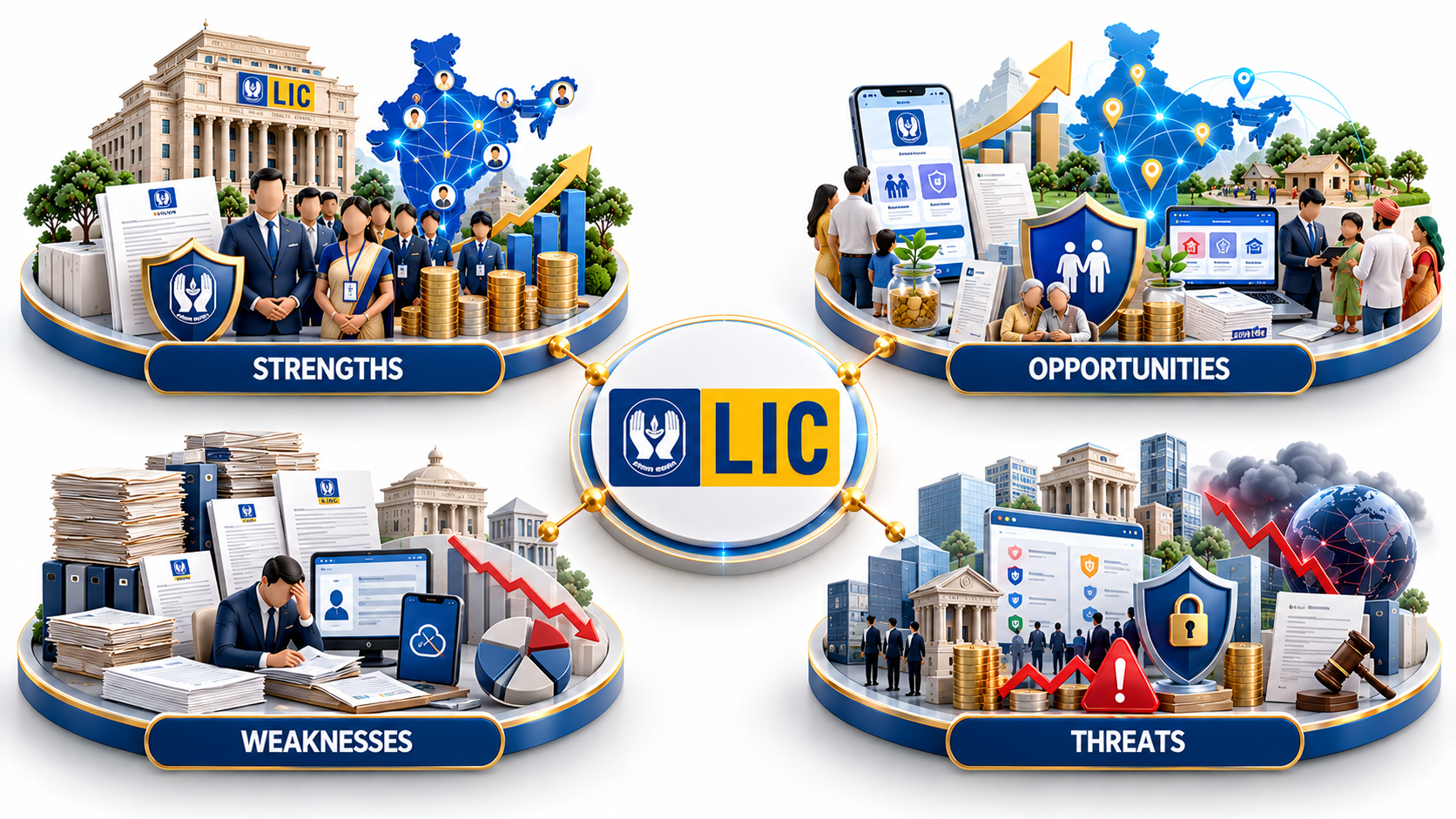
A SWOT analysis sorts a company’s situation into strengths and weaknesses (inside the company) and opportunities and threats (outside it). The SWOT Analysis of LIC works well because LIC is easy to admire and easy to criticise, and most people only do one of the two.
What SWOT Actually Means in Plain Language
Strengths are things LIC does better than almost anyone, like reaching a village with no bank branch. Weaknesses are internal problems it could fix, like low online sales. Opportunities are outside events that could help it, like a tax change. Threats are outside events that could hurt it, like new competitors. Inside versus outside is the whole trick. Mix them up and the analysis turns to mush.
Why LIC Needs a Proper SWOT and Not a Headline
Most LIC coverage swings between two moods. One says the giant is unstoppable. The other says the giant is slow and doomed. Both ignore the numbers. LIC earns huge profits, loses market share, holds a giant portfolio and sells almost everything through one channel. A structured SWOT forces all those facts onto one page, so you can see how they push against each other.
How This SWOT Analysis of LIC Is Built
Every point below comes from something checkable: LIC’s own quarterly disclosures, IRDAI data, government notifications, or widely reported events. Where a number is a snapshot, the quarter is named. Where something is an opinion, it’s marked as one. If you like learning from real company breakdowns, the case studies section on Academy Of Digital Marketing follows the same approach.
Quick Background Before the SWOT Analysis of LIC
Before scoring anything, you need to know what LIC is and how it earns money. The company has a strange history, an unusual ownership structure, and a business model that looks nothing like a typical listed firm. Skip this part and half the SWOT will look odd.
From 245 Private Insurers to One Government Giant
LIC was created on 1 September 1956, when Parliament nationalised the life insurance business and merged 245 insurers and provident societies into a single corporation. The government put in ₹5 crore as starting capital. For the next 44 years, LIC had no competitor at all. Private players were only allowed back in 2000, and that head start explains why LIC’s brand and reach still look so lopsided today.
LIC Today: The Numbers That Matter
Here are the Q1 FY27 numbers. Total premium income rose 6.75% to Rs 1,27,250 crore for the quarter. Assets under management reached ₹59.39 lakh crore. Gross NPAs declined to Rs 7,168 crore, with a gross NPA ratio of 1.21%. Those figures place LIC among the largest financial institutions in the country, not just among insurers.
How LIC Actually Makes Money
An insurer makes money in three places: the spread between what it collects and pays out, returns on the pool of premiums it invests, and margins on new policies. LIC’s edge has always been the second one. Premiums come in first, claims go out years later, and the money in between gets invested in government bonds, corporate debt and equities. That investment engine is why a bad year in the stock market can shake LIC and a good one can lift it.
Strengths
The strengths side of the SWOT Analysis of LIC is loud, and honestly most of it is deserved. Some strengths are old, like the brand. Others are newer, like better margins. Together they explain why competitors have had a hard time cracking LIC despite better apps and slicker marketing.
Sovereign Backing and a Brand People Trust With Their Savings
Section 37 of the LIC Act carries a government guarantee on the sums assured under LIC policies. Very few private insurers can say that. For a family buying a policy to protect a daughter’s wedding fund, that promise counts for more than a good interest rate. Brand Finance has ranked LIC among the strongest insurance brands in the world in recent years. Trust like that takes generations to build and one scandal to dent.
An Agent Network Nobody Else Can Copy
LIC has more than 13 lakh agents, and the numbers on how much they matter are hard to ignore. In Q1 FY27, 98.51% of policies were sold by the agency force and 93.07% of individual new business premium came from the agency channel. These agents live in the same neighbourhoods as their customers, attend the same weddings, and get called at 9 pm when a claim needs filing. A private insurer can hire salespeople. It can’t easily copy thirty years of relationships.
Market Share and Scale That Rivals Envy
LIC’s overall market share by first year premium income was 60.10% in Q1 FY27, with 38.89% in the individual segment and 70.90% in group. That group number matters. Employers and institutions buying pension and gratuity cover tend to pick the biggest, safest name. Scale also means cheaper operations per policy and enormous data on how Indian households save, pay and lapse. dailypioneer
A Massive Investment Book With Decent Balance Sheet Cushions
The investment book stood at ₹59.39 lakh crore, and the solvency ratio improved to 2.42 from 2.17. IRDAI requires at least 1.5, so LIC sits well above the line. Management said in 2024 that the market value of its equity holdings was around ₹15 lakh crore. That portfolio gives LIC room to absorb shocks, pay bonuses to policyholders and still fund new business.
Profitability Is Finally Moving in the Right Direction
For years, the knock on LIC was volume without margin. That story is changing. Value of New Business jumped 61.32% to Rs 3,136 crore, with net VNB margin at 22.9%. VNB simply means the profit LIC expects from policies sold in the period. In August 2024, management had promised roughly a 20% margin over the next two to three years. It got there faster. The reason is a shift toward non-participating products, whose share in individual APE rose to 32.49% from 30.34%.
A Claim Settlement Record That Sells Itself
The claim settlement ratio is the share of death claims an insurer actually pays. LIC’s has hovered around 98.6% in recent IRDAI data, which is near the top of the industry. It looks like a boring statistic, but it does the selling for LIC. When a family gets a claim paid without a fight, they tell relatives, and those relatives become the next agent’s leads. That’s free marketing money can’t buy.
Weaknesses
Now the harder half. The weaknesses side of the SWOT Analysis of LIC is where the real thinking happens, because these are problems LIC could fix and hasn’t fully. None of them are fatal alone, but together they explain why the share price behaves so differently from the profit line.
Market Share Keeps Slipping
LIC’s premium market share was 60.10% in Q1 FY27 versus 63.51% in Q1 FY26. That is a drop of more than three points in one year. Management says it is a deliberate trade: give up low-margin group business, protect profit. Maybe so, and the margin numbers support that story. Still, a company that loses share every quarter needs to prove the next quarter won’t be worse, and that proof isn’t fully in yet.
Too Much Dependence on One Sales Channel
Agents bring in 93% of individual premium. Bancassurance and other channels collected only Rs 907.14 crore in individual new business premium versus Rs 861.92 crore a year earlier. Private rivals like HDFC Life and SBI Life get a large share from bank branches. One channel means one point of failure. If agents leave in big numbers or a regulator squeezes commissions, LIC has no second engine ready.
Persistency Is Mixed at Best
Persistency measures how many customers keep paying premiums after buying. Analysts covering Q1 FY27 described LIC’s persistency ratios as mixed. That matters more than it sounds. A lapsed policy means the insurer spent commission and got nothing back. It also hints at mis-selling, where a policy is pushed on someone who can’t sustain the premium. The best private insurers have historically reported higher retention.
An Old Product Habit: Savings Plans With Modest Returns
For decades, the classic LIC pitch was the endowment or money-back plan. Those plans return maybe 5% to 6% a year once bonuses are counted, which looks weak next to a plain fixed deposit or index fund. Financial planners have criticised this for years, and honestly they have a point. LIC is now shifting toward non-par and protection, but millions of old policies were sold on the older promise.
Government Ownership Comes With Baggage
LIC has long been asked to help with things that aren’t purely commercial. It bought a controlling stake in IDBI Bank in 2019 as a rescue, and that stake has been on the block for a strategic sale for years. It took large positions in state-linked share sales. In early 2023, its Adani group exposure drew heavy political attention. Whether each decision was good or bad isn’t the point. The perception of state direction makes some investors nervous.
The Share Price Hangover
The stock’s slide from ₹949 to a ₹382 floor price at the August 2026 sale is a weakness because it affects how the company raises money, retains talent and looks to outsiders. Profit growth of 23% didn’t stop the fall. Some of that is an IPO priced too high in a hot market. Some of it is real doubt about growth. Either way, the market has been unconvinced, and that has to be answered with results.
Opportunities
The opportunities side of the SWOT Analysis of LIC is where LIC gets interesting, because the country is basically still on the first floor of an insurance boom. Opportunities come from outside the company, so LIC doesn’t create them. It has to be ready when they arrive.
India Is Still Badly Under-Insured
India’s life insurance penetration sits around 3% of GDP, and total insurance penetration is roughly 3.7%, against a global average closer to 7%. Put simply, most Indian families have far too little cover. A salaried father earning ₹8 lakh a year might have a ₹5 lakh policy that wouldn’t cover even three years of household costs. That gap is LIC’s biggest growth runway, and it has more branches than anyone to chase it.
GST Relief on Individual Life Premiums
From 22 September 2025, GST on individual life insurance premiums was removed. Before that, buyers paid 18% on top. The change makes a ₹50,000 premium about ₹9,000 cheaper on paper. There’s a catch: insurers lose input tax credit, so some pass part of that cost back through pricing. Even so, cheaper cover helps first-time buyers, and LIC sells to more first-time buyers than anyone.
Retirement, Annuity and Protection Products
India is ageing. Tens of millions of workers have no employer pension. That’s a huge gap for annuity and retirement products, and LIC already has names like Jeevan Shanti in that space. Protection plans like term cover carry better margins than old savings plans. If LIC grows there, the margin story from the latest quarter continues, and the business mix stops depending on low-return policies.
Digital Tools and Bima Sugam
LIC lags online, but the fix isn’t to abandon agents. It’s to give agents digital tools so each one can serve more people. Customer portals, app-based premium payments and a marketplace like IRDAI’s Bima Sugam, being rolled out as a kind of UPI for insurance, could cut paperwork sharply. Anyone learning how a legacy brand modernises will find it useful to study digital marketing basics, because the same logic applies: keep the trusted channel, add better tools around it.
Women Agents and Small-Town Reach
In December 2024, LIC launched Bima Sakhi Yojana, which trains women, often from small towns, as insurance agents with a stipend during the first years. It’s a smart move because trust travels best through people who already live in the community. Semi-urban and rural India, where private insurers have thin branches, is where LIC has an unfair advantage and a chance to grow the base further.
Growing Beyond Plain Life Cover
LIC already has LIC Mutual Fund, LIC Pension Fund and a big stake in LIC Housing Finance. As rules loosen, it could expand into health and other adjacent products through partnerships or subsidiaries. That would let it sell more to the same customer it already knows by name. The best insurance sales come from someone who already trusts you, and LIC has crores of those.
Threats
This section of the SWOT Analysis of LIC matters most for anyone thinking about the next five years. Threats are outside events LIC can’t control. It can only respond, and some of them are already in motion.
Private Insurers Now Get 100% Foreign Ownership
Parliament passed the Sabka Bima Sabki Raksha (Amendment of Insurance Laws) Bill in December 2025, and the government notified 100% FDI in insurance companies under the automatic route, while keeping LIC’s foreign investment cap at 20%. So rivals can raise unlimited foreign capital, and LIC can’t do the same. LIC’s own MD noted that incumbents should prepare for stronger competition.
Banks, Aggregators and Online Platforms
Private insurers sell through bank branches, where a customer walking in for a loan gets a policy pitch in the same visit. Others use platforms like PolicyBazaar, where buyers compare term plans by price in five minutes. LIC’s agent model doesn’t compete well on price comparison. A younger buyer under 35 who wants pure term cover may never meet an LIC agent at all.
Tougher Regulation
IRDAI has been raising surrender value rules since October 2024, which changes the economics of policies customers exit early. India also reportedly moved to a Risk-Based Capital framework from April 2026, where insurers selling risky products or investing in volatile stocks must keep much higher reserves. LIC’s big equity holdings and guaranteed products may need more capital under that model. Rules are fair, but they raise costs.
Interest Rate and Market Swings
LIC’s guaranteed and participating policies promise returns years ahead. If bond yields fall, reinvesting premiums at lower rates squeezes the spread. If share markets fall hard, its equity portfolio, worth roughly ₹15 lakh crore, drops with them. A big part of LIC’s profit comes from investment gains, so a bad market year hits the bottom line quickly and visibly.
Agent Attrition and Mis-Selling Risk
If commissions get squeezed or better-paying platforms lure people, a chunk of the 13 lakh agents could drift away. Mis-selling adds fuel: pushing a long-term policy on someone who can’t afford it leads to lapses and complaints. One viral video of a wrongly sold policy can undo the goodwill of a thousand smooth claim settlements.
More Government Stake Sales and Political Pressure
The government held 96.5% of LIC before the August sale and needs to bring its stake to 90% by May 16, 2027. It has until May 2032 to reach 75%. The CEO has said another public offer is unlikely for the next 18 to 24 months. Still, more shares hitting the market later can weigh on the price, and political pressure to support policies or rescue other PSUs never fully goes away.
SWOT Analysis of LIC at a Glance
Sometimes you just need the whole picture in one place. This section pulls the four boxes together so you can scan the SWOT Analysis of LIC in under a minute, then read how the boxes connect, since a list on its own doesn’t tell you what matters.
| Strengths | Weaknesses |
|---|---|
| Government-backed brand and trust | Falling premium market share |
| 13 lakh plus agents | 93% of individual premium from one channel |
| 60.10% share of first year premium | Mixed persistency |
| Investment book of ₹59.39 lakh crore | Old low-return savings products |
| VNB margin up to 22.9% | Share price far below IPO price |
| Opportunities | Threats |
|---|---|
| Low insurance penetration | 100% FDI for rivals, LIC capped at 20% |
| GST removed on individual life premiums | Banks and online aggregators |
| Retirement and protection products | Tougher rules and capital needs |
| Digital tools and Bima Sugam | Interest rate and equity swings |
| Bima Sakhi and small-town reach | More government stake sales |
How the Four Boxes Connect
The agent network is both a strength and a weakness. It brings in 93% of sales, and it’s also the single point of failure. The huge equity book is a strength when markets rise and a threat when they crash. The GST cut is an opportunity only if LIC’s agents can actually convert first-time buyers. A good SWOT isn’t four separate lists. It’s a map of how each item leans on the others.
How to Use the SWOT Analysis of LIC as a Policyholder, Investor or Student
Different readers need different things from the same analysis. A person holding a policy asks whether their money is safe. A person holding shares asks whether the price will recover. A student asks how to write a clean case study. Here is how each can pull what they need.
If You Already Hold an LIC Policy
Your policy isn’t in danger. The sovereign guarantee, a claim settlement ratio around 98.6% and a solvency ratio of 2.42 all point to a company that can pay. What deserves attention is the product itself. Check your policy’s actual return, using the internal rate of return figure, and compare it against what else the same money could earn. If it’s a pure savings plan with a 5% yield, decide with open eyes whether to continue or stop paying.
If You Are Thinking of Buying LIC Shares
Look at the strengths and weaknesses together. Profit and VNB margin are rising, which supports the business. Market share is falling and the stock has been weak since the IPO, which is a warning. Watch three things each quarter: VNB margin, market share by first year premium, and persistency. If you follow companies like this closely, tools such as free calculators and trackers help you compare quarterly numbers without spreadsheets. None of this is investment advice, so talk to a registered advisor before putting money in.
If You Are Writing a Case Study or Exam Answer
Start with numbers, not adjectives. Instead of writing “LIC has a strong market share,” write “LIC held 60.10% of first year premium in Q1 FY27, down from 63.51%.” Then link each SWOT point to a cause and a consequence. Examiners and editors both spot generic lines a mile away. If your topic is money and careers more broadly, the make money section has more practical breakdowns of how to research a company properly.
Frequently Asked Questions
What is a SWOT analysis of LIC?
A SWOT analysis of LIC is a structured look at the company’s internal strengths and weaknesses and the outside opportunities and threats it faces. For LIC, it covers things like market share, the agent network, investment portfolio, new competition and regulation. It helps policyholders, investors and students see the whole picture in one place.
What are the biggest strengths of LIC?
LIC’s biggest strengths are its government-backed brand, a network of more than 13 lakh agents, a 60.10% share of first year premium and an investment book of about ₹59.39 lakh crore. Its net VNB margin has also risen to 22.9%. Together these give it a position that private insurers find hard to match.
What are the main weaknesses of LIC?
The main weaknesses are falling market share, dependence on agents for about 93% of individual new business premium, mixed persistency and a history of low-return savings plans. The share price is also well below the May 2022 IPO price of ₹949. These problems are fixable, but they need time and consistent results.
Is LIC safe for policyholders?
Yes, on the evidence available. The LIC Act carries a government guarantee on sums assured, the claim settlement ratio has been around 98.6%, and the solvency ratio improved to 2.42 in Q1 FY27 against a regulatory minimum of 1.5. Safety of the promise is different from the quality of returns, so check your policy’s yield separately.
How did LIC perform in Q1 FY27?
LIC’s profit after tax rose 22.81% to ₹13,492 crore and total premium income grew 6.75% to ₹1,27,250 crore. Value of New Business jumped 61.32% to ₹3,136 crore, and net VNB margin expanded to 22.9% from 15.4%. Market share by first year premium fell to 60.10% from 63.51%.
What is VNB margin and why does it matter for LIC?
VNB margin is the profit an insurer expects from new policies as a percentage of the premium collected. A higher margin means LIC earns more on every rupee of new business. LIC’s margin rising from 15.4% to 22.9% shows its product mix is shifting toward more profitable plans like non-participating products.
Why is LIC losing market share?
LIC’s share is falling partly because private insurers are growing faster, and partly because management has chosen to reduce low-margin group business to improve profitability. Its overall share by first year premium fell from 63.51% to 60.10% in a year. Whether the trade-off works depends on whether margins keep improving.
How does 100% FDI in insurance affect LIC?
Private insurers can now be fully foreign-owned under the automatic route, which lets them raise more capital and bring in global expertise. LIC’s foreign investment cap stays at 20%. This makes competition sharper, especially in urban and online markets, though LIC still holds a clear lead in reach and brand trust.
Did the GST exemption on life insurance help LIC?
The removal of GST on individual life insurance premiums from 22 September 2025 makes policies cheaper for buyers, which helps a company that sells to many first-time customers. Insurers lose input tax credit though, so some of the benefit can be offset through pricing. Overall it supports demand more than it hurts.
Why did LIC’s share price fall after the IPO?
The government sold shares at ₹949 in May 2022, and by August 2026 the OFS floor price was ₹382. Reasons include a high IPO valuation, slowing market share, concerns about persistency and an overhang of future government share sales. Strong profit growth hasn’t fully offset those doubts yet.
How much of LIC does the government still own?
Before the August 2026 offer for sale, the government held 96.5%. It sold up to 6.5% and has to reduce its stake to 90% by May 16, 2027 and to 75% by May 2032. Government ownership will stay very high for years, which shapes both governance and share supply.
Is LIC a good stock to buy based on its SWOT?
The SWOT shows a profitable, dominant company facing real competitive pressure, so the answer depends on your time frame and risk comfort. Rising margins support the business, while falling market share and past price weakness are cautions. This isn’t financial advice, so check the latest quarterly numbers and speak to a registered advisor before investing.