



Look at any list of the biggest banks on the planet and J.P. Morgan is sitting at the top, or close to it, almost every single year. That’s not an accident and it’s not just because the bank has been around since the 1800s. Something is working, and something is also creaking under the weight of running a $4.4 trillion balance sheet across more than sixty countries. This post digs into all of it — the good, the bad, the stuff that could go either way.

Here’s the thing about analyzing a bank this size. Most SWOT write-ups you find online are recycled from five years ago with a new date slapped on the title. That’s not useful to anyone. J.P. Morgan closed out 2025 with $57 billion in net income, a 17% return on equity, and total assets of $4.4 trillion. Those numbers tell a story, but so do the headlines about regulatory fines, the pressure from fintech upstarts eating into payments revenue, and Jamie Dimon’s own warnings about market complacency. A proper SWOT analysis of JP Morgan has to hold both of those threads at once — the scale that makes it nearly untouchable and the risks that could genuinely bite.
This guide walks through J.P. Morgan’s strengths, weaknesses, opportunities, and threats in plain language, backed by real numbers from its own filings and recent earnings calls, not vague guesses dressed up as insight.
What You Will Learn in This Guide
- Why J.P. Morgan’s size and diversification act as both a shield and a source of drag
- How the bank’s 2025 financial results (revenue, profit, capital ratios) stack up against its own history
- Where the cracks are showing — expense growth, regulatory pressure, concentration risk
- The growth bets J.P. Morgan is making right now, from AI spending to wealth management
- The competitive and macroeconomic threats that could actually dent this bank’s dominance
- Answers to the most common questions people ask about J.P. Morgan’s business model and outlook
SWOT Analysis of J.P. Morgan
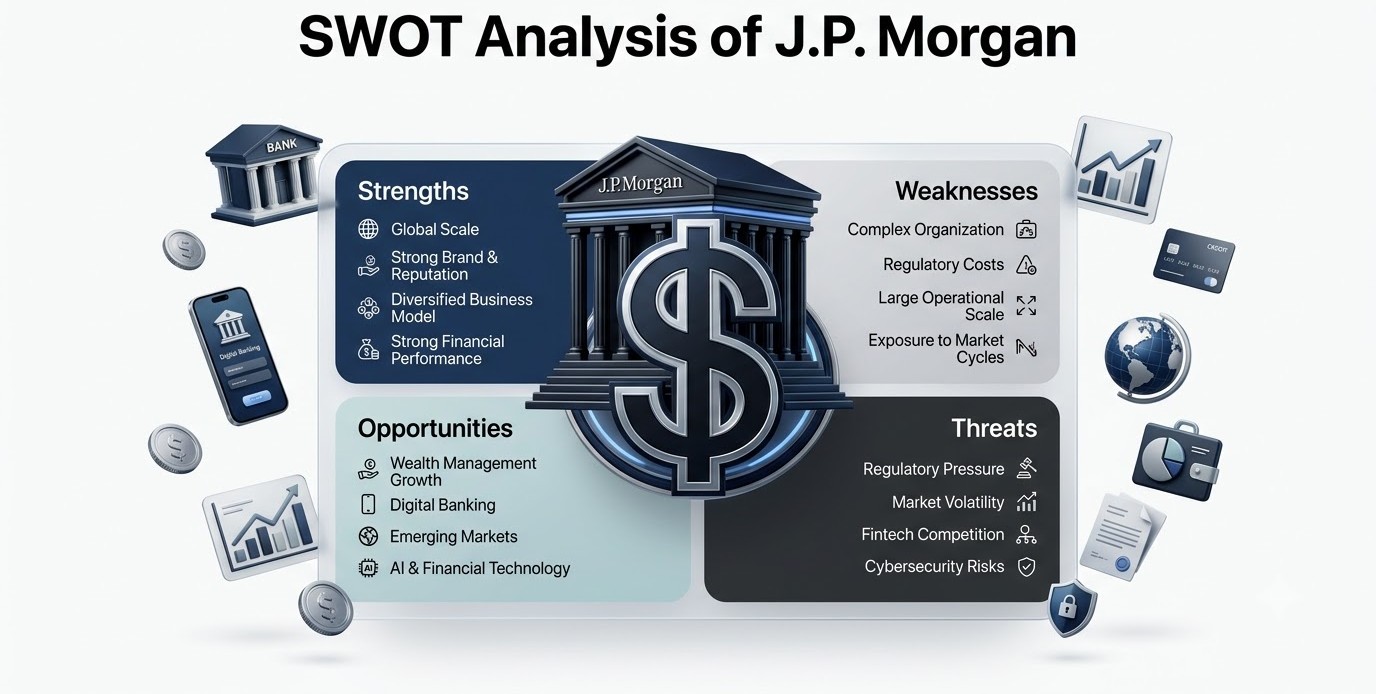
Before jumping into the four boxes of the framework, it helps to understand what kind of company is actually being analyzed here. J.P. Morgan Chase isn’t really “a bank” in the way most people picture a bank. It’s four different businesses bolted together under one roof: Consumer & Community Banking (the Chase branches, credit cards, mortgages), the Corporate & Investment Bank (trading, M&A advisory, underwriting), Commercial Banking (lending to mid-size and large companies), and Asset & Wealth Management (money management for individuals and institutions). Each of those segments has its own competitors, its own cycle, and its own risk profile.
That structure is exactly why a SWOT Analysis of JP Morgan can’t just be “big bank, strong brand, done.” The investment bank thrives when deal-making picks up and markets get volatile — volatility is basically fuel for trading desks. Consumer banking thrives on stable employment and steady spending. Wealth management thrives when markets go up and rich people want someone to manage the gains. These forces don’t always move together, and that’s the whole point of running a diversified financial supermarket. When one engine sputters, another one usually picks up the slack.
For 2025, the numbers back this up. Total net revenue came in at $182.4 billion, up 3% from the prior year, while net income landed at $57.0 billion. Return on tangible common equity hit 20%, a level most regional banks can only dream about. Asset & Wealth Management was the standout performer with a 40% ROE and record net inflows of $553 billion for the year. That’s not a typo — over half a trillion dollars of client money moved into J.P. Morgan’s wealth platform in twelve months. Meanwhile the Corporate & Investment Bank posted an 18% ROE, still solid but clearly not the star of the show this particular year.
None of this happens by luck. It happens because the firm has spent decades building scale in nearly every corner of financial services, and that scale is the foundation for everything discussed in the strengths section below.
J.P. Morgan Strengths
Strength, in this context, doesn’t mean “things the marketing department likes to say.” It means structural advantages that are hard for a competitor to copy even if they tried for a decade. J.P. Morgan has quite a few of these, and they compound on each other in ways that smaller banks simply cannot replicate.
Massive Scale and Profitability
J.P. Morgan is the largest bank in the United States by assets, sitting at $4.4 trillion as of the end of 2025. Scale like that means lower funding costs, more data to price risk accurately, and enough capital cushion to absorb shocks that would sink a mid-size regional bank overnight. Net income of $57 billion for the year isn’t just a big number for bragging rights — it funds technology spending, share buybacks, dividend increases, and acquisitions, all at the same time, without straining the balance sheet. Few institutions on earth can operate at this level of profitability while still growing loans and deposits year over year.
Diversified Business Model Across Four Segments
The four-segment structure — Consumer & Community Banking, Corporate & Investment Bank, Commercial Banking, and Asset & Wealth Management — spreads risk in a way that pure-play banks or trading houses can’t match. When investment banking fees slow down because deal activity cools off, consumer banking can still chug along on deposit spreads and card fees. When rates squeeze net interest income, wealth management fees pick up the pace instead. This isn’t theoretical. In 2025, AWM delivered a 40% ROE while CIB posted 18%, and the blended result still came out strong because the businesses don’t move in lockstep. That’s diversification actually doing its job, not just sitting on a slide deck.
Fortress Balance Sheet and Capital Position
Jamie Dimon has used the phrase “fortress balance sheet” for years, and the capital ratios back up the branding. J.P. Morgan closed 2025 with a standardized CET1 ratio of 14.5%, well above regulatory minimums, and total loss-absorbing capacity of $564 billion. Cash and marketable securities sat at $1.5 trillion. In plain terms, this bank could absorb a genuinely ugly recession, a wave of loan defaults, and a market shock all at once and still keep operating without government intervention. That kind of cushion is exactly what let it acquire First Republic’s assets during the 2023 regional banking crisis when other banks were scrambling.
Heavy, Sustained Investment in Technology and AI
Technology spending is set to hit $19.8 billion in 2026, up 10% year over year. The bank has around 400 AI projects running internally, with roughly $600 million in identified efficiencies tied to those projects so far. This isn’t a bank dabbling in AI for a press release. It’s a firm treating technology spend as a core competitive weapon, using machine learning for fraud detection, trading signal generation, and customer service automation at a scale smaller banks can’t afford to match. Every dollar spent here widens the gap between J.P. Morgan and a community bank still running on legacy mainframes.
Market Leadership Across Multiple Businesses
J.P. Morgan ranked #1 in U.S. retail deposits for the fifth consecutive year in 2025, and its investment banking fee pool leadership has been consistent for years running. In the third quarter of 2025 alone, the bank added more than 400,000 net new checking accounts and saw investment banking fees rise 16% as deal activity picked back up. Being the market leader in multiple, unrelated categories at once — deposits, IB fees, trading revenue, credit cards — creates a kind of gravitational pull. Corporate clients want the bank with the biggest balance sheet backing their deals. Consumers want the bank with the most branches and the strongest app. That reputation becomes self-reinforcing over time.
Global Reach With Deep Local Roots
Operating in more than 60 countries gives J.P. Morgan exposure to growth outside the slow-growing U.S. economy, while its dominant position inside the U.S. gives it a stable home base most global banks would envy. Very few institutions can serve a multinational corporation’s treasury needs in Singapore, underwrite a bond offering in London, and still run the most-used banking app for a college student in Ohio. That combination of global capability and domestic dominance is genuinely rare, and it took decades of acquisitions and organic build-out to construct.
J.P. Morgan Weaknesses
None of this means J.P. Morgan is invincible. Size brings its own problems, and some of these weaknesses are structural — they don’t go away just because the bank posts another record quarter.
Regulatory Scrutiny and Compliance Costs
Being the largest bank in the country means being the most-watched bank in the country. Regulators from the Federal Reserve, OCC, CFPB, and international bodies all keep a close eye on J.P. Morgan’s operations, and compliance failures get expensive fast. The bank has paid billions in fines and settlements over the years for issues ranging from mortgage practices to trading conduct. Every new regulation, stress test, and capital requirement adds operating costs and slows down decision-making that a smaller, less-scrutinized competitor doesn’t have to deal with in the same way.
Heavy Dependence on the U.S. Market
Despite operating in over 60 countries, the bulk of J.P. Morgan’s revenue and profit still comes from the United States. Consumer & Community Banking alone is almost entirely a domestic business. That concentration means a U.S. recession, a spike in unemployment, or a sharp downturn in American consumer spending hits this bank harder, proportionally, than it hits truly global competitors with more balanced geographic revenue. The international expansion efforts discussed later in this post exist precisely because leadership knows this concentration is a real vulnerability, not a hypothetical one.
Rising Noninterest Expense
Noninterest expense climbed to $95.6 billion in 2025, up 4% year over year, driven by higher compensation, more employees, higher brokerage and distribution fees, and continued technology investment. Some of that spending is good — it funds growth and AI capability. But expense growth outpacing revenue growth in any given year, even briefly, is worth watching closely. A $95.6 billion cost base is enormous, and even small percentage increases translate into real dollars that eat into margins if revenue growth ever slows down unexpectedly.
Organizational Complexity and Bureaucracy
Running four distinct business lines under one roof, employing well over 300,000 people worldwide, inevitably creates layers of management, competing internal priorities, and slower decision cycles than a nimble fintech startup can manage. A product decision that a five-person fintech team makes in a week might take months to move through committees, risk reviews, and compliance sign-offs at a bank this size. That caution is partly a feature — it’s why the bank rarely blows up — but it’s also a real drag on speed when competing against companies built from scratch around a single narrow product.
Legacy Technology Debt in Parts of the Business
Even with $19.8 billion in annual tech spending, a bank with a history stretching back over two centuries carries legacy systems in corners of its operations that newer competitors simply don’t have to deal with. Modernizing core banking infrastructure while keeping trillions of dollars in transactions running without interruption is an enormously difficult, expensive, multi-year undertaking. Some of that AI investment mentioned earlier in the strengths section is specifically aimed at working around, rather than fully replacing, older infrastructure that would take years to rebuild from scratch.
Exposure to Interest Rate Swings
Net interest income, a huge chunk of total revenue, is directly tied to interest rate movements and the shape of the yield curve. Management has already guided that NII excluding Markets will be roughly flat for 2026 at around $95 billion, even with balance sheet growth, because the rate tailwinds that boosted results in prior years are fading. When rates fall, deposit margins compress. When rates rise too fast, borrowing slows and credit risk increases. Managing this balance is a constant challenge, and it’s one lever the bank genuinely does not fully control, no matter how sophisticated its treasury desk is.
J.P. Morgan Opportunities
Now for the fun part — where the growth is actually coming from, and where management is placing its bets for the next few years.
AI-Driven Efficiency and New Revenue Streams
With 400 AI projects already running and $600 million in identified efficiencies, J.P. Morgan is positioned to squeeze more profit out of its existing operations while also building entirely new AI-powered products for trading, wealth advisory, and fraud prevention. Notably, management has said these efficiencies are largely being reinvested into more technology spending rather than used to shrink headline costs, which signals a long-term bet that AI will eventually become a genuine competitive moat, not just a cost-cutting exercise. If that bet pays off the way leadership expects, the gap between J.P. Morgan and slower-moving competitors could widen even further over the next several years.
Wealth Management Expansion
Record net inflows of $553 billion in 2025 and more than 43,000 first-time investors added in a single quarter show that J.P. Morgan’s wealth management arm is firing on all cylinders. As more households accumulate assets and look for professional management, especially younger investors who grew up with the J.P. Morgan or Chase brand already in their pocket via a checking account or credit card, the bank has a built-in pipeline to convert everyday customers into wealth management clients. This cross-selling opportunity, moving someone from a basic checking account to a managed investment portfolio, is one of the most valuable growth levers available to a bank with this kind of consumer footprint.
International and Emerging Market Growth
Given how domestically concentrated the revenue base still is, expanding further into international consumer and corporate banking represents real upside. J.P. Morgan has already tested international digital banking expansion in markets like the UK, and continuing to build out corporate banking relationships in growing economies across Asia and the Middle East gives the firm room to diversify its revenue base away from U.S. economic cycles. This is a slow, expensive process, but the payoff — reduced concentration risk plus access to faster-growing economies — is significant if executed well.
Digital Banking and Fintech Partnerships
Rather than treating fintech purely as a competitive threat, J.P. Morgan has increasingly partnered with and invested in fintech infrastructure, from payments rails to embedded finance tools that let other companies offer banking services under the hood. This approach lets the bank capture fintech-driven growth without having to out-innovate every scrappy startup on its own. Continuing to expand these partnerships, along with improving the Chase mobile app and digital wealth tools, keeps the bank relevant to younger customers who expect a slick digital experience first and a physical branch second, if at all.
Growth in Payments and Transaction Banking
Global commerce increasingly runs through digital payment rails, and J.P. Morgan’s payments business, spanning merchant services, treasury services, and cross-border payments for corporations, sits right in the middle of that shift. Higher Payments fees were already called out as a contributor to noninterest revenue growth in 2025. As e-commerce and B2B digital payments keep expanding worldwide, this segment has room to keep growing faster than the bank’s more mature, saturated businesses like traditional retail deposits.
Private Credit and Alternative Lending
As banks pull back from certain types of higher-risk lending due to capital requirements, private credit funds have stepped into that gap in a big way over the past several years. J.P. Morgan’s asset management arm is well positioned to participate in this shift, either by lending directly through its own balance sheet capacity or by managing private credit funds for institutional clients hungry for yield outside of traditional public markets. This is a genuinely fast-growing corner of finance, and a bank with J.P. Morgan’s balance sheet and client relationships has real advantages in competing for a piece of it.
JP Morgan Threats
Every strength discussed earlier comes with a corresponding threat lurking somewhere nearby. Here’s what could actually knock this bank off its stride.
Fintech and Challenger Bank Competition
Companies like Chime, SoFi, and a long list of neobanks worldwide have chipped away at younger, less profitable customer segments by offering fee-free checking, faster onboarding, and slicker apps than traditional banks historically offered. While J.P. Morgan has invested heavily in its own digital experience, the sheer number of nimble competitors targeting specific niches, whether that’s small business banking, cross-border payments, or buy-now-pay-later lending, means the bank has to keep defending market share on multiple fronts simultaneously rather than facing one dominant rival.
Regulatory and Political Risk
Financial regulation shifts with political administrations, economic conditions, and public sentiment following any crisis. New capital requirements, restrictions on fees, changes to how banks can use customer data, or a more aggressive antitrust posture toward large financial institutions could all directly affect J.P. Morgan’s profitability and flexibility. Because the bank is the largest and most visible player in U.S. banking, it’s also usually the first target when lawmakers or regulators want to make an example out of the industry.
Economic Slowdown and Credit Risk
A meaningful economic downturn would hit J.P. Morgan on multiple fronts at once: rising loan defaults in consumer and commercial lending, slower deal-making hurting investment banking fees, and reduced spending hurting card revenue. The bank builds credit reserves to cushion against this, and its capital position is strong enough to absorb real stress, but a severe or prolonged recession would still meaningfully dent profitability across nearly every business line simultaneously, not just one isolated segment.
Cybersecurity and Technology Risk
A bank holding $4.4 trillion in assets and serving tens of millions of customers is one of the most attractive targets on the planet for cybercriminals and state-sponsored hackers alike. A serious data breach or successful cyberattack wouldn’t just cause direct financial losses; it would damage the trust that underpins the entire consumer banking relationship. Even with massive technology spending dedicated partly to security, the threat landscape keeps evolving, and no institution, no matter how well-funded, can claim to be fully immune from a sophisticated enough attack.
Dependence on Market Volatility and Trading Revenue
Markets revenue, a significant chunk of the Corporate & Investment Bank’s results, tends to be lumpy and cyclical, benefiting from higher volatility and client trading activity. Management has argued that post-pandemic market activity levels are structurally higher rather than just temporarily elevated, but that thesis hasn’t been tested through a full, calm, low-volatility market cycle yet. If trading volumes and volatility revert toward older historical norms, this revenue stream could shrink meaningfully, and it’s one of the harder pieces of the business to forecast with real confidence.
Geopolitical Risk
Operating across 60-plus countries means exposure to trade tensions, sanctions regimes, currency instability, and outright political conflict in various regions. A serious escalation in any major geopolitical flashpoint could disrupt cross-border banking relationships, freeze certain markets entirely, or create sudden compliance headaches tied to sanctions enforcement. This is simply the cost of being a truly global financial institution, and it’s a risk that domestic-only competitors don’t have to manage at nearly the same scale.
Conclusion
Pulling all of this together, a SWOT Analysis of JP Morgan doesn’t land on a simple “buy it” or “avoid it” conclusion, and it shouldn’t. What it does show is a bank with genuinely rare structural advantages: massive scale, a diversified business model that smooths out cyclical bumps, a capital position strong enough to survive real stress, and a technology budget most competitors can’t come close to matching. At the same time, the weaknesses and threats are real and specific, not vague hand-waving. Expense growth is outpacing some of the easy revenue gains. Regulatory scrutiny never fully goes away for the biggest player in the room. Fintech competitors keep nibbling at specific niches. And the bank’s own guidance shows that the rate tailwinds propping up recent results are already starting to fade heading into 2026.
What makes J.P. Morgan worth watching closely isn’t that it’s flawless. It’s that the firm keeps making deliberate, well-funded bets, on AI, on wealth management, on private credit, on international growth, rather than just coasting on its size. Whether those bets keep paying off the way they have over the last few years is the real story to follow going into the rest of this decade, and it’s one worth checking back in on as new earnings and guidance roll out each quarter.
Frequently Asked Questions
Is J.P. Morgan the biggest bank in the world?
J.P. Morgan is the largest bank in the United States by total assets, sitting at $4.4 trillion as of the end of 2025. Globally, a handful of Chinese state-owned banks are technically larger by raw asset size, but J.P. Morgan is consistently ranked as the most valuable and most profitable bank on the planet by market capitalization and net income.
What are J.P. Morgan’s main business segments?
The bank operates through four segments: Consumer & Community Banking (branches, cards, mortgages), the Corporate & Investment Bank (trading, advisory, underwriting), Commercial Banking (lending to businesses), and Asset & Wealth Management (managing money for individuals and institutions). Each segment has its own revenue drivers and competitive dynamics, which is part of what makes the overall business resilient.
How much profit did J.P. Morgan make in 2025?
J.P. Morgan reported full-year 2025 net income of $57.0 billion, with earnings per share of $20.02. Return on equity came in at 17%, while return on tangible common equity hit 20%, both strong numbers relative to the broader banking industry.
Why is J.P. Morgan considered financially strong?
The bank maintains a standardized CET1 capital ratio of 14.5%, well above regulatory minimums, along with $564 billion in total loss-absorbing capacity and $1.5 trillion in cash and marketable securities. This capital cushion lets the firm absorb economic shocks that would seriously damage smaller, less-capitalized institutions.
What is J.P. Morgan’s biggest weakness right now?
Rising noninterest expense is one of the clearer weaknesses heading into 2026. Expenses hit $95.6 billion in 2025, up 4% year over year, and continued spending on compensation, technology, and brokerage fees means the bank has to keep growing revenue at a healthy clip just to maintain current profit margins.
How is J.P. Morgan using artificial intelligence?
The bank currently runs roughly 400 AI projects internally, spanning fraud detection, trading signal generation, and customer service automation, with about $600 million in identified efficiencies tied to those projects. Technology spending overall is projected to reach $19.8 billion in 2026, much of it aimed at building out AI capability further.
Is J.P. Morgan a good long-term investment?
This is a question for a financial advisor familiar with someone’s individual goals and risk tolerance, not something a blog post can answer responsibly. What can be said factually is that the bank has a strong capital position, diversified revenue, and a long track record of profitability, though like any bank stock, it remains sensitive to interest rates, credit cycles, and regulatory changes.
What risks does J.P. Morgan face from fintech competitors?
Neobanks and fintech companies have targeted specific niches like fee-free checking, faster loan approvals, and slicker mobile apps, pulling away certain younger or less profitable customer segments. J.P. Morgan has responded by investing heavily in its own digital products and by partnering with select fintech companies rather than trying to out-compete every niche player on its own.
How does J.P. Morgan make most of its money?
Net interest income, essentially the spread between what the bank earns on loans and investments versus what it pays on deposits, made up roughly $95.4 billion of the $182.4 billion in total net revenue for 2025. The rest comes from noninterest revenue sources like investment banking fees, trading, asset management fees, and card income.
What was J.P. Morgan’s revenue in 2025?
Total net revenue on a managed basis was $182.4 billion for 2025, up 3% from the prior year. Reported GAAP revenue figures can differ slightly depending on how certain items are classified, which is common across large diversified banks.
Why did J.P. Morgan’s revenue guidance for net interest income stay flat for 2026?
Management guided NII excluding Markets at roughly $95 billion for 2026, essentially flat year over year, because the interest rate tailwinds that boosted results in prior years are fading. Deposit margin compression and lower rates are expected to offset gains from balance sheet growth, at least based on current guidance.
Does J.P. Morgan operate internationally?
Yes, the firm operates in more than 60 countries, serving multinational corporations, institutional investors, and increasingly some international consumer banking customers through digital-first platforms. That said, the majority of revenue and profit still comes from the United States, making international growth one of the bank’s clearer long-term opportunities.