


IBM turns 115 years old and it still shows up in earnings headlines. That alone should tell you something. Most tech companies from the early 1900s don’t exist anymore, let alone post $67.5 billion in annual revenue and a free cash flow number that’s the highest in over a decade. So the first question worth asking isn’t “is IBM still relevant.” It clearly is. The real question is: relevant at what, and for how long?
That’s what a SWOT Analysis of IBM is supposed to answer. Not a nostalgia piece about mainframes and Deep Blue beating Garry Kasparov. A working breakdown of where the company actually has an edge, where it’s bleeding, where the next five years of growth might come from, and what could knock it off course. Because IBM in 2026 is not the IBM most people picture. It sold Kyndryl. It bought Red Hat for $34 billion. It’s chasing generative AI with something called watsonx. Its software business now makes up 45% of total revenue, up from just 25% back in 2018. That’s not the punch-card company anymore. That’s a company that reinvented itself in plain sight, and most people didn’t notice.
This guide walks through the full picture. Not a surface-level list of four bullet points per quadrant. A real breakdown, section by section, with numbers, names, and reasoning behind every claim.
What You Will Learn in This Guide
- Where IBM’s real competitive strengths sit today, and why hybrid cloud plus Red Hat matters more than it sounds
- The specific weaknesses dragging on IBM’s growth, including its consulting segment and its brand perception problem
- The opportunities in AI, quantum computing, and enterprise automation that IBM is positioned to capture
- The threats from AWS, Microsoft Azure, Google Cloud, and faster-moving AI-native startups
- How IBM’s SWOT stacks up against its closest competitors
- What this analysis means if you’re an investor, a student, or a business leader studying IBM as a case
- A quick-reference SWOT table and more than ten frequently asked questions
A Quick Snapshot of IBM Before the SWOT Breakdown
Before jumping into the SWOT Analysis of IBM itself, it helps to know where the company stands right now, because a lot of outdated commentary about IBM is still floating around online. Some of it is from 2015. Some of it is from before the Kyndryl spin-off. None of it reflects the current business.
IBM closed 2025 with $67.5 billion in revenue, up 6% at constant currency. That’s the fastest growth rate the company has posted in years. Free cash flow hit $14.7 billion, the highest in over a decade. Software revenue grew 9% at constant currency, the highest annual growth rate in IBM’s history, and software alone now makes up roughly 45% of total revenue. Chairman, president, and CEO Arvind Krishna has been steering this shift since 2020, and the strategy has been consistent the whole way through: sell the low-margin infrastructure services business (Kyndryl), buy Red Hat to own hybrid cloud, and now push hard into generative AI with a book of business north of $12.5 billion.
That context matters because a SWOT analysis written about “IBM the mainframe company” and a SWOT analysis written about “IBM the hybrid cloud and AI platform company” look completely different. This guide is about the second one, because that’s the company that exists today.
What is a SWOT Analysis and Why It Matters for a Company Like IBM
A SWOT analysis is a strategy framework that breaks a company’s position into four buckets: Strengths, Weaknesses, Opportunities, and Threats. Strengths and weaknesses are internal, they’re about what the company controls directly, like its technology, its people, its balance sheet. Opportunities and threats are external, they’re about the market and the competition, things the company can respond to but doesn’t fully control.
It sounds basic. It is basic. But basic doesn’t mean useless. The value of a SWOT analysis isn’t the four-box grid you see in every PowerPoint deck. The value is in forcing a clear-eyed look at a company without letting the good news drown out the bad, or the other way around. A lot of “analysis” online about big tech companies is either fan content or hit piece. SWOT forces balance because you have to fill in all four boxes honestly.
Why a SWOT Analysis of IBM Specifically Is Useful Right Now
IBM is in the middle of a genuine transformation, not a marketing-department rebrand. It shed a low-margin business, bought its way into open-source hybrid cloud with Red Hat, and it’s now trying to become one of the default enterprise AI platforms. That’s three separate bets stacked on top of each other. A SWOT analysis is the cleanest way to check whether those bets are paying off, where the risk is concentrated, and whether the strengths are strong enough to outweigh the threats. This isn’t a company standing still, so a snapshot analysis actually tells you something useful about direction, not just position.
Who Should Care About This Analysis
Students studying business strategy or MBA case competitions use companies like IBM constantly because there’s decades of public data to work with. Investors care because IBM pays a dividend that’s now stretched across 110 consecutive years of quarterly payments, and that kind of track record attracts a specific type of investor who wants stability alongside growth. Enterprise IT buyers care because choosing IBM as an infrastructure or AI vendor is a multi-year commitment, not a quick software subscription. And competitors care, obviously, because IBM’s moves in hybrid cloud and AI shape what Microsoft, AWS, Google, and Oracle build next.
SWOT Analysis of IBM: The Framework Applied
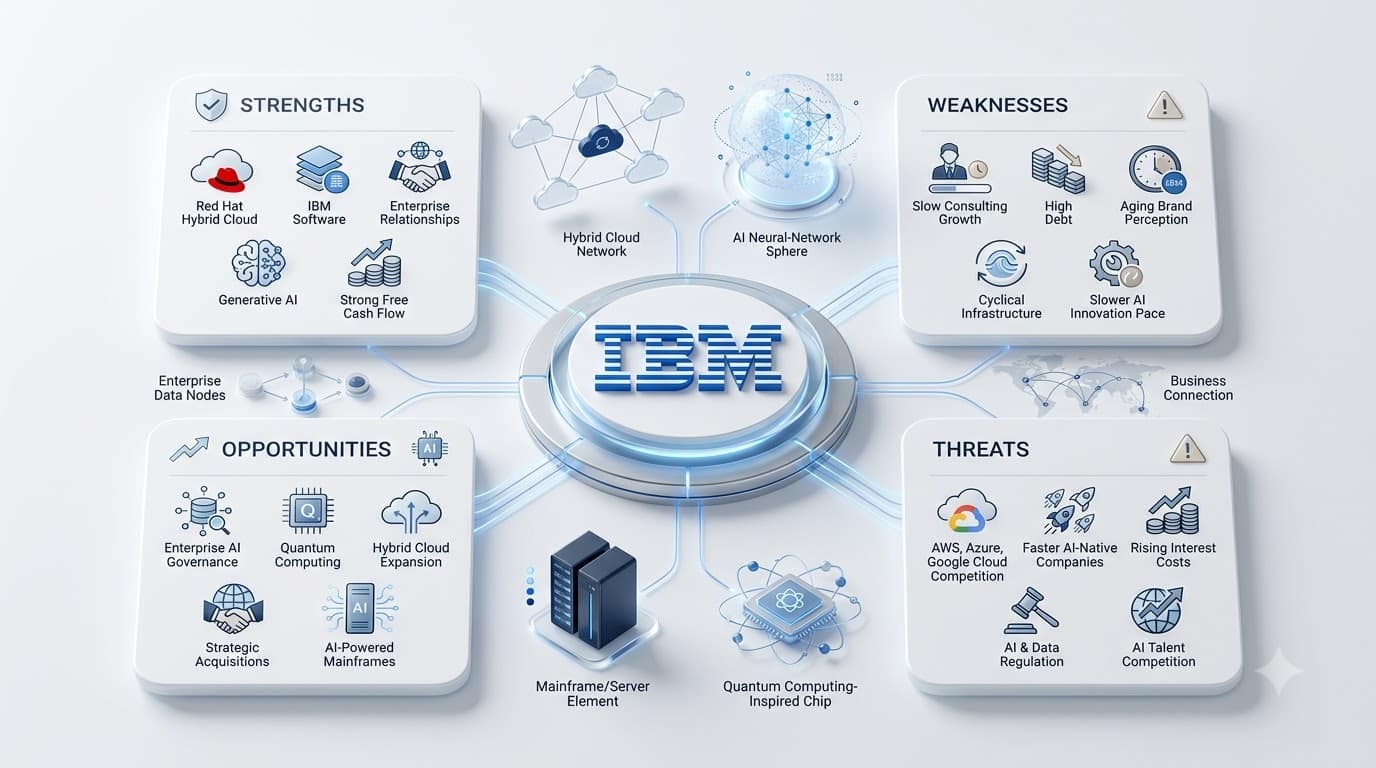
This is where the SWOT Analysis of IBM gets specific. Each of the four sections below breaks down into three to five points, and each point gets explained properly instead of left as a one-line bullet that tells you nothing. Skip around if you want, but reading strengths and weaknesses together, then opportunities and threats together, gives the clearest comparison.
Strengths of IBM
IBM’s strengths aren’t accidental. They’re the product of a company that’s been repositioning itself for close to a decade, cutting what didn’t work and doubling down on what did.
A Software Business That’s Actually Accelerating
Software grew 9% at constant currency in 2025, the fastest annual growth in IBM’s history, and now makes up about 45% of total company revenue, up from 25% in 2018. That shift matters because software carries much higher margins than hardware or staffing-heavy consulting work. Annual recurring revenue in software hit $23.6 billion at the end of 2025, up roughly $2 billion from the year before. A company moving its revenue mix toward recurring, high-margin software isn’t just growing, it’s growing in the direction that makes each dollar of revenue worth more on the bottom line.
Red Hat and the Hybrid Cloud Position
IBM paid $34 billion for Red Hat back in 2019, and at the time a lot of analysts called it overpriced. Five years later, it looks like the smartest acquisition IBM has made this century. Red Hat’s OpenShift platform lets enterprises run workloads across multiple clouds and on-premises systems without getting locked into a single vendor. That’s a real problem for large companies. Nobody wants to hand their entire infrastructure to Amazon or Microsoft and lose all negotiating leverage. Red Hat gives IBM a credible, open-source-rooted answer to “how do we avoid vendor lock-in,” and that’s a pitch that resonates with CIOs at banks, insurers, and governments who move slowly and hate being trapped.
Deep Enterprise Relationships Built Over Decades
IBM has sold to banks, insurance companies, airlines, and government agencies for longer than most of its competitors have existed. Those relationships don’t show up cleanly on a balance sheet, but they matter enormously in enterprise sales. A bank that’s run its core systems on IBM mainframes for thirty years doesn’t switch vendors on a whim, and IBM’s sales teams already have the security clearances, compliance track record, and institutional trust that a newer AI vendor would need years to build. This is a genuine moat, and it’s one reason IBM Z mainframe revenue jumped 48% in 2025, an unusually strong number for a product category most people assumed was fading away.
A Real, Monetized Generative AI Business
A lot of companies talk about AI. IBM has an actual number attached to it: a generative AI book of business north of $12.5 billion since inception, according to the 2025 annual report. That includes watsonx, IBM’s AI and data platform, plus consulting engagements tied to helping enterprises actually deploy AI safely inside regulated environments. The distinction that matters here is “enterprise AI” versus “consumer AI.” IBM isn’t trying to build the next ChatGPT for the general public. It’s trying to be the company that helps a hospital system or an insurance company deploy AI without violating a dozen compliance rules in the process. That’s a narrower lane, but it’s one IBM is well positioned to own because of point three above: the enterprise relationships already exist.
Strong Free Cash Flow and a Century-Long Dividend Record
$14.7 billion in free cash flow for 2025 is the highest IBM has posted in over a decade, and the free cash flow margin was the best in the company’s reported history. IBM also approved a $1.68 per share dividend that, once paid, marks 110 straight years of quarterly dividend payments. That kind of consistency doesn’t happen by accident, and it tells you something about how the company manages its balance sheet through both good and bad cycles. For investors specifically, that dividend record is a strength that very few tech companies can even compete with, because most of IBM’s peers in “big tech” are only twenty or thirty years old.
Weaknesses of IBM
None of the strengths above erase the real problems. A honest SWOT Analysis of IBM has to sit with these just as long.
Consulting Growth Has Basically Stalled
IBM’s consulting segment grew just 1% in the fourth quarter of 2025, and was flat for the full year at constant currency. That’s a problem because consulting used to be one of the three legs IBM stood on alongside software and infrastructure. When one of your three main segments is barely moving while the other two are growing in double digits, it drags down the overall growth story and makes the software numbers do more of the heavy lifting than they should have to. Consulting is also where a lot of AI-native competitors and even boutique firms are eating into IBM’s traditional strength, because enterprises increasingly want smaller, faster-moving teams for AI implementation work instead of large legacy consulting engagements.
Heavy Debt Load
IBM carried a debt balance of $61.3 billion at the end of 2025 against $14.5 billion in cash. That’s a debt-heavy balance sheet, largely a legacy of the Red Hat acquisition and years of share buybacks before the current strategy took hold. It’s manageable given the cash flow the business generates, but it does limit flexibility. Higher interest expenses eat into free cash flow every year, and the company has flagged rising net interest expense as a headwind heading into 2026. A company with less debt has more room to make aggressive acquisitions or absorb a bad year without shareholders getting nervous. IBM has less of that room than it would like.
Brand Perception Stuck in the Past
Ask a random twenty-five-year-old in tech what IBM does and a lot of them will say something vague about “old computers” or “that company that used to make PCs.” IBM sold its PC business to Lenovo back in 2005, more than twenty years ago, and yet the brand perception hasn’t fully caught up to the current business. That matters for recruiting talent, especially the kind of AI and cloud engineering talent that has plenty of options at companies with flashier reputations. It also matters in enterprise sales when a younger generation of decision-makers is coming up the ranks without the built-in trust that older IBM sales relationships carry.
Infrastructure Revenue Is Cyclical and Volatile
IBM’s Infrastructure segment, which includes the mainframe business, grew a strong 17% in Q4 2025 thanks to the new z17 mainframe cycle. But the company itself is guiding for a low-single-digit decline in infrastructure revenue in 2026, because mainframe sales move in multi-year product cycles. When a new mainframe launches, revenue spikes. Then it tapers off until the next generation comes out years later. That’s not a steady growth engine, it’s a sawtooth pattern, and it makes IBM’s overall revenue numbers lumpier and harder to forecast than a pure software company’s would be.
Slower Innovation Cycle Compared to Pure AI Companies
IBM’s watsonx platform and its enterprise AI offerings are real and monetized, but the pace of innovation in generative AI right now is set by companies like OpenAI, Anthropic, and Google DeepMind, all of whom ship new frontier models multiple times a year. IBM isn’t trying to build frontier models the same way, its strategy leans more toward integration, governance, and deployment inside enterprise environments. That’s a legitimate strategy, but it does mean IBM is often a step behind on raw model capability, and enterprise customers occasionally ask why they should use watsonx tooling instead of just building directly on top of a frontier model from a different vendor.
Opportunities for IBM
This is the section that determines whether the strengths above compound into something bigger, or whether IBM just holds steady where it is.
Enterprise AI Governance and Deployment
Every large company that wants to use generative AI is running into the same wall: how do you deploy it without leaking sensitive data, violating regulations, or producing an answer that gets the company sued. That’s a governance problem, not a model-capability problem, and it’s exactly the kind of problem IBM has been solving for enterprise clients for decades in other domains like security and compliance software. Watsonx.governance, IBM’s AI governance product, is built specifically to track, monitor, and explain AI decision-making inside regulated industries. As more governments introduce AI regulation, and they are, this becomes a bigger and bigger requirement rather than a nice-to-have, and IBM has a real head start on the tooling.
Quantum Computing as a Long-Term Bet
IBM has said publicly it’s on track to deliver a large-scale, fault-tolerant quantum computer by 2029. Quantum computing is still mostly a research field rather than a commercial one, but IBM has been investing in it longer and more consistently than almost any other company, including its own IBM Quantum Platform that researchers and enterprises can already access. If quantum computing hits commercial viability anywhere close to the 2029 target, IBM is positioned to be one of the first companies with a usable, enterprise-grade product, and that’s the kind of technological lead that’s extremely hard for a competitor to catch up on quickly once it’s established.
Continued Hybrid Cloud Expansion Through Red Hat
Multi-cloud and hybrid cloud adoption keeps growing because large enterprises don’t want to be fully dependent on one vendor, whether that’s for cost reasons, regulatory reasons, or plain negotiating leverage. Red Hat’s OpenShift and Ansible products sit right at the center of that trend, and IBM has room to expand this relationship further by bundling AI tooling directly into the Red Hat ecosystem. Every enterprise that adopts OpenShift as its container platform becomes a much easier sell for IBM’s other software and AI products down the line, because the technical foundation is already IBM-adjacent.
Acquisitions to Fill Specific Gaps
IBM closed 10 acquisitions in 2025 alone, including HashiCorp, the infrastructure automation company known for tools like Terraform. That’s an aggressive acquisition pace, and it shows IBM is willing to buy its way into capability gaps rather than only building organically. HashiCorp specifically strengthens IBM’s position in infrastructure-as-code and automation, which pairs naturally with the Red Hat portfolio. Expect more of this. IBM has the cash flow to keep making targeted acquisitions in AI tooling, security, and automation, filling in whatever pieces the organic roadmap is missing.
Mainframe Modernization Combined with AI
The z17 mainframe, launched in 2025, is being positioned not just as a transaction-processing workhorse but as a platform for running AI inference directly where sensitive data already lives, instead of shipping that data out to a separate cloud environment. For banks and insurers that are legally required to keep certain data on specific systems, that’s a real opportunity: run AI models on the mainframe itself rather than building a separate, riskier pipeline. If IBM executes on this well, it turns what looked like a legacy product line into one of the more interesting AI infrastructure stories in the industry, because almost nobody else is solving AI-on-mainframe the way IBM is positioned to.
Threats Facing IBM
Every opportunity above has a mirror image on the threat side, and some of these are serious enough to genuinely slow IBM down if they’re not managed well.
AWS, Microsoft Azure, and Google Cloud Dominate Cloud Infrastructure
IBM Cloud is a real product, but it’s nowhere close to the market share of AWS, Azure, or Google Cloud. Most large enterprises already run significant workloads on one or more of the big three hyperscalers, and IBM’s hybrid cloud pitch through Red Hat depends partly on enterprises wanting flexibility across multiple providers rather than choosing IBM as the primary cloud. That’s a real strategy, but it means IBM is playing a supporting role in a market where three other companies play the lead. If those hyperscalers decide to compete more aggressively on the hybrid and multi-cloud management layer specifically, that narrows IBM’s differentiation.
Faster-Moving AI-Native Competitors
Startups and AI-focused companies move faster than IBM can, structurally. A twenty-person AI startup can ship a new feature in a week. IBM, with 264,300 employees and enterprise sales cycles that stretch for months, cannot move at that speed, and it doesn’t try to. But that speed gap means IBM sometimes loses deals to smaller, more specialized AI vendors who can promise faster implementation, even if IBM’s offering is ultimately more robust for large-scale regulated deployment. Enterprises increasingly run “build versus buy versus partner” evaluations, and IBM has to keep proving its enterprise-grade tooling is worth the slower rollout compared to a scrappier alternative.
Rising Interest Costs and Debt Servicing Pressure
With $61.3 billion in debt, IBM is exposed to interest rate conditions in a way that lower-debt tech companies aren’t. The company has already flagged higher net interest expense as a pressure point for 2026 free cash flow. If borrowing costs stay elevated or rise further, that eats directly into the cash IBM has available for dividends, buybacks, and further acquisitions, which is the engine behind a lot of the strengths listed earlier in this SWOT Analysis of IBM.
Regulatory Risk Around AI and Data
IBM’s enterprise AI strategy leans heavily on governance and compliance as a selling point, which is smart, but it also means IBM is directly exposed to however AI regulation evolves globally. Different regions are moving at different speeds and with different rules, the EU’s approach doesn’t match the US approach, which doesn’t match how China or India are regulating AI. IBM has to build governance tooling that works across all of these frameworks simultaneously, and getting that wrong, or being slow to adapt when a new regulation lands, could turn what’s currently a strength into a compliance headache that slows enterprise sales cycles down even further.
Talent Competition From Bigger AI Compensation Packages
The AI talent market right now is brutally competitive, and companies like OpenAI, Google, Meta, and various well-funded startups are paying compensation packages that IBM’s traditional pay structures weren’t built around. IBM needs top-tier machine learning researchers and engineers to keep watsonx competitive, but it’s competing for that same small pool of talent against companies that can offer both higher pay and, frankly, a more exciting brand story to a twenty-six-year-old engineer choosing where to work next. Losing that talent race even partially slows down product development at exactly the moment IBM needs to move faster, not slower.
IBM SWOT Analysis Summary Table
| Category | Key Points |
|---|---|
| Strengths | Fast-growing, high-margin software business; Red Hat and hybrid cloud leadership; decades-deep enterprise relationships; monetized generative AI book of business over $12.5 billion; strong free cash flow and 110-year dividend record |
| Weaknesses | Stalled consulting growth; $61.3 billion debt load; outdated brand perception among younger talent and buyers; cyclical, lumpy infrastructure revenue; slower frontier AI innovation pace |
| Opportunities | Enterprise AI governance and compliance tooling; long-term quantum computing lead; continued hybrid cloud expansion via Red Hat; active acquisition strategy (10 deals in 2025 including HashiCorp); AI-on-mainframe positioning with z17 |
| Threats | Dominance of AWS, Azure, and Google Cloud in core cloud infrastructure; faster-moving AI-native competitors; rising interest costs on existing debt; global AI regulatory uncertainty; intense competition for AI talent |
How IBM’s SWOT Compares to Its Closest Competitors
Looking at IBM in isolation only tells half the story. A SWOT Analysis of IBM gets sharper once you put it next to the companies fighting for the same enterprise budgets.
IBM vs Microsoft
Microsoft plays a bigger, broader game across cloud, productivity software, and consumer AI through its OpenAI partnership. IBM can’t and doesn’t try to compete on that scale. Where IBM wins is in hybrid, multi-cloud environments where a company specifically doesn’t want to be locked into Azure. Microsoft’s strength is breadth and consumer reach; IBM’s strength is depth in regulated, complex enterprise environments where vendor neutrality actually matters to the buyer.
IBM vs AWS
AWS is the dominant cloud infrastructure provider by a wide margin, and there’s no realistic argument that IBM Cloud competes with AWS on raw scale. But AWS is primarily a single-cloud proposition. IBM’s Red Hat-powered hybrid approach is a direct answer to companies that specifically don’t want to be all-in on AWS. IBM isn’t trying to beat AWS at being AWS, it’s trying to be the layer that sits comfortably on top of AWS, Azure, and on-premises systems all at once.
IBM vs Oracle
Oracle and IBM overlap heavily in serving large, legacy enterprise customers, especially in databases and enterprise applications. Oracle has pushed hard into cloud infrastructure with its own hyperscaler ambitions, while IBM has largely ceded that specific race and focused instead on software, consulting, and hybrid architecture. Oracle’s strength is deep database lock-in; IBM’s strength is broader platform flexibility and its AI governance positioning, which Oracle hasn’t matched with the same depth.
IBM vs Pure AI Startups
Startups like Anthropic and OpenAI compete on raw model capability and speed of iteration, areas where IBM deliberately doesn’t try to lead. IBM’s edge shows up in the layer above the model: governance, compliance, integration into decades-old enterprise systems, and long-term support contracts that a startup with fifty employees simply isn’t built to service. Different games, different scoreboards, and both types of company can win depending on what a customer actually needs.
What This SWOT Analysis Means for Investors
For anyone looking at IBM as a stock or a long-term holding, this SWOT Analysis of IBM points to a company that’s executing on a real turnaround, not just talking about one. Revenue growth accelerating to 6% for the full year, software revenue growing at its fastest rate in company history, and free cash flow at a decade-plus high are not soft metrics, they’re the kind of numbers that show up directly in valuation models. The 110-year dividend streak also matters for a specific type of investor who prioritizes income stability over pure growth.
The risk side of the ledger centers on debt servicing costs and whether consulting growth can recover from its current standstill. Watching those two numbers each quarter tells you more about IBM’s near-term trajectory than almost anything else in the earnings report.
What This SWOT Analysis Means for Business Students and Case Study Work
If this is being used for a case study, an MBA assignment, or general business education, the most interesting thing about IBM right now isn’t any single strength or weakness. It’s the sequencing of the turnaround: sell the low-margin business first (Kyndryl), acquire the strategic asset that defines the next decade (Red Hat), then layer a new growth vector on top once the foundation is stable (generative AI through watsonx). That’s a textbook example of deliberate, staged corporate transformation, and it’s rare to see a company over a century old actually pull it off instead of just announcing it and losing momentum halfway through.
Key Lessons From IBM’s SWOT for Other Businesses
A few patterns from this analysis apply well beyond IBM itself, and they’re worth pulling out separately.
Legacy Assets Can Become New Advantages
The mainframe business looked like a dying product line a decade ago. Instead, IBM found a new angle, positioning it as a secure platform for AI inference on sensitive data, and grew that segment 17% in a single quarter. Old assets aren’t automatically dead weight if there’s a genuine new use case for them.
Debt-Funded Acquisitions Need Patience to Prove Out
The Red Hat deal was criticized heavily at the time of purchase in 2019 for being overpriced. Five years later, it’s one of the clearest strategic wins in the company’s recent history. Big, expensive acquisitions often look wrong in year one and only prove themselves in year four or five, which is a hard truth for any company under quarterly earnings pressure.
Growth in One Segment Can Mask Weakness in Another
IBM’s overall numbers look strong, but that’s driven almost entirely by software, while consulting has gone flat. It’s worth always checking the segment-level breakdown behind any company’s headline growth number, because averages hide real problems.
Conclusion
A SWOT Analysis of IBM in 2026 tells the story of a company that actually changed direction and has the numbers to prove it. The strengths are real: an accelerating software business, a genuinely valuable hybrid cloud position through Red Hat, decades of enterprise trust, and a generative AI business with actual revenue attached to it rather than just a press release. The weaknesses are just as real: a consulting segment that’s basically stuck, a debt load that limits flexibility, and a brand that hasn’t fully caught up with how much the company has changed. The opportunities in AI governance, quantum computing, and mainframe-AI convergence are genuinely differentiated, not copycat plays. The threats from hyperscalers, faster AI-native competitors, and talent competition are serious and won’t get easier to manage.
None of that adds up to a simple verdict, and it shouldn’t. What it adds up to is a company worth watching closely over the next few earnings cycles, because the direction is set, and the next test is whether execution holds up as the bets get bigger.
Frequently Asked Questions
What is a SWOT Analysis of IBM?
A SWOT Analysis of IBM is a strategic breakdown of the company’s internal strengths and weaknesses alongside external opportunities and threats. It covers areas like IBM’s software growth, its Red Hat-powered hybrid cloud position, its generative AI business, its debt levels, and the competitive pressure from AWS, Microsoft, and Google Cloud.
Is IBM still a relevant company in 2026?
Yes. IBM generated $67.5 billion in revenue in 2025 with 6% growth at constant currency, its fastest pace in years, and posted $14.7 billion in free cash flow, the highest in over a decade. The company has shifted heavily toward software and AI, with software now representing about 45% of total revenue.
What is IBM’s biggest strength right now?
IBM’s biggest strength is its software business combined with the Red Hat hybrid cloud platform. Software grew 9% at constant currency in 2025, its fastest growth rate in company history, and Red Hat gives enterprises a way to run workloads across multiple clouds without full vendor lock-in.
What is IBM’s biggest weakness?
IBM’s consulting segment is its clearest weakness right now, growing just 1% for the full year in 2025 while software and infrastructure grew much faster. The company’s debt load of $61.3 billion is also a structural weakness that limits financial flexibility.
How does IBM make money today compared to ten years ago?
A decade ago, IBM leaned much more heavily on hardware and staffing-based consulting and services revenue. Today, software makes up roughly 45% of total revenue, up from 25% in 2018, driven by products tied to hybrid cloud, automation, and AI, particularly through the Red Hat portfolio and watsonx.
Is IBM’s generative AI strategy actually working?
There’s real revenue behind it. IBM’s generative AI book of business stood at more than $12.5 billion since inception as of early 2026. The strategy focuses on enterprise deployment, governance, and compliance rather than building frontier consumer AI models, which puts IBM in a different lane than companies like OpenAI or Anthropic.
How does IBM compare to Microsoft in cloud computing?
Microsoft Azure has significantly larger cloud market share and a broader consumer and productivity software footprint through its OpenAI partnership. IBM doesn’t compete with Azure at that scale. Instead, IBM positions Red Hat as a vendor-neutral hybrid layer for companies that specifically don’t want to depend fully on one cloud provider, including Azure.
Why did IBM buy Red Hat for $34 billion?
IBM bought Red Hat in 2019 to gain a leading position in hybrid and multi-cloud infrastructure through open-source technology, primarily OpenShift. Many analysts questioned the price at the time, but Red Hat has since become central to IBM’s growth strategy and is widely seen as one of the company’s strongest strategic decisions of the past decade.
Is IBM a good dividend stock?
IBM has paid a quarterly dividend for 110 consecutive years, one of the longest unbroken dividend streaks of any public company, with a $1.68 per share quarterly dividend approved for the latest period. That consistency makes it a common choice for income-focused investors, though any investment decision should weigh the company’s debt levels and growth trajectory alongside the dividend history.
What are the biggest threats to IBM’s future growth?
The biggest threats include the dominant cloud market share held by AWS, Microsoft Azure, and Google Cloud, competition from faster-moving AI-native startups, rising interest costs tied to IBM’s $61.3 billion debt load, evolving AI regulation across different regions, and intense competition for AI engineering talent against better-funded tech companies.
What happened to IBM’s mainframe business?
Far from disappearing, IBM’s mainframe business had a strong 2025, with IBM Z revenue up 48% following the launch of the z17 system. The mainframe is increasingly positioned not just for transaction processing but as a platform for running AI workloads directly on sensitive enterprise data, which has renewed interest in the product line.
Should I study IBM as a business case for corporate transformation?
IBM is a strong case study for staged corporate transformation because of the clear sequencing involved: divesting the lower-margin Kyndryl business, acquiring Red Hat to anchor hybrid cloud, and then building a generative AI strategy on top of that foundation. It’s a useful example of how a century-old company can restructure its revenue mix without losing its core enterprise customer base.
How many employees does IBM have?
IBM had approximately 264,300 employees as of 2025, spread across its software, consulting, and infrastructure segments worldwide.
Does IBM still make hardware?
Yes, though its hardware focus has narrowed considerably. IBM’s Infrastructure segment today centers mainly on mainframe systems (IBM Z) and Power Systems servers, rather than the broader consumer hardware lineup it once sold, including the PC business it exited in 2005.