


Walk into almost any kitchen or bathroom in India and there’s a decent chance you’ll find something made by Hindustan Unilever sitting on a shelf. Surf Excel in the laundry basket. Lifebuoy or Dove by the sink. Red Label tea in the kitchen cabinet. That kind of presence doesn’t happen by accident, and it’s exactly why a proper SWOT Analysis of HUL is such a useful exercise for anyone studying business, marketing, or the Indian stock market. This isn’t a company you can sum up in one line as “big and successful.” It’s more complicated than that, and honestly, more interesting.
HUL is India’s largest FMCG company by a wide margin, with a portfolio of more than 50 brands spread across roughly 15 categories. It posted a turnover of around Rs 64,138 crore in FY25, with a net profit of Rs 10,649 crore. Those are staggering numbers for a company selling soap bars and tea packets. But scratch beneath the surface and you’ll find sales growth that’s been sluggish for years, a rural consumer base that keeps flaking on demand cycles, and a wave of scrappy D2C brands eating into categories HUL used to own outright. A SWOT Analysis of HUL that only talks about “market leadership” and skips all of that isn’t telling you the real story.
This guide breaks HUL down the way it actually deserves to be broken down: strengths that are genuinely hard to copy, weaknesses that show up in the quarterly numbers, opportunities that are unfolding right now (the GST rate cuts of September 2025 being a big one), and threats that go well beyond the usual “competition exists” line. There’s also a section on what this analysis actually means if you’re an investor or a student writing a case study, because a SWOT framework that doesn’t translate into a decision isn’t worth much.
What You Will Learn in This Guide
- What HUL’s business actually looks like today, including the ice cream demerger that just happened
- The specific strengths that make HUL hard to displace, not the vague “strong brand” line you’ll find everywhere else
- The real weaknesses hiding inside HUL’s financial results, backed by actual numbers
- The opportunities HUL is sitting on right now, from GST cuts to premium D2C acquisitions
- The threats that are genuinely changing the FMCG game in India, including Reliance and D2C challengers
- How to read this SWOT if you’re an investor versus if you’re writing an academic case study
- Answers to the most common questions people search when researching HUL
What Is HUL and Why the SWOT Analysis of HUL Matters
Before getting into the four boxes of strengths, weaknesses, opportunities and threats, it helps to know what kind of company you’re actually analyzing. HUL isn’t a startup with a single product line. It’s a diversified consumer goods giant that touches almost every category of daily spending, and that scale changes how you should read each part of the SWOT.
HUL’s Business at a Glance
Hindustan Unilever was incorporated in 1933 as Lever Brothers India Limited, and it became Hindustan Lever Limited in 1956 after a merger with two other companies. It was renamed Hindustan Unilever Limited in 2007. It’s listed on both the NSE (HINDUNILVR) and BSE (500696), with the UK-Dutch parent company Unilever holding roughly 61.9% of the shares. That parentage matters a lot in this analysis, both as a strength and, in some ways, as a constraint.
The business runs across three main segments: Beauty & Personal Care, Home Care, and Foods & Refreshment, with a smaller “Others” bucket that used to include the water purifier brand Pureit before HUL divested it in FY25. Beauty & Personal Care has typically been the biggest chunk of revenue, contributing close to 39% of sales in recent years, followed by Home Care at around 33% and Foods & Refreshment at roughly 24%. Brands under these segments include Lifebuoy, Lux, Dove, Surf Excel, Rin, Wheel, Pond’s, Lakme, Sunsilk, Clinic Plus, Closeup, Pepsodent, Brooke Bond, Red Label, Taj Mahal, Bru, Lipton, Kissan, Knorr, Horlicks and Boost. In FY25, HUL also acquired the premium D2C skincare brand Minimalist, a move that says a lot about where the company thinks growth is going next.
One big structural change just happened. HUL’s ice cream business, which included Kwality Wall’s, Cornetto, Magnum, Feast and Creamy Delight, was demerged into a separately listed company called Kwality Wall’s (India) Limited, with the demerger becoming effective on 1 December 2025. Shareholders got one KWIL share for every HUL share they held, and the global Magnum Ice Cream Company (part of Unilever’s worldwide ice cream spin-off) is set to acquire a 61.9% stake in the new entity. Ice cream only contributed about 3% of HUL’s turnover, roughly Rs 1,783 crore in FY25, so the financial impact on HUL’s core numbers is small, but it’s a clean signal that HUL wants to run a tighter, more focused portfolio going forward.
Why Investors, Students and Marketers Study HUL
A SWOT Analysis of HUL gets used constantly in MBA classrooms, CFA prep material, and equity research notes, and it’s not just because HUL is a big company. It’s because HUL is a case study in almost every core business concept at once: brand building, rural distribution, pricing power, portfolio management, and now, corporate restructuring through the ice cream demerger.
For investors, HUL is a bellwether stock. If HUL’s volume growth slows down, that tells you something about the broader health of Indian consumption, not just about one company. Its market cap sat around Rs 4,54,364 crore as of September 2026, making it one of the largest listed companies on the Indian exchanges, and analysts watch its quarterly commentary closely because it’s often the first big company to flag a rural slowdown or a recovery.
For students and marketers, HUL is the go-to example of how a company builds a “distribution moat,” a term that basically means your product physically shows up in more stores than anyone else’s can manage. That’s not a soft or abstract advantage. It’s logistics, relationships with local distributors, and decades of infrastructure that a new entrant simply cannot replicate in a year or two, no matter how much venture capital they raise. Understanding why that moat exists, and where it’s starting to crack, is the whole point of doing this analysis properly instead of just listing generic bullet points.
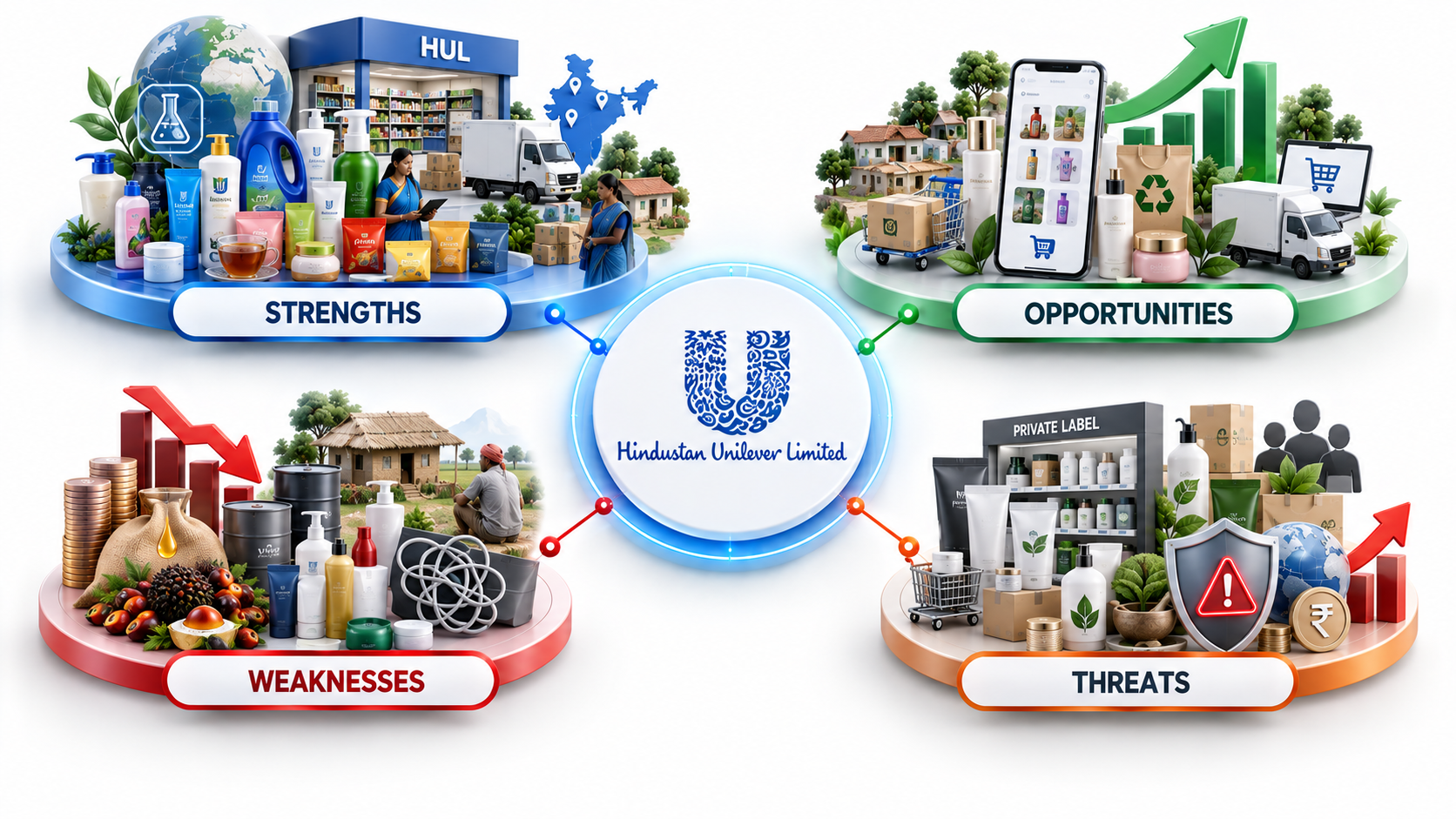
Strengths
Here’s the thing about HUL’s strengths: most articles list “strong brand” and “wide distribution” and move on, like that explains anything. It doesn’t. The actual strength is in how those two things reinforce each other, plus a few other factors that don’t get talked about enough.
Brand Portfolio That Sits in Every Indian Home
HUL doesn’t rely on one hero brand the way some companies do. It runs a portfolio of 50-plus brands across roughly 15 to 16 categories, and a huge share of them hold the number one or number two position in their category. Lifebuoy leads the soap category by volume. Surf Excel dominates premium detergents. Brooke Bond Red Label and Taj Mahal sit at the top of the branded tea market. Wheel and Rin cover the budget end of laundry, which matters enormously in a price-sensitive market like India.
This spread matters because it insulates HUL from category-specific shocks. If detergent demand softens for a quarter because of unseasonal weather or a price war, tea and personal care can pick up the slack. Competitors like Dabur or Marico tend to be concentrated in two or three core categories, which makes their quarterly results far more volatile than HUL’s. That diversification is a real, structural advantage, not a marketing talking point.
There’s also a psychological layer to this. Brands like Pond’s, Lux and Pepsodent have been around in Indian households for two, sometimes three generations. That kind of familiarity creates habitual buying, where a consumer picks up Lifebuoy without even glancing at the shelf, simply because that’s what their household has always bought. Newer brands have to fight for attention every single time; HUL often doesn’t have to.
Distribution Network Nobody Else Can Match
This is arguably HUL’s single biggest structural advantage, and it’s the one competitors have the hardest time replicating. HUL reaches over 1 million retail outlets directly and touches more than 10 million outlets in total across India, covering close to the entire urban population and hundreds of millions of rural consumers. That’s not a distribution network, that’s closer to a piece of national infrastructure.
The rural piece is where it gets genuinely impressive. Through Project Shakti, launched back in 2001, HUL trained rural women, known as “Shakti Ammas,” to become micro-entrepreneurs distributing products door-to-door in villages too small or remote for a conventional distributor to service profitably. That network has grown to touch over 100,000 women across 18 states, and it does two things at once: it gets HUL’s products into places its competitors physically cannot reach cost-effectively, and it builds genuine community trust, since the seller is a known face in the village rather than a stranger.
What most guides skip is why this is so hard to copy. A new entrant, even a well-funded one, would need years to build relationships with lakhs of local retailers and thousands of redistribution stockists, and rural logistics in India are genuinely brutal, involving everything from unpaved roads to seasonal flooding. HUL solved that problem decades ago through trial, error, and sustained investment. You can’t shortcut that with a bigger ad budget.
Go back through HUL’s own history and you’ll see this network wasn’t built in one clean push, it was stitched together over close to a century through phases with names like “Project Streamline” and “Project Bharat,” each one targeting a specific gap, first the semi-urban towns, then the deep villages, then personal care categories that rural consumers hadn’t been educated about yet. That patchwork approach is actually the point. A competitor trying to copy the end result today would be copying the outcome of dozens of small, localized decisions made over decades, not a single blueprint they could license or reverse-engineer. That’s the real moat, not the outlet count itself but the accumulated, hard-won knowledge of exactly which village needs a cycle-riding Shaktimaan versus a redistribution stockist with a van.
R&D and Innovation Backed by a Global Parent
Being part of the Unilever Group gives HUL access to a level of research and development that a standalone Indian FMCG company simply can’t match on its own. Unilever runs global R&D centers that HUL taps into, while also maintaining India-specific research through its own centers in Mumbai and Bangalore, set up decades ago specifically to adapt global formulations to Indian skin types, water hardness, climate and price sensitivity.
This shows up in real product decisions. Glow & Lovely, the renamed and reformulated version of what was previously Fair & Lovely, is one example of HUL responding to shifting social attitudes while keeping the underlying category alive. Lever Ayush was built specifically around Ayurveda-based ingredients to compete with the wave of “natural” and Ayurvedic brands like Patanjali and Himalaya. The acquisition of Minimalist in FY25 is a more recent, and more telling, move: rather than trying to build a science-backed, ingredient-transparent skincare brand from scratch internally, HUL bought one that had already found product-market fit with a younger, more online audience.
The mistake people make when reading this strength is assuming “R&D” means constant, flashy innovation. In HUL’s case, it’s usually quieter than that: reformulating a shampoo to use less water in production, tweaking a detergent bar’s fat content when palm oil prices spike, or adjusting pack sizes to hit specific price points for rural buyers. None of that gets headlines, but it protects margins and keeps products relevant year after year.
There’s also a supply chain dimension to this R&D advantage that rarely gets discussed. Being inside the Unilever Group means HUL can borrow manufacturing processes and packaging formats that have already been tested and refined in dozens of other countries, then localize them instead of starting from zero. A packaging innovation piloted in Indonesia or Brazil for a similar low-income, price-sensitive market can land in India within a couple of product cycles rather than taking years of independent trial and error. That global knowledge transfer is something a purely domestic competitor like Dabur or Godrej Consumer Products simply doesn’t have access to at the same scale, and it quietly compounds year after year.
Cash Generation and Balance Sheet Strength
HUL is close to debt-free and has consistently maintained a very high dividend payout ratio, sitting around 92% in recent years. That’s not a small detail. A company generating this much free cash flow with almost no leverage has enormous flexibility. It can absorb a bad quarter of commodity inflation without panicking, it can fund acquisitions like Minimalist without raising debt, and it can keep paying shareholders through demand cycles that would badly hurt a more leveraged competitor.
This financial cushion is also what allowed HUL to execute the ice cream demerger cleanly, without needing to restructure debt or renegotiate covenants as part of the process. A weaker balance sheet company trying the same move would have had a much messier time of it. When you’re doing a SWOT Analysis of HUL for an investing decision, this balance sheet strength is honestly one of the most underrated points, because it’s what gives every other strength room to actually play out over a long horizon.
Weaknesses
No company this size is without real problems, and HUL has a few that show up consistently in its own quarterly commentary, not just in outside criticism. Ignoring these would make this SWOT Analysis of HUL pretty useless.
Heavy Dependence on Rural Demand Cycles
HUL gets a large chunk of its volume from rural India, and rural demand is genuinely unpredictable. It rises and falls with monsoon quality, government welfare spending, minimum support prices for crops, and general agricultural income. When the monsoon is poor or rural wages stagnate, HUL’s volume growth slows almost immediately, and there’s not much the company can do about it in the short term because it doesn’t control the underlying driver.
This isn’t a hypothetical risk. HUL has flagged rural slowdowns multiple times over the past several years, and its own five-year sales growth has been described as weak, sitting around 6.5% on a compounded basis according to public financial data, well below what a “market leader” narrative would suggest. Look at what actually happens during a slowdown: consumers downtrade from a premium shampoo sachet to a cheaper local brand, or they stretch a soap bar an extra week instead of replacing it on schedule. That downtrading hits HUL’s premium categories hardest, which is exactly where its margins are best.
What makes this weakness worse is that HUL can’t really diversify its way out of it the way a smaller company might. Rural India isn’t an optional slice of the business, it’s a huge share of overall volume, so HUL can’t simply shift focus to cities and wait out a bad monsoon year. Every quarterly earnings call includes some version of management explaining whether rural sentiment is “recovering” or “still soft,” and honestly, that single line often moves the stock more than anything else in the results. A student or investor reading a SWOT Analysis of HUL should treat rural dependence less as one bullet point and more as the lens through which almost every other number in the report should be read.
Commodity Price Exposure Eats Into Margins
A huge share of HUL’s raw materials, things like palm oil, crude derivatives used in detergents, and packaging inputs, are commodities with volatile global prices that HUL doesn’t control. When crude oil spikes, the cost of making a detergent bar or a shampoo bottle goes up almost immediately, but HUL can’t always pass that cost on to price-sensitive Indian consumers without losing volume to cheaper competitors.
This creates a genuinely difficult balancing act every single quarter. Raise prices too aggressively, and rural and value-conscious urban consumers switch to unbranded or regional alternatives. Absorb the cost instead, and EBITDA margins take a hit, which is exactly what happened in FY25, when HUL’s EBITDA margin came in at 23.1%, down 30 basis points year-on-year, largely because of pricing actions taken to pass on commodity-related benefits and cost pressure elsewhere in the portfolio. This isn’t a one-off problem. It’s structural, and it will keep recurring every time global commodity cycles turn.
Here’s what makes it trickier than a simple cost-versus-price trade-off: HUL sells thousands of individual stock-keeping units across dozens of pack sizes, and each one has a different commodity exposure and a different price elasticity in its specific market segment. A five-gram sachet of shampoo sold in a village kirana store behaves completely differently from a 650-milliliter bottle sold on a quick commerce app in a metro city, even though both are technically “shampoo.” Managing margin across that entire matrix, in real time, while commodity prices swing weekly, is a genuinely hard operational problem, and it’s one reason why HUL’s pricing team is one of the largest and most closely watched functions inside the company.
Slow Sales Growth Compared to the Hype
Here’s what most SWOT write-ups won’t say directly: HUL’s growth has been underwhelming for a company of its size and reputation. Underlying sales growth of 2% to 3% a year, which is what HUL has been posting recently, is barely ahead of inflation in a lot of quarters. For a company that dominates its categories the way HUL does, that’s a warning sign about category saturation, not just a temporary blip.
Part of this is simply math. When you already have 60-90% household penetration in categories like soap or shampoo, there aren’t many new households left to sell to. Growth has to come from either premiumization (getting existing customers to spend more per unit) or from entering adjacent categories, and both of those are slower and harder than the “add more customers” growth that fueled HUL for decades. Investors comparing HUL’s growth rate to smaller, faster-growing FMCG or D2C names need to keep this scale reality in mind, because it’s genuinely not a fair like-for-like comparison.
Losing Ground in Trendy, Fast-Moving Categories
HUL built its empire on mass-market categories: soap, detergent, tea, basic shampoo. But the categories growing fastest in India right now, things like clean-label skincare, niche haircare, and specialty foods, are being defined by younger, nimbler D2C brands that move faster than a company HUL’s size ever can. A large organization has layers of approval, brand safety checks, and legal review that a 30-person D2C team simply doesn’t have to deal with.
That’s why HUL had to buy its way into this space with Minimalist rather than building an equivalent brand organically from a standing start. That’s not necessarily a bad strategy, acquiring proven winners is a legitimate playbook, but it is an admission that HUL’s internal innovation engine, as strong as its formal R&D is, struggles to move at the speed the newest, fastest-growing corners of the FMCG market now demand.
Opportunities
This is where things get genuinely interesting, because a few big, concrete developments are unfolding for HUL right now, not five years from now.
The GST Rate Cut Just Handed HUL a Tailwind
In September 2025, the GST Council rationalized India’s tax structure into a simplified two-rate system, and it cut GST on a long list of everyday FMCG products, soaps, shampoos, toothpaste, hair oil and more, from 18% down to just 5%. HUL, along with P&G, Colgate-Palmolive and Dabur, passed those savings straight through to consumers with revised price lists effective from September 22, 2025.
Roughly 40% of HUL’s portfolio is expected to benefit directly from this rate cut, according to analyst estimates. This matters enormously for a company as exposed to price-sensitive rural demand as HUL is. Cheaper toothpaste and shampoo make it easier for a household on a tight monthly budget to justify buying the branded version instead of trading down to an unbranded local alternative, which is exactly the dynamic HUL needs to reverse its stalling volume growth. HUL even ran a “Retailer Bonanza” with discounts of up to 20% on select shampoo sizes to clear old-rate inventory and get shelves stocked at the new, lower prices ahead of the festive season. If this pricing benefit actually converts into sustained volume growth over the next few quarters, it could be the single biggest near-term opportunity in this entire SWOT Analysis of HUL.
Premiumization and the Shift to D2C Brands Like Minimalist
Indian consumers, particularly in urban and semi-urban markets, are increasingly willing to spend more on products they perceive as backed by real science, transparent ingredients, or a specific skin or hair concern. That’s the entire thesis behind brands like Minimalist, which HUL acquired in FY25, and it’s a smart hedge against the slow, saturated growth in HUL’s traditional mass-market categories.
The opportunity here isn’t just owning one premium brand. It’s learning the playbook of how these brands acquire and retain customers, mostly through content-heavy digital marketing, influencer partnerships, and a direct relationship with the buyer rather than relying entirely on a retailer’s shelf space, and then applying pieces of that playbook across the wider HUL portfolio. If you’re studying this for a course in digital marketing, this is a genuinely useful real-world example of a legacy giant trying to absorb a startup’s growth mechanics rather than simply competing against it from the outside.
E-commerce and Quick Commerce Growth
Quick commerce platforms like Blinkit, Zepto and Instamart have fundamentally changed how urban Indians buy everyday FMCG products, and HUL has had to adapt its go-to-market strategy accordingly. HUL launched UShop as a direct-to-consumer digital platform back in 2022, and it maintains strong supply partnerships with Amazon, Flipkart and BigBasket alongside the newer quick commerce players.
The opportunity is twofold. First, quick commerce reduces HUL’s dependence on the traditional kirana and modern trade channel mix, giving it a third leg to stand on if either of the other two slows down. Second, and this is the part people miss, quick commerce data gives HUL far more granular, real-time visibility into which SKUs are actually moving in which neighborhoods than the traditional distributor-stockist model ever could. That kind of demand signal, used well, can sharpen everything from inventory planning to new product launches.
The Ice Cream Demerger Could Unlock Value
The demerger of Kwality Wall’s into a separately listed entity, effective 1 December 2025, is being framed by HUL’s management as a way to “unlock fair value” for shareholders, and there’s a genuine logic to that beyond just corporate jargon. Ice cream is a fundamentally different business from soap or detergent: it needs cold-chain logistics, different seasonality, different competitive dynamics against players like Amul and regional gelato brands, and a different growth profile.
By spinning it out, HUL gets to run a leaner, more focused FMCG core, while the ice cream business gets dedicated management and capital allocation suited specifically to its category rather than being a smaller, less-prioritized line item inside a much bigger company. For shareholders, the opportunity is holding two more clearly valued businesses instead of one conglomerate where the market might be underpricing the ice cream unit’s growth potential by burying it inside HUL’s overall numbers. KWIL’s listing was expected around Q4 of FY26, and how the market prices that new stock will be a genuinely interesting data point on whether this demerger thesis actually plays out.
Sustainability Commitments Are Starting to Open Real Doors
As a Unilever subsidiary, HUL has had sustainability baked into its operating model for longer than most Indian FMCG peers, with goals around reducing plastic packaging, cutting water use in manufacturing, and sourcing raw materials more responsibly. For a long time this read mostly as reputation management, the kind of thing that looks good in an annual report but doesn’t move the sales needle much.
That’s shifting. Large modern retail chains and quick commerce platforms are increasingly using sustainability credentials as a factor in which brands get premium shelf placement or featured slots on an app’s home screen, especially for personal care products aimed at urban, environmentally conscious consumers. HUL’s decade-plus head start on plastic reduction and refill formats, things like compact concentrated detergents that use less packaging per wash, gives it a genuine edge over competitors that are only now starting to build sustainability into their product design rather than bolting it on afterward. It’s not a massive revenue driver today, but it’s the kind of opportunity that compounds quietly over the next five to ten years as regulation and retailer preferences keep tightening.
Threats
Every strength HUL has is currently being tested by someone. This section is where a lot of generic SWOT write-ups get lazy and just say “increasing competition.” That’s not useful. Here’s specifically who and what is putting pressure on HUL right now.
Reliance and Private Labels Undercutting on Price
Reliance Retail’s consumer products arm has been aggressively expanding into categories HUL has traditionally dominated, relaunching legacy brands like Campa Cola at aggressive price points and building out its own private-label FMCG portfolio across Reliance’s massive retail footprint, both physical stores and its digital commerce platforms. Reliance has scale advantages HUL doesn’t: it owns the retail shelf itself in many of its stores, it can subsidize FMCG pricing using profits from other parts of its business, and it doesn’t need to build a distribution network from zero because it already has one for groceries and electronics.
This is a genuinely different kind of threat than HUL has historically faced. Competing against Dabur or ITC is a fight between peers using similar playbooks. Competing against Reliance is closer to fighting a company that can choose to lose money on a category for years if it decides that category matters strategically, which is a much harder opponent to out-execute purely on brand strength or distribution reach.
D2C Challenger Brands Chipping Away at Categories
Brands like Mamaearth (now under parent company Honasa Consumer), Sugar Cosmetics, WOW Skin Science and Plum have carved out real market share in personal care and beauty categories over the past several years, particularly among younger, digitally native consumers who discover products through Instagram and YouTube rather than a store shelf. These brands don’t need HUL’s scale to win a specific niche; they need a strong hero product, a compelling brand story, and an efficient digital acquisition funnel.
What makes this threat sting more than older competition is speed. A D2C brand can spot a trending ingredient or format, launch a product around it, and start selling within weeks. HUL’s internal processes, built for a company managing 50-plus brands and massive manufacturing scale, simply cannot move at that pace organically, which is exactly why the acquisition route through brands like Minimalist has become HUL’s main defense mechanism rather than trying to out-innovate these challengers from scratch every single time.
Regional and Ayurvedic Players Still a Problem
Patanjali reshaped a big part of the Indian FMCG conversation around natural and Ayurvedic positioning, and while its momentum has cooled somewhat from its peak years, the broader shift toward “natural” ingredients it triggered hasn’t gone away. Dabur, Himalaya and various regional players continue to compete hard in categories like toothpaste, hair oil and skincare using that same natural-ingredient positioning, often at price points below HUL’s comparable offerings.
This matters because it forces HUL to compete on two fronts simultaneously: premium, science-backed positioning against brands like Minimalist’s competitors on one side, and natural, value-priced positioning against Patanjali-style brands on the other. Stretching a portfolio to credibly cover both ends of that spectrum without diluting brand identity is genuinely difficult, and it’s a big part of why HUL’s category-level market share has come under pressure in specific segments even while its overall scale remains dominant.
Currency and Input Cost Swings
Because a meaningful share of HUL’s raw materials are imported or priced in global commodity markets, movements in the rupee and in commodities like palm oil and crude derivatives directly affect input costs. A weaker rupee makes imported inputs more expensive even if the underlying commodity price hasn’t moved, compounding the margin pressure discussed earlier in the weaknesses section.
This threat is largely outside HUL’s control, and it’s genuinely cyclical rather than something the company can permanently solve through better hedging or sourcing alone. The mistake most guides make is treating this as a minor footnote. It isn’t. A sharp rupee depreciation combined with a commodity spike, which has happened before and will happen again, can knock several hundred basis points off EBITDA margin inside a single fiscal year, regardless of how strong the brand portfolio or distribution network looks on paper.
Leadership Transitions and Talent Retention
HUL has long been called a “CEO factory” in Indian business circles, a company whose alumni go on to run other major businesses across the country and beyond. That reputation is a genuine strength in terms of talent inflow, ambitious people want to work there specifically because of the training and exit opportunities it offers, but it cuts both ways. The same system that produces strong leaders also means HUL constantly loses experienced managers to competitors, private equity-backed startups, and even to the D2C brands that are now competing directly against HUL’s own categories.
Leadership transitions at the very top carry real weight too. A change in CEO or a shift in the senior management team can visibly alter strategic priorities within a couple of quarters, whether that’s a renewed push into premiumization, a different pace of D2C acquisitions, or a change in how aggressively the company defends market share on price versus protecting margin. This is a softer threat than something like a Reliance-driven price war, it doesn’t show up as a single dramatic headline, but over a five or ten year horizon, how well HUL manages this constant churn of senior talent will shape almost every other item in this SWOT, from how fast new brands get integrated to how consistently the company executes its rural distribution strategy.
What This SWOT Analysis of HUL Means in Practice
A SWOT framework is only useful if it changes how you actually think about a decision. Here’s how to actually use everything above, depending on why you’re reading this.
For Investors Looking at HINDUNILVR
If you’re evaluating HUL as a stock, the core tension is simple: this is a high-quality, cash-generative, low-debt business with genuine structural moats in distribution and brand recall, but it’s also a slow grower trading at a premium valuation that assumes a lot of things go right. The GST rate cut tailwind and the Minimalist-style premiumization strategy are the two things worth watching most closely over the next several quarters, because they’re the clearest near-term catalysts that could actually move underlying sales growth back up from the low single digits it’s been stuck at.
The ice cream demerger is also worth tracking separately rather than ignoring once the KWIL shares land in your demat account. Whether the market prices KWIL as a standalone growth story or discounts it heavily will tell you a lot about whether HUL’s broader “focus the core, spin off the rest” strategy is actually working, which matters for how you should think about the parent company’s valuation going forward too. None of this is investment advice, and every investor should do their own research or speak with a licensed financial advisor before making a decision, but this is the lens the SWOT points you toward.
For Marketing Students and Case Study Writers
If you’re writing this up for a course or a case competition, resist the temptation to just list generic points. The strongest version of a SWOT Analysis of HUL connects the boxes to each other. HUL’s distribution strength (a strength) is exactly what makes it vulnerable to Reliance (a threat), because Reliance is the first competitor in decades with a plausible path to matching that kind of reach. HUL’s rural dependence (a weakness) is exactly what makes the GST rate cut (an opportunity) so significant, because cheaper branded products specifically help HUL win back price-sensitive rural buyers who were downtrading.
That kind of cross-referencing is what separates a genuinely insightful case study from a template exercise. If you want to go deeper on how to structure a business analysis like this one properly, with the kind of research rigor that holds up in a real case study, it’s worth studying how equity analysts and business journalists actually source and verify the numbers they use, rather than repeating figures that have been copy-pasted across a dozen student blogs without a source check.
Conclusion
A real SWOT Analysis of HUL doesn’t end with “HUL is a market leader with strong brands and wide distribution.” That’s the starting point, not the conclusion. The honest picture is a company with genuinely hard-to-replicate structural advantages that’s also grappling with saturated core categories, real margin pressure from commodities, and a new breed of competitor, from Reliance’s scale to nimble D2C brands, that didn’t exist in the same form a decade ago. The GST rate cuts and the ice cream demerger are the two biggest live developments worth watching right now, because they’ll show fairly quickly whether HUL’s next chapter looks like renewed growth or more of the same slow grind.
Whatever your reason for researching this, whether it’s an investment decision, a case study, or just genuine curiosity about how a company this size actually operates, go back to the primary sources. Pull HUL’s own quarterly investor presentations, check the actual GST notifications, and read the demerger filings directly rather than relying only on secondhand summaries, this one included.
Frequently Asked Questions
What is a SWOT Analysis of HUL used for?
A SWOT Analysis of HUL is used to evaluate Hindustan Unilever’s internal strengths and weaknesses alongside external opportunities and threats, most commonly by business students writing case studies, equity investors assessing the stock, and marketing professionals studying how large FMCG companies compete and defend market share.
What are HUL’s biggest strengths?
HUL’s biggest strengths are its brand portfolio of over 50 brands across roughly 15 categories, its distribution network reaching more than 1 million retail outlets directly and 10 million in total, its access to Unilever’s global R&D, and a near debt-free balance sheet with consistently high cash generation.
What is HUL’s biggest weakness right now?
HUL’s most pressing weakness is slow underlying sales growth, running at 2% to 3% in recent years, combined with heavy dependence on unpredictable rural demand cycles and continuous margin pressure from volatile commodity input costs like palm oil and crude derivatives.
How did the September 2025 GST rate cut affect HUL?
The GST Council reduced tax rates on products like soap, shampoo and toothpaste from 18% to 5% effective September 22, 2025, and roughly 40% of HUL’s portfolio benefited directly. HUL passed the savings on to consumers through revised price lists, which is expected to support volume growth, particularly among price-sensitive rural buyers.
Why did HUL demerge its ice cream business?
HUL demerged its ice cream business, including Kwality Wall’s, Cornetto and Magnum, into a separately listed company called Kwality Wall’s (India) Limited, effective 1 December 2025, to let the ice cream unit run with dedicated management and capital allocation while HUL focuses its core FMCG portfolio, a move management described as unlocking fair value for shareholders.
Is HUL a good stock to invest in?
HUL has structural advantages like brand strength, distribution reach and a strong balance sheet, but it also has slow growth relative to its size and trades at a premium valuation. Whether it’s a good investment depends on individual financial goals and risk tolerance, so it’s best evaluated with a licensed financial advisor rather than from a single article.
Who are HUL’s biggest competitors?
HUL’s biggest competitors include Dabur, Godrej Consumer Products, ITC, Marico, Colgate-Palmolive and Procter & Gamble in traditional FMCG categories, Patanjali and Himalaya in the natural and Ayurvedic space, Reliance Consumer Products through its expanding private-label and value brands, and D2C challengers like Honasa’s Mamaearth, Sugar Cosmetics and WOW Skin Science in personal care and beauty.
What percentage stake does Unilever hold in HUL?
Unilever, through the Unilever Group, holds approximately 61.9% of HUL’s issued and paid-up share capital, making it the majority promoter shareholder, with the remaining stake held by public and institutional investors on the NSE and BSE.
What is Project Shakti and why does it matter in a SWOT Analysis of HUL?
Project Shakti is HUL’s rural distribution initiative, launched in 2001, that trains rural women known as Shakti Ammas to distribute HUL products door-to-door in villages too remote for conventional distributors. It matters in a SWOT Analysis of HUL because it’s a core part of HUL’s distribution strength and a model that’s genuinely difficult for competitors to replicate quickly.
How is HUL responding to competition from D2C brands?
HUL is responding to D2C competition primarily through acquisition rather than building competing brands from scratch internally, with the purchase of premium skincare brand Minimalist in FY25 being the clearest recent example, alongside continued investment in its own e-commerce platform, UShop, and stronger partnerships with quick commerce players.
What was HUL’s revenue and profit in FY25?
HUL reported consolidated revenue of approximately Rs 64,138 crore in FY25, up from Rs 62,707 crore in FY24, with net profit attributable to owners at Rs 10,649 crore, up from Rs 10,277 crore the previous year, and earnings per share rising to Rs 45.32.
Does a SWOT Analysis of HUL apply to other FMCG companies too?
The SWOT framework itself applies to any FMCG company, but the specific points in this analysis, HUL’s distribution scale, its rural dependence, the GST rate cut impact and the ice cream demerger, are specific to HUL and would need to be researched separately for companies like Dabur, Godrej Consumer Products or ITC, since each has a different brand mix, distribution model and set of competitive pressures.