


Walk into any IT park in Noida, Chennai, or Bangalore and mention HCL, and you will get two very different reactions. Ask a fresher trying to crack a job and they will talk about the notoriously long interview rounds and the “band” system that decides your salary for years. Ask a fund manager tracking the IT sector and they will talk about deal wins, margins, and how HCLTech has quietly become one of the few Indian IT companies growing faster than the industry average in a rough year for tech spending. Both of them are talking about the same company, but they are looking at completely different sides of it. That gap between perception and reality is exactly why a proper SWOT analysis of HCL matters, and why most articles on this topic barely scratch the surface.
HCL Technologies, now branded as HCLTech, is not a small player anyone can dismiss. It employs well over two lakh people, pulls in revenue north of 13 billion dollars a year, and works with some of the largest banks, telecom firms, and manufacturers on the planet. But size alone does not tell you whether a company is a good bet, a good employer, or a good long-term partner. That takes a closer look at what the company does well, where it struggles, what is opening up in front of it, and what could knock it off course. This guide breaks all of that down without the fluff you usually find in generic business school templates copied and pasted for every company on the NIFTY 50.
Whether you are an investor deciding if HCLTech deserves a spot in your portfolio, a student researching the company before a placement interview, or a business owner comparing IT vendors, this breakdown is built to answer the actual questions you have, not just recite a textbook framework.
What You Will Learn in This Guide
- What HCL actually does today, beyond the old “IT outsourcing” label people still attach to it
- The real strengths that let HCLTech win large deals against TCS, Infosys, and Accenture
- The weaknesses the company does not talk about in its investor calls
- Where the next wave of growth is genuinely coming from, and where it is just marketing talk
- The threats that could slow HCLTech down over the next few years
- What this analysis means practically if you are investing in the stock or considering a job there
Understanding HCL Before You Read the SWOT Analysis of HCL
Before jumping into strengths and weaknesses, it helps to know what HCL actually is today, because a lot of people still picture it as the company behind those old “HCL and Me” desktop computer ads from the 1990s and early 2000s. That consumer hardware business, HCL Infosystems, split away years ago and is a separate, much smaller entity now. The company most people mean when they say HCL is HCL Technologies, listed as HCLTECH on the NSE, and rebranded simply as HCLTech in 2022 to reflect a shift away from pure IT services toward software, engineering, and cloud work.
HCLTech runs on three main business lines. IT and Business Services, which is the classic application development, infrastructure management, and consulting work most people associate with Indian IT. Engineering and R&D Services, which involves building actual product components for clients in aerospace, automotive, telecom, and medical devices, work that is far more technical than basic coding support. And HCLSoftware, which owns and sells enterprise software products the company acquired from IBM back in 2019, including tools like BigFix and Unica. That third segment is the one competitors like TCS and Infosys genuinely do not have at the same scale, and it changes the entire risk profile of the business because software licensing revenue behaves very differently from project-based service revenue.
Why a SWOT Analysis of HCL Looks Different From a Generic Company Template
Most SWOT templates you find online treat every company the same way: list four strengths, four weaknesses, call it a day. That approach falls apart with a company like HCLTech because its strengths and weaknesses are tied directly to the structure of the IT services industry itself. A weakness like client concentration, for instance, is not unique to HCL. It is a structural feature of how enterprise IT contracts work, where a handful of billion-dollar clients can make up a huge share of revenue. Ignoring that context makes the analysis feel generic and honestly, kind of useless. This guide keeps coming back to what is specific to HCL versus what is an industry-wide pattern the company happens to share with TCS, Infosys, Wipro, and Cognizant.
SWOT Analysis of HCL
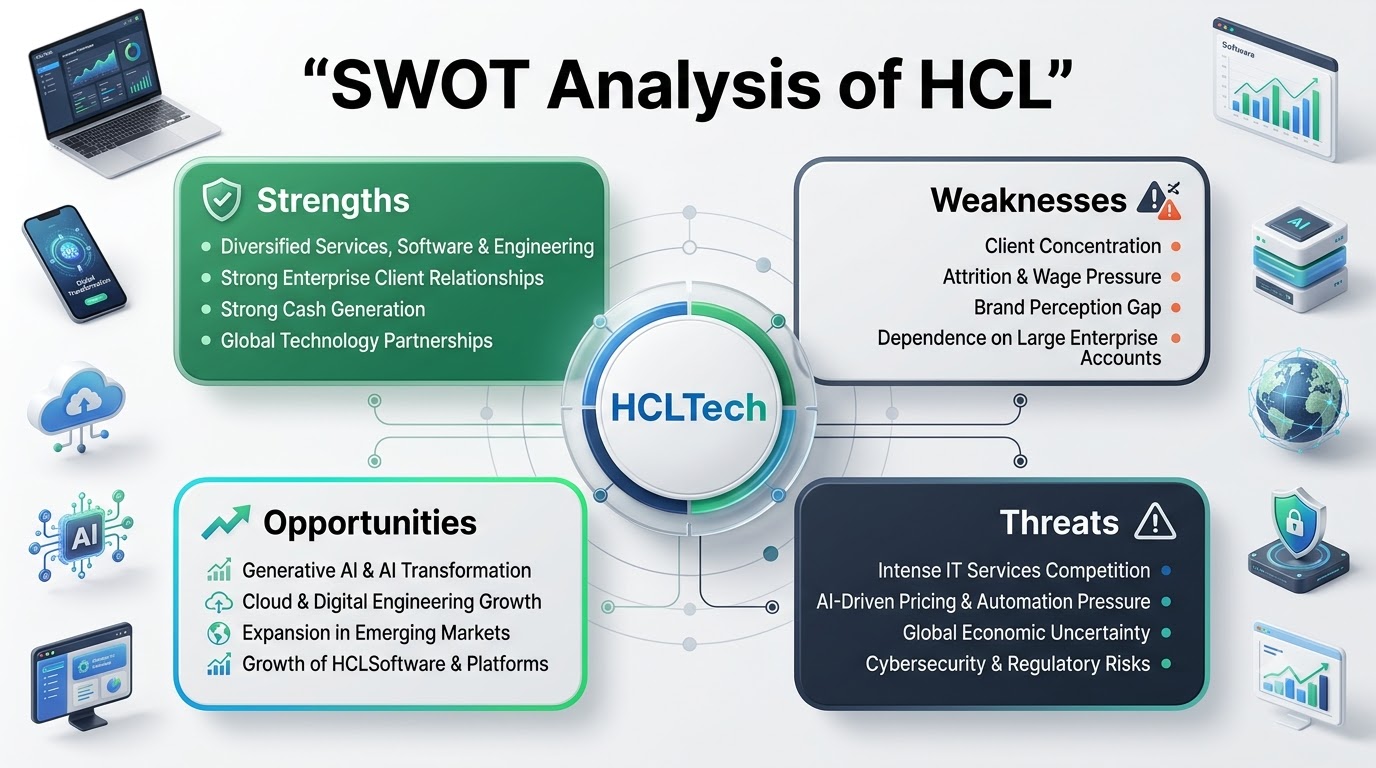
Strengths in the SWOT Analysis of HCL
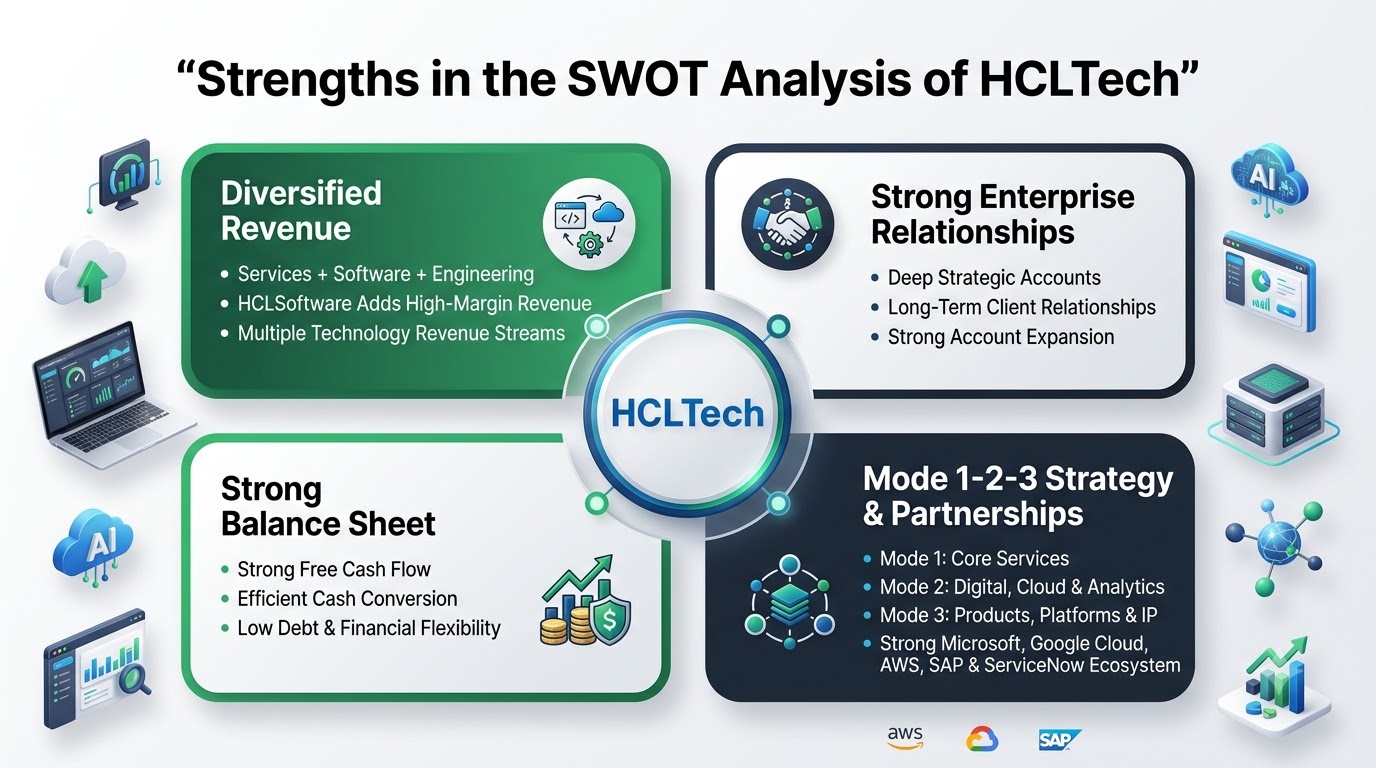
The strengths section is usually where these articles get lazy and just say “strong brand” or “skilled workforce” without backing it up. Here, every strength gets tied to something concrete: a number, a deal, or a strategic decision the company actually made.
Diversified Revenue Across Services, Software, and Engineering
Here is the thing that separates HCLTech from most of its Indian IT peers. TCS and Infosys make almost all their money from services contracts: staff-augmentation-style deals, application development, and IT infrastructure management. HCLTech does that too, but it also owns a genuine software business. When it bought a set of IBM products in 2019 for 1.8 billion dollars, most analysts were skeptical, because Indian IT companies had a poor track record buying and running product businesses. It turned out to be one of the smarter bets in the sector. HCLSoftware now contributes a meaningful, high-margin slice of revenue that does not depend on billing hours to a client.
This matters because software licensing revenue is stickier and carries better margins than services work. A services contract can get renegotiated or cut when a client freezes budgets. A software license that is embedded into a bank’s fraud detection system or a telecom’s network management stack is much harder to rip out. That difference shows up directly in how HCLTech has weathered slowdowns better than pure-play services competitors during periods when IT spending got tight.
Deep, Long-Term Relationships With Large Enterprise Clients
HCLTech has built what the industry calls “strategic accounts,” meaning clients that generate over a certain revenue threshold each year, and the company has been steadily growing the number of clients in its highest revenue brackets. Look at the trend over the last several years and you will notice the count of clients billing over 100 million dollars annually has climbed, not stayed flat. That is not an accident. It comes from a deliberate account-mining strategy where HCLTech does not just deliver the original contract, it actively looks for adjacent problems inside the same client and pitches new work to solve them.
A concrete example: a telecom client that originally hired HCLTech for network operations support later expanded that relationship into 5G infrastructure engineering and customer experience platforms, turning a single-service contract into a multi-hundred-million-dollar relationship spanning years. That kind of account expansion is far cheaper than winning a brand-new client from scratch, and it is one of the biggest, quietest strengths in the company’s playbook.
Strong Balance Sheet and Cash Generation
Numbers matter here, so look at them directly. HCLTech consistently generates strong free cash flow relative to its net income, often converting more than 90 percent of net income into free cash flow in a given year, which is unusually efficient for a services business. That cash funds acquisitions, buybacks, and a dividend policy that has made the stock a favorite among income-focused investors in the Indian market. The company has also kept debt levels low relative to peers, giving it room to make acquisitions when opportunities show up rather than needing to raise capital under pressure.
For anyone comparing HCLTech to competitors on pure financial health, this consistency in cash conversion is one of the clearest strengths, and it is the kind of detail that gets buried under vaguer statements like “financially strong” in most write-ups.
The Mode 1-2-3 Strategy and Ecosystem Partnerships
HCLTech organizes its growth strategy into what it calls Mode 1, Mode 2, and Mode 3. Mode 1 covers the core services business, the bread-and-butter application and infrastructure work. Mode 2 covers newer, faster-growing areas like digital, analytics, and cloud. Mode 3 covers products, platforms, and IP, which is where HCLSoftware and its engineering IP live. This framework is not just marketing language. It shapes how the company allocates investment and where it pushes its sales teams to focus.
On top of that, HCLTech has built genuinely deep partnerships with hyperscalers like Microsoft, Google Cloud, and AWS, plus enterprise software giants like SAP and ServiceNow. These are not logo-slapping partnerships. HCLTech has thousands of certified professionals across these platforms and co-invests in joint go-to-market programs, which means when a client needs a large SAP S/4HANA migration or an Azure cloud transformation, HCLTech shows up with pre-built accelerators instead of starting from zero. That shortens delivery time and directly improves win rates against competitors pitching the same deal.
Weaknesses
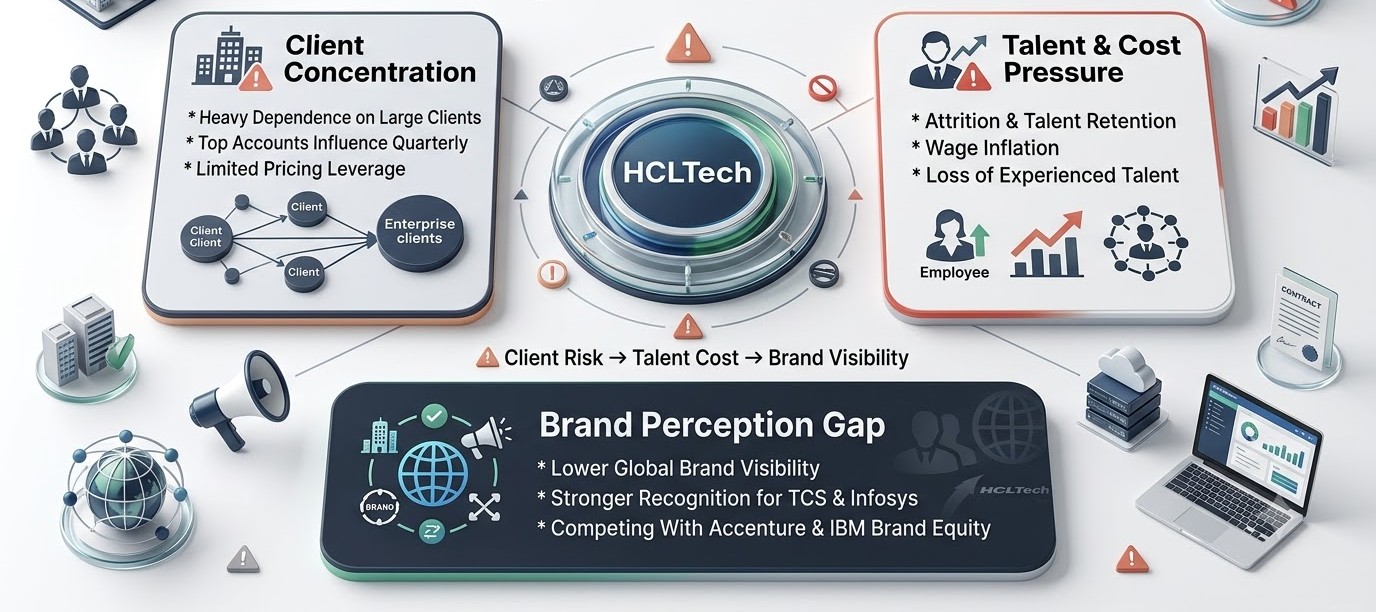
No company this size is without real problems, and glossing over them does a disservice to anyone actually trying to make a decision based on this analysis. HCLTech has structural weaknesses that show up repeatedly in earnings calls, employee reviews, and analyst notes.
Heavy Dependence on a Small Number of Large Clients
Despite the account diversification story above, HCLTech still leans heavily on its top clients for a disproportionate share of revenue. Losing or even significantly shrinking a relationship with one of its top ten accounts can visibly move quarterly numbers. This is not unique to HCL, every large IT services firm has this exposure, but it is a real vulnerability worth naming rather than skipping past. When a client goes through its own restructuring, gets acquired, or decides to bring work in-house, the ripple effect on HCLTech’s numbers can be immediate.
This concentration also gives large clients outsized negotiating leverage on pricing. A client contributing 3 to 4 percent of total company revenue can demand rate cuts or extended payment terms that HCLTech has limited room to refuse, because losing that account would hurt far more than absorbing a margin hit.
Attrition, Wage Inflation, and Talent Retention Struggles
Ask anyone who has worked in the Indian IT services industry and they will tell you attrition is a constant headache, and HCLTech is not immune. During the hiring boom years, voluntary attrition at HCLTech climbed into uncomfortable territory, forcing the company to raise wages faster than revenue growth could comfortably absorb. Even after the broader industry cooled down and attrition rates came back to more manageable levels, wage inflation left a lasting mark on operating margins.
The deeper issue is retention of experienced, mid-level talent, the engineers and project leads who actually understand a client’s systems after two or three years on an account. Losing that institutional knowledge is far more damaging than losing a fresher, because replacing that expertise takes months of ramp-up time on a new hire, during which delivery quality and client satisfaction can slip. HCLTech has invested in internal reskilling programs and career progression paths to address this, but the underlying tension between wage costs and margin targets has not disappeared.
Brand Perception Gap Compared to TCS, Infosys, and Global Consultancies
In global boardrooms, when a CIO is picking a strategic transformation partner, brand recognition genuinely influences shortlists. TCS and Infosys have spent decades building name recognition through visible sports sponsorships, marathon branding, and consistent global marketing. Accenture and IBM carry the weight of decades as management consultancies before they were technology firms. HCLTech, by comparison, has historically been quieter on the brand-building front, even though its actual delivery capability in areas like engineering services is arguably stronger than some bigger-name competitors.
This gap matters most in situations where a client is choosing between vendors with genuinely comparable technical capability, and brand trust becomes the tie-breaker. HCLTech has been actively working to close this gap through sports sponsorships in tennis and increased visibility at major industry events, but brand equity built over decades does not close in a few years of marketing spend.
Opportunities
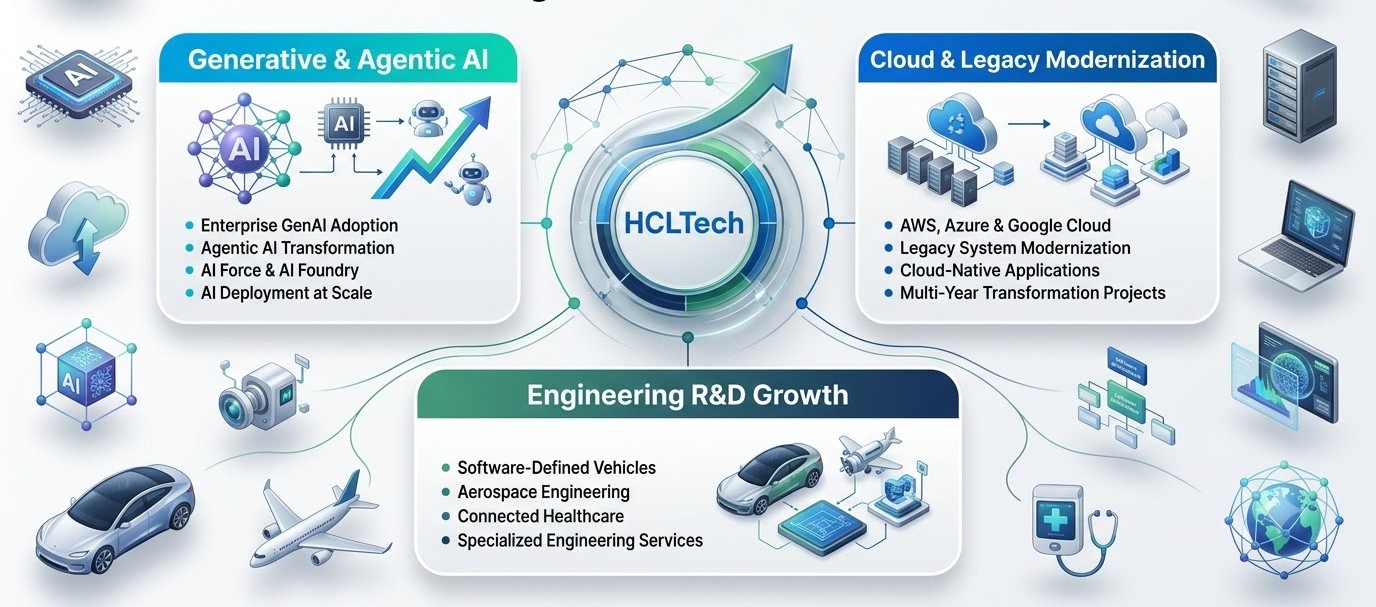
This is where the analysis gets interesting, because the opportunities in front of HCLTech right now are genuinely different from what the IT services industry looked like even five years ago.
Generative AI and Agentic AI Services Demand
Every large enterprise client HCLTech works with is under pressure from their own board to show an AI strategy, and most of them do not have the internal talent to build one from scratch. That gap is exactly the kind of opportunity HCLTech’s Mode 2 and Mode 3 strategy was built to capture. The company has been rolling out AI Force and AI Foundry offerings aimed at helping clients move beyond AI pilots that never go anywhere and actually deploy generative AI and agentic AI systems into production workflows.
What makes this opportunity real rather than hype is the nature of enterprise AI adoption. It is not just about plugging in a chatbot. Clients need help with data readiness, model governance, integration into legacy systems that are decades old, and change management for employees who are wary of the technology. HCLTech’s existing deep relationships inside large accounts, combined with its engineering services background, position it well to sell these AI transformation projects as extensions of existing contracts rather than needing to win brand-new clients.
Cloud Migration and Legacy System Modernization
A huge percentage of enterprise workloads, especially in banking, insurance, and manufacturing, still run on legacy infrastructure that was never designed for the cloud. Every year that passes makes that legacy technical debt more expensive and riskier to maintain, and eventually these clients have no choice but to modernize. HCLTech’s cloud partnerships with AWS, Microsoft Azure, and Google Cloud give it a direct pipeline into these modernization projects, and the company has built dedicated cloud-native and platform engineering practices to capture this demand.
The opportunity here is not just moving a workload from a data center to the cloud. It is the far more complex and higher-margin work of re-architecting applications to actually take advantage of cloud-native capabilities like auto-scaling and microservices, which is exactly the kind of multi-year engagement that builds the account-expansion story mentioned earlier in the strengths section.
Engineering R&D Growth in Automotive, Aerospace, and Healthcare
HCLTech’s Engineering and R&D Services segment is quietly one of its most differentiated businesses, and it is riding some genuinely strong tailwinds. Automotive companies are racing to build software-defined vehicles, aerospace firms need engineering support for next-generation aircraft systems, and medical device companies need software validation and regulatory compliance work as more devices become connected and data-driven. HCLTech has built specialized engineering capability in each of these verticals, often through dedicated centers of excellence and partnerships with equipment manufacturers.
This segment tends to carry different, often higher, margins than commodity IT services, because it requires domain-specific engineering talent that is harder for smaller competitors to replicate. As more industries digitize their physical products, this segment has real room to keep expanding faster than the company’s traditional IT services business.
Threats
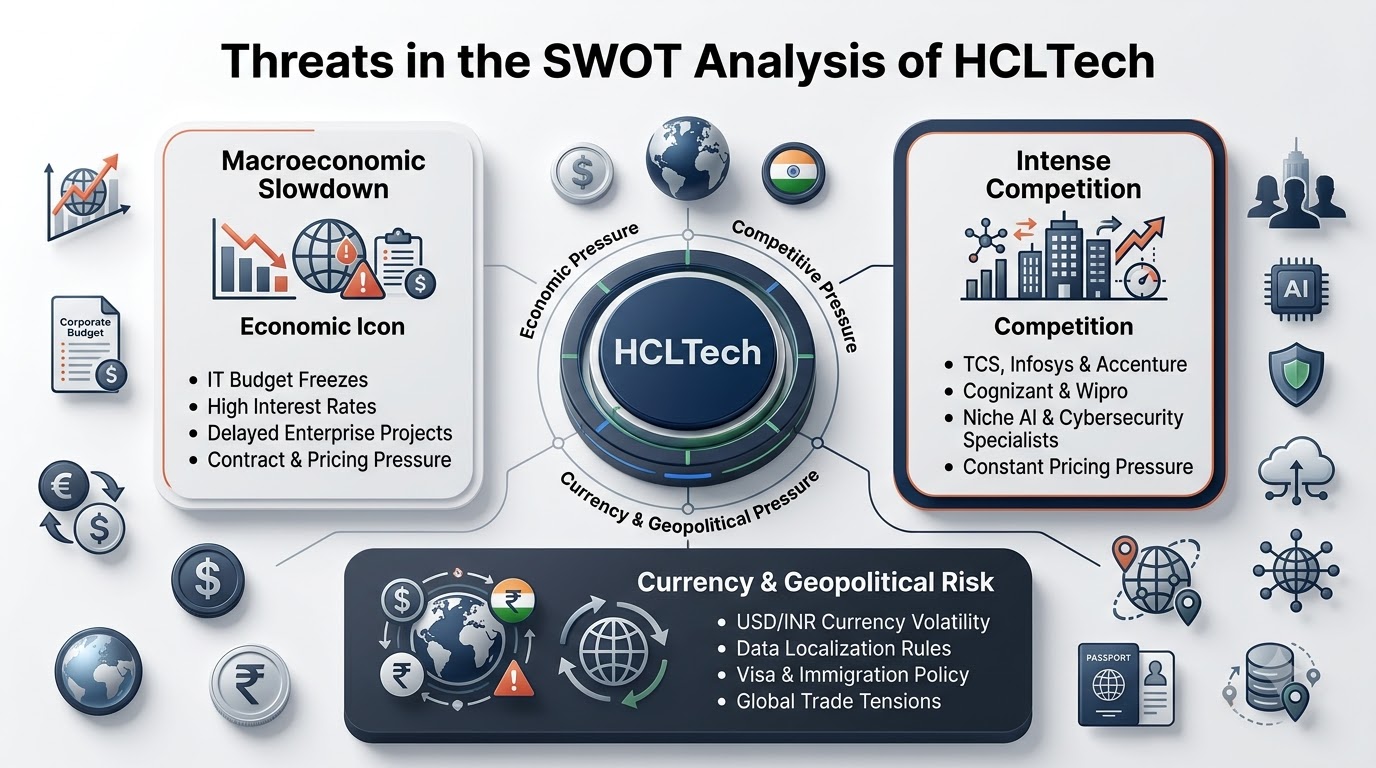
Opportunities only matter if the company can actually capture them, and there are real threats that could get in the way.
Global Macroeconomic Slowdown and IT Budget Freezes
The IT services industry runs on discretionary spending, and discretionary spending is the first thing companies cut when they get nervous about the economy. When major markets like the United States and Europe, HCLTech’s largest revenue sources, go through periods of high interest rates or recession fears, enterprise clients delay new technology projects and renegotiate existing contracts downward. This has happened repeatedly over the past several years, and it directly compresses growth for every Indian IT firm, HCLTech included.
The company has less control over this threat than almost anything else on this list, because it depends entirely on decisions being made in corporate boardrooms thousands of miles away, driven by interest rate policy and consumer demand that HCLTech has no influence over.
Intense Competition From Both Scale Players and Niche Specialists
HCLTech is squeezed from two directions at once. On one side, it competes against giants like TCS, Infosys, Accenture, Cognizant, and Wipro for the same large transformation deals, and pricing pressure in that competition is constant. On the other side, smaller, more specialized firms are winning pieces of business in areas like cybersecurity consulting, specific AI implementation niches, and boutique cloud architecture work, where a focused ten-person firm can sometimes move faster and pitch more credibly on a narrow problem than a massive services organization.
This two-sided competitive pressure means HCLTech has to keep proving it can win on both scale and specialization simultaneously, which is a genuinely difficult balancing act for any organization of its size.
Currency Volatility and Geopolitical Risk
HCLTech earns the vast majority of its revenue in US dollars and other foreign currencies while a large chunk of its costs, especially wages, are in Indian rupees. That currency mismatch means exchange rate swings directly affect reported margins even when the underlying business performance has not changed. A strengthening rupee against the dollar can quietly eat into profitability without any operational issue at all.
On top of currency risk, geopolitical tensions around data localization laws, visa policy changes in the United States and United Kingdom that affect how easily Indian IT companies can send employees onsite, and broader trade tensions between major economies all add a layer of unpredictability that sits outside the company’s direct control but can meaningfully affect its cost structure and delivery model.
What This SWOT Analysis of HCL Means in Practice
Reading through strengths, weaknesses, opportunities, and threats is useful, but the real value comes from what you actually do with that information depending on why you are reading this in the first place.
For Investors Evaluating HCLTech Stock
If the goal is deciding whether HCLTech deserves a place in a portfolio, the picture that emerges from this analysis is a company with genuinely diversified revenue streams, strong cash generation, and real exposure to growth areas like AI and engineering services, balanced against client concentration risk and a business model that is structurally sensitive to global economic cycles. That combination tends to appeal more to investors looking for steady dividend income and moderate, dependable growth than to those chasing explosive returns. Anyone doing this evaluation seriously should look past this single article and study the company’s actual quarterly earnings calls and annual reports for the most current numbers, since figures in the IT services sector shift meaningfully from year to year.
For Job Seekers and Current Employees
For someone deciding whether to join or stay at HCLTech, the weaknesses around attrition and wage pressure are not just abstract business risks, they directly shape what working there feels like day to day. The upside is that the strengths around diversified business lines and growing AI and engineering practices mean there are genuinely more varied career paths available now than there were a decade ago, when the company was seen mostly as a pure IT services shop. Someone building a career in engineering R&D or cloud platform work is stepping into one of the areas with the most forward momentum inside the company.
Final Thoughts on the SWOT Analysis of HCL
Boiled down, HCLTech is a company that made a genuinely unusual bet a few years back by buying software products instead of just staying in the services lane like most of its Indian peers, and that bet has paid off in ways that show up clearly in its margins and cash flow today. It has real strengths in client relationships and financial discipline, real weaknesses in talent retention and brand visibility, real opportunities in AI and engineering, and real threats sitting in the global macro environment that no single company can control. None of that makes it a guaranteed winner or a company to avoid. It makes it a business worth watching closely, with specific things to track: client concentration numbers, attrition trends, and how fast the AI services revenue actually shows up in reported numbers rather than just investor presentations. That is the honest takeaway from this SWOT analysis of HCL, and it is a far more useful lens than a generic checklist ever could be.
Frequently Asked Questions About HCL’s SWOT Analysis
What is HCL Technologies known for today?
HCL Technologies, now branded HCLTech, is known for IT services, enterprise software products under HCLSoftware, and engineering R&D work for industries like automotive, aerospace, and telecom. It is one of India’s largest IT services exporters and works with major global banks, manufacturers, and technology firms.
What are the biggest strengths of HCL according to this SWOT analysis?
The biggest strengths are a diversified business model spanning services, software, and engineering, deep long-term relationships with large enterprise accounts, strong free cash flow generation, and established partnerships with major cloud and enterprise software providers like Microsoft and SAP.
What are HCL’s main weaknesses?
HCL’s main weaknesses include dependence on a small number of large clients for a significant share of revenue, ongoing attrition and wage inflation pressures that affect margins, and a brand recognition gap compared to larger, longer-established competitors like TCS, Infosys, and Accenture.
Is HCLTech the same company as HCL Infosystems?
No. HCL Infosystems, which made computer hardware, split from HCL Technologies years ago and is now a separate, much smaller company. HCLTech is the technology services and software company most people are referring to today when they mention HCL.
How does HCL make money?
HCLTech earns revenue through three main segments: IT and Business Services, which covers application development and infrastructure management, Engineering and R&D Services, which involves technical product engineering for industries like automotive and healthcare, and HCLSoftware, which sells enterprise software products it acquired from IBM.
Why did HCL buy IBM software products in 2019?
HCLTech acquired a set of IBM software products in 2019 to build a higher-margin, recurring revenue business that did not depend purely on hourly services billing. That deal became the foundation of HCLSoftware, which now contributes meaningfully to the company’s overall profitability.
What opportunities does HCLTech have in artificial intelligence?
HCLTech has significant opportunity in helping enterprise clients move generative AI and agentic AI projects from pilot stage into actual production use, including data readiness, integration with legacy systems, and change management. This builds on existing client relationships rather than requiring entirely new business development.
What threats could hurt HCLTech’s growth in the coming years?
The biggest threats are a global economic slowdown that causes clients to freeze discretionary IT spending, intense competition from both large scale players and specialized niche firms, and currency volatility since HCLTech earns mostly in foreign currency while paying a large share of costs in Indian rupees.
Is HCLTech a good stock for long-term investors?
HCLTech tends to appeal to investors looking for steady dividends and moderate growth backed by strong cash generation and revenue diversification, rather than investors chasing rapid, high-risk returns. Anyone considering the stock should review current quarterly earnings and analyst coverage rather than relying only on a general SWOT analysis, since financial conditions change year to year.
How does attrition affect HCLTech’s business?
High attrition forces HCLTech to spend more on hiring and training replacement staff, raises wage costs to retain talent, and risks losing experienced employees who understand specific client systems, which can affect delivery quality and client satisfaction on ongoing projects.
What makes HCLTech different from TCS and Infosys?
The clearest difference is HCLTech’s ownership of HCLSoftware, a genuine enterprise software product business, which TCS and Infosys do not have at a comparable scale. HCLTech also has a particularly strong Engineering and R&D Services segment focused on deep technical product engineering rather than only IT services delivery.
Should students consider a career at HCLTech?
Students considering HCLTech should weigh the company’s growing opportunities in engineering, cloud, and AI-related roles against known industry challenges like high attrition and demanding project timelines. Researching the specific business unit and role, rather than judging the company as a whole, gives a much clearer picture of what day-to-day work actually looks like.