


Google made over $402 billion in revenue in 2025. That number alone tells you why a SWOT analysis of Google is not some academic exercise you do for a business school assignment and forget about. This is a company that runs the world’s default search engine, owns the operating system on roughly seven out of ten phones on earth, and just crossed $70 billion in annual cloud run rate. And yet, in the same year it hit those records, a federal judge ruled that Google had illegally maintained a monopoly in search. So which is it? Is Google an unstoppable machine or a company sitting on a pile of legal and competitive landmines?

Honestly, it’s both. That’s the part most write-ups on this topic get wrong. They either write Google up as a company that can do no wrong, or they get so caught up in the antitrust headlines that they forget Alphabet just posted a 30% jump in net income. A real SWOT analysis of Google has to hold both of these truths at the same time: massive structural advantages, and equally massive structural risk. That tension is exactly what makes this company worth studying, whether you’re a marketing student, a startup founder trying to compete with Google in some corner of the market, or an investor trying to figure out if the stock still has room to run.
This guide breaks Google down the way you’d actually want it broken down if you were sitting across the table from someone who has spent years watching how search, ads, and cloud businesses actually behave. No fluff, no generic “Google is a tech giant” filler. Just the strengths that are real moats, the weaknesses that could genuinely hurt the business, the opportunities that are already showing up in the numbers, and the threats that keep people inside Mountain View up at night.
What You Will Learn in This Guide
- Why Google’s search and Android dominance function as two separate moats, not one
- The exact financial weak points inside Alphabet’s business model, including how dependent it still is on advertising
- What the September 2025 antitrust ruling actually changed, and what it didn’t
- Where Google’s real growth is coming from right now, and it is probably not what you’d guess
- Which competitors, from OpenAI to Amazon, pose the most direct threat to each part of Google’s business
- How to use this exact framework to build a SWOT analysis for your own company or a competitor
What Is a SWOT Analysis of Google and Why It Matters Right Now
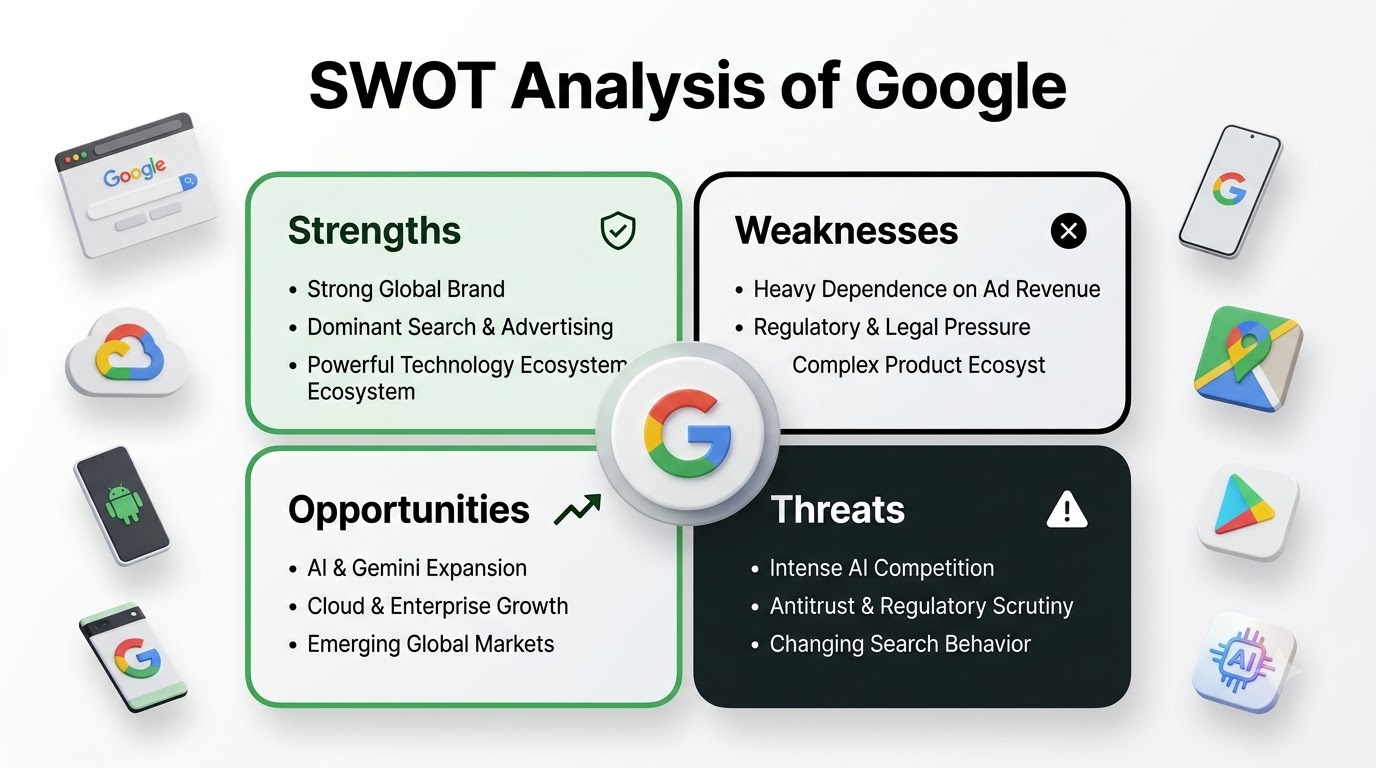
A SWOT analysis of Google is a structured breakdown of the company’s internal strengths and weaknesses, alongside the external opportunities and threats sitting in front of it. The internal factors are things Google controls directly, like its engineering talent or its dependence on ad revenue. The external factors are things happening in the market that Google has to react to, like a court ruling or a competitor’s product launch. Put those four categories together and you get a full picture of where the company stands, not just a highlight reel of its wins.
Here’s why doing this exercise on Google specifically is more useful than doing it on almost any other company. Google sits at the intersection of search, advertising, mobile operating systems, cloud infrastructure, and now frontier AI models. Most companies you’d analyze operate in one or two of these lanes. Google operates in all five, which means a weakness in one area can bleed into another. A regulatory restriction on search defaults, for example, doesn’t just hurt search. It touches Chrome, it touches Android, and it touches the ad business that funds everything else. That’s the kind of connected risk a surface-level SWOT misses.
The Four Pillars of a SWOT Analysis of Google
Strengths and weaknesses look inward at Alphabet’s own operations: its cash flow, its talent, its product graveyard, its decision-making speed. Opportunities and threats look outward at the market: what’s changing in AI, in regulation, in consumer behavior, and in what competitors are building. The mistake people make is treating a strength as permanent and a threat as temporary. Neither assumption holds up here. Search dominance, a clear strength today, could become a liability tomorrow if regulators keep chipping away at the defaults that protect it. And a threat like generative AI search could just as easily become an opportunity if Google’s own Gemini models keep improving as fast as they have been.
Why Alphabet’s Business Model Makes This SWOT Analysis of Google Different from Smaller Companies
Most SWOT analyses cover a single product line or a single market. Alphabet is a holding company for Google Search, YouTube, Android, Chrome, Google Cloud, Waymo, DeepMind, and a handful of experimental “Other Bets” that mostly lose money. That structure means strengths in one division can mask weaknesses in another. Google Cloud, for instance, only just turned meaningfully profitable in the last couple of years, years after AWS and Azure got there. A SWOT analysis of Google that only looks at the parent company’s total revenue misses that Cloud spent nearly a decade as a drag on margins while Search quietly funded the whole operation. Understanding this layered structure is the difference between a surface-level take and one that actually explains how decisions get made inside the company.
Strengths in the SWOT Analysis of Google
Google’s strengths aren’t just “it’s a big company with lots of money.” That’s lazy analysis. The real strengths are specific, defensible, and in most cases, extremely hard for a competitor to replicate even with unlimited funding.
Google Search still handles somewhere around nine out of every ten search queries globally, and that share has barely moved in over a decade despite Bing’s Copilot integration, despite DuckDuckGo’s privacy pitch, and despite Perplexity’s rise among power users. That kind of consistency at that kind of scale is rare in tech, where user habits usually shift every five to seven years. Android runs on close to seven out of ten smartphones worldwide, giving Google a default distribution channel that Apple’s iOS, walled off as it is, can never fully match in raw volume. Layer YouTube, Chrome, Gmail, and Google Maps on top of that, and you get a company that touches nearly every digital habit a person has in a given day.
[Screenshot: Similarweb Global Search Engine Market Share report showing Google’s share over the last 12 months]
Search Engine Dominance and Market Share
Search is still the crown jewel, and the reason isn’t just habit. It’s a data flywheel. Every query Google processes makes its ranking algorithms slightly better at understanding intent, which makes results slightly more relevant, which keeps users coming back, which generates more queries. That loop has been spinning for over 25 years, and no competitor, not even one backed by billions in AI investment, has the same volume of historical query data to train against. Google Search & other revenue alone grew double digits through 2025, which tells you the core product isn’t just holding steady, it’s still expanding even as AI chatbots supposedly threaten to replace it.
Android’s Global Reach
Android isn’t just an operating system, it’s the delivery mechanism for everything else Google sells. Every Android phone ships with Google Search as a default, the Play Store as the default app marketplace, and Gmail, Maps, and YouTube pre-installed. In emerging markets across Southeast Asia, Africa, and Latin America, where budget Android devices dominate, this default positioning is often the only way a first-time smartphone user is ever exposed to these products. That’s not marketing spend working in Google’s favor, that’s structural placement. The September 2025 antitrust remedies did loosen some of these defaults on the search side, but Android’s role as a distribution engine for the broader Google ecosystem remains largely intact.
Google Cloud Platform Growth
For years, Cloud was the punchline in every Google earnings call, the division that grew revenue but bled operating losses while AWS and Microsoft Azure ran laps around it. That changed. Google Cloud revenue jumped 48% year over year in the fourth quarter of 2025, closing the year at an annual run rate north of $70 billion, and operating income for the segment rose 154% in that same quarter. What’s driving it isn’t the old core infrastructure pitch, it’s enterprise demand for AI infrastructure and Gemini-powered solutions layered on top of Workspace. Cloud finally became a real strength, not a strategic ambition Google kept funding out of hope.
Advertising Revenue Machine
Google Ads and YouTube ads together are still the financial backbone of the entire company. YouTube alone crossed $60 billion in combined ad and subscription revenue for full year 2025. Google’s advertising business benefits from something competitors can’t easily copy: intent data. A user searching “best running shoes for flat feet” is telling Google exactly what they want to buy, right before they buy it. Meta and TikTok get attention and engagement data, but Google gets purchase intent, and advertisers pay a premium for that difference.
Talent, R&D Spend and AI Research
DeepMind, folded fully into Google’s AI efforts, has produced some of the most cited research in the field, from AlphaFold’s protein-folding breakthroughs to the Gemini model family. Alphabet’s planned 2026 capital expenditure sits between $175 and $185 billion, most of it aimed at AI infrastructure and compute. That’s not a company playing defense on AI, that’s a company betting its entire future capital allocation on staying ahead of it. Sundar Pichai has pointed to Gemini’s API usage processing over 10 billion tokens per minute as proof the investment is already paying off in adoption, not just in lab benchmarks.
Brand Trust and Data Advantage
“Google it” became a verb for a reason. Decades of reliability built a level of default trust that new entrants, no matter how good their product is on day one, simply don’t have yet. Combine that trust with the sheer volume of behavioral data Google has collected across Search, Android, Chrome, and Maps, and you get targeting and personalization capabilities that smaller AI-native competitors are years away from matching, regulatory restrictions on data use aside.
Weaknesses Inside the SWOT Analysis of Google
Here’s the thing that gets glossed over in most of these breakdowns: a company this large doesn’t have small weaknesses. When something goes wrong at Google’s scale, it shows up in courtrooms, in regulatory filings, and in billions of dollars of fines, not in a quiet product tweak nobody notices.
Overdependence on Advertising Revenue
Google Services, which is mostly Search and YouTube advertising, still made up the overwhelming majority of Alphabet’s $402.8 billion in 2025 revenue. Cloud is growing fast, but it’s still a fraction of the total. That concentration means any meaningful disruption to the ad business, whether from a regulatory restriction, a shift in how people search, or an economic downturn that cuts ad budgets, hits Alphabet’s bottom line far harder than it would hit a more diversified company like Amazon, which balances retail, cloud, and advertising in closer proportion.
Regulatory and Antitrust Pressure
This is the weakness with the most immediate teeth. In August 2024, Judge Amit Mehta ruled that Google had illegally maintained a monopoly in general search and search advertising, violating Section 2 of the Sherman Act. In September 2025, the remedies phase concluded: Google avoided the worst-case outcome of a forced Chrome or Android divestiture, but was banned from entering exclusive contracts that made Google Search, Chrome, Google Assistant, and the Gemini app the mandatory default across partner devices, and was ordered to share certain search data with competitors. Both the Department of Justice and Google have filed appeals, which means this fight is nowhere near over. On top of that, Google absorbed a $3.5 billion charge tied to a European Commission fine in a single quarter of 2025, on top of the roughly $8 billion in EU antitrust penalties issued over the previous decade. Regulatory exposure isn’t a one-time cost here, it’s a recurring line item.
Privacy Backlash and Data Concerns
Google’s entire ad targeting engine runs on data collection, and that puts it in a permanent tug of war with privacy regulation. GDPR in Europe, evolving state-level privacy laws in the US, and Apple’s App Tracking Transparency changes have all chipped away at the ease with which Google can build detailed user profiles. Every new privacy restriction is a direct hit to ad targeting precision, and precision is exactly what advertisers pay a premium for. Google has spent years trying to build “privacy-safe” alternatives like the Privacy Sandbox, with mixed adoption and plenty of pushback from the ad industry itself.
The Product Graveyard Problem
Go look up “Killed by Google” if you haven’t already. The list runs past 250 discontinued products, from Google Reader to Stadia to Google+. This isn’t just a meme, it’s a real strategic weakness. When a company builds a reputation for abandoning products, enterprise customers and developers get cautious about betting their workflows on anything new Google ships, including AI tools. That hesitation slows adoption of genuinely good products because the market has learned, through repeated experience, not to trust Google’s long-term commitment to anything outside Search and Ads.
Slow Decision Making in a Large Organization
A company running Search, Ads, Android, Cloud, YouTube, and a portfolio of experimental Other Bets has to coordinate decisions across an enormous organizational structure. That size, which is a strength when it comes to R&D budgets, becomes a weakness when speed matters. OpenAI shipped ChatGPT and iterated on it faster than Google’s internal AI teams could respond in the early days of the generative AI wave, even though Google had been researching transformer models, the technology underlying ChatGPT, since 2017. Size bought Google research depth. It cost Google speed to market.
Opportunities Highlighted in the SWOT Analysis of Google
Not everything outside Google’s walls is a threat. Some of the biggest shifts happening in tech right now play directly into Google’s existing strengths, if the company executes well.
[Screenshot: Google Trends showing worldwide search interest for “Gemini AI” over the past 12 months]
Generative AI and Gemini Expansion
Gemini 3’s launch was, by Pichai’s own description, a major milestone, and the adoption numbers back that framing up. The Gemini app has grown past 750 million monthly active users, and API-level token processing has climbed past 10 billion tokens per minute. That’s a real opportunity: Google isn’t starting from zero in the AI race the way a smaller competitor would be, it’s layering frontier models on top of Search, Workspace, and Cloud, distribution channels that already reach billions of people. AI Overviews and AI Mode rolling out inside Search itself is Google’s attempt to make sure the next generation of “search” still happens on Google’s turf, not on a competitor’s chat interface.
Cloud Computing Market Growth
Enterprise AI adoption is still in its early innings, and every company that wants to run large models needs infrastructure to do it on. Google Cloud’s 48% growth in the final quarter of 2025 shows this opportunity is already converting into real revenue, not just a future promise. The pitch to enterprise customers has shifted from “use our cloud because it’s reliable” to “use our cloud because it’s where Gemini and AI-optimized infrastructure already live,” and that pitch is landing.
Hardware Ecosystem Expansion
Pixel phones, Nest devices, and Google’s push into AI-integrated hardware give the company a direct-to-consumer channel that doesn’t depend on Android licensing deals with third-party manufacturers. It’s a smaller business than Search or Cloud, but it’s a genuine opportunity to control the full stack, from chip to software to AI model, the same integrated approach Apple has used to defend premium margins for years.
Emerging Markets and the Next Billion Users
Smartphone penetration is still climbing across large parts of Africa, South Asia, and Southeast Asia, and most of those new users are landing on budget Android devices with Google’s ecosystem pre-installed. Every one of those new users is a future Search query, a future YouTube view, and a future Google Ads impression. This is slower, less headline-grabbing growth than the AI story, but it’s durable, long-term growth that doesn’t depend on winning any single competitive battle.
Enterprise AI Tools and Workspace Integration
Gemini embedded directly into Docs, Sheets, Gmail, and Slides gives Google a distribution advantage that a standalone AI tool simply can’t match: it’s already inside the software hundreds of millions of professionals use every single day. Microsoft has the same play with Copilot inside Office, which makes this one of the more direct head-to-head battles in the whole industry, but Google’s advantage is that Workspace adoption has been climbing specifically because of Gemini integration, not despite it.
Threats Facing Google in This SWOT Analysis
This is the section where the picture gets genuinely uncomfortable for Google, because these threats aren’t hypothetical. They’re already reshaping how people search, how regulators act, and how advertisers spend.
Competition from OpenAI, Microsoft Copilot and Perplexity
Judge Mehta himself pointed to generative AI companies as a “nascent competitor threat” to Google’s dominance when he was crafting the September 2025 remedies, which tells you how seriously even the courts are taking this shift. ChatGPT, Perplexity, and Copilot are changing the first move people make when they have a question. That behavior shift, even a small percentage of it, matters enormously against a search business that generates hundreds of billions of dollars specifically because of query volume. Google’s answer, AI Mode and AI Overviews, is a direct response, but it also risks cannibalizing the very ad clicks that fund the business if users get their answer without clicking through to a website at all.
Regulatory Breakup Risk in the US and EU
The current remedies avoided a Chrome or Android divestiture, but both the DOJ and Google have filed appeals, and the DOJ’s Assistant Attorney General has explicitly left the door open to seeking additional relief. That means the structural breakup threat, while dodged for now, isn’t permanently off the table. Europe adds another layer of pressure through the Digital Markets Act, which imposes ongoing “gatekeeper” obligations on Google that didn’t exist a few years ago, along with the recurring fines that come with any perceived non-compliance.
Changing Search Behavior
TikTok’s rise as a search tool among younger users, Reddit’s growing visibility in search results as a trusted source, and the habit of asking an AI chatbot directly instead of searching and clicking through links are all chipping at the traditional search funnel from different directions. None of these alone threatens to replace Google Search. Together, spread across a younger generation’s daily habits, they represent a slow erosion in exactly the kind of query volume that Google’s ad business depends on.
Ad Market Competition from Amazon and Meta
Amazon’s advertising business has grown into a genuine third pillar of digital ad spend, built on something Google doesn’t have as directly: purchase-ready shopper intent captured right at the point of sale. Meta continues to compete hard for the same brand ad budgets Google chases. Every dollar an advertiser shifts to Amazon’s retail media network or Meta’s Reels ad inventory is a dollar not going through Google Ads, and that competitive pressure only intensifies as advertisers get more sophisticated about tracking which platform actually drives conversions.
Cybersecurity and Geopolitical Risk
Running critical infrastructure at Google’s scale, across Search, Cloud, Gmail, and Android, makes the company a permanent, high-value target for state-sponsored cyberattacks. Add in geopolitical friction around chip supply chains, data localization laws in countries like India and China, and rising trade tensions that can disrupt hardware manufacturing, and you get a category of risk that doesn’t show up cleanly in a quarterly earnings report but can absolutely disrupt operations when it hits.
How to Apply a SWOT Analysis of Google to Your Own Business Strategy
Here’s what most people miss when they read a SWOT analysis of Google and then close the tab: the value isn’t in memorizing what Google’s strengths are, it’s in learning how to structure this same thinking for a company you actually care about, whether that’s your own business or a competitor you’re trying to out-position.
Using Google’s SWOT as a Benchmark for Competitor Analysis
Start by mapping which of Google’s strengths and weaknesses have a direct parallel in your own market. If you’re building an SEO strategy, for example, Google’s search dominance isn’t just a fact to note, it’s the reason keyword research and search intent matter as much as they do, since nearly every strategy in this space is built around ranking inside a system one company controls. Anyone working through the fundamentals of SEO strategy and keyword research is, in a very real sense, building their entire approach around Google’s strengths and around the antitrust remedies now shaping how that search experience gets delivered.
Common Mistakes When Building Your Own SWOT Analysis
The most common mistake is treating strengths and opportunities as permanent facts instead of current conditions. Google’s search dominance looked untouchable in 2023. Two years later, a federal court had ruled it an illegal monopoly and generative AI competitors were pulling meaningful query volume away. Revisit your SWOT analysis every six to twelve months, not once and done. The second mistake is listing generic points without evidence, “strong brand” means nothing without a number or a specific example attached to it. Every point in this guide ties back to a real figure, a real ruling, or a real product, and that’s the standard to hold your own analysis to. If you’re mapping this out for a broader digital marketing strategy, pull in real competitor data before you write a single point down, don’t guess and backfill later.
Conclusion
A SWOT analysis of Google in 2026 tells a story of a company defending an empire on one front while building the next one on another. Search and Android remain genuine, hard-to-replicate strengths, and Cloud has finally turned into the growth story Alphabet always promised investors it would become. But the weaknesses are just as real: heavy dependence on ad revenue, a regulatory fight that’s still working through appeals courts, and a well-earned reputation for abandoning products that makes enterprise buyers cautious. The opportunities in generative AI and enterprise cloud are converting into actual revenue right now, not just roadmap slides, while the threats from OpenAI, changing search habits, and ongoing antitrust exposure aren’t going away anytime soon. If you’re studying this for a business case, an investment decision, or just to sharpen how you think about competitive strategy, the real lesson from this SWOT analysis of Google is that even the most dominant company in a market has to keep proving it deserves that position, every single quarter.
Frequently Asked Questions
What is a SWOT analysis of Google in simple terms?
A SWOT analysis of Google is a breakdown of the company’s internal strengths (like search dominance and Android reach) and weaknesses (like ad revenue dependence and antitrust exposure), alongside external opportunities (like AI and cloud growth) and threats (like regulatory action and competitors such as OpenAI). It gives a full, balanced picture rather than just listing what the company does well.
What are Google’s biggest strengths right now?
Google’s biggest strengths are its dominant global search market share, Android’s reach across roughly seven in ten smartphones worldwide, a fast-growing and now genuinely profitable Cloud business, and a massive advertising engine built on purchase-intent data from Search and YouTube. Its ongoing AI research through DeepMind and Gemini adds another structural advantage few competitors can match.
Is Google’s search monopoly a proven legal fact?
Yes. In August 2024, US District Judge Amit Mehta ruled that Google illegally maintained a monopoly in general search and search advertising, violating Section 2 of the Sherman Act. The remedies phase concluded in September 2025 with behavioral restrictions rather than a company breakup, and both Google and the Department of Justice have since filed appeals.
Did Google have to sell Chrome or Android because of the antitrust ruling?
No. Judge Mehta explicitly rejected the Department of Justice’s request for a forced divestiture of Chrome or Android, calling that kind of structural breakup a “drastic” remedy reserved for extreme cases. Instead, Google faces behavioral remedies, including a ban on exclusive default-placement contracts and a requirement to share certain search data with competitors.
How much revenue does Google make in a year?
Alphabet, Google’s parent company, reported $402.8 billion in revenue for full year 2025, a 15% increase from $350 billion in 2024. Google Services, which includes Search and YouTube ads, contributed the majority of that figure, while Google Cloud closed the year at an annual run rate above $70 billion.
Is Google Cloud actually profitable now?
Yes, and this is a relatively recent shift. Google Cloud’s operating income jumped 154% year over year in the fourth quarter of 2025 alone, reaching $5.3 billion for that quarter, after years of running at a loss while the division built out its infrastructure and enterprise sales motion.
What is the biggest threat to Google’s search business?
The biggest threat is the combination of generative AI tools like ChatGPT and Perplexity changing user search habits, alongside regulatory restrictions that limit how Google can maintain default placement on browsers and devices. Judge Mehta himself cited AI competitors as a factor in shaping the September 2025 remedies, which shows how seriously this threat is being taken even in legal proceedings.
How is Google responding to competition from OpenAI and ChatGPT?
Google has rolled out AI Overviews and AI Mode directly inside Search, along with rapid expansion of its Gemini model family, now processing over 10 billion tokens per minute through API usage. The Gemini standalone app has also grown past 750 million monthly active users, showing Google is fighting for the same AI-native usage that made ChatGPT popular in the first place.
What is a weakness that most people overlook in Google’s business model?
Most people overlook how dependent Alphabet still is on advertising revenue despite the growth of Cloud and other divisions. Google Services still makes up the large majority of total revenue, which means any disruption to ad spending, whether from an economic downturn or a shift in search behavior, hits the company harder than a more diversified competitor.
Why does Google keep discontinuing products?
Google has a long history of shutting down products that don’t hit internal growth or usage targets, a pattern documented extensively on sites tracking discontinued Google products, which now list well over 250 shut-down services. This happens because Google’s internal culture rewards rapid experimentation and equally rapid abandonment of anything that isn’t scaling fast enough, which builds efficiency but also erodes long-term trust from developers and enterprise customers.
Is Google losing market share to Amazon in advertising?
Amazon has built a meaningful third pillar in digital advertising, largely because it captures purchase-ready shopper intent directly at the point of sale, something Google’s search ads approximate but don’t match exactly. This has pulled some advertiser budget away from Google, particularly in retail and e-commerce categories, even as Google’s overall ad revenue continues to grow in absolute terms.
What role does antitrust regulation play in this SWOT analysis of Google?
Antitrust regulation sits squarely in the weaknesses and threats categories. It’s a weakness because Google’s own past business practices, specifically exclusive default-placement deals, triggered the legal violation in the first place. It’s a threat because both the DOJ and Google have ongoing appeals that could still reshape the remedies, and because the European Union continues to impose Digital Markets Act obligations and fines on top of the US case.
How does Google’s AI investment compare to its competitors?
Alphabet’s planned 2026 capital expenditure sits between $175 and $185 billion, most of it directed at AI infrastructure and compute capacity. That scale of investment puts Google in the same tier as Microsoft and Amazon in terms of AI infrastructure spending, and its DeepMind research division gives it a research depth advantage that smaller AI-native competitors like OpenAI or Perplexity don’t have the same institutional history to match.
Can a small business use the same SWOT framework as this Google analysis?
Yes, the exact same four-category structure works at any company size. The difference is scale and evidence: a small business’s strengths might be a loyal local customer base instead of a global search monopoly, but the discipline of backing every point with a specific number or example, rather than a vague claim, applies whether you’re analyzing a multinational or a five-person startup.
What is the difference between a SWOT analysis and a competitor analysis?
A SWOT analysis looks at one company’s internal strengths and weaknesses alongside external opportunities and threats. A competitor analysis compares multiple companies side by side across specific metrics like pricing, market share, or product features. They’re related tools, and a strong SWOT analysis of Google, for instance, naturally references competitors like OpenAI and Amazon, but a full competitor analysis would go further and map those rivals out in the same depth as Google itself.