


In February 2026, Dell closed a fiscal year with $113.5 billion in revenue. Six months later, in a single quarter, it booked $60.9 billion worth of AI server orders. Read that again. One quarter of orders came within shouting distance of what the entire company used to earn in half a year. And yet, in that same stretch, Dell’s gross margin sat at 21.1%, which is the kind of number a supermarket chain would recognise. That contradiction is the whole story, and it is why most versions of a SWOT analysis of Dell floating around the internet are close to useless. They list “strong brand” and “low profit margins” and call it a day.

Here is the thing about SWOT. It is a four-box framework invented in the 1960s, and it survives because it forces a simple question: what does this company control, and what is being done to it? Dell is one of the best case studies for that question available right now, because both sides of it moved violently in the last 24 months. The AI buildout handed Dell a demand wave nobody forecasted. The memory shortage that came with that same wave is now eating the margin on every laptop Dell sells. Same trend. Opposite effects. Different boxes.
This guide breaks down a SWOT analysis of Dell using actual filed numbers, not vague adjectives. Every claim gets a figure attached where a figure exists. The company behind the analysis gets explained first, because a SWOT without business model context is just a list. Then strengths, weaknesses, opportunities and threats, each one broken into sub-points with the mechanism explained, not just named. After that, a TOWS matrix that turns the four boxes into actual strategy, a step-by-step method for writing this analysis yourself for a class assignment or an interview, the marketing lessons hiding inside Dell’s direct model, and a long FAQ section.
Fair warning: this is long. Dell is a company with two businesses that behave like opposites, roughly 108,000 employees, and a balance sheet shaped by the biggest technology acquisition ever signed. Short analysis of a company like that is just wrong analysis wearing a tie.
TL;DR: Quick Summary
- Dell’s FY26 revenue hit $113.5 billion, up 17%, with AI-optimized server revenue alone jumping 166% to $24.7 billion.
- The biggest weakness is not size or brand, it is margin: ISG operating margin slipped to 11.7% from 12.8% even while revenue exploded, because AI servers sell at thin spreads.
- Dell exited FY26 with a $43 billion AI backlog and hit $95 billion by Q2 FY27, which converts “opportunity” from a guess into a scheduling problem.
- Memory is now the single largest threat to the consumer side, with DRAM contract prices up 90% or more in a single quarter and Dell raising list prices 17% in March 2026.
- The strategic tension worth writing about: the AI boom that rescued Dell’s growth story is the same force starving its PC business of affordable components.
- A good SWOT analysis of Dell ranks items by financial impact instead of listing twenty bullets of equal weight, which is what separates an A-grade answer from a template.
What You Will Learn in This Guide
Most SWOT write-ups tell you what the four letters stand for and then leave you with a shopping list. This one is built to be used, whether the goal is a graded assignment, a case interview, a competitive analysis at work, or just understanding how a hardware company actually makes money. Here is what gets covered and why each piece matters.
How Dell Actually Makes Money, Segment by Segment
Before any judgement about strengths or weaknesses, the revenue mix needs to be clear. Dell reports two segments, ISG and CSG, and they behave so differently that averaging them produces nonsense. This section explains what sits inside each one, what margin each carries, and which parts are growing versus quietly shrinking.
The Full SWOT Analysis of Dell With Numbers Attached
Every strength, weakness, opportunity and threat gets a figure, a mechanism, and a consequence. Not “strong supply chain” but why a negative cash conversion cycle means suppliers fund Dell’s inventory, and what happens to that advantage when memory prices double.
How to Convert SWOT Into Strategy Using a TOWS Matrix
The four boxes on their own do not produce a decision. Pairing them does. Strength plus opportunity gives an attack plan, weakness plus threat gives a defensive priority. This part shows how to run those pairings on Dell specifically.
A Repeatable Method for Writing Any Company SWOT
Sources to pull from, how to separate internal from external factors without getting confused, how to quantify each point, how to rank by impact, and the six mistakes that get students marked down. The method transfers to Apple, Tata Motors, Zomato, anything.
The Marketing Playbook Buried Inside Dell’s Model
Dell built a direct-to-customer business in 1984, decades before “D2C” became a pitch deck phrase. What that model does to customer data, pricing power, and content strategy is directly useful to anyone learning digital marketing fundamentals today.
Answers to the Questions People Actually Search
Twelve FAQs at the end, covering everything from Dell’s competitive position against HP and Lenovo to whether the AI server business is actually profitable.
Dell Technologies at a Glance
Dell Technologies is an American technology company headquartered in Round Rock, Texas, selling PCs, servers, storage, networking gear, and the services wrapped around them, with FY26 revenue of $113.5 billion across roughly 108,000 employees. It sells directly to customers and through partners, and it is structurally two businesses stapled together: one that ships laptops by the million, and one that builds data centre infrastructure by the rack. Understanding that split is the precondition for any useful SWOT analysis of Dell, because the strengths of one half are frequently the weaknesses of the other.
From a Dorm Room in Austin to a $113 Billion Revenue Base
Michael Dell started PC’s Limited in 1984 out of a University of Texas at Austin dorm room with about $1,000. The idea was not a better computer. It was a better way to sell one: skip the retailer, take the order directly, build the machine after the money arrives. That sequence sounds boring until you look at what it does to working capital, which is covered properly in the strengths section. The company renamed itself Dell Computer Corporation in 1988, went public the same year, and by 2001 it was the largest PC maker in the world.
The dorm room detail gets repeated so often it has turned into folklore, and folklore is bad input for analysis. The useful part is not the origin story. It is that the operating model chosen in 1984 still explains Dell’s balance sheet in 2026, because build-to-order plus direct sales is why Dell can carry lower inventory than a company that has to stuff retail shelves before knowing if anything sells.
The 2013 Buyout and the EMC Deal That Reshaped the Balance Sheet
Two events matter more than anything else in Dell’s modern history. In 2013, Michael Dell and Silver Lake took the company private in a deal worth roughly $24.9 billion, which removed quarterly earnings pressure during a period when PC demand was falling and the transition to enterprise products needed years, not quarters. Then in September 2016, Dell closed its acquisition of EMC for about $67 billion, the largest technology acquisition ever completed at the time.
EMC brought enterprise storage leadership, plus majority ownership of VMware. It also brought a mountain of debt that shaped every capital allocation decision for the next several years. Dell returned to public markets in December 2018 through a transaction involving the VMware tracking stock, and spun VMware off completely in November 2021, collecting roughly $9.3 billion in the process and using much of it to pay down debt. Any SWOT that mentions Dell’s debt without mentioning EMC is describing a symptom and skipping the cause.
ISG vs CSG: Two Businesses With Opposite Personalities
Dell reports through two segments, and the FY26 numbers make the contrast obvious. The Infrastructure Solutions Group, ISG, brought in $60.8 billion, up 40%, with operating income of $7.1 billion at an 11.7% segment margin. Inside ISG, AI-optimized servers generated $24.7 billion, up 166% from $9.3 billion the year before. Traditional servers and networking added $19.5 billion, up 9%. Storage was $16.6 billion, up a barely visible 1%.
The Client Solutions Group, CSG, delivered $51.0 billion, up 5%, with operating income of $2.8 billion at a 5.6% margin. Commercial client revenue, meaning laptops and desktops sold to businesses, was $44.1 billion and grew 8%. Consumer was $6.9 billion and fell 8%. So roughly 86% of CSG revenue comes from business buyers, not from someone shopping for a laptop on a Sunday afternoon. That single ratio kills a common myth about Dell being a consumer brand first.
Notice the margin gap. ISG earns double the percentage that CSG earns on every rupee or dollar of revenue. Notice also that both segment margins went down year over year despite revenue growth. Growth and profitability moved in opposite directions, which is exactly the tension a proper SWOT has to explain rather than bury.
Who Dell Competes With, Category by Category
Dell does not have one competitor. It has a different set in every product line, and treating “HP and Lenovo” as the full answer is where most competitive analyses go wrong. In commercial PCs, the fight is with Lenovo and HP, with Apple taking the premium end and Asus and Acer pushing on price. In mainstream servers, it is HPE, Lenovo, Supermicro, and increasingly the original design manufacturers like Quanta and Wistron that sell directly to hyperscalers with no brand attached.
In enterprise storage, Dell’s rivals are NetApp, Pure Storage, HPE, Huawei in select markets, and the slow leak of workloads into Amazon S3 and Azure Blob storage. In the AI infrastructure business specifically, Dell competes with Supermicro on speed and price, HPE on enterprise relationships, and, uncomfortably, with the cloud providers themselves, because every workload that runs on rented GPUs is a workload that did not need a purchased server.
SWOT Analysis of Dell: The Complete Picture in One Table
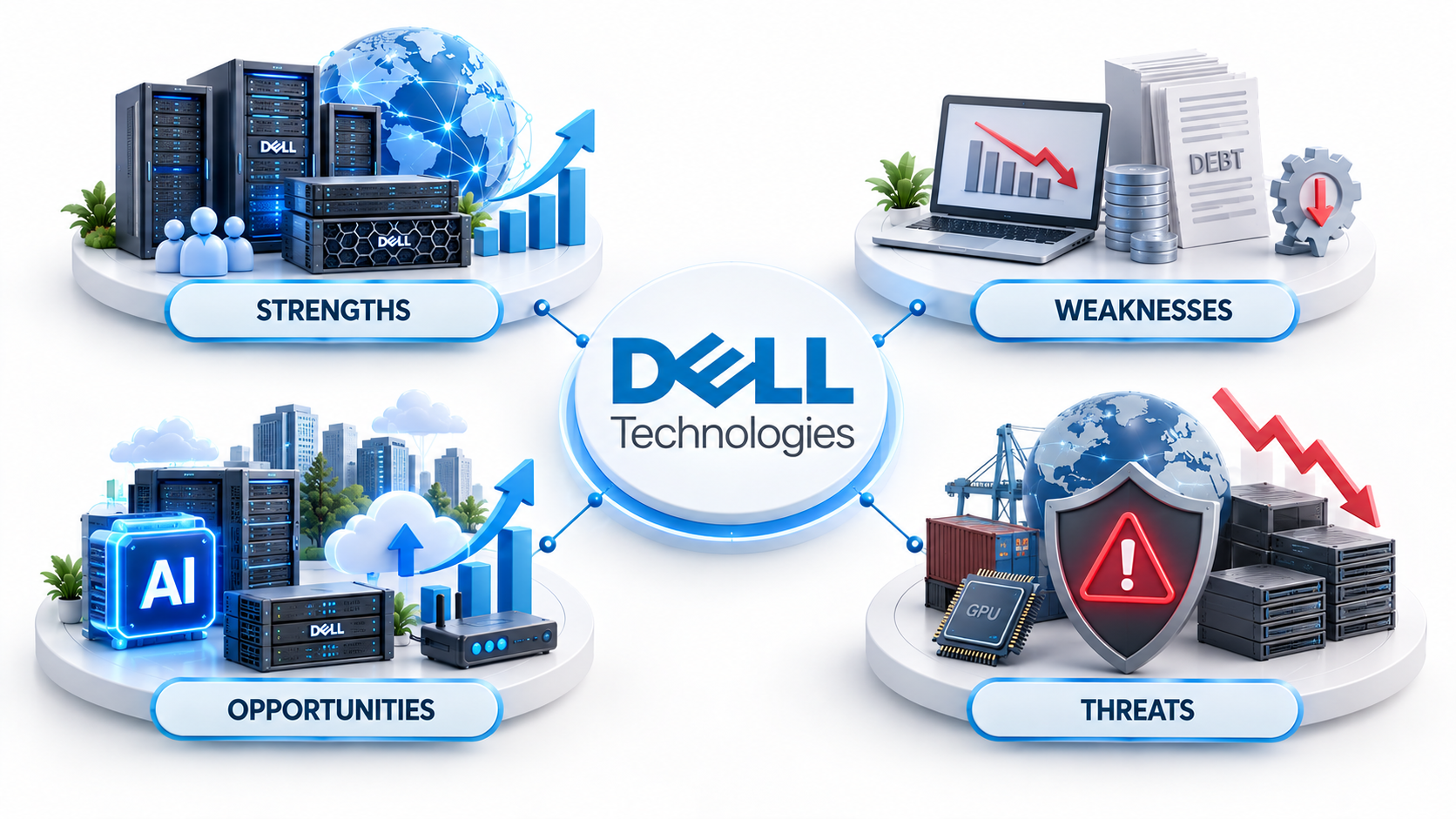
A SWOT analysis of Dell sorts the company into four boxes: internal strengths, internal weaknesses, external opportunities, and external threats. Strengths and weaknesses are things Dell controls and could change with enough time and money. Opportunities and threats exist whether Dell likes them or not. The table below is the compressed version, and every line in it gets expanded later with the reasoning and the numbers behind it.
The Four Boxes, Summarised
| Strengths | Weaknesses |
|---|---|
| Direct, build-to-order model with negative cash conversion cycle | Low gross margin, 21.1% in Q2 FY27 |
| No. 1 position in mainstream servers and external storage | Heavy exposure to a PC market forecast to shrink in 2026 |
| $95 billion AI backlog as of Q2 FY27 | Thin AI server margins that dilute overall profitability |
| Deep enterprise relationships plus Dell Financial Services | Debt legacy from the $67 billion EMC acquisition |
| Engineering and deployment capability for large GPU clusters | R&D spend small relative to chip and cloud rivals |
| Global services and ProSupport attach revenue | Weak consumer ecosystem and no mobile presence |
| Opportunities | Threats |
|---|---|
| FY27 AI server revenue guided toward roughly $50 billion and later raised | DRAM and NAND shortage driving component costs up 90%+ per quarter |
| Sovereign AI and neocloud buildouts across regions | IDC scenarios pointing to PC shipment declines of 5% to 11% in 2026 |
| Windows 10 end-of-support refresh cycle still unfinished | Hyperscalers and ODMs bypassing branded server vendors |
| Edge and on-premises inference workloads | Price competition from Supermicro, HPE and Lenovo in AI servers |
| Storage modernisation with Dell IP products like PowerStore | Nvidia dependence for GPU allocation and roadmap timing |
| Recurring revenue through APEX subscription models | Tariffs, export controls and geopolitical supply chain risk |
How to Read a SWOT Analysis Without Fooling Yourself
The mistake nearly everyone makes is treating all six bullets in a box as equally important. They are not. Dell’s brand recognition is a genuine strength and it is worth maybe nothing in a bid where the buyer is a neocloud startup comparing price per GPU hour. Meanwhile the $95 billion backlog is worth more than every other strength on the list combined, because it converts future revenue from forecast to schedule.
So rank them. Ask one question of every item: if this factor disappeared tomorrow, how much revenue or margin moves? Brand disappearing costs Dell something small and slow. The backlog disappearing costs Dell its entire growth story. Same box, wildly different weight. Good analysis says so out loud instead of pretending the list is flat.
The second trap is confusing internal and external. Memory prices rising is a threat, external, nobody at Dell chose it. Dell’s decision to keep selling entry-level configurations with less RAM instead of exiting the segment is internal, and it belongs in strengths or weaknesses depending on whether it works. Students mix these constantly, and graders notice.
Strengths
Dell’s core strengths are its direct build-to-order model, a supply chain that runs on a negative cash conversion cycle, leadership positions in mainstream servers and external storage, an AI infrastructure order book worth $95 billion as of Q2 FY27, and enterprise relationships backed by its own financing arm. These are not brand adjectives. Each one shows up in a specific line of the financial statements, and each one is explained below with the mechanism that makes it work.
The Direct Model and Configure-to-Order Manufacturing
Dell takes the order, then builds the machine. That sequence, which sounds like an operational detail, is the foundation of everything else. A retailer-first competitor has to guess demand months ahead, manufacture into that guess, ship product to shelves, and eat the discounting when the guess is wrong. Dell’s model collapses that guessing window, which is why its inventory risk during component price swings is structurally lower than a pure channel player’s.
Configure-to-order also does something subtle to revenue quality. When a buyer picks 64GB of memory instead of 32GB, or a discrete GPU instead of integrated graphics, Dell captures the upgrade at full margin without a retailer clipping the ticket. Dell’s own filings attribute part of its FY26 commercial revenue growth to “richer configurations,” which is corporate language for customers ticking more boxes at checkout.
The part most guides skip: the direct model is also a data asset. Every configuration choice, every refresh cycle timing, every support ticket lands in Dell’s own systems rather than a distributor’s. That feeds forecasting accuracy, which feeds supply planning, which feeds the cash cycle advantage in the next point. The model compounds.
A Supply Chain That Gets Paid Before It Pays
Dell has historically operated with a negative cash conversion cycle, meaning customers pay Dell before Dell pays its suppliers. Plain language version: Dell collects the money for a laptop in days, holds inventory for a short window, and settles supplier invoices weeks later. The gap between those events is free working capital. Suppliers are, in effect, financing Dell’s growth without charging interest for it.
Scale that mechanism across $113.5 billion in FY26 revenue and it becomes a real weapon. Dell reported record FY26 cash flow from operations of $11.2 billion and returned $7.5 billion to shareholders through buybacks and dividends in the same year, repurchasing roughly 54 million shares. A company with a positive cash cycle at that revenue level would need a far larger financing structure to do the same thing.
There is a catch worth naming now rather than hiding in the weaknesses box. A negative cash cycle works beautifully when component prices are stable or falling, which was the semiconductor industry’s normal state for decades. When memory prices rise 90% in a quarter, holding low inventory means buying at the new higher price rather than the old lower one. The advantage does not vanish, but it stops being free.
Market Leadership in Servers and External Storage
Dell holds the number one position in mainstream server revenue and in external enterprise storage, and leadership in those categories does something specific: it makes Dell the default vendor on the shortlist. Enterprise procurement teams rarely evaluate every option. They evaluate the incumbent plus two challengers. Being the incumbent in the server room is worth more than any advertising campaign, because it puts Dell in the room before the bidding starts.
The FY26 numbers show why that matters even in the non-glamorous parts of the portfolio. Traditional servers and networking grew 9% to $19.5 billion, and Dell’s filings credit higher average selling prices from richer configurations rather than unit growth. Then in Q2 FY27, traditional server and networking revenue jumped 122% to $10.5 billion in a single quarter. An install base that aged out during the 2022 to 2024 spending pause finally started refreshing, and Dell captured it because it was already there.
The $95 Billion AI Backlog
This is the strongest single item in the entire SWOT analysis of Dell, and it is worth stating precisely. In FY26 Dell closed more than $64 billion in AI-optimized server orders, shipped more than $25 billion, and entered FY27 with a $43 billion backlog. Then in Q2 FY27 alone, Dell booked a record $60.9 billion in AI orders, recognised $16.4 billion of AI server revenue, and exited the quarter with a $95 billion backlog.
Backlog is not the same thing as revenue, and anyone writing this analysis should say so. Orders can be cancelled, rescheduled, or repriced. But a backlog of that size changes the nature of the business. Dell is no longer trying to find demand, it is trying to schedule supply against demand that already signed. That is a completely different management problem, and a much better one.
The reason Dell wins these deals is worth understanding rather than assuming. Building a large GPU cluster is not a matter of shipping boxes. It involves liquid cooling, power density engineering, rack-scale integration, network fabric design, and deployment teams that can stand up thousands of nodes on a deadline. Dell’s leadership has repeatedly pointed to bespoke engineering and rapid deployment of large complex clusters as the reason it wins, and that capability is genuinely hard to copy in eighteen months.
Enterprise Relationships Plus Dell Financial Services
Dell sells to a large share of the world’s biggest enterprises, and those relationships come with switching costs that have nothing to do with product quality. A bank running Dell PowerEdge servers, Dell storage, Dell laptops, and Dell support contracts has standardised its operational processes, staff training, and procurement systems around one vendor. Swapping out one layer means renegotiating all of them.
Dell Financial Services adds a second lock. When Dell can finance a $40 million infrastructure purchase itself, the buyer’s CFO objection about capital expenditure shifts into an operating expense conversation. Deals that would stall on budget timing close instead. Competitors without a captive financing arm have to involve a third-party lessor, which adds friction, time, and another party’s credit approval into the cycle.
Portfolio Breadth From Alienware to PowerMax
Very few companies can sell a gaming laptop and a petabyte-scale storage array under one contract. Dell’s range runs from Alienware and XPS at the consumer end, through Latitude, OptiPlex and Precision on the commercial side, into PowerEdge servers, and then PowerStore, PowerMax and PowerScale in storage. That breadth means Dell can bundle, and bundling is how hardware vendors protect price.
Breadth also spreads risk across demand cycles that do not move together. Consumer PC revenue fell 8% in FY26 while AI servers rose 166%. A pure consumer PC company would have had a bad year. Dell had a record one. That diversification is a real strength, though it comes with a matching weakness covered later: managing two businesses with opposite economics inside one P&L is genuinely hard.
Services, Support and the Attach Revenue Engine
Every server Dell ships can carry a ProSupport contract, deployment services, and managed service options behind it. Services revenue is stickier than hardware revenue because it renews on a schedule instead of waiting for a refresh cycle, and it typically carries better margin than the box it attaches to. For a company fighting a 21.1% gross margin, attach rates are one of the few levers that move profitability without needing the hardware price to rise.
Global support reach matters even more in the AI business. A neocloud operator deploying clusters across three continents needs someone who can physically show up. Dell’s support footprint is one of the reasons enterprise and sovereign buyers pick a branded vendor over a cheaper contract manufacturer, and it is an argument that gets stronger as cluster complexity increases.
Brand Trust in the Commercial Buying Decision
Dell’s brand does not work the way Apple’s does, and treating the two the same is a common analytical error. Nobody queues overnight for a Latitude. What Dell’s brand buys is procurement confidence: an IT manager choosing Dell for 4,000 endpoints is making a decision nobody will question if something goes wrong. That is defensive brand value, and in B2B it is worth more than desirability.
The proof is in the mix. Commercial client revenue of $44.1 billion versus consumer revenue of $6.9 billion in FY26 tells you exactly where the brand converts. Dell’s strength is with buyers who care about fleet management, security compliance, driver stability over a three-year deployment, and having one throat to choke when a batch of machines misbehaves. Those are unglamorous attributes. They are also the ones that print $44 billion.
Weaknesses
Dell’s main weaknesses are structurally low margins, a profit mix that gets worse as its fastest-growing business grows, dependence on a PC market entering a contraction, debt inherited from the EMC deal, R&D spending that is small next to its most important suppliers, and almost no consumer ecosystem to fall back on. Each weakness below is internal, meaning Dell could in principle fix or mitigate it, which is exactly what separates this box from the threats box.
The Margin Problem Hiding Inside the Growth Story
Dell’s Q2 FY27 gross margin was 21.1%. Revenue grew 58% that quarter and net income jumped 189%, so the headline looked spectacular, but the percentage tells a different story about what kind of company Dell is becoming. Hardware assembly at scale is a thin-spread business, and the more Dell sells of its fastest-growing product, the thinner the blended spread gets.
Look at what actually happened to segment profitability in FY26. ISG revenue grew 40% while ISG operating margin fell from 12.8% to 11.7%. CSG revenue grew 5% while CSG operating margin fell from 6.1% to 5.6%. Both segments got bigger and both got less profitable per dollar. That is the signature of a mix shift toward lower-margin products combined with rising input costs, and no amount of revenue celebration makes it disappear.
Why it happens is mechanical. In an AI server, the GPU is the expensive part, and Nvidia captures most of the value in that component. Dell adds integration, cooling, networking, deployment and support, then sells the whole assembly. The bill of materials is enormous relative to the value Dell adds on top, so even a well-executed deal produces a modest percentage.
AI Server Economics Dilute Overall Profitability
This deserves its own point because it is the most misunderstood part of any current SWOT analysis of Dell. Selling more AI servers grows absolute profit dollars while shrinking profit percentages. In Q2 FY26, Dell’s gross margin fell to 18.7% from 22% a year earlier, with management pointing to one-time supply chain expenses and aggressively priced early Blackwell-generation deals as the cause.
Dell’s own answer to this has been value engineering, better scale economics, and shifting the customer mix toward enterprise buyers who pay more for integration than a neocloud buying raw capacity does. By Q2 FY27 the gross margin rate had recovered to 21.1% with operating income at 12.6% of revenue, so the fix is working. But the underlying constraint has not changed: the customer with the biggest order also has the most negotiating power.
The honest framing for any analysis is this. Dell is winning enormous revenue in a category where it is not the primary value capturer. That is a viable business. It is not a moat, and the difference matters when you are forecasting five years out instead of two quarters.
Dependence on a PC Market That Is Shrinking
CSG still produced $51.0 billion in FY26, roughly 45% of total revenue. That business is now facing the worst pricing environment in years. IDC’s scenarios for 2026 have ranged from a moderate 5% shipment decline to a pessimistic 11.3% contraction, driven almost entirely by component costs rather than weak demand.
Dell’s exposure here is structural, not temporary. Nearly half the revenue base sits in a category where unit volumes are falling, average prices are being pushed up by costs rather than by added value, and the buyer has the option to simply extend the refresh cycle another year. Commercial buyers delayed purchases through 2022 to 2024 for exactly that reason, and they can do it again.
Debt and Capital Structure Legacy From EMC
The $67 billion EMC acquisition in 2016 gave Dell storage leadership and a debt load that took years to work down. The VMware spinoff in 2021 helped, delivering roughly $9.3 billion that went substantially toward deleveraging, and record FY26 cash flow of $11.2 billion gives Dell far more room than it had five years ago.
Still, carrying significant debt while running a business that needs to fund enormous working capital swings is a real constraint. Building $95 billion of backlog requires buying components before customers pay. In a market where memory suppliers demand prepayment or long-term commitments, the company with the cleanest balance sheet has the most flexibility, and Dell is not that company.
R&D Spending That Is Small Next to Its Suppliers
Dell spends a few billion dollars a year on research and development. Nvidia, Apple, Microsoft and Amazon each spend multiples of that. This is not a criticism of Dell’s engineering, which is genuinely strong in system design, thermals, and rack-scale integration. It is a statement about where Dell sits in the value chain: Dell engineers around other people’s silicon rather than creating the silicon.
The consequence shows up in pricing power. When the differentiating component is a GPU that every competitor can also buy, differentiation has to come from integration quality, deployment speed, and service, all of which are real but all of which are easier to match than a semiconductor roadmap. Dell’s storage software portfolio, PowerStore and PowerMax and PowerScale, is the main exception, which is exactly why Dell keeps emphasising “Dell IP” storage in its results commentary.
No Consumer Ecosystem and No Mobile Presence
Dell sells hardware. Apple sells hardware wrapped in an operating system, an app store, a services subscription bundle, and a device ecosystem that makes leaving expensive. Consumer revenue of $6.9 billion in FY26, down 8%, shows what happens when you compete in premium consumer without ecosystem lock-in: you compete on specification and price, and that fight never ends.
Dell exited smartphones years ago and there is no realistic path back. That closes off the consumer services revenue that funds Apple’s margins and, separately, it means Dell has no recurring consumer touchpoint between refresh cycles. A buyer who purchases an XPS has no reason to interact with Dell again for three years. Apple has a reason every month.
Customer Support Reputation in the Consumer Segment
Dell’s enterprise support is a genuine strength, as covered earlier. Consumer support is a different experience, and complaints about long wait times, warranty escalation loops, and inconsistent quality show up consistently in forums and review sites. The gap is not an accident: enterprise contracts pay for service levels, consumer purchases do not, and the economics flow accordingly.
The weakness is reputational rather than financial in the short term. In the long term it feeds the consumer revenue decline, because the person who had a bad warranty experience with a Dell laptop makes a different choice next time and tells other people about it. For a segment already shrinking 8% a year, that is not a problem to leave unattended.
Managing Two Businesses With Opposite Economics
This weakness rarely appears in published analyses, which is odd because it explains several others. ISG runs on long sales cycles, custom engineering, and 11.7% margins. CSG runs on volume manufacturing, channel logistics, and 5.6% margins. They need different talent, different supply chain behaviour, and different capital allocation rhythms.
When both compete for the same scarce memory supply, leadership has to choose. Allocate DRAM to AI servers with a signed backlog, or to laptops that keep the commercial relationship intact? Dell reported supply constraints across DRAM, NAND and certain CPUs in Q2 FY27, which means that choice is being made right now, quarter by quarter. Whichever way it goes, one side of the house loses.
Opportunities
The opportunities in a SWOT analysis of Dell are unusually concrete right now, because several of them already have signed orders attached. The main ones are AI infrastructure at data centre scale, sovereign and neocloud buildouts, the unfinished Windows 10 replacement cycle, enterprise storage modernisation, on-premises inference at the edge, and recurring revenue through subscription models. Each is external, meaning Dell can pursue it but did not create it.
AI Infrastructure Demand That Is Already Booked
Most opportunity sections in SWOT analyses are speculation. This one is arithmetic. Dell guided FY27 AI-optimized server revenue to roughly $50 billion at the start of the year, then raised full-year total revenue guidance by $25 billion to $192 billion after Q2, with non-GAAP EPS guidance of $25.50. That revision did not come from a forecast model, it came from orders landing faster than the model assumed.
The scale of the opportunity is easier to grasp in comparison. AI-optimized servers generated $1.9 billion in FY24. By FY26 that was $24.7 billion. Two fiscal years, roughly thirteen times bigger. Very few businesses at Dell’s size have a product line that moves like that, and the constraint on it is not demand, it is supply and deployment capacity.
The execution risk sits in the same place. Converting a $95 billion backlog requires GPU allocation, memory, power, cooling, and field engineers. Every one of those is contested. The opportunity is real and it is also the hardest logistics problem Dell has ever taken on.
Sovereign AI and Neocloud Customers
Dell’s own commentary has described its AI pipeline as a mix of neocloud, sovereign and enterprise customers. That mix matters more than the total. Neoclouds are GPU rental companies that buy enormous clusters and squeeze hard on price. Sovereign AI buyers are governments building national compute capacity, and they buy for reasons that are not purely economic: data residency, security, and independence from foreign cloud providers.
Sovereign deals suit Dell specifically. A government building domestic AI capacity needs on-premises hardware, local deployment support, and a vendor willing to build to an unusual specification. That is exactly the bespoke engineering capability Dell keeps citing as its differentiator, and it is not a fight that cloud providers can win, because the entire point of the purchase is not using someone else’s cloud.
The Windows 10 Refresh That Has Not Finished
Microsoft ended mainstream support for Windows 10 in October 2025, which created a hard deadline for millions of corporate machines. That refresh has run slower than the industry hoped, but it has not gone away. Commercial client revenue grew 22% year over year to $13.2 billion in Q2 FY27, with Dell’s own filings attributing improved CSG margin to disciplined pricing rather than volume alone.
Here is the interesting part. The memory shortage that is hurting Dell’s cost base is also compressing the value end of the market, and large vendors with supply contracts and inventory leverage are better placed to survive that than small or regional builders. IDC has said as much: market share should shift toward the largest vendors while white-box and lower-tier builders absorb the worst of the shortage. A shrinking market can still be a share-gain opportunity.
Storage Modernisation and Dell IP Products
Storage was the quiet disappointment of FY26, growing just 1% to $16.6 billion. Then it grew 26% to $4.85 billion in Q2 FY27. That turn matters because storage carries better margin than servers and because AI workloads eventually need somewhere to keep their data. Training data, checkpoints, vector indexes, inference outputs, all of it lands on storage.
Dell’s advantage here is software it owns rather than components it buys. PowerStore, PowerMax and PowerScale are Dell IP, which means the margin does not leak to a component supplier the way it does in a GPU server. Management has repeatedly flagged Dell IP storage demand outgrowing the broader market, and if AI infrastructure spending pulls storage attach along with it, that is the single best margin opportunity in the portfolio.
Edge Computing and On-Premises Inference
Training giant models happens in a small number of enormous data centres. Running them does not. Inference wants to be near the user for latency, near the data for privacy, and inside the building for regulatory reasons. A hospital running diagnostic models on patient scans, a factory running defect detection on a production line, a retail chain running demand forecasting across 900 stores: none of those are natural cloud workloads.
That is Dell’s home turf. The company already sells the servers, already has the enterprise relationships, and already handles distributed deployment at scale. The opportunity is less headline-grabbing than a $60 billion order, and it is probably more durable, because edge deployments come with refresh cycles, support contracts, and management software attached.
Recurring Revenue Through Subscription Infrastructure
Dell’s APEX portfolio sells infrastructure as a consumable service rather than a capital purchase. Customers pay for capacity used, Dell owns and manages the hardware. For buyers, that turns a large upfront commitment into a predictable monthly cost. For Dell, it turns a lumpy transaction into recurring revenue, which is the kind of revenue stock markets value at higher multiples.
The strategic value is in smoothing the cycle rather than in the revenue itself. Dell’s biggest weakness is exposure to purchasing decisions that customers can postpone. Subscription contracts make postponement harder, because the relationship is continuous instead of episodic. Migration from a capital model to a consumption model takes years and depresses reported revenue while it happens, which is precisely why it belongs in opportunities rather than strengths.
Services Attached to AI Deployments
Every AI cluster Dell ships is a services opportunity that most analyses ignore. Designing the network fabric, planning power and cooling, validating the stack, keeping thousands of GPUs running, retiring and replacing failed nodes: customers buying their first cluster have none of these skills in-house. Professional services, managed services and multi-year support contracts attach naturally to that gap.
This matters because services margin is not constrained by the bill of materials. A GPU costs what Nvidia charges. A deployment engagement is priced on expertise. As the installed base of AI hardware grows, the attached services base grows with it, and that is one of the few structural routes Dell has to raise blended margin without raising hardware prices.
Threats
The biggest external threats to Dell are the memory shortage driving component costs to record levels, a contracting PC market, hyperscalers and contract manufacturers bypassing branded vendors entirely, aggressive price competition in AI servers, dependence on Nvidia’s roadmap and allocation decisions, and geopolitical disruption to a supply chain that spans a dozen countries. These are things happening to Dell. The strategy question is not how to stop them, it is how to absorb them.
The Memory Shortage Is the Defining Threat of 2026
This is not a background risk, it is the main event. AI data centre demand pulled DRAM and NAND capacity away from consumer devices, and prices went vertical. Reports through the cycle described DDR5 rising 70% year over year with some parts spiking far higher, then Q1 2026 delivering quarter-on-quarter increases in the 90% range, a spike with no real precedent.
The cost structure of a PC changed as a result. Memory used to be roughly 15% to 18% of a machine’s bill of materials. HP told investors that figure had reached 35%, making memory the single biggest cost line in building a computer. Dell’s own COO Jeff Clarke said publicly that he had never seen memory costs rise that fast, and Dell raised list prices 17% on 30 March 2026, then raised them again in the weeks that followed. Quote validity on server configurations shortened to as little as one to two weeks.
Look at what actually happens to a business when this occurs. Dell cannot absorb the cost without destroying margin, and it cannot pass it all through without killing demand. So it does both partially, ships entry configurations with less memory, and quietly retreats from the cheapest segments. Analysts expect elevated pricing to persist into 2027, which means this threat is not a quarter-long inconvenience.
PC Market Contraction and Demand Destruction
Higher prices shrink markets. IDC’s 2026 scenarios have run from a moderate 5% decline to a pessimistic 11.3% contraction in PC shipments, with Gartner in a similar range, and the cause is affordability rather than lack of need. A business planning to refresh 5,000 machines at $900 each looks at a 17% increase and refreshes 3,000 instead, or waits.
For Dell, with roughly 45% of revenue in CSG, that is a direct hit to nearly half the business. The mitigation is real but partial: commercial buyers have a Windows deadline, large vendors have better supply access than small ones, and disciplined pricing has actually pushed CSG operating margin up to 7.6% in Q2 FY27. Dell is managing this threat well. It is still a threat.
Hyperscalers and ODMs Cutting Out the Middle
The largest AI buyers do not need a brand on the front of the rack. Amazon, Google, Microsoft and Meta design their own servers and have them built by original design manufacturers like Quanta, Foxconn and Wistron. Every one of those racks is a rack Dell never got to quote on, and those buyers represent the largest concentration of AI infrastructure spending in the world.
The threat extends downward too. As neocloud operators mature, they gain the internal engineering capability that made them hire Dell in the first place. The second cluster is easier than the first, and the fifth is a procurement exercise. Dell’s defence is to keep the engineering value high enough that buying direct looks like a false economy, through liquid cooling design, rack-scale integration and deployment speed. That defence works until the customer’s own team catches up.
Price Competition in AI Servers
Supermicro built its business on getting new GPU platforms to market fast at aggressive prices. HPE has the enterprise relationships and the same access to Nvidia silicon. Lenovo competes hard on cost. When four vendors are assembling similar components into similar racks, the buyer runs an auction, and auctions compress margins.
Dell has already felt this. Management attributed part of the Q2 FY26 gross margin drop to competitively priced early Blackwell deals, which is a polite way of saying the first big contracts of a new GPU generation get bid thin to win reference customers. Every GPU generation resets that dynamic. The threat is not one bad quarter, it is a recurring pattern tied to the product cycle.
Dependence on Nvidia’s Roadmap and Allocation
Dell’s AI business runs on silicon Dell does not make. That creates three separate exposures. Allocation: if Nvidia prioritises other customers, Dell’s backlog slips regardless of how many orders it holds. Timing: when a new architecture ships late, Dell’s revenue recognition moves with it. Pricing: the supplier capturing most of the value in the box has the leverage in any negotiation.
Dell mitigates this by supporting AMD and Intel accelerators and by building differentiation in the parts it does control. That helps. It does not change the basic position, which is that the most valuable component in Dell’s fastest-growing product is designed, priced and allocated by someone else. Any serious SWOT analysis of Dell has to name this as a top-tier threat rather than a footnote.
Public Cloud Migration in the Traditional Business
The long-running shift of enterprise workloads to AWS, Azure and Google Cloud has not stopped. Every application that moves from a company’s own data centre to rented infrastructure reduces the demand for servers and storage arrays with a Dell badge. Dell’s storage growth of 1% in FY26 is partly that story.
The counter-trend is repatriation. Companies that ran up unpredictable cloud bills have moved steady-state workloads back on-premises, where owning hardware is cheaper at consistent utilisation. Dell benefits from that swing and has said as much through its traditional server growth commentary. But repatriation is a correction within a larger migration, not a reversal of it, and analysis that treats it as a durable tailwind is being optimistic.
Tariffs, Export Controls and Supply Chain Geopolitics
Dell manufactures and sources across China, Malaysia, Mexico, Poland, India, Vietnam and elsewhere. Tariff changes, export controls on advanced chips, and shifting trade rules each create cost and planning risk that no amount of operational excellence fully neutralises. Restrictions on where high-end accelerators can be shipped directly affect which sovereign AI deals are even legal to pursue.
The company’s response has been multi-region manufacturing and supply diversification, which lowers concentration risk while adding complexity and cost. There is no clean fix here. This threat belongs in the box permanently, reviewed every year, because the variable being managed is government policy rather than anything a supply chain team controls.
Cybersecurity and Data Incidents
For a company selling infrastructure to banks, hospitals and governments, a security incident carries reputational damage far beyond its direct cost. Dell has faced data exposure incidents involving customer information in the past, and the enterprise buyer’s calculation is simple: if the vendor cannot secure its own systems, why trust it with the hardware running yours?
The broader threat is supply chain security, including firmware integrity and component provenance. Enterprise and government procurement increasingly audits these things directly. That raises Dell’s compliance cost, and it also creates an opening, because vendors who handle it well gain an advantage over cheaper competitors who cannot pass the audit at all.
What the SWOT Analysis of Dell Means for Strategy: The TOWS Matrix
A SWOT analysis on its own does not produce a decision. It produces a list. The TOWS matrix fixes that by pairing the boxes: strengths with opportunities, weaknesses with opportunities, strengths with threats, and weaknesses with threats. Four pairings, four strategy types. This is the part that separates a description of Dell from an argument about what Dell should do, and it is usually what earns the marks in an assignment.
SO Strategy: Use Strengths to Capture Opportunities
Dell’s deployment engineering and global support capability meet the sovereign and enterprise AI opportunity almost perfectly. The play is to push hard into buyers who need bespoke clusters built and supported on-site, where price sensitivity is lower than in the neocloud segment and where the value of Dell’s engineering is visible in the specification, not buried in a spreadsheet comparison.
The second SO move is attaching Dell IP storage to every AI deal. Dell already owns the customer relationship at the moment the compute order is signed. Selling PowerScale or PowerStore into that same project raises deal margin without needing a higher server price, which directly addresses the profitability weakness using an existing strength.
WO Strategy: Fix Weaknesses to Unlock Opportunities
Dell’s margin weakness limits how much it can invest while chasing the AI opportunity. The corrective move is mix management: prioritise enterprise and sovereign orders over the thinnest neocloud deals, expand services attach, and keep pushing value engineering on the hardware itself. Dell’s gross margin recovery from 18.7% in Q2 FY26 to 21.1% in Q2 FY27 shows this is not theoretical.
The other WO move is the subscription transition. Dell’s weakness is revenue that customers can delay. Recurring consumption contracts convert that into a continuous relationship, which also smooths the cash flow needed to fund working capital during a component price shock. It is slow and it dents reported revenue in the short term, which is exactly why it needs to be a deliberate decision rather than a drift.
ST Strategy: Use Strengths to Defend Against Threats
Against the memory shortage, Dell’s strength is scale and supplier leverage. Large vendors get allocation that small ones do not, so the defensive play is to press that advantage: lock long-term memory contracts, concentrate scarce supply into the highest-margin configurations, and let the unprofitable entry-level segment go rather than fight for it at negative contribution.
Against hyperscalers and ODMs, the defence is engineering depth. Dell cannot win on price against a contract manufacturer with no brand overhead, so it has to make the integration work valuable enough that building in-house looks slower and riskier. Liquid cooling, power density, cluster validation and time-to-first-token are the battleground, not cost per node.
WT Strategy: Minimise Exposure Where You Are Weak and Exposed
The worst quadrant for Dell is consumer PCs during a memory shortage: low margin, shrinking demand, rising costs, no ecosystem lock-in, and weaker support economics. The rational answer is retreat, not investment. Concentrate consumer effort on the segments that still hold price, meaning Alienware and premium XPS-class machines, and stop chasing volume at the bottom.
The second WT exposure is concentration in AI orders. A large backlog held by a small number of customers is fragile, because one cancellation moves the number badly. Diversifying across enterprise, sovereign and neocloud buyers is the mitigation, and Dell’s own description of its pipeline suggests management already treats this as a live risk rather than a hypothetical one.
How to Write a SWOT Analysis of Dell for an Assignment or Interview
If you have been asked to produce this analysis for a class, a case study round, or a competitive briefing at work, the difference between an average answer and a strong one is not how many bullets you list. It is whether each point has a number, a mechanism, and a consequence attached. Here is the working method, step by step, using Dell as the example. The same process transfers to any listed company, which is why running a few of these is one of the fastest ways to learn how businesses actually work.
Step 1: Pull the Primary Sources Before Reading Any Summaries
Start with the company’s 10-K annual filing and the most recent quarterly press release on the investor relations site. For Dell that means investors.delltechnologies.com and the SEC EDGAR database. The segment tables in the 10-K, the ones showing ISG and CSG revenue and operating income by fiscal year, give you more usable material in two pages than a dozen blog posts will.
Read the risk factors section too. Companies are legally required to disclose what could go wrong, which means the threats box is literally written for you by the company’s own lawyers. Most students skip it because it is long and dry. It is also the single highest-yield source in the entire document.
Step 2: Separate Internal From External Without Guessing
Use one test. If the company’s own leadership could change this factor within a few years by making a decision, it is internal, so it belongs in strengths or weaknesses. If it would still be true regardless of what the company decides, it is external, so it belongs in opportunities or threats.
Apply it to Dell. Low gross margin is internal, because pricing, mix and cost structure are Dell’s choices. The memory shortage is external. Dell’s decision to raise list prices 17% in response is internal again. Getting this boundary right is what stops a SWOT from turning into two lists of good things and bad things.
Step 3: Attach a Number to Every Point You Can
“Strong server business” is a claim. “ISG revenue of $60.8 billion in FY26, up 40%, with AI-optimized servers at $24.7 billion” is evidence. Whenever a point resists quantification, ask whether it belongs at all. Some genuinely do, like brand trust or culture, but they should be the minority.
The numbers also protect you in an interview. If someone challenges your point, a figure from a filing ends the argument. An adjective invites more questions you cannot answer, which is exactly the situation you want to avoid three minutes into a case discussion.
Step 4: Rank Every Item by Financial Impact
Take each box and order the items by how much revenue or margin they move. For Dell, the $95 billion backlog sits at the top of strengths, and brand recognition sits near the bottom. In threats, the memory shortage tops the list because it is actively reshaping the cost structure of half the company, while cybersecurity risk sits lower because its expected financial impact is smaller and less certain.
State the ranking explicitly in your write-up. One sentence, something like “the two factors that matter most here are X and Y, and the rest are second-order.” Examiners and interviewers read that as judgement rather than recall, and judgement is what the exercise is actually testing. Looking at how other companies have been analysed in published business case studies is a fast way to calibrate what good ranking looks like.
Step 5: Convert the Analysis Into Recommendations
Finish with three recommendations that follow from the TOWS pairings, each with a rough timeframe. For Dell: prioritise enterprise and sovereign AI deals over thin neocloud volume in the next twelve months, accelerate storage attach on every AI project, and manage the consumer PC business for margin rather than share while memory prices stay elevated.
Each recommendation should trace back to specific boxes. That traceability is the proof your analysis did work rather than decoration. A SWOT that ends without recommendations is an unfinished piece of work, and it reads that way.
Step 6: Date Your Analysis and Say What Would Change It
Write the as-of date at the top, based on the most recent quarter you used. Then add two or three sentences on what would invalidate your conclusions: a collapse in AI capital spending, memory prices normalising faster than expected, or a large AI order cancellation.
This habit is what analysts call stating your assumptions, and it is rare enough in student work that it stands out immediately. It also makes the analysis honest. A SWOT built on Q2 FY27 data is a snapshot, and pretending otherwise is the fastest way to be confidently wrong six months later.
Marketing Lessons Hiding Inside Dell’s Direct Model
Dell is usually studied as an operations case. That is a mistake, because the most transferable lessons in the company’s history are marketing ones. Dell ran a direct-to-customer business in 1984, took its business online early, survived one of the first major social media crises, and built a B2B content and configuration engine that still converts. Here is what actually transfers to anyone building a brand today, whether that is a small D2C label or a service business.
Owning the Customer Relationship Beats Renting It
Selling direct means the transaction, the data, and the follow-up all belong to Dell. No retailer sits between the company and the buyer deciding what gets promoted. That is the same argument behind every D2C brand launched in the last decade, except Dell was running it before most of those founders were born.
The practical lesson for a smaller business is about where the relationship lives. If every sale happens on a marketplace, the marketplace owns the customer list, controls the pricing environment, and can promote a competitor on your own product page. Owning the channel costs more upfront in traffic acquisition and pays back in margin, data and pricing control. Dell’s commercial business is a fifty-billion-dollar demonstration of that trade.
Segmentation Done Properly, Not Just Labelled
Dell does not run one marketing motion. It runs several, split by buyer type, and the product naming makes the segmentation visible: Latitude and OptiPlex for business fleets, Precision for workstation users, XPS for premium consumers, Alienware for gaming, PowerEdge and PowerStore for the data centre. Different buyers, different sales cycles, different messages, different channels entirely.
Most beginner marketing plans claim segmentation and then produce one message for everybody. Look at what Dell actually does: the enterprise buyer gets a named account manager, a configuration portal, financing terms and a support SLA. The gaming buyer gets performance benchmarks and product launches. Neither would respond to the other’s material. Real segmentation changes the offer, not just the ad copy.
The “Dell Hell” Episode and Why Listening Became a Function
In 2005, blogger Jeff Jarvis wrote a series of posts about his experience with Dell’s customer support that spread across the early blogosphere and stuck to the brand under the name “Dell Hell.” The company’s initial response was the standard corporate one, which made it worse. Then Dell did something genuinely unusual for the time: it started engaging in public, launched the IdeaStorm community in 2007 to collect customer suggestions, and later built a dedicated social media listening operation.
The lesson is not “respond to complaints.” It is that a public complaint from one credible person can outrank your own marketing in search results and shape what a buyer sees before they ever reach your site. Monitoring what gets said about your brand is part of search and reputation work, not a separate PR activity, and treating it as optional is how a bad week turns into a permanent search result.
Configuration as a Conversion Tool
Dell’s product pages let a buyer change processor, memory, storage and warranty, watching the price move in real time. That is not a technical feature, it is a conversion mechanism. It keeps the buyer engaged, surfaces upsells at the exact moment of decision, and produces a record of what people wanted versus what they bought.
The same principle applies at a much smaller scale. A pricing page with a slider, a service quote calculator, or a package builder gets people interacting instead of reading, and interaction predicts purchase far better than time on page does. Plenty of free calculators and web tools can be adapted to do this without a developer. The reason it works for Dell is the reason it works everywhere: people commit to configurations they built themselves.
Mistakes People Make in a SWOT Analysis of Dell
Having read a lot of these, the same errors repeat. They are easy to avoid once named, and avoiding them is most of the gap between a generic answer and a good one.
Treating Dell as a Consumer PC Company
The single most common mistake. Consumer revenue was $6.9 billion of $113.5 billion in FY26, roughly 6% of the business, and it is shrinking. Any analysis built around Dell’s competition with Apple in laptops is analysing a rounding error while ignoring the $60.8 billion infrastructure segment that drives the entire story.
Using Numbers That Are Two Years Stale
Dell’s business changed shape between FY25 and FY27. An analysis citing FY25 revenue of $95.6 billion as current in late 2026 misses a 17% growth year and a doubling of the AI business. Always pull the latest quarter, and say which one you used.
Confusing Revenue Growth With Health
Revenue grew 58% in Q2 FY27. Segment margins in FY26 fell in both divisions. Both facts are true, and an analysis that reports only the first one is cheerleading. The interesting question in any hardware business is always what the growth costs, not how big the growth is.
Listing Generic Strengths That Apply to Any Large Company
“Global presence,” “skilled workforce,” “strong brand.” These sentences would survive if you replaced Dell with any Fortune 500 name, which means they carry no information. If a point does not distinguish the company from its peers, cut it and use the space for something that does.
Ignoring the Interaction Between Boxes
The AI boom is Dell’s biggest opportunity and the direct cause of its biggest threat, because the same demand that fills the order book is what drained memory supply away from PCs. Boxes that look separate on a template are often the same force viewed from two angles, and spotting that connection is what makes an analysis feel like it was written by someone who understands the business.
Forgetting the Time Horizon
A threat that bites in twelve months and a threat that bites in a decade do not belong in the same undifferentiated list. Memory prices are a now problem. Cloud migration is a slow decade-long drift. Label the horizon on each item and the whole analysis becomes more useful to whoever has to act on it.
Conclusion
The honest summary of a SWOT analysis of Dell is that the company has the best growth story of its life and the hardest margin problem of its life, and both come from the same source. AI infrastructure turned a mature hardware business growing at single digits into one guiding toward $192 billion in revenue for FY27. The same demand wave pushed memory costs into territory nobody in the industry had seen, squeezing the PC business that still produces almost half the revenue.
What to watch next is straightforward: how much of that $95 billion backlog converts, at what margin, and whether storage attach keeps growing fast enough to lift the blended number. If you are writing your own version of this analysis, pull Dell’s latest quarterly results, attach a number to every claim you make, rank the items by financial impact, and finish with three recommendations. Then run the same process on a company in an industry you already know, because the second one is where the method actually sinks in. More worked breakdowns like this one are available across the Academy Of Digital Marketing learning hub.
Frequently Asked Questions
What is a SWOT analysis of Dell in simple terms?
A SWOT analysis of Dell is a structured review of the company’s internal strengths and weaknesses alongside the external opportunities and threats it faces. Strengths include its direct build-to-order model, leadership in servers and storage, and an AI server backlog of $95 billion as of Q2 FY27. Weaknesses include low gross margins around 21% and heavy exposure to the PC market. Opportunities centre on AI infrastructure, storage modernisation and the enterprise refresh cycle, while threats include the memory shortage, PC market contraction and competition from hyperscalers building their own hardware.
What are Dell’s biggest strengths right now?
Dell’s largest strength is its AI infrastructure order book, which reached a record $95 billion backlog after the company booked $60.9 billion in AI server orders in Q2 FY27. Beyond that, Dell holds the number one position in mainstream servers and external storage, operates a direct sales model with a historically negative cash conversion cycle that frees up working capital, and offers in-house financing through Dell Financial Services. Its ability to engineer and deploy large, complex GPU clusters quickly is what management credits for winning these deals.
What is Dell’s biggest weakness?
Margin. Dell’s gross margin was 21.1% in Q2 FY27, and both reporting segments saw operating margins decline in FY26 despite revenue growth: ISG fell from 12.8% to 11.7% and CSG from 6.1% to 5.6%. The cause is structural. In an AI server, the GPU represents most of the cost and most of the value capture belongs to the chip supplier, so Dell earns a thin spread on a very large number. Growing the AI business therefore grows profit dollars while diluting profit percentages.
Is Dell’s AI server business actually profitable?
Yes, but at lower margin rates than Dell’s traditional products. ISG delivered $7.1 billion of operating income on $60.8 billion of revenue in FY26, an 11.7% margin, down from 12.8% the prior year as AI server mix increased. Dell saw gross margin drop to 18.7% in Q2 FY26 partly because of aggressively priced early Blackwell-generation deals, then recover to 21.1% by Q2 FY27 through value engineering and a better customer mix. The business is profitable in absolute dollars and dilutive to percentage margins.
How much revenue does Dell make and where does it come from?
Dell reported $113.5 billion in revenue for fiscal 2026, which ended 30 January 2026, up 17% year over year. The Infrastructure Solutions Group contributed $60.8 billion, split between AI-optimized servers at $24.7 billion, traditional servers and networking at $19.5 billion, and storage at $16.6 billion. The Client Solutions Group contributed $51.0 billion, of which $44.1 billion came from commercial customers and just $6.9 billion from consumers. Dell later raised full-year FY27 revenue guidance to roughly $192 billion.
Who are Dell’s main competitors?
Dell faces different competitors in each product category. In commercial PCs it competes with Lenovo, HP, Apple, Asus and Acer. In servers, the rivals are HPE, Lenovo, Supermicro, and original design manufacturers such as Quanta and Wistron that build unbranded hardware directly for hyperscalers. In enterprise storage, competition comes from NetApp, Pure Storage and HPE. In AI infrastructure specifically, Dell competes with Supermicro on speed and price, HPE on enterprise relationships, and indirectly with cloud providers renting GPU capacity.
Why are Dell laptop prices increasing?
Because memory costs exploded. AI data centre demand pulled DRAM and NAND manufacturing capacity away from consumer devices, driving contract prices up by roughly 90% in a single quarter during early 2026. Memory rose from about 15% to 18% of a PC’s bill of materials to as much as 35%, according to figures HP shared with investors. Dell raised list prices by 17% on 30 March 2026 and has adjusted pricing multiple times since. Analysts expect elevated component costs to persist into 2027.
Is Dell still dependent on the PC market?
Less than it used to be, but yes. The Client Solutions Group produced $51.0 billion of Dell’s $113.5 billion FY26 revenue, roughly 45% of the total. However, the mix within that has shifted heavily toward business buyers: commercial clients accounted for $44.1 billion while consumer accounted for $6.9 billion. As infrastructure revenue grows faster than client revenue, PC dependence falls as a share of the business, though CSG remains large enough that a double-digit market contraction would be clearly visible in results.
What does the EMC acquisition have to do with Dell’s weaknesses?
Dell acquired EMC in September 2016 for roughly $67 billion, the largest technology acquisition completed at that point. The deal delivered enterprise storage leadership and majority ownership of VMware, and it also loaded Dell with substantial debt that shaped capital allocation for years afterwards. Dell spun off VMware in November 2021, receiving approximately $9.3 billion that went largely toward reducing that debt. Any discussion of Dell’s balance sheet constraints traces back to this transaction.
How is Dell affected by the global memory shortage?
In two opposite directions at once. On the infrastructure side, the AI demand causing the shortage is what filled Dell’s order book, since AI servers require enormous quantities of high-bandwidth memory. On the client side, the same shortage raised the cost of building every laptop and desktop, forcing price increases of 15% to 20% across the industry and prompting IDC to forecast PC shipment declines between roughly 5% and 11% for 2026. Dell has reported supply constraints across DRAM, NAND and certain CPUs.
Is Dell a good case study for students learning business analysis?
It is one of the better ones, for a specific reason: Dell publishes clean segment-level data showing two businesses with opposite economics inside one company. You can see growth and margin moving in different directions, trace a specific external shock through the cost structure, and connect a 2016 acquisition to a 2026 balance sheet. Most case studies require you to take the analyst’s word for it. Dell’s filings let you check the arithmetic yourself, which is how the skill is actually learned.
How often should a SWOT analysis of Dell be updated?
Every quarter, at minimum, and immediately after any major earnings release or acquisition. Dell’s situation changed materially within a six-month window during 2026, with full-year revenue guidance rising by $25 billion after a single quarter’s results. An analysis built on data more than two quarters old will misstate both the scale of the opportunity and the severity of the cost pressure. Always record the reporting period your figures came from at the top of the document.
What is the difference between SWOT and TOWS when analysing Dell?
SWOT identifies factors, TOWS converts them into strategy by pairing them. A SWOT tells you Dell has strong deployment engineering and that sovereign AI buildouts are growing. TOWS pairs those two into a specific action: target government AI projects where bespoke engineering justifies a price premium. The four pairings are strength-opportunity for offensive moves, weakness-opportunity for capability building, strength-threat for defence, and weakness-threat for risk reduction or retreat. Most assignments that ask for SWOT are really testing whether you can reach the TOWS stage.