


Ask anyone above 40 in a small town in Bihar, Odisha or Himachal Pradesh what BSNL means to them, and you won’t get a case study answer. You’ll get a story. A landline that worked during floods when the private towers went dark. A broadband connection that kept working in a village where Jio’s tower signal drops to one bar the moment it rains. That’s the strange thing about Bharat Sanchar Nigam Limited. On paper, it looks like a company that lost the plot years ago. In practice, it’s still carrying a chunk of India’s telecom backbone on its shoulders, quietly, without much noise, while everyone talks about Jio and Airtel’s 5G speeds.

This is exactly why a SWOT Analysis of BSNL is worth doing properly, not as a textbook exercise but as a real look at a real company. BSNL isn’t just another PSU story of red tape and inefficiency, though there’s plenty of that here too. It’s also a story about what happens when a government-owned telecom operator gets outpaced by private players who move faster, spend smarter on marketing, and don’t have to ask a ministry for permission before launching a new plan. At the same time, it’s a story about a company that still owns more towers in remote India than most private operators would ever bother building, because there’s no profit in serving a village of 400 people in the hills. BSNL does it anyway, mostly because it has to, but the by-product is a rural footprint that’s genuinely hard to replicate.
So this isn’t going to be one of those SWOT breakdowns where every point sounds like it was copied off a Wikipedia summary. Instead, this walks through what’s actually strong about BSNL, what’s genuinely broken, where the real opportunities sit right now with 4G finally rolling out and BharatNet expanding, and what threats could still derail things even with government money behind it. There’s a summary table near the end for quick revision, a section on the actual revival plan, and a set of FAQs pulled from the kind of questions people search for when they’re trying to understand BSNL for an exam, an interview, or just out of curiosity about why their hometown landline still says BSNL on the bill.
Whether the reason for reading this is a business studies assignment, a UPSC or MBA prep session, or plain interest in how a government telecom company survives in a market run by billionaires with 5G towers on every street corner, the goal here is the same: give a complete, honest, and detailed picture. No fluff, no generic filler lines that could apply to any PSU. Just BSNL, as it actually stands today.
What You Will Learn in This Guide
- What BSNL is and why it still matters in Indian telecom, even after years of losses
- A full SWOT Analysis of BSNL broken down point by point, with real numbers and real context
- Why BSNL’s rural network is still an asset nobody else can copy overnight
- Why the delayed 4G rollout hurt BSNL more than almost any other single decision
- Where BSNL’s actual opportunities lie in 2026, and why some of them are already showing results
- The threats that could still sink BSNL even after the government bailout money
- A quick-reference SWOT table for revision or presentations
- What BSNL’s revival plan looks like on the ground, not on paper
- What students and business folks can actually learn from this case
- 12+ FAQs covering the questions people keep typing into Google about BSNL
What is BSNL?

Before diving into the SWOT Analysis of BSNL, it helps to know what the company actually is and where it came from, because a lot of its strengths and weaknesses trace directly back to its history as a government department turned corporation.
BSNL’s Journey From State Monopoly to Struggling PSU
BSNL was carved out of the Department of Telecom Services and Department of Telecom Operations in October 2000, when the government decided to convert its telecom operations wing into a corporate entity. Before that, telecom in most of India outside Delhi and Mumbai was basically run by the government directly, no private competition at all. For years after its formation, BSNL was the dominant player, especially in landlines and early mobile connections in the 2000s. It even turned a profit for a while in the mid-2000s, something that gets forgotten in most discussions today. The trouble started around 2009-2010, right when private players like Bharti Airtel, Vodafone, and later Reliance Jio began investing aggressively in 3G, then 4G infrastructure. BSNL, tied down by government procurement rules, slower decision cycles, and a workforce inherited from the old government department days, simply couldn’t move at that pace. By the time it needed to make big infrastructure calls, it was already a step or two behind.
Why BSNL Still Matters in Indian Telecom
Even with all that history working against it, BSNL still holds a subscriber base in the range of 9 to 10 crore users as of recent years, spread heavily across rural and semi-urban India. It’s also the operator that runs a huge share of India’s landline network and has one of the largest fibre and copper broadband footprints outside the big four private cities. Government departments, defence establishments, and rural banking correspondents often depend on BSNL connectivity precisely because it reaches places where a Jio tower would take years to become commercially viable. That’s the paradox worth remembering throughout this whole analysis: BSNL is financially weak but strategically necessary, which is a very different position from a company that’s simply failing.
SWOT Analysis of BSNL — The Framework Explained
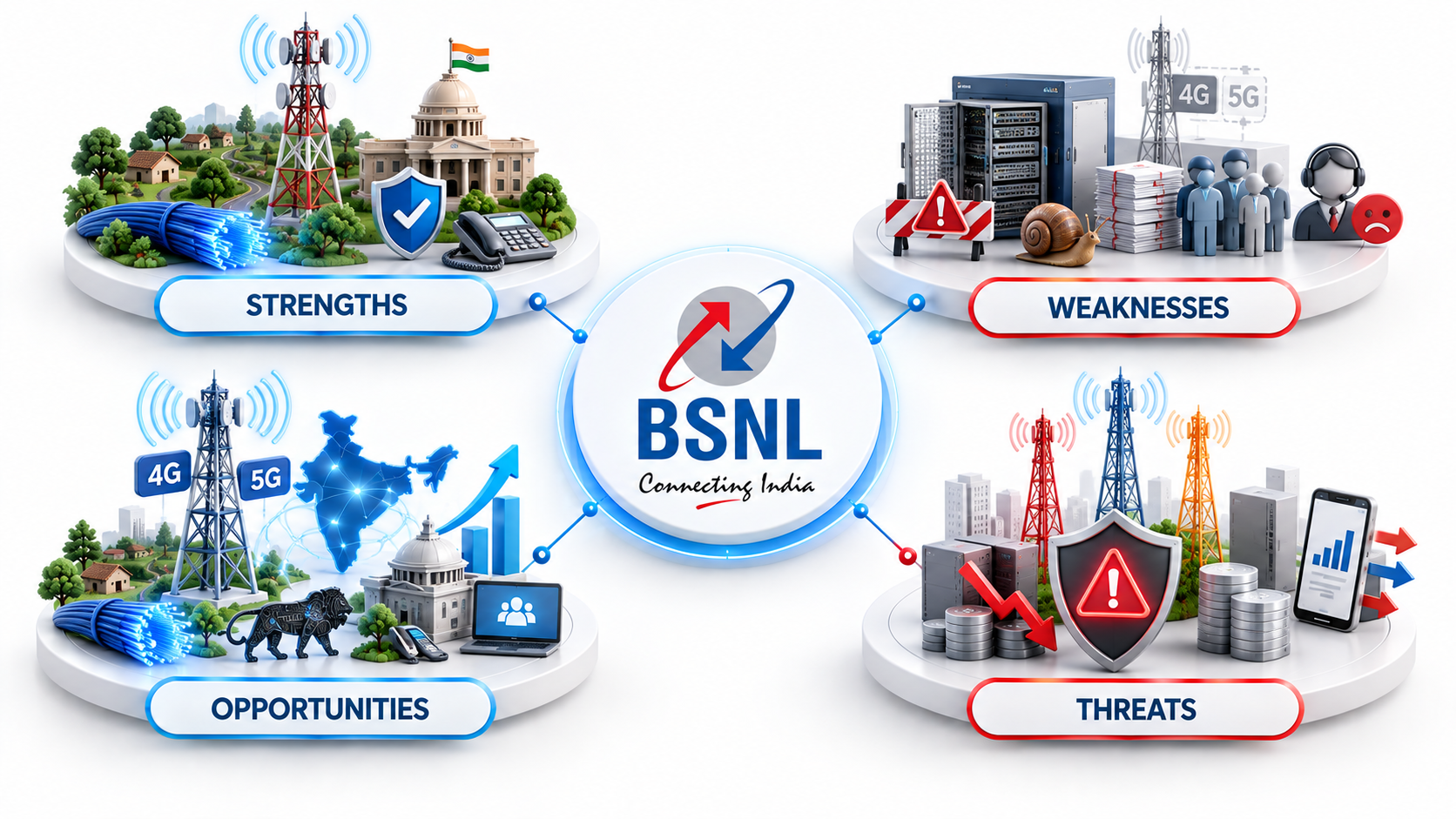
Before listing out every strength, weakness, opportunity, and threat, it’s worth being clear about what a SWOT Analysis of BSNL is actually trying to achieve, because a lot of people just memorize the four letters without understanding why the framework works so well for a company exactly like this one.
What SWOT Analysis Means for a Telecom PSU
SWOT stands for Strengths, Weaknesses, Opportunities, and Threats. Strengths and weaknesses look inward, at what the company itself controls: its infrastructure, its people, its finances, its brand. Opportunities and threats look outward, at the market conditions BSNL doesn’t fully control but has to respond to, like competitor pricing, government policy, and shifts in customer behaviour. For a telecom PSU like BSNL, this split matters a lot because the internal side (strengths and weaknesses) is shaped heavily by decades of government ownership, while the external side (opportunities and threats) is shaped by a market that changed faster than any government-run company could keep up with.
Why BSNL Is a Textbook SWOT Case Study
Business schools and UPSC case study material love using BSNL for SWOT exercises because it’s rare to find a company where the internal and external forces pull so hard in opposite directions. Its strengths (reach, trust, spectrum, government backing) are almost the mirror image of its weaknesses (slow decisions, poor service, outdated systems). And its opportunities (4G rollout, rural digital push) sit right next to threats that could cancel them out entirely (private competition, financial losses). Few companies illustrate the tension inside all four SWOT quadrants as clearly as BSNL does right now, which is exactly why it keeps showing up in business case studies year after year.
Strengths of BSNL
This section is the heart of the strength side of the SWOT Analysis of BSNL. These are the things BSNL genuinely has going for it, things that took years to build and that competitors can’t easily replicate even with unlimited funding.
Massive Rural and Remote Network Reach
BSNL’s biggest strength, hands down, is its network presence in places private telecom companies never found profitable enough to enter seriously. Villages in the Northeast, high-altitude regions in Himachal and Ladakh, and remote parts of central India often have a BSNL tower or landline exchange when nothing else exists. Private operators build where the average revenue per user justifies the capital spend, and a village of a few hundred households rarely clears that bar. BSNL, being government-owned, was pushed into these areas as a policy obligation, and while that hurt its profitability for years, it built a physical footprint nobody else has bothered to match. This reach alone makes BSNL relevant for government schemes, rural banking connectivity, and disaster response communication when private towers go down.
Government Backing and Financial Support
Being state-owned isn’t just a weakness, even though it’s often framed that way. It also means BSNL gets equity infusions and revival packages that private players could never access. The government approved a revival package worth roughly Rs 69,000 crore back in 2019, and a much bigger one worth around Rs 1.64 lakh crore in 2022, covering things like 4G spectrum allocation, VRS costs, and capital for network upgrades. No private telecom company gets that kind of lifeline when it’s bleeding money. This backing means BSNL, unlike a private company in similar financial trouble, isn’t at real risk of shutting down or being sold off in a hurry. That stability, even if it comes from taxpayer money, is a strength competitors simply don’t have.
Largest Landline and Broadband Infrastructure
BSNL still runs one of the largest fixed-line and Bharat Fiber (FTTH) broadband networks in the country. In cities where fibre-to-the-home is booming with private ISPs like Jio Fiber and Airtel Xstream, BSNL’s copper and fibre infrastructure, some of it decades old, still gives it a physical presence competitors have to build from scratch. Upgrading existing copper exchanges to fibre is cheaper and faster than laying entirely new cable, and BSNL has thousands of these exchanges already in place across small towns where private fibre hasn’t reached yet.
Spectrum Holdings and Airwaves
BSNL holds spectrum across multiple bands, some allocated administratively rather than through the expensive auction process private telcos have to go through. This matters a lot because spectrum is one of the biggest costs in running a telecom network. Jio and Airtel spend tens of thousands of crores buying spectrum in auctions. BSNL, being government-owned, got allocations for its 4G rollout without that same auction cost, which meaningfully lowers its cost of building out a modern network compared to private rivals.
Trust Factor Among Older and Rural Customers
There’s a generational trust factor that doesn’t show up neatly in financial statements but matters on the ground. Older customers, government employees, and people in smaller towns often stick with BSNL because it feels stable and government-backed, even when the service isn’t the fastest. Landline customers especially skew toward this demographic, people who’ve had the same number for 20 years and see no reason to switch. This isn’t a huge revenue driver, but it’s a loyal base that gives BSNL a floor it can build from rather than starting at zero.
Weaknesses of BSNL
Now for the part where the honest picture gets less flattering. These are the internal problems that explain why a company with such strong fundamentals still posts losses year after year.
Delayed 4G and Missing 5G Rollout
This is probably the single biggest self-inflicted wound in BSNL’s recent history. While Jio launched 4G in 2016 and completely rewired customer expectations around data speed and pricing, BSNL didn’t get its own 4G network running commercially until 2023, seven years later. Seven years is an eternity in telecom. By the time BSNL’s 4G towers using indigenous technology from C-DOT and Tejas Networks started going live, most of urban and even a lot of rural India had already moved to private 4G, and Jio and Airtel were already talking about 5G rollout. BSNL essentially skipped straight from patchy 3G to a late 4G launch, and it’s only now working toward 5G trials. That gap didn’t just cost subscribers, it cost the brand its reputation as a serious technology player.
Bureaucratic Decision Making
Every decision at BSNL, from procurement to pricing to hiring, moves through layers of government approval that private companies don’t deal with. A private telco can decide on a Monday to launch a new plan on Wednesday. BSNL often needs board approvals, ministry clearances, and compliance with public procurement rules that were designed for accountability, not speed. This isn’t a criticism of the people working there, many of whom are genuinely skilled engineers and planners. It’s a structural problem baked into how PSUs function, and it shows up everywhere from network upgrades to something as simple as launching a new recharge plan.
Poor Customer Service and Outdated Retail Experience
Walk into a BSNL customer service centre in a smaller town and compare that to a Jio or Airtel store, and the gap is obvious. Private telcos invested heavily in retail experience, app-based self-service, instant online recharge, and quick complaint resolution through chatbots and call centres. BSNL’s systems, in many circles, are still catching up, with slower complaint resolution and a retail presence that feels more like a government office than a modern telecom brand. This directly affects customer retention, because switching to a competitor with a smoother app experience becomes an easy decision once someone’s had one bad service experience.
High Employee Costs and Legacy Workforce
BSNL inherited a huge workforce from the old government telecom departments, many with permanent government-style job protections and pay scales tied to seniority rather than performance. Even after a large Voluntary Retirement Scheme in 2019-2020 that reduced headcount by roughly 78,000 employees, staff costs remain a heavy burden relative to revenue, especially compared to private telcos that run lean, tech-heavy operations with a fraction of the headcount per subscriber. This cost structure eats directly into any operational efficiency BSNL tries to build.
Weak Marketing and Brand Perception
Jio spends aggressively on marketing, bundling, and brand positioning. Airtel runs slick campaigns built around speed and reliability. BSNL, by comparison, barely advertises, and when it does, the messaging often feels dated compared to competitors. This isn’t a small detail. Telecom is a business where perception drives switching decisions almost as much as actual network quality does, and BSNL’s quiet, low-visibility marketing approach means a lot of younger, urban customers barely think about it as an option at all, regardless of what its actual network can do.
Opportunities for BSNL
Here’s where the SWOT Analysis of BSNL gets more interesting, because the opportunity side isn’t just theoretical. Some of these are already playing out with visible results.
4G Saturation Sale, 5G Launch Potential
BSNL’s 4G rollout, late as it was, actually started paying off in an unexpected way. In mid-2024, when Jio, Airtel, and Vi all raised their tariffs by around 10 to 25 percent, BSNL didn’t follow. That single decision triggered a genuine subscriber surge, with reports of BSNL adding several million new users in the weeks right after the price hikes, as budget-conscious customers ported their numbers over. That’s proof BSNL still has pricing power it can use strategically, and if the 4G network continues expanding in quality and coverage, a future 5G launch built on indigenous technology could actually position BSNL as the affordable alternative in a market that’s gotten expensive for a lot of low-income users.
Rural Digital India Push
The government’s own Digital India agenda, plus schemes for rural banking, telemedicine, and e-governance, all depend on last-mile internet connectivity in areas BSNL already serves. As these programs expand, BSNL is naturally positioned to be the backbone provider, since it already has physical infrastructure in these regions that private players haven’t bothered building. Every new government scheme requiring rural connectivity is effectively free demand generation for BSNL’s existing network.
Enterprise and Government Contracts
BSNL has a real edge in landing large institutional contracts, things like BharatNet (the project connecting village-level gram panchayats with fibre broadband), Indian Railways’ communication network, and defence and paramilitary connectivity needs. These aren’t glamorous consumer contracts, but they’re stable, large-scale, and don’t face the same price competition as the retail mobile market. As BharatNet phases continue rolling out across thousands of gram panchayats, BSNL stands to be one of the primary beneficiaries simply because of its existing rural presence and its status as a trusted government entity for sensitive communication needs.
Make in India and Indigenous Equipment
BSNL’s 4G network runs on indigenous technology developed by C-DOT (Centre for Development of Telematics) along with private partners like Tejas Networks and TCS, making it one of the few 4G networks in the world built almost entirely on homegrown telecom stack rather than imported Chinese or European equipment. This matters for two reasons. First, it aligns with the government’s Make in India push, which means continued policy support and funding. Second, it builds domestic manufacturing capability that could eventually be exported, giving BSNL and its technology partners a role in global telecom equipment markets, something no private Indian telco is positioned to do since they mostly buy equipment from Ericsson, Nokia, or Huawei rather than building it domestically.
Fibre Broadband (Bharat Fiber) Expansion
Home broadband is one of the fastest-growing segments in Indian telecom, and BSNL’s Bharat Fiber service has actually been gaining decent traction in smaller cities and towns where Jio Fiber and Airtel Xstream haven’t fully saturated the market yet. Since BSNL already owns copper exchanges in these towns, converting them to fibre is a cheaper upgrade path than a private player building fresh infrastructure from zero. If BSNL prices this competitively and fixes installation turnaround times, Bharat Fiber could become a genuinely strong revenue stream, especially in tier-2 and tier-3 towns that private ISPs still treat as secondary markets.
Threats to BSNL
No SWOT Analysis of BSNL is complete without being honest about what could still go wrong, even with government support and a 4G network finally live.
Competition From Jio, Airtel, Vi
This is the obvious one, but it’s worth being specific about how severe it actually is. Jio alone has over 45 crore subscribers and a network built on the newest technology money can buy. Airtel dominates the premium urban segment with a reputation for reliability. Even Vodafone Idea, despite its own financial troubles, still holds a subscriber base larger than BSNL’s in several circles. These three companies compete aggressively on price, data speed, bundled OTT content, and 5G coverage, areas where BSNL is still playing catch-up. Every month BSNL spends finishing its 4G rollout is a month private players spend expanding 5G further, widening the technology gap rather than closing it.
Financial Losses and Mounting Debt
BSNL has posted losses for well over a decade, with cumulative losses running into tens of thousands of crores. Even with the 2019 and 2022 revival packages, the company hasn’t returned to sustained profitability. Government equity infusions help keep operations running, but they’re not a permanent fix, and there’s a real ceiling on how many times the government can justify pumping public money into a loss-making PSU before political and fiscal pressure forces harder decisions, like asset monetization or further downsizing.
Talent Drain and Aging Workforce
Even after the 2019 VRS reduced headcount significantly, the employees who remain skew older on average than staff at private telecom companies. Younger engineers with strong technical skills in areas like 5G core networks, cloud infrastructure, and network automation are far more likely to join Jio, Airtel, or a tech company altogether, where pay scales and career growth move faster. This creates a long-term risk: BSNL could end up with a workforce that’s stable in terms of job security but increasingly out of step with the technical skills modern telecom networks demand.
Rapid Tech Change and Cost of Upgrades
Telecom technology doesn’t stand still. The moment BSNL gets 4G fully rolled out, the industry conversation has already moved to 5G, and soon enough, 6G research will start too. Each generational shift requires massive capital investment, and BSNL’s slower decision-making process means it consistently plays catch-up rather than staying ahead. If this pattern continues, BSNL risks permanently trailing the technology curve, always launching a generation late, which keeps eroding its competitiveness even as it spends heavily just to stay in the game.
Consumer Shift to Private Players in Cities
In major metros and large cities, BSNL’s mobile market share is genuinely thin. Urban consumers, especially younger ones, have grown used to fast 4G and now 5G speeds from private operators and see little reason to switch to a network that’s historically been associated with slower data and patchy urban coverage. Even the recent subscriber gains after the 2024 tariff hikes were concentrated more in price-sensitive rural and semi-urban segments rather than reversing the urban market share loss. If BSNL can’t win back meaningful urban market share, its growth ceiling stays capped mostly at rural and government-linked revenue, which limits how much it can ever really compete with the private giants on overall scale.
SWOT Analysis of BSNL Table (Quick Summary)
Here’s a quick-reference table pulling together everything covered above, useful for revision or presentations.
| Strengths | Weaknesses |
|---|---|
| Massive rural and remote network reach | Delayed 4G rollout, 5G still catching up |
| Government financial backing and revival packages | Slow, bureaucratic decision-making |
| Largest landline and broadband infrastructure | Poor customer service and retail experience |
| Spectrum holdings without full auction cost | High employee costs from legacy workforce |
| Strong trust among rural and older customers | Weak marketing and brand visibility |
| Opportunities | Threats |
|---|---|
| Subscriber gains after 2024 private tariff hikes | Intense competition from Jio, Airtel, Vi |
| Rural Digital India and e-governance demand | Continued financial losses and rising debt |
| BharatNet, Railways, and defence contracts | Talent drain to private telecom and tech firms |
| Indigenous 4G tech (C-DOT, Tejas) and Make in India push | Fast-changing technology raising upgrade costs |
| Bharat Fiber growth in tier-2 and tier-3 towns | Weak urban market share against private players |
What BSNL’s Revival Plan Actually Looks Like
A lot of SWOT write-ups stop at listing points, but the real question people want answered is simpler: is BSNL actually turning things around, or is this just government money keeping a sinking ship afloat a little longer? The honest answer sits somewhere in between, and it’s worth breaking down what’s actually happening on the ground.
4G Rollout With Tejas and C-DOT Gear
BSNL’s 4G network, built on homegrown technology from Tejas Networks and C-DOT with support from TCS, started large-scale deployment from 2023 onward, with tens of thousands of towers activated across the country. This wasn’t just a technology milestone, it was also a bet on Indian-made telecom equipment at a scale that hadn’t been attempted before by any Indian operator. Early results were mixed, with some regions reporting solid speeds and others still facing coverage gaps, but the pace of tower activation picked up significantly through 2024 and 2025, with the company pushing to cover a much larger share of its existing 2G and 3G sites with 4G upgrades.
Government Equity Infusion and Spectrum Allocation
The 2022 revival package of roughly Rs 1.64 lakh crore wasn’t just a cash handout. A large chunk of it went toward spectrum allocation for 4G and future 5G use, debt restructuring to ease BSNL’s interest burden, and funding for network expansion including fibre. This kind of structured support, tied to specific infrastructure goals rather than just covering operational losses, gives BSNL a real shot at building a network that can compete on coverage, even if it still lags on raw speed and urban penetration compared to Jio and Airtel.
BSNL’s Comeback in Subscriber Numbers
The subscriber bump after the July 2024 private tariff hikes was real and measurable, with BSNL reportedly gaining several million new subscribers within weeks as budget-conscious users ported over from private networks. That’s not enough to close the massive gap with Jio’s user base, but it’s a signal that price-sensitive demand still exists in the market, and BSNL, with government backing that lets it hold prices steady even during industry-wide hikes, has a genuine structural advantage it can lean into if it plays this right going forward.
Lessons From BSNL’s SWOT for Students and Businesses
Beyond the specifics of telecom, the BSNL case offers lessons that apply well beyond one industry, which is part of why it keeps showing up in business school discussions and competitive exam prep.
What This Case Teaches About PSU Turnarounds
BSNL shows that government backing can buy time, but it can’t buy speed. The financial cushion from revival packages kept the company alive through its worst years, but the actual turnaround only started showing results once BSNL made a concrete technology decision, going indigenous with its 4G stack, and once external market conditions (competitor price hikes) created an opening. The lesson for anyone studying PSU turnarounds is that financial support alone rarely fixes a structural problem. It has to be paired with a real operational or strategic shift, and that shift often depends on timing that’s partly outside the company’s control.
How to Apply This SWOT Framework to Other Companies
The structure used throughout this SWOT Analysis of BSNL, pairing internal strengths against internal weaknesses, and external opportunities against external threats, works for analyzing almost any company facing disruption, not just telecom PSUs. Whether it’s a legacy retail chain facing e-commerce competition or a traditional bank facing fintech disruption, the same questions apply: what does the incumbent still control that new entrants can’t easily replicate (strengths), what internal habits or structures are slowing it down (weaknesses), what market shifts could actually work in its favour if timed right (opportunities), and what could permanently erode its position if ignored (threats). BSNL just happens to be one of the clearest, most public examples of all four forces playing out at once.
Conclusion
BSNL isn’t a company that’s simply failing, and it isn’t a company that’s quietly winning either. It’s somewhere in between, sitting on genuine strengths like rural reach and government-backed spectrum, while carrying real weaknesses like a workforce and decision-making structure built for a different era of telecom. A proper SWOT Analysis of BSNL makes one thing clear: the opportunities on the table right now, especially around 4G expansion, BharatNet, and price-sensitive customers switching over after private tariff hikes, are real and already producing results. But the threats, particularly the technology gap with Jio and Airtel and the risk of continued urban market share loss, haven’t gone away just because the government wrote another cheque. Whether BSNL turns this into a lasting recovery or just another decade of managed decline depends less on how much money it gets next, and more on how fast it can actually move once the money arrives.
Frequently Asked Questions
What is the biggest strength of BSNL?
BSNL’s biggest strength is its network reach in rural and remote parts of India where private telecom operators haven’t found it commercially worthwhile to build infrastructure. This includes villages, hilly regions, and border areas where BSNL often remains the only reliable option for landline and mobile connectivity.
Why did BSNL’s 4G rollout take so long compared to Jio and Airtel?
BSNL’s 4G rollout was delayed mainly due to slow government procurement processes, initial reliance on foreign equipment vendors that fell through due to security clearance issues, and a final decision to build the network using indigenous technology from C-DOT and Tejas Networks, which took years to develop and deploy at scale. Commercial 4G services only went live in 2023, roughly seven years after Jio’s launch.
Is BSNL still profitable in 2026?
BSNL has posted losses for more than a decade and has not returned to sustained annual profitability, even after receiving large government revival packages in 2019 and 2022. It continues to depend on equity infusions and financial restructuring rather than operating at a consistent profit.
What is BSNL’s biggest weakness according to SWOT analysis?
The most significant weakness identified in most SWOT breakdowns of BSNL is its delayed technology adoption, particularly the late 4G launch, combined with slow bureaucratic decision-making that makes it hard for the company to respond quickly to market changes compared to private competitors.
How does BSNL compare to Jio in terms of subscribers?
Jio has a subscriber base of over 45 crore users, several times larger than BSNL’s roughly 9 to 10 crore subscribers. However, BSNL did see a noticeable subscriber increase in mid-2024 after Jio, Airtel, and Vi raised their tariffs and some price-sensitive customers switched to BSNL.
What opportunities does BSNL have going forward?
BSNL’s key opportunities include expanding its newly launched 4G network, benefiting from rural digital India initiatives like BharatNet, winning large institutional contracts with railways and defence, growing its Bharat Fiber broadband service in smaller towns, and positioning itself as an affordable alternative after competitor price hikes.
What technology does BSNL use for its 4G network?
BSNL’s 4G network is built on indigenous technology developed by C-DOT (Centre for Development of Telematics) in partnership with Tejas Networks and Tata Consultancy Services, making it one of the few large-scale 4G networks built almost entirely on homegrown Indian telecom equipment rather than imported technology.
Does BSNL have 5G services?
As of the current rollout status, BSNL has been conducting 5G trials and planning its 5G launch, but it has not achieved the same scale of commercial 5G deployment that Jio and Airtel have across Indian cities. Its immediate focus remains completing and stabilizing the nationwide 4G rollout before scaling up 5G.
Why do rural customers still prefer BSNL over private telecom companies?
Rural customers often prefer BSNL because it has physical infrastructure, like towers and exchanges, in areas private companies consider commercially unviable. There’s also a trust factor tied to BSNL being a government-owned entity, along with long-standing landline connections that many rural and older customers have held for years.
What was the BSNL revival package and how much money did the government give?
The Indian government approved a revival package worth approximately Rs 69,000 crore in 2019, followed by a much larger package worth around Rs 1.64 lakh crore in 2022. These packages covered debt restructuring, spectrum allocation for 4G, voluntary retirement scheme costs, and capital for network modernization.
How many employees did BSNL lose through its Voluntary Retirement Scheme?
BSNL’s Voluntary Retirement Scheme, rolled out around 2019-2020, saw roughly 78,000 employees opt for early retirement, significantly reducing the company’s headcount and associated staff costs, though employee expenses relative to revenue remain high compared to private telecom operators.
Is BSNL a good option for broadband compared to Jio Fiber or Airtel Xstream?
BSNL’s Bharat Fiber broadband service can be a strong option in smaller towns and semi-urban areas where Jio Fiber and Airtel Xstream haven’t expanded their fibre networks yet, since BSNL can often upgrade its existing copper exchanges to fibre faster and cheaper in these regions. In major metro cities, however, private fibre broadband generally offers faster installation and more competitive plans.
What does BharatNet have to do with BSNL’s opportunities?
BharatNet is a government project aimed at providing fibre-based broadband connectivity to gram panchayats across India, and BSNL is one of the primary implementing agencies for this project given its existing rural infrastructure. As BharatNet expands, it directly increases BSNL’s rural broadband footprint and revenue potential.
Can BSNL actually compete with Jio and Airtel in the long run?
Whether BSNL can genuinely compete with Jio and Airtel long-term depends on how quickly it closes the technology gap, particularly around 5G, and whether it can improve customer service and urban market presence. Its rural reach and government-backed pricing power give it a real niche, but matching private operators on nationwide speed, coverage, and urban market share remains a significant challenge.