


Walk into almost any hardware shop in a small Indian town and ask for paint. Nine times out of ten, the shopkeeper will pull out a shade card with the Asian Paints logo on it before he even asks what color you want. That kind of default-brand status doesn’t happen by accident, and it doesn’t stay that way forever either. That’s exactly why a proper SWOT Analysis of Asian Paints matters right now, not as some textbook exercise, but as a way to understand what’s happening to a company that used to feel untouchable and suddenly doesn’t.

For decades, Asian Paints ran the Indian decorative paints market almost like a monopoly with extra steps. Then, in February 2024, the Aditya Birla Group walked in with Birla Opus, backed by ten thousand crore rupees and zero patience for slow growth. Within a year, market share numbers that hadn’t moved much in a decade started shifting. Revenue fell. Profit fell harder. And a company that investors treated as a permanent compounding machine suddenly had analysts asking uncomfortable questions on earnings calls.
None of this means Asian Paints is in trouble the way a company facing bankruptcy is in trouble. It means the competitive picture changed, and the old assumptions need a fresh look. That’s what this guide does. It breaks down the strengths that still make Asian Paints formidable, the weaknesses that Birla Opus and a sluggish home décor bet have exposed, the opportunities sitting in waterproofing and rural markets, and the threats that could keep margins under pressure for years. Numbers are pulled from actual quarterly results and annual reports, not guesswork, because a SWOT analysis without real figures is just an opinion dressed up in a business template.
There’s also a reason this particular company makes for such a good SWOT case study compared to most Indian consumer businesses. Paint is a low-frequency, high-trust purchase. Households repaint once every five to seven years on average, which means the brand a person picks isn’t really about that single transaction, it’s about years of accumulated shelf presence, dealer recommendation, and advertising recall finally cashing in at one specific moment. When a challenger with deep pockets shows up and starts chipping away at that accumulated trust through pricing alone, it tests something that most quarterly earnings reports never really get to test: whether decades of brand equity can survive a genuine price war, or whether it was always more fragile than the balance sheet suggested.
What You Will Learn in This Guide
- Why Asian Paints still leads the Indian paint industry despite losing market share to Birla Opus
- The real financial numbers behind Asian Paints’ FY2025 slowdown and its FY2026 recovery
- Where the company’s home décor and international bets have actually struggled
- The specific opportunities in waterproofing, rural distribution, and premium services that could drive the next phase of growth
- How Asian Paints stacks up against Berger Paints, Kansai Nerolac, and Birla Opus on market share and pricing
- What this SWOT analysis practically means if you’re an investor tracking the stock or a marketing student studying the brand
What Is a SWOT Analysis of Asian Paints and Why It Matters Right Now
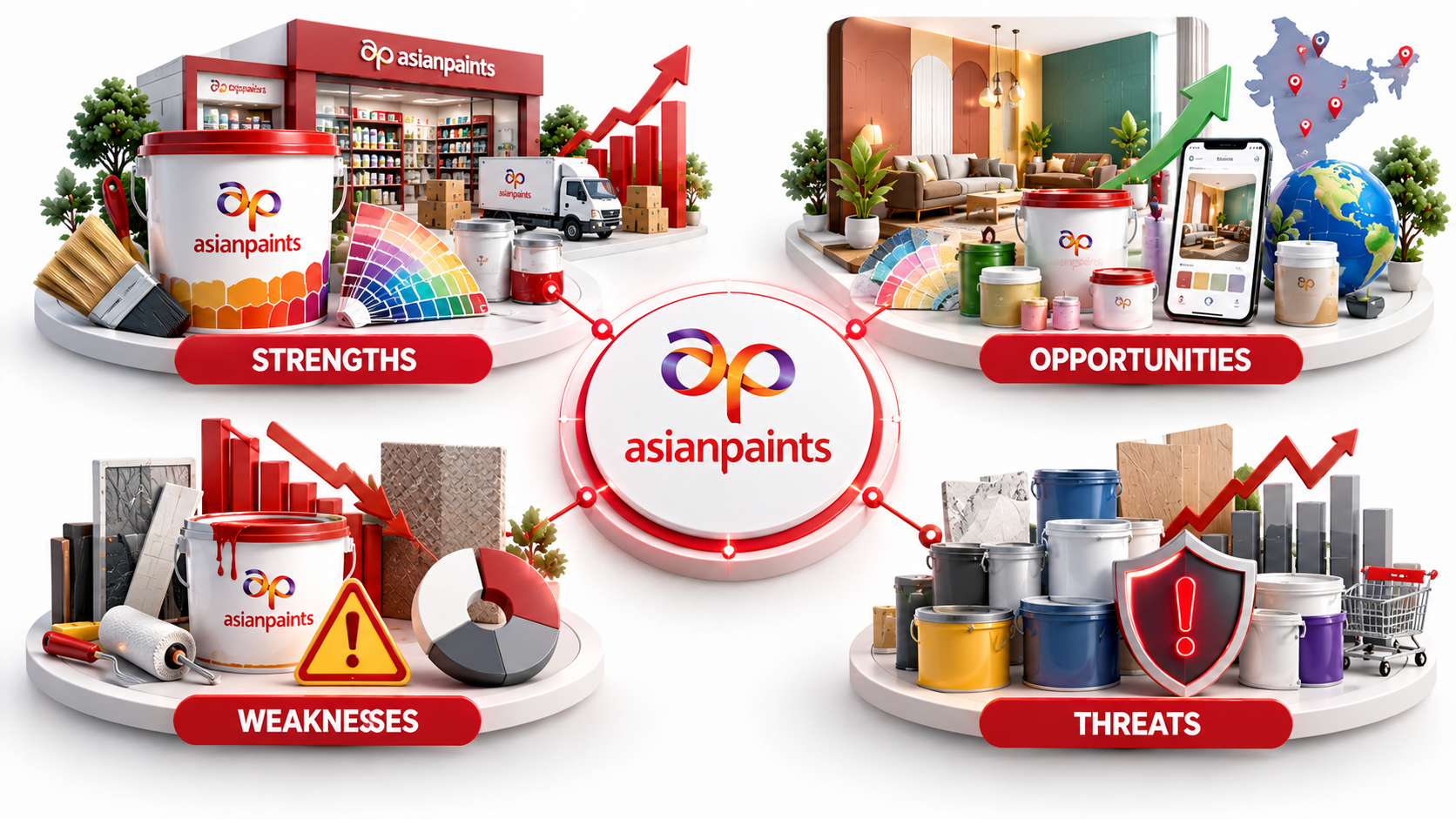
A SWOT Analysis of Asian Paints looks at four things side by side: what the company does better than anyone else (strengths), where it’s exposed or falling behind (weaknesses), where growth could come from next (opportunities), and what could genuinely hurt the business in the next few years (threats). The reason this framework works so well for Asian Paints specifically is timing. The company spent close to sixty years building a near-monopoly, and in under two years that position has been tested harder than it ever has been before.
This isn’t an academic exercise pulled from a business school slide. Asian Paints reported a 4.5% drop in consolidated revenue for FY2025 and a 32.8% fall in net profit, numbers that would have been unthinkable five years ago. At the same time, the company clawed back momentum in the following quarters, with net profit jumping 43% year-on-year in Q2 FY26. Both of those facts are true at once, and a SWOT framework is the cleanest way to hold both realities without pretending the story is simpler than it is.
Quick Company Snapshot Before Going Further
Asian Paints was founded in 1942 by four friends in Mumbai and went public in 1973. Today it’s India’s largest paint and décor company by revenue, the second-largest in Asia, and among the top ten decorative coatings companies globally. The company is led by Managing Director and CEO Amit Syngle, and it runs manufacturing operations across more than a dozen countries outside India, including Sri Lanka, Nepal, Bangladesh, Egypt, and parts of the Middle East and South Pacific under brands like Asian Paints Berger, SCIB Paints, and Taubmans. Decorative paints and home décor together made up close to 87% of consolidated revenue in the most recent reporting year, which tells you exactly how concentrated the business still is around one core category.
How This Guide Breaks Down the SWOT Analysis of Asian Paints
Each section ahead treats one quadrant of the SWOT framework as its own mini-report, backed by named competitors, actual rupee figures, and specific product lines rather than vague statements like “strong brand” or “competitive pressure.” The goal is that by the end, you could explain to someone else exactly why Asian Paints stock has been volatile, exactly what Birla Opus is doing differently, and exactly where the next five years of growth are supposed to come from, without needing to look anything else up.
Strengths
Strengths are the part of any SWOT Analysis of Asian Paints that’s easiest to write and easiest to get lazy about. It’s tempting to just say “strong brand, big network, good finances” and move on. That’s not good enough here, because the specific mechanics of why Asian Paints’ strengths work are exactly what’s being tested by Birla Opus right now, and understanding the mechanics tells you whether those strengths will hold up or erode further.
Market Leadership That’s Still Real, Even After Losing Ground
Asian Paints still commands somewhere between 47% and 52% of India’s organized decorative paints market, depending on which analyst estimate you look at. Antu Thomas, a research analyst at Geojit Investments, pegged the company’s share at 47% for 2024-25, down from 51% the year before. Yes, that’s a real decline, and yes, it happened faster than most analysts expected when Birla Opus launched. But losing four to twelve percentage points from a base of nearly sixty percent still leaves Asian Paints with a lead that’s roughly two and a half times the size of its nearest rival, Berger Paints, which holds around 20%. Being the largest player by a wide margin still matters enormously in a category like paint, where dealers stock what sells fastest and consumers default to the name they already trust.
A Distribution Network Competitors Can’t Copy Overnight
This is where the real moat sits, and it’s more specific than “good distribution.” Asian Paints built its manufacturing base to over 1,850 million litres per annum of installed capacity in India alone, the largest of any player in the country, spread across ten plants in states including Gujarat, Uttar Pradesh, Tamil Nadu, and Haryana. On top of that sits a dealer and retail network that industry estimates put well above 70,000 touchpoints, built over eight decades of relationships with hardware shop owners who often stock Asian Paints tinting machines, branded shelving, and point-of-sale material that a new entrant simply can’t replicate in eighteen months, no matter how much capital is behind them. Birla Opus has moved fast, reaching around 50,000 dealers within its first year, but reach isn’t the same as depth, and depth is what determines whether a dealer pushes your brand when a customer asks “which one is better?”
Brand Trust Built Over Eight Decades
The “Har Ghar Kuch Kehta Hai” campaign line has run for years, and it’s stuck because it ties directly to how Indian households actually think about home renovation: paint as an emotional decision tied to family milestones, not just a maintenance task. That emotional positioning matters more in paint than most categories because the purchase happens rarely, maybe once every five to seven years for a household, which means brand recall at the moment of decision carries outsized weight. Younger, more price-sensitive consumers are showing some willingness to switch to cheaper alternatives, with some surveys suggesting close to 30% openness to trying Birla Opus on price alone. That’s a real crack, but it’s a crack in a wall that’s still standing, not a wall that’s fallen.
Financial Strength and a Genuinely Clean Balance Sheet
Numbers matter more here than adjectives. Asian Paints has consistently posted Return on Capital Employed above 30%, compared to an industry average closer to 22%, according to analyst estimates cited around its FY2025 results. The company carries minimal net debt and holds cash reserves that have exceeded ₹3,000 crore, giving it room to absorb a bad year or two without touching its dividend policy or its ability to invest in new capacity. For FY2025, even with profit down sharply, the board still recommended a total dividend of ₹24.80 per share for the year. That’s not the balance sheet of a company in genuine distress. It’s the balance sheet of a company that can afford to fight a price war longer than most challengers can afford to wage one.
Manufacturing Scale, Backward Integration, and R&D
Asian Paints doesn’t just sell paint, it manufactures a meaningful share of its own raw materials, including emulsions and pigments, through backward integration that smooths out some of the volatility in titanium dioxide and crude-linked input costs. On the innovation side, the company runs its own trend forecasting platform called ColourNext, operates Beautiful Homes retail stores dedicated to décor products, and has pushed digital tools like colour visualizer apps and Ezycolour tinting machines into thousands of retail points. None of these are flashy headlines, but together they add up to a company that controls more of its supply chain and customer touchpoints than any competitor in the category, which is exactly the kind of structural advantage that shows up quietly in margins rather than loudly in press releases.
Weaknesses
No fair SWOT Analysis of Asian Paints can stop at strengths, because the last two years have exposed real cracks that go beyond “a new competitor showed up.” Some of these weaknesses were building quietly before Birla Opus even launched, and the new competition has just made them impossible to ignore.
Market Share Erosion Since Birla Opus Arrived
This is the headline weakness, and the numbers are specific enough to be uncomfortable. Birla Opus went from zero to somewhere between 7% and 10% revenue market share in the decorative paints category within roughly a year of full-scale operations, according to industry estimates reported in mid-2025. By capacity, Birla Opus has already become the second-largest player in India at 1,096 million litres per annum, behind only Asian Paints’ 1,850 MLPA. That’s an extraordinarily fast climb for any company entering a category dominated by one incumbent for decades, and it happened specifically because Grasim Industries was willing to spend ₹10,000 crore upfront on manufacturing and distribution before selling a single litre of paint. Asian Paints responded by cutting prices and expanding its own offerings, which helped defend share in later quarters, but the fact that a response was needed at all says something about how comfortable the company had become.
The Home Décor Bet That Hasn’t Paid Off Yet
Asian Paints spent several years pushing into kitchens, bath fittings, furnishings, and interior design platforms under its Home Décor umbrella, including acquisitions like White Teak. The results have been disappointing. White Teak’s revenue actually declined 19.9% to ₹107 crore in FY2025, and the company had to book impairment charges related to that investment along with another one called Weatherseal. In the more recent Q2 FY26 quarter, the Home Décor kitchen and bath segment kept underperforming, with bath fittings sales down 4.7% and kitchen sales down 7.2% year-on-year. Diversification only works as a strength once it starts generating returns, and right now this particular diversification is a drag on consolidated numbers rather than a driver of them.
Heavy Dependence on the Domestic Decorative Segment
Decorative and home décor revenue made up close to 87% of Asian Paints’ total consolidated revenue in the most recent reporting year. International operations contributed only around 9%, and industrial coatings, run through the AP-PPG joint venture, contributed under 4%. That kind of concentration means any slowdown in Indian housing demand, urban consumer spending, or dealer sentiment hits the company’s overall numbers almost directly, with very little cushioning from other business lines. Compare that to a more diversified industrial coatings player, and the difference in earnings volatility becomes obvious the moment domestic demand softens, which is exactly what happened through FY2025.
Premium Pricing Strategy Struggling Against a Downtrading Market
For years, Asian Paints leaned into premiumisation, pushing higher-margin products like Royale and Ultima and betting that Indian consumers would keep trading up. That bet has run into a downtrading environment, where cost-sensitive buyers are moving toward cheaper alternatives rather than premium ones, partly because of general economic pressure and partly because Birla Opus specifically targeted the value end of the market with aggressive pricing. Data from Q2 FY2025 showed lower-margin products growing 12% in volume even as the overall revenue mix diluted, squeezing profitability by an estimated 180 basis points. A strategy built around consumers spending more doesn’t work well in a stretch where a large chunk of the market is actively looking to spend less.
International Business That’s Still Small and Inconsistent
Asian Paints operates in roughly 15 countries outside India with international revenue of around ₹3,350 crore, growing modestly but unevenly. In the FY2025 results, international revenue actually declined 1.5% on a reported basis, even though constant-currency growth was closer to 6%, and management specifically flagged macroeconomic challenges in African markets like Nigeria and Egypt as a drag. The company also divested loss-making operations in Indonesia to reduce that stress. An international business this size, contributing under 10% of revenue after decades of overseas expansion, isn’t yet the geographic diversification cushion that a company this large might be expected to have built by now.
Opportunities
Here’s the thing that gets lost when people only focus on the Birla Opus threat: Asian Paints still has genuine, underexploited growth avenues that have nothing to do with defending its core paint market share. This section of the SWOT Analysis of Asian Paints is where the more interesting long-term story actually lives.
Waterproofing and Construction Chemicals Are Quietly Booming
While decorative paint volumes have been sluggish, waterproofing and construction chemicals have been growing in double digits for Asian Paints, driven by its SmartCare brand and related products. This category benefits from something paint doesn’t always get: it’s often sold as a solution to an active problem, like a leaking roof or a damp wall, rather than a discretionary aesthetic choice, which makes demand somewhat less sensitive to the kind of downtrading pressure hitting decorative paints. As Indian housing stock ages and monsoon-related damage becomes a recurring cost for homeowners, this segment has room to keep expanding faster than the core paints business, and it carries better margins because it’s a specialized, less commoditized category than basic wall paint.
Rural India and Tier 3, Tier 4 Towns Still Have Room to Grow
Despite decades of expansion, rural and semi-urban penetration for premium and even mid-tier paint products still lags urban markets significantly. As rural incomes recover and government infrastructure spending continues to improve connectivity to smaller towns, there’s a real runway for Asian Paints to convert first-time painters and repainting households in these markets, particularly through its lower-priced Tractor Emulsion and similar product lines. The company’s existing dealer depth in smaller towns, built over decades, gives it a genuine head start here over Birla Opus, which is still building out its network layer by layer.
Premiumisation Through Services, Not Just Products
The Beautiful Homes platform and Safe Painting Service represent a shift from selling cans of paint to selling an entire home improvement experience, including colour consultancy, professional application, and design guidance. Services carry structurally different economics than product sales because they’re harder for a price-focused competitor like Birla Opus to replicate quickly, since services depend on trained manpower, quality control systems, and customer trust built over repeat interactions rather than just manufacturing capacity. If Asian Paints can grow this side of the business faster, it creates a layer of differentiation that isn’t just about who has the cheaper can of paint on the shelf.
Sustainable and Low-VOC Paints as a Genuine Differentiator
Environmental regulations around Volatile Organic Compound content in paints are tightening globally and gradually in India too, and consumer awareness of indoor air quality is rising, especially among urban, higher-income buyers who are exactly the demographic Asian Paints has spent years cultivating for its premium lines. Being early and credible on low-VOC, water-based, and eco-certified paint formulations gives Asian Paints a chance to defend its premium positioning on health and sustainability grounds rather than purely on brand nostalgia, which matters as younger buyers increasingly research ingredients and certifications before making a purchase decision that used to be driven mostly by dealer recommendation.
Consolidation Opportunities After AkzoNobel’s Exit
AkzoNobel exited the Indian decorative paints race entirely, selling its stake to JSW Paints, which reshuffled the competitive map in a way that could work in Asian Paints’ favor over time. Every time a smaller or struggling player exits or gets absorbed, it typically redistributes dealer relationships and market share among the remaining players rather than creating an entirely new competitive threat from scratch. Asian Paints, with its financial strength and existing scale, is better positioned than most mid-sized players to pick up displaced distribution relationships or acquire smaller regional brands if consolidation accelerates further in a crowded, increasingly competitive category.
Threats
This is the section where the Asian Paints story gets genuinely uncomfortable for anyone who assumed the company’s dominance was permanent. These aren’t hypothetical risks pulled from a generic template, they’re threats that have already shown up in quarterly results.
Birla Opus and the New Capital-Backed Competition
Birla Opus isn’t a scrappy startup nibbling at the edges, it’s a division of Grasim Industries, part of the Aditya Birla Group, one of India’s largest and best-capitalized conglomerates. The company invested ₹10,000 crore upfront, launched three of six planned factories simultaneously on day one, an industry first, and has publicly stated its goal of hitting double-digit market share and ₹10,000 crore in gross revenue within three years of full-scale operations. This is a competitor with the patience and balance sheet to absorb losses for years while it builds share, which is a fundamentally different threat than the regional or mid-sized challengers Asian Paints has dealt with in the past. CEO Rakshit Hargave has been explicit that the company intends to keep gaining market share every single quarter, which means the pressure isn’t a one-time shock, it’s an ongoing structural feature of the category now.
Raw Material Price Volatility
Paint manufacturing depends heavily on crude oil derivatives and inputs like titanium dioxide and various monomers, all of which are exposed to global commodity price swings that Asian Paints doesn’t control. When these input costs spike, the company has to choose between absorbing the hit to margins or raising prices in a market where a well-funded competitor is actively undercutting on price, which is exactly the kind of squeeze that showed up in FY2025’s margin compression. Hedging strategies and backward integration help, but they don’t eliminate the exposure entirely, especially in a period when pricing power itself is under pressure from competition.
Real Estate Slowdown and Weak Urban Demand
A meaningful chunk of decorative paint demand is tied to new construction and home renovation cycles, both of which slow down when real estate activity cools or urban consumer sentiment weakens. FY2025 saw exactly this kind of environment, with muted demand conditions cited repeatedly by management across multiple quarters as a drag on volume growth, independent of the competitive pressure from Birla Opus. Paint demand recovering meaningfully depends on broader housing and construction activity picking back up, which is a macro factor entirely outside Asian Paints’ control, no matter how strong its brand or distribution network is.
Regulatory and Environmental Compliance Costs
Tightening environmental regulations, including new classification requirements for chemical substances that apply progressively through 2025 and 2026, add compliance costs and reformulation work that smaller players sometimes skip or delay. For a company the size of Asian Paints, staying ahead of these requirements is manageable but not free, and it adds a layer of operational cost and complexity that competes for capital with growth investments in distribution and new product categories. Environmental compliance is generally a strength for large, well-resourced players over time, but the near-term cost is real and shows up in operating expenses.
Private Labels and Regional Players Nibbling at the Bottom
Beyond Birla Opus, regional and private label paint brands continue to compete aggressively at the value end of the market, particularly in price-sensitive rural and semi-urban segments where brand loyalty matters less than raw cost per litre. These players rarely make headlines the way Birla Opus does, but collectively they represent a persistent drag on the lower end of Asian Paints’ portfolio, especially in a downtrading environment where more consumers are actively looking for the cheapest acceptable option rather than the most trusted one.
Asian Paints vs Its Competitors: Where the SWOT Analysis of Asian Paints Gets Tested
A SWOT Analysis of Asian Paints only means something when it’s checked against how the company actually performs relative to specific named rivals, not abstract “competitive pressure.” Here’s how the comparison actually looks.
Asian Paints vs Berger Paints
Berger Paints holds roughly 20% of the decorative paints market compared to Asian Paints’ 47% to 52%, making it the clearer number two player even after Birla Opus’s entry. Berger has largely maintained its share through the recent disruption rather than losing ground to Birla Opus the way Asian Paints has, partly because Berger’s customer base and regional strongholds, particularly in eastern India, overlap less directly with where Birla Opus has focused its early push. On valuation, Asian Paints trades at a higher market capitalization of roughly ₹2.3 lakh crore against Berger’s approximately ₹63,000 crore, reflecting both its larger scale and the market’s continued, if reduced, premium for its leadership position.
Asian Paints vs Birla Opus
This is the comparison that actually matters for the next five years. Birla Opus has built manufacturing capacity of 1,096 MLPA against Asian Paints’ 1,850 MLPA, meaning it already has well over half the production scale of the market leader despite launching from zero in February 2024. Where Birla Opus wins is speed and aggression: rapid dealer network expansion to around 50,000 outlets, consumer-facing innovations like QR-code based product tracking, and pricing that specifically targets cost-sensitive buyers. Where Asian Paints still wins is depth of relationships built over decades, a far larger installed base of tinting machines and branded retail infrastructure, and a services layer through Beautiful Homes and Safe Painting that Birla Opus hasn’t built out yet. The real test over the next two to three years is whether Birla Opus’s stated ambition of reaching double-digit market share within three years actually plays out, or whether Asian Paints’ pricing and product response through FY26 is enough to stabilize its share in the high 40s to low 50s.
Asian Paints vs Kansai Nerolac and the Remaining Field
Kansai Nerolac, backed by Japan’s Kansai Paint, has historically been strong in industrial and automotive coatings alongside a smaller decorative presence, and it has largely held its ground through the recent disruption similar to Berger. AkzoNobel’s exit from the Indian market, with its stake sold to JSW Paints, removed one competitor but potentially created a new one with fresh capital and ambition, since JSW is not a company known for entering categories quietly. The overall picture across the field is a market that went from one dominant player and a handful of stable followers to a genuinely contested field with at least one new, well-funded, aggressive entrant, which changes the competitive calculus for everyone, not just Asian Paints.
Financial Performance Behind the SWOT Analysis of Asian Paints
Numbers tell a more honest story than sentiment does, and the recent financial trajectory of Asian Paints is really a story in two distinct chapters.
FY2025: The Year Things Slowed Down
Consolidated net sales for the full year ended March 31, 2025 came in at ₹33,797 crore, down 4.5% from the prior year, while standalone net sales fell 5.4% to ₹29,421 crore. Net profit after minority interest dropped a sharp 32.8% to ₹3,667 crore, and consolidated PBDIT margin compressed from 21.4% to 17.8%. The fourth quarter alone told the story clearly: consolidated sales fell 4.3% to ₹8,329.6 crore, decorative paint volumes in India grew a modest 1.8%, but revenue in that same segment actually declined 5.2% because of downtrading and intensified competitive pricing. This is the quarter where the impact of Birla Opus and weak consumer demand showed up together, and it’s the period that triggered most of the concerned analyst commentary through mid-2025.
FY2026 So Far: Signs of a Genuine Turnaround
The picture shifted meaningfully in the following quarters. Q2 FY26 results showed consolidated net profit surging 43% year-on-year to ₹994 crore on revenue growth of 6.4% to ₹8,514 crore, with domestic decorative volume growth of a robust 10.9% and EBITDA margin expanding 220 basis points to 17.7%. International revenue also grew 9.9% to ₹846 crore in the same quarter. Subsequent commentary pointed to standalone revenue growing 5.6% to ₹7,360 crore in the following quarter, EBITDA up 21% year-on-year, and PAT up 14%, with the company reportedly defending market share better after several quarters of losing ground to Birla Opus. None of this means the competitive threat has disappeared, margin pressure is still described as likely to persist given the intensity of competition, but it does mean the sharpest phase of the disruption may be behind the company rather than ahead of it.
What This SWOT Analysis of Asian Paints Means for Investors and Marketers
A SWOT framework is only useful if it changes how you actually act on the information, whether you’re managing money or managing a brand strategy assignment.
For Investors Tracking the Stock
The core question for anyone holding or considering Asian Paints stock isn’t whether the company will disappear, it clearly won’t given its balance sheet strength and continued market leadership. The real question is whether the stock’s historically premium valuation, trading around 67 times trailing earnings compared to Berger’s roughly 60.5 times, is justified in a world where market share is no longer guaranteed to expand year after year the way it did for most of the last two decades. Watching quarterly volume growth, margin trends, and specifically how much further Birla Opus’s market share climbs beyond its current 7% to 10% range will tell you more about the next three years than any single SWOT category on its own.
For Marketing Students and Brand Strategy Professionals
Asian Paints remains one of the best real-world case studies in India for understanding how brand equity, distribution depth, and pricing strategy interact under genuine competitive pressure, rather than in a textbook vacuum. The “Har Ghar Kuch Kehta Hai” campaign and the shift toward services like Beautiful Homes are worth studying specifically because they show a mature market leader trying to move up the value chain from product to experience, precisely at the moment when a competitor is attacking from below on price. Watching how the company balances defending its value segment against Birla Opus while still protecting its premium positioning is a live case study in a dilemma most growth marketing courses only describe in theory.
Conclusion: Where the SWOT Analysis of Asian Paints Leaves Things
Put the four quadrants together and the picture that emerges isn’t a company falling apart, and it isn’t a company coasting on old glory either. Asian Paints still leads its category by a wide margin, still generates returns most industrial companies would envy, and still controls a distribution network built over eighty years that no competitor can replicate in eighteen months. At the same time, the arrival of Birla Opus exposed real cracks in pricing strategy, home décor diversification, and international consistency that were probably always there, just never tested seriously enough to show up in the numbers.
The SWOT Analysis of Asian Paints, done honestly, points to a company in a genuine fight for the first time in decades, one it’s currently winning on scale and financial strength but no longer winning by default. Whether you’re watching the stock, studying the brand, or just trying to understand why a paint company suddenly became interesting business news, the thing to track over the next few quarters is simple: does Asian Paints’ market share stabilize in the high 40s, or does Birla Opus keep climbing toward the double digits it’s publicly promised its investors.
Frequently Asked Questions
What is a SWOT analysis of Asian Paints in simple terms?
A SWOT analysis of Asian Paints breaks the company’s business situation into four parts: its strengths like market leadership and distribution reach, its weaknesses like recent market share loss and a struggling home décor segment, its opportunities in areas like waterproofing and rural expansion, and threats like Birla Opus and raw material price swings. It’s a structured way to evaluate the company beyond just looking at the stock price.
Is Asian Paints still the market leader in India’s paint industry?
Yes, Asian Paints remains India’s largest paint company by a significant margin, holding an estimated 47% to 52% of the organized decorative paints market as of the most recent reporting periods. That’s still more than double the share held by its closest competitor, Berger Paints, even after losing several percentage points to Birla Opus since 2024.
How much market share has Asian Paints lost to Birla Opus?
Industry estimates suggest Asian Paints’ market share fell from around 51% to about 47% between 2023-24 and 2024-25, while Birla Opus captured roughly 7% to 10% of the decorative paints market within its first year of full-scale operations. The exact figures vary slightly by analyst source, but the direction of the shift is consistent across reports.
Why did Asian Paints’ profit fall so sharply in FY2025?
Asian Paints reported a 32.8% drop in net profit for FY2025, driven by a combination of falling revenue from weak consumer demand, intensified price competition from Birla Opus, downtrading toward cheaper products, and impairment charges related to underperforming investments like White Teak and Weatherseal in the home décor segment.
Is Asian Paints a good stock to invest in right now?
That depends on individual investment goals and risk tolerance, and this isn’t financial advice. What’s clear from the numbers is that Asian Paints retains strong fundamentals, including a Return on Capital Employed above 30% and minimal debt, but its historically premium valuation is being tested by increased competition and slower growth, which is worth weighing carefully against alternatives like Berger Paints before making any decision.
What is Birla Opus and why is it a threat to Asian Paints?
Birla Opus is the decorative paints brand launched by Grasim Industries, part of the Aditya Birla Group, in February 2024, backed by an upfront investment of ₹10,000 crore. It’s a threat because of its scale and capital backing rather than being a typical small challenger, having already become the second-largest player in India by manufacturing capacity and capturing high single-digit market share within its first year.
How does Asian Paints compare to Berger Paints?
Asian Paints holds roughly 47% to 52% of the decorative paints market compared to Berger Paints’ approximately 20%, and Asian Paints has a significantly larger market capitalization at around ₹2.3 lakh crore versus Berger’s roughly ₹63,000 crore. Berger has generally held its market share more steadily through the recent competitive disruption than Asian Paints has.
What are Asian Paints’ biggest weaknesses right now?
The most significant weaknesses are recent market share erosion due to Birla Opus, an underperforming Home Décor segment including kitchens and bath fittings that has seen declining sales and impairment charges, heavy dependence on the domestic decorative paints category for around 87% of revenue, and a premium pricing strategy that has struggled in a market shifting toward cheaper, value-oriented products.
What growth opportunities does Asian Paints have besides decorative paints?
Waterproofing and construction chemicals under the SmartCare brand have been growing in double digits and represent a strong opportunity, along with deeper rural and semi-urban penetration, growth in premium services through the Beautiful Homes and Safe Painting platforms, and increasing demand for sustainable, low-VOC paint formulations among environmentally conscious urban consumers.
Has Asian Paints’ financial performance improved after the FY2025 slowdown?
Yes, results through FY2026 have shown a recovery, with Q2 FY26 consolidated net profit growing 43% year-on-year to ₹994 crore and domestic decorative volume growth of 10.9%. Subsequent quarterly commentary also pointed to Asian Paints defending market share more effectively against Birla Opus than it had in earlier quarters of the disruption.
What percentage of Asian Paints’ revenue comes from outside India?
International operations contribute roughly 9% of Asian Paints’ consolidated revenue, around ₹3,350 crore, despite the company operating in about 15 countries outside India. This remains a relatively small and, in some recent periods, inconsistent contributor to overall revenue compared to the domestic decorative business.
Why does raw material price volatility matter so much for Asian Paints?
Paint manufacturing relies heavily on crude oil derivatives, titanium dioxide, and various monomers, all of which are exposed to global commodity price swings outside the company’s control. When these costs rise, Asian Paints faces a difficult choice between absorbing the hit to margins or raising prices in a market where Birla Opus and other competitors are actively pricing aggressively to gain share.