


Back in 2007, two guys in San Francisco couldn’t pay their rent. So they threw an air mattress on the floor of their apartment and rented it out to strangers attending a design conference because every hotel in the city was booked solid. That’s it. That’s the origin story of Airbnb, a company now worth more than most airlines, more than Marriott, and more than pretty much every hotel chain you can name off the top of your head.

Nobody in that apartment thought they were building the future of travel. They were broke and needed cash for rent. But that scrappy, almost accidental start says a lot about why Airbnb works the way it does today, and why it also struggles with the same problems it had back then, just at a much bigger scale. A SWOT Analysis of Airbnb matters right now because the company sits at a weird crossroads. It’s massive, profitable, and everywhere, but cities are fighting it, hosts are frustrated, and travelers are complaining that Airbnb stopped being cheap a long time ago.
This isn’t going to be some dry corporate breakdown with buzzwords stapled together. Airbnb is a genuinely interesting business to study because it didn’t just build an app, it changed how millions of people think about travel, income, and even their own homes. Some of that change has been great. Some of it has wrecked housing markets in cities like Barcelona and New York. Both things are true at once, and that tension is exactly what a proper SWOT Analysis of Airbnb needs to capture.
So here’s what this guide actually does. It walks through Airbnb’s strengths, the stuff that genuinely works and keeps the company ahead of copycats. Then it gets into weaknesses, the cracks that don’t get talked about enough in glossy business case studies. After that, opportunities, meaning where Airbnb could still grow if it plays its cards right. And threats, the stuff that could genuinely hurt the business if ignored. Numbers get used throughout, not vague claims. Real comparisons get made, not fluffy statements about “the evolving travel landscape.” If you’re a student, a marketer, an investor, or just someone curious about how this company actually makes money and where it might be headed, this is written for you.
What You Will Learn in This Guide
This guide isn’t a quick skim-and-forget listicle. It goes deep into each part of the framework so you actually walk away understanding the business, not just memorizing four labeled boxes for an exam. Here’s a quick rundown of what’s covered before diving in.
- How Airbnb’s business model actually generates revenue and why that model is different from a hotel chain’s
- A full breakdown of Airbnb’s core strengths, including its host and guest network, brand trust, and asset-light structure
- The real weaknesses that don’t usually make it into polished case studies, like host reliability issues and legal exposure
- Where Airbnb has room to grow, including new markets, experiences, and long-term stays
- The threats that could genuinely slow the company down, from regulation to competition to economic downturns
- A side-by-side look at Airbnb compared to traditional hotels
- What this analysis means practically for investors thinking about the stock
- Lessons other businesses, even ones nowhere near travel, can pull from Airbnb’s playbook
- Answers to more than ten frequently asked questions people actually search for about Airbnb’s SWOT
Airbnb’s Business Model in a Nutshell
Before getting into the actual SWOT Analysis of Airbnb, it helps to understand how the company makes its money, because that shapes every strength and weakness discussed later. Airbnb doesn’t own a single property. Not one hotel, not one apartment building, nothing. It’s purely a marketplace that connects people who have space to rent with people who need a place to stay, and it takes a cut from both sides of that transaction.
How Airbnb Makes Money
The core of Airbnb’s revenue comes from service fees. Hosts pay a percentage, usually somewhere around 3%, when they book a reservation through the platform. Guests get charged a separate service fee too, which can range from about 5% to 15% depending on the booking size and location. So on a $300 weekend stay, Airbnb might collect $9 from the host and another $30 or so from the guest, all without lifting a broom or changing a bedsheet. That’s the beauty of the model. It scales without the massive capital costs that come with building actual hotels.
There’s also Airbnb Experiences, where local guides charge for activities like cooking classes or city tours, and Airbnb takes a cut there too, though it’s a much smaller slice of total revenue compared to the core lodging business. In 2023, Airbnb pulled in over $9.9 billion in revenue, and most of that came straight from those booking fees on millions of nights stayed around the world.
Airbnb’s Global Footprint
Airbnb currently operates in over 220 countries and regions, with more than 5 million hosts listing properties on the platform. That’s not a small niche business anymore, that’s basically every corner of the planet where tourism exists. Big cities dominate obviously, places like Paris, New York, and Bali get enormous booking volume, but rural areas and small towns have also picked up steam because Airbnb gave property owners in places with zero hotel infrastructure a way to earn tourism income for the first time.
SWOT Analysis of Airbnb
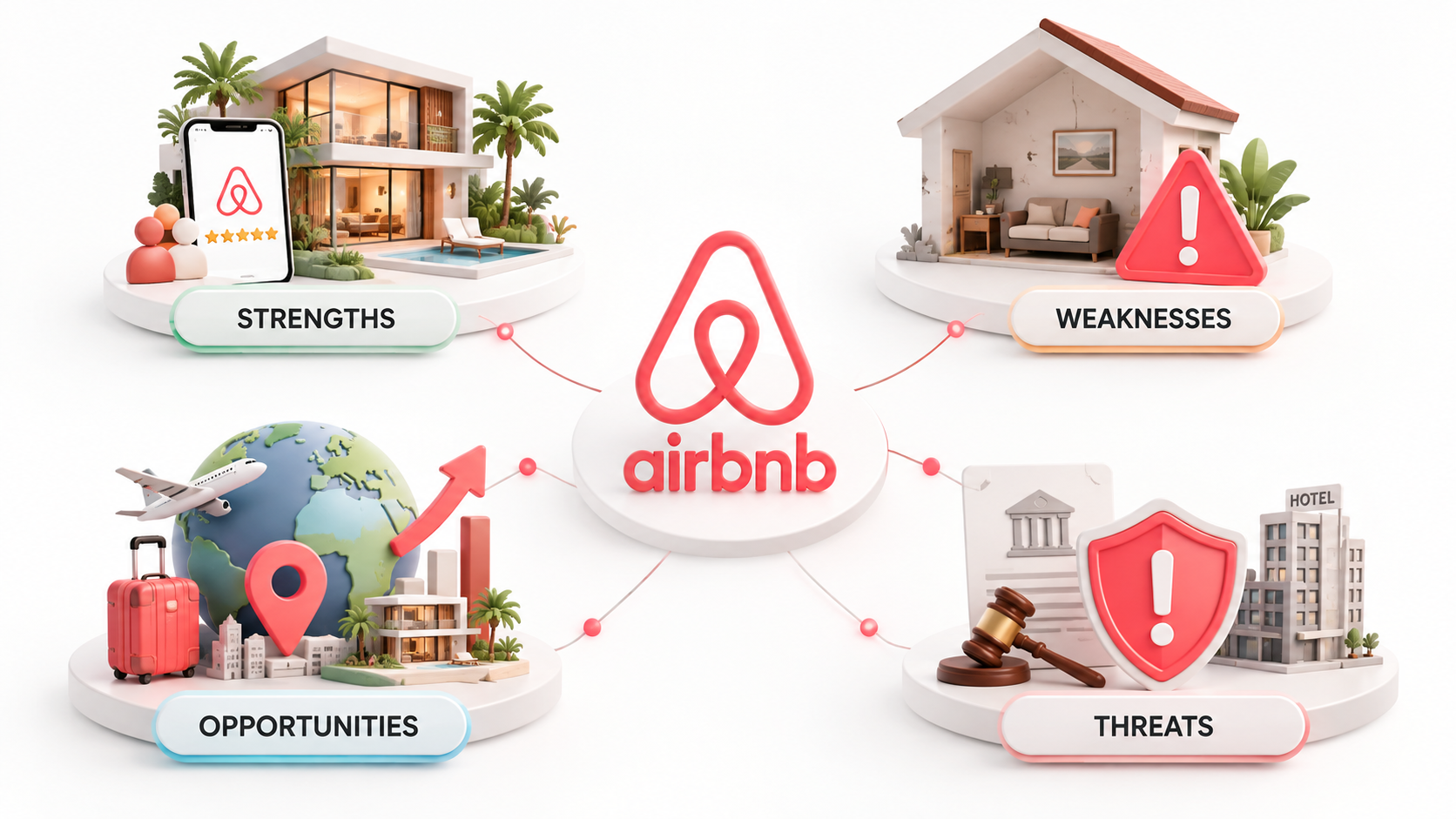
A SWOT analysis of Airbnb provides a structured overview of the company’s current business position by examining its Strengths, Weaknesses, Opportunities, and Threats. As a leading global accommodation marketplace, Airbnb operates in a highly competitive and rapidly changing travel industry. Its strong brand recognition, large network of hosts, and unique accommodation options give it several advantages, while challenges such as regulatory restrictions, service consistency, and competition can affect its growth. At the same time, expanding travel demand, new markets, and evolving customer preferences create opportunities for further development. Analyzing these four areas helps understand Airbnb’s competitive position, growth potential, and the challenges it may face in the future.
Strengths
This is where things get interesting. Airbnb’s strengths aren’t accidental, they come from smart early decisions about how to build trust between two strangers who’ve never met, which honestly sounds like an impossible problem to solve at scale. Somehow they pulled it off.
A Massive Two-Sided Network
Airbnb has something that’s brutally hard to copy: millions of hosts and millions of guests already using the platform. New competitors can build a nicer app or offer lower fees, but they can’t manufacture five million hosts overnight. This network effect means guests keep coming back because the selection is huge, and hosts keep listing because that’s where the guests already are. It’s a loop that reinforces itself, and it’s the single biggest reason Airbnb still dominates despite competitors like Vrbo trying to chip away at market share for years.
Strong Brand Recognition
Say “Airbnb” to almost anyone on the planet and they know what it means. That’s not true for most travel companies. The brand became a verb, kind of like how people say “Google it” instead of “search the internet.” People say “let’s Airbnb it” instead of “let’s find a vacation rental.” That kind of brand penetration took years of consistent marketing and word-of-mouth, and it’s worth an enormous amount because it lowers customer acquisition costs. People search directly for Airbnb rather than needing an ad to remind them the option exists.
Asset-Light Business Structure
Marriott owns very few of its hotels directly, but it still deals with franchise agreements, management contracts, and physical property standards. Airbnb skips almost all of that. It owns zero real estate. When a recession hits and travel demand drops, Airbnb doesn’t have empty hotel rooms costing money to maintain, it just has fewer bookings on an app. This structure means the company can scale up in good times and shrink cost exposure in bad times far more easily than a company that has real buildings, real mortgages, and real staff to manage on-site.
Wide Variety of Listings
A hotel room in Chicago looks basically the same whether it’s a Hilton, a Marriott, or a Hyatt. Airbnb offers everything from a treehouse in Oregon to a castle in Scotland to a houseboat in Amsterdam. That variety attracts travelers who want something memorable, not just a bed to sleep in. Families needing space for six people can rent a whole house instead of booking three separate hotel rooms, which usually ends up cheaper and way more practical.
Data and Personalization
Every search, every booking, every review gets logged, and Airbnb uses that data to fine-tune search rankings, suggest listings, and personalize the whole browsing experience. Over time this means better matches between what a guest wants and what’s actually available, which keeps people using the app instead of jumping over to a competitor that doesn’t know their preferences at all.
Weaknesses
No business is perfect, and pretending Airbnb has no real problems would make this analysis useless. Some of these weaknesses are structural, meaning they’re baked into how the whole model works, and they’re not going away easily.
Zero Control Over Property Quality
Because Airbnb doesn’t own or manage any of the actual properties, quality varies wildly. One listing might be spotless and exactly as pictured, and the next one might have moldy walls and a host who ghosts you the second you check in. Airbnb has policies and review systems to catch bad actors, but enforcement lags behind the scale of the platform, and guests sometimes get burned before a listing finally gets flagged and removed.
Trust and Safety Incidents
Stories about hidden cameras in rentals, scam listings that never existed, and guests trashing hosts’ homes show up in the news regularly. Each incident chips away at trust, and trust is the entire foundation Airbnb was built on. A single viral bad experience can spread across social media faster than any PR team can respond, and it hurts the brand in a way that a hotel chain, with standardized rooms and on-site staff, doesn’t have to worry about nearly as much.
Dependence on Host Behavior
Airbnb’s service quality is only as good as the millions of individual hosts running their own listings. Some hosts are professional and treat it like a real business, responding fast and keeping properties spotless. Others are part-time landlords who forget to update their calendar or cancel bookings last minute because they got a better offer elsewhere. Airbnb can set rules, but it can’t force every single host to behave consistently, and that inconsistency creates real friction for guests trying to plan a trip.
Rising Prices and Hidden Fees
Airbnb used to be the cheap alternative to hotels. That reputation has taken a hit hard over the past few years. Cleaning fees, service fees, and other add-ons can push a $100-a-night listing to $160 or more once everything gets tallied at checkout. Guests noticed, and plenty of them started openly complaining online that booking a hotel room is now sometimes cheaper and definitely simpler, with no surprise fees tacked on at the last screen before payment.
Legal and Regulatory Exposure
Cities around the world have started cracking down hard on short-term rentals. New York City passed rules in 2023 that effectively wiped out a huge chunk of Airbnb listings overnight because hosts now need to register and, in most cases, be physically present during a guest’s stay. Barcelona announced plans to ban short-term tourist rentals entirely by 2028. Every time a major city tightens regulation, Airbnb loses inventory in that market, and there’s very little the company can do about it besides lobbying and adjusting policy on the fly.
Opportunities
Despite the weaknesses, Airbnb still has plenty of room to grow if the leadership makes smart moves. Growth doesn’t have to come from squeezing more fees out of existing users, it can come from expanding into areas the company hasn’t fully tapped yet.
Growth in Long-Term and Remote Stays
The rise of remote work changed how people travel. Instead of booking a week-long vacation, more people now book a month or longer in a different city just because they can work from anywhere. Airbnb noticed this shift and pushed hard into monthly stays, which now make up a meaningful chunk of total nights booked. This trend isn’t slowing down anytime soon, and doubling down on flexible, longer bookings could open up a whole new category of steady, predictable revenue.
Expansion Into Underserved Markets
Big cities and popular tourist spots are basically saturated at this point. But plenty of regions in Africa, Southeast Asia, and parts of South America still have low Airbnb penetration relative to their tourism potential. As internet access improves and more travelers look for alternatives to expensive resort chains in these regions, Airbnb has a real shot at building host networks there before competitors even show up.
Growing the Experiences Business
Airbnb Experiences hasn’t taken off the way lodging did, but the idea behind it is solid. People want more than just a place to sleep, they want to do something memorable while they’re there. If Airbnb invests more heavily in curating and marketing this side of the business, it could turn into a genuine second revenue stream instead of a side feature most users forget even exists.
Partnerships With Local Governments and Tourism Boards
Instead of constantly fighting regulation, Airbnb has started working with certain cities and countries to create formal frameworks that let short-term rentals operate legally while still addressing housing concerns. Portugal and parts of Japan have experimented with this kind of cooperative approach. If Airbnb leans further into being a partner rather than an opponent to local governments, it could avoid the outright bans happening in places like Barcelona.
AI-Powered Personalization and Trip Planning
Airbnb has already started rolling out AI tools to help guests find listings that match specific, oddly detailed preferences, like “a quiet cabin near hiking trails with good wifi.” As this tech matures, it could turn Airbnb from just a booking site into something closer to a full trip-planning assistant, which would make the platform stickier and harder for guests to abandon for a competitor.
Threats
Now for the stuff that could genuinely hurt Airbnb if the company doesn’t adapt fast enough. These aren’t hypothetical worries, several of them are already actively playing out in real markets right now.
Intensifying Regulatory Crackdowns
This is probably the single biggest threat on the list. Cities aren’t just tweaking rules anymore, some are banning short-term rentals outright. When New York’s local law 18 took effect, active listings dropped by more than 80% almost immediately. If more major cities follow Barcelona’s lead and ban short-term rentals entirely by a set deadline, Airbnb loses access to some of its highest-value markets, and there’s no easy replacement for that lost inventory.
Competition From Vrbo, Booking.com, and Hotel Chains
Vrbo has carved out a strong niche in whole-home rentals, often appealing to families who don’t want to share space with a host living on-site. Booking.com added vacation rental listings years ago and has the advantage of massive existing traffic from hotel bookers who might just stay on the same site instead of switching to Airbnb. Meanwhile, hotel chains like Marriott launched Homes & Villas specifically to compete in the space Airbnb built. None of these competitors are killing Airbnb outright, but they’re each nibbling away pieces of market share.
Economic Downturns and Travel Slowdowns
Travel spending is one of the first things people cut when money gets tight. A recession, a spike in fuel prices, or a global event like a pandemic can crush booking volume almost overnight, and Airbnb felt this hard in 2020 when revenue dropped by roughly 30%. While the asset-light model helps the company survive downturns better than hotel chains, it still doesn’t make Airbnb immune to a serious pullback in consumer travel spending.
Housing Market Backlash
In cities where Airbnb listings pulled a huge chunk of long-term rental units out of the market, local residents got angry, and rightfully so in a lot of cases. When landlords realize they can make more renting nightly to tourists than monthly to locals, rents for actual residents climb. This backlash has fueled a lot of the regulatory action mentioned earlier, and public opinion turning against the platform in specific cities creates political pressure that’s hard to reverse once it builds momentum.
Data Privacy and Cybersecurity Risks
Airbnb holds a staggering amount of personal data, payment info, home addresses, ID verification documents, and more, for both hosts and guests. Any major data breach would be a disaster, not just from a legal liability standpoint but because trust is the entire product Airbnb sells. If people stop trusting Airbnb with their personal information, the whole two-sided marketplace model takes a direct hit.
Airbnb vs Traditional Hotels: A Quick Comparison
It helps to see how Airbnb stacks up against the industry it disrupted, because the differences explain a lot of why this SWOT Analysis of Airbnb looks the way it does.
Cost and Value
Hotels charge a fixed nightly rate that usually includes basic amenities, cleaning, and front desk service baked in. Airbnb’s pricing can be lower for longer stays or larger groups, but once cleaning fees and service charges get added, a short weekend stay sometimes ends up costing about the same or more than a mid-range hotel room, especially in cities with tight regulation driving up host costs.
Consistency and Service Standards
A Hilton in Tokyo and a Hilton in Chicago follow roughly the same standards for cleanliness, check-in process, and customer service. Airbnb listings don’t have that consistency because every host runs things their own way. This is either a feature or a bug depending on what a traveler wants. Some people love the unpredictability and local character. Others just want to know exactly what they’re getting before they arrive.
Flexibility and Space
Hotels are built around individual rooms. Airbnb is built around entire homes, apartments, and unique spaces. A family of five traveling together usually finds more value and comfort in a two-bedroom Airbnb with a kitchen than in two separate cramped hotel rooms, and that kitchen alone can save a meaningful amount of money on food during a longer trip.
What This SWOT Analysis of Airbnb Means for Investors
Anyone looking at Airbnb stock needs to weigh the strengths against the threats honestly, not just cheerlead the brand because it’s popular. The network effect and asset-light model are genuinely strong long-term advantages that are hard for competitors to replicate quickly. That’s the bullish case in a nutshell.
The Bull Case
Airbnb generates strong free cash flow because it doesn’t carry the debt and capital expenses that come with owning real estate. It has room to grow into new markets and categories like long-term stays and experiences. Margins are healthy, and the company has already proven it can weather a massive shock like the 2020 travel collapse and come back stronger than before, which says something about the underlying resilience of the model.
The Bear Case
Regulatory risk is real and growing, not shrinking. Every city that bans or heavily restricts short-term rentals removes potential revenue permanently. Guest complaints about pricing and hidden fees could eventually push meaningful volume back toward hotels if Airbnb doesn’t address the perception that it’s no longer the budget-friendly option it used to be. Investors need to watch regulatory news closely, because a handful of major cities banning the platform could genuinely dent growth projections that assume steady global expansion.
Lessons From Airbnb’s SWOT for Other Businesses
Airbnb’s story offers lessons that go way beyond the travel industry, and that’s part of why this case gets taught so often in business courses.
Trust Can Be Engineered, Not Just Assumed
Nobody thought strangers would willingly stay in each other’s homes. Airbnb solved that with reviews, verified IDs, secure payments, and host guarantees. Any business trying to connect strangers for a transaction, whether it’s a rideshare app or a freelance marketplace, can learn from how carefully Airbnb built trust mechanisms before scaling the platform.
An Asset-Light Model Can Beat Owning Everything
Plenty of industries assume you need to own the infrastructure to dominate a market. Airbnb proved that owning the marketplace and the relationships matters more than owning the physical assets. This lesson applies to logistics companies, service marketplaces, and honestly any business built around connecting supply and demand rather than manufacturing the supply itself.
Conclusion
Airbnb isn’t going anywhere anytime soon, but it’s also not the scrappy underdog it used to be. It’s a massive, sometimes controversial company that reshaped how millions of people travel and how millions of property owners earn income. The strengths are real and hard to copy. The weaknesses are just as real and won’t disappear just because the company is profitable. Regulation is tightening in exactly the markets where Airbnb makes the most money, and that tension isn’t resolving cleanly anytime soon.
Whether Airbnb keeps winning depends a lot on how it handles the next five years of city-by-city fights over housing and regulation. The brand strength and network effects give it a huge cushion, but cushions don’t last forever if the underlying friction keeps building. This is exactly why understanding a proper SWOT Analysis of Airbnb matters, not just for investors or business students, but for anyone trying to understand where the short-term rental industry is actually headed next.
Frequently Asked Questions
What is the biggest strength in Airbnb’s SWOT analysis?
The biggest strength is easily the network effect created by millions of hosts and guests already using the platform. That scale is genuinely difficult for any new competitor to replicate quickly, no matter how much funding they raise or how polished their app looks on launch day.
What is Airbnb’s biggest weakness right now?
Rising prices combined with inconsistent host quality stands out as the biggest weakness. Airbnb built its reputation on being an affordable, reliable alternative to hotels, and both of those pillars have weakened noticeably over the past few years as fees climbed and quality control remained uneven across listings.
How does regulation threaten Airbnb’s business model?
Cities can restrict or outright ban short-term rentals, instantly wiping out large chunks of active listings in high-value markets. New York and Barcelona are the clearest recent examples of how fast regulation can shrink Airbnb’s available inventory in a single city, with almost no warning for hosts relying on that income.
Is Airbnb still cheaper than staying in a hotel?
Not always anymore. Once cleaning fees and service charges get added, many Airbnb bookings end up costing close to or more than a comparable hotel room, especially for short one or two night stays where those flat fees make up a bigger percentage of the total cost.
Why don’t hotels compete directly with Airbnb’s model?
Some actually have started, like Marriott with Homes & Villas. But most hotel chains rely on owning or franchising physical properties with consistent staffing and amenities, which is a fundamentally different cost structure than Airbnb’s marketplace approach that owns no real estate at all.
What opportunities does Airbnb have for future growth?
Long-term and remote work stays represent one of the clearest growth opportunities, along with expanding into underserved regions in Africa, Southeast Asia, and South America where Airbnb’s presence remains relatively thin compared to tourism demand in those areas.
How did Airbnb perform during the 2020 pandemic?
Revenue dropped by roughly 30% in 2020 as global travel came to a near standstill, but the asset-light business model let Airbnb cut costs and adapt faster than traditional hotel chains carrying heavy fixed costs from owned or leased properties.
Does Airbnb make money from anything besides booking fees?
Yes, though it’s a smaller piece of the pie. Airbnb Experiences lets local guides charge for activities and tours, and the company takes a percentage cut there too, but the vast majority of revenue still comes directly from service fees on lodging bookings.
How many countries does Airbnb operate in?
Airbnb operates in more than 220 countries and regions worldwide, with over 5 million active hosts listing properties, making it one of the most globally distributed travel platforms currently in operation.
What cities have banned or heavily restricted Airbnb?
New York City enforced strict registration rules in 2023 that eliminated most short-term listings almost overnight, and Barcelona announced a plan to ban short-term tourist rental licenses entirely by 2028, both signaling a broader trend of major cities cracking down on the industry.
Is Airbnb a good stock to invest in based on its SWOT?
That depends entirely on risk tolerance. The company has strong margins, a defensible network effect, and room for growth, but regulatory risk is significant and growing across multiple major markets, so investors need to weigh that ongoing legal exposure against the underlying strength of the business model itself.
What can other businesses learn from Airbnb’s success?
The clearest lesson is that trust between strangers can be systematically built through verification, reviews, and guarantees rather than just assumed, and that owning a marketplace connecting supply and demand can be more valuable and scalable than owning the physical assets involved in the transaction.