


Local SEO is one of the most important strategies for businesses that want to attract customers from a specific geographic area. Whether you run a local shop, service business, or multi-location brand, your visibility in local search results directly impacts your growth. One of the most critical—but often misunderstood—parts of local SEO is citations.

Citations help search engines like Google verify your business information and understand how trustworthy and relevant your business is. However, not all citations are the same. There are two main types: structured and unstructured citations. Both play different roles, and understanding how to use them correctly can give you a strong competitive advantage.
In this guide, you will learn the difference between structured and unstructured citations, how they impact rankings, and how to build a powerful citation strategy for 2026.
What Are Local SEO Citations?
Local SEO citations are online mentions of your business information. These mentions usually include your NAP details:
- Name
- Address
- Phone Number
Search engines use these citations to confirm that your business is real and trustworthy. The more consistent and accurate your citations are across the internet, the more confidence search engines have in your business.
Citations also help users discover your business. When your business appears on multiple platforms, it increases your visibility and improves your chances of getting clicks, calls, and visits.
Additionally, citations contribute to local rankings by supporting three important factors:
- Trust and credibility
- Business relevance
- Online visibility
Citations are not the same as backlinks, but they still play a crucial role in local SEO performance.
Types of Citations in Local SEO
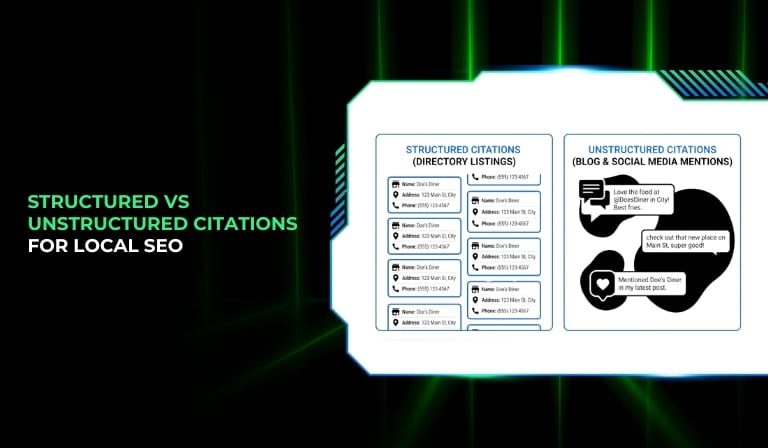
There are two main types of citations in local SEO: structured and unstructured citations. Each type serves a different purpose and contributes differently to your overall SEO strategy.
- Structured citations are listings in directories with fixed formats
- Unstructured citations are mentions of your business within content
Both types are important. Structured citations help search engines validate your business data, while unstructured citations help build authority and brand presence.
What Are Structured Citations?
Structured citations are listings of your business on platforms where your information is displayed in a specific, organized format.
Definition and Key Characteristics
Structured citations are typically found on business directories or listing platforms. These platforms have predefined fields where you enter your business details.
- Information is organized in fields like name, address, phone, website
- Listings are easy for search engines to read and verify
- Data is consistent across platforms when properly managed
These citations are highly reliable signals for search engines.
Examples of Structured Citations
Structured citations appear on well-known platforms such as:
- Google Business Profile
- Yelp
- Bing Places
- Apple Maps
- Industry-specific directories
These platforms act as trusted sources of business information.
Benefits of Structured Citations
Structured citations offer several important advantages:
- Improve NAP consistency across the web
- Help search engines verify your business information
- Increase chances of appearing in local search results
- Provide direct visibility to potential customers
- Are easier to control and update
They form the foundation of any local SEO strategy.
What Are Unstructured Citations?
Unstructured citations are mentions of your business information that appear naturally within content rather than in a fixed directory format.
Definition and Key Characteristics
These citations are not limited to structured fields. They can appear anywhere online where your business is mentioned.
- Appear in articles, blogs, or social media posts
- May include partial or full business details
- Not always formatted consistently
- Often contextual and content-driven
They are less controlled but highly valuable for authority.
Examples of Unstructured Citations
Unstructured citations can be found in:
- Blog posts mentioning your business
- News articles covering your company
- Social media posts
- Online forums and discussions
- Reviews and testimonials
These mentions often occur naturally as your brand gains recognition.
Benefits of Unstructured Citations
Unstructured citations provide powerful SEO benefits:
- Build brand authority and trust
- Increase online visibility beyond directories
- Strengthen topical relevance
- Support Google’s understanding of your brand
- Improve prominence in local search
They act as signals of popularity and credibility.
Structured vs Unstructured Citations (Key Differences)
Understanding the difference between these two types of citations is essential for building an effective strategy.
Side-by-Side Comparison Table
- Format: Structured citations follow a fixed format, while unstructured citations appear naturally in content
- Control: Structured citations are fully controlled by you; unstructured citations are not
- SEO Impact: Structured citations help with verification; unstructured citations build authority
- Tracking: Structured citations are easier to track; unstructured ones are harder to monitor
- Scalability: Structured citations can be scaled quickly; unstructured citations take time
Core Difference Explained Simply
Structured citations focus on data validation. They help search engines confirm that your business information is accurate.
Unstructured citations focus on authority signals. They show that your business is being talked about across the web, which increases trust and credibility.
How Citations Impact Google’s Local Ranking Factors
Google uses three main factors to rank local businesses. Citations play a role in all of them.
Relevance
Relevance refers to how well your business matches a user’s search query.
- Accurate categories in structured citations improve relevance
- Keywords in unstructured mentions add context
- Consistent business information strengthens topic alignment
Distance (Proximity)
Distance refers to how close your business is to the searcher.
- Address consistency across citations helps Google understand your location
- Multiple location signals improve accuracy
Prominence
Prominence refers to how well-known your business is.
- Unstructured citations increase brand mentions
- Media coverage and online discussions boost visibility
- Reviews and social signals enhance trust
Both citation types work together to improve your local rankings.
Which Is More Important: Structured or Unstructured?
Both structured and unstructured citations are important, but they serve different purposes.
Structured citations are essential for building a strong foundation. Without accurate listings, search engines may struggle to trust your business information.
Unstructured citations provide a competitive advantage. They help you stand out by building authority and increasing brand awareness.
You should prioritize structured citations when starting out. Once your foundation is strong, focus on earning unstructured citations to scale your visibility.
The best approach is a balanced strategy that combines both types.
How to Build Structured Citations (Step-by-Step)
Building structured citations requires a systematic approach to ensure accuracy and consistency.
Claim & Optimize Google Business Profile
- Create or claim your listing
- Add accurate NAP details
- Choose correct business categories
- Upload images and update information regularly
Submit to Core Directories
- List your business on major platforms
- Ensure all details match your primary listing
- Focus on high-quality directories
Use Data Aggregators
- Submit your data to aggregators that distribute information
- Helps maintain consistency across multiple platforms
Choose Correct Categories
- Select categories that match your services
- Avoid irrelevant or overly broad categories
Maintain NAP Consistency
- Keep your business name, address, and phone number identical everywhere
- Update all listings when changes occur
Common Mistakes to Avoid
- Creating duplicate listings
- Using inconsistent contact details
- Selecting incorrect categories
- Ignoring outdated listings
How to Earn Unstructured Citations (Advanced Strategies)
Unstructured citations require effort and strategy, as they cannot be directly controlled.
Digital PR & Local Media Coverage
- Reach out to local journalists
- Share newsworthy updates about your business
- Get featured in local publications
Guest Blogging & Thought Leadership
- Write articles for relevant websites
- Share expertise in your industry
- Mention your business naturally
Local Partnerships & Sponsorships
- Collaborate with local organizations
- Sponsor events or initiatives
- Get mentioned on partner websites
Influencer & Community Mentions
- Work with local influencers
- Engage with online communities
- Encourage organic mentions
Social Media Engagement
- Stay active on social platforms
- Encourage sharing and discussions
- Build a recognizable brand presence
Pro Tip
Search engines are increasingly analyzing brand mentions and context. Even without links, mentions of your business can influence how your brand is perceived and ranked.
NAP Consistency: The Backbone of Citation SEO
NAP consistency is one of the most important factors in citation management.
What is NAP Consistency?
NAP consistency means your business name, address, and phone number are identical across all platforms.
Why It Matters for Rankings
- Helps search engines verify your business
- Prevents confusion and duplicate listings
- Builds trust and credibility
How to Audit & Fix Inconsistencies
- Search your business name online
- Identify incorrect or outdated listings
- Update or remove duplicates
- Use tools or manual checks to maintain accuracy
Citation Audit & Tracking
Tracking your citations helps you understand their impact and maintain accuracy.
How to Audit Existing Citations
- Identify all platforms where your business is listed
- Check for accuracy and completeness
- Remove duplicates or incorrect entries
Tools for Citation Management
- Use tools to track listings
- Monitor changes and updates
- Automate distribution where possible
How to Measure Impact (traffic, rankings, calls)
- Track local search rankings
- Monitor website traffic from directories
- Measure calls and inquiries
- Analyze visibility improvements
Structured vs Unstructured Citations: Best Strategy for 2026
To succeed in local SEO, you need a balanced and forward-thinking approach.
- Start with structured citations to build a strong foundation
- Focus on high-quality directories and accurate information
- Gradually invest in unstructured citations to build authority
- Combine citations with backlinks, reviews, and content marketing
- Prioritize quality over quantity
This combination ensures long-term growth and stability.
Quick Action Plan (Beginner to Advanced)
- Week 1: Set up and optimize your Google Business Profile and fix NAP consistency
- Week 2: Submit your business to top directories
- Week 3–4: Start outreach for mentions and partnerships
- Ongoing: Monitor, update, and expand your citation profile
Conclusion
Structured and unstructured citations are both essential for a successful local SEO strategy. Structured citations provide the foundation by ensuring your business information is accurate and consistent across platforms. Unstructured citations build on that foundation by increasing your brand’s authority, visibility, and trust.
To succeed in 2026, businesses must move beyond basic directory listings and focus on building a strong, well-rounded online presence. By combining accurate structured citations with strategic unstructured mentions, you can improve your local rankings, attract more customers, and build long-term credibility in your market.
A balanced approach is the key to sustainable growth in local SEO.
FAQs
What is the difference between structured and unstructured citations?
Structured citations are listings in directories with fixed formats, while unstructured citations are mentions of your business within content.
Do citations still matter for SEO in 2026?
Yes, citations remain important because they help search engines verify business information and assess trust and relevance.
How many citations do I need?
There is no fixed number. Focus on quality, consistency, and relevance rather than quantity.
Can unstructured citations replace backlinks?
No, unstructured citations support authority but do not replace backlinks. Both are important for SEO.
How long does it take to see results?
Results can take weeks to months, depending on competition and consistency of efforts.