


Open the Myntra app on a random Tuesday and you’ll see something strange happening. A t-shirt that cost 899 rupees yesterday is now 449. A brand you’ve never heard of, Bewakoof or Snitch or The Souled Store, is sitting right next to Nike on the homepage carousel. There’s a livestream running in one corner where someone is trying on kurtas in real time. None of this is random. Every one of those moments is the result of a marketing mix that Myntra has been sharpening for close to fifteen years, and honestly, most people writing about it online just skim the surface.
Myntra didn’t become India’s largest fashion and lifestyle platform by accident. It started in 2007 as a company that sold personalized gifts, pivoted hard into fashion e-commerce, got bought by Flipkart in 2014 for roughly 300 million dollars, and somehow managed to stay a separate, distinct brand even after that acquisition. That’s rare. Most acquired companies get absorbed and lose their identity within a couple of years. Myntra kept its own app, its own culture, its own marketing voice, and its own customer base that behaves differently from Flipkart’s.
This piece breaks down the Myntra marketing mix using the classic 4Ps framework: Product, Price, Place, and Promotion. But we’re not going to just define each P and move on like a textbook. We’re going to look at what Myntra actually does differently from Ajio, Amazon Fashion, and Nykaa Fashion, why some of its bets worked, why some of them didn’t, and what the numbers behind those decisions actually look like. If you run an e-commerce business, study marketing, or just want to understand why your Myntra app looks the way it does, this is going to answer that fully.
What You Will Learn in This Guide
- How Myntra structures its product strategy across private labels, marketplace brands, and exclusive licensing deals
- Why Myntra’s pricing looks chaotic but is actually built on data-driven dynamic pricing and flash sale psychology
- How Myntra solved the same-day and next-day delivery problem in a country where logistics infrastructure is genuinely difficult
- What makes Myntra’s promotion strategy different from a typical influencer marketing playbook
- Real numbers: revenue figures, sale event performance, app download stats, and where Myntra stands against Ajio and Amazon Fashion in 2026
- The mistakes Myntra made along the way, because no marketing strategy is a straight line to success
Myntra Marketing Mix
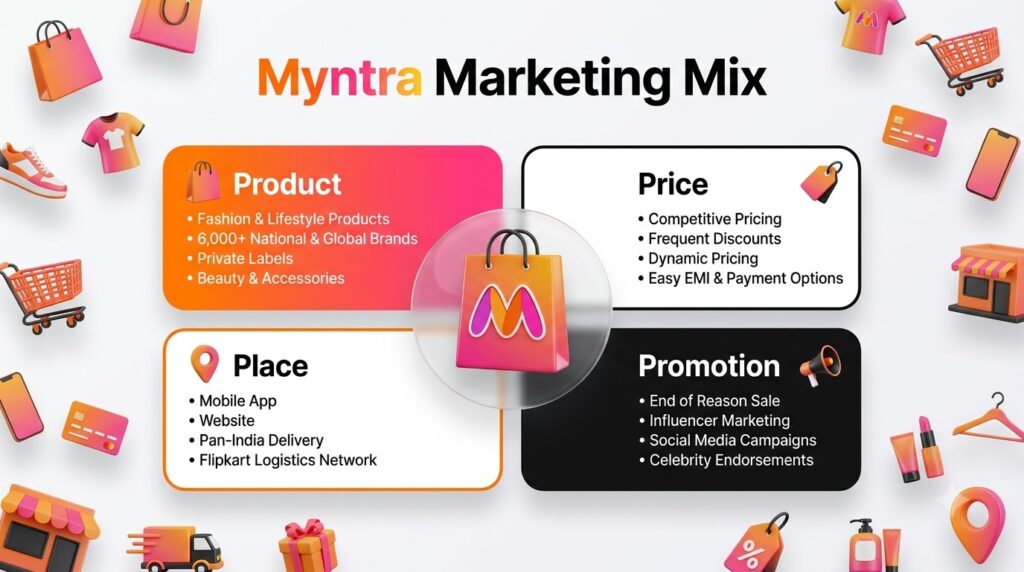
Myntra’s success in India’s competitive online fashion industry is not driven by discounts alone. Instead, the company follows a well-structured marketing mix that combines a wide product portfolio, competitive pricing, seamless digital distribution, and aggressive promotional campaigns. This strategy has helped Myntra become one of India’s leading fashion and lifestyle marketplaces while attracting millions of active users across different customer segments.
Let’s explore the four pillars of Myntra’s marketing mix.
Myntra Product Strategy
Myntra’s product strategy is the part most competitors struggle to copy, mainly because it isn’t one strategy. It’s three strategies running in parallel: a massive third-party marketplace, a growing stack of private labels, and a set of exclusive brand partnerships that don’t exist anywhere else in India. Each of these does a different job, and understanding why Myntra runs all three at once tells you a lot about how the company thinks about growth.
Wide Product Assortment Across Categories
Myntra carries somewhere north of 20 lakh style options across clothing, footwear, accessories, beauty, and home decor, sourced from more than 7,000 brands. That’s not a made-up number to sound impressive, it’s what makes the app function as a one-stop shop instead of a niche fashion site. A shopper who came in looking for running shoes ends up browsing gym wear, then protein shakers, then a yoga mat, because Myntra built its categories to feed into each other rather than sit as isolated silos.
This matters more than it sounds like on paper. Amazon Fashion has scale too, but its interface treats fashion as one category among millions. Myntra built its entire homepage, filters, and recommendation engine around fashion-first browsing, which is why people who are shopping specifically for clothes tend to land on Myntra first and treat Amazon as the backup option when something is out of stock.
Myntra’s Private Label Strategy
This is the part that genuinely changed Myntra’s margins. Private labels like Roadster, HRX (co-owned with Hrithik Roshan), Here&Now, Dressberry, and Kook N Keech now make up a significant chunk of Myntra’s total sales, some estimates put private label contribution at close to 30 to 35 percent of overall revenue in certain categories like men’s casualwear. That’s a huge number for a marketplace that started as a pure third-party aggregator.
Why does this matter for the business? Because when Myntra sells a third-party brand’s product, it earns a commission, usually somewhere between 15 to 30 percent depending on the category and the seller agreement. When Myntra sells its own private label product, it captures the entire margin, manufacturing cost aside. Roadster alone is reportedly one of the most profitable single brands on the entire platform, and it competes directly with brands like US Polo and Levi’s on price while sitting comfortably above them on margin for Myntra internally.
Exclusive Brand Partnerships and Licensing
Myntra was one of the first platforms in India to lock in exclusive online partnerships with global and domestic brands. Puma, for years, sold exclusively through Myntra in certain categories. H&M ran its India e-commerce presence through Myntra for a long stretch before branching out. These deals aren’t just about product variety, they’re a moat. If you want Puma’s latest drop online in India during that exclusivity window, Myntra is the only place to get it, and that pulls in traffic that competitors simply can’t intercept no matter how aggressive their pricing is.
Curation Over Catalog
Here’s something people miss. Myntra doesn’t just list products, it curates them into edits: “Wedding Season Edit,” “Monsoon Ready,” “Office Wear Under 999.” This is a deliberate move away from being a search-and-filter catalog toward being a styling assistant. Fashion e-commerce in India was, for a long time, dominated by people who knew exactly what they wanted and searched for it directly. Myntra’s curated collections target the much larger group of shoppers who open the app without a specific item in mind and want inspiration first, decision second.
Myntra Studio and Content-Led Product Discovery
Myntra Studio, the platform’s short-video and livestream shopping feature, blurs the line between product and content. Users watch styling reels, creators try on outfits live, and purchases happen without leaving the video. This is Myntra borrowing the Instagram Reels and TikTok Shop playbook and applying it directly to product discovery, and it’s working well enough that Myntra has kept expanding the creator base feeding into it, with thousands of creators now uploading styling content weekly.
Myntra Price/Pricing Strategy
If you’ve ever looked at your Myntra cart and wondered how a 2,999 rupee jacket became 1,499 with a coupon on top, you’ve experienced Myntra’s pricing engine directly. This isn’t random discounting, it’s a layered pricing system built to serve different customer intents at different times of the year.
Dynamic and Demand-Based Pricing
Myntra runs dynamic pricing based on demand signals, inventory levels, seasonality, and even device and browsing behavior in some cases. A jacket priced at full rate in July might see a 40 percent markdown in October once winter demand kicks in and inventory needs to move faster. This isn’t unique to Myntra, most large e-commerce platforms do some version of this, but Myntra’s execution is tightly tied to its category calendar. Wedding season pricing, monsoon pricing, festive pricing, back-to-school pricing, each one gets its own price movement pattern, and the algorithm adjusts based on how fast a SKU is selling relative to its target velocity.
The End of Reason Sale (EORS) and Flash Sale Psychology
Myntra’s biggest pricing event is the End of Reason Sale, which typically runs multiple times a year and has, in past editions, generated single-day gross merchandise value in the hundreds of crores. EORS isn’t just a discount event, it’s built on scarcity and urgency mechanics: limited-time flash deals, “only 3 left” indicators, countdown timers on the checkout page. These aren’t decorative, they measurably increase conversion rates during sale windows, which is why nearly every major fashion e-commerce player has copied this format, but Myntra was doing it at scale in India before most of them.
Freemium Loyalty: Myntra Insider
Myntra Insider is a tiered loyalty program (Bronze, Silver, Gold, Platinum, Insider Circle) that rewards repeat purchase behavior with early sale access, free shipping, and exclusive discounts. This is a smart pricing lever because it doesn’t discount the product itself, it discounts the relationship. A Gold tier customer gets early access to EORS 12 hours before regular users, which sounds small but drives real behavioral change: insiders convert faster and buy in higher volume during flash sales because they’re not competing with the entire user base for stock.
Price Segmentation Across Value, Mid, and Premium Tiers
Myntra runs three pricing bands simultaneously and doesn’t try to force them into one identity. Value bands are served by private labels and mass brands like HRX and Roadster, priced to compete directly with Meesho and budget fashion apps. Mid-tier is where most third-party brands like Puma, US Polo, and Levi’s sit. Premium and luxury is served through Myntra Luxe, a separate section carrying brands like Michael Kors, Jimmy Choo, and other high-end labels, priced without the aggressive discounting seen elsewhere on the platform because luxury shoppers respond to exclusivity signals, not markdowns.
Coupon Stacking and Bank Offer Partnerships
Myntra partners with HDFC, ICICI, and other major banks for card-specific discounts stacked on top of regular sale pricing. During EORS, it’s common to see a base discount, a coupon code discount, and a bank cashback offer all applying at checkout simultaneously. This layered structure creates a psychological effect where the final price feels like a personal win rather than a standard markdown, which increases both conversion and the perceived value of the Myntra Insider membership tier that unlocks some of these stacked offers first.
Myntra Place & Distribution Strategy:
Getting a t-shirt from a warehouse in Bengaluru to a customer’s doorstep in a tier-3 town in Bihar within 24 to 48 hours is a genuinely hard logistics problem, and Myntra’s place strategy is built almost entirely around solving it.
App-First, Not Website-First
Roughly 90 percent plus of Myntra’s total transactions happen through its mobile app rather than the desktop website. This wasn’t an accident, Myntra built its entire UX, notification system, and personalization engine mobile-first from a fairly early stage, well before most Indian e-commerce players took mobile seriously. The app uses push notifications tied to browsing behavior, abandoned cart reminders, and wishlist price-drop alerts to pull users back in constantly, something a website simply can’t replicate as effectively.
Warehouse and Fulfillment Network
Myntra operates fulfillment centers across multiple states, with major hubs in Karnataka, Haryana, and Maharashtra, supported by smaller regional centers that reduce delivery distance for high-demand pin codes. Myntra also uses a hybrid model that combines its own logistics arm with Flipkart’s Ekart network, since the shared ownership means Myntra doesn’t need to build an entirely separate last-mile delivery system from scratch. This shared infrastructure is one of the quieter benefits of the Flipkart acquisition that doesn’t get talked about enough.
Tier 2 and Tier 3 Expansion
Metro cities are saturated. Real growth in Indian e-commerce over the last five years has come from tier 2 and tier 3 towns, and Myntra has pushed hard into this segment through regional language support in the app, cash-on-delivery options (still a dominant payment method outside metros), and localized marketing that features regional festivals and clothing preferences rather than a one-size-fits-all national campaign.
M-Now and Rapid Delivery
Myntra launched M-Now in select metro cities to offer delivery within a few hours for a curated selection of products, directly responding to the quick commerce wave led by Blinkit, Zepto, and Swiggy Instamart moving into fashion adjacent categories. This is Myntra defending its core category from being nibbled at by quick commerce players who might otherwise capture impulse fashion purchases, things like a last-minute accessory before an event, that a customer used to just skip buying online because next-day delivery felt too slow.
Myntra Fashion Superstore (Offline Retail)
Myntra opened its first physical retail stores, branded as Myntra Fashion Superstore, in cities like Bengaluru, marking a genuine shift for a company that built its identity on being online-only. This move mirrors what Nykaa did successfully with its offline stores, using physical retail not to replace online sales but to build brand trust in categories like footwear and innerwear where customers still want to touch and try before buying, and to serve as a discovery channel that eventually funnels shoppers back to the app.
Myntra Promotion & Advertising Strategy:
This is where Myntra’s marketing team genuinely earns its reputation. The promotion strategy isn’t built around one campaign a year, it’s a constant, layered system running across influencers, celebrities, content, and performance marketing simultaneously.
Influencer and Creator Marketing at Scale
Myntra works with creators across every tier, from mega-influencers with millions of followers down to nano and micro creators with under 50,000 followers who often drive better engagement rates within niche fashion communities. The platform’s influencer strategy isn’t just about reach, it’s about seeding trends before they go mainstream. A specific silhouette or color trend often shows up on Myntra Studio and creator content weeks before it hits the homepage as a formal campaign, which lets Myntra test demand cheaply before committing ad budget to it.
Celebrity Brand Ambassadors and Co-Owned Labels
Myntra doesn’t just pay celebrities for endorsement, it co-owns brands with them. HRX with Hrithik Roshan is the clearest example, structured as a genuine business partnership rather than a one-off ad deal. This gives Myntra a celebrity’s fanbase and credibility baked permanently into a product line rather than rented for a campaign cycle, and it means the marketing cost is amortized across years of product sales instead of a single burst of ad spend.
Social Media Strategy Across Platforms
Myntra runs distinct content strategies on Instagram, YouTube, and increasingly on platforms like Snapchat and Pinterest for style discovery. Instagram carries the bulk of trend-driven, aesthetic content, styling reels, outfit inspiration, campaign teasers. YouTube is used for longer-format content like sale event trailers and brand documentaries around private labels. This platform-specific approach means Myntra isn’t repurposing the same asset everywhere, which is a mistake a lot of smaller D2C brands still make.
Sale Event Marketing and Hype Building
Before every major sale like EORS or the Big Fashion Festival, Myntra runs a multi-week hype cycle: countdown content, “coming soon” teasers, early wishlist reminders, and influencer unboxing previews. This staggered rollout treats a sale event less like a discount and more like a product launch, which is a subtle but important reframing. Customers aren’t shown up to a sale, they’re invited to an event, and that framing measurably increases app opens in the days leading up to the actual sale start date.
Performance Marketing and Retargeting
Behind the creative campaigns sits a heavy performance marketing operation: Google Shopping ads, Meta dynamic product ads, and retargeting campaigns that follow a user across the internet after they’ve browsed a product without buying it. Abandoned cart retargeting alone recovers a meaningful chunk of otherwise lost sales, and Myntra’s use of dynamic creative, ads that automatically populate with the exact product a user viewed, rather than a generic banner, keeps click-through rates well above industry average for fashion retargeting.
AI-Powered Personalization in Promotion
Myntra’s homepage isn’t the same for every user. Recommendation algorithms surface different categories, brands, and price points based on past browsing and purchase history, effectively turning the homepage itself into a personalized promotional channel. A user who regularly buys athleisure sees a homepage dominated by HRX and sportswear brands, while a user who’s browsed ethnic wear during wedding season sees a completely different layout. This level of personalization means Myntra’s biggest promotional real estate, its own app homepage, is doing individualized marketing at a scale a human team could never manually replicate.
Conclusion
Myntra’s marketing mix works because none of the four Ps operate in isolation. The product strategy feeds the pricing strategy, private labels can afford deeper discounts because Myntra owns the full margin, and the pricing strategy feeds the promotion strategy, since flash sales need hype cycles to hit their targets, and the whole thing rides on a distribution network built to actually deliver on the promises made in the marketing. That’s the real lesson in the Myntra marketing mix: it’s not four separate strategies, it’s one system where each piece makes the others work better than they would alone. If you’re studying this for a business case or building your own e-commerce brand, the takeaway isn’t to copy the tactics individually, it’s to build that same kind of feedback loop between what you sell, what you charge, how it reaches people, and how you talk about it.
FAQs
What is the Myntra marketing mix?
The Myntra marketing mix refers to how the company structures its Product, Price, Place, and Promotion strategies together. It combines a mix of private labels, third-party brands, and exclusive partnerships (Product), dynamic and tiered pricing with loyalty rewards (Price), an app-first distribution model backed by strong logistics (Place), and influencer-driven, highly personalized advertising (Promotion).
Who owns Myntra?
Myntra is owned by Flipkart, which acquired the company in 2014. Flipkart itself is majority owned by Walmart. Despite the acquisition, Myntra continues to operate as a distinct brand with its own app, leadership structure, and marketing identity separate from Flipkart’s main platform.
What are Myntra’s private label brands?
Myntra’s major private labels include Roadster, HRX, Here&Now, Dressberry, Kook N Keech, and Sassafras, among others. These brands are manufactured and sold exclusively by Myntra, allowing the company to capture full margins instead of paying commission to third-party sellers.
How does Myntra’s pricing strategy work?
Myntra uses dynamic, demand-based pricing that adjusts based on seasonality, inventory levels, and sale events. Prices shift for flash sales like the End of Reason Sale, and are further layered with coupon codes, bank offers, and loyalty tier discounts through the Myntra Insider program.
What is Myntra Insider?
Myntra Insider is the platform’s tiered loyalty program with levels including Bronze, Silver, Gold, Platinum, and Insider Circle. Higher tiers unlock benefits like early access to sales, free shipping, and exclusive discounts based on how much a customer spends and how often they shop on the platform.
Is Myntra better than Ajio for shopping?
Myntra generally has a wider product catalog, stronger private label margins, and a more developed loyalty and personalization system compared to Ajio. Ajio, owned by Reliance, competes aggressively on pricing and has strong offline retail backing through Reliance Trends stores, but Myntra tends to lead in app engagement and influencer-driven marketing reach.
What is the End of Reason Sale (EORS)?
The End of Reason Sale is Myntra’s flagship discount event, held multiple times a year, offering deep markdowns across categories for a limited window. It’s built around flash sale psychology, including countdown timers, limited stock indicators, and early access for loyalty members, and it typically generates some of Myntra’s highest single-event sales volumes.
Does Myntra have physical stores?
Yes, Myntra opened physical retail locations under the Myntra Fashion Superstore format, starting in cities like Bengaluru. These stores are meant to build trust in categories like footwear and innerwear where customers prefer trying products before buying, while still funneling most transactions back to the app.
What is Myntra Studio?
Myntra Studio is the platform’s short-video and livestream shopping feature, where creators post styling content and run live try-on sessions. Users can shop directly from the video content without leaving the app, blending entertainment and product discovery into a single shopping experience.
How does Myntra use influencer marketing?
Myntra works with influencers across every tier, from large celebrity partnerships to micro and nano creators with smaller but highly engaged niche audiences. This approach lets Myntra seed emerging fashion trends early through smaller creators before scaling successful trends into larger campaigns and homepage promotions.
What is Myntra Luxe?
Myntra Luxe is a dedicated premium section of the platform carrying high-end and luxury brands like Michael Kors and Jimmy Choo. Unlike the rest of the platform, Myntra Luxe relies less on aggressive discounting and more on exclusivity and curated presentation to appeal to premium shoppers.
How does Myntra handle delivery and logistics?
Myntra uses a combination of its own fulfillment centers and Flipkart’s Ekart logistics network to manage last-mile delivery across India. It has also expanded into faster delivery formats like M-Now in select metro cities to compete with the rise of quick commerce platforms entering fashion-adjacent categories.