


Most people who type “Marketing Mix of Wipro” into Google are students working on an assignment due tomorrow morning. Fair enough. But here’s the thing nobody tells them: Wipro is one of the weirdest marketing mix case studies in the Indian IT industry, and not for the reason you’d expect.
This is a company that started out selling vegetable oil and laundry soap in 1945, spent three decades quietly building a hardware and consumer goods business, then pivoted so hard into software services that most people under 30 have no idea it ever sold cooking oil at all. Somewhere along the way it sold off its entire FMCG and lighting division to a private equity firm, rebuilt its brand identity from scratch, bought a financial consulting firm for close to a billion and a half dollars, and renamed its core purpose to “Realizing Human Potential.” That’s not a small pivot. That’s a company rewriting its own marketing mix in public, more than once.
So this guide isn’t going to give you the textbook version where Product means “IT services,” Price means “competitive,” Place means “global,” and Promotion means “advertising.” That version tells you nothing and it’s the reason most Wipro marketing mix articles online read exactly the same. Here you’ll get the actual mechanics: which business units make up Wipro’s product portfolio today, how its pricing models changed as the industry moved from billing by the hour to billing by outcome, where its delivery centers actually sit and why that geography matters, how it promotes a B2B brand that never runs a TV ad you’d remember, and what the newer 7Ps additions (people, process, physical evidence) look like inside a 230,000-person services company.
What You Will Learn in This Guide
- What the marketing mix of Wipro actually covers in 2026, not the version from a decade-old textbook
- How Wipro’s product portfolio is structured across IT services, consulting, engineering, and its AI-native units
- The different pricing models Wipro uses depending on the client, the deal size, and the type of work
- How Wipro’s global delivery model and digital channels function as its “place” strategy
- The promotion tactics a B2B services company like Wipro actually relies on, since it isn’t selling to consumers
- How people, process, and physical evidence extend the classic 4Ps into a full picture for a services business
- Common mistakes people make when writing about the marketing mix of Wipro for assignments or reports
- Practical lessons any marketer, student, or founder can pull from studying this case
Quick Summary
- Wipro’s product mix today is almost entirely IT services, consulting, and engineering R&D. The old consumer goods and lighting business was spun off into the privately held Wipro Enterprises years ago and is not part of the listed IT company anymore.
- Pricing runs on a mix of time-and-material billing, fixed-price contracts, and increasingly outcome-based and subscription-style pricing tied to AI and cloud platforms.
- Place isn’t retail shelf space. It’s a global delivery network across strategic market units in the Americas, Europe, and APMEA, plus a growing digital delivery layer through cloud partnerships.
- Promotion for Wipro leans almost entirely on B2B channels: analyst relations, sponsorships, LinkedIn thought leadership, and account-based marketing, not mass advertising.
- The extended marketing mix (people, process, physical evidence) matters more for Wipro than for a product company, because the service and the delivery team are the product.
What Is the Marketing Mix of Wipro
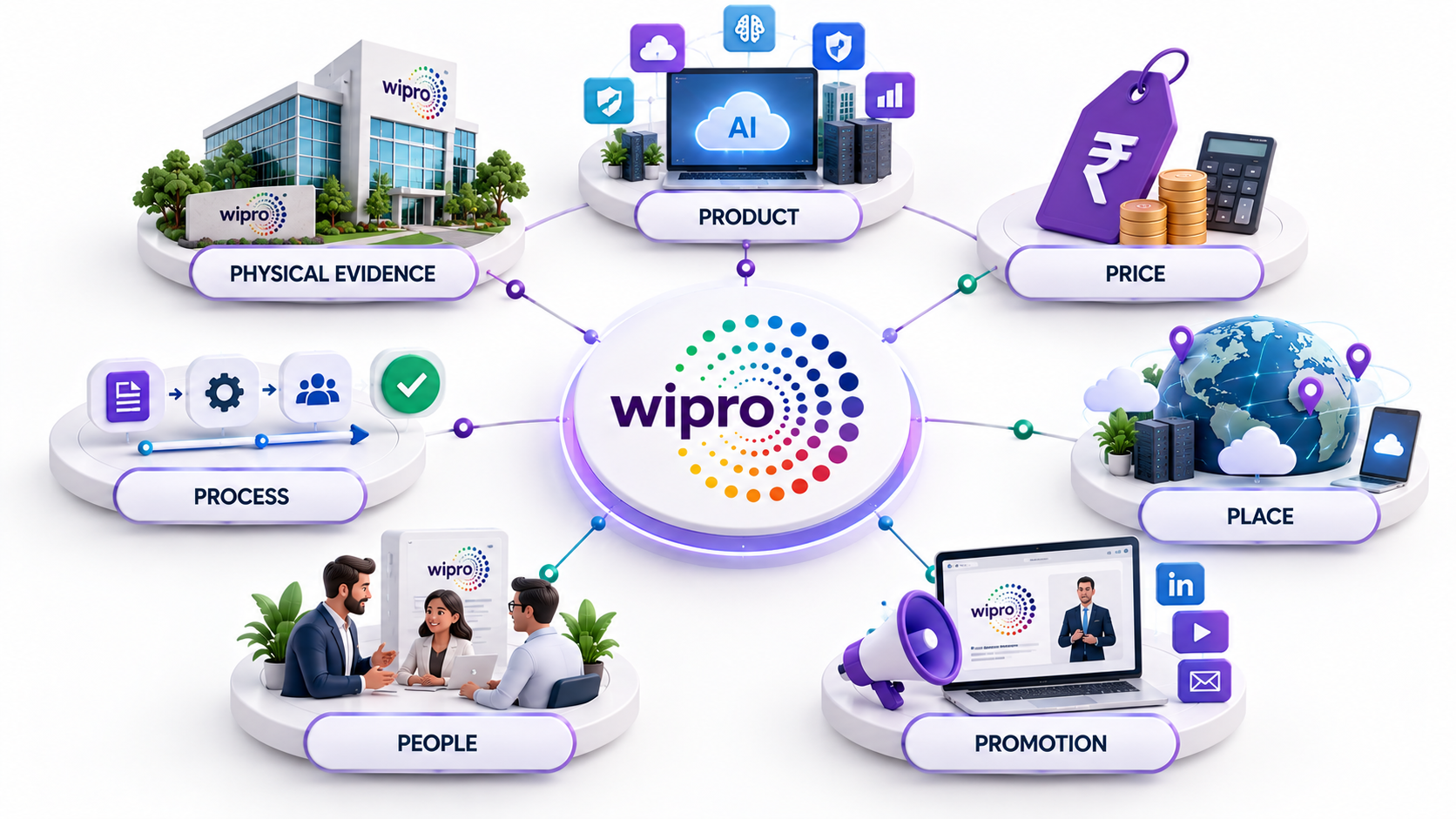
The marketing mix of Wipro is the combination of decisions the company makes around what it sells, how it prices it, where it delivers it, and how it gets in front of the clients who buy it. For a services company like Wipro, this framework looks quite different from how you’d apply it to a soap brand or a smartphone maker, and that difference is exactly what most students miss when they copy a generic 4Ps template into their assignment.
Wipro Limited is headquartered in Bengaluru and today runs almost entirely as a global IT services, consulting, and business process company. It employs roughly 230,000 people across six continents and reports revenue in the range of ten to eleven billion dollars a year from its IT services segment alone. Srini Pallia took over as CEO and Managing Director in 2024, while Rishad Premji, son of founder Azim Premji, sits as Executive Chairman. That leadership detail matters for a marketing mix study because Wipro’s brand positioning over the last few years, including the 2023 rebrand to a red thumbprint logo and the tagline “Realizing Human Potential,” happened directly under this leadership transition.
Here’s where most articles trip up. They still list “consumer care, lighting, and FMCG products” as part of Wipro’s product mix. That business was carved out into a separate entity called Wipro Enterprises Private Limited back in 2013, and Wipro sold off pieces of that unit’s consumer care and lighting operations to Advent International in a deal completed around 2020. Wipro Enterprises still exists, is still owned by the Premji family, and still sells soaps, lighting, and hydraulic cylinders. But it is not the same company as the publicly listed Wipro Limited that runs the IT services business. If your assignment lumps “Santoor soap” and “cloud consulting” into the same product mix, you’re describing two different companies that happen to share a founder’s surname.
That distinction is also why the marketing mix of Wipro is genuinely more interesting to study than most FMCG cases. You’re not analyzing a static portfolio. You’re analyzing a company that actively reshaped its product, price, and promotion strategy over roughly a decade to move from “diversified conglomerate” to “focused global technology and consulting player.” Every section below reflects where that reshaping landed, not where it started.
Product Strategy
The product element in the marketing mix of Wipro covers everything the company actually delivers to a paying client, and today that’s almost entirely intangible: services, consulting hours, platforms, and outcomes rather than physical goods. Wipro organizes its offerings around IT Services as the core segment, layered with consulting brands it has acquired, engineering R&D services, and a newer set of AI-native platforms it’s pushing hard as of 2025 and 2026.
IT Services and Digital Transformation
This is the backbone. Wipro’s IT services segment covers application development and maintenance, cloud migration and management, cybersecurity, data and AI engineering, and infrastructure management, sold to large enterprise clients across banking, healthcare, manufacturing, energy, and technology sectors. The company reports its business through Strategic Market Units, essentially Americas 1, Americas 2, Europe, and APMEA (Asia Pacific, Middle East and Africa), and through sector groupings like Banking, Financial Services and Insurance, which alone typically accounts for over a third of total revenue.
What makes this product layer worth studying rather than skimming past is how concentrated it is. BFSI clients routinely make up around a third of Wipro’s revenue mix, which means the “product” isn’t generic IT services, it’s IT services shaped heavily by what banks and insurers need: regulatory compliance work, core banking modernization, fraud and risk platforms, and increasingly generative AI tools bolted onto legacy systems that are decades old. If you’re writing about product strategy here, the real insight is that Wipro doesn’t sell one product to everyone. It sells sector-specific service bundles that look completely different depending on whether the client is a European bank or an American healthcare payer.
Consulting and Acquired Capabilities
Wipro doesn’t build every capability from scratch, it buys it. The clearest example is Capco, a financial services consulting firm Wipro acquired in 2021 for close to one and a half billion dollars, one of the largest acquisitions in the company’s history. Capco operates as a distinct consulting brand under the Wipro umbrella, focused specifically on banking, payments, and capital markets consulting, and it deliberately kept its own name and identity instead of being rebranded as “Wipro Consulting” because financial services clients trust boutique consulting brands more than they trust a generalist IT vendor’s consulting arm.
Alongside Capco, Wipro has folded in Rizing (an SAP-focused consulting firm), Ampion (an Australian cybersecurity and quality engineering firm), Edgile, LeanSwift, and design consultancy Designit, which handles the more creative, human-centered design work that a pure engineering shop can’t credibly sell. Each acquisition extends the product portfolio into a specific niche rather than duplicating what Wipro already had. That’s a deliberate product strategy: instead of one broad “we do everything” pitch, Wipro assembles a set of specialist sub-brands it can point to depending on what a client actually needs, whether that’s SAP implementation, cybersecurity audits, or brand design work.
Engineering, R&D, and Platform Products
The third product layer is engineering services and what Wipro now brands as its AI-native platforms. This covers embedded software, chip design support, product engineering for manufacturing and automotive clients, and platforms like Wipro’s FullStride Cloud offering, built jointly with hyperscalers, which packages cloud migration and modernization into a more standardized, sellable unit rather than pure custom consulting hours.
More recently, Wipro has pushed its “AI Native Business & Platforms” unit, essentially repackaging services as software-like products with recurring value rather than one-off project billing. CEO Srini Pallia has talked publicly about pivoting toward a “services-as-a-software model,” which is a meaningful shift in product strategy: instead of selling 500 hours of a developer’s time, the goal is to sell a platform subscription that happens to be powered by Wipro’s engineers and AI tooling underneath. If that shift succeeds, it changes not just the product but the pricing model that goes with it, which is exactly where the next section picks up.
Price Strategy
Pricing for a company like Wipro isn’t a number on a shelf tag, it’s a negotiated commercial structure that changes deal by deal, and that’s exactly what makes it worth breaking down properly instead of writing “Wipro uses competitive pricing” and moving on, which is what most articles do.
Time and Material vs Fixed Price Contracts
Historically, and still today for a large chunk of its business, Wipro prices work using two dominant models. Time and material (T&M) billing charges the client based on the actual hours or resources deployed, which works well for projects where scope is fuzzy or evolving, like ongoing application support. Fixed-price contracts quote a total cost for a defined scope of work, shifting delivery risk onto Wipro rather than the client, which clients generally prefer for well-defined projects like migrating a specific application to the cloud.
The mix between these two matters a lot for margins. Fixed-price work forces Wipro’s delivery teams to estimate accurately and execute efficiently, because any overrun eats directly into their own margin instead of getting billed to the client. T&M work is safer for Wipro’s margins but less attractive to increasingly cost-conscious clients who want cost certainty upfront, especially during the kind of macroeconomic tightening the industry has seen through 2024 and 2025, when enterprise clients pulled back discretionary tech spending across the board.
Outcome-Based and Value-Based Pricing
Here’s the shift that actually matters if you’re studying this for anything beyond a homework assignment. The Indian IT services industry as a whole, and Wipro along with it, has been moving deals away from pure hourly billing toward outcome-based pricing, where a portion of the fee is tied to a measurable business result: reduced downtime, faster claims processing, a specific cost saving percentage. This is harder to sell because it requires both sides to agree on what “success” looks like before work even starts, but it commands a pricing premium because the client is effectively buying a guaranteed result rather than a guaranteed number of engineer-hours.
Wipro’s push into generative AI tooling accelerates this trend, because AI-assisted delivery can genuinely cut the hours needed to do the same work, which breaks the old logic of billing by the hour. If an AI copilot lets a Wipro engineer do in ten hours what used to take forty, hourly billing actively punishes Wipro for its own efficiency gains. That’s why the “services-as-a-software” language from leadership isn’t just marketing talk, it’s a direct response to a pricing problem the whole industry is wrestling with right now.
Competitive Pricing Against TCS, Infosys, and HCLTech
Wipro doesn’t set prices in a vacuum. It competes directly against Tata Consultancy Services, Infosys, HCLTech, Tech Mahindra, and global players like Accenture and Cognizant for the same large enterprise deals, and pricing in this industry is almost always benchmarked against what those competitors are quoting for comparable scope. Wipro has generally positioned itself as competitively priced relative to TCS and Infosys, sometimes accepting thinner margins on large deals specifically to win market share and rebuild its bookings pipeline after a stretch of slower growth compared to its peers through the early 2020s.
Deal size also changes the pricing conversation entirely. Wipro’s large deal bookings, deals valued at tens or hundreds of millions of dollars in total contract value, run through a different negotiation process than smaller project work, often involving multi-year commitments, volume discounts, and bundled pricing across several service lines at once. A client signing a five-year, two-hundred-million-dollar infrastructure deal is negotiating something closer to a strategic partnership price than a simple rate card.
Place and Distribution Strategy
Place, for a services company, isn’t about shelf space or warehouses. It’s about where the delivery actually happens, which channels a client uses to reach Wipro, and which partner ecosystems extend Wipro’s reach beyond its own sales force.
Global Delivery Centers and the Offshore Model
Wipro’s delivery footprint is built around large centers in India, primarily Bengaluru, Pune, Hyderabad, Chennai, and Kolkata, supplemented by near-shore delivery centers closer to major client markets and onsite teams embedded directly inside client organizations. This is the classic Indian IT offshore-delivery model: keep the bulk of engineering talent in lower-cost Indian cities, staff a smaller onsite presence for client-facing work and requirements gathering, and use near-shore hubs in places like Eastern Europe or Latin America to cover time zones closer to European and American clients.
The reason this counts as a “place” decision rather than just an HR decision is that it directly shapes what Wipro can competitively bid on. A deal requiring heavy data residency compliance, say, a European client that legally cannot have certain data processed outside the EU, forces Wipro to deliver from a specific geography regardless of where its cheapest talent sits. Increasingly, clients in regulated sectors like banking and healthcare are asking for exactly this kind of geographic guarantee, which is pushing Wipro and its competitors to build out more localized delivery capacity in Europe and North America rather than routing everything through India.
Strategic Market Units as a Distribution Structure
Wipro organizes its go-to-market not by service line first but by geography, through what it calls Strategic Market Units, split roughly into Americas 1, Americas 2, Europe, and APMEA. Each SMU has its own leadership and effectively functions as a regional business unit responsible for client relationships and revenue in that geography. Americas 1 typically contributes the largest single share of revenue, often over a third of the total, reflecting how dominant the US market remains for Indian IT services exports generally.
This geographic structure is itself a distribution decision. It means account teams, sales relationships, and even pricing conversations are managed regionally rather than centrally, which lets Wipro tailor its pitch to regional buying behavior. A German manufacturing client and a Texas insurance client are not being sold to by the same playbook, even if the underlying service, say, application modernization, is technically identical.
Digital Channels and Partner Ecosystems
Beyond physical delivery centers, Wipro’s “place” strategy runs heavily through cloud partner ecosystems. Wipro holds top-tier partner status with Microsoft, AWS, Google Cloud, SAP, Salesforce, and ServiceNow, and a meaningful share of new deals get sourced or co-sold through these hyperscaler and platform partnerships rather than through Wipro’s own sales team knocking on doors cold. When a client is already deep into an AWS migration and needs an implementation partner, AWS’s own partner referral network can route that client straight to Wipro, which functions exactly like a retail distribution channel does for a physical product, just built on cloud marketplaces and partner certifications instead of store shelves.
Wipro Ventures, the company’s corporate venture capital arm, plays a quieter role in this same distribution logic. By investing in early-stage startups working on cloud, cybersecurity, and AI tooling, Wipro gets early access to emerging technology and, often, a commercial relationship that lets it resell or integrate that startup’s product into its own client engagements. It’s a distribution channel disguised as an investment strategy.
Promotion Strategy
If you were expecting a section about TV commercials, that’s not how a B2B services company like Wipro promotes itself, and this is exactly the H2 where a lot of student assignments fall apart because they try to force a consumer marketing template onto an enterprise sales business. Promotion here is built almost entirely around trust-building with a small number of very large buyers, not mass reach across millions of anonymous consumers.
B2B Thought Leadership and Analyst Relations
A huge chunk of Wipro’s promotional effort goes into analyst relations, meaning the ongoing work of briefing firms like Gartner, Forrester, and IDC so that Wipro gets placed favorably in their industry reports and “magic quadrant” style rankings. Enterprise buyers, the actual decision-makers signing multi-year contracts, lean heavily on these analyst reports before shortlisting vendors, so a strong quadrant placement functions almost like a five-star review does for a consumer product, except the “review” comes from a research firm most consumers have never heard of.
Alongside analyst relations, Wipro publishes research reports, industry whitepapers, and executive commentary through its own channels and business press like the Economic Times, Bloomberg, and Reuters, positioning its leaders, including CEO Srini Pallia and Chairman Rishad Premji, as credible voices on enterprise AI adoption and digital transformation. This is promotion aimed at CIOs and CFOs reading industry coverage, not at a general public audience scrolling social media for entertainment.
Sponsorships and Brand Visibility
Wipro has run a long-standing sponsorship strategy tied to global sports and cultural events, historically including golf’s PGA Tour and tennis tournaments, using these sponsorships less to sell directly to consumers and more to build brand recognition among the exact demographic of senior executives who attend or watch these events. A CIO who sees the Wipro logo courtside at a tennis tournament isn’t going to sign a contract because of it, but repeated visibility at events frequented by decision-makers reinforces the brand as a serious, globally established player rather than a low-cost outsourcing shop, which was the reputation Indian IT companies spent decades trying to shake.
The 2023 rebrand fits into this same bucket. Wipro moved to a new red thumbprint logo and the tagline “Realizing Human Potential,” replacing its older “Applying Thought” identity. A rebrand at this scale is itself a promotional act, it’s a signal to clients, employees, and investors that the company sees itself differently than it did a decade ago, less as a back-office IT vendor and more as a strategic AI and consulting partner. Whether that repositioning has fully landed with clients is genuinely debatable, but the intent behind it is clear.
Digital Marketing and Account-Based Marketing
On the digital side, Wipro runs a heavy LinkedIn presence, both corporately and through individual executive thought leadership posts, because LinkedIn is where the B2B buying audience for enterprise IT services actually spends attention, unlike Instagram or Facebook, which are close to irrelevant for this kind of purchase decision. Content here focuses on case studies, AI adoption trends, and sector-specific insights rather than product features, because the actual “features” of an IT services engagement are too abstract to market the way you’d market a phone’s camera specs.
Wipro also runs account-based marketing (ABM) for its largest target clients, meaning personalized campaigns, content, and even dedicated microsites built for a single named account rather than a broad audience. If you’re only familiar with consumer marketing, ABM can feel strange: imagine building an entire targeted campaign for one company instead of one demographic segment. But when a single client relationship can be worth hundreds of millions of dollars over a multi-year contract, that level of individualized promotion actually makes economic sense in a way it never would for a company selling ten-dollar products to millions of people.
People, Process, and Physical Evidence in Wipro’s Extended Marketing Mix
The classic 4Ps framework was built with physical products in mind, and it genuinely struggles to explain a services business properly. That’s why marketing academics extended it to 7Ps for service industries, adding people, process, and physical evidence, and honestly, for a company like Wipro, these three extra Ps carry more weight than price or place do, because the actual “product” a client is buying is largely the people doing the work.
People: Talent, Culture, and Delivery Teams
For an IT services company, the delivery team is the product. A client isn’t buying a box off a shelf, they’re buying the specific engineers, architects, and consultants who will show up and do the work, which means Wipro’s ability to recruit, train, and retain talent is directly a marketing and product decision, not just an HR function tucked away in the background.
Wipro invests heavily in structured campus hiring from Indian engineering colleges, internal reskilling programs to move existing employees into AI and cloud specializations, and leadership development pipelines, exactly the kind of talent pipeline that CEO Srini Pallia himself came up through over more than three decades at the company before becoming CEO. Attrition rate, meaning how many employees leave within a year, is a metric Wipro reports publicly every quarter precisely because clients care about it. High attrition on an account means the client loses institutional knowledge and has to retrain new people constantly, which is a real service-quality risk, not an abstract HR statistic.
Process: Delivery Methodology and Quality Assurance
Process covers the actual mechanics of how work gets delivered: project management frameworks, quality assurance checkpoints, escalation procedures when something goes wrong, and the governance structure that lets a client track progress on a multi-year engagement. Wipro markets its delivery methodology explicitly, using certifications like CMMI (Capability Maturity Model Integration) and various ISO standards as proof points that its process is standardized and auditable rather than ad hoc.
This matters commercially because large enterprise procurement teams, especially in regulated sectors like banking and healthcare, will not sign a contract without evidence of a repeatable, documented process. A client evaluating Wipro against TCS or Infosys is often comparing process maturity almost as closely as they’re comparing price, because a chaotic delivery process on a multi-year contract is a bigger risk to a bank’s core systems than a slightly higher hourly rate would be.
Physical Evidence: Offices, Certifications, and Case Studies
Physical evidence, for a services company, means the tangible signals that convince a client the service is real, credible, and safely delivered. This includes Wipro’s physical offices and delivery centers (which clients sometimes visit before signing large contracts), security certifications like ISO 27001 for data protection, published case studies with named clients and measurable results, and even the design of client-facing collaboration spaces where onsite teams and client stakeholders work together.
Awards and rankings function as physical evidence too. Wipro’s placement in analyst reports, industry recognitions, and its listing on stock exchanges (it trades on both the NSE/BSE in India and the NYSE in the US as an ADR) all serve as tangible proof points a procurement team can point to internally when justifying a vendor choice to their own leadership. None of this is glamorous marketing, but for a services company, it’s arguably more persuasive than any advertisement could be.
[Screenshot: Wipro.com Certifications page listing ISO 27001, CMMI Level 5, and other quality certifications]
Lessons You Can Learn From the Marketing Mix of Wipro
Studying Wipro’s marketing mix isn’t just useful for an assignment, it actually teaches a few things that apply well beyond IT services, and it’s worth pulling these out explicitly instead of letting them stay buried inside the sections above.
Your Product Portfolio Isn’t Fixed Forever
Wipro spent decades as a diversified conglomerate selling everything from vegetable oil to hydraulic cylinders before deliberately narrowing down to IT services and consulting. That kind of portfolio surgery, cutting entire business lines that no longer fit the strategic direction, is a legitimate marketing mix decision, not just a finance department exercise. If you’re building a brand or a business, periodically asking “does this product line still belong in our mix” is healthier than assuming your original product lineup is permanent.
Pricing Models Have to Evolve With Delivery Technology
The shift from pure hourly billing toward outcome-based and subscription-style pricing at Wipro exists because AI tooling broke the old economics of billing by the hour. Any business built on billing for time, whether that’s a services agency, a law firm, or a freelance consultant, faces the exact same pressure once AI tools start compressing the hours needed to do the same work. The lesson generalizes well beyond IT services: if your delivery method changes, your pricing model eventually has to change with it, or you end up penalizing yourself for getting more efficient.
B2B Promotion Runs on Trust Signals, Not Reach
Wipro’s promotion strategy barely touches mass consumer channels because its actual buyers are a small number of enterprise decision-makers who respond to analyst reports, case studies, and peer reputation far more than they respond to advertising reach. Anyone marketing a B2B product or service, even a small SaaS tool, can learn from this: chasing broad visibility on channels your actual buyer doesn’t use wastes budget, while a single strong case study or analyst mention can move a deal that an ad campaign never would.
Mistakes When Studying This Case
A few mistakes show up repeatedly in student write-ups and even some published articles on this topic:
Treating Wipro Enterprises and Wipro Limited as the same company. They aren’t. Wipro Enterprises holds the old consumer care, lighting, and infrastructure engineering businesses privately, while Wipro Limited is the publicly listed IT services company. Mixing their product lines together produces a factually wrong marketing mix.
Describing pricing as simply “low cost.” That framing was more accurate two decades ago, when Indian IT’s whole pitch was cost arbitrage. Today Wipro competes on outcome-based value and specialized consulting expertise as much as on cost, especially through acquired units like Capco.
Ignoring the acquisition strategy entirely. A huge part of Wipro’s current product mix, Capco, Rizing, Designit, Ampion, came through acquisition rather than organic build-out. Skipping this makes the product section shallow and inaccurate about where Wipro’s actual capabilities come from.
Forgetting the extended 7Ps. A services business genuinely cannot be explained well with just the classic 4Ps. If your assignment or article stops at promotion and skips people, process, and physical evidence, you’re missing the part of the mix that arguably matters most for a company like this.
If you’re building out marketing case studies like this one as part of a broader learning plan, it helps to study how other companies structure their marketing mix and positioning side by side, since the patterns that show up in Wipro’s B2B promotion strategy repeat across most enterprise services brands. And if the goal is to actually apply this kind of thinking to your own brand or business rather than just analyze someone else’s, working through a structured digital marketing curriculum will get you there faster than piecing it together from case studies alone.
Conclusion
The marketing mix of Wipro tells the story of a company that stopped trying to be everything to everyone and instead built a focused, acquisition-fueled services and consulting business with a pricing model that’s still catching up to what AI-driven delivery makes possible. Product, price, place, and promotion all shifted meaningfully over the last decade, and the extended 7Ps, especially people and process, explain far more about how this company actually competes than the classic 4Ps ever could on their own.
If you take one thing from this guide, take this: a services company’s marketing mix isn’t really about the marketing department at all. It’s about talent strategy, delivery methodology, and pricing structure working together, with promotion sitting almost downstream of all three. That’s a very different way of thinking about marketing than what most textbooks teach, and it’s the reason Wipro is a genuinely useful company to study instead of a boring one.
Frequently Asked Questions
What is the marketing mix of Wipro?
The marketing mix of Wipro refers to how the company structures its product portfolio (IT services, consulting, and engineering), its pricing models (time-and-material, fixed price, and outcome-based), its delivery and distribution network (global delivery centers and cloud partner ecosystems), and its promotional strategy (B2B thought leadership, analyst relations, and sponsorships), extended further with people, process, and physical evidence since Wipro is a services business.
Is Wipro still in the consumer goods and FMCG business?
No, not under the listed company Wipro Limited. The consumer care, lighting, and infrastructure engineering businesses were spun off into a separate privately held entity, Wipro Enterprises, back in 2013, and parts of the consumer care and lighting operations were later sold to Advent International around 2020. Wipro Limited, the IT services company, has no ongoing FMCG product line.
What are Wipro’s main product segments today?
Wipro’s core product segments are IT services (application development, cloud, cybersecurity, and data/AI engineering), consulting (through acquired brands like Capco and Rizing), and engineering R&D services, along with newer AI-native platform offerings like FullStride Cloud and its AI Native Business & Platforms unit.
How does Wipro price its services?
Wipro uses a mix of pricing models depending on the deal: time-and-material billing for evolving scope, fixed-price contracts for well-defined projects, and a growing share of outcome-based or value-based pricing tied to measurable business results, especially as AI tools change how much effort a given task actually takes to deliver.
Who is Wipro’s current CEO?
Srini Pallia serves as CEO and Managing Director of Wipro Limited, having taken over the role in 2024 after more than three decades at the company in various leadership positions, including CEO of Wipro’s largest Strategic Market Unit before his promotion.
Why did Wipro rebrand its logo and tagline?
Wipro rebranded in 2023 to a red thumbprint logo and the tagline “Realizing Human Potential,” replacing its older identity, as part of an effort to reposition itself as a strategic AI and consulting partner rather than a traditional back-office IT outsourcing vendor, aligning its brand image with the higher-value consulting work it has been acquiring and building.
How does Wipro promote itself if it doesn’t run consumer advertising?
Wipro’s promotion strategy runs almost entirely through B2B channels: analyst relations with firms like Gartner and Forrester, executive thought leadership on LinkedIn and in business press, sponsorships of global sporting and cultural events aimed at senior executive audiences, and account-based marketing campaigns built for individual large clients rather than broad consumer reach.
What is Capco and why does it matter to Wipro’s product mix?
Capco is a financial services consulting firm Wipro acquired in 2021 for close to one and a half billion dollars. It operates under its own brand name rather than being folded into “Wipro Consulting,” because clients in banking and capital markets trust a specialized consulting brand more than a generalist IT vendor’s consulting arm, making it a distinct and valuable part of Wipro’s product portfolio.
Is Wipro’s marketing mix the same as TCS or Infosys?
The broad structure is similar since all three compete in the same industry with comparable delivery models, but the specifics differ. Wipro has leaned harder into acquisition-led consulting expansion (Capco, Rizing, Designit) and a more aggressive brand repositioning effort in recent years, while pricing and delivery-center strategy across all three companies tend to converge because they’re competing for the same large enterprise clients.
Why do services companies like Wipro need the extended 7Ps instead of just 4Ps?
Because a service is intangible and delivered by people rather than manufactured and shipped, the classic 4Ps (product, price, place, promotion) don’t capture what actually convinces a client to buy. People (the delivery team’s skill and retention), process (the delivery methodology and quality assurance), and physical evidence (certifications, case studies, and visible proof of capability) directly determine whether a client trusts the company enough to sign a multi-year contract.
What percentage of Wipro’s revenue comes from banking and financial services clients?
Banking, Financial Services and Insurance (BFSI) is typically Wipro’s largest single sector, often accounting for roughly a third of total IT services revenue, which is why so much of Wipro’s product and consulting investment, including the Capco acquisition, has been directed specifically at deepening its financial services capabilities.
How many employees does Wipro have and where are they based?
Wipro employs roughly 226,000 to 230,000 people globally, with the largest concentration of delivery talent based in Indian cities like Bengaluru, Pune, Hyderabad, Chennai, and Kolkata, supplemented by near-shore delivery centers and onsite client-facing teams across North America, Europe, and other regions where its clients operate.