


Walk into any Walmart on a Saturday morning and you’ll see something strange happen. A guy buying motor oil walks past a woman buying prenatal vitamins, who walks past a kid begging for a $4 toy near the checkout, who walks past someone loading up on rotisserie chicken because it’s still cheaper than cooking one at home. That’s not an accident. That’s decades of decisions stacked on top of each other, and every single one of them ties back to how Walmart thinks about product, price, place, and promotion.

Most people assume Walmart just “won” because it’s big. Nope. It’s big because it won, and it won because Sam Walton and everyone after him obsessed over a handful of decisions that most retailers get wrong. The marketing mix of Walmart isn’t some textbook exercise you do once and forget. It’s a living system that gets tweaked constantly, store by store, region by region, sometimes shelf by shelf. And honestly, that’s what makes it worth studying. Not because it’s flashy. Walmart is about as far from flashy as a company gets. But because it works at a scale nobody else has managed to touch.
This guide breaks down exactly how Walmart builds its marketing mix, why certain choices were made, where the company has gotten things wrong, and what smaller businesses can actually steal from the playbook without needing Walmart’s checkbook. We’re not going to hide behind vague statements like “Walmart focuses on customer value.” Yeah, obviously. Everyone says that. We’re going deeper than that, into the actual mechanics of pricing, sourcing, real estate, logistics, and the digital push that’s been reshaping Walmart for the last several years.
What You Will Learn in This Guide
- What the marketing mix of Walmart looks like across product, price, place, and promotion
- Why Walmart’s Everyday Low Price model works differently than a typical discount strategy
- How Walmart’s supply chain became one of its biggest competitive weapons
- What role private label brands play in Walmart’s product strategy
- How Walmart is fighting Amazon and Target on their own turf
- The extended marketing mix elements — people, process, and physical evidence — and why they matter
- Real criticisms and challenges Walmart faces with its current approach
- Practical lessons smaller retailers and D2C brands can actually apply
What Is a Marketing Mix and Why Walmart’s Version Matters
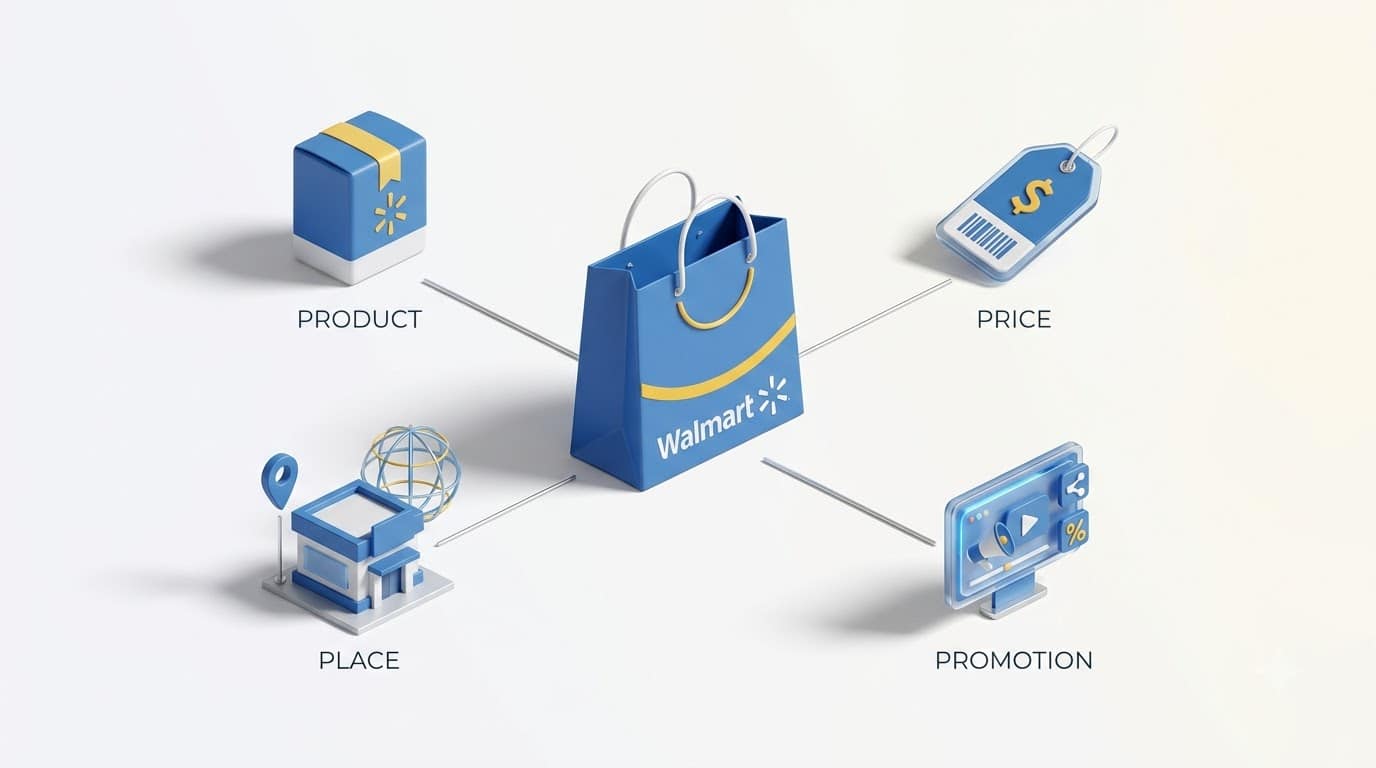
A marketing mix, at its core, is just the set of decisions a company makes about what it sells, what it charges, where it sells it, and how it tells people about it. Sounds simple when you say it that way. But when you’re operating over 10,500 stores across nearly 20 countries, every one of those decisions turns into thousands of smaller decisions that all have to line up. That’s where Walmart’s version of the marketing mix gets interesting, because most companies can’t execute at this scale without things falling apart somewhere.
The Classic 4Ps Framework
The 4Ps framework — product, price, place, promotion — was coined decades ago by marketing professor E. Jerome McCarthy, and it’s still the backbone most retail companies use to plan their strategy. Product means what you’re actually selling. Price is what you charge for it. Place covers where and how customers can get it. Promotion is everything you do to make people aware of it and want it. It’s a simple structure, but simple doesn’t mean easy to pull off well, especially not at Walmart’s size.
Why Walmart Needed to Rewrite the Rules
Here’s the thing about Walmart. The standard 4Ps framework was built with a single store or a single product line in mind. Walmart operates supercenters, neighborhood markets, Sam’s Club warehouses, and a massive e-commerce operation, all selling everything from bananas to laptops to prescription drugs. So Walmart didn’t just adopt the 4Ps, it stretched them until they covered grocery logistics, private label manufacturing deals, and a loyalty program that competes directly with Amazon Prime. That stretching is exactly why studying Walmart’s marketing mix teaches you more than studying a typical retailer’s.
Marketing Mix of Walmart – Product Strategy
When people talk about the marketing mix of Walmart, product strategy usually gets underrated. Everyone wants to talk about price because that’s the flashy part. But Walmart’s product mix is honestly just as calculated. The company carries somewhere around 120,000 items in a typical supercenter, and that number balloons past 20 million when you count Walmart.com’s third-party marketplace. That’s not “we sell a lot of stuff.” That’s an entire logistical philosophy built around breadth.
Private Label Brands That Actually Move Units
Walmart’s private label game is bigger than most shoppers realize. Great Value, Equate, Mainstays, Parent’s Choice, Sam’s Choice — these aren’t filler brands stuck on a bottom shelf. Great Value alone generates billions in annual sales and sits in nearly every category from snacks to cleaning supplies. The reason this matters for the marketing mix is simple: private label lets Walmart control margin, control quality perception, and control price without needing a name-brand supplier’s permission to do any of it.
Look at what actually happens when Walmart builds a private label line. It studies what’s selling in a category, figures out what a name-brand version costs to make, then negotiates a private label version that undercuts it by 20 to 30 percent while still hitting acceptable margins. That’s not glamorous work. It’s spreadsheet work, supplier negotiation work, quality control work. But it’s the engine behind a huge chunk of Walmart’s product strategy, and it quietly trains customers to trust the Walmart name itself, not just the products stocked inside it.
Category Breadth Over Category Depth
Walmart doesn’t try to be the deepest option in any one category. Head to a specialty running shoe store and you’ll find twenty variations of the same shoe in different widths and cushioning levels. Walmart doesn’t do that. It picks maybe four or five options per category that cover the widest range of customer needs, then focuses its shelf space on categories that drive repeat visits, groceries, household basics, and seasonal goods.
This breadth-over-depth approach is deliberate. Walmart isn’t trying to win the customer who wants the perfect specialized product. It’s trying to win the customer who wants one stop for groceries, socks, motor oil, and a birthday card without needing to visit four different stores. That’s an entirely different value proposition than a specialty retailer, and it shapes every buying decision Walmart’s merchandising teams make.
Grocery as the Anchor
Grocery is where the real strategy lives. More than half of Walmart’s US revenue comes from grocery, and that’s not by chance. Groceries bring people in weekly, sometimes multiple times a week, and every trip is an opportunity to sell them something else along the way. That’s why Walmart pushed so hard into supercenters instead of sticking with the smaller discount store format it started with back in the 1960s. Groceries are the hook. Everything else in the store is the upsell.
Marketing Mix of Walmart – Price Strategy
If there’s one word people associate with Walmart, it’s cheap. That reputation didn’t happen by accident, and it’s the single most defining piece of the marketing mix of Walmart. Sam Walton built the entire company around the idea that if you sell things cheaper than everyone else and you sell enough volume, you win. Decades later, that idea still runs the pricing playbook, even as the company has added a lot more nuance around it.
Everyday Low Price (EDLP) Explained
EDLP, or Everyday Low Price, is the pricing philosophy Walmart is most known for. Instead of running big discount sales and then jacking prices back up, Walmart tries to keep prices consistently low all the time. The logic here is that customers get tired of chasing sales and price-matching between stores. If you know Walmart is basically always going to be cheap, you stop comparison shopping and just default to Walmart. That trust, once built, is incredibly hard for competitors to break.
This isn’t just a marketing slogan either. EDLP requires Walmart to run lean on operating costs across the board, from store design to staffing ratios to how much they spend on advertising compared to competitors. Every dollar saved somewhere else in the business gets funneled back into keeping shelf prices low. That’s honestly the real secret. It’s not that Walmart has some magic pricing formula. It’s that the entire company is built to operate at lower cost than anyone else, and the pricing strategy is just the visible result of that.
How Walmart Squeezes Suppliers
This is the part people don’t love talking about, but it’s central to how the pricing actually works. Walmart is famous, or infamous depending who you ask, for negotiating hard with suppliers. Because Walmart controls such a massive share of a supplier’s total sales in many categories, it has leverage to demand lower wholesale prices, faster shipping terms, and packaging designed specifically to move efficiently through Walmart’s distribution centers.
Suppliers who want shelf space at Walmart often have to redesign their entire operations around Walmart’s requirements, from case sizes to barcoding standards to delivery windows. It sounds harsh, and for a lot of smaller suppliers it genuinely is a tough deal to accept. But that pressure is exactly what allows Walmart to keep prices as low as it does. The savings get passed down the chain, supplier to Walmart to shopper, and that chain only works because Walmart has enough scale to force it.
Price Matching and Rollbacks
Walmart also uses tactical pricing tools like Rollbacks, temporary price cuts on specific items, to create the feeling of a deal without abandoning the EDLP philosophy entirely. A Rollback sign next to a product signals “this is even cheaper than our usual cheap,” which triggers impulse buying without requiring Walmart to run store-wide sales events like a typical department store would. It’s a smart middle ground between pure everyday-low pricing and traditional promotional pricing.
Price matching, meanwhile, used to be a bigger deal for Walmart back when local competitors were the main threat. These days, with Amazon’s pricing shifting by the hour on some products, formal price-match guarantees matter less than they used to. Walmart has leaned instead on tools like its app-based price comparison features, which quietly do the same job without needing a customer to bring in a competitor’s flyer at the register like it’s 2009.
Marketing Mix of Walmart – Place Strategy
Place, in Walmart’s world, isn’t just “where the stores are.” It’s the entire physical and digital infrastructure that gets a product from a factory in Vietnam or Ohio to your cart. This part of the marketing mix of Walmart is arguably the most underappreciated by the average shopper, because it’s mostly invisible. You don’t see the distribution center behind the scenes. You just see a fully stocked shelf and assume that’s normal.
Store Footprint and Real Estate Logic
Walmart’s original strategy under Sam Walton was almost the opposite of what you’d expect from a company that became this dominant. Instead of opening in big cities first, Walmart deliberately targeted small towns that larger retailers ignored. Towns with maybe 5,000 to 25,000 people, places too small for competitors like Kmart to bother with but big enough to support a large discount store if you were the only option in town.
That real estate logic gave Walmart a massive first-mover advantage in rural America, and it built a customer base loyal to the brand long before Walmart expanded into cities and suburbs. Even today, Walmart’s store placement strategy factors in population density, existing competition, highway access, and how far the nearest distribution center sits. Every new store location goes through serious data analysis before a single brick gets laid.
Supply Chain and Distribution Centers
Honestly, this might be the most impressive part of the entire marketing mix of Walmart, and it gets the least credit. Walmart operates a massive network of regional distribution centers strategically placed so that most stores can be restocked within a day or two. The company pioneered cross-docking, a system where goods arriving from suppliers get sorted and shipped straight back out to stores without ever sitting in a warehouse for long. That single innovation cut costs and inventory time dramatically compared to older retail models.
Walmart was also one of the earliest major retailers to invest heavily in satellite tracking and, later, RFID technology to monitor inventory in real time across its entire network. That level of visibility means Walmart rarely runs into the kind of empty-shelf problems that plague smaller chains, and it means the company can react to demand spikes, like a heat wave driving up fan sales, within days instead of weeks. This is logistics as a genuine competitive weapon, not just background operations.
Walmart.com and Omnichannel Push
For years Walmart lagged badly behind Amazon in e-commerce, and honestly, it showed. Walmart.com used to feel clunky, slow, and like an afterthought bolted onto a physical retail giant. That’s changed a lot over the past several years. Walmart has poured billions into its digital operations, acquiring companies like Jet.com early on to get e-commerce talent in the door, then building out its own marketplace, delivery network, and same-day pickup options.
The real shift, though, has been the omnichannel push, blending physical stores with digital ordering in a way that plays to Walmart’s biggest advantage: it already has thousands of stores sitting close to where people live. Instead of building expensive new fulfillment centers from scratch like Amazon had to, Walmart turned existing stores into mini distribution hubs, using them for online order pickup, curbside delivery, and ship-from-store fulfillment. That’s a smart use of an asset competitors simply don’t have.
Marketing Mix of Walmart – Promotion Strategy
Promotion is where Walmart has historically spent the least, relative to its size, compared to other major retailers. That’s not a mistake. It’s baked directly into the EDLP philosophy. If your prices are already low every day, you don’t need to spend heavily convincing people to come in for a sale. But that doesn’t mean Walmart ignores promotion entirely. It just approaches it differently than a brand chasing flashy ad campaigns.
Advertising Approach
Walmart’s traditional advertising has leaned heavily on value-focused messaging rather than lifestyle branding. You won’t see a lot of Walmart ads trying to make you feel a certain way about your identity, the way a brand like Nike does. Walmart’s ads tend to hammer home simple, direct ideas: save money, live better, get everything you need in one trip. That tagline, “Save Money. Live Better,” has stuck around because it captures exactly what Walmart wants you thinking about when its name comes up.
In recent years Walmart has also built out Walmart Connect, its retail media advertising arm that lets brands pay to advertise directly on Walmart’s website, app, and in-store screens. This is honestly one of the smartest moves Walmart has made recently. It turns Walmart’s massive customer traffic into an advertising revenue stream, letting brands like Procter & Gamble or Coca-Cola pay Walmart to promote products directly to shoppers who are already there to buy. It’s advertising that pays for itself and then some.
Walmart+ and Loyalty
Walmart+ launched in 2020 as a direct answer to Amazon Prime, and it’s grown into a real piece of the promotion and retention strategy. For a membership fee, subscribers get free delivery, fuel discounts, and access to Walmart’s streaming partnership perks. It’s not just a loyalty program bolted on for show, it’s a genuine attempt to lock customers into a recurring relationship with Walmart the same way Prime locked people into Amazon.
The bet here is straightforward. Once someone is paying a monthly or annual fee for Walmart+, they’re far more likely to default to Walmart first for both physical and online shopping, just to make the membership feel worth it. That’s the same psychology that makes Costco memberships so sticky, and Walmart clearly studied that playbook closely before building its own version.
Social Media and Digital Marketing
Walmart’s social media presence has gotten noticeably sharper over the past few years. It’s not chasing every trend, but when it does jump on something, like a viral TikTok moment or a meme format, it tends to do it with a decent amount of self-aware humor rather than the stiff corporate tone you’d expect from a company this size. That shift matters because younger shoppers respond to brands that feel like they’re in on the joke rather than talking down to them.
Beyond organic social content, Walmart has invested heavily in influencer partnerships and livestream shopping events, particularly around fashion and beauty categories where it’s trying to shed its old reputation as a place you go only for basics. It’s a slow rebrand, and it hasn’t fully landed yet, but the effort is visible if you’ve paid attention to Walmart’s marketing over the last few years.
The Extended Marketing Mix – People, Process, and Physical Evidence
The classic 4Ps framework gets extended to 7Ps for service-heavy businesses, and retail definitely counts. People, process, and physical evidence round out the full picture of Walmart’s marketing mix, and honestly these three elements explain a lot about why shopping at Walmart feels the way it does, for better or worse.
People – Associates and Customer Service
Walmart employs over 2 million people worldwide, making it one of the largest private employers on the planet. That scale creates a huge challenge: how do you maintain any kind of consistent customer experience across that many employees in that many locations? Walmart’s answer has mostly been standardized training programs and store-level management structures designed to keep operations predictable no matter which Walmart you walk into.
That said, this is also where Walmart takes the most criticism. Wages, scheduling practices, and staffing levels have been persistent controversies for decades, and they tie directly back into customer experience. Understaffed stores mean longer checkout lines and fewer employees available to help you find something. Walmart has made real wage increases in recent years, partly due to labor market pressure, but the tension between keeping costs low and keeping employees happy is baked permanently into this part of the marketing mix.
Process – Checkout, Returns, Fulfillment
Process covers the actual mechanics of how a purchase happens, from the moment you walk in to the moment you leave, or the moment your online order shows up on your porch. Walmart has invested heavily in self-checkout technology, streamlined return policies, and app-based scan-and-go features aimed at cutting down how much time a purchase actually takes.
Returns policy specifically has become a competitive tool. Walmart’s relatively generous and simple return process removes a lot of the hesitation shoppers feel about buying something they’re unsure of, particularly for private label products where there’s less brand trust built in already. Reducing friction at every step of the process, checkout, returns, delivery, keeps customers coming back even when a single experience wasn’t perfect.
Physical Evidence – Store Layout and Branding
Physical evidence refers to the tangible cues that shape how customers perceive a brand, and for Walmart that means store layout, signage, and even the specific blue-and-yellow color scheme that’s instantly recognizable anywhere in the world. Store layouts are engineered with real intention. Grocery sections are typically positioned to require walking past general merchandise, increasing the odds of impulse purchases along the way.
Even things like the width of aisles, the height of shelving, and the placement of clearance sections aren’t random choices. They’re tested and refined based on how they affect shopping behavior and basket size. It’s a subtle piece of the marketing mix, but walk into a Walmart in Texas and one in New Jersey and you’ll notice the layout feels remarkably similar. That consistency is deliberate, and it reinforces the predictability that customers have come to associate with the Walmart brand.
Marketing Mix of Walmart vs Competitors
Comparing Walmart’s marketing mix against its biggest rivals makes the strategy clearer, because you start to see what Walmart is actually optimizing for versus what other companies chase instead. This isn’t about declaring a winner. It’s about understanding why these companies each built such different playbooks despite competing for a lot of the same customers.
Walmart vs Amazon
Amazon’s marketing mix leans almost entirely into convenience and selection, backed by a tech-first infrastructure that Walmart is still catching up to in some areas. Amazon doesn’t need physical stores to move product, and its pricing model shifts dynamically based on demand, competition, and algorithms constantly running in the background. Walmart, by contrast, leans on its physical footprint as an advantage Amazon simply doesn’t have, using stores as fulfillment hubs and leaning into same-day pickup as a differentiator.
Where Walmart genuinely competes well against Amazon is grocery. Amazon’s grocery push through Whole Foods and Amazon Fresh hasn’t come close to matching Walmart’s grocery market share, largely because Walmart already had decades of grocery infrastructure and customer trust built up before Amazon even entered the category seriously.
Walmart vs Target
Target’s marketing mix leans harder into design and lifestyle branding than Walmart’s does. Target has spent years building a reputation for trendy, well-designed private label products and partnerships with designers that give it a slightly more upscale feel, even though the price points aren’t wildly different from Walmart’s in a lot of categories. That’s a perception game, and Target has played it well.
Walmart’s response hasn’t been to chase Target’s design-forward image directly. Instead, Walmart has focused on out-scaling Target through sheer store count and grocery dominance, categories where Target simply can’t match Walmart’s footprint or supply chain depth. Both companies win with different customer psychology, Target sells a feeling, Walmart sells reliability and volume.
Walmart vs Costco
Costco’s marketing mix runs almost entirely opposite to Walmart’s in one key way: membership-gated pricing. Costco makes most of its actual profit from membership fees, not merchandise margins, which lets it price products even more aggressively than Walmart in bulk categories. Walmart doesn’t require membership for its core stores, keeping the shopping experience more accessible, though Sam’s Club, Walmart’s own warehouse brand, directly mirrors Costco’s model.
The real difference comes down to shopping frequency and basket size. Costco trips tend to be planned, bulk-focused, and less frequent. Walmart trips happen constantly, sometimes multiple times a week, because the format supports quick grocery runs alongside bigger shopping trips. Both models work, they’re just built around different customer habits entirely.
Challenges Walmart’s Marketing Mix Faces
No marketing mix is perfect, and Walmart’s approach, as dominant as it is, comes with real criticism and real vulnerabilities. Ignoring these would make this whole breakdown feel like a press release instead of an honest look at the strategy.
Labor and Wage Criticism
Walmart has faced sustained criticism for decades over wages, benefits, and scheduling practices for its hourly workforce. Even with wage increases pushed through in recent years, largely a response to tightening labor markets and public pressure rather than pure altruism, Walmart still gets compared unfavorably to competitors like Costco, which has built a reputation for paying warehouse workers significantly more. That criticism directly affects the “people” element of the marketing mix and shapes how some customers feel about shopping there at all.
Small Business Displacement
The classic criticism of Walmart, especially in its early expansion decades, is that it hollowed out small-town retail by undercutting local businesses on price until they couldn’t compete and eventually closed. This is well documented in economic research going back to the 1990s and 2000s, and it’s part of why Walmart still carries a mixed reputation in a lot of communities even as shoppers continue walking through its doors every week. The convenience and pricing win out for most people, but the tension around local economic impact hasn’t fully gone away.
E-commerce Catch-up
Even with the massive digital investments of the past several years, Walmart is still playing catch-up to Amazon in a lot of e-commerce fundamentals, particularly around third-party marketplace trust, delivery speed in less densely populated areas, and product discovery on the app. Walmart has closed the gap significantly, but closing a gap and eliminating it entirely are two different things, and this remains one of the more exposed parts of the current marketing mix.
What Other Businesses Can Learn From Walmart’s Marketing Mix
You don’t need Walmart’s budget to learn something useful from how it operates. A lot of the underlying principles scale down just fine, even for a small local business or a growing online store.
Scale Is a Strategy, Not Just an Outcome
Walmart didn’t get cheap because it got big. It got big because it committed early to operational efficiency and let that efficiency compound over decades. Smaller businesses can apply the same mindset on a smaller scale, cutting unnecessary costs early and consistently rather than waiting until they’re forced to by a cash crunch. Efficiency built early becomes a genuine competitive advantage later, even if you never get anywhere near Walmart’s size.
Consistency Beats Cleverness
Walmart’s marketing isn’t clever in the way a viral ad campaign is clever. It’s consistent. Same pricing philosophy, same store layout logic, same “save money, live better” message repeated for years. That consistency builds trust in a way that constantly reinventing your brand voice never quite manages to do. Businesses chasing the next trendy campaign could genuinely learn something from how boring, in the best sense, Walmart’s core messaging has stayed over time.
Conclusion
The marketing mix of Walmart isn’t one clever trick. It’s dozens of unglamorous decisions, made consistently over decades, about product selection, supplier negotiation, store placement, and customer trust. None of it looks exciting from the outside. There’s no single ad campaign or product launch you can point to and say “that’s why Walmart won.” It’s the accumulation of small, disciplined choices across every part of the marketing mix, repeated at a scale almost nobody else can match. That’s honestly the real lesson here, not that you need to copy Walmart exactly, but that boring, consistent execution beats flashy strategy more often than most businesses want to admit.
FAQs
1. What are the 4Ps in the marketing mix of Walmart?
The four core elements are product, price, place, and promotion. Walmart builds its product mix around breadth and grocery dominance, keeps prices low through its Everyday Low Price model, uses a massive store and distribution network for place, and relies on value-focused advertising along with tools like Walmart Connect for promotion.
2. Why is Walmart’s pricing strategy called Everyday Low Price?
Because Walmart avoids the cycle of temporary sales followed by price hikes that a lot of retailers use. Instead, it keeps prices consistently low year-round, which builds long-term customer trust and removes the need for shoppers to wait around for a sale before buying.
3. How does Walmart keep its prices so low compared to competitors?
A combination of factors, including massive bulk purchasing power, tough supplier negotiations, an efficient distribution network built on cross-docking, and lean operating costs across stores. Every part of the business is designed to strip out unnecessary cost so prices can stay low without wrecking margins.
4. What role do private label brands play in Walmart’s product strategy?
Private label brands like Great Value and Equate let Walmart control quality, pricing, and margin without depending on name-brand suppliers. They also quietly build trust in the Walmart name itself, since customers start associating the store brand with reliability across many different product categories.
5. How is Walmart competing with Amazon in e-commerce?
Walmart has invested heavily in Walmart.com, its third-party marketplace, and same-day delivery options. Its biggest advantage over Amazon is its huge network of physical stores, which double as fulfillment hubs for online orders, letting Walmart offer fast pickup and delivery without building an entirely new warehouse network from scratch.
6. What is Walmart+ and how does it fit into the marketing mix?
Walmart+ is a paid membership program launched in 2020 that offers free delivery, fuel discounts, and other perks. It’s Walmart’s direct answer to Amazon Prime, designed to build customer loyalty and encourage shoppers to default to Walmart for both online and in-store purchases.
7. How does Walmart choose where to open new stores?
Walmart analyzes population density, existing competition, highway access, and proximity to distribution centers before opening a new location. Historically, Walmart targeted small towns that bigger retailers ignored, which gave it a strong early foothold before expanding into cities and suburbs later on.
8. What is Walmart Connect?
Walmart Connect is Walmart’s retail media advertising business, allowing brands to pay for ad placements directly on Walmart’s website, app, and in-store screens. It turns Walmart’s existing customer traffic into an additional revenue stream and has grown into a significant part of the company’s promotion strategy.
9. How does Walmart’s marketing mix differ from Target’s?
Target leans into design-forward branding and a slightly more upscale shopping experience, while Walmart focuses on scale, grocery dominance, and consistent low pricing. Both companies compete for similar customers but appeal to different psychological triggers, Target sells a feeling, Walmart sells reliability and value.
10. What criticism does Walmart face regarding its marketing mix?
Common criticisms include wage and labor practices, the displacement of small local businesses through aggressive pricing, and a slower-than-ideal transition into fully competitive e-commerce compared to Amazon. These issues affect public perception even as Walmart continues to dominate in sales volume.
11. Does Walmart use social media marketing effectively?
Yes, increasingly so. Walmart has shifted toward a more self-aware, humor-driven tone on platforms like TikTok, along with influencer partnerships and livestream shopping events, particularly in fashion and beauty categories where it’s trying to shift its image beyond just being a place for basics.
12. What is the biggest strength in Walmart’s marketing mix?
Its supply chain and distribution network are widely considered its biggest competitive advantage. The ability to restock thousands of stores quickly and efficiently, combined with real-time inventory tracking, gives Walmart a level of operational reliability that’s genuinely difficult for competitors to replicate.