


Sony sells a PlayStation for close to what it costs to build, a pair of noise-cancelling headphones for around $400, a Spider-Man film that grossed nearly two billion dollars, and the image sensors sitting inside other companies’ phones. Same company. Completely different customers. So how does one brand hold all of that together without looking like a confused conglomerate? That question is the reason the marketing mix of Sony keeps showing up in business school syllabi, and honestly, it’s one of the more interesting cases you can pick.

Most brand case studies are boring because the company only sells one kind of thing. Nike sells shoes. Coca-Cola sells drinks. Sony sells gaming, TVs, cameras, music, films, anime, semiconductors and, soon, maybe cars. Each of those has a different price logic, a different shelf, a different way of getting people excited. Looking at the marketing mix of Sony means looking at six businesses wearing one logo, and figuring out what actually ties them together. Spoiler: it isn’t the logo.
This guide walks through the full picture. You’ll see the four classic Ps (product, price, place, promotion), then the three extra ones that matter for service-heavy businesses (people, process, physical evidence). Along the way there are real products, real launch prices, real mistakes (Betamax, anyone?), and a long section on how Sony plays the game in India. Written for students, beginners and small business owners who want to steal the good ideas.
TL;DR
Short on time? Here is the whole article in five lines.
- The marketing mix of Sony is a premium-quality, multi-category strategy: different products, one promise of well-made, emotionally engaging technology.
- Pricing swings by business: loss-leader hardware plus subscriptions for PlayStation, premium prices for cameras and headphones, tighter competition on TVs.
- Distribution blends big retailers, Sony’s own stores, direct online sales and fully digital delivery for games, music and streaming.
- Promotion leans on product launches, cross-promotion between Sony’s own entertainment arms, creator communities and big events like PlayStation State of Play.
- Sony’s weak spots are mobile phones, rising hardware prices and a lineup that can feel hard to explain to a new customer.
What You Will Learn in This Guide
Here is what this guide covers, in the order you’ll read it.
- What the marketing mix is and how the marketing mix of Sony fits both the 4Ps and the 7Ps models
- Sony’s history and how its brand positioning changed from the Walkman era to today
- Product strategy across PlayStation, Bravia, Alpha cameras, audio, sensors, entertainment and Afeela
- Pricing methods: premium pricing, console loss-leader pricing, subscriptions and bundles
- Place and distribution: retail partners, Sony Centers, online stores and digital delivery
- Promotion: advertising, cross-promotion, events, creator marketing and sponsorships
- People, process and physical evidence, the three extra Ps most blogs skip
- How Sony runs its marketing in India, and how it compares with Samsung, Apple and Microsoft
- Strengths, weaknesses, lessons you can copy, and 12 FAQs with direct answers
What Is the Marketing Mix of Sony?
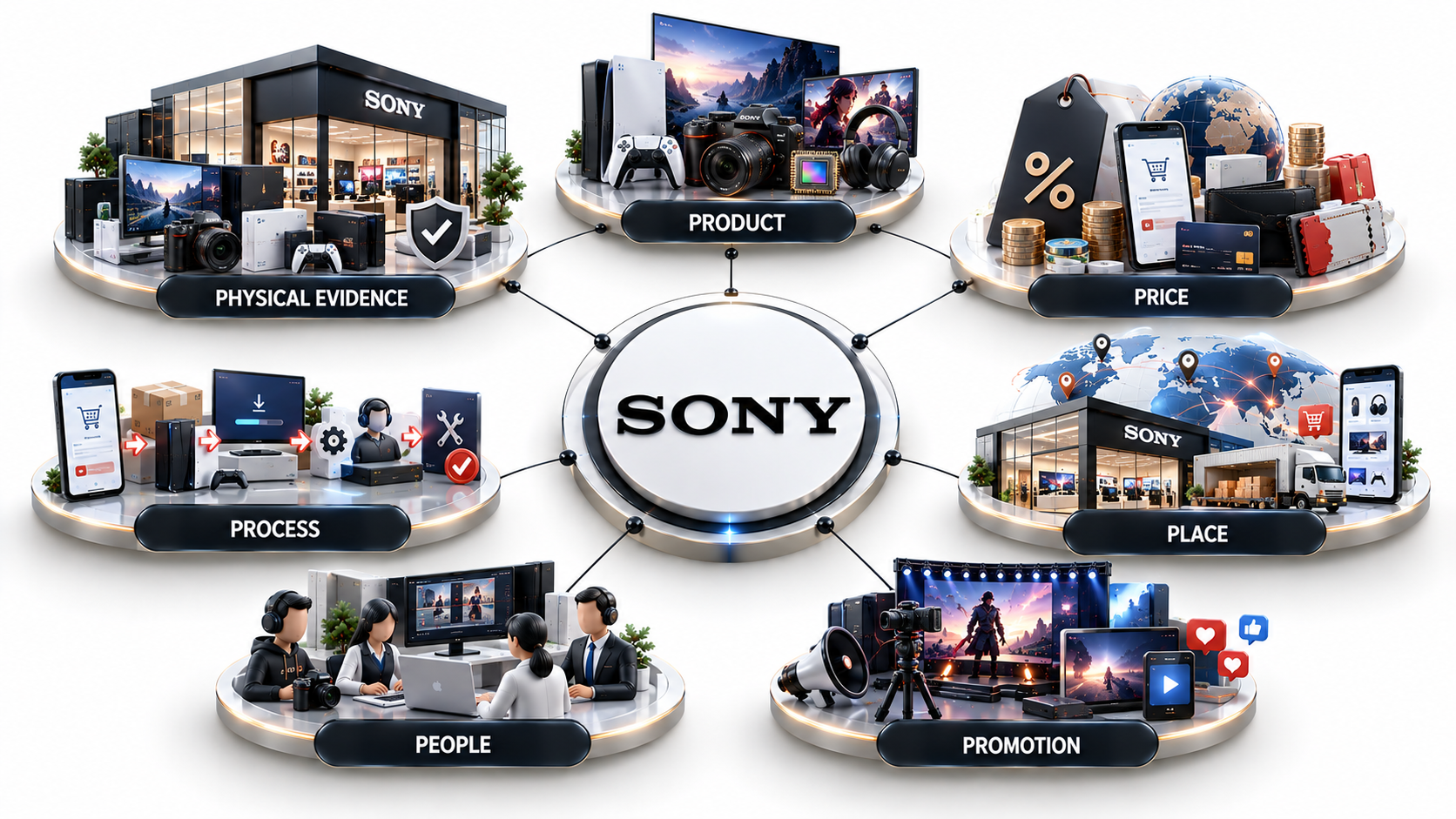
The marketing mix of Sony is the set of choices the company makes about what it sells, what it charges, where it sells and how it tells people about it. Marketers call that product, price, place and promotion. For a company as sprawling as Sony, each P looks different depending on whether you’re talking about a console, a camera or a film.
The 4Ps of Sony in One Table
Before getting into detail, here is the short version. A table makes it easy to see how the same four levers flex across Sony’s biggest businesses.
| P | What Sony does |
|---|---|
| Product | PlayStation, Bravia TVs, Alpha cameras, WH-1000X headphones, image sensors, films, music, anime, Afeela EV |
| Price | Premium on cameras and audio, near-cost on consoles, subscription revenue on PlayStation Plus, regional pricing |
| Place | Electronics retailers, Sony Centers, own online stores, PlayStation Store, streaming and music platforms |
| Promotion | Launch events, TV and digital ads, movie cross-promotion, creator communities, sports and tech partnerships |
That table is the featured-snippet answer. Everything below is the explanation behind it, and the explanation is where the interesting stuff lives.
Why the 7Ps Model Fits Sony Better Than the 4Ps
The classic 4Ps were built for physical goods. Sony sells plenty of those, but it also sells subscriptions, streaming, live service games, music rights and customer support. Once a company sells experiences and services, three more Ps start to matter: people, process and physical evidence. That’s the 7Ps model.
Take a PS5 owner. They buy a box (product), pay a price, pick it up at a store (place), and saw an ad (promotion). Fine. But then they sign into PlayStation Network, pay for PS Plus, deal with support when a download fails, and judge the brand on how that goes. Those moments sit outside the 4Ps. If you’re new to all this, the digital marketing fundamentals section on this site covers how these frameworks connect to real campaigns.
Sony Is Not One Company, It’s Six
Here is the thing most summaries skip: Sony Group runs several very different businesses under one roof. Game and Network Services (PlayStation), Music, Pictures, Entertainment Technology and Services (TVs, cameras, audio), and Imaging and Sensing Solutions (chip sensors). Sony’s financial arm was spun off as a separate listed company in late 2025, so the group looks leaner now than it used to.
Why does that matter for marketing? Because a single mix doesn’t work. A teenager buying Spider-Man tickets, a wedding photographer buying a Sony a7 IV, and Apple’s supply chain team ordering sensors are three completely different buyers. Sony runs separate marketing mixes for each, then holds them together with brand feeling. Total revenue sits around 13 trillion yen a year, which tells you the scale involved.
Sony’s Brand Story Behind the Marketing Mix of Sony
Every part of the marketing mix of Sony grew out of the company’s history. The products it chose, the premium positioning, even the habit of launching new categories rather than copying rivals, all go back to how the company started. A quick tour of that story explains a lot of what Sony does today.
Two Engineers, a Burned Rice Cooker and a Bet on Sound
Sony began in 1946 as Tokyo Tsushin Kogyo, founded by Masaru Ibuka and Akio Morita in a bombed-out Tokyo department store building. The story goes that their first product was an electric rice cooker that burned the rice. Not a great start. They moved to tape recorders instead and found their footing.
The name change came in 1958. Sony came from the Latin word “sonus” (sound) mixed with “sonny,” a friendly term for a young guy. Short, easy to say in any language, and printable on a product without translation. Morita pushed hard for a global brand early, which is why Sony was selling overseas decades before many rivals even thought about it.
The Walkman Changed How Sony Thought About Products
In July 1979, Sony launched the Walkman in Japan at 33,000 yen. Market research reportedly said nobody would buy a cassette player without a recording function. Morita ignored it. Within a few years the Walkman was a cultural object, and Sony has sold well over 400 million units across formats since.
The lesson for the marketing mix of Sony is simple: create the category, then own it. Sony didn’t wait for customers to ask for a portable music player. It built one and told people why they needed it. That habit shows up again in PlayStation, the Alpha line and noise-cancelling headphones.
From Make.Believe to Be Moved
For roughly a decade Sony used the tagline “Make.Believe,” a line about turning ideas into products. Around 2019 and 2020 the company shifted to “Be Moved,” backed by a purpose statement about filling the world with emotion through creativity and technology. That’s an odd thing for an electronics company to say, but it explains a lot.
Sony makes the camera that shoots the film, the studio that releases it, the label that scores it, the TV that plays it and the console that turns it into a game. “Be Moved” gives all of those a single feeling to aim for. It’s less about specs and more about what the thing does to you.
Where Sony Sits in the Customer’s Mind Today
Ask a random person about Sony and you’ll hear “PlayStation” first, then “good TVs,” then “headphones.” Sony is positioned as a premium, quality-first brand that costs a bit more but delivers better picture, better sound and better build. Not the cheapest. Not the flashiest. The one that feels engineered.
That positioning has a cost. Premium prices mean Sony loses sales to cheaper brands in price-sensitive markets, and it’s rarely the default choice for a first-time buyer. But for the right customer, a film nerd, a hybrid shooter, a console gamer, it works. The marketing mix of Sony is built to protect that premium feeling rather than chase volume.
Product Strategy
Product is where the marketing mix of Sony is strongest. Sony makes things people genuinely talk about, and the portfolio is wide enough that almost nobody avoids the brand entirely. Let’s go through the major lines one by one, because each has its own logic.
PlayStation: The Engine of the Whole Group
PlayStation started in 1994 after a collaboration with Nintendo on a CD add-on fell apart, and Ken Kutaragi pushed Sony to build its own console. The PS2 went on to sell over 155 million units, the PS4 passed 117 million, and the PS5 is well past 80 million. Gaming is now Sony’s biggest profit engine.
The product here is bigger than a box. It’s the console, the DualSense controller with its haptic feedback, PS VR2, first-party studios (Naughty Dog, Insomniac, Bungie after a $3.6 billion acquisition in 2022) and the PlayStation Network. Hardware gets you in the door, but exclusive games and services keep you there.
Bravia TVs: Picture Quality as the Pitch
Sony launched the Bravia brand in 2005 and has kept one idea ever since: a Sony TV should look like the director meant it to look. Bravia sets use Sony’s own picture processors, and the company works with film studios on calibration. Yes, some of that is marketing, but reviewers do consistently rate Sony picture processing highly.
Notice the strategy here. Sony doesn’t try to win a spec war on screen size or lowest price. It sells fidelity. A mid-range Bravia often costs more than a Samsung or TCL with a similar panel, and Sony simply accepts that. It’s a product decision wearing a price tag.
Alpha Cameras: Taking on Canon and Nikon
When Sony launched the full-frame mirrorless a7 and a7R in 2013, Canon and Nikon were still leaning on DSLRs. Sony bet that mirrorless would win, and it did. Over the next decade Sony became one of the leading names in full-frame mirrorless, with a lens lineup (G Master) that photographers actually respect.
The product range is smart. The ZV-1 and ZV-E10 target vloggers. The a7 line serves enthusiasts and working pros. The Alpha 1 sits at the very top for sports and wildlife photographers. Sony also built Alpha Universe, a community site for photographers, and Imaging Pro Support for working professionals. Product, support and community all point at the same customer.
Audio: From Walkman to WH-1000XM
Sony’s headphones are a quiet success story. The 1000X noise-cancelling line began in 2016, and the WH-1000XM series has been near the top of “best headphones” lists ever since. The XM5 launched at $399.99 in 2022, and the line keeps getting refreshed with better microphones and noise-cancelling chips.
Sony also sells the cheaper WH-CH series, in-ear LinkBuds, speakers and the high-end Signature Series. That’s classic product-line depth: a flagship to build reputation, mid-range products to move volume, and entry-level items for people who just want something that works. Not every Sony audio product is a hit, but the flagship carries the whole category.
Image Sensors: The Product You Never See
Here is the unglamorous truth about the marketing mix of Sony: some of its biggest products have no consumer marketing at all. Sony Semiconductor Solutions makes image sensors for smartphones, cars and industrial cameras. It’s widely reported that iPhone cameras have used Sony sensors for years, and the company holds roughly half of the smartphone sensor market.
This is a business-to-business product, so promotion looks completely different. No billboards. Instead it’s long design-win contracts, engineering relationships and technical credibility. For students, it’s a good reminder that a marketing mix can be almost invisible and still be doing huge work.
Entertainment: Pictures, Music and Anime
Sony Pictures owns Columbia Pictures, the Spider-Man film rights (Spider-Man: No Way Home grossed around $1.9 billion worldwide) and a huge television library including Jeopardy! and Wheel of Fortune. Sony Music runs labels like Columbia and RCA. And Crunchyroll, bought in 2021 for about $1.175 billion, is the biggest anime streaming service in the world.
These are products too, just ones you can’t hold. And they feed the hardware side: a Spider-Man game on PS5, a movie in 4K on a Bravia, a soundtrack through WH-1000XM headphones. Entertainment content gives Sony a reason to sell the devices that play it.
Afeela and Other Bets
Sony Honda Mobility, a joint venture formed in 2022, is building the Afeela 1 electric car. Pricing from $89,900 and a reservation system for the US market have been announced, with early deliveries planned for California. It’s a long shot, and nobody serious thinks it’ll move Sony’s profit needle soon.
But it follows an old Sony pattern. Try something big, learn from it, and fold the technology (sensors, audio, entertainment systems) back into the main businesses. Sometimes it flops, as with the Betamax, but sometimes you get a Walkman. The product strategy leaves room for those swings.
Product
A wide product range creates its own problem: which things deserve money and attention, and which should quietly be shut down? The marketing mix of Sony shows a company that has learned the hard way how to manage that. Some lines grow, some mature and some get cut.
Stars, Cash Cows and Question Marks
Use the old BCG matrix and Sony’s portfolio sorts itself pretty quickly. PlayStation and image sensors are stars: big market, strong share. Bravia and audio are closer to cash cows, steady and profitable but growing slowly. Afeela and some new game genres are question marks. Weak performers get cut or sold.
Sony’s accounts show how well this works. Gaming and music now generate far more profit than consumer electronics ever did in the Walkman days. The company didn’t abandon hardware, but it moved its weight toward content, services and components. Marketing budgets follow that shift.
The Product Life Cycle in Action
Products pass through introduction, growth, maturity and decline. Sony plays each stage differently. PS5 is mid-growth and mature in some regions, so Sony pushes the Pro model and new bundles. Headphones refresh every two to three years to keep the line in the news. TV models update every spring.
Mature stages are where Sony earns money. Once a console has millions of owners, game sales and subscriptions do the work. The PS4 is a good example: it kept earning for years after the PS5 launched. Smart product lifecycle management means you don’t panic when a product ages, you shift how you make money from it.
Product Failures: Betamax, Vaio and Mobile
Sony isn’t perfect, and the failures are useful. Betamax lost the video format war to VHS in the 1980s, partly because of shorter recording time and tighter licensing. Sony sold its Vaio PC business in 2014. And Xperia phones, while still sold, have never come close to Samsung or Apple in volume.
What links these? Usually Sony built something technically excellent and underestimated price, partners or ecosystem. Betamax had better quality but fewer movies. Xperia had good cameras but weak distribution. If you like breaking down brand stumbles like these, the case studies hub on this site has more real-world examples to pick through.
Price
Pricing is where the marketing mix of Sony gets messy and interesting. A single company uses at least four pricing approaches at once, and each one makes sense for its category. Let’s separate them out so you can see the logic behind each price tag.
Premium Pricing on Cameras, TVs and Headphones
Sony generally prices above the market average for cameras, high-end TVs and noise-cancelling headphones. The WH-1000XM5 launched at $399.99 while many rivals sat well under $300. The a7 IV and a7R series cost far more than entry-level mirrorless from Canon or Fujifilm.
This works because Sony ties price to a quality story. Premium pricing needs proof: great reviews, great samples, loyal professional users. Sony has that in cameras and headphones. In TVs, where Samsung and TCL undercut aggressively, the premium sometimes feels harder to defend. Sony knows that, and sometimes runs promotions to close the gap.
Console Pricing: Razor, Blades and Loss Leaders
Console makers often sell hardware near or below cost, then earn money from games and subscriptions. The PS3 famously launched at $599 in 2006 and reportedly lost money on every unit. The PS5 launched at $499.99 for the disc version and $399.99 for the digital edition in 2020.
Sony earns its margin through the PlayStation Store, where it takes roughly a 30 percent cut on third-party game sales (an industry-standard rate), plus PS Plus subscriptions and first-party game sales. In recent years Sony has also raised console prices in several regions, including the US, which shows how far inflation and tariffs can push a loss-leader strategy.
Subscription Pricing With PlayStation Plus
PlayStation Plus has three tiers: Essential, Extra and Premium. Essential covers online multiplayer and monthly games. Extra adds a library of catalogue titles. Premium adds classic games and cloud streaming. Each step up costs more, and each gives the customer a clear reason to pay.
This is tiered pricing done properly. Sony isn’t forcing everyone to pick one plan. It’s letting casual players pay little and heavy gamers pay more. Subscription revenue also smooths out the lumpy income that comes from console and game launches, which is why Sony talks about it so often in investor calls.
Bundles, Discounts and Trade-Ins
Sony uses bundles constantly. A PS5 with a game or a second controller, a Bravia with a soundbar, an Alpha camera with a kit lens or a free memory card. Bundles let Sony drop the effective price without cutting the sticker price, which protects the brand’s premium image.
Seasonal sales matter too: Black Friday, Diwali, Amazon Great Indian Festival. Sony also runs trade-in and cashback offers through retail and banking partners. The trick is timing. Cut prices too often and customers stop paying full price. Sony usually waits for a predictable window and then uses bundles to hold the line.
Regional Pricing, Tariffs and Currency
Sony prices differently by country because taxes, import duties and currency swings change the cost of each product. A PS5 in India costs a different share of income than one in the US. Weak yen helps Sony’s profits, but local price hikes happen when costs rise elsewhere.
Look at the last few years: tariffs, shipping costs and component prices have pushed Sony to adjust console and accessory prices more than once. Customers grumble, but the brand has enough pull that most still buy. That pricing power is itself a sign of how strong the marketing mix of Sony is.
Place and Distribution
Place is about getting the product in front of the person who wants to buy it. Sony’s distribution is layered: big retail partners for volume, its own channels for control and fully digital routes for games, music and video. Each layer solves a different problem.
Retail Partners: Best Buy, Amazon, Croma and More
Most Sony hardware sells through third-party retailers. In the US that means Best Buy, Amazon and Walmart. In India it’s Croma, Reliance Digital, Vijay Sales, Amazon and Flipkart. These partners give Sony shelf space in thousands of locations without Sony needing to build or staff them.
The tradeoff is control. Retailers decide what to display, which model to push and how much to discount. Sony manages this with retail staff training, in-store displays and promotional funds. A good Sony corner in a shop can lift sales for an entire quarter, which is why the brand invests in those details.
Sony Centers, Exclusive Stores and Direct Online Sales
Sony runs its own branded stores in several markets, called Sony Centers, where customers can try products and talk to trained staff. In India there are Sony Centers across major cities plus an official online store, ShopatSC. In the US, PlayStation Direct sells consoles and accessories straight from Sony.
Direct channels do three things. They give Sony better margin per sale, real customer data, and a place to show the full range properly. They’re also where Sony tests new products and bundles. Not every shopper uses them, but those who do are usually the most engaged and highest-spending buyers.
Digital Distribution: PlayStation Store, PS Plus, Crunchyroll
A growing share of Sony’s revenue never touches a shelf. Games on the PlayStation Store, PS Plus subscriptions, Crunchyroll anime streaming, music streaming royalties and Sony LIV in India are all digital. Delivery cost is close to zero and margins are higher than hardware.
This is where the marketing mix of Sony is heading. Physical products create the audience, and digital products create the profit. A console owner who buys three games a year and a PS Plus subscription is worth far more than the hardware sale alone, and Sony designs its distribution to reflect that.
Supply Chain and Manufacturing
Sony makes products in Japan, China, Thailand, Malaysia and other places, depending on category. The 2020 to 2022 chip shortage hit PS5 supply badly, and consoles sold out for months. That shortage became its own piece of marketing drama, with queues, scalpers and restock alerts everywhere.
Since then Sony has improved supply, but the episode showed how much distribution depends on components. A great product that people can’t buy hurts the brand. Sony now plans production around demand forecasts, and it keeps close contact with chip suppliers, some of which are Sony’s own semiconductor business.
Promotion
Promotion is how Sony tells its story. It’s also where the company shows its personality. Sony rarely screams. It prefers events, partnerships and cross-promotion between its own businesses, plus smart use of creators. Here are the main tools it uses and why each one works.
Advertising and Brand Campaigns
Sony runs TV, print, outdoor and digital advertising, usually tied to a theme like “Be Moved” for the corporate brand or “Play Has No Limits” for PlayStation. Early PlayStation ads in the 1990s used the line “Live in Your World, Play in Ours,” aimed at older teens and young adults and quite edgy for the time.
Good Sony ads rarely lead with specs. They show a feeling: a concert through headphones, a landscape through a camera, a game through a controller. That’s deliberate. In a category where competitors shout about megapixels and refresh rates, Sony sells emotion and trusts quality to back it up.
Cross-Promotion Across Sony’s Own Businesses
This is Sony’s quiet advantage. Sony Pictures releases a Spider-Man film, PlayStation releases a Spider-Man game, Sony Music handles the soundtrack, and Bravia TVs show up in marketing as the best way to watch it. Each business promotes the others without paying outside media costs.
Few rivals can do that. Apple has services but no film studio of this scale. Samsung has devices but no big entertainment arm. Sony’s content and hardware feed each other, and the marketing mix of Sony takes full advantage with product placement, bundled promotions and shared launch campaigns.
Launch Events and Showcases
PlayStation State of Play, the PlayStation Showcase and Sony’s CES presence are major promotional moments. A single State of Play stream can pull in millions of live viewers and dominate gaming news for days. No paid ad buys that kind of attention.
Camera and TV launches follow a similar model: a press event, review units shipped to YouTubers and publications, then a coordinated wave of coverage on launch day. Sony understands that tech buyers research before spending, so it feeds reviewers early and lets third-party opinions do the persuading.
Creator and Community Marketing
Sony works closely with photographers, vloggers, filmmakers and streamers. Alpha Universe publishes tutorials and features from working photographers. The ZV-1 was practically built for YouTubers, and Sony sends gear to creators for honest reviews. PlayStation does the same with streamers and influencers.
This is smart because creators are trusted more than ads. A photographer showing real results with an a7 IV on YouTube is more persuasive than any billboard. If you’re building your own brand, the lesson is obvious, and the social media marketing section here covers how to run this kind of community-led approach on a smaller budget.
Sponsorships and Technology Partnerships
Sony acquired Hawk-Eye Innovations in 2011, the ball-tracking tech used in tennis, cricket and football VAR. Every time a replay shows a line call, Sony’s name is quietly attached to the trust in that decision. In India, Sony Sports Network has carried the UEFA Champions League.
Sponsorship here isn’t just logo placement. It’s showing the technology working in public. That fits a brand built on engineering credibility. It’s also much cheaper than creating that credibility through ads alone, and it ties into what Sony sells: cameras, displays and sports broadcasting.
Sales Promotions, Loyalty and CRM
Sony uses cashback offers, festival discounts, extended warranties, free subscriptions with a console purchase, and referral campaigns. PS Plus free monthly games and PlayStation Stars (a loyalty program that launched in 2022) keep owners engaged between big releases.
These tools are less glamorous than a big launch, but they drive repeat purchases. A customer who gets a free game every month feels rewarded, and a customer who feels rewarded stays in the ecosystem. For a company that earns most of its game profit after the console sale, that retention is the point of the whole system.
People, Process and Physical
The extra three Ps are what separate a thin analysis from a good one. Sony sells services and experiences now, so the people who deliver them, the processes behind them and the physical signals around the brand matter as much as the product itself.
People: Engineers, Creators and Support Staff
Sony’s people fall into three groups: the engineers and designers who build products, the creators (game developers, filmmakers, musicians) who make content, and the customer-facing staff in stores and support centers. The company has long been known for engineering culture, with Ibuka and Morita setting that tone from the start.
Customer-facing people are the ones shoppers actually meet. A trained Sony Center employee who can explain the difference between two camera bodies is worth more than ten banner ads. Sony invests in staff training and brand ambassadors because a bad experience with a person can undo the best product design.
Process: Ordering, Updates, Support and Repairs
Process covers everything that happens around the purchase: ordering online, shipping, setting up the product, receiving software updates, claiming warranty. For PlayStation, that includes account creation, downloading games, parental controls, refunds and troubleshooting. Each step is a chance to delight or annoy.
Sony’s process is usually good, but not flawless. The 2011 PlayStation Network breach, which exposed millions of accounts and took the service down for weeks, was a serious process failure. Sony recovered by offering free games and identity protection. Since then the company has treated account security and service uptime as much more important to the brand.
Physical Evidence: Packaging, Design and Stores
Physical evidence means the tangible things that signal quality. For Sony that includes industrial design (the clean, minimal PS5 look is a good example), packaging, store layout and even the weight of a camera body in your hand. These cues tell the customer “this is premium” before they’ve used it.
Retail displays matter here too. A Sony Center with a dedicated PlayStation area, camera testing station and big-screen Bravia wall shows the brand at its best. Even the startup sound of a PlayStation is physical evidence, a sensory signal people recognize instantly. Small details add up to a premium feeling.
Marketing Mix of Sony in India
India is one of the biggest growth markets for consumer electronics, gaming and streaming, and Sony has been here since the mid-1990s. The marketing mix of Sony in India uses the same global playbook but adjusts price, distribution and content for local conditions. Here’s how it plays out.
Product and Price in India
Sony India sells Bravia TVs, Alpha cameras, WH-1000XM headphones, PlayStation consoles, home audio and accessories. The PS5 launched in India in February 2021 at ₹49,990 for the disc version and ₹39,990 for the digital edition. The WH-1000XM5 arrived at around ₹34,990.
Those are premium prices in a price-sensitive market, so Sony relies on festive discounts, EMI plans, bank offers and bundles. Mid-range products like the WH-CH series and entry-level Bravia models give more people an affordable way in. Premium is the identity, but Sony knows you can’t live on premium alone in India.
Place and Distribution in India
Sony sells through Croma, Reliance Digital, Vijay Sales, large e-commerce platforms like Amazon and Flipkart, exclusive Sony Centers and ShopatSC.com. Tier-2 and tier-3 cities rely mostly on authorized dealers and online delivery. Service centers across the country handle repairs and warranty work.
Service access matters more in India than many global brands assume. A premium TV or camera needs reliable after-sales support, or customers won’t spend at that level. Sony’s wide service network is part of what lets it keep a premium position here, and it’s often overlooked in brand analyses.
Promotion and Sony Entertainment in India
This is where Sony India gets unusual. Sony Pictures Networks India runs Sony Entertainment Television, Sony SAB, Sony Sports channels and the SonyLIV streaming app. Shows like Kaun Banega Crorepati and Indian Idol have run on Sony for years, giving the brand constant visibility in Indian homes.
That’s a huge cross-promotion advantage. Sony electronics ads can run on Sony channels, cricket and football coverage on Sony Sports builds brand recall with sports fans, and SonyLIV brings the company into online streaming. Few foreign electronics brands in India own this much media reach, and Sony uses it well.
How the Marketing Mix of Sony Compares With Samsung, Apple and Microsoft
No marketing mix exists in isolation. Putting Sony next to its biggest rivals shows where it wins, where it loses and why it chooses the strategy it does. Let’s go competitor by competitor.
Sony vs Samsung
Samsung sells almost everything Sony does (TVs, phones, audio, cameras, semiconductors) but with far more volume and aggressive pricing. In TVs, Samsung typically leads global market share and spreads across every price tier. Samsung also dominates smartphones, where Sony has a small niche.
Sony counters with quality and specialization. Its Bravia picture processing, Alpha cameras and noise-cancelling headphones compete on performance, not price. Sony also has gaming and entertainment arms Samsung lacks. The two firms are rivals in some categories and customers of each other in others, which keeps things interesting.
Sony vs Apple
Apple’s strength is the closed ecosystem: iPhone, Mac, AirPods and services all lock together. Sony’s ecosystem is looser, strongest inside PlayStation and weaker across everything else. An Apple customer tends to buy more Apple products, while a Sony customer might own a PS5 and a Samsung phone.
Interestingly, Apple is also a Sony customer, as iPhone cameras have used Sony sensors. Apple’s own stores give it a distribution edge, too. Sony can’t copy that completely, but it’s building toward it with PlayStation Direct and Sony Centers, plus tying more products together through accounts and apps.
Sony vs Microsoft and Nintendo
In gaming, Microsoft pushes Xbox Game Pass and cloud access, trying to make the console less important. Nintendo targets families with unique hardware and beloved characters like Mario and Zelda. Sony sits between them, strong on exclusives, graphics and a big third-party catalog.
PlayStation has led console sales for most of the last three generations, with the PS5 comfortably ahead of Xbox Series X and S in unit sales. Sony’s mix of high-end hardware, strong exclusives and a premium community has proven hard to beat, though Nintendo’s Switch line remains a serious competitor on a very different axis.
What Sony Gets Right and Where the Marketing Mix of Sony Slips
A fair analysis has to include both sides. The marketing mix of Sony has real strengths and some obvious weak spots, and they’re worth separating so you can learn from each.
Strengths of the Marketing Mix of Sony
Sony’s strongest asset is the brand itself: a name people associate with quality and emotional connection. Add a diverse portfolio so the company isn’t dependent on one product, cross-promotion between content and hardware, and strong engineering in sensors, audio and displays.
Gaming adds recurring revenue from subscriptions and digital sales, which stabilizes earnings. And Sony’s willingness to create new categories, from the Walkman to mirrorless cameras, keeps the brand interesting. The marketing mix works because the pieces support each other, not because any single P is perfect.
Weaknesses and Risks
Sony’s weaknesses are real. Premium pricing limits volume in price-sensitive markets. Xperia phones haven’t scaled. Hardware prices keep rising due to tariffs and costs. And the product range is so wide that customers can struggle to understand what Sony stands for beyond PlayStation.
There’s also platform risk. If gaming slows or a live-service bet misfires (Sony’s Concord shooter shut down within weeks of launching in 2024), the group’s profit leans hard on one segment. Smart marketing can soften those shocks, but it can’t remove them completely.
Lessons Students and Small Businesses Can Copy
You don’t need Sony’s budget to use its ideas. Pick a clear position and stick to it. Use bundles instead of constant discounts. Let customers and creators tell your story. Make your product, service and support feel like one experience. Those are cheap moves with big returns.
Conclusion
The marketing mix of Sony works because it’s flexible. Different products get different prices, different channels and different promotions, but all of it sits under one promise: well-made technology that moves you. When it breaks (Betamax, Xperia, a failed game launch), the cause is usually a gap in one P, such as price, distribution or ecosystem.
If you’re writing an assignment or planning a brand, the takeaway is simple: map each P for each business, then check whether they support each other. Want more breakdowns like this? Explore the free Learn hub and keep going with the next brand.
Frequently Asked Questions
What is the marketing mix of Sony?
The marketing mix of Sony is the combination of product, price, place and promotion strategies the company uses across its businesses. It covers gaming, TVs, cameras, audio, sensors, music and films. Sony uses premium pricing, wide retail distribution and cross-promotion between its entertainment and electronics arms to reach different customers.
What are the 4Ps of Sony?
Product: PlayStation, Bravia, Alpha cameras, headphones, sensors and entertainment content. Price: premium pricing on cameras and audio, near-cost pricing on consoles, plus subscriptions. Place: retail partners, Sony Centers, online stores and digital platforms. Promotion: advertising, events, creator marketing, sponsorships and cross-promotion.
What are the 7Ps of the marketing mix of Sony?
The 7Ps add people, process and physical evidence to the standard four. People means engineers, creators and support staff. Process covers ordering, updates, support and account systems like PlayStation Network. Physical evidence includes product design, packaging, stores and the sensory signals that make Sony feel premium.
What pricing strategy does Sony use?
Sony uses several. Cameras, headphones and high-end TVs follow premium pricing. Consoles are sold near cost, with profit coming from games and subscriptions. PlayStation Plus uses tiered pricing. Bundles, festive discounts and trade-in offers help Sony adjust effective prices without damaging its premium image.
How does Sony distribute its products?
Sony distributes through third-party retailers like Best Buy, Amazon, Croma and Reliance Digital, plus its own Sony Centers and online stores like PlayStation Direct and ShopatSC in India. Digital products such as games, PS Plus, music and anime are delivered straight through online platforms.
How does Sony promote its products?
Sony promotes through TV and digital advertising, launch events like PlayStation State of Play, creator partnerships, cross-promotion between Sony Pictures, PlayStation and Bravia, sports technology deals like Hawk-Eye, and loyalty programs. Its tone is emotional rather than spec-driven, in line with the “Be Moved” brand purpose.
What is Sony’s target market?
Sony targets several segments: gamers and young adults for PlayStation, home entertainment buyers and film fans for Bravia, photographers and vloggers for Alpha cameras, commuters and professionals for headphones, and phone makers for image sensors. The common thread is customers who value quality and are willing to pay more for it.
What is Sony’s positioning in the market?
Sony is positioned as a premium, quality-focused brand known for engineering and emotional entertainment. It isn’t the cheapest option in any category. Instead it competes on picture and sound quality, camera performance, game exclusives and a strong content library across film, music and anime.
Who are Sony’s main competitors?
Samsung and LG compete in TVs and audio. Canon, Nikon and Fujifilm compete in cameras. Microsoft and Nintendo compete in gaming. Apple competes in audio and mobile devices. In streaming and entertainment, Netflix, Disney and other studios compete with Sony Pictures and Crunchyroll.
Is Sony a premium brand?
Yes. Sony generally prices above mass-market rivals in cameras, TVs and headphones, and backs that up with engineering and picture or sound quality. It does offer entry-level products in some categories, but its brand identity and reputation are built around premium quality and performance.
How does Sony use cross-promotion?
Sony uses its own businesses to promote each other. A Spider-Man movie from Sony Pictures can come with a PlayStation game, a Sony Music soundtrack and Bravia TV promotions. This lowers outside advertising costs and builds a connected ecosystem around a single piece of content.
How does Sony market its products in India?
Sony India sells through retailers like Croma and Reliance Digital, e-commerce platforms, Sony Centers and ShopatSC. It promotes with festive offers, EMI plans and bundles, and uses Sony Pictures Networks India (Sony Entertainment Television, Sony Sports and SonyLIV) to build brand awareness alongside its electronics and PlayStation business.
What can students learn from the marketing mix of Sony?
Students can learn how one brand adjusts the 4Ps and 7Ps across very different products, how bundling protects premium pricing, how cross-promotion cuts costs, and how past failures like Betamax show the risk of ignoring partners and ecosystem. It’s a good case for analysing consistency across a diverse portfolio.