


Ask a hundred marketing students what the marketing mix of RBI looks like and most of them will freeze. That’s fair, because everything they’ve been taught about the 4Ps or 7Ps comes wrapped around toothpaste, sneakers, and food delivery apps. Nobody sits you down and says, look, a central bank sells something too, just not in the way Coca-Cola sells a bottle of soda. The Reserve Bank of India doesn’t have a sales team knocking on doors, and it definitely isn’t running a Diwali discount on interest rates. Yet it has a product, a price, a place, a promotion strategy, people running the show, defined processes, and physical evidence you can literally hold in your wallet right now. That’s the whole marketing mix of RBI sitting quietly in plain sight, and once you see it, you can’t unsee it.

Here’s why this matters beyond an exam answer sheet. RBI isn’t a private company chasing profit, but it behaves like an organization that has to manage trust, reputation, and stakeholder relationships at a scale most CMOs would find terrifying. It has to convince 140 crore people that a piece of paper is worth something. It has to convince banks to follow rules they’d rather bend. It has to convince global investors that India’s monetary policy is stable enough to park money in. That’s marketing, just dressed up in RBI circulars and monetary policy statements instead of billboards and Instagram reels.
This guide breaks down the marketing mix of RBI element by element, using the 7Ps model that fits service-oriented and institutional players far better than the old 4Ps ever could. Expect real numbers, real RBI initiatives, and an honest look at what works and what genuinely doesn’t in how India’s central bank manages its own version of a brand.
What You Will Learn in This Guide
- What the marketing mix of RBI actually means when the “product” is trust, currency, and monetary stability instead of a physical good.
- How the 7Ps framework, Product, Price, Place, Promotion, People, Process, and Physical Evidence, maps onto a central bank’s operations.
- The specific tools RBI uses for pricing, like the repo rate and CRR, and why they function exactly like pricing decisions in any other business.
- How RBI distributes its services through regional offices, digital platforms, and a network of over 90,000 bank branches acting as intermediaries.
- The promotional campaigns RBI runs, including RBI Kehta Hai, and why financial literacy is treated as a core marketing function, not an afterthought.
- The people, processes, and physical evidence that quietly hold the entire system of public trust together.
- Common mistakes people make when analyzing RBI’s marketing mix in assignments and interviews, and how to avoid them.
Quick Summary
- RBI’s core “product” isn’t currency alone, it’s monetary stability, trust, and a functioning banking system that underwrites the entire Indian economy.
- Pricing in the marketing mix of RBI happens through policy rates like the repo rate, reverse repo rate, and Cash Reserve Ratio, not through invoices.
- Place, or distribution, works through 31 regional offices, four zonal offices, and roughly 90,000+ bank branches that act as RBI’s retail counter.
- Promotion leans heavily on financial literacy campaigns such as RBI Kehta Hai, rather than product advertising in the traditional sense.
- People matter more here than in almost any other sector because a single statement from the RBI Governor can move currency markets within minutes.
- Physical evidence ranges from the currency notes in your pocket to the RBI Monetary Museum in Mumbai, both quietly building institutional credibility.
The Marketing Mix of RBI Before You Break It Down
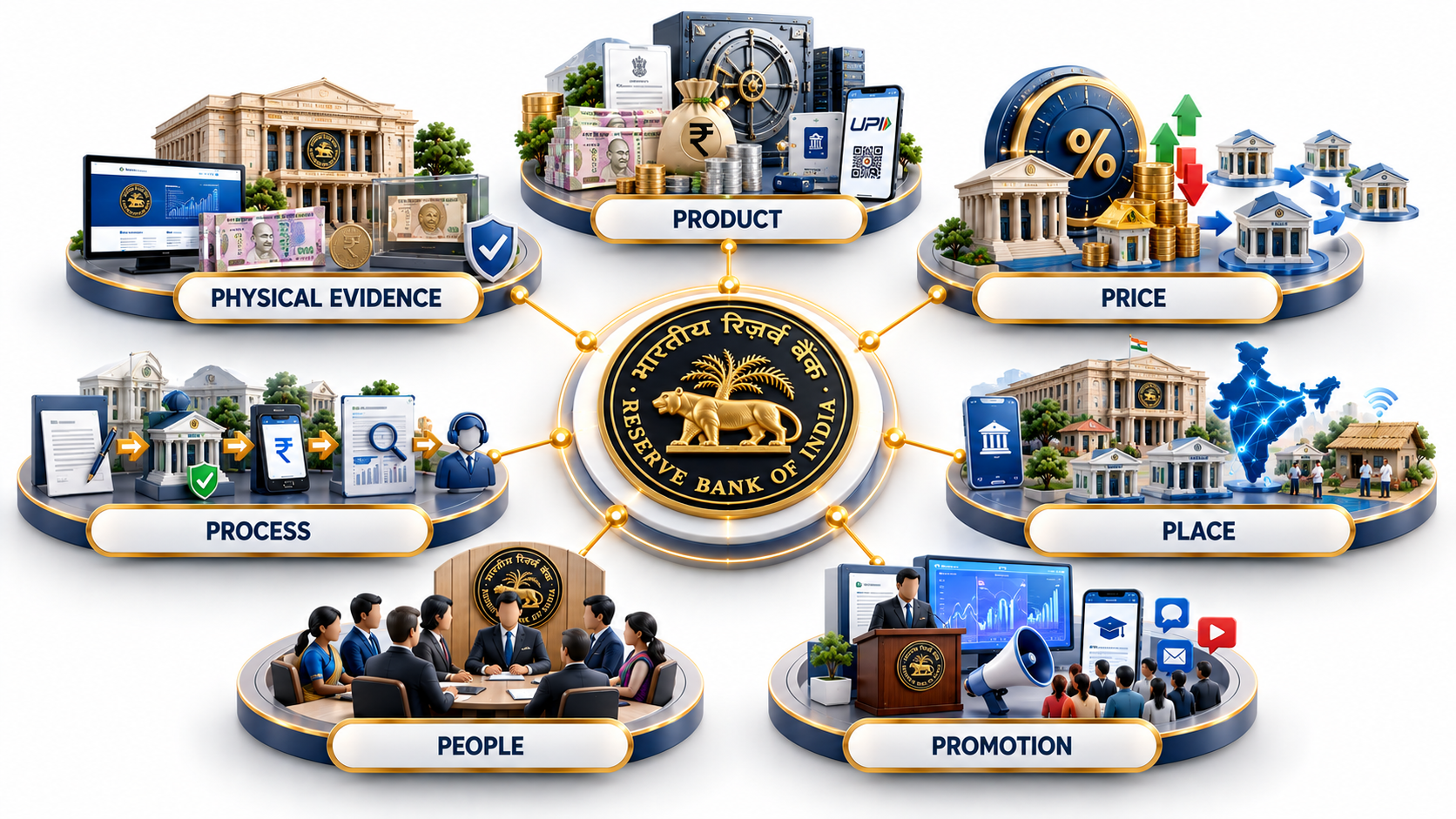
Before jumping into each of the 7Ps, it helps to get one thing straight: RBI isn’t marketing a product to make a sale, it’s marketing an institution to maintain confidence. That distinction changes everything about how you read the marketing mix of RBI compared to a regular company’s marketing mix. A bank like HDFC wants you to open an account. RBI wants the entire banking system, including HDFC, to function without anyone panicking and pulling their money out overnight. That’s a completely different marketing job, and honestly, a much harder one.
RBI’s Dual Role as Regulator and Service Provider
RBI wears two hats at once, and most people analyzing its marketing mix only look at one of them. On one side, it’s a regulator, setting rules for how banks operate, how much capital they must hold, and what interest rates they can charge. On the other side, it’s a service provider, issuing currency, managing government debt, and running the payment infrastructure that keeps UPI transactions clearing in seconds. When you study the marketing mix of RBI, you have to treat both hats as part of the same “offering,” because the public doesn’t separate them. If a bank collapses, people don’t blame the bank alone, they ask what RBI was doing. That’s the weight of dual accountability sitting on top of every marketing decision RBI makes.
Why a Corporate Marketing Framework Even Applies to a Central Bank
Skeptics will say applying a marketing framework to RBI is forcing a business school template onto something that was never meant to be sold. Fair point, but here’s the thing. Marketing, at its core, is about managing perception, delivering value, and maintaining relationships with the people who depend on you. RBI does all three, constantly. Every monetary policy statement is a communication exercise aimed at managing market expectations. Every new currency series is a product launch with security features as the differentiator. Every financial literacy drive is promotion with a social good angle instead of a sales angle. The marketing mix of RBI works because the underlying principles of the 7Ps translate cleanly, even when the end goal isn’t revenue but stability.
Product Strategy
The product element in the marketing mix of RBI isn’t one single item, it’s a bundle of services and guarantees that together keep the Indian financial system running. Most textbooks stop at “currency issuance” and move on, which honestly undersells how layered RBI’s product portfolio actually is. Currency is the most visible part, but it’s the smallest piece of what RBI actually delivers to the economy.
Currency Management as the Core Product
RBI holds the sole authority to issue currency notes in India under Section 22 of the RBI Act, 1934, and that single legal fact is the foundation of its entire product identity. Every note from the ₹10 to the ₹500 denomination carries the Governor’s signature and a promise to pay the bearer, which sounds old-fashioned until you realize that promise is what makes the paper worth anything at all. RBI manages the entire lifecycle here: printing through four currency presses, distribution through regional offices, and eventually withdrawing and destroying soiled notes so the currency in circulation stays clean and trustworthy. When RBI introduced the Mahatma Gandhi (New) Series with upgraded security features like color-shifting ink and enhanced windowed security threads, that was a product upgrade in every sense of the word, just one most people never think to call it that.
Monetary Policy as a Product in Itself
This is where the marketing mix of RBI gets genuinely interesting, because monetary policy itself functions as a product. The bi-monthly Monetary Policy Committee meetings produce a “release,” an announcement that markets consume, react to, and price into everything from home loan EMIs to stock valuations. The product here is predictability. Businesses and investors don’t just want low rates, they want to know RBI will act consistently and transparently, because unpredictability is what actually spooks capital markets. That’s why RBI shifted to a formal inflation-targeting framework in 2016, aiming to keep retail inflation at 4%, with a tolerance band of plus or minus 2%. That target itself is a productized commitment, something markets can hold RBI accountable to.
Banking Services to Government and Commercial Banks
RBI acts as banker to the government, managing its accounts, handling market borrowings through Treasury Bills and dated securities, and executing the Ways and Means Advances facility when the government needs short-term liquidity. It’s also the banker’s bank, holding reserves for commercial banks and acting as lender of last resort during liquidity crunches. When Yes Bank hit a liquidity crisis in 2020, RBI stepped in with a reconstruction scheme and a ₹600 crore rescue plan led through State Bank of India, essentially delivering the exact product any central bank exists to deliver: system-level confidence when a single player wobbles.
Financial Inclusion and Payment Infrastructure
RBI’s product line extends into infrastructure most people never associate with a “central bank.” The National Payments Corporation of India, working under RBI’s oversight, built UPI, which processed over 16 billion transactions in a single month by mid-2024, a scale genuinely no other country’s real-time payment system has matched. RTGS and NEFT, both regulated and operated within frameworks RBI sets, form the backbone of how money actually moves in India today. This is product strategy at its most practical: build the pipes, set the standards, and let the entire economy run through infrastructure that barely anyone notices until it breaks.
Foreign Exchange Reserves as a Product Guarantee
RBI also manages India’s foreign exchange reserves, which crossed $700 billion for the first time in 2024, and this function operates as a kind of insurance product sitting quietly behind everything else RBI does. These reserves let RBI intervene in currency markets to smooth out excessive rupee volatility, buying dollars when the rupee strengthens too fast or selling them when it weakens sharply during periods of capital outflow. Without this reserve cushion, every other part of RBI’s product line, currency stability, banking confidence, monetary policy credibility, would be far more vulnerable to external shocks like a sudden spike in oil prices or a global risk-off event triggered by US Federal Reserve rate decisions.
Pricing Strategy
Pricing sounds like the odd one out when you’re talking about a central bank, because RBI isn’t charging you for a loan or a checking account. But look closer and pricing is arguably the sharpest, most consequential lever in the entire marketing mix of RBI. Every rate decision it makes ripples through EMIs, business loans, deposit returns, and even the rupee’s exchange value against the dollar.
The Repo Rate as RBI’s Primary Pricing Tool
The repo rate, the rate at which RBI lends short-term funds to commercial banks against government securities, functions exactly like a price list in any business, just aimed at banks instead of consumers. When RBI raises the repo rate, borrowing gets costlier for banks, and banks pass that cost onto you through higher loan interest rates. Between May 2022 and February 2023, RBI raised the repo rate from 4% to 6.5% across six consecutive hikes, a direct response to inflation crossing its tolerance band after the Russia-Ukraine war disrupted global commodity prices. That’s a pricing strategy playing out in real time, and if you had a home loan during that stretch, you felt it directly in your EMI statement.
Reverse Repo Rate and Liquidity Pricing
The reverse repo rate works the opposite way, it’s the rate RBI pays banks for parking excess funds with it overnight. This is pricing aimed at managing liquidity rather than lending, and it matters just as much. During the COVID-19 pandemic, RBI slashed the reverse repo rate to 3.35% in 2020, deliberately making it less attractive for banks to hoard cash with RBI, nudging them instead to lend that money out into a struggling economy. That’s a pricing decision engineered to change behavior at a system-wide level, something a soap company’s pricing team could never dream of doing.
Cash Reserve Ratio and Statutory Liquidity Ratio
CRR and SLR function as a kind of “cost of doing business” pricing mechanism RBI imposes on every scheduled commercial bank. CRR requires banks to keep a percentage of their deposits with RBI in cash, currently around 4.5%, earning no interest. SLR requires banks to maintain a percentage of deposits in liquid assets like government bonds. Both tools directly affect how much money a bank actually has available to lend, which indirectly prices the credit available in the entire economy. When RBI cut CRR by 50 basis points in December 2024 to release roughly ₹1.16 lakh crore into the banking system, that was pricing strategy used to solve a liquidity problem without touching the repo rate at all.
Interest Rate Transmission and Why It Doesn’t Always Work Smoothly
Here’s the part most guides skip entirely. RBI can cut rates all it wants, but banks don’t always pass those cuts on to borrowers at the same speed, something economists call incomplete rate transmission. Public sector banks historically transmit rate cuts slower than private banks because their cost of funds is stickier, tied up in older fixed-deposit liabilities. RBI introduced the External Benchmark Lending Rate system in 2019 specifically to fix this, forcing banks to link retail and MSME loan rates to an external benchmark like the repo rate itself, rather than an internal formula banks could quietly manipulate. That’s RBI adjusting its own pricing mechanism to close a gap competitors, meaning the banks it regulates, were exploiting.
Place and Distribution
Place, in a traditional marketing mix, means where and how a customer accesses a product. For RBI, distribution isn’t about retail shelves, it’s about the network of institutions and digital rails that carry RBI’s decisions down to the last customer standing at a bank counter in a small town in Odisha or Bihar.
Regional and Zonal Office Network
RBI operates through 31 regional offices and sub-offices spread across India, plus a central office in Mumbai where the Governor and top management sit. This isn’t just administrative convenience, it’s a distribution decision. Having regional offices in places like Bhopal, Guwahati, and Thiruvananthapuram means RBI’s currency management, banking supervision, and grievance redressal functions stay closer to the ground instead of being centralized entirely in Mumbai and Delhi. When a currency chest in a district needs fresh notes or has to deposit soiled ones, that regional office is the actual “distribution point” in this marketing mix, doing work equivalent to a warehouse in a retail supply chain.
Commercial Banks as RBI’s Retail Counter
This is the part that trips up a lot of students. RBI doesn’t interact with the average person directly for most banking services, it distributes through commercial banks acting as intermediaries. India has over 90,000 bank branches nationwide, and every single one of them is functionally a distribution point for RBI’s monetary policy and currency. When RBI’s policy rate changes, it “distributes” through the balance sheets of SBI, HDFC, ICICI, and every regional rural bank down to cooperative banks in small towns. This layered distribution model is exactly why RBI invests so heavily in banking supervision, because a weak link anywhere in that 90,000-branch network becomes a weak link in how RBI’s own decisions reach the public.
Digital Distribution Channels
RBI has pushed hard into digital distribution over the last decade, and honestly, this is where its marketing mix has modernized the fastest. The RBI website hosts real-time data on exchange rates, inflation, and policy decisions, updated the moment a Monetary Policy Committee meeting concludes. The Sachet portal lets citizens check if a financial entity offering suspiciously high returns is even registered with a regulator, a direct digital distribution of consumer protection. The RBI Retail Direct platform, launched in 2021, lets individual investors buy government securities directly, bypassing intermediaries entirely, something that would have been unthinkable a decade earlier when only large institutional players could access that market.
RBI Kehta Hai and Mobile-First Reach
Recognizing that most Indians now access information through smartphones rather than newspapers, RBI built out mobile-friendly distribution for its financial literacy content under the RBI Kehta Hai campaign, along with region-specific radio jingles and social media content in multiple Indian languages. This matters because distribution isn’t just physical anymore, it’s about reaching people wherever their attention actually is, and RBI has clearly understood that a farmer in rural Maharashtra is more likely to hear a radio spot in Marathi than read an English press release from Mint Street.
Promotion Strategy
Promotion is where the marketing mix of RBI looks least like traditional advertising and most like public education, and that’s by design. RBI isn’t trying to sell you anything, it’s trying to build financial awareness broadly enough that the entire system becomes more resilient, with fewer people falling for Ponzi schemes and more people using formal banking channels instead of hoarding cash under a mattress.
RBI Kehta Hai Financial Literacy Campaign
Launched to simplify complex banking concepts for the average citizen, RBI Kehta Hai uses short videos, radio spots, and social posts to explain things like how to spot a fake currency note, why you shouldn’t share your OTP, and how deposit insurance actually protects your savings up to ₹5 lakh per bank through the Deposit Insurance and Credit Guarantee Corporation. What most people get wrong is assuming this is just a CSR-style side project. It isn’t. Financial literacy directly reduces systemic risk, because informed depositors are less likely to trigger panic-driven bank runs based on rumors, which is exactly the kind of event RBI’s entire regulatory apparatus is built to prevent.
Press Releases and Monetary Policy Communication
Every Monetary Policy Committee decision comes with a detailed press release and a live-streamed briefing by the RBI Governor, something that has become significantly more transparent since Raghuram Rajan’s tenure pushed for clearer central bank communication starting around 2013. Markets parse every word in these statements, sometimes moving on a single phrase change between “accommodative” and “neutral” stance language. This is promotion in its purest form: managing expectations through carefully worded communication, where the “product” being promoted is confidence in the direction of monetary policy itself.
Financial Inclusion Drives and Rural Outreach
RBI runs financial literacy weeks annually, coordinating with banks to set up camps in villages explaining basic banking, digital payments, and fraud prevention. The Financial Literacy Centres, run in partnership with banks across India, specifically target rural and underserved populations who’ve historically been outside the formal banking net. Pradhan Mantri Jan Dhan Yojana, while a government scheme rather than an RBI initiative directly, works hand in hand with RBI’s promotional push toward financial inclusion, having opened over 53 crore bank accounts since 2014. RBI’s role here is less about running the scheme and more about ensuring the banking infrastructure and consumer protection framework exists to support it.
[Screenshot: RBI Kehta Hai official YouTube channel showing a financial literacy video with view count and multilingual subtitle options]
Crisis Communication as Promotional Strategy
Here’s an angle most people never consider: RBI’s handling of communication during a crisis is itself a promotional exercise in maintaining trust. During the 2016 demonetization exercise, RBI issued a stream of clarifications and FAQs as public confusion mounted over exchange limits and deposit rules. Whether you agreed with the policy or not, the sheer volume and frequency of RBI’s public communication during that period was a masterclass in crisis-driven promotion, aimed squarely at preventing panic from spiraling into something worse. That’s promotion doing exactly what it’s supposed to do: manage perception when stakes are highest.
People
People matter enormously in service-based marketing mixes, and few institutions demonstrate that better than RBI, where a single sentence from the Governor can shift bond yields within seconds of being spoken.
The Governor and Monetary Policy Committee
The RBI Governor functions as the public face of the entire institution, and market participants read every speech, interview, and even body language for hints about future policy direction. The six-member Monetary Policy Committee, introduced in 2016 with three RBI members and three external economists, was specifically designed to make rate decisions less dependent on any single individual’s judgment, reducing the “key person risk” that plagued earlier decades when the Governor alone decided rates. This is people-strategy in the marketing mix of RBI functioning almost like a governance safeguard, spreading credibility across a committee rather than betting everything on one person’s reputation.
RBI’s Workforce and Institutional Structure
Beyond the Governor, RBI employs close to 11,000 people across its central office and regional offices, ranging from economists and researchers in its Department of Economic and Policy Research to currency management staff overseeing note printing and distribution. The Deputy Governors, typically four at a time, each oversee specific verticals like monetary policy, financial stability, or regulation, ensuring institutional knowledge doesn’t collapse if one person leaves. This layered leadership structure is exactly what keeps RBI’s marketing mix, and really its entire operational credibility, stable even during leadership transitions, something that’s happened multiple times in the last two decades without ever destabilizing the institution itself.
Stakeholder Relationships with Banks and Government
RBI’s “people” strategy extends beyond internal staff into how it manages relationships with commercial bank leadership, government finance ministry officials, and international bodies like the IMF and the Bank for International Settlements. The Financial Stability and Development Council, chaired by the Finance Minister with the RBI Governor as a key member, exists specifically to coordinate regulatory action across RBI, SEBI, IRDAI, and PFRDA, preventing the kind of turf battles that could otherwise create gaps in oversight. Managing these relationships well is just as much a marketing function as managing customer relationships is for a private company, because trust between regulators is what prevents systemic blind spots.
How Leadership Style Has Shaped RBI’s People Element
Different Governors have left visibly different fingerprints on RBI’s marketing mix, and comparing them shows just how much the People element actually shapes public perception. Raghuram Rajan, Governor from 2013 to 2016, pushed hard for communication transparency and is widely credited with laying the groundwork for the inflation-targeting framework, often speaking candidly at public forums in a way that made global markets pay closer attention to RBI’s independence. Urjit Patel, who succeeded him, took a noticeably quieter public posture during the demonetization period, which drew criticism for insufficient communication during one of the most disruptive economic events in recent Indian history. Shaktikanta Das, Governor since December 2018, has leaned toward calm, measured messaging through the COVID-19 pandemic and subsequent inflation fight, generally avoiding surprises in policy communication. None of these are objectively right or wrong leadership styles, but each one demonstrably shifted how markets and the public experienced RBI’s Promotion and People elements during their respective tenures, proving that the individual sitting in the Governor’s chair is very much part of the institution’s marketing mix, not separate from it.
Process
Process refers to the systems and procedures through which a service actually gets delivered, and for RBI, this is where bureaucratic-sounding mechanisms turn out to have real teeth when you look closely.
Monetary Policy Formulation Process
The process behind every rate decision follows a structured cycle: RBI’s research departments compile inflation and growth data, the Monetary Policy Committee meets for three days every two months, votes on the rate decision, and then publishes minutes of the meeting within two weeks, showing exactly how each member voted and why. This level of procedural transparency wasn’t always standard, it was built deliberately post-2016 to make monetary policy less opaque than it had been for decades. Anyone can go online and read exactly why a particular MPC member dissented on a rate hold versus a rate cut, which is a remarkably transparent process compared to how most government institutions operate.
Regulatory and Supervisory Process
RBI supervises banks through a risk-based supervision framework, conducting on-site inspections and off-site surveillance using data banks are required to report periodically. When RBI placed Punjab and Maharashtra Cooperative Bank under restrictions in 2019 after uncovering a massive loan fraud linked to Housing Development and Infrastructure Limited, that action came out of exactly this supervisory process catching irregularities before they metastasized further, even though depositors still faced painful withdrawal restrictions during the resolution period. The process isn’t perfect, and PMC Bank is a case study in how supervision can catch problems late, but the framework exists precisely to catch what individual banks won’t self-report.
Grievance Redressal Through the RBI Ombudsman
RBI runs an Integrated Ombudsman Scheme, consolidated in 2021 from three separate ombudsman schemes into a single unified process, letting any customer with an unresolved complaint against a bank, NBFC, or payment system operator escalate directly to RBI through the CMS portal at cms.rbi.org.in. This process handled over 4 lakh complaints in a single year following the consolidation, and critically, it’s free for the complainant. That’s a customer-facing process built directly into the marketing mix of RBI, functioning as the institutional equivalent of a customer support escalation line, except backed by regulatory authority rather than just a call center script.
Currency Verification and Exchange Process
RBI has a defined process for exchanging soiled, mutilated, or defective notes, called the Note Refund Rules, which specifies exactly how much value a bank must refund based on how much of the note is intact. This sounds minor until you realize it directly affects public trust in currency as a store of value, since people need confidence that even a damaged note retains recoverable value rather than becoming worthless the moment it tears.
Physical Evidence
Physical evidence covers everything tangible that reinforces trust in a service, and for RBI, this ranges from the notes in your wallet to buildings most Indians will never step inside but instinctively associate with financial authority.
Currency Notes and Coins as Tangible Trust
Every currency note is physical evidence in the truest sense, carrying security features like the see-through register, latent image, and micro-lettering that let both machines and untrained eyes verify authenticity. The Mahatma Gandhi (New) Series notes introduced from 2016 onward included Braille-like intaglio markings specifically to help visually impaired citizens identify denominations, a physical design decision rooted directly in accessibility and inclusion. This is arguably the most literal piece of physical evidence in any marketing mix anywhere, something millions of Indians physically touch every single day without necessarily connecting it back to RBI as an institution.
RBI Headquarters and Regional Offices
The RBI headquarters building on Mint Street in Mumbai, and its regional offices across the country, function as institutional physical evidence, the same way a bank’s polished branch interior signals stability to a walk-in customer. These buildings rarely feature in public consciousness the way a flashy corporate headquarters might, but their permanence and formality reinforce the seriousness of what happens inside, particularly during high-stakes moments like MPC meetings that get covered live by financial news channels.
The RBI Monetary Museum
Located in Mumbai, the RBI Monetary Museum showcases the evolution of Indian currency from ancient punch-marked coins to the digital rupee pilot launched in 2022. This is physical evidence built specifically for public education and brand-building in the truest marketing sense, letting visitors, including countless school groups and finance students, physically walk through India’s monetary history and leave with a stronger intuitive grasp of why currency stability matters.
[Screenshot: RBI Monetary Museum exhibit hall showing a timeline display of Indian currency evolution from ancient coins to modern notes]
Digital Platforms as Modern Physical Evidence
In a digital-first world, physical evidence has expanded beyond buildings and paper currency into RBI’s own digital platforms. The RBI website’s clean data dashboards, the Sachet portal’s fraud-checking interface, and the Retail Direct platform’s investment dashboard all function as digital physical evidence, tangible touchpoints where users directly interact with RBI’s credibility. A cluttered, unreliable government website erodes trust just as fast as a shabby bank branch would, which is exactly why RBI has invested consistently in improving these digital interfaces over the past several years.
SWOT Analysis Within the Marketing Mix of RBI
Layering a SWOT analysis on top of the 7Ps gives you a sharper picture of where RBI’s marketing mix actually holds up under pressure and where it doesn’t. This isn’t a separate exercise, it’s the same framework viewed from a different angle, and it exposes gaps that a straight 7Ps breakdown tends to smooth over.
Strengths That Anchor RBI’s Marketing Mix
RBI’s biggest strength is institutional credibility built over nine decades since its founding in 1935, something no new regulator could replicate quickly even with unlimited funding. Its legal monopoly over currency issuance under the RBI Act removes any competitive threat to its core “product,” a position almost no commercial brand ever enjoys. The inflation-targeting framework adopted in 2016 also gave RBI a clear, measurable mandate, which strengthens the Price element of its marketing mix by making rate decisions rule-based rather than arbitrary, something markets reward with more stable expectations.
Weaknesses Still Visible in the System
Interest rate transmission remains slower than it should be, particularly through public sector banks carrying legacy fixed-rate liabilities, which weakens the Price element’s effectiveness in reaching consumers quickly. Supervisory gaps also show up periodically, as the PMC Bank and Yes Bank episodes demonstrated, where fraud or mismanagement went undetected for years before RBI’s process caught it. Financial literacy campaigns, while genuinely well-produced, still struggle to reach the most vulnerable rural populations who remain most exposed to Ponzi schemes and unregistered lending apps, exposing a real gap in the Promotion element.
Opportunities RBI Hasn’t Fully Captured
The digital rupee pilot, launched in December 2022, represents a massive opportunity to modernize the Product element further, potentially reducing the cost of physical currency management while improving transaction traceability. Expanding Retail Direct’s user base beyond the current niche of financially literate urban investors could meaningfully deepen retail participation in government securities, an opportunity that’s currently underused relative to its potential. Artificial intelligence-driven fraud detection, something RBI has only begun exploring through its regulatory sandbox initiatives, could sharpen the Process element considerably if scaled properly across the banking sector.
Threats That Could Strain the Marketing Mix
Cryptocurrency and unregulated digital lending apps represent a genuine threat to RBI’s product monopoly on trust, since they offer alternative financial rails that operate outside RBI’s regulatory reach entirely. Global economic shocks, like the kind seen during the 2022 commodity price spike following the Russia-Ukraine war, force RBI into reactive pricing decisions that can strain public patience if inflation stays elevated for too long despite rate hikes. Cybersecurity threats to digital payment infrastructure like UPI also pose a growing risk, since a major breach could undo years of carefully built digital trust in a matter of hours.
How the Marketing Mix of RBI Compares to Global Central Banks
Comparing RBI’s marketing mix to other central banks isn’t just an academic exercise, it shows which parts of RBI’s approach are genuinely distinctive and which parts follow a fairly standard central banking playbook.
RBI Versus the US Federal Reserve
The Federal Reserve operates with a dual mandate covering both price stability and maximum employment, while RBI’s mandate under the 2016 framework leans almost entirely toward inflation targeting. This difference shows up clearly in the Price element: the Fed’s rate decisions often weigh job market data as heavily as inflation figures, while RBI’s Monetary Policy Committee statements center almost exclusively around the Consumer Price Index. On the Promotion side, the Fed Chair’s press conferences get intense global media coverage given the dollar’s reserve currency status, whereas RBI’s Governor commands significant domestic attention but comparatively less global market-moving weight, reflecting the rupee’s more regional role in international finance.
RBI Versus the European Central Bank
The European Central Bank operates across nineteen different countries using the euro, which makes its Place and distribution element vastly more complex than RBI’s, since it has to coordinate policy transmission through national central banks across the Eurozone rather than a single unified banking network. RBI’s advantage here is straightforward: a single regulatory jurisdiction means faster, more coordinated policy transmission across its 90,000-plus branch network compared to the ECB’s multi-country coordination challenges. On Physical Evidence, both institutions rely heavily on currency design for public trust, though the euro’s banknote design deliberately avoids featuring any single country’s national symbols, a compromise RBI never has to make given India’s single-currency, single-nation structure.
What RBI Does Genuinely Better
RBI’s financial literacy push through RBI Kehta Hai and Financial Literacy Centres arguably outpaces equivalent efforts by both the Fed and ECB in terms of grassroots reach, given India’s much larger unbanked and underbanked population historically. UPI’s success, built under RBI and NPCI’s combined oversight, has become something central banks worldwide now study directly, with several countries including Singapore and the UAE exploring interoperability links with India’s payment rails. That’s a rare case where RBI’s Product and Place elements have leapfrogged what more established global central banks have managed to build domestically.
Conclusion
Look at the marketing mix of RBI closely enough and a pattern shows up everywhere: every single one of the 7Ps exists to protect one thing, public confidence in the Indian financial system. Currency notes, repo rate decisions, regional offices, financial literacy campaigns, the Governor’s press briefings, ombudsman complaint resolution, even the Monetary Museum in Mumbai, none of it is random. It’s a coordinated, if unconventional, marketing strategy built around trust as the product rather than profit as the goal.
If you’re studying this for an exam, an interview, or just genuine curiosity about how a central bank actually operates, the real takeaway is this: marketing frameworks aren’t just for companies selling shampoo. Any institution that depends on public trust, government or private, ends up making the exact same kinds of decisions RBI makes every single day, whether it labels them “marketing” or not.
Frequently Asked Questions
What is the marketing mix of RBI?
The marketing mix of RBI refers to how the Reserve Bank of India structures its core functions, currency issuance, monetary policy, banking supervision, and financial literacy, using the 7Ps framework of Product, Price, Place, Promotion, People, Process, and Physical Evidence. Instead of selling a product for profit, RBI uses these elements to maintain trust, stability, and confidence across India’s financial system.
Why does RBI need a marketing mix if it doesn’t sell products for profit?
RBI still needs to manage perception, deliver consistent value, and maintain relationships with banks, the government, and the public, which are the exact goals any marketing mix is designed to achieve. Even without a profit motive, RBI depends on public confidence functioning the same way customer trust does for a private brand.
What is the “product” in the marketing mix of RBI?
RBI’s core product includes physical currency, monetary policy stability, banking and regulatory services to government and commercial banks, and payment infrastructure like UPI and RTGS oversight. The underlying product across all of these is trust and systemic stability rather than a single tangible good.
How does RBI use pricing as part of its marketing mix?
RBI prices its services through monetary policy tools like the repo rate, reverse repo rate, Cash Reserve Ratio, and Statutory Liquidity Ratio, all of which affect how much it costs banks to borrow, lend, and hold reserves. These rates then influence loan interest rates and deposit returns for the general public, functioning as an indirect pricing mechanism across the entire economy.
What role does the repo rate play in the marketing mix of RBI?
The repo rate is RBI’s primary pricing lever, determining the interest rate at which it lends short-term funds to commercial banks. When RBI raises or lowers the repo rate, it directly affects how expensive or cheap borrowing becomes for consumers and businesses across the country.
How does RBI distribute its services across India?
RBI distributes its services through 31 regional and sub-offices, a network of over 90,000 commercial bank branches acting as intermediaries, and digital platforms including its official website, the Sachet portal, and the RBI Retail Direct scheme for government securities investment.
What promotional strategies does RBI use to reach the public?
RBI’s main promotional tool is financial literacy education, delivered through campaigns like RBI Kehta Hai, Financial Literacy Centres, press briefings after every Monetary Policy Committee meeting, and multilingual content spread across radio, social media, and video platforms.
Who are the key people in RBI’s marketing mix?
The RBI Governor, the six-member Monetary Policy Committee, four Deputy Governors overseeing different verticals, and nearly 11,000 employees across departments make up the people element. Market reactions to Governor statements alone show how much influence individual leadership carries within this marketing mix.
What processes make up RBI’s service delivery?
Key processes include the bi-monthly monetary policy formulation cycle, risk-based bank supervision and inspection procedures, the Integrated Ombudsman Scheme for customer grievance redressal, and the Note Refund Rules governing currency exchange for damaged notes.
What counts as physical evidence in RBI’s marketing mix?
Physical evidence includes currency notes and coins with embedded security features, RBI’s headquarters and regional office buildings, the RBI Monetary Museum in Mumbai, and digital platforms like the official website and Retail Direct dashboard that users interact with directly.
Is the marketing mix of RBI the same as its monetary policy?
No, monetary policy is only one part, specifically falling under the Product and Price elements. The full marketing mix of RBI also covers distribution channels, promotional and financial literacy strategy, people and leadership structure, service delivery processes, and physical evidence of trust. Treating monetary policy as the whole picture is one of the most common shortcuts people take, and it usually means the other five Ps get ignored entirely in an analysis or answer sheet.
Can the 4Ps model be used instead of the 7Ps for RBI’s marketing mix?
The traditional 4Ps model, Product, Price, Place, and Promotion, can technically be applied, but it leaves out People, Process, and Physical Evidence, three elements that matter enormously for a service-driven, trust-dependent institution like RBI. Since RBI’s credibility depends so heavily on leadership communication, supervisory processes, and tangible symbols of stability, the extended 7Ps model gives a far more complete and defensible analysis than the older 4Ps framework alone.
How is the marketing mix of RBI different from a commercial bank’s marketing mix?
A commercial bank markets specific products like savings accounts, loans, and credit cards to acquire and retain customers for profit. RBI’s marketing mix instead focuses on regulating and enabling the entire banking ecosystem, prioritizing systemic stability and public trust over individual customer acquisition or revenue generation.
Why is financial literacy considered part of RBI’s promotion strategy?
Financial literacy reduces systemic risk by helping citizens avoid fraudulent schemes, understand deposit insurance limits, and use formal banking channels confidently, which directly supports RBI’s larger goal of financial stability. Treating it as a promotional function, rather than a side activity, reflects how central public education is to RBI’s overall mission.
Has RBI’s marketing mix changed with digital banking growth?
Yes, RBI’s marketing mix has shifted significantly toward digital channels over the last decade, with UPI oversight, the Retail Direct platform, the Sachet fraud-checking portal, and a digital rupee pilot all representing modernized versions of its product, place, and physical evidence elements.
Does RBI’s marketing mix change during a financial crisis?
Yes, RBI actively adjusts its Price element by cutting or raising rates, its Place element by ensuring banking access stays functional, and its Promotion element by increasing public communication frequency during crises like demonetization in 2016 or the COVID-19 pandemic in 2020. These adjustments show how the 7Ps in RBI’s marketing mix work together rather than as isolated categories.
What is the biggest weakness in RBI’s current marketing mix?
Incomplete interest rate transmission through public sector banks and gaps in reaching rural, underbanked populations with financial literacy content remain the most cited weaknesses. Both point to the same underlying challenge: RBI’s decisions are strong at the policy level but sometimes lose effectiveness by the time they reach the last customer in the chain.