


Try booking a mini-truck the old way. You call a local transporter, he doesn’t pick up, you call another one, he quotes a number that feels made up on the spot, and you still don’t know if the vehicle will actually show up on time. That’s the exact mess Porter walked into back in 2014, and honestly, the fact that it managed to turn that mess into a business worth over a billion dollars says a lot about how well it built its marketing mix, not just its technology.
This article breaks down the marketing mix of Porter using the 7Ps framework, which is a more complete way to study a service business like this than the old-school 4Ps that most marketing textbooks still lean on. Product and Price and Place and Promotion tell you part of the story, but a logistics marketplace lives and dies on People, Process, and Physical Evidence too. A driver who shows up late ruins the product no matter how good the app looks. A confusing booking flow kills conversions no matter how competitive the price is. That’s why we’re going with all seven.
Porter isn’t just an app that books trucks. It’s a genuinely interesting case study because it sits at the intersection of a physical, unpredictable, on-ground service and a clean, tech-first customer experience. Getting that combination right is hard, and most companies trying to digitize a messy offline industry get at least one of the 7Ps badly wrong. Porter, for the most part, hasn’t, which is why it’s worth studying closely instead of just skimming a features list.
Before going further, it helps to draw a line between four things people often lump together when they talk about Porter: its logistics services, which is the actual transportation work; its technology platform, meaning the app and backend matching system; its brand positioning, or how it wants to be perceived in the market; and its driver-partner ecosystem, the actual humans who make every single booking possible. Keeping these four things separate in your head will make the rest of this marketing mix of Porter breakdown a lot easier to follow.
What You Will Learn in This Guide
- How Porter defines its “product” when the core offering is really a service, not a physical good
- The logic behind Porter’s pricing model and why it isn’t the same as a fixed-rate courier service
- How Porter’s “place” strategy works when there’s no physical store to walk into
- A full breakdown of Porter’s promotion strategy across digital channels, content, and brand campaigns
- Why people, meaning drivers, support staff, and customers themselves, matter just as much as the app
- The step-by-step process Porter uses to take a booking from search to delivery
- How physical evidence, like branded vehicles and the app interface, builds trust in an intangible service
- A SWOT-style look at Porter’s marketing mix and how it stacks up against competitors
- Practical marketing lessons any business can pull from Porter’s approach
- A set of FAQs answering the exact questions people search for about Porter’s marketing mix
About Porter: Company Overview and Business Model
You can’t really analyze the marketing mix of Porter without first understanding what the company actually does and who it’s built for. So let’s slow down here before jumping into the 7Ps themselves.
What Is Porter?
Porter is an on-demand logistics and transportation platform that connects customers who need to move goods with driver-partners who own vehicles and are available to move them. That’s the simplest way to put it. The company doesn’t own a fleet of trucks. Instead, it built a technology layer that matches demand with supply, the same basic logic behind ride-hailing, except the passenger seat is now a cargo bed.
Core categories span goods transportation using mini-trucks and larger commercial vehicles, two-wheeler delivery for smaller and time-sensitive parcels, and household or office relocation support. What ties all of this together is Porter’s role in simplifying intra-city goods movement, taking something that used to require phone calls, waiting, and price haggling, and turning it into a few taps on a screen.
Porter’s Target Market
Porter doesn’t chase a single customer type, and understanding this segmentation is genuinely important for the marketing mix of Porter because different segments respond to different parts of the mix.
Individual customers use Porter mainly for household shifting, furniture transportation, moving personal goods across the city, and small-item transportation that’s too heavy or awkward for a regular courier. This group cares a lot about convenience and trust since they’re often moving things that matter to them personally, like a fridge or a family heirloom.
Small and medium businesses make up a huge chunk of Porter’s actual usage. Retailers restocking shelves, wholesalers moving bulk goods, local manufacturers shipping raw materials or finished products, e-commerce sellers handling their own fulfillment, distributors managing regional supply, and restaurants that need regular ingredient deliveries all show up here. This segment cares more about reliability and cost predictability than flashy branding.
Enterprise customers are businesses with recurring transportation requirements and larger logistics or supply-chain needs. These clients don’t book once and disappear, they need consistent, contract-style service, and that changes what Porter has to offer them in terms of account management and integration.
Porter’s Value Proposition
Strip away the marketing language and Porter’s actual value proposition comes down to a handful of concrete things: convenience, since booking takes minutes instead of hours of phone calls, faster booking through an app instead of a negotiation, transparent pricing so customers see a fare before committing, reliable vehicle availability across a wide network of driver-partners, technology-enabled logistics that includes tracking and digital payments, genuine door-to-door transportation instead of drop-off points, and multiple vehicle options so customers aren’t forced into a one-size-fits-all booking.
Porter’s Competitive Positioning
Porter sits in a pretty specific spot in the market. It’s positioned between old-school local transport operators, who are cheap but unreliable and offer zero technology, and larger logistics companies, who are reliable but built for bulk, long-haul, or enterprise-scale shipping rather than quick, local, on-demand jobs. Porter’s technology-led approach and app-based convenience let it own the middle ground: fast, local, intra-city transportation that feels as easy as booking a cab, backed by a driver-partner network big enough to scale across cities.
Why Porter Is a Strong Marketing Mix Case Study
Here’s honestly why Porter makes such a good subject for a 7Ps breakdown. It’s a service business, not a product business, so you can’t just talk about packaging and features. It has two-sided marketplace characteristics, meaning it has to keep both customers and drivers happy simultaneously, which is a genuinely different marketing challenge than a normal B2C brand. It depends heavily on customer experience because a single bad driver interaction can undo months of brand-building. It has to scale locally, city by city, rather than just flipping a switch nationally. And it blends technology with a physical, human-delivered service in a way that forces every single P in the marketing mix to actually matter, not just the ones that look good in a slide deck.
Marketing Mix of Porter: The 7Ps Framework
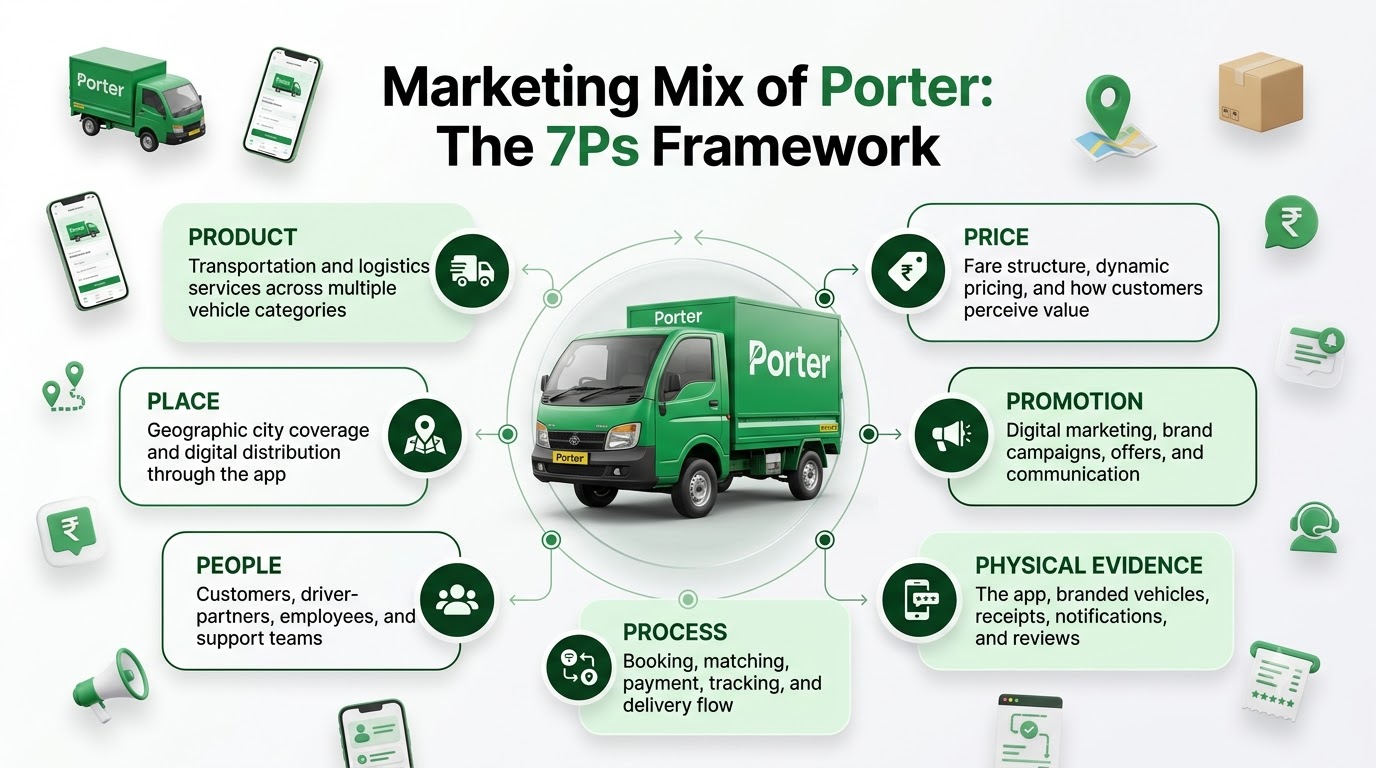
Before diving into each element separately, it helps to see the whole picture laid out together.
| Marketing Mix Element | What It Means for Porter |
|---|---|
| Product | Transportation and logistics services across multiple vehicle categories |
| Price | Fare structure, dynamic pricing, and how customers perceive value |
| Place | Geographic city coverage and digital distribution through the app |
| Promotion | Digital marketing, brand campaigns, offers, and communication |
| People | Customers, driver-partners, employees, and support teams |
| Process | Booking, matching, payment, tracking, and delivery flow |
| Physical Evidence | The app, branded vehicles, receipts, notifications, and reviews |
These seven elements don’t operate in isolation. A good price means nothing if the process to book it is clunky. A great app means nothing if the driver who shows up is rude or late. The marketing mix of Porter only really works when all seven pieces reinforce each other, and that’s the lens we’re going to use throughout this article.
Product Strategy of Porter
What Is Porter’s Product?
Here’s the thing people get wrong when they analyze Porter: they treat it like a product company selling an app. It isn’t. Porter’s actual product is transportation, the physical movement of goods from one point to another. The technology is an enabling layer sitting on top of that core service, not the service itself. If you strip away the app entirely, Porter is still, at its core, a company that moves stuff from point A to point B using a network of vehicles and drivers.
Porter’s Core Services
Depending on the market and city, Porter’s service lineup typically spans mini-truck and goods transportation for everyday cargo needs, two-wheeler transportation for smaller and time-sensitive parcels, packers and movers-related services for full household or office relocations, local goods movement for short-distance business deliveries, business logistics support for retailers and wholesalers, enterprise transportation solutions for large-scale recurring needs, and other logistics services that vary by city depending on local demand patterns.
Vehicle Portfolio as a Product Strategy
This is honestly one of the smartest parts of Porter’s product design. Not every shipment needs the same vehicle, so Porter built a portfolio that scales with cargo size instead of forcing everyone into one category. Two-wheelers handle small, urgent parcels that don’t need a full truck. Three-wheelers cover a middle ground for slightly bulkier local deliveries. The Tata Ace and similar mini-trucks handle the bulk of everyday business and household transportation needs. Larger commercial vehicles step in for bigger loads, like full relocations or bulk business shipments. Vehicle selection based on load size means a customer moving a single sofa isn’t paying for the same vehicle as a business moving five hundred kilograms of inventory, and that flexibility is a real product advantage.
Convenience as a Product Feature
Convenience isn’t just marketing language here, it’s baked directly into the product itself. On-demand booking means a vehicle can be arranged in minutes instead of hours. Doorstep pickup removes the need for customers to haul goods anywhere themselves. Digital booking replaces phone calls and back-and-forth negotiation. Driver matching happens automatically instead of the customer having to find and vet a transporter manually. Real-time status and tracking, where available, gives customers visibility they never had with traditional transport. Cashless and digital payment options remove the awkwardness of exact change and cash handling. And estimated fares shown upfront mean no surprises when the job is done.
Porter’s Technology-Enabled Product
The mobile application is really the front door to everything Porter offers, but the technology stretches well beyond just the app interface. Automated matching connects available vehicles with incoming requests without manual dispatching. Location-based service uses GPS to find the nearest available driver-partner. Digital communication keeps customers updated without needing a phone call. Order management lets both customers and the platform track bookings from start to finish. And customer support ties the whole experience together when something doesn’t go as planned.
Product Customization for Different Customers
Porter doesn’t offer the exact same experience to every customer type, and that’s intentional. Individual consumers mostly want simplicity: book fast, get a fair price, done. Small businesses want reliability and repeat-use convenience, since they’re often booking the same kind of trip multiple times a week. SMEs need a bit more structure, like consistent pricing and dependable vehicle availability during business hours. Enterprise clients need something closer to account management: dedicated support, predictable service levels, and integration into their own operational workflows rather than a one-off booking experience.
Porter’s Product Differentiation
What actually separates Porter from a random local transporter with a phone number? Convenience is the obvious one, since booking takes seconds instead of a string of phone calls. Reliability matters because a matched driver is confirmed, not a maybe. Speed comes from automated matching instead of manual searching. Variety of vehicles means customers aren’t boxed into one option. Technology gives visibility that traditional transport simply can’t match. Availability across a large driver network reduces the odds of “sorry, no vehicles right now.” And brand trust, built over years, means customers don’t have to gamble on an unknown transporter every single time they need something moved.
Product Life Cycle Perspective
Porter’s product hasn’t stayed static since 2014, and looking at it through a life cycle lens tells a useful story. In the introduction phase, Porter was a single-category mini-truck booking service testing whether digitized local transport could actually work. Market expansion followed as the company proved the model in its first city and started replicating it elsewhere. Service diversification came next with two-wheeler delivery, packers and movers, and Enterprise logistics getting added to the mix. Geographic expansion pushed the service into more cities beyond the early metros. Increasing competition arrived as other platforms noticed the same opportunity and started building similar offerings. And now Porter faces potential maturity challenges, where growth has to come from deepening existing markets and adding real value, not just adding more cities to a map.
Product Strategy Strengths and Weaknesses
Strengths worth calling out include diverse use cases that cover everything from a single sofa to bulk business inventory, tight technology integration that makes booking genuinely easy, a scalable service model that doesn’t require owning physical assets to grow, and strong day-to-day utility that keeps customers coming back without needing constant convincing.
Challenges are just as real though. Service consistency is genuinely hard to guarantee across thousands of independent drivers. Driver availability fluctuates by city and time of day, which can leave customers waiting longer than expected in certain zones. Vehicle quality isn’t uniform since Porter doesn’t own the vehicles itself. And customer experience variability means one customer’s smooth five-star trip can be another customer’s frustrating, delayed one, even on the same day in the same city.
Price Strategy of Porter
Porter’s Pricing Model
Logistics pricing isn’t as simple as “distance times rate,” even though that’s the mental shortcut most customers use. Porter’s fares typically factor in distance between pickup and drop, vehicle category chosen, current demand in that specific area, the exact pickup and drop location, time of day and how busy the roads are, load requirements based on the goods being moved, and any additional services layered onto the booking, like helper assistance for loading and unloading.
Value-Based Pricing
Here’s something worth being honest about: customers aren’t really paying Porter just for the physical act of moving a box from one place to another. They’re paying for convenience, speed, reliability, and accessibility, the fact that they didn’t have to spend an hour calling around town trying to find someone who’d actually show up. Compare that to the perceived value of traditional local transport, where the price might technically be lower, but the hidden cost is time, uncertainty, and the stress of not knowing if the truck will actually arrive.
Dynamic Pricing
Like most on-demand platforms, Porter’s fares shift based on real-time conditions rather than staying fixed no matter what. Peak demand periods, like early mornings when businesses are restocking or evenings when households are relocating, tend to push fares up because supply gets tighter. Driver availability in a given area at a given moment affects pricing directly. Location-specific supply matters too, since a dense urban zone with lots of drivers behaves differently than a quieter suburb. And seasonal fluctuations, like festival season moving spikes, can shift pricing patterns across the year.
Transparent Pricing as a Competitive Advantage
This is genuinely one of Porter’s strongest pricing moves. Upfront fare visibility means customers know the cost before they commit, not after the job is halfway done. Digital quotation replaces the awkward back-and-forth negotiation that defines traditional transport booking. Reduced negotiation saves time and removes the anxiety of wondering whether you’re getting ripped off. And for businesses specifically, easier budgeting becomes possible when logistics costs are predictable instead of varying wildly depending on who you happened to call that day.
Porter vs Traditional Transport Pricing
| Factor | Traditional Local Transport | Porter |
|---|---|---|
| Price discovery | Often negotiated | Digitally displayed |
| Booking | Phone/in-person | App/platform |
| Tracking | Limited | Technology-enabled |
| Payment | Often cash | Digital options |
| Convenience | Variable | Standardized platform |
Pricing for Business Customers
Business customers don’t think about price the same way individual customers do, and Porter’s pricing approach for them reflects that. Recurring transportation needs mean businesses care more about consistency than about squeezing the absolute lowest fare out of a single trip. Volume requirements can open the door to better rates for businesses booking frequently. Enterprise contracts bring a different pricing logic entirely, often built around predictable monthly costs rather than per-trip fares. Operational efficiency matters because a business that knows its logistics costs in advance can plan budgets properly. And cost predictability, more than raw price, is often the deciding factor for a business choosing whether to stick with Porter long term.
Discounts, Offers and Customer Acquisition
Like most platform businesses, Porter uses pricing incentives to pull in new users and keep existing ones active. Promotional pricing during launch phases in new cities helps build initial trial. Referral incentives turn existing customers into a low-cost acquisition channel. First-order offers reduce the risk of trying the platform for the first time. Business incentives target SMEs and enterprise accounts specifically, since acquiring a business customer who books repeatedly is worth far more than acquiring a one-time individual user. And discounts, used well, can genuinely encourage trial among customers who were previously loyal to a local transporter out of habit rather than actual preference.
Porter’s Pricing Challenges
Pricing isn’t a solved problem for Porter, and it’s worth being honest about that. Maintaining affordability for price-sensitive customers, especially small businesses and MSMEs, is a constant balancing act. Driver earnings have to stay competitive enough to keep drivers active on the platform, which pushes costs upward. Fuel and operating costs for vehicle owners keep rising, and that pressure eventually has to show up somewhere in the pricing structure. Competitive pressure from other logistics apps means Porter can’t just raise prices freely without risking customer churn. And customer price sensitivity, particularly among MSMEs who treat logistics as a variable cost to minimize, limits how much pricing power Porter actually has, even with a strong brand behind it.
Place Strategy of Porter
What Does “Place” Mean for Porter?
Place is a weird category to apply to Porter because there’s no storefront to walk into. Instead, it splits into two very different things: digital distribution through the mobile app and website, where customers actually access the service, and physical service delivery through the actual vehicles and drivers moving goods around the city. Geographic availability sits in between these two, since the app is useless in a city where Porter has no driver network to back it up.
Geographic Expansion Strategy
Porter’s city-by-city growth wasn’t random. Expansion typically started from major urban markets where demand was dense enough to support the platform economically, then moved outward as the model proved itself. Increasing city coverage over time reflects a careful balance between opportunity and operational readiness. Population density matters a lot here, since more people packed into a smaller area generally means more transportation demand per square kilometer. Business activity levels, e-commerce penetration, and overall transportation demand in a given city all factor into whether it makes sense for Porter to launch there in the first place.
Hyperlocal Logistics
A big chunk of what Porter actually does falls under hyperlocal logistics, meaning short-distance goods movement within a city rather than long-haul freight between cities. This includes local business deliveries for retailers and wholesalers who need frequent short trips, neighborhood-level demand from households and small shops, and the genuine urban logistics challenges that come with navigating narrow streets, traffic, and inconsistent addressing systems that GPS sometimes struggles with.
Digital Distribution
The mobile application remains Porter’s primary distribution channel, the place where almost every customer interaction starts and ends. The website serves a similar function for customers who prefer browsing on a larger screen, particularly business users researching the service before committing. The digital customer journey, from first search to completed booking, is designed to minimize friction at every step. And online booking itself replaces what used to be an entirely offline, relationship-dependent process.
Driver Network as Porter’s Physical Distribution Infrastructure
Here’s an angle that’s easy to miss: Porter’s driver network is basically its physical distribution infrastructure, the equivalent of a retail chain’s store locations. Driver-partner acquisition in each city determines how well Porter can actually serve that market. Vehicle availability across neighborhoods determines how fast a customer’s booking gets fulfilled. Supply-demand matching through the app’s backend keeps this whole system functioning without manual dispatching. And local network effects mean a city with more drivers naturally attracts more customers, which then attracts even more drivers looking for consistent work.
Location-Based Availability
Not every part of a city gets the same experience, and that’s worth being upfront about. Geographic serviceability depends on how well Porter’s network covers a specific area. Demand density in that area shapes how quickly bookings get fulfilled. Driver density nearby directly affects response time, since a driver five minutes away obviously beats one thirty minutes out. And response time itself becomes a real differentiator between neighborhoods with strong Porter coverage versus areas where the network is still thin.
Porter’s Place Strategy for Businesses
Businesses interact with Porter’s place strategy differently than individual customers do. Business delivery requirements often involve recurring routes between specific locations, like a warehouse and multiple retail outlets. Retail distribution needs mean consistent availability during business hours matters more than flashy features. Last-mile movement for e-commerce sellers requires reliable short-distance delivery capacity. And recurring local transportation, the kind a small manufacturer might need every single day, depends on Porter having consistent driver availability in that business’s specific operating zone.
Challenges in Porter’s Place Strategy
Place strategy isn’t without real friction points. Low-demand areas within a city can suffer from thin driver coverage, since drivers naturally gravitate toward zones with more consistent bookings. Driver shortages during peak hours or in newer markets can lead to longer wait times. Traffic and urban congestion, a fact of life in most Indian cities, directly affects delivery timelines regardless of how good the technology is. Expansion economics mean a new city needs enough demand density before it becomes profitable to operate in, which limits how fast Porter can realistically grow geographically. And service consistency across cities is genuinely hard to maintain, since a mature market like Bangalore behaves very differently from a newer, less dense market.
Promotion Strategy of Porter
This section deserves real depth because Porter has genuinely built strong brand recognition through modern marketing, and it’s worth understanding exactly how.
Porter’s Brand Positioning
Porter’s brand leans into convenience-led positioning, presenting itself as the easy button for a task that used to be genuinely stressful. Technology-driven logistics messaging reinforces the idea that this isn’t your grandfather’s local transporter. The core message consistently centers on making goods transportation easier for everyday people and businesses alike. Human and relatable communication, rather than dry corporate messaging, helps the brand feel approachable. And all of this compounds into strong brand recall, the kind where “just Porter it” starts to feel like a natural phrase rather than a marketing slogan.
Digital Marketing Strategy
Porter’s promotional efforts lean heavily digital, which makes sense given its target audience skews toward smartphone users comfortable booking services through an app. This spans search marketing to capture people actively looking for transportation solutions, social media presence to build ongoing brand awareness, display advertising for broader reach, video marketing to tell relatable stories, content marketing to build search authority, app marketing to drive installs and engagement, and performance marketing focused on measurable customer acquisition.
Social Media Marketing
Different platforms serve genuinely different purposes in Porter’s promotional mix.
Instagram works well for short-form videos that dramatize relatable logistics situations, like the chaos of last-minute moving day, brand storytelling that builds personality, and lightweight product or service education that doesn’t feel like a sales pitch.
YouTube allows for longer brand videos that can actually explain the platform’s value proposition in depth, explainer content walking through how booking works, customer stories that build trust through real testimonials, and campaign videos tied to bigger marketing pushes.
LinkedIn shifts the tone entirely toward B2B communication, focusing on business logistics use cases, employer branding to attract talent, and corporate announcements that matter to enterprise decision-makers evaluating Porter as a logistics partner.
Content Marketing
Beyond paid promotion, Porter benefits from educational logistics content that answers real questions people search for. This includes business transportation advice for SMEs trying to figure out their logistics options, moving guides for individuals planning a relocation, delivery-related content explaining how different services work, and search-driven content built specifically to capture organic traffic from people actively researching transportation solutions.
Search Engine Marketing
SEO efforts likely focus on location-based searches, since someone searching “mini truck booking in Pune” has extremely high purchase intent, along with service-specific searches and broader logistics-related keywords that build topical authority over time.
PPC campaigns complement this by targeting high-intent searches where someone is ready to book right now, capturing local demand in specific cities, and driving direct customer acquisition through paid clicks rather than waiting for organic rankings to build.
Brand Campaigns and Creative Advertising
Porter’s advertising has room to lean into humor, everyday Indian situations that people immediately recognize, relatable customer problems like the stress of moving houses or scrambling to find a truck last minute, cultural relevance that ties into festivals or seasonal moving patterns, and simple, uncomplicated messaging that doesn’t try too hard to sound clever. Emotional and humorous communication tends to stick in people’s memory far longer than a straightforward features list ever could, which is exactly why brand recall matters so much in a category as functional as goods transportation.
Referral and Word-of-Mouth Marketing
Some of Porter’s best marketing probably doesn’t come from paid ads at all. Customer recommendations, especially among small business owners who talk to each other constantly, carry serious weight. Driver-partner interactions shape word-of-mouth too, since a friendly, professional driver becomes a walking advertisement for the platform. Business referrals between shop owners in the same market or neighborhood spread trust fast. Repeat usage itself is a form of promotion, since a customer who books Porter five times a month becomes genuinely hard to poach. And reviews and ratings visible within the app or on external platforms shape first impressions for anyone considering trying Porter for the first time.
Promotions and Offers
Tactical promotions round out Porter’s promotional mix. New-user offers reduce the friction of trying an unfamiliar service. Referral campaigns turn happy customers into an acquisition channel. Seasonal promotions capture spikes in demand, like moving season or festival-related shopping surges. And business acquisition offers specifically target SMEs and enterprise clients, since landing one recurring business customer can be worth dozens of one-off individual bookings.
App-Based Marketing
Once a customer has downloaded the app, Porter’s promotional job shifts from acquisition to retention. Push notifications keep the app top of mind without needing external advertising spend. Personalized offers based on past booking behavior feel more relevant than generic discounts. Repeat-order reminders nudge business customers who book on a predictable schedule. And cross-selling different services, like nudging a goods transportation customer toward trying Packers & Movers, helps deepen the relationship over time.
B2B Promotion Strategy
Enterprise and business customers don’t respond to the same tactics as individual consumers, so Porter’s B2B promotion looks different. Enterprise sales teams handle direct outreach and relationship-building with larger clients. LinkedIn marketing targets decision-makers rather than casual browsers. Case studies demonstrate real results to prospective business clients who need proof before committing. Direct sales conversations close deals that a self-serve app simply can’t handle for large accounts. Partnerships with complementary businesses extend reach. And industry events give Porter visibility among the exact audience of logistics and supply-chain decision-makers it wants to reach.
Porter’s Promotion Strategy: Strengths and Challenges
Strengths include strong brand recall built through consistent messaging, a genuinely digital-first communication approach that matches how its audience actually consumes content, relatable advertising that avoids feeling corporate or stiff, and a wide spread across multiple channels rather than betting everything on one platform.
Challenges are real too. Rising customer acquisition costs, a problem every digital-first company faces as ad platforms get more expensive and competitive, eat into margins. Competition for digital attention means Porter isn’t just fighting other logistics apps, it’s fighting every brand trying to grab a few seconds of someone’s scroll time. Maintaining consistent messaging across so many channels and campaigns takes real discipline. And balancing promotional spend with actual profitability is a constant tension, since aggressive discounting can win customers short-term while quietly hurting unit economics long-term.
People Strategy of Porter
Why People Matter in Porter’s Business
It’s tempting to think of Porter as a pure technology company, but that would be a mistake. Porter is technology-enabled, sure, but it’s fundamentally service-dependent, meaning the actual customer experience hinges heavily on human interaction, not just app design. A perfectly designed booking flow means nothing if the driver who shows up is rude, late, or careless with the goods.
Driver-Partners
Driver-partners are the single most important “people” element in Porter’s entire marketing mix, and it’s not close. They handle core service delivery, the actual physical act of moving goods. They’re the primary point of customer interaction during the trip itself. Their availability directly determines vehicle availability across the platform. Delivery execution, meaning whether goods arrive on time and undamaged, rests entirely on them. And whether they realize it or not, every single driver-partner is representing the Porter brand in that moment, for better or worse.
Driver-Partner Acquisition and Retention
Keeping a healthy driver network isn’t a one-time task, it’s ongoing work. Platform incentives, like bonuses for completing a certain number of trips, help keep drivers active. Earnings opportunities need to stay competitive against other platforms fighting for the same pool of vehicle owners. Technology support, meaning an app that actually works well for drivers and not just customers, matters for day-to-day satisfaction. Flexible work arrangements appeal to drivers who value control over their own schedules. And proper training and onboarding set expectations early, reducing the odds of service quality issues down the line.
Customer Support Team
When something goes wrong, and in a business this operationally complex, something eventually will, the customer support team becomes the face of Porter. Booking problems need quick resolution before a frustrated customer gives up entirely. Payment issues, delays, and complaints all funnel through this team. Refunds and adjustments, when warranted, have to be handled fairly and fast. And the overall resolution process, how quickly and how well a problem gets solved, often matters more to customer loyalty than whether the original booking went perfectly.
Employees and Operations Teams
Beyond drivers and support staff, Porter runs on a broader internal workforce. Technology teams build and maintain the platform that everything else depends on. Marketing teams handle everything covered in the promotion section above. Sales teams, particularly for Enterprise accounts, build and manage business relationships. Logistics operations teams handle the unglamorous but essential work of keeping the whole system running smoothly across dozens of cities. And customer success teams focus specifically on keeping existing customers happy and engaged over the long term.
Customer as Part of the Service Ecosystem
Here’s something people often overlook: the customer isn’t just a passive recipient of the service, they’re actually part of making it work well. Booking behavior, like providing accurate pickup details, affects how smoothly the trip goes. Communication with the driver during the trip helps avoid confusion or delays. Pickup readiness, meaning having goods prepared and accessible when the driver arrives, directly affects trip efficiency. And ratings and feedback from customers feed back into the system, helping maintain accountability across the driver network.
People as a Competitive Advantage
Done well, the people element becomes a genuine differentiator rather than just an operational necessity. Better service interactions build the kind of trust that keeps customers coming back instead of shopping around. Faster issue resolution turns a potential negative experience into a positive one. Reliable drivers, the ones who consistently show up on time and treat goods carefully, become the backbone of repeat business. And a consistent experience across different bookings, different drivers, and different cities is honestly one of the hardest things to achieve in this business, which is exactly why it matters so much when it’s achieved.
Challenges in Managing a Large Service Network
None of this is easy at scale, and it’s worth being honest about that. Service consistency across thousands of independent drivers is genuinely difficult to guarantee. Driver retention requires constant attention, since drivers who feel undervalued or underpaid will simply switch to a competing platform. Training a distributed, independent workforce isn’t the same as training in-house employees who show up to one office. Customer complaints, when they happen, need fast and fair handling to prevent reputation damage. Safety, both for drivers and for the goods being transported, has to be a constant priority. And quality control across a network this large requires systems and processes that can catch problems before they become patterns.
Process Strategy of Porter
What Is Process in Porter’s Marketing Mix?
Process covers the complete customer journey from the moment someone realizes they need a vehicle to the moment the job is done and paid for. In a service business like Porter, process isn’t a backend detail, it’s something the customer actually experiences directly, step by step.
Porter Customer Journey
Step 1: Search or Discovery. A customer realizes they need transportation and discovers Porter, whether through a search engine, a friend’s recommendation, or an ad they saw scrolling through social media.
Step 2: App or Website Visit. The customer opens the app or website and starts navigating toward the specific service they need.
Step 3: Enter Pickup and Drop Location. Location details get entered, forming the basis for both the fare estimate and the driver matching that follows.
Step 4: Vehicle Selection. The customer chooses the appropriate vehicle category based on what they’re moving, whether that’s a two-wheeler for a small parcel or a larger truck for bulk goods.
Step 5: Fare Estimation. The platform shows an estimated price upfront, giving the customer full visibility before they commit to anything.
Step 6: Booking. The customer confirms the transportation requirement and the booking gets locked in.
Step 7: Driver Matching. Porter’s backend system automatically connects the customer with an available, nearby driver-partner.
Step 8: Pickup. The matched vehicle arrives at the pickup location to collect the goods.
Step 9: Transportation. The actual physical movement of goods from pickup to destination happens here.
Step 10: Delivery. Goods reach their final destination.
Step 11: Payment. The customer completes payment, whether through digital methods or cash depending on what’s available.
Step 12: Feedback. The customer rates the experience, feeding data back into the system that helps maintain accountability across the driver network.
Technology in Porter’s Process
Technology quietly runs underneath almost every step of that journey. GPS and location services power both matching and tracking. Automated matching removes the need for manual dispatching, which would be impossible to scale across dozens of cities. Digital payments simplify the transaction at the end of the trip. Notifications keep customers informed at each stage without requiring a phone call. Tracking, where available, gives customers visibility into where their goods actually are. And data-driven optimization behind the scenes constantly refines how matching and routing work based on accumulated trip data.
Process Standardization
One of Porter’s real achievements is creating a consistent customer experience despite the inherent unpredictability of physical logistics. Standardizing the booking process reduces human dependency, meaning customers don’t need to rely on a specific person’s memory or goodwill to get a fair booking. This consistency, more than any single feature, is what makes customers trust the platform enough to use it repeatedly instead of falling back on familiar local transporters.
Customer Support Process
When the standard process breaks down somewhere, whether it’s a late pickup or a payment glitch, a clear support process matters enormously. Complaint registration needs to be simple and accessible, not buried in menus. Issue escalation should move quickly from a first response to actual resolution. Resolution needs to happen fast enough that the customer doesn’t give up and just avoid the platform next time. And refunds or adjustments, where genuinely warranted, need to be handled without excessive friction, because nothing damages trust faster than a company that makes customers fight for a fair outcome.
Process Efficiency as a Competitive Advantage
A tight, efficient process becomes a genuine business advantage over time. Faster booking means customers spend less time and mental energy arranging transportation. Reduced waiting, both for the booking confirmation and the actual vehicle arrival, improves overall satisfaction. Better vehicle utilization, meaning drivers aren’t sitting idle for long stretches, improves the underlying unit economics of the whole marketplace. And improved customer satisfaction from a smooth process directly feeds into repeat usage and positive word-of-mouth.
Process Challenges
Not everything in the process runs perfectly, and it’s worth naming the real friction points honestly. Driver cancellations happen and disrupt the flow customers expect. Delays caused by traffic or unforeseen circumstances are genuinely hard to eliminate entirely. Incorrect pickup information provided by customers themselves can throw off the whole matching process. Service availability, particularly in newer or less dense markets, isn’t always guaranteed. And customer-driver communication, especially when there’s a language barrier or unclear instructions, can create friction that no amount of good app design can fully prevent.
Physical Evidence Strategy of Porter
Physical evidence matters more than people assume for a company that feels mostly digital on the surface. Since transportation is an intangible service in the sense that you can’t hold it or try it on before buying, customers rely heavily on tangible cues to judge whether they can trust it.
What Is Physical Evidence?
Physical evidence refers to the tangible elements customers associate with an otherwise intangible service. In Porter’s case, that means everything from the app interface to the actual truck that shows up outside your building.
Porter’s App and Website
The user interface itself functions as a form of physical evidence, since a clean, professional-looking app subconsciously signals a reliable, well-run company. Visual branding across booking screens reinforces recognition. Pricing display, when clear and upfront, builds trust before the customer has even completed a booking. And notifications throughout the process reassure the customer that things are moving along as expected, even when they can’t physically see the vehicle yet.
Porter-Branded Vehicles
This is a genuinely underrated piece of Porter’s physical evidence strategy. The blue-and-white brand identity on vehicles isn’t just decoration, it’s a mobile billboard driving around the city all day. Logo visibility on every trip reinforces brand recognition among people who aren’t even Porter customers yet. Brand recognition on the road compounds over time, since seeing the same branded vehicle repeatedly builds familiarity. And there’s a real mobile advertising effect here, essentially free impressions every time a branded truck sits in traffic or parks outside a business.
Driver Presentation
How a driver looks and behaves matters more than most companies want to admit. Professional appearance builds immediate confidence in first-time customers. Proper identification reassures customers they’re dealing with a legitimate, verified partner rather than a random stranger. And customer-facing behavior, things like basic courtesy and clear communication, shapes the entire perception of the trip regardless of how smoothly the actual logistics went.
Digital Receipts and Notifications
Booking confirmations give customers a clear record that the transaction actually went through. Fare information displayed clearly avoids confusion or disputes later. Payment receipts serve as proof of transaction, particularly important for business customers who need records for their own accounting. And ongoing service communication throughout the trip keeps customers reassured rather than anxiously wondering what’s happening.
Customer Reviews and Ratings
Reviews function as social proof, arguably one of the strongest forms of physical evidence in a digital-first business. Trust signals from other customers’ experiences help new users feel confident trying the platform for the first time. And overall service credibility, built up over thousands of completed trips and visible ratings, becomes a genuine competitive asset that’s hard for a newer competitor to replicate quickly.
Brand Consistency
Consistency across every touchpoint matters enormously for a service this operationally complex. The app needs to feel the same as the website. The website needs to align visually with the vehicles on the road. Advertising needs to match the tone customers actually experience when they use the service. Customer support needs to reflect the same brand personality shown in marketing campaigns. And social media presence needs to feel like the same company across every single channel, because inconsistency, even small inconsistencies, quietly erode the trust that Porter has worked hard to build.
Marketing Mix of Porter Analysis: How the 7Ps Work Together
This is really the part that separates a surface-level breakdown from actual strategic understanding. The seven Ps aren’t a checklist, they’re a system, and looking at how they interact is where the real insight lives.
Product and Price
A useful service only works commercially if customers perceive the price as reasonable relative to the convenience it delivers. Porter’s product strategy, offering flexible vehicle options and reliable availability, directly supports its pricing strategy by making transparent, upfront fares feel fair rather than arbitrary.
Product and Place
Multiple vehicle options mean very little if they aren’t actually available where and when customers need them. Porter’s product breadth only pays off when it’s backed by genuine geographic availability, which is exactly why place and product have to move together rather than being planned separately.
Promotion and Product
Advertising that communicates convenience only works if the actual product delivers on that promise. If Porter’s marketing sells “easy, fast, reliable” but the actual booking experience feels clunky or unreliable, promotion actively damages the brand instead of helping it, which is why these two elements have to stay tightly aligned.
People and Process
Technology provides the structure, the app, the matching algorithm, the notification system, but people are the ones who actually execute the service inside that structure. A perfectly designed process still fails if the driver executing it doesn’t follow through, which is exactly why Porter’s investment in people has to match its investment in process design.
Physical Evidence and Promotion
Branded vehicles driving around a city reinforce every ad campaign Porter runs, essentially extending brand advertising into the physical world for free. This connection between physical evidence and promotion is one of the more clever, low-cost pieces of Porter’s overall marketing mix.
The Porter Customer Experience Loop
Put together, the whole system runs as a loop: Awareness leads to Booking, which leads to Driver Matching, which leads to Pickup, then Delivery, then Payment, then Feedback, and ideally back to Repeat Purchase. Every one of the 7Ps touches this loop somewhere, and a weak link anywhere in that chain can break the whole cycle, which is exactly why treating these elements as isolated silos misses the real strategic picture.
Porter’s Network Effect
There’s a genuine flywheel running underneath all of this. More customers using the platform can attract more driver-partners looking for consistent earning opportunities. More drivers on the platform can improve vehicle availability and reduce wait times. Better availability then attracts even more customers, since word spreads that Porter reliably has vehicles ready when needed. And greater overall usage generates more operational data, which feeds back into better matching, pricing, and route optimization over time.
Marketing Mix of Porter SWOT Analysis
Strengths
Porter’s marketing mix strengths include a strong technology platform that makes booking genuinely easy, a recognizable brand built through consistent digital and physical presence, convenient booking that removes the friction of traditional transport negotiation, diverse transportation options that serve different customer needs, a scalable marketplace model that doesn’t require owning heavy physical assets, and strong urban use cases where demand density supports fast, reliable service.
Weaknesses
On the flip side, Porter’s marketing mix carries real weaknesses too. Dependence on driver-partners means service quality isn’t fully within Porter’s direct control. Service experience can vary noticeably from one trip to another. Operational complexity increases as the business adds more cities and service categories. And high customer acquisition costs, a challenge shared by nearly every digital-first platform business, put ongoing pressure on marketing budgets and overall profitability.
Opportunities
There’s real upside sitting in front of Porter’s marketing mix. Tier-2 and Tier-3 cities represent largely untapped demand for organized logistics. SME logistics deepening offers room to grow existing relationships rather than just acquiring new customers. E-commerce growth continues to fuel demand for reliable local delivery. Last-mile delivery specifically presents a growing category worth further investment. Enterprise logistics offers more predictable, contract-based revenue. Electric commercial vehicles open a sustainability angle that’s becoming more important to business clients. And technology-led optimization, using accumulated data more aggressively, could meaningfully improve efficiency across the whole marketing mix.
Threats
The threats are just as real. Local transport operators, despite being less organized, still compete hard on price in cost-sensitive segments. Other app-based logistics companies are fighting for the same customers and the same pool of driver-partners. Rising fuel costs squeeze margins across the entire industry. Regulatory changes around gig work and commercial vehicles could reshape the economics overnight. Driver retention challenges remain a constant operational threat. And price competition, when it intensifies, can quickly erode the margins that took years to build.
Marketing Mix of Porter vs Competitors: Competitive Analysis
Comparing Porter against relevant players, including ride-hailing-turned-logistics platforms and traditional operators, sharpens the picture considerably.
Comparison Framework
| Factor | Porter | Traditional Transport | Other App-Based Platforms |
|---|---|---|---|
| Booking | Digital | Offline/phone | Digital |
| Pricing | Platform-based | Negotiated | Platform-based |
| Vehicle choice | Multiple options | Variable | Variable |
| Tracking | Technology-enabled | Limited | Technology-enabled |
| Brand | Strong | Local | Varies |
| Business solutions | Available | Relationship-based | Varies |
| Scalability | High | Limited | High |
Key Competitive Differentiators
What actually separates Porter from the rest of the pack comes down to a specialized focus on intra-city goods transportation rather than trying to be everything to everyone, genuine technology depth that goes beyond a basic booking screen, real convenience baked into every step of the process, a large enough network to deliver on availability promises, a brand that’s earned actual recall rather than just existing, and a genuine variety of services that covers individual, SME, and enterprise needs under one platform.
Marketing Mix of Porter: Key Lessons for Businesses
Lesson 1: Solve a Clear Customer Problem
Porter didn’t succeed because of clever branding first. It succeeded because it made transportation easier and reduced the friction customers used to deal with constantly. That’s the foundation everything else was built on top of.
Lesson 2: Technology Should Improve the Product
Technology only matters when it genuinely improves convenience for the customer, not when it’s added just to sound modern. Porter’s tech stack works because it removes real friction, not because it looks impressive on a pitch deck.
Lesson 3: Build a Strong Brand Around Utility
Even a purely functional service, like moving a fridge across town, can become a memorable brand if the experience and communication around it are consistently well executed. Utility and brand-building aren’t opposites, they reinforce each other.
Lesson 4: Price According to Perceived Value
Customers weigh convenience, time saved, and reliability alongside raw cost, not cost alone. Porter’s pricing works because it reflects that broader value, not just the cheapest possible number.
Lesson 5: People Still Matter in Digital Businesses
No amount of clean app design replaces the impact of a reliable, courteous driver actually showing up on time. Technology can’t fully substitute for good service delivery on the ground.
Lesson 6: Standardize the Customer Journey
Consistent processes create predictable experiences, and predictability is exactly what builds trust in a business where things can easily go wrong at any step.
Lesson 7: Use Physical Branding to Build Recognition
Vehicles moving through a city all day become moving brand assets, generating free impressions that compound over time in a way paid advertising alone never could.
Lesson 8: Combine B2C and B2B Opportunities
Diversifying across individual customers, SMEs, and enterprise clients creates multiple revenue streams and reduces dependence on any single customer type, which makes the whole business more resilient.
Future Marketing Strategy for Porter
Expand Beyond Major Cities
There’s genuine opportunity in Tier-2 and Tier-3 cities where local business demand for organized logistics still isn’t well served by existing options.
Strengthen B2B Marketing
SME-focused campaigns, deeper enterprise logistics positioning, and recurring delivery solutions tailored to business customers all represent real room for growth beyond individual consumer marketing.
Invest in AI and Automation
Demand forecasting, smarter driver matching, route optimization, customer personalization, and predictive support could all meaningfully improve both efficiency and customer experience if invested in seriously.
Promote Sustainable Logistics
Electric vehicles, green delivery options, and lower-emission transportation increasingly matter to business clients who face their own sustainability pressures, making this a genuine differentiation opportunity rather than just good PR.
Improve Customer Retention
Loyalty programs, personalized offers, dedicated business accounts, and subscription-style solutions could all deepen existing customer relationships rather than relying purely on new customer acquisition.
Strengthen Content and SEO
Building out content clusters around local transportation guides, business logistics guides, moving guides, delivery cost guides, and SME logistics content would help Porter capture organic search demand from people actively researching solutions.
Build Stronger Driver-Partner Branding
Partner success stories, structured training programs, recognition initiatives, and genuine community building among drivers could improve retention while also strengthening Porter’s overall brand story.
Marketing Mix of Porter: Key Takeaways
Pulling the full 7Ps analysis together into a condensed summary.
Product: Porter combines transportation services with technology to deliver genuine convenience across multiple vehicle categories and customer segments.
Price: Its platform-based pricing focuses on transparency, perceived value, and responsiveness to real-time market conditions.
Place: Its digital platform paired with a physical driver network lets it deliver services across multiple urban markets without owning heavy assets.
Promotion: Digital marketing, brand communication, social media, content, performance marketing, and word-of-mouth work together to drive both awareness and repeat usage.
People: Drivers, employees, customer support teams, and customers themselves all shape the actual experience customers walk away with.
Process: A technology-driven booking and delivery journey reduces friction at nearly every step, from search to feedback.
Physical Evidence: The app, branded vehicles, receipts, notifications, and reviews all make an otherwise intangible service feel tangible and trustworthy.
Porter’s competitive advantage doesn’t come from any single marketing-mix element working in isolation. It comes from integrating technology, logistics, branding, pricing, people, and customer experience into one connected ecosystem where each part reinforces the others.
Frequently Asked Questions About Porter’s Marketing Mix
What is the marketing mix of Porter?
The marketing mix of Porter refers to the strategic combination of Product, Price, Place, Promotion, People, Process, and Physical Evidence that the company uses to deliver its on-demand logistics service. Rather than relying on just one strong element, Porter blends all seven to create a consistent, trustworthy experience across individual, SME, and enterprise customers.
What are the 7Ps of Porter?
Porter’s 7Ps include Product, its transportation and logistics services across multiple vehicle categories; Price, its transparent, demand-responsive fare structure; Place, its digital app paired with a physical driver network; Promotion, its digital marketing and brand campaigns; People, the drivers, staff, and customers who shape the experience; Process, the step-by-step booking and delivery journey; and Physical Evidence, the tangible elements like branded vehicles and the app interface that build trust.
What is Porter’s product strategy?
Porter’s product strategy centers on offering multiple vehicle categories, from two-wheelers to large commercial trucks, so customers can choose based on their actual cargo size and needs. The core “product” is really the transportation service itself, with technology acting as an enabling layer that makes booking, tracking, and payment far more convenient than traditional local transport.
What is Porter’s pricing strategy?
Porter uses a platform-based, demand-responsive pricing model where fares depend on distance, vehicle category, current demand, location, and time of day. The company emphasizes transparent, upfront fare estimates so customers know the cost before booking, which stands in sharp contrast to the negotiated, often unpredictable pricing common with traditional local transporters.
How does Porter promote its services?
Porter promotes its services through a mix of digital marketing channels including search engine marketing, social media across Instagram, YouTube, and LinkedIn, content marketing focused on logistics-related search queries, referral and word-of-mouth programs, app-based push notifications, and dedicated B2B outreach for enterprise clients through direct sales and case studies.
What is Porter’s target market?
Porter’s target market spans individual customers handling household shifting and personal goods movement, small and medium businesses like retailers, wholesalers, and local manufacturers with recurring transportation needs, and enterprise customers requiring large-scale, contract-based logistics solutions. This diversified customer base is a core part of Porter’s overall marketing mix strategy.
What makes Porter different from traditional logistics providers?
Porter differs from traditional logistics providers through its technology-enabled booking process, transparent upfront pricing, real-time tracking capabilities, standardized customer journey, and a much wider range of vehicle options available through a single platform. Traditional providers typically rely on phone-based negotiation and offer limited visibility once a booking is confirmed.
What are Porter’s main strengths in its marketing mix?
Porter’s main marketing mix strengths include strong brand recognition, a reliable technology platform, genuinely convenient booking, a diverse range of vehicle and service options, and a scalable marketplace model that lets it grow across cities without owning a physical fleet. Its branded vehicles and consistent digital presence also reinforce trust at every customer touchpoint.
What challenges does Porter face in its marketing mix?
Porter faces real challenges including rising customer acquisition costs, competition from both traditional local transporters and other app-based logistics platforms, the difficulty of maintaining consistent service quality across a large network of independent driver-partners, and ongoing pricing pressure from cost-sensitive customers, particularly small businesses and MSMEs.
Why is physical evidence important for a digital company like Porter?
Physical evidence matters for Porter because transportation is fundamentally an intangible service, meaning customers can’t inspect it before purchasing. Tangible cues like the app’s design, branded vehicles, digital receipts, and visible customer reviews help build the trust and credibility that customers need before committing to book.
How does Porter’s process strategy improve customer experience?
Porter’s process strategy standardizes the entire customer journey, from search and booking through driver matching, pickup, delivery, payment, and feedback, which removes much of the unpredictability associated with traditional transport booking. This consistency reduces customer anxiety and builds the kind of trust that encourages repeat usage.
How do driver-partners fit into Porter’s marketing mix?
Driver-partners fall under the People element of Porter’s marketing mix and play arguably the most important human role in the entire business. They execute the actual service delivery, interact directly with customers, and represent the Porter brand in every single trip, which means their reliability and professionalism directly shape customer perception of the platform as a whole.
Is Porter’s pricing the same for individual customers and businesses?
Not exactly. While the underlying pricing logic, distance, vehicle category, and demand, applies broadly, business customers often benefit from different considerations like volume-based rates, contract pricing for enterprise accounts, and a stronger emphasis on cost predictability rather than the lowest possible per-trip fare that individual customers might prioritize.