


Open Pinterest on any random Tuesday and you’ll see wedding centerpieces sitting next to kitchen renovation ideas, which sit next to someone’s mood board for a startup logo. That mix is not an accident. It’s the result of years of decisions about what Pinterest is, what it costs, where you find it, how it talks to you, who runs it, how it works behind the scenes, and what it looks and feels like when you use it. Put all of that together and you get something marketers call a marketing mix.

Most people think Pinterest is “just” a place to save recipes and outfit ideas. Honestly, that’s a lazy way to look at a platform that pulled in billions of dollars in ad revenue and sits in a weird, useful spot between Google and Instagram. It’s not quite a search engine. It’s not quite social media. It’s something in between, and that in-between position is exactly why studying the marketing mix of Pinterest is worth your time, whether you’re a student writing an assignment, a marketer trying to figure out if you should spend budget there, or a founder wondering how a visual bookmarking app turned into a real advertising business.
This guide walks through the marketing mix of Pinterest using the extended 7Ps model: Product, Price, Place, Promotion, People, Process, and Physical Evidence. That’s the version marketers use for platforms and services, not just physical goods, and it fits Pinterest a lot better than the old 4Ps ever would. We’re not going to rush through this. Each section digs into how Pinterest actually built its business, not just textbook definitions copied from somewhere else.
Look, a lot of what’s written online about Pinterest’s marketing mix reads like it was generated by someone who never opened the app. We’re doing this differently. Every section here reacts to how Pinterest actually behaves in the real world, what its numbers say, and where it’s made smart calls versus where it’s clearly struggled to keep up with Instagram and TikTok. So let’s get into it.
What You Will Learn in This Guide
- What the marketing mix of Pinterest means and why the 7Ps model fits Pinterest better than the traditional 4Ps
- How Pinterest’s core product features work and why “visual discovery” is a different promise than “social media”
- How Pinterest actually makes money and what its pricing models look like for advertisers
- Where and how Pinterest distributes itself across devices, countries, and partner apps
- How Pinterest promotes itself and helps creators and brands promote through it
- Who uses Pinterest, who builds it, and how that shapes the platform’s decisions
- How the Pinterest algorithm and user journey actually work, step by step
- What physical evidence means for a digital-only platform like Pinterest
- How Pinterest’s marketing mix compares to Instagram and Google
- Real lessons brands can pull from Pinterest’s approach
- Answers to the most common questions people ask about Pinterest’s marketing strategy
Marketing Mix of Pinterest: Why the 7Ps Framework Fits Here
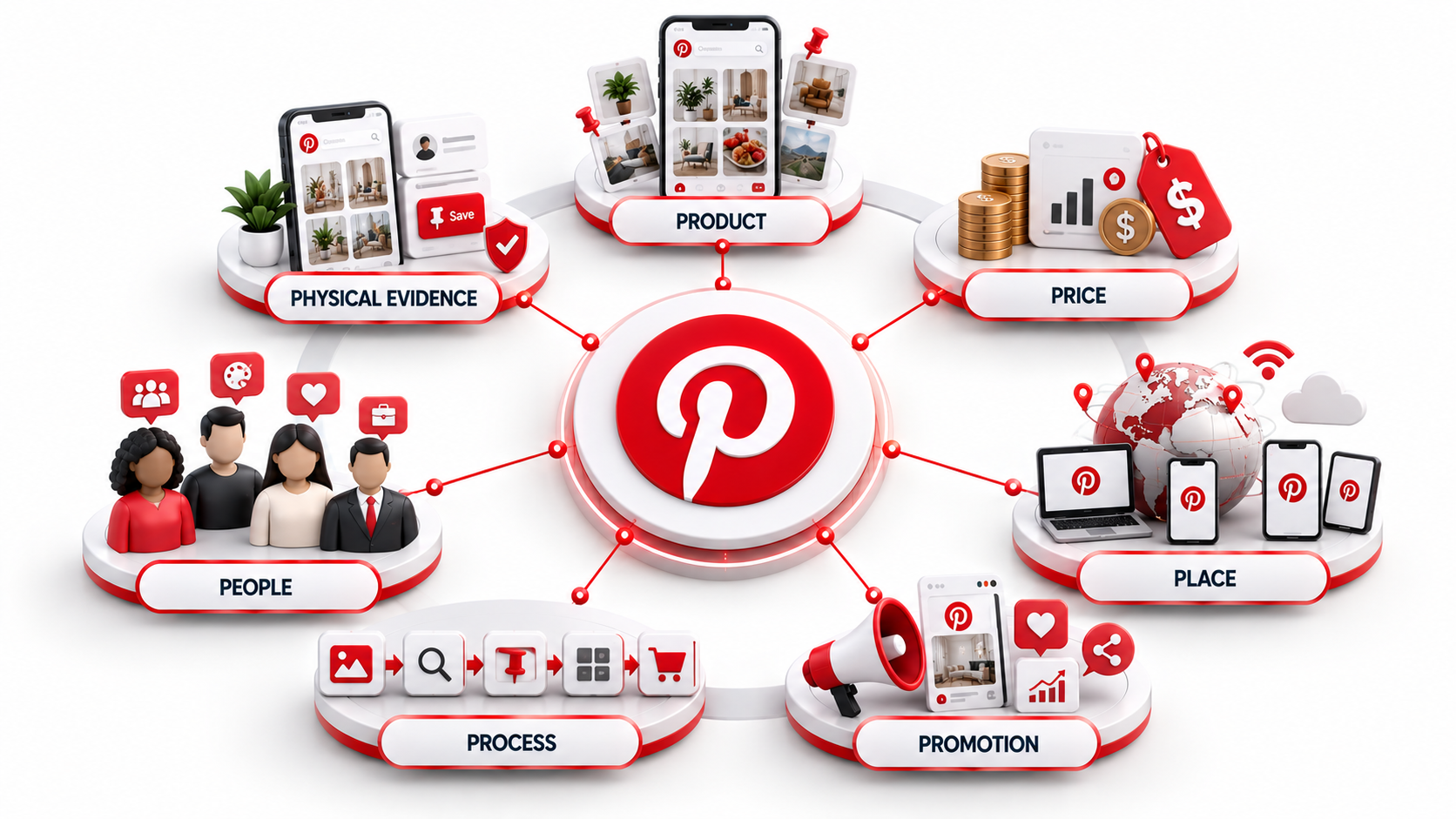
The marketing mix of Pinterest can’t really be explained using the old 4Ps model that works fine for a bar of soap or a pair of shoes. Pinterest is a service, and services need the extra three Ps: People, Process, and Physical Evidence. Without those three, you’d be leaving out the algorithm, the creator community, and the entire feel of using the app, which honestly is a huge part of why people stick around or bounce off within a week.
Why Pinterest Needs a Different Marketing Mix Than Other Platforms
Pinterest doesn’t sell you a product in the traditional sense. You don’t pay for it, you don’t unbox it, and there’s no delivery truck involved. What Pinterest sells, really, is attention and intent. People go there already planning something: a wedding, a home office setup, a birthday party for a five-year-old obsessed with dinosaurs. That intent-driven behavior is closer to how people use Google than how they scroll Instagram, and that difference changes every single P in the mix.
The 7Ps Framework Applied to Pinterest
When you apply Product, Price, Place, Promotion, People, Process, and Physical Evidence to Pinterest, you start to see why the company has made some of its weirder choices, like staying away from short-form video for so long or refusing to turn itself into a pure e-commerce app. Each P interacts with the others. The Product shapes the Process, the People shape the Promotion, and Physical Evidence, meaning the actual look and trustworthiness of the app, ties everything together. That’s the real value of using this framework instead of just listing random facts about the company.
Product Element
The product part of the marketing mix of Pinterest is where most people get it wrong. They call Pinterest a social network. It isn’t, not really. Pinterest calls itself a visual discovery engine, and that phrase actually matters because it changes what the product needs to do well.
Pinterest as a Visual Discovery Engine
A social network wants you to interact with people you already know. Pinterest doesn’t really care about your friends list. It cares about your intent. You search “small balcony garden ideas” and Pinterest shows you Pins from strangers, brands, and bloggers who have exactly what you’re picturing in your head but couldn’t quite describe. That’s discovery, not socializing, and it’s the reason Pinterest’s engagement patterns look nothing like Facebook’s or Instagram’s. People come back to Pinterest for months on a single project, not for a daily social fix.
Core Product Features That Define Pinterest
Boards, Pins, and the home feed are the backbone of the product, but the features that actually keep Pinterest relevant in 2026 go further than that. Visual search, where you can screenshot a lamp and find where to buy it, changed how people shop through the app. The recommendation engine behind the home feed pulls from your saved Pins, your searches, and even seasonal trends, like showing Halloween decor ideas in September before most people have even thought about it.
Idea Pins, Boards and Pinterest Shopping
Idea Pins were Pinterest’s answer to the whole world going video-first, and they let creators post multi-page, swipeable content instead of a single static image. Boards are still the original organizing tool, and honestly they’re underrated. People build boards for years, adding to a “future kitchen” board slowly over three years before actually renovating. Pinterest Shopping ties product Pins directly to retailer pages, turning inspiration into an actual buy button, which is where the product strategy quietly overlaps with the revenue strategy.
Price Element
The price part of the marketing mix of Pinterest is a little unusual because regular users never pay a cent. So when we talk price here, we’re really talking about two different audiences: the free experience for users and the paid experience for advertisers and businesses.
How Pinterest Makes Money
Pinterest makes nearly all of its money from advertising. Businesses pay to get their Pins in front of people who are already searching for related ideas, which honestly is a smarter ad model than interrupting someone’s video of their cousin’s wedding. Pinterest also earns through Pinterest Shopping partnerships and, more recently, through deeper e-commerce integrations that let retailers sync entire product catalogs directly into the platform.
Ad Pricing Models on Pinterest
Advertisers on Pinterest typically pay through cost-per-click, cost-per-thousand-impressions, or cost-per-action models, depending on the campaign goal. What’s interesting is that Pinterest’s average cost-per-click tends to run lower than Instagram’s in a lot of categories, especially home, fashion, and food, because competition for ad space is lighter and the intent behind searches is higher. A brand selling handmade candles can get real traction on a modest budget here in a way that’s much harder on more crowded platforms.
Free vs Paid Value for Users
For the average user, Pinterest is completely free, and that’s intentional. Charging users would kill the exact behavior that makes the platform valuable to advertisers, which is casual, frequent, intent-rich browsing. Instead, Pinterest gives away the entire discovery experience and makes its money by selling access to that attention to brands. It’s the same logic Google uses with search, just wrapped in a much more visual package.
Place Element
Place in the marketing mix of Pinterest isn’t about physical stores. It’s about where and how people actually access the platform, and Pinterest has spread itself pretty wide here.
Pinterest’s Global Distribution Strategy
Pinterest operates in more than 30 languages and is available in most major markets worldwide, though its strongest user bases sit in the United States, Brazil, Germany, and increasingly India. The company has leaned into international growth over the past few years because its US user growth had started to plateau, and honestly that shift makes sense. There’s only so much room left to grow domestically once you’ve already hit a huge chunk of the population.
Mobile App vs Desktop vs Browser Extension
Most Pinterest usage happens on mobile, which tracks with basically every other platform today, but the desktop experience still matters more here than it does for something like TikTok. People planning a wedding or redesigning a kitchen often sit down at a laptop to build boards more carefully. Pinterest also offers a browser extension that lets you save any image from any website straight to a board, which quietly extends the platform’s reach across the entire internet, not just its own app.
Regional Growth and Market Expansion
Pinterest has pushed hard into markets like India, Brazil, and parts of Southeast Asia, adjusting local content and language support to match. This regional expansion is a big part of the place strategy because ad revenue outside the US, while smaller per user, is growing faster and diversifies the company away from relying so heavily on the American ad market, which can be unpredictable depending on the broader economy.
Promotion
Promotion is where the marketing mix of Pinterest gets genuinely interesting, because Pinterest promotes itself in ways that look nothing like a typical ad campaign, and it also gives businesses tools to promote themselves inside the platform.
Pinterest Ads and Promoted Pins
Promoted Pins look almost identical to regular Pins, just with a small “Promoted” label, and that’s deliberate. Unlike a banner ad that screams for attention, a Promoted Pin blends into the natural flow of browsing, so people are more likely to engage with it instead of scrolling past on autopilot. Pinterest offers several ad formats now, including video ads, carousel ads, and shopping ads that link straight to a product page.
Influencer and Creator Partnerships
Pinterest built a Creator Rewards program and various partnership initiatives to bring more original content onto the platform, because for years it leaned too heavily on content pulled in from blogs and other sites. Working with creators who make original Idea Pins, recipes, DIY tutorials, and style guides gives Pinterest content that can’t be found anywhere else, which matters a lot when you’re competing against Instagram and TikTok for the same creators’ time.
Content Marketing and SEO on Pinterest
Pinterest functions like a search engine in a lot of ways, so SEO on Pinterest is a real discipline, not an afterthought. Keywords in Pin titles, descriptions, and board names directly affect whether content shows up in search results. Brands that understand this treat Pinterest almost like a second Google, optimizing Pin descriptions the same way they’d optimize a blog post, and that approach tends to outperform brands that just dump their Instagram content onto Pinterest without any adjustment.
People Element
People make up one of the most overlooked parts of the marketing mix of Pinterest, but they matter enormously here because the platform’s value comes almost entirely from what its users and creators contribute.
Pinterest’s User Base Demographics
Pinterest’s audience skews female, though that gap has been narrowing over the past several years as more men join for topics like fitness, cars, and home improvement. The platform also tends to attract users with real purchase intent and, in many markets, higher household incomes, which is exactly why advertisers in categories like home decor, wedding planning, and fashion pay attention here even though Pinterest’s total user base is smaller than Instagram’s or TikTok’s.
Internal Team and Company Culture
Pinterest’s internal teams, especially its engineering and trust-and-safety groups, shape the product in ways users rarely think about. The company has invested heavily in making the platform feel calmer and safer than other social apps, actively limiting things like weight-loss ads and political content that could turn the experience negative. That’s a people decision made by leadership, and it directly shapes how the brand feels to use every single day.
Creator Community and Partners
Creators are the lifeblood of fresh content on Pinterest. Without people posting original recipes, outfit ideas, and design tutorials, the platform would just be a glorified bookmarking tool. Pinterest has had to work harder than Instagram to convince creators to prioritize the platform, since the payout and virality potential historically lagged behind TikTok, but its more recent creator monetization tools are closing that gap.
Process Element
Process covers everything happening behind the scenes that determines what you actually see when you open the app, and this part of the marketing mix of Pinterest is honestly the most technical but also the most important for understanding why people stay engaged.
How the Pinterest Algorithm Works
The Pinterest algorithm looks at your past saves, searches, and the Pins you’ve lingered on, then predicts what you’ll want to see next. It also factors in freshness, meaning newer Pins can get a boost, and relevance to seasonal trends. Unlike Instagram, where the algorithm often chases pure engagement like likes and comments, Pinterest leans harder into relevance to your actual goals, which is part of why its recommendations tend to feel less noisy and more useful over time.
User Journey From Search to Purchase
The typical Pinterest journey starts with a vague idea, something like “I want to redo my living room,” moves into browsing and saving dozens of Pins, then narrows down toward specific products or tutorials, and can end in an actual purchase, sometimes weeks or months later. That long consideration window is unusual for digital platforms and it’s exactly why Pinterest positions itself as a place for planning rather than instant gratification.
Advertiser Onboarding Process
Setting up ads on Pinterest is fairly straightforward: create a business account, verify your website, upload a product catalog if you’re doing shopping ads, and set your budget and targeting. Pinterest has simplified this process a lot over the last few years because early on it was clunky enough that smaller businesses avoided it entirely. Now even a small Etsy seller can get a campaign running in under an hour.
Physical Evidence Element
Physical evidence sounds like an odd category for a digital platform, but it refers to the tangible and visual cues that build trust and shape how the brand feels, and this part of the marketing mix of Pinterest is more important than people give it credit for.
App Design and Visual Identity
Pinterest’s clean, grid-based layout with its signature red logo and masonry-style feed is instantly recognizable. That visual identity is consistent whether you’re on the app, the website, or the browser extension, and consistency like that builds familiarity, which matters when you’re competing against apps that redesign themselves every six months trying to chase trends.
Trust Signals and Brand Reputation
Verified merchant badges, clear labeling on Promoted Pins, and Pinterest’s public stance against harmful content like misinformation and extreme diet culture all act as trust signals. These cues tell users the platform is a safer space than some of its competitors, and that reputation has become a genuine selling point, especially for brands that don’t want their ads sitting next to controversial content.
Customer Support and Reviews
Pinterest’s support system for advertisers includes help centers, dedicated account managers for larger spenders, and community forums where smaller businesses trade tips. App store reviews for Pinterest tend to be more positive on average than reviews for apps like Twitter or TikTok, largely because the platform avoids a lot of the toxicity that plagues more comment-heavy social apps.
Marketing Mix of Pinterest vs Competitors
Comparing the marketing mix of Pinterest to its closest rivals makes the platform’s strategy clearer, because you start to see what Pinterest deliberately chose not to become.
Pinterest vs Instagram
Instagram chases engagement and social validation through likes, comments, and stories that disappear in 24 hours. Pinterest chases long-term intent, where a Pin saved today might matter six months from now when someone finally gets around to that home project. Instagram’s promotion strategy leans on influencer hype and trends; Pinterest leans on search relevance and evergreen content. Neither approach is wrong, they’re just built for completely different user behaviors.
Pinterest vs Google Search
Pinterest and Google actually compete more than people realize, especially for visual queries like “bedroom paint colors” or “birthday cake ideas.” Google’s product is built on text and links; Pinterest’s product is built entirely on images and visual pattern matching. For certain categories, especially lifestyle and design, people now start their search on Pinterest before they’d even think to open Google, which says a lot about how well Pinterest has carved out its own discovery niche.
Lessons Brands Can Learn From Marketing Mix of Pinterest
Studying the marketing mix of Pinterest isn’t just an academic exercise. There are real, practical lessons here for any brand trying to figure out where to put its energy.
Building a Visual First Strategy
Brands that succeed on Pinterest treat visuals as the entire pitch, not an accessory to a caption. A blurry product photo with a clever caption does fine on Instagram; it flops on Pinterest because there’s no caption doing the heavy lifting. High-quality, vertical images with clear text overlays consistently outperform everything else on the platform.
Mistakes to Avoid When Marketing on Pinterest
The most common mistake brands make is treating Pinterest like a dumping ground for Instagram leftovers. Reposting square Instagram images without optimizing for Pinterest’s vertical format, skipping keyword-rich descriptions, and ignoring seasonal planning are the fastest ways to waste ad spend here. Pinterest rewards patience and planning, not quick, reactive posting.
Conclusion
Pinterest built its entire business around a pretty simple insight: people don’t just want to scroll, they want to plan. Every part of its marketing mix, from the free product experience to the intent-based ad pricing to the calm, trustworthy app design, exists to support that one idea. It’s not the flashiest platform out there, and it never will out-hype TikTok or out-social Instagram. But for brands and users who care about long-term intent over short-term noise, Pinterest has carved out a lane that nobody else really occupies the same way. That’s the real story behind the marketing mix of Pinterest, and it’s a pretty good case study in knowing exactly what you are instead of chasing what everyone else is doing.
Frequently Asked Questions
1. What is the marketing mix of Pinterest?
The marketing mix of Pinterest refers to the combination of Product, Price, Place, Promotion, People, Process, and Physical Evidence that Pinterest uses to attract users, retain them, and generate advertising revenue from businesses trying to reach that audience.
2. Why does Pinterest use the 7Ps model instead of the traditional 4Ps?
Because Pinterest is a service-based digital platform, not a physical product. The extra three Ps, People, Process, and Physical Evidence, capture things like the algorithm, the creator community, and the app’s visual trust signals, none of which fit neatly into the older 4Ps model.
3. How does Pinterest make money if it’s free for users?
Pinterest earns almost all of its revenue through advertising, primarily Promoted Pins, along with shopping ads and catalog partnerships with retailers. Users never pay directly, which keeps the platform’s core discovery experience accessible to everyone.
4. Who is Pinterest’s main target audience?
Pinterest’s audience skews toward users planning specific life events or projects, weddings, home renovations, recipes, fashion choices. It has historically leaned female, though the male user base has grown steadily over recent years across categories like fitness and DIY.
5. What makes Pinterest different from Instagram in terms of marketing strategy?
Pinterest focuses on long-term intent and search-driven discovery, while Instagram focuses on real-time social engagement and trends. That difference shapes everything from ad formats to how content gets recommended to users.
6. What ad formats does Pinterest offer businesses?
Pinterest offers Promoted Pins, video ads, carousel ads, and shopping ads that link directly to product pages. Businesses can choose pricing models like cost-per-click or cost-per-thousand-impressions depending on their campaign goals.
7. Is Pinterest SEO a real thing?
Yes, and it works a lot like traditional search engine optimization. Keywords in Pin titles, descriptions, and board names directly influence whether your content shows up when someone searches for related topics on the platform.
8. How important are creators to Pinterest’s marketing mix?
Extremely important. Creators supply original content like tutorials, recipes, and design inspiration that keeps the platform fresh. Without active creators, Pinterest would rely too heavily on repurposed content from other sites, which hurts user engagement over time.
9. What role does Physical Evidence play for a digital platform like Pinterest?
Physical Evidence covers the visual design, trust signals, and overall feel of using Pinterest, things like the clean grid layout, verified merchant badges, and clear ad labeling. These cues build user trust even though there’s nothing physical to touch or hold.
10. How does the Pinterest algorithm decide what to show users? It looks at your saved Pins, search history, and engagement patterns, then factors in content freshness and seasonal relevance to predict what you’ll want to see next. It prioritizes relevance to your goals more than raw engagement metrics like likes.
11. Can small businesses actually succeed on Pinterest without a big budget?
Yes, and this happens more often than people expect. Because competition for ad space is generally lighter than on Instagram, and because organic SEO-style reach is still possible, small businesses with strong visual content and good keyword strategy can get real traction without huge spend.
12. How does Pinterest expand into new international markets?
Pinterest expands by adding language support, adjusting content recommendations for local trends, and building region-specific partnerships. Markets like India, Brazil, and parts of Southeast Asia have become priority growth areas as US growth has slowed.