


Here is a strange fact to start with. Oracle sold roughly $67 billion worth of software, cloud services, and hardware in its 2026 fiscal year, and most people outside of IT still cannot tell you what Oracle actually sells. Ask ten friends about Nike, and they will describe a shoe. Ask about Oracle and you get a shrug, or a vague memory of a database from a college syllabus. That gap between how big Oracle is and how little the public knows about it is exactly what makes the marketing mix of Oracle such an interesting thing to study.
Most brand case studies are about companies that sell to you directly. Oracle sells to the people who run banks, hospitals, airlines, governments and, lately, AI labs. Nobody walks into a store and buys an Oracle database on a whim. A single deal can take eighteen months, involve fifteen people on the buyer’s side and end with a contract worth more than some countries spend on roads. So the usual marketing textbook advice about catchy ads and discount codes does not map neatly onto this company. Something else is going on, and it is worth understanding properly.
This guide breaks down the marketing mix of Oracle one piece at a time: product, price, place, promotion, and the three extra Ps (people, process, physical evidence) that matter so much for a business like this. It uses real numbers from Oracle’s fiscal 2026 results, real products like Oracle Database, Oracle Cloud Infrastructure and NetSuite, and real examples of how the company sells. There is also a proper SWOT analysis of Oracle, a section on how it stacks up against AWS, Microsoft and SAP, and a FAQ at the end for the questions that show up in exams and interviews.
If you are a student writing an assignment, a beginner trying to understand B2B marketing, or someone prepping for an interview where Oracle comes up, this is written for you. No fluff. Just what the company does, why it does it, and where it might go wrong.
What You Will Learn in This Guide
Before getting into it, here is what this article covers, so you can jump to the part you need.
- What the marketing mix is, and why the 4Ps are not enough for a company like Oracle
- A plain-language snapshot of Oracle’s history, numbers and leadership as of fiscal 2026
- How Oracle’s product line works, from the database to cloud infrastructure to healthcare software
- How Oracle prices its products, including licenses, cloud credits, Java subscriptions and giant AI contracts
- How Oracle reaches customers through direct sales, partners, regions and multicloud deals
- How Oracle promotes itself, from Larry Ellison’s loud claims to Formula 1 sponsorship
- How people, process and physical evidence fit into the extended 7Ps model
- A full SWOT analysis of Oracle with strengths, weaknesses, opportunities and threats
- A step-by-step method to write your own marketing mix analysis without sounding like a textbook
TL;DR
- The marketing mix of Oracle is built around enterprise trust: sticky products, contract-based pricing, direct sales and a very small number of huge customers.
- Oracle’s fiscal 2026 revenue hit $67.4 billion, and its remaining performance obligations (signed but undelivered contracts) reached $638 billion, mostly from AI infrastructure deals.
- Pricing is the most unusual P: Oracle mixes old-school license and support fees, flat cloud rates, employee-based Java pricing and multi-year AI contracts.
- The biggest strength is how deeply Oracle databases and business apps are embedded in customer systems, and the biggest risk is the debt needed to build data centers.
- A good Oracle assignment names real products, real numbers and real trade-offs instead of listing generic points under each P.
What Is the Marketing Mix of Oracle and Why Does It Matter?
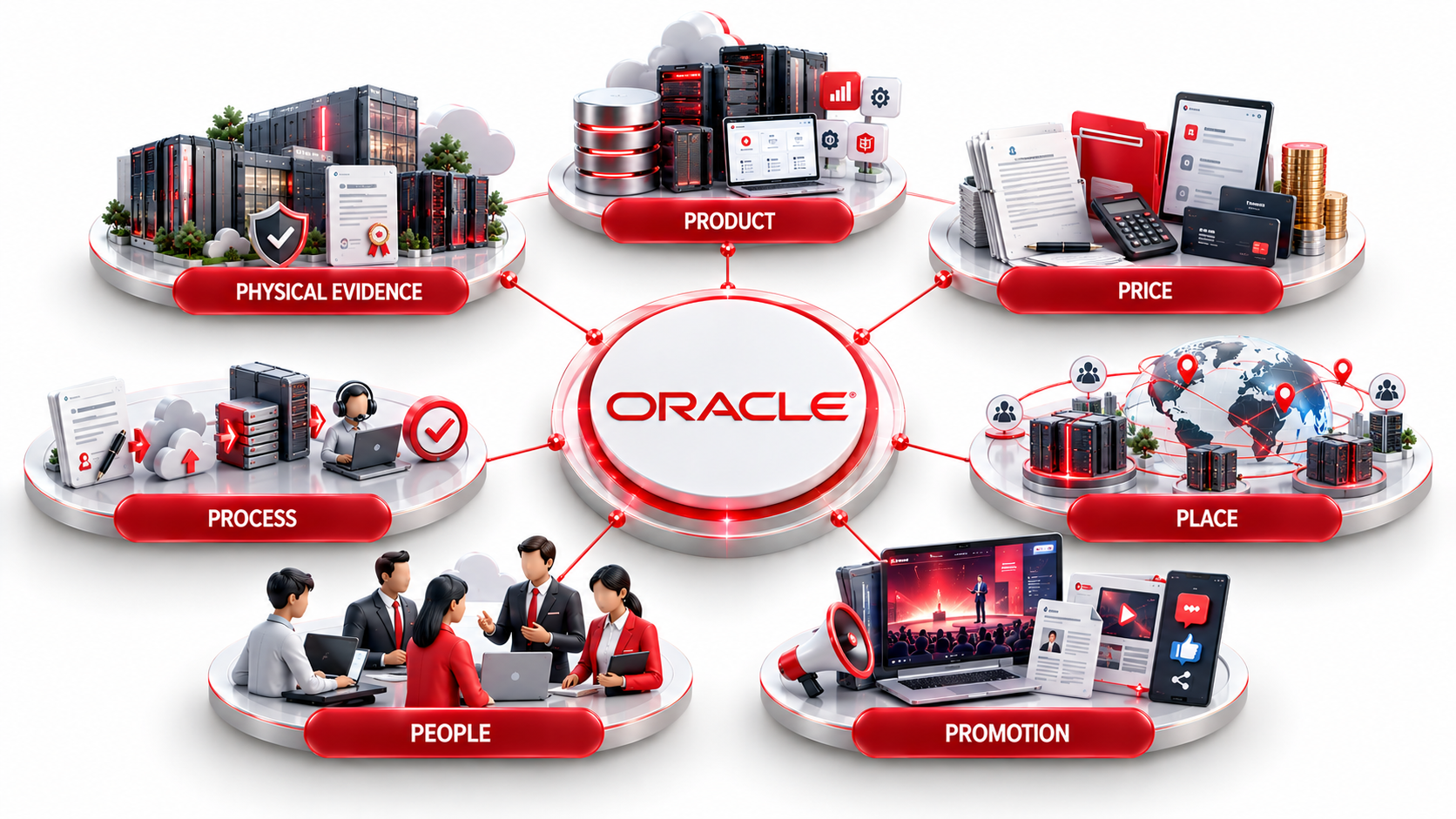
The marketing mix of Oracle is the set of decisions the company makes about what it sells, what it charges, where and how it sells, and how it convinces buyers. It covers products, pricing, distribution and promotion, plus people, process and physical evidence. For a B2B giant like Oracle, the mix is less about ads and more about trust, contracts and long relationships.
The marketing mix in plain language
The marketing mix is a checklist that helps a business think through how it takes something to market. The classic version, called the 4Ps, covers product, price, place and promotion. Think of it like a recipe: change one ingredient and the taste changes. If you want to see how this idea fits into the bigger picture of campaigns and funnels, the digital marketing fundamentals section on this site is a good place to start.
The 7Ps model adds people, process and physical evidence. Those three were added mainly for service businesses, where the thing you buy is not a box you can hold. A cloud contract is a promise that servers will stay on, data will stay safe and support will pick up the phone. You cannot touch any of that, so the extra Ps become just as important as the first four.
Why Oracle needs the 7Ps, not just the 4Ps
If you only use the 4Ps on Oracle, you end up with a thin answer. Product: software and cloud. Price: expensive. Place: worldwide. Promotion: events. That reads like a template, and any examiner will notice. The reality is far more interesting once you look at who actually writes the cheque.
Oracle’s buyers are chief information officers, finance heads and procurement teams who have been burned by bad vendors before. They care about uptime, support, audit trails and who answers the phone at 3 a.m. That is why people, process and physical evidence (like data centers and certifications) carry real weight in the marketing mix of Oracle. Skip them and you miss half the story.
What makes Oracle a different case study
Most marketing mix articles use consumer brands like Coca-Cola, Apple or Nike because the examples are easy. Oracle is harder and, honestly, better for learning. You see how marketing works when the buyer is an organization, the sales cycle is long, switching is painful and the price is negotiated rather than printed on a tag.
There is another reason Oracle makes a good case right now. In the last two years the company has changed shape. It used to be known as the database and business software company. Today a huge chunk of its future revenue depends on renting AI computing power to customers like OpenAI. When a company changes its product this fast, every other P has to move with it. That is what makes the current marketing mix of Oracle so worth dissecting.
Oracle Company Snapshot Before Breaking Down the Marketing Mix of Oracle
You cannot analyze a marketing mix without knowing the company behind it. This section covers where Oracle came from, what its latest numbers say and who is running it now. Keep these facts handy, because every later section, from pricing to the SWOT, leans on them.
A short history of Oracle in plain words
Oracle was founded in 1977 by Larry Ellison, Bob Miner and Ed Oates. The company name came from a CIA project codenamed Oracle that Ellison had worked on, and the first big idea was a relational database that could run on many kinds of computers. Oracle went public in 1986 and spent the next three decades turning that database into the backbone of corporate IT.
Then came the shopping spree. Oracle bought PeopleSoft in 2005, Siebel in 2006, Sun Microsystems in 2010 (which brought Java and MySQL), NetSuite in 2016 and Cerner in 2022 for about $28 billion. Each deal added customers, products or both. The headquarters moved from Redwood Shores in California to Austin, Texas in 2020, which tells you something about where the company wanted to be.
The numbers from fiscal 2026
Oracle’s fiscal year ends on May 31. For fiscal 2026, total revenue rose 17% to $67.4 billion. Cloud revenue (infrastructure plus applications) grew 39% to $34.0 billion, which means cloud is now about half the company. Software revenue, mostly license and support, slipped 1% to $24.5 billion. Services brought in $5.7 billion and hardware $3.1 billion. Operating cash flow was $32.0 billion.
The number that makes analysts stare is remaining performance obligations, or RPO. That is the value of contracts customers have signed but Oracle has not delivered yet. It ended the year at $638 billion, up 363% from a year earlier. Oracle said most of the jump in the last two quarters came from large AI contracts where customers either prepaid for GPUs or supplied the chips themselves. Big promise, big delivery problem. More on that in the SWOT section.
Leadership change and the cloud pivot
On September 22, 2025, Safra Catz stepped back from the CEO role after eleven years and moved to executive vice chair. Two co-CEOs took over: Clay Magouyrk, who built Oracle Cloud Infrastructure, and Mike Sicilia, who ran the industry and applications business. Larry Ellison stays as chairman and chief technology officer, and he is still the loudest voice at the company.
Pairing an infrastructure builder with an applications seller was not random. It mirrors the two halves of the marketing mix of Oracle today: rent computing power at massive scale, and keep selling the business software that customers already depend on. The pivot has come at a cost, though. Oracle has cut jobs (reports put the number above 20,000), raised tens of billions in debt and equity, and seen its share price fall by more than half from its September 2025 peak.
Product Strategy
Product is the first P and, for Oracle, the one with the most moving parts. The company sells a database, a cloud infrastructure platform, business applications, healthcare software, Java and a pile of hardware. Each product has a different buyer and a different job. Here is how the lineup actually works, and why customers rarely leave once they are in.
Oracle Database: the product that built the company
Oracle Database is the thing most people mean when they say “Oracle.” It stores and manages the data behind banking transactions, airline bookings, telecom billing and government records. Its pitch has never been about being trendy. It is about not losing your data, not slowing down under load and not breaking when something fails at the worst possible moment.
Over the years Oracle added features like Real Application Clusters, Exadata hardware tuned for databases and Autonomous Database, which handles tuning and patching automatically. Newer releases build AI vector search directly into the database so companies can run AI queries on their own data without shipping it elsewhere. The lesson for students: Oracle keeps the product relevant by adding to it, not replacing it.
Oracle Cloud Infrastructure: the new growth engine
Oracle Cloud Infrastructure, usually shortened to OCI, is where Oracle rents out servers, storage, networking and GPUs. It is the product behind the huge jump in remaining performance obligations. In the fourth quarter of fiscal 2026, Oracle reported infrastructure revenue growth of 93%, which is the kind of number you rarely see from a business that already makes billions.
OCI started late. Amazon Web Services launched in 2006, Microsoft Azure in 2010, and Oracle’s second-generation cloud only arrived around 2018. So Oracle could not win by being first. It went after workloads the others handled badly, like running Oracle databases in the cloud, and then pivoted hard into AI training, where customers need huge clusters of GPUs linked by fast networking. OCI is the company’s biggest product bet by a distance.
Fusion Cloud Applications and NetSuite
On the software side, Oracle sells business applications that run finance, HR, supply chain and customer operations. Oracle Fusion Cloud Applications targets large enterprises, while NetSuite, bought in 2016, targets mid-sized and fast-growing companies and has tens of thousands of customers. Cloud applications grew about 10% in the fourth quarter of fiscal 2026, so this is the steady part of the business rather than the fast part.
Think of this as the “boring but sticky” side. A company that runs payroll, accounting and procurement on Oracle is not going to rip it out because a competitor ran a nicer ad. Moving those systems takes years, costs millions and risks messing up the books. That stickiness is a product feature in its own right, even if no brochure says so.
Oracle Health and the Cerner bet
In 2022 Oracle paid about $28 billion for Cerner, a maker of electronic health record systems used by hospitals. The goal was to bring Oracle’s cloud and database strengths into healthcare, a market with lots of money and lots of outdated software. Oracle has since rebuilt parts of the system on its own cloud and added AI tools for doctors, including clinical note taking.
Honestly, this one has been bumpy. Rolling out the new health record system to the US Department of Veterans Affairs hit well-publicized problems with patient safety reports and delays. Healthcare is a good example of how product strategy can look brilliant on a slide and messy in real hospitals. Students should mention both the promise and the difficulty.
Java, MySQL and the developer products
When Oracle bought Sun Microsystems in 2010, it picked up Java, the programming language and runtime used across banks, Android apps and enterprise systems, plus MySQL, one of the most used open-source databases in the world. These are not flashy revenue lines, but they give Oracle something priceless: influence over what developers learn and use.
That developer base feeds the rest of the business. A student who learns Java, then joins a company that runs MySQL, then moves to a team using Oracle Database is already inside Oracle’s world without any ad ever being shown. Oracle University also offers certifications that employers recognize, and that keeps a pipeline of Oracle-trained people flowing into the job market.
What students should take from Oracle’s product mix
The pattern is easy to spot once you see it. Oracle sells layers: database at the bottom, cloud infrastructure underneath, applications on top and services around the edges. Each layer makes the others harder to replace. A customer on Exadata with Fusion apps and OCI is deeply tied in.
For an assignment, do not just list products. Explain the relationship between them. Say which one brings customers in (database), which one drives growth now (OCI), which one keeps cash flowing (support and applications) and which one is a risk (Oracle Health). That kind of reasoning earns far more marks than a bullet list of product names.
Pricing Strategy
Price is where the marketing mix of Oracle gets truly unusual. There is no single price tag. Oracle charges through licenses, annual support fees, cloud usage credits, per-employee subscriptions and negotiated multi-year contracts. Understanding how each one works explains both why Oracle makes so much money and why some customers get so annoyed with it.
The classic license and support model
For decades, Oracle sold software through a perpetual license: pay a big upfront fee, own the right to use the software forever. Then pay roughly 22% of the license price every year for support, updates and patches. That support stream is the quiet profit machine. A license sold in 2005 can still be generating revenue in 2026.
This is why software revenue, even though it slipped 1% in fiscal 2026 to $24.5 billion, still matters so much. It is high margin, predictable and hard for customers to cancel without losing patches. Critics call it a lock-in. Oracle calls it protection for mission-critical systems. Either way, it is a pricing strategy built on long relationships, not one-time sales.
Cloud pricing: simple on purpose
Oracle knew it was late to the cloud, so it used price as a weapon. OCI advertises the same pricing in every region, which is not true of every rival. It also gives a generous chunk of free outbound data transfer each month (10 TB at the time of writing), whereas other providers have built a reputation for expensive data exit fees. Oracle also runs an Always Free tier, handy for students and developers testing things out.
The pitch is simple: we are cheaper, and we do not surprise you at the end of the month. That message works on cost-sensitive buyers who have seen their cloud bills spike. It is also a classic penetration pricing move, setting prices lower than the market leaders to win share from them. If you are writing about pricing strategy, use that term and explain it in one sentence.
Java subscription pricing and the audit effect
In January 2023, Oracle changed how it charges for Java SE. Instead of pricing by user or processor, it moved to an employee-based subscription, which counts every employee in a company, whether or not they touch Java. For big organizations the bill jumped, since a bank with 50,000 employees pays for all 50,000 even if only 500 are developers.
That change got a lot of attention on forums and among licensing consultants. It also shows a pattern in the marketing mix of Oracle: when the company controls something the customer depends on, pricing can move in the vendor’s favor. Oracle also runs license compliance audits, and many customers say audits are a stressful part of dealing with the company. This matters for reputation, which we come back to in the SWOT section.
Giant AI contracts and prepaid GPUs
The newest pricing model looks nothing like the old one. Oracle is signing multi-year contracts worth tens or hundreds of billions with AI companies. According to the fiscal 2026 results, a large part of the RPO increase came from deals where customers either prepaid Oracle for GPUs or bought the GPUs and supplied them to Oracle to run.
That is a financing structure as much as a price. Prepayment helps Oracle fund the data centers it has to build. Customer-supplied chips reduce Oracle’s cash outlay. Neither is a normal “price per hour” setup. For a marketing student, the takeaway is that Oracle’s pricing now includes deal design, where the way money moves matters as much as the amount.
Discounts, negotiation and the Universal Credits idea
Oracle’s cloud offers Universal Credits: a customer commits to spending a set amount and can apply it to any cloud service in the portfolio. This gives buyers flexibility and gives Oracle a committed revenue number up front. Sales reps then negotiate discounts based on size, term length and how much the customer already spends with Oracle.
So the real price is rarely the list price. In enterprise sales, nearly every deal is negotiated, bundled and tied to a timeline. That is why you will not find a single clean number for what Oracle charges. When writing about pricing, describe the structure (commitment, discount, bundle) instead of pretending there is a fixed fee.
How pricing connects to the rest of the mix
Price never works alone. Oracle’s low-cost cloud rates only make sense because the company also sells a sticky database and applications that keep customers around. A discount on OCI today can lead to a bigger Fusion or database deal next year. The giant AI contracts only work because Oracle’s financing, data center building and sales teams all line up behind them.
So when writing about the pricing P, link it to the others. Say that flat cloud rates support the place strategy (multicloud and regions), that license-and-support pricing depends on product stickiness and that negotiated contracts depend on people (strong account teams). That linking is the difference between a list and an analysis.
Place and Distribution
Place means how a product gets to the buyer. For physical goods that is shops and warehouses. For Oracle it is sales teams, partner firms, cloud regions and deals with rival clouds. This part of the marketing mix of Oracle has changed more in the last three years than in the previous twenty, mostly because of one surprising decision: working with competitors.
Direct sales for the big accounts
Oracle’s largest customers are handled by dedicated account teams, often with a salesperson, a solutions engineer and an executive sponsor. These teams build relationships over years, know the customer’s systems better than some of the customer’s own staff and are paid on big contract wins. A single database renewal conversation can involve legal, procurement and several technical leads.
Direct selling makes sense here because the deals are huge, complex and customized. You cannot sell a $500 million AI infrastructure contract through a website checkout button. The downside is cost: direct sales forces are expensive, and that is why Oracle also relies heavily on partners for mid-sized customers and specialized markets.
The partner network: consultants, resellers and clouds
Oracle runs a large partner program called Oracle PartnerNetwork. Partners include global consulting firms like Accenture and Deloitte, Indian IT firms like Infosys and TCS, regional resellers and software vendors who build products on Oracle technology. They handle implementation, customization and support, which is where much of the customer’s real spend lands.
Partners extend Oracle’s reach into places the company’s own sales team cannot cover efficiently. A mid-sized manufacturer in a smaller city is far more likely to meet an Oracle partner than an Oracle employee. For students, this is the “channel” part of distribution: intermediaries who sell, install or support the product and earn a margin or fee for doing so.
Cloud regions, Dedicated Region and sovereign options
Distribution for a cloud business means physical locations. OCI operates dozens of public cloud regions around the world, including in Mumbai and Hyderabad in India. It also offers Dedicated Region, where Oracle builds a full cloud inside a customer’s own data center, and Alloy, which lets partners resell Oracle cloud under their own brand.
Why does this matter? Many banks, governments and healthcare organizations have rules about where data can live. A cloud that can be placed in a specific country, or even inside a customer’s building, solves that problem. This flexibility is one of the more clever parts of Oracle’s place strategy because bigger rivals are less willing to ship a whole cloud into someone else’s premises.
Multicloud: selling Oracle Database inside Azure, AWS and Google Cloud
Here is the move that surprised people. Starting with Microsoft in 2023, Oracle began placing its database hardware inside rival cloud data centers. Oracle Database@Azure came first, followed by Database@Google Cloud and Database@AWS. Customers get Oracle’s database running next to their other cloud applications, billed through the partner’s marketplace.
Look at what that does. Oracle’s database customers do not have to move everything to OCI to keep using Oracle. Oracle meets them where they already are. It is a distribution decision that treats competitors as sales channels, and it shows how much the company’s thinking changed once it accepted that it was not going to be the biggest cloud.
Promotion
Promotion covers how a company gets attention, builds belief and closes deals. Oracle does not do soft, emotional ads. Its promotion is a mix of big claims from the top, events for customers, sponsorships that pay off in prestige and a steady flow of content aimed at technical and executive buyers. Here is how each piece works in the marketing mix of Oracle.
Larry Ellison as the brand’s loudest voice
Few companies have a founder who is as central to marketing as Larry Ellison. He is famous for bold statements, taking shots at competitors and making predictions that sometimes age well and sometimes do not. Oracle’s earnings calls and keynotes often feature direct comparisons with AWS and others about speed, security or price.
That style is deliberate positioning, not just personality. When your competitors are far bigger in the cloud, a challenger voice stands out. The risk is credibility: big claims need delivery. Oracle has been burned before by promises that did not match customer experience, which is why the loud-founder approach works best when product results back it up.
Events, executive briefings and customer proof
Oracle’s flagship conference, held annually in Las Vegas under the Oracle AI World name (it used to be called OpenWorld and later CloudWorld), pulls in tens of thousands of customers, partners and developers. Product launches, customer stories and training sessions all happen there, and sales teams use it to book meetings and close deals.
Beyond the big show, Oracle runs regional events, executive briefings and webinars. Customer references are huge in enterprise sales. A hospital group saying “we moved to Oracle Cloud and cut costs by 30%” is worth more than any banner ad. If you write about this, use the term “social proof” and show how case studies and testimonials do the job in B2B.
Sponsorship: Oracle Red Bull Racing and Oracle Park
Oracle puts its name on very visible things. It is the title sponsor of Oracle Red Bull Racing in Formula 1, and the team uses Oracle Cloud for race simulations and strategy. Oracle also holds the naming rights to Oracle Park, home of the San Francisco Giants. And Ellison’s yacht racing history, including the Oracle Team USA America’s Cup wins in 2010 and 2013, gave the brand sporting credibility.
These sponsorships are not aimed at casual fans buying databases. They put the brand in front of executives, build recognition in the markets where buyers live and give Oracle a story to tell: “our cloud helps a championship team make split-second decisions.” Sponsorship in B2B is about association and conversation, not direct response.
Content, SEO and digital channels
Oracle also pushes a constant stream of whitepapers, documentation, tutorials and product pages. Its documentation is one of its biggest traffic drivers. Developers searching for how to fix a SQL error or set up a cloud instance land on Oracle’s own pages, which quietly turns support content into marketing. If you want to see how that kind of traffic works, this breakdown of organic search strategy explains the basics.
LinkedIn is another core channel, since decision makers hang out there. Oracle uses sponsored posts, executive thought leadership and account-based advertising to target specific companies. It is less glamorous than a Super Bowl ad, but for a company whose next big customer might be one of 500 organizations worldwide, precision beats reach.
Comparison messaging and the “faster and cheaper” claim
Oracle’s cloud messaging has leaned on head-to-head comparisons for years. The company talks about better price-performance than AWS, simpler billing and tighter security by design. These claims show up in keynotes, in sales decks and in benchmark charts that customers can test during a proof of concept.
The smart part is that comparison messaging gives skeptical buyers something to check. A CIO does not trust “best cloud ever.” A CIO will run a test workload on two platforms and look at the invoice. If Oracle wins that test, the claim sells itself. If it loses, the claim backfires, which is why this style of promotion is risky for any challenger brand.
Free training and the developer funnel
Oracle gives away a lot of training content and offers a free cloud tier. Oracle University sells certifications, and many learning paths for OCI, Java and databases are available at little or no cost. The company wants more people who know Oracle tools, because every trained person is a future recommender inside some company.
This is a long-game promotion strategy. A student who passes an OCI certification today might be the architect choosing a cloud in five years. It is not instant lead generation, but over time it creates a talent pool and a built-in preference for Oracle. That is a smart, low-cost way to build brand familiarity in a category where ads rarely work.
People, Process and Physical Evidence
The last three Ps are where services get won or lost. People are the staff customers deal with, process is how things get delivered, and physical evidence is anything that proves the service is real. In the marketing mix of Oracle, these three decide whether a $100 million deal renews.
People: sales engineers, consultants and a company under pressure
Oracle’s people include account executives, solution architects, support engineers, consultants and the executives who show up to calm a nervous customer. In enterprise deals, the buyer is partly buying the team. A good solutions engineer who can explain how a migration will actually work often matters more than the brochure.
This is also where Oracle faces a real challenge. The company cut a large number of jobs in the past year to free up cash for data centers, and layoffs hurt morale and institutional knowledge. Customers who lose their familiar account contact can feel the shift. People are a strength when they are experienced and stable, and a risk when turnover climbs.
Process: onboarding, migration and support
Process means the steps a customer goes through, from first meeting to signed contract to go-live to renewal. Oracle uses structured sales stages, proof-of-concept trials, migration programs and tiered support levels. For something like moving a company’s finance system to Fusion Cloud, the implementation process can take many months.
What makes process a selling point is predictability. Buyers want to know there is a plan, a timeline and someone accountable. Oracle also has process tools like Cloud Lift services, which help customers move workloads. When they work well, they cut the fear that stops companies from switching. When they fail, the whole experience falls apart, so this P needs constant attention.
Physical evidence: data centers, certifications and customer logos
Physical evidence is anything that proves the service is real. For Oracle that means the data centers it is building, the cloud region map on its website, security and compliance certifications, uptime reports and the logos of well-known customers. A Dedicated Region sitting inside a bank is the most literal physical evidence you can imagine.
Offices matter too. The Austin headquarters and the Nashville campus Oracle announced for its health business send a message of scale and permanence. And the scale of the Stargate project with OpenAI and SoftBank, including the massive Abilene, Texas site, acts as visible proof that Oracle can build. In a world where trust is the product, evidence is part of the pitch.
SWOT Analysis of Oracle and How It Shapes the Marketing Mix of Oracle
A SWOT analysis lists a company’s strengths, weaknesses, opportunities and threats. Strengths and weaknesses are internal, while opportunities and threats come from outside. This SWOT analysis of Oracle ties each point back to the marketing mix, so you can see how the company’s position changes what it sells, charges and promotes.
Strengths: sticky customers, huge backlog and cash from support
Oracle’s biggest strength is lock-in built on trust. Thousands of large organizations run their most sensitive data on Oracle Database and their finance on Oracle applications, and they renew year after year. That produces steady support revenue and operating cash flow of $32.0 billion in fiscal 2026. It also gives Oracle credibility when it walks into a boardroom.
The second strength is the $638 billion RPO backlog, which signals demand for OCI far beyond what the company can deliver today. Add a full stack from chips to applications, flexible deployment (public cloud, Dedicated Region, multicloud) and an experienced founder who still drives strategy. Those strengths feed directly into pricing power and long contracts.
Weaknesses: debt, cash flow and a patchy reputation
The weakest point is financial. Building data centers is brutally expensive, and Oracle’s capital spending ran at roughly $55 billion in fiscal 2026, compared with about $21 billion the year before. Total debt has crossed $100 billion, and free cash flow has been negative. Raising $40 to $50 billion through bonds and equity dilutes shareholders and ties up management attention.
There is also a reputation problem. Many customers see Oracle as an aggressive licensor, quick to audit and slow to bend on price. Oracle Health has had a bumpy rollout, and cloud applications are growing at only about 10%. A heavy reliance on a few giant AI customers, especially OpenAI, adds concentration risk. Weakness in these areas hurts pricing goodwill and promotion alike.
Opportunities: AI infrastructure, sovereign cloud and healthcare
The biggest opportunity is AI. Demand for GPU capacity has outrun supply, and Oracle has positioned OCI as a fast, relatively cheap place to train and run large models. If it delivers on its backlog and hits the fiscal 2027 revenue target of $90 billion, the company moves into a very different league of cloud providers.
Other openings include sovereign and dedicated cloud for governments that want data kept at home, multicloud database growth inside Azure, AWS and Google Cloud, and healthcare, where better software could save money and lives. NetSuite also has room to grow among small and mid-sized businesses in markets like India and Southeast Asia. Each opportunity pushes Oracle’s marketing mix toward new buyers.
Threats: giant rivals, AI cycle risk and financing stress
The first threat is competition. AWS, Microsoft Azure and Google Cloud have far larger customer bases and deeper pockets, and they are also building huge AI infrastructure. In applications, SAP, Workday and Salesforce fight Oracle for every big deal. Oracle can win niches, but it cannot be complacent about market share in the cloud, which sits in the low single digits.
The second threat is the AI cycle itself. If AI companies cannot pay their bills, or if demand slows, Oracle could be left with expensive data centers and a lot of debt. Reports of banks pulling back from financing and bondholder lawsuits show that investors are already nervous. Add regulation, energy limits for data centers and chip supply, and the margin for error is thin. That is why execution matters so much right now.
How the Marketing Mix of Oracle Compares With Rivals
A marketing mix only makes sense when you compare it with what competitors do. Oracle’s rivals fall into two groups: cloud infrastructure giants and business software vendors. Here is how the marketing mix of Oracle differs from each, with a short look at how Oracle segments, targets and positions itself.
Oracle vs AWS, Microsoft Azure and Google Cloud
AWS sells breadth: hundreds of services, a huge partner network and a developer-first brand. Azure sells connection to Microsoft’s software, especially Office and Windows. Google Cloud sells data and AI expertise. Oracle sells databases, performance for demanding workloads and aggressive pricing. In product terms, Oracle is narrower but deeper in the areas it targets.
On promotion, Oracle is more combative, with direct claims about speed and price. On place, it is the only one among the four that actively places its own hardware inside rival clouds. That multicloud approach is an admission of reality: Oracle is not winning by being the biggest, so it wins by being easy to fit in. Honest comparison like this is what examiners want to read.
Oracle vs SAP, Workday and Salesforce
In business applications the fight is different. SAP is Oracle’s oldest rival in enterprise resource planning, with a similarly sticky base of large customers. Workday is strong in HR and finance for big companies. Salesforce dominates customer relationship software. Oracle competes by bundling everything on one database and one cloud, which can mean fewer integration headaches.
Pricing here tends to be subscription-based, and promotion focuses on customer proof, analyst rankings and executive relationships. The trade-off is that suites can feel heavy compared with specialists. Oracle’s counter is NetSuite for smaller firms and Fusion for large ones, giving it two entry points. That is a segmentation decision as much as a product one.
Segmentation, targeting and positioning in plain words
Segmentation means dividing buyers into groups. Oracle splits by size (large enterprises with Fusion, mid-sized firms with NetSuite), by industry (healthcare, financial services, telecom, public sector) and by need (database, applications, AI compute). Targeting is choosing which groups to chase first. Today the focus is large AI customers and regulated industries.
Positioning is the one-line idea in the buyer’s head. For Oracle it is something like: “the reliable home for your most important data, now with fast and affordable AI infrastructure.” Whether the market buys that depends on execution. If you want your assignment to stand out, state the positioning clearly and then test it against what the company actually does.
Lessons From the Marketing Mix of Oracle for Students and Marketers
Studying Oracle is useful beyond one assignment. The company shows how B2B marketing really works: slow, relationship-heavy and tied to contracts. This section pulls out practical lessons and shows how to build your own marketing mix analysis, step by step, without falling into the usual traps.
Mistakes to avoid when writing about Oracle
The most common mistake is writing a generic list. “Product: software. Price: premium. Place: global. Promotion: advertising.” That could describe any company. The second mistake is using old facts. Oracle’s story changed dramatically after 2023, so anything that ignores OCI, AI contracts or the co-CEO structure is stale.
A third mistake is treating Oracle like a consumer brand and talking about discounts or social media giveaways. And a fourth is skipping the extended Ps. Always add people, process and physical evidence, and tie them to trust. If you want more worked examples of this kind, the case studies section here shows how real brands get analyzed.
How to write your own marketing mix analysis in five steps
Step one: collect facts. Use the company’s annual report, earnings release and product pages. Step two: write one sentence for each P that is specific to the company, with a real name or number. Step three: add a “why” to each sentence. Why does Oracle price Java by employee? Why does it place databases inside Azure? The why is where the marks are.
Step four: connect the Ps. Show how a pricing choice affects distribution, or how a product decision changes promotion. Step five: finish with a SWOT and a one-paragraph recommendation.
Why Oracle’s story is about more than one company
Look past the details and Oracle shows a pattern: a mature business using its cash and customer trust to bet on a new market. It started with a database, built an empire of sticky software and is now racing to become a major AI infrastructure provider. Every P changes to support that bet.
The lesson for any marketer is that the mix is not fixed. When the product shifts, the price, the channels and the message must shift with it. Oracle’s marketing mix is a moving target, and that is the best reason to study it. Check back on its quarterly results, because the picture can change within a single earnings call.
Conclusion
The marketing mix of Oracle comes down to trust, stickiness and a huge bet on AI. Products form a layered stack, pricing runs from old license-and-support to prepaid GPU contracts, distribution mixes direct sales with partners and rival clouds, and promotion leans on a loud founder, events and sponsorship. People, process and physical evidence hold it together.
The SWOT analysis of Oracle shows both sides: a $638 billion backlog and loyal customers against heavy debt and delivery risk. Your next step is simple. Pick one P, find one fresh fact in Oracle’s latest earnings release, and write a paragraph explaining what it means. For more guides like this, browse the free learning hub on this site.
Frequently Asked Questions
What is the marketing mix of Oracle?
The marketing mix of Oracle is the combination of product, price, place, promotion, people, process and physical evidence that the company uses to sell its technology. Oracle sells databases, cloud infrastructure, business applications and healthcare software to large organizations. Because buyers are companies and governments, the mix leans on direct sales, long contracts, partner networks and customer trust rather than consumer advertising or discounts.
What are the 4Ps of Oracle’s marketing mix?
The 4Ps are product, price, place and promotion. Oracle’s product is a layered stack of database, cloud and applications. Its price mixes license and support fees, cloud credits and negotiated enterprise contracts. Place covers direct sales, partners, cloud regions and multicloud deals. Promotion includes events, sponsorships like Oracle Red Bull Racing, founder-led messaging and technical content aimed at decision makers.
Why does Oracle need the 7Ps instead of the 4Ps?
Oracle sells services and long-term relationships, not just boxed products. A customer buying cloud infrastructure is trusting the people who support it, the process used to migrate and run it, and the physical proof such as data centers and security certifications. The extra three Ps capture that trust. Without them, an analysis of Oracle misses the factors that actually decide whether large contracts are won and renewed.
What is Oracle’s pricing strategy?
Oracle uses several pricing models at once. Older software follows a perpetual license plus roughly 22% annual support. Cloud services use usage-based pricing with commitments and Universal Credits, with consistent rates across regions. Java uses an employee-based subscription since 2023. The largest AI deals are multi-year contracts where customers may prepay or supply GPUs. Most big deals are negotiated rather than priced from a list.
Who are Oracle’s main customers and target market?
Oracle targets large enterprises, governments and mid-sized businesses across industries like financial services, healthcare, telecom, retail and public sector. NetSuite serves smaller, fast-growing companies, while Fusion Cloud Applications and Oracle Database target the biggest organizations. More recently, AI companies such as OpenAI have become major customers for Oracle Cloud Infrastructure, driving much of the rise in remaining performance obligations to $638 billion.
How does Oracle promote its products?
Oracle promotes through executive-led messaging, an annual flagship conference in Las Vegas, regional events, customer case studies, whitepapers, documentation and LinkedIn campaigns. It also uses sponsorships such as Oracle Red Bull Racing in Formula 1 and the naming rights to Oracle Park in San Francisco. Free training and certifications help build familiarity among developers who later influence purchasing decisions in their companies.
What is the distribution strategy of Oracle?
Oracle distributes through direct sales teams for large accounts, the Oracle PartnerNetwork of consultants and resellers, and cloud regions around the world. It also offers Dedicated Region and Alloy for customers that need cloud inside their own data centers. Since 2023 it has placed Oracle Database inside Microsoft Azure, Google Cloud and AWS, so customers can keep Oracle technology while using other cloud platforms.
What are Oracle’s biggest strengths in a SWOT analysis?
Oracle’s biggest strengths are its sticky customer base, a steady stream of support revenue, operating cash flow of $32.0 billion in fiscal 2026 and a backlog of contracts worth $638 billion. It also has a full technology stack, from database to cloud infrastructure to applications, and flexible deployment options. Together these give it pricing power and long customer relationships that competitors find hard to break.
What are Oracle’s biggest weaknesses and threats?
The main weaknesses are heavy debt, negative free cash flow from data center spending, reliance on a few huge AI customers and a reputation for tough licensing and audits. The main threats are competition from AWS, Azure and Google Cloud, the risk that AI demand slows, financing stress and limits on power and chip supply. Oracle must deliver on its contracts without damaging its balance sheet.
How is Oracle different from AWS and Microsoft Azure?
AWS and Azure are far larger in cloud market share and offer broader service catalogs. Oracle is narrower but strong in database workloads, high-performance computing and AI training clusters. It competes with straightforward, consistent pricing and low data transfer costs. Oracle is also unusual in running its database inside rival clouds, using competitors as distribution channels while keeping its own technology in the middle.
How much revenue did Oracle make in fiscal 2026?
Oracle reported total revenue of $67.4 billion for fiscal 2026, a 17% increase. Cloud revenue rose 39% to $34.0 billion, software revenue slipped 1% to $24.5 billion, services reached $5.7 billion and hardware $3.1 billion. For fiscal 2027, the company has guided to about $90 billion in total revenue. Always check the latest earnings release, since these figures update every quarter.
Is Oracle a good case study for B2B marketing assignments?
Yes. Oracle shows how enterprise marketing works when sales cycles are long, buyers are cautious and switching costs are high. It also demonstrates how a company can change its marketing mix when strategy shifts, moving from licensed software to cloud infrastructure and AI. A strong assignment names specific products, uses current numbers and connects each P to the company’s real position in the market.
Who is the CEO of Oracle now?
Oracle has two co-CEOs: Clay Magouyrk and Mike Sicilia. They took over from Safra Catz on September 22, 2025, when she became executive vice chair. Larry Ellison remains chairman and chief technology officer. Magouyrk previously led Oracle Cloud Infrastructure, while Sicilia led the industry and applications business. Since leadership roles can change, verify the current structure on Oracle’s investor relations page before submitting academic work.
What is remaining performance obligations (RPO) and why does it matter for Oracle?
Remaining performance obligations are the total value of signed contracts that a company has not yet delivered or recognized as revenue. Oracle’s RPO reached $638 billion at the end of fiscal 2026. It shows how much future business is already booked, but it is not guaranteed cash. Oracle still has to build the data centers and deliver the services before that backlog turns into actual revenue.