


Pull out your wallet right now. Chances are good there’s a Mastercard sitting in there, tucked behind your driver’s license or buried under a loyalty card you never use. You’ve probably tapped it at a coffee shop this week without thinking twice. That’s the thing about Mastercard — it’s everywhere, but almost nobody stops to ask how it got that way. Nobody wakes up thinking “I want to study the marketing mix of Mastercard today.” And yet, once you start pulling the thread, it’s one of the more interesting case studies in modern branding, because Mastercard doesn’t actually sell you anything directly. You don’t buy a Mastercard the way you buy a pair of Nike shoes. Your bank issues it. Your employer might issue it. Your government might even issue it for benefits disbursement. So how does a company build one of the most recognized brands on the planet when it never has a direct relationship with the person swiping the card?
That question is exactly why the marketing mix of Mastercard is worth picking apart. Most marketing case studies you read online are about companies that sell a tangible product straight to a consumer. Mastercard is different. It sits in the middle of a three-sided relationship between banks, merchants, and cardholders, and it has to make all three groups feel like the brand is working for them specifically. That’s a much harder trick than it sounds. Visa is doing something similar. American Express is doing something similar but with a different twist. And yet Mastercard has carved out its own identity, its own tone, its own campaigns — “Priceless” being the most obvious one — and built a business worth tens of billions of dollars in revenue a year without ever putting its name on a storefront the way Starbucks or McDonald’s does.
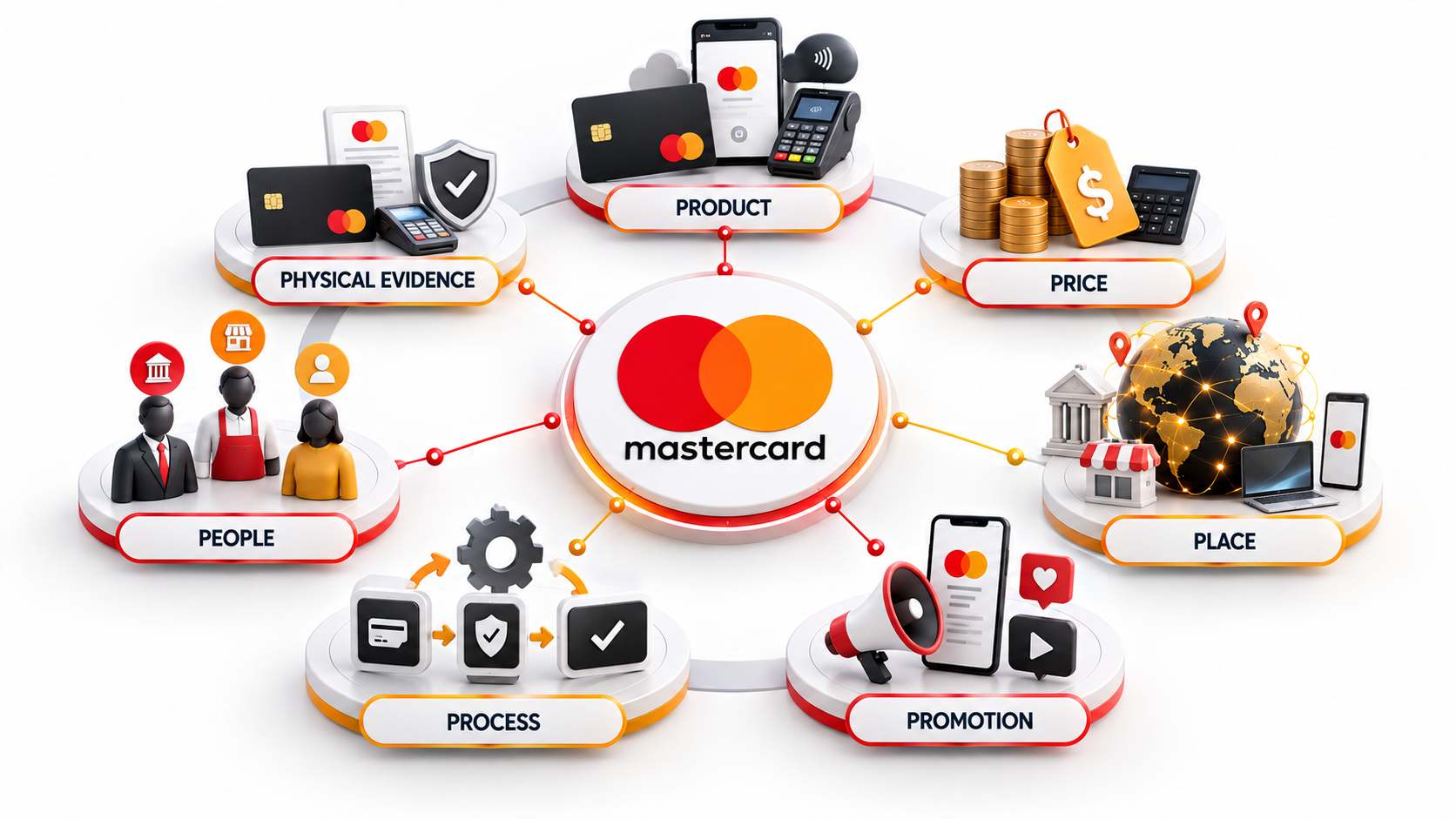
This guide goes deep into the seven elements of the marketing mix of Mastercard: product, price, place, promotion, people, process, and physical evidence. We’re not going to skim the surface here. We’re going to look at real numbers, real campaigns, real partnerships, and the actual mechanics behind how this company positions itself in a market where trust is the entire product. If you’re a marketing student trying to understand B2B2C business models, a professional preparing a case study, or just someone who got curious after reading “priceless” on a billboard for the hundredth time, this is written for you.
And honestly, the more you dig into it, the stranger the business looks on paper. Mastercard operates in an industry where the underlying technology between competitors isn’t wildly different — a payment either clears or it doesn’t, fraud either gets caught or it doesn’t — so the actual differentiation has to come from somewhere else. That somewhere else is exactly what a marketing mix is supposed to explain. This isn’t a company that can lean on a superior product feature the way a phone maker might point to a better camera. It has to win on relationships, on trust, on the emotional residue of decades of advertising, and on infrastructure most people will never see or think about. That combination is what makes this a genuinely rich topic once you stop treating it as just another “here are the 4Ps” exercise copied from a textbook.
What You Will Learn in This Guide
Before we get into it, here’s a quick rundown of what this guide actually covers, so you know what you’re getting into and can jump around if you want to.
- What a marketing mix is and why the traditional 4Ps aren’t enough for a company like Mastercard
- A full breakdown of the Product element in the marketing mix of Mastercard, including its card products, network services, and data businesses
- How Mastercard structures pricing across banks, merchants, and its B2B clients, and why “price” doesn’t mean the same thing here as it does for a retail brand
- The distribution and partnership network that gets a Mastercard-branded card into your pocket without Mastercard ever selling to you directly
- A detailed look at the Promotion strategy, including the “Priceless” campaign, sports sponsorships, and how the brand shows up on social media
- The People element — how Mastercard’s internal culture and account management teams shape the brand experience for banks and merchants
- The Process element — the actual mechanics of how a transaction moves through Mastercard’s network in a fraction of a second
- Physical Evidence — how a company with no physical stores still creates tangible brand touchpoints
- A side-by-side comparison of Mastercard’s marketing mix against Visa and American Express
- Lessons other brands, especially B2B and platform businesses, can pull from how Mastercard operates
- Common mistakes people make when they try to analyze or replicate this marketing mix
- Over a dozen FAQs answering the questions people actually type into Google about this topic
What Is a Marketing Mix, Anyway?
Okay, quick refresher before we get into Mastercard specifically, because if you’re rusty on this, the rest of the article won’t land the same way. A marketing mix is basically the set of controllable levers a company pulls to position itself in the market. The classic version is the 4Ps: Product, Price, Place, and Promotion. That framework was fine for decades when most businesses were selling physical goods off a shelf. Toothpaste, cars, cereal — the 4Ps covered it.
But somewhere along the way, marketers realized service businesses needed more nuance. You can’t just talk about the “product” when the product is an experience delivered by actual humans, or when the “place” isn’t a store shelf but a digital interface. That’s where the extended marketing mix comes in — the 7Ps — adding People, Process, and Physical Evidence to the original four. For a company like Mastercard, which sells almost nothing physical and interacts with three completely different customer groups at once, the 7P model isn’t optional. It’s the only framework that actually captures what’s going on. So that’s the lens we’re using here.
Think about it this way: a company selling laundry detergent has one customer group to worry about — the person buying the detergent. Mastercard has at least three groups pulling in different directions at once. Banks care about incentive payments and network reliability. Merchants care about transaction fees and acceptance rates. Consumers care about rewards, security, and whether the card feels good to carry around. A marketing mix that only accounts for one of those groups would miss most of what actually drives the business, which is exactly why the 7P lens matters so much more here than it would for a simple consumer packaged good.
Overview of Mastercard

Here’s where we get into the actual subject. The marketing mix of Mastercard is unusual because Mastercard operates a two-sided (really three-sided) network business rather than a direct-to-consumer brand. It doesn’t manufacture cards. It doesn’t set your interest rate. It doesn’t decide your credit limit. Instead, it operates the payment rails — the technology and infrastructure — that let a transaction move from your card to the merchant’s bank account in about a second, while also handling fraud checks, currency conversion, and settlement behind the scenes.
Founded in 1966 as Interbank Card Association and rebranded as Mastercard in 1979, the company has spent decades building relationships with financial institutions rather than consumers. Today it processes transactions across more than 200 countries and territories, and according to its own 2024 financial filings, it pulled in net revenue of roughly $28.2 billion for the year, up from about $25.1 billion in 2023. That’s not a small operation quietly running in the background — that’s one of the biggest financial infrastructure companies on earth, and its marketing mix has to serve an incredibly complex web of relationships to keep that machine running.
Mastercard’s Position in the Payments Industry
Mastercard sits as the number two payment network globally by most volume measures, trailing Visa but well ahead of American Express and Discover in terms of raw transaction volume. But “number two” undersells what’s actually happening here. Mastercard has spent the last decade aggressively diversifying beyond just card payments — moving into open banking, cybersecurity services, and data analytics through acquisitions like Vocalink, RiskRecon, and Ekata. So when you study the marketing mix of Mastercard today, you’re not just looking at a card company. You’re looking at a technology and data company that happens to have started with plastic cards forty years ago.
Why Mastercard’s Marketing Mix Matters as a Case Study
Look, most marketing case studies you find online cover consumer brands. Coca-Cola. Nike. Apple. Those are useful, but they’re direct-to-consumer businesses, and the lessons don’t always transfer if you’re working in B2B, fintech, or any kind of platform business. Mastercard is a genuinely useful case study precisely because it’s not selling to you. It has to build brand equity and trust with consumers who never write it a check, convince banks to issue its cards over a competitor’s, and give merchants a reason to accept it without gouging them on fees. That three-way balancing act is honestly more relevant to a huge chunk of modern businesses — SaaS platforms, marketplaces, app stores — than a straightforward toothpaste comparison would be.
Product
The Product element in the marketing mix of Mastercard is where things get more layered than people expect. On the surface, “the product” looks like a physical card. Underneath that, it’s actually a bundle of network access, security infrastructure, and increasingly, data services sold to banks and merchants rather than to you.
Core Card Products and Tiers
Mastercard offers a tiered lineup of card products that banks can license and brand as their own: Standard, World, and World Elite being the common tiers, each unlocking different levels of benefits like airport lounge access, concierge services, and purchase protection. A bank in Bangalore issuing a World Elite Mastercard and a bank in Berlin doing the same thing are both tapping into the identical underlying network, but the actual card — the interest rate, the rewards structure, the annual fee — is entirely up to the issuing bank. This is a genuinely clever product design because it lets Mastercard offer a consistent global standard (you know roughly what a World Elite card gets you no matter where you are) while letting local banks compete on the details that actually matter to their specific customers.
There’s also a debit and prepaid tier that doesn’t get nearly as much marketing attention but does a huge amount of the actual volume, especially in markets where credit penetration is lower. Prepaid Mastercards get used for everything from government benefit disbursement to corporate expense cards to gift cards sold at the grocery store checkout counter. None of that is glamorous compared to a metal World Elite card, but it’s a massive part of the product portfolio, and it’s a big reason Mastercard’s product strategy can’t just be summarized as “premium credit cards for wealthy travelers.” It’s a full spectrum, from a teenager’s first prepaid card to a corporate executive’s platinum travel card, all running on the same underlying rails.
Value-Added Services Beyond the Card
This is where Mastercard’s product strategy has shifted hardest in the last ten years. According to its own financial reporting, value-added services and solutions brought in about $10.8 billion in net revenue in 2024, up 17% from the year before — growing faster than the core payment network business. That includes things like Mastercard’s cybersecurity and fraud-prevention tools sold to banks, its consulting arm (Mastercard Data & Services), and its digital identity verification products. Honestly, this is the part of the product mix that gets the least public attention but might matter the most to the company’s future. Nobody’s writing think-pieces about Mastercard’s fraud-scoring algorithms, but that business is quietly becoming as important as the cards themselves.
Technology and Innovation Products
Mastercard has also pushed hard into contactless payments, tokenization (which replaces your actual card number with a secure digital token for online and mobile transactions), and biometric authentication pilots in select markets. It’s also been experimenting with blockchain-based settlement and has run various central bank digital currency pilots with governments. None of this is flashy in the way a new iPhone launch is flashy, but it’s how Mastercard keeps its core product relevant as payment behavior shifts toward phones, wearables, and eventually whatever comes after that. The product element of the marketing mix of Mastercard, in short, isn’t static — it’s constantly being rebuilt underneath the same recognizable interlocking circles logo.
Price
Pricing is probably the most misunderstood part of the entire marketing mix of Mastercard, mostly because consumers never see a Mastercard invoice. You don’t pay Mastercard a monthly fee. Your bank might charge you an annual fee for the card itself, but that money mostly goes to the bank, not to Mastercard. So where does Mastercard actually make its money, and how does pricing work as a strategic lever here?
Interchange and Transaction Fees
The bulk of Mastercard’s revenue comes from small fees charged on each transaction — assessment fees and transaction processing fees paid primarily by the banks that issue cards and, indirectly, by merchants who accept them. These fees are often a fraction of a percent per transaction, but multiply that across trillions of dollars in gross dollar volume (Mastercard processed over $9 trillion in gross dollar volume across the full year 2024) and you get a business that’s enormously profitable despite charging what looks like almost nothing per swipe. This is a pricing model built entirely on volume, not margin per unit, and it explains a lot about why Mastercard is so aggressive about expanding into new markets and new use cases — every additional transaction, no matter how small, adds up at that scale.
B2B Pricing Strategy With Banks and Merchants
Mastercard doesn’t publish a single price list the way a retailer might. Pricing is negotiated, often confidentially, based on volume commitments, exclusivity arrangements, and incentive deals. Mastercard’s own filings openly discuss “rebates and incentives” paid to customers — in 2024 alone, payment network rebates and incentives came to roughly $17.6 billion, which is actually larger than the entire value-added-services revenue line. That’s a staggering amount of money flowing back to banks and partners to keep them issuing Mastercard-branded products instead of a competitor’s. This tells you something important: pricing here isn’t about maximizing what you charge per transaction. It’s about winning and retaining massive institutional relationships, sometimes by giving money back in the form of incentives to make sure a bank picks Mastercard over Visa for its next card launch.
Value-Based Pricing for Premium Services
For its higher-margin services — fraud detection, consulting, data analytics — Mastercard prices based on the value delivered rather than a flat transaction fee. A bank paying for Mastercard’s fraud-scoring tools is essentially paying for reduced chargeback losses, and Mastercard can price that service based on the measurable savings it produces. This is a much more traditional B2B software pricing model, and it’s becoming a bigger share of the pie every year as the value-added-services segment grows faster than the traditional card network.
Place
“Place” in a traditional marketing mix means where the product gets sold — retail shelves, online stores, that kind of thing. Mastercard doesn’t have shelves. So place, in this case, is really about distribution through partnerships and the sheer reach of its network infrastructure.
Bank and Financial Institution Partnerships
Every single Mastercard-branded card in the world exists because a bank, credit union, or fintech company signed an agreement to issue it. Mastercard doesn’t choose who gets a card — the issuing institution does that. What Mastercard controls is how attractive it makes itself as the network of choice for those institutions to partner with. That’s why so much of Mastercard’s “place” strategy is really relationship management with thousands of banks across more than 200 countries, plus increasingly with fintech companies and neobanks like Revolut, N26, and various buy-now-pay-later platforms that need a network to ride on.
Global Network Reach and Infrastructure
The actual physical and digital infrastructure — the servers, data centers, and network nodes that route a transaction from a point-of-sale terminal to the issuing bank and back in under a second — is Mastercard’s real “place.” This infrastructure has to work whether someone’s buying groceries in rural Kenya or paying for a hotel in Tokyo, and it has to work at massive scale without going down. Building and maintaining that kind of global reach is arguably a bigger competitive moat than the brand name itself. A new payment network could theoretically copy Mastercard’s advertising tone. Copying forty years of built-out global network infrastructure is a completely different problem.
Digital and Mobile Distribution Channels
More recently, “place” has expanded to include digital wallets — Apple Pay, Google Pay, Samsung Pay — where Mastercard has made sure its cards are compatible and easy to add. It’s also pushed into e-commerce checkout flows through tokenization technology like Mastercard Click to Pay, which lets online shoppers check out without manually typing in card numbers. This matters because as more spending shifts away from physical card swipes toward phone taps and app-based checkouts, Mastercard has to make sure it’s distributed everywhere consumers actually transact, not just where cards get physically swiped.
Promotion
This is the part most people actually think about when they hear “Mastercard marketing.” The brand’s advertising has been genuinely effective for decades, and it’s worth breaking down why, because it’s not just clever copywriting — there’s real strategic thinking behind it.
The “Priceless” Campaign and Its Staying Power
Launched back in 1997, “Priceless” is one of the longest-running ad campaigns in modern advertising history, and it’s still running in some form nearly three decades later. The format — list a few things you can buy, then end with something money can’t buy, tag it “priceless” — became so recognizable it turned into a cultural shorthand that outlasted most of its advertising contemporaries. What’s smart about it isn’t just the format. It’s that “Priceless” reframes Mastercard from a boring financial utility into an emotional experience enabler. Nobody feels warm and fuzzy about interchange fees. But everybody understands the feeling of a moment with family that money can’t buy, and Mastercard attached its brand to that feeling for nearly thirty straight years. That’s not luck. That’s disciplined brand management sticking with one idea long enough for it to actually sink in.
Sponsorships and Sports Marketing
Mastercard has poured serious money into sports and entertainment sponsorships — FIFA World Cup partnerships, UEFA Champions League, various Grammy and music festival tie-ins. In 2024 alone, the company spent roughly $815 million on advertising and marketing according to its financial filings. Sports sponsorship works particularly well for a payment brand because it puts the logo in front of massive, emotionally engaged global audiences during moments people actually pay attention to — nobody skips the World Cup final to avoid ads the way they might skip a banner ad online. It also lets Mastercard associate itself with excitement and passion, two things a payment network otherwise struggles to project on its own.
What’s interesting is how Mastercard uses these sponsorships beyond just logo placement on a stadium banner. During major tournaments, it typically rolls out cardholder-exclusive experiences — ticket pre-sales, meet-and-greets, stadium tours — tying the sponsorship directly back to a tangible cardholder benefit rather than leaving it as passive brand exposure. That turns a sponsorship deal into an actual product feature for a limited window of time, which is a smarter use of sponsorship dollars than most brands manage. A lot of companies pay for a logo on a jersey and call it a day. Mastercard tends to build an entire cardholder journey around the sponsorship, from pre-event content to on-site perks to post-event social content, which stretches the value of that spend across months instead of just the ninety minutes of a match.
Digital Marketing and Social Media Presence
Beyond the big campaigns, Mastercard runs an active digital and social media operation, using platforms to push financial literacy content, small business support programs, and behind-the-scenes sponsorship content. It’s also leaned into experiential marketing — setting up “Priceless” branded pop-up experiences at events, giving cardholders access to exclusive concert pre-sales or dining experiences through its Priceless.com platform. This shifts promotion away from pure advertising and toward tangible perks, which does double duty: it’s promotion and product benefit rolled into one, giving cardholders a real reason to reach for a Mastercard over a competing card in their wallet.
People
People matters more in Mastercard’s business than you’d expect for a company most consumers never talk to directly. The people element here breaks down into two very different groups: the internal workforce and the relationship managers who deal directly with banks and merchants.
Employee Culture and Talent Strategy
Mastercard employs roughly 34,000 people worldwide (per recent company disclosures) across engineering, security, data science, and traditional corporate functions. Because so much of the company’s value now comes from technology — fraud detection algorithms, tokenization, data analytics — its people strategy has shifted heavily toward recruiting engineers and data scientists rather than just traditional sales and marketing staff. The company has also made a public push around diversity and inclusion and financial inclusion initiatives, partly because a payments company’s reputation for trustworthiness depends heavily on being seen as a responsible actor, not just a profit machine sitting between banks and consumers.
Relationship and Account Management Teams
The people who actually shape how banks and merchants experience the Mastercard brand are the account managers and relationship teams negotiating deals, onboarding new fintech partners, and handling the incentive structures mentioned earlier. This is basically an invisible sales force to the average consumer, but it’s arguably the most important “people” function in the entire business, because losing a major bank partnership to Visa or a rival network can mean losing millions of cardholders overnight. These relationships are built over years, sometimes decades, and the quality of the humans managing them directly affects whether a bank renews its Mastercard partnership or jumps ship.
Process
Process is where Mastercard’s engineering muscle actually shows up, even though it’s invisible to the average person tapping their card at checkout. This is the part of the marketing mix of Mastercard that’s easiest to take for granted precisely because it works so well you never think about it.
How a Transaction Actually Moves Through the Network
When you tap your card, here’s roughly what happens in under a second: the merchant’s terminal sends the transaction data to their acquiring bank, which routes it through Mastercard’s network to your card’s issuing bank, which checks your available balance or credit, runs fraud checks, and sends an approval or decline back through the same path. All of that — routing, checking, approving — happens in what Mastercard itself has described as roughly a tenth of a second in ideal conditions. That speed is a product of decades of infrastructure investment, and it’s genuinely one of the most impressive pieces of invisible engineering most people interact with daily without ever noticing.
Security and Fraud Prevention as a Core Process
Because trust is the entire product Mastercard sells, its fraud detection and security processes are treated as central to the brand rather than a background function. The company uses machine learning models that analyze transaction patterns in real time, flagging anything that looks off before it clears. It’s also invested heavily in acquisitions like RiskRecon and Ekata specifically to strengthen this process layer. Every fraud case that gets caught before it happens reinforces the brand promise that a Mastercard transaction is safe, and every headline about a payments breach — even one involving a competitor — puts pressure on Mastercard to keep proving its process is airtight.
This is also where the process element quietly overlaps with promotion, even though almost nobody talks about it that way. When Mastercard publishes statistics about fraud rates dropping or highlights a new security partnership in a press release, that’s technically a process update, but it functions as reputation-building content too. A consumer who reads that fraud losses are falling industry-wide feels a little more comfortable tapping their card at an unfamiliar terminal in a foreign city, and that comfort is worth more to the brand long-term than almost any single ad campaign could be. Nobody gets excited about a fraud-detection algorithm the way they get excited about a World Cup sponsorship, but it’s doing quieter, arguably more important work underneath everything else.
Physical Evidence
Physical evidence usually refers to the tangible cues customers use to judge a service brand — think of a hotel lobby or a restaurant’s décor. Mastercard has almost none of that in the traditional sense, so it’s had to get creative about what counts as physical evidence in a business with no storefronts.
Card Design, Materials, and Branding Consistency
The card itself is the most obvious piece of physical evidence, and Mastercard is deliberate about it. The interlocking red and yellow circles logo has to appear consistently whether the card is metal, plastic, or a limited-edition design issued for a sports sponsorship. Premium tiers sometimes use metal cards specifically because the weight and feel of the card itself signals status — that’s physical evidence doing real psychological work, even on something as small as a piece of plastic (or metal) in your wallet.
Digital Interface and App Experience as Physical Evidence
In a modern payments business, physical evidence has expanded to include digital touchpoints: the checkout screen showing the Mastercard logo, the tap-to-pay animation on a phone screen, the confirmation notification you get after a purchase. These moments function the same way a well-designed retail store would for a traditional brand — they’re the tangible, visible proof that the service is working as promised, even though nothing physical actually changes hands.
Competitive Analysis: How Mastercard’s Marketing Mix Compares
No marketing mix breakdown means much without comparing it to the competition, so let’s put Mastercard side by side with its two biggest rivals.
Mastercard vs Visa
Visa remains the larger network by transaction volume and total cards in circulation globally, and its marketing has historically leaned on partnerships (Visa was long associated with the Olympics, for example, similar to how Mastercard leans on FIFA and UEFA). The core pricing and distribution models are nearly identical between the two companies — both rely on bank partnerships and interchange-style fees — so the real differentiation ends up happening almost entirely in promotion and value-added services. Mastercard’s “Priceless” campaign has arguably created more emotional brand recall than Visa’s more functional “everywhere you want to be” positioning ever did, even though Visa has the larger raw market share.
Mastercard vs American Express
American Express plays an entirely different game. Amex is a closed-loop network, meaning it issues its own cards directly to consumers and acts as both the network and the issuing bank, which lets it control the entire customer experience, including premium travel perks and its own merchant relationships. Mastercard, by contrast, never touches the consumer relationship directly — it always operates through a bank intermediary. That makes Amex’s marketing mix simpler in some ways (one company controls product, price, and promotion end to end) but limits its merchant acceptance compared to Mastercard’s broader network, since not every merchant wants to pay Amex’s typically higher fees.
Strengths and Weaknesses Built Into Mastercard’s Marketing Mix
Every marketing mix has trade-offs baked in, and Mastercard’s is no exception. Looking at what actually holds this system together — and where it’s exposed — tells you more than just listing the seven elements ever could.
Where the Marketing Mix of Mastercard Is Genuinely Strong
The biggest strength is diversification of revenue away from pure transaction fees. A decade ago, Mastercard was basically a toll booth business — charge a tiny fee every time money moved through the network. Today, roughly 38% of net revenue comes from value-added services rather than the core payment network, and that number keeps climbing. That matters because toll-booth businesses are vulnerable to regulation (interchange fee caps have hit the industry before, especially in Europe) while software and data services are stickier and harder for regulators to touch. Another real strength is the sheer weight of the “Priceless” brand equity. Building a recognizable emotional campaign that survives almost three decades without losing relevance is rare, and it gives Mastercard pricing power in negotiations with banks — issuers want to be associated with a brand consumers already trust, which strengthens Mastercard’s hand even in a market where the underlying technology between competitors is pretty similar.
Where the Marketing Mix of Mastercard Shows Real Vulnerabilities
The flip side is that Mastercard’s dependence on bank relationships means it has almost no direct control over the actual card experience a consumer gets. If a bank designs a clunky app, offers bad customer service, or has a data breach, Mastercard’s brand takes reputational damage even though it didn’t cause the problem. That’s a real weakness compared to a closed-loop competitor like American Express, which controls the whole chain. There’s also regulatory exposure sitting underneath the pricing element — interchange fees have faced caps and lawsuits in multiple markets over the years, and any future regulation that squeezes those fees hits the core of Mastercard’s revenue model directly. And honestly, the network effect that makes Mastercard powerful also makes it slow. Rolling out a new feature globally means coordinating with thousands of banks and millions of merchant terminals, which is nowhere near as fast as a startup shipping an app update overnight.
Financial Inclusion and Purpose-Driven Positioning in Mastercard’s Marketing Strategy
Somewhere along the way, Mastercard decided that being a faceless payments processor wasn’t enough of a story to tell, and it leaned hard into financial inclusion as a positioning pillar. This shows up across the promotion and product elements in ways that are worth pulling apart on their own.
The Financial Inclusion Commitment as a Brand Pillar
Mastercard publicly committed to bringing hundreds of millions of people into the formal financial system, partnering with governments and NGOs in Africa, Asia, and Latin America to issue digital payment cards to people who previously operated entirely in cash. This isn’t just charity messaging tacked onto an annual report. It functions as genuine market expansion — every person brought into the formal banking system is a potential future cardholder — while also giving Mastercard a values-driven story to tell that a pure profit narrative never could. Look at what actually happens when a company ties growth strategy to a mission like this: it gets easier to recruit talent who want to feel like their work matters, easier to win government contracts for social payment programs, and easier to justify premium positioning to consumers who care about corporate values.
Small Business Support Programs as Promotion and Product Combined
Mastercard has also rolled out small business support initiatives, offering free tools, mentorship programs, and payment technology access to small merchants, particularly women-owned and minority-owned businesses. This blurs the line between promotion and product in an interesting way. It’s promotional because it generates goodwill and press coverage. But it’s also a product play, because every small merchant that gets set up with Mastercard-compatible payment technology becomes part of the acceptance network that makes the whole system more valuable for cardholders everywhere else. That’s the kind of dual-purpose move you don’t see nearly enough of in traditional marketing mixes, where promotion and product usually stay in separate lanes.
The Future of the Marketing Mix of Mastercard
Nobody has a crystal ball, but the direction of travel here is pretty visible if you’re paying attention to where Mastercard keeps putting its money.
AI, Data, and the Next Phase of the Product Element
Mastercard has been investing heavily in artificial intelligence for fraud detection, personalized offers, and predictive analytics sold to banks as a service. Its Decision Intelligence platform uses machine learning to score transactions in real time, and its 2022 acquisition of Dynamic Yield (later sold off, but reflective of the broader strategic direction) showed genuine ambition to move into personalization and recommendation technology, not just payment processing. Expect the product element of the marketing mix of Mastercard to keep shifting toward “we sell intelligence about money movement” rather than just “we move the money.” That’s a fundamentally different business, even if the logo on your card never changes.
Digital Currencies and the Next Chapter of Place
Mastercard has run multiple pilots with central banks exploring digital currencies, and it’s built infrastructure to let its network handle blockchain-based settlement if and when that becomes mainstream. This matters for the place element specifically, because if money increasingly moves through digital wallets and programmable currencies rather than physical cards, Mastercard needs to be the invisible plumbing underneath that shift too, the same way it became the invisible plumbing underneath plastic cards forty years ago. Whether that bet pays off depends entirely on regulatory decisions nobody can fully predict yet, but the fact that Mastercard is positioning itself early rather than waiting tells you something about how seriously it takes distribution risk.
Lessons From the Marketing Mix of Mastercard for Other Brands
You don’t have to run a payments company to pull something useful from how Mastercard operates. A few lessons apply well beyond fintech.
Building Trust at Scale Without a Direct Relationship
If your business operates through intermediaries — a platform, a marketplace, a wholesale distributor — Mastercard’s approach shows that brand trust doesn’t require a direct billing relationship with the end user. What it requires is consistency: the same look, the same security standard, the same experience, no matter which bank or merchant is delivering it on your behalf. That consistency is what lets a consumer trust a card issued by a bank they’ve never heard of, purely because it has the Mastercard logo on it.
Balancing Global Standards With Local Flexibility
Mastercard’s tiered product structure — a consistent global standard with local banks free to customize the details — is a model worth studying for any brand trying to scale internationally. Rigid global uniformity often fails locally. Complete local customization dilutes the brand. Mastercard’s middle path, setting minimum standards while letting local partners compete on specifics, is a genuinely useful template for franchise businesses, software platforms, and any brand expanding across very different markets at once.
Regional Case Examples: How the Marketing Mix of Mastercard Shifts by Market
Here’s something a lot of writeups skip entirely: the marketing mix of Mastercard doesn’t look identical from country to country. The seven elements stay the same in structure, but the emphasis shifts hard depending on how mature the local payments market already is.
Emerging Markets: Growth Through Financial Access
In markets like India, Nigeria, and Indonesia, Mastercard’s marketing mix leans heavily on the product and place elements, because the real opportunity is bringing first-time card users into the system rather than fighting over an existing pie. Partnerships with local fintech companies, government social payment programs, and mobile-first digital cards matter more here than a glossy sports sponsorship campaign. Promotion in these markets often looks like financial literacy content and merchant onboarding support rather than emotional brand advertising, because the job to be done is education and access, not brand preference among already-banked consumers who already own three or four cards. Pricing also gets more aggressive in these regions, sometimes with lower fees or special incentive structures to win volume in markets where card penetration is still relatively low compared to mature economies.
Mature Markets: Competing on Brand and Experience
In markets like the United States, the United Kingdom, and much of Western Europe, nearly everyone who wants a card already has one, sometimes several. Here, Mastercard’s marketing mix shifts almost entirely toward promotion and physical evidence — competing on the emotional pull of “Priceless” experiences, premium card tiers with metal designs, and exclusive access to concerts or sporting events through Priceless.com. The product conversation moves away from basic access and toward differentiation: cashback structures, travel insurance, airport lounge access, and other perks that convince a consumer to put a Mastercard-branded card at the front of their wallet instead of a competing Visa or Amex product sitting right next to it. This is a genuinely different marketing job than the one happening in emerging markets, even though it’s technically the same seven-part framework underneath.
Common Mistakes Brands Make When Studying Mastercard’s Marketing Mix
A lot of case study writeups treat Mastercard like a straightforward consumer brand, and that’s honestly the biggest mistake people make here. They analyze “Priceless” ads in isolation without connecting it to the pricing and distribution reality underneath — the fact that Mastercard makes almost nothing directly from a consumer and everything from bank and merchant relationships. Another common mistake is ignoring the value-added services business entirely and treating Mastercard as if it’s still purely a card network, when that segment is now growing faster than the core payments business and will likely define the company’s next decade more than any advertising campaign will. People also tend to underweight the “process” and “people” elements because they’re less visible than a flashy ad campaign, even though the fraud-detection process and the bank relationship teams are arguably doing more heavy lifting for brand trust than any commercial ever could.
Conclusion
So, what does the marketing mix of Mastercard actually teach us? Mostly that a company can build one of the most trusted brands on the planet without ever selling directly to the people carrying its name in their wallet. Every element — product, price, place, promotion, people, process, and physical evidence — has been shaped around one central fact: Mastercard’s real customers are banks and merchants, while consumers are the ones who have to feel good about the brand anyway. That’s a genuinely hard balancing act, and the fact that most people never even think about it while tapping their card at checkout is probably the clearest sign of how well it’s working.
There’s also a bigger point buried in here for anyone building a modern business. The old assumption that you need a direct relationship with your end customer to build a strong brand just doesn’t hold up anymore. Platforms, marketplaces, app stores, payment networks — an increasing share of the economy runs on businesses that sit between other businesses and the actual end user. Mastercard figured out how to make that indirect relationship feel personal decades before most companies had to think about it, and it did that through discipline rather than luck: one campaign concept stretched over thirty years, one consistent set of network standards applied across thousands of banks, and a willingness to keep reinvesting in the boring infrastructure that nobody notices until it breaks. That’s less exciting than a viral ad campaign, sure. But it’s probably the more useful lesson buried in the marketing mix of Mastercard than anything you’ll find on a highlight reel of its best commercials.
FAQs About the Marketing Mix of Mastercard
1. What is the marketing mix of Mastercard based on? Mastercard’s marketing mix is best understood through the extended 7P model rather than the basic 4Ps, because it operates as a service and technology network rather than a product-based retail business. The seven elements — product, price, place, promotion, people, process, and physical evidence — each get shaped by the fact that Mastercard sells to banks and merchants first, with consumers experiencing the brand indirectly through the cards those partners issue.
2. Does Mastercard sell cards directly to consumers? No, and this trips people up constantly. Mastercard licenses its network and brand to banks, credit unions, and fintech companies, which then issue the actual physical or digital cards to consumers. You can’t walk into a Mastercard store or website and order a card directly — you have to go through an issuing bank, which is exactly why the company’s marketing mix looks so different from a typical consumer brand.
3. How does Mastercard make money if it doesn’t charge consumers directly? Mastercard earns revenue primarily through small transaction and assessment fees charged to the banks that issue its cards and, indirectly, to merchants that accept them. With gross dollar volume running into the trillions of dollars annually, even fractions of a percent per transaction add up to tens of billions in net revenue, which topped roughly $28.2 billion in 2024.
4. What is the “Priceless” campaign and why has it lasted so long? “Priceless” launched in 1997 and is still running in various forms nearly three decades later, making it one of the longest continuously running ad campaigns in advertising history. It works because it reframes a financial transaction brand around emotional, memorable experiences rather than fees and interest rates, which is a much easier thing for consumers to actually connect with.
5. What are the 7Ps in the marketing mix of Mastercard? The seven elements are Product (card tiers and value-added services), Price (interchange fees, rebates, and value-based B2B pricing), Place (bank partnerships and global network infrastructure), Promotion (Priceless campaign, sponsorships, digital marketing), People (internal culture and relationship management teams), Process (transaction processing and fraud prevention), and Physical Evidence (card design and digital interface touchpoints).
6. How is Mastercard’s marketing mix different from Visa’s? The underlying business models are extremely similar — both rely on bank partnerships and interchange-style fees rather than direct consumer sales. The real differences show up in promotion and brand positioning, with Mastercard’s emotionally driven “Priceless” campaign contrasting against Visa’s more functional messaging, even though Visa typically holds a larger share of global transaction volume.
7. Why does Mastercard sponsor sports events like the FIFA World Cup? Sports sponsorships put the Mastercard brand in front of massive, emotionally engaged global audiences during high-attention moments, which is valuable for a company that otherwise has very few natural opportunities to connect emotionally with consumers. It also lets the brand borrow the excitement of live sport, something a payments network can’t generate on its own through product features alone.
8. What is Mastercard’s biggest source of revenue growth right now? Value-added services and solutions — things like fraud prevention tools, data analytics, and consulting sold to banks and merchants — grew about 17% in 2024, outpacing the traditional payment network business. This segment is quickly becoming as important to Mastercard’s future as the card network itself.
9. How does Mastercard ensure consistent branding across thousands of different banks worldwide? Mastercard sets clear standards for how its logo, card tiers, and network benefits must appear regardless of which bank issues the card, while still allowing banks flexibility on interest rates, rewards programs, and annual fees. This balance between global consistency and local flexibility is one of the more replicable lessons from studying Mastercard’s marketing mix.
10. What role does fraud prevention play in Mastercard’s marketing strategy? Fraud prevention functions as both a product and a process element, and it directly supports the brand’s core promise of trust and security. Every prevented fraud case reinforces the reputation that a Mastercard transaction is safe, which matters enormously for a company whose entire business depends on people trusting an invisible piece of financial infrastructure.
11. Is Mastercard’s marketing mix relevant to businesses outside the payments industry? Yes, particularly for platform businesses, marketplaces, and any B2B2C company that reaches consumers through intermediaries rather than directly. The lessons around building trust without a direct billing relationship, and balancing global standards with local flexibility, apply well beyond fintech.
12. How many countries does Mastercard operate in? Mastercard’s network reaches more than 200 countries and territories, supported by partnerships with thousands of financial institutions and merchants worldwide, which is a big part of why its distribution strategy, the “place” element of its marketing mix, functions more like infrastructure than traditional retail distribution.
13. What is Mastercard Click to Pay and how does it fit the marketing mix? Click to Pay is Mastercard’s tokenized online checkout technology that lets shoppers complete purchases without manually entering card details, reducing friction and fraud risk. It fits into both the product element (as a technology offering) and the place element (as a digital distribution channel), reflecting how the company has adapted its network for an increasingly cashless, app-driven world.
14. How much does Mastercard actually spend on advertising and marketing? According to its 2024 financial filings, Mastercard spent about $815 million on advertising and marketing for the year, a figure that’s stayed fairly consistent year over year even as overall revenue has climbed. That spending covers everything from the “Priceless” campaign production costs to sports sponsorship fees and digital marketing programs run across dozens of markets.
15. Why doesn’t Mastercard just sell cards directly and cut out the banks? Becoming a direct issuer would mean taking on credit risk, regulatory compliance burdens, and customer service obligations in every single country it operates in, which is an entirely different and far more capital-intensive business than running a network. By staying a network operator and letting banks handle issuance, Mastercard keeps its business model asset-light and scalable, even if it means giving up direct control over the end customer relationship.
16. How does Mastercard’s marketing mix support its B2B relationships specifically? The pricing element, especially the rebates and incentives paid out to banks (which reached roughly $17.6 billion in 2024), functions as a direct lever for winning and retaining institutional partnerships. Combine that with dedicated relationship management teams under the people element, and you get a marketing mix where B2B retention is treated with the same seriousness most companies reserve for consumer acquisition.
17. What can startups learn from studying the marketing mix of Mastercard? Startups building platform or marketplace businesses can learn that brand trust doesn’t require owning the entire customer relationship, and that consistency across partners matters more than direct control. They can also learn the value of picking one emotional idea, the way “Priceless” did, and sticking with it for years instead of chasing a new campaign concept every quarter.