


Picture a second-year BBA student the night before submission. The assignment says: “Explain the marketing mix of LIC.” She googles it, lands on a page with four bullet points (product, price, place, promotion), two lines each, and copies them down. Ten pages required. Four lines in hand. Yeah, that’s the problem with most write-ups out there. They treat the Marketing Mix of LIC like a tick-box exercise, when LIC isn’t selling a phone or a packet of biscuits. It’s selling a promise that has to hold for thirty years.
And that’s what makes this case so interesting. Life Insurance Corporation of India started in 1956 with ₹5 crore from the government. Today it manages assets of more than ₹50 lakh crore, works through over 13 lakh agents, and still writes well over half of India’s new life insurance premium, even though HDFC Life, SBI Life and ICICI Prudential have had more than two decades to eat into its share. Ad budgets didn’t do that. Something deeper is going on in how the whole marketing mix is put together.
So let’s pull it apart properly. This guide covers all seven Ps of services marketing: product, price, place, promotion, people, process and physical evidence. Every section uses real plan names, real numbers where they can be trusted, and honest opinions about what LIC does well and where it’s stuck. Students get something they can write pages from. Marketers get a case worth stealing ideas from. And anyone who just wants to know why their uncle still swears by LIC will find the answer somewhere in the middle.
What You Will Learn in This Guide
- What the marketing mix of LIC actually means and how the 7Ps of services marketing apply to a life insurer
- Which LIC products drive the business, from Jeevan Anand to Tech Term, and why savings plans dominate
- How LIC prices policies, and what bonuses, loans, grace periods and GST changes do to the real cost
- Why the agent network is the real engine behind LIC’s distribution, and where digital and bancassurance fit
- How LIC promotes itself through its diya logo, its Sanskrit tagline, advertising and word of mouth
- How people, process and physical evidence quietly close the sale, including claim settlement and Bima Sakhi
- LIC’s strengths, weaknesses and a side-by-side comparison with private insurers, plus lessons any marketer can copy
TL;DR: Marketing Mix of LIC in 60 Seconds
- LIC’s mix runs on trust first, and every P (from the sovereign-backed brand to the branch signboard) feeds that one idea.
- Product is heavy on savings-cum-insurance plans like endowment and whole life, while pure term cover is a smaller slice.
- Price is more than the premium: bonuses, monthly to yearly modes, policy loans and a 30-day grace period shape how affordable a plan feels.
- Place means people, not pixels. Over 13 lakh agents and roughly 2,000 branches reach places private insurers still struggle to enter.
- Promotion leans on the diya logo, the tagline Yogakshemam Vahamyaham and relationships, not on flashy campaigns.
- The weak spots are younger urban buyers, modest returns on traditional plans and a digital experience that trails the newer players.
What Is the Marketing Mix of LIC and Why Does It Matter?
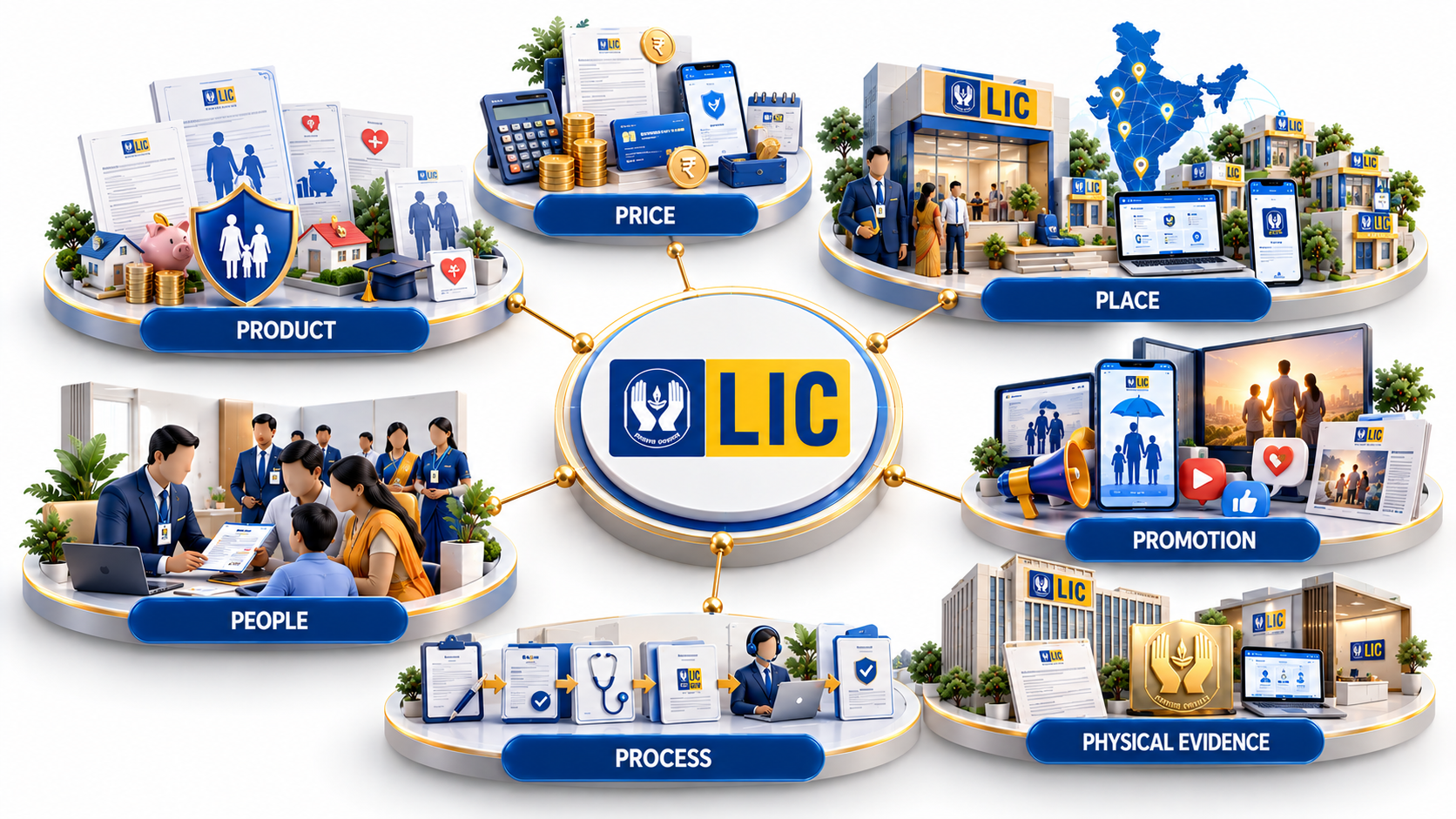
The marketing mix of LIC is the set of seven decisions the corporation makes about what it sells, what it charges, where it sells, how it promotes, who sells and services it, how the buying steps work, and what customers can see and touch. Every decision leans on one thing: trust built over decades. Get that, and the rest clicks.
The 7Ps Framework in Plain Language
The original marketing mix had four Ps: product, price, place and promotion. E. Jerome McCarthy put that version together in 1960, and it worked fine for things like soap and scooters. Then service businesses got big, and the four Ps started feeling thin. In 1981, Bernard Booms and Mary Jo Bitner added three more for services: people, process and physical evidence. Insurance sits squarely in that second camp.
Quick translation. Product is the policy. Price is the premium, plus everything wrapped around it like bonus and loan terms. Place is how a policy reaches you: agent, branch, website, bank. Promotion is advertising and every other way LIC talks to you. People are agents and staff. Process is the steps from proposal form to claim cheque. Physical evidence is anything you can see that proves LIC is real, like the building, the policy bond and the logo.
If marketing basics are still new to you, the digital marketing basics hub on this site covers the foundations in simple language.
LIC at a Glance: The Numbers Behind the Brand
Numbers first, because they explain why anyone bothers writing about this. LIC began on 1 September 1956, after the government merged 245 private insurers and provident societies into a single corporation with ₹5 crore of capital. The headquarters sits in Mumbai, in the Yogakshema Building. The network runs to roughly 2,000 branch offices, split across zonal and divisional offices, plus a workforce of agents that crossed 13 lakh.
In May 2022, LIC went public with a ₹21,000 crore IPO priced at ₹949 a share, the biggest India had seen at that time. It listed below the issue price, which annoyed a lot of retail investors, but that’s a separate story. What matters for marketers is the market position: LIC still writes well above half of India’s new business premium, and an even bigger share of policies by count, because its average policy is smaller. That tells you LIC sells to the masses, not just the top ten percent.
Why Insurance Needs Seven Ps and Not Four
Nobody test drives a life insurance policy. That one fact changes everything. A phone can be handled in a shop, a car can be driven around the block, but a 25-year endowment plan is a paper promise you can’t sample. Marketers call this intangibility, and it means buyers lean on proxies: the brand, the agent’s face, the office they visited, how easy the paperwork felt.
Then there’s inseparability, which is a fancy word for “the seller is part of the product.” When a neighbour who has known your family for fifteen years explains a policy, the agent and the product blur together. Add the long time horizon (a 28-year-old signing today might collect in 2051) and you get a purchase driven almost entirely by trust. Four Ps can’t capture that. People, process and physical evidence can.
Why Students and Marketers Keep Studying LIC
LIC is one of the few Indian brands that lived through a full cycle from monopoly to competition. From 1956 to 1999, it was the only life insurer in the country. Then the IRDA Act of 1999 opened the sector, and by 2000 HDFC Standard Life, ICICI Prudential and Max New York Life had entered. Its share of new business fell from near-total to somewhere around the sixty percent mark, then held there. Defending that much share against well-funded rivals is rare.
For a student, that’s a gift of a case study because there’s a real before and after. For a working marketer, the interesting question is which parts of the mix did the defending. Spoiler: it wasn’t the advertising. It was distribution, trust and pricing familiarity, and the sections below show how each one works.
Product and Price Strategy
Product and price are where most write-ups stop, and even there they stay shallow. LIC’s product line is deliberately wide, but sales pile up in a handful of plan types. Price is also more than the premium figure. It includes bonuses, payment modes and loan terms, which is where the real pricing story hides.
LIC’s Product Portfolio: Where the Range Actually Sits
LIC sells almost every category of life insurance: endowment plans, whole life plans, money-back plans, term plans, children’s plans, pension and annuity plans, unit-linked plans (ULIPs), health riders and micro-insurance for low-income buyers. There’s also a big group insurance business selling to employers and banks. On paper that’s a full shelf, comparable to any private insurer.
But look at where the premium actually comes from. The bulk sits in savings-cum-insurance plans, the kind that give a life cover and a lump sum or regular payout at the end. Pure protection, meaning term plans where you pay a small premium and get nothing back if you outlive the policy, is a smaller slice of LIC’s book than it is at many private players. That’s not an accident. Savings-type plans are easier to sell to first-time buyers in small towns because the buyer can see money coming back.
Endowment and Money-Back Plans: The Bread and Butter
Take Jeevan Anand (plan 915). It pays a maturity benefit at the end of the premium term and then continues life cover for the rest of your life, which is why agents love pitching it as “cover that doesn’t end.” New Endowment Plan (914) is simpler: pay for a set number of years, get sum assured plus accumulated bonus at maturity. Jeevan Umang (945) is a whole life plan that pays a survival benefit of 8 percent of the basic sum assured every year after the premium paying term, with cover up to age 100.
Why do these sell? Because buyers feel like the money isn’t gone. A 30-year-old schoolteacher in Nagpur can look at the maturity table and imagine her daughter’s college fees being covered. That emotional hook matters more than a spreadsheet. The catch, and it’s a real one, is that the returns on traditional participating plans have generally sat in the ballpark of 4 to 6 percent a year once you work out the internal rate of return. Fine for guaranteed, safe money. Not fine if someone sells it as an investment that beats equity.
Term, Pension and Unit-Linked Plans: The Newer Push
LIC does sell pure term cover: Tech Term (plan 954), sold online, and Jeevan Amar (plan 955), sold through agents. For a healthy 30-year-old non-smoker, a ₹1 crore cover till age 60 typically costs somewhere around ₹10,000 to ₹15,000 a year at most insurers, LIC included. Cheap for what it gives. Honestly, that’s the product every financial planner tells young earners to buy first.
So why doesn’t LIC push it harder? Commission. Agents earn far more selling a ₹50,000-a-year endowment plan than a ₹12,000-a-year term plan, and LIC’s whole system runs through agents. On the pension side, Jeevan Akshay sells immediate annuities and Jeevan Shanti covers deferred annuities. LIC also sells ULIPs like SIIP and Nivesh Plus, mainly to compete with private players’ market-linked plans, though that’s not where its strength lies.
How LIC Prices Its Policies
Premium pricing in life insurance comes from actuarial maths, but the inputs are easy to understand. The insurer looks at your age, sum assured, policy term, gender, smoking status, health history and plan type. It then uses mortality tables (data on how many people of a given age are expected to die each year) and assumptions about investment returns to work out what it needs to collect.
The important split is between participating and non-participating plans. Most LIC endowment and whole life plans are participating, meaning policyholders share in the profits through bonuses. Because of that, the premium is set higher upfront. As a rough ballpark, a ₹10 lakh endowment for a 30-year-old over 20-odd years might land somewhere between ₹45,000 and ₹55,000 a year. That’s a ballpark, not a quote, so anyone building an assignment example should check LIC’s online premium calculator for the exact figure.
Bonuses, Payment Options and Loans: The Pricing Flexibility Nobody Mentions
Here’s the part guides skip. LIC’s real pricing appeal isn’t the sticker premium. It’s the flexibility around it. Premiums can be paid yearly, half-yearly, quarterly or monthly. There’s a Salary Savings Scheme where an employer deducts premium straight from salary, which locks in discipline. Grace periods run 30 days for most modes and 15 days for monthly, so a missed date doesn’t kill a policy immediately.
Bonuses are declared every year, usually as a certain rupee amount per ₹1,000 of sum assured, and they’re a big part of why people trust the plans: the number keeps growing on paper. Loans against the policy are available, often up to around 90 percent of surrender value. A lapsed policy can be revived within five years. Put those together and the price feels friendlier than the raw premium suggests, especially to families with irregular income.
The Surrender Value and GST Changes That Changed Pricing
Two rule changes shifted how price feels. First, IRDAI’s 2024 regulations (effective 1 October 2024) improved surrender values, meaning people who quit a policy early now get back more than they used to. Before that, someone who surrendered in the first two or three years could walk away with almost nothing, and that was a real gripe against traditional plans.
Second, GST. For years, term plans carried 18 percent GST, while endowment plans had lower effective rates (around 4.5 percent in year one and 2.25 percent after). From 22 September 2025, GST on individual life insurance premiums was removed. That instantly made pure protection about 15 percent cheaper than before and took away one of the tax quirks that had tilted the field toward savings plans. For pricing strategy, it’s a small earthquake that private insurers and LIC are still adjusting to.
Place and Promotion Strategy
Place and promotion explain how LIC reaches customers and how it earns their attention. The short version: the agent does most of the work, branches back the agent up, digital is growing, and promotion relies on a small set of very strong symbols. Here’s how each part fits together.
The Agent Network: LIC’s Real Distribution Engine
Over 13 lakh agents. Let that sink in. That’s more than the population of some Indian states’ capital cities, all selling one brand’s policies. Each agent is a small entrepreneur working on commission, often in the same locality where they grew up. Above them sit Development Officers who recruit, train and manage agents, and above those sit branch managers and divisional heads. It’s a pyramid built for reach.
The commission structure is front-loaded, meaning agents earn a lot on the first-year premium and much less on renewals. That shapes behaviour: agents chase new sales, sometimes at the cost of servicing old ones. LIC also runs recognition clubs like the Chairman’s Club and Corporate Club for top performers, and many LIC agents qualify for the global Million Dollar Round Table. Agents aren’t just a channel. They’re the whole sales floor.
Branch Offices and Reach into Small Towns
LIC has roughly 2,000 branch offices, along with satellite offices and premium collection points, arranged under 8 zonal offices and over 100 divisional offices. That footprint reaches tier-3 towns and semi-rural areas where private insurers barely have a shopfront. A farmer or shopkeeper in a small district town can walk into an LIC branch and see a real desk with real people.
That matters more than it sounds. In many small towns, LIC’s branch is the only insurance office within a bus ride. It handles premium payments, loan requests, maturity claims and servicing queries. Private insurers often rely on bank branches or agents on scooters to cover the same ground. The branch works as both a service centre and a trust signal, which is why it belongs in the “place” and “physical evidence” columns at once.
Digital Channels, Bancassurance and Online Sales
Digitally, LIC runs a website (licindia.in), a Customer Portal for policy status and premium payment, mobile apps, WhatsApp-based services and UPI premium payments through apps like PhonePe and Google Pay. Its online term plan, Tech Term, is sold directly on the website. All useful. None of it feels as slick as what HDFC Life or a Policybazaar journey offers.
Bancassurance is where LIC has a structural gap. SBI Life sells through SBI’s 22,000-plus branches, and HDFC Life sells through HDFC Bank. LIC doesn’t have a bank owner in the same way, though it took a controlling stake in IDBI Bank in 2019, and the government has since been working on selling a large part of that holding (worth checking the latest status before quoting it in an exam). LIC does have corporate agent and bank tie-ups, but nothing that matches the natural pipeline of a bank-owned insurer.
Promotion: Advertising, the Diya and Yogakshemam Vahamyaham
LIC’s promotion runs on symbols. The logo shows two hands cupping a flame, a diya, which suggests protection and light. The tagline “Yogakshemam Vahamyaham” comes from the Bhagavad Gita and roughly means “your welfare is our responsibility.” Another line that stuck with generations is “Zindagi ke saath bhi, zindagi ke baad bhi” (with life, and after life).
Advertising is emotional and family-driven: a father thinking about a child’s education, a mother thinking about a daughter’s wedding, someone building a home. It shows up on newspapers, hoardings, TV and increasingly digital. Brand Finance has ranked LIC among the strongest insurance brands in the world, which says plenty about recall. But compared with what LIC spends on agent commissions, advertising is a small line. The brand does the heavy lifting and the ads just remind people it’s still there.
Word of Mouth, Agent Clubs and Personal Selling
Ask around any family and there’s a good chance a parent or grandparent held an LIC policy. That’s the strongest promotion LIC has: inherited trust. When a 25-year-old buys a first policy, the first name that comes to mind is often LIC, because that’s what the family used. No ad creates that. Decades of paid claims do.
Personal selling ties into this. An agent doesn’t cold call from a script; they usually start with relatives, friends and neighbours. Recognition programmes like the Chairman’s Club, Corporate Club and Zonal Manager’s Club keep agents motivated, with status, travel and prestige as rewards. Meetings at branch level, birthday greetings and reminders at renewal time keep the relationship alive. Call it low-tech CRM. It works, which is annoying for anyone who’s paid for a fancy marketing automation tool.
What LIC Does on Social Media
LIC is present on YouTube, Instagram, Facebook and X. The content tends to be plan announcements, festival greetings, premium payment reminders and fraud alerts. That last one is worth noticing: LIC regularly warns that it never calls customers to ask for OTPs or bank details, which is a smart piece of trust-protecting content, since insurance fraud calls are common in India.
Honestly, though, the social presence is more informational than engaging. Newer players and fintech brands run sharper content, with short videos, explainers and creator tie-ups. A proper content calendar built around customer questions (“what happens if I miss a premium?”, “how do I check my maturity date?”) would probably do LIC more good than another festival greeting. That’s a gap a student can write about with confidence.
People, Process and Physical Evidence
The last three Ps are where services get won or lost. Nobody sees these in a brochure, but every customer feels them. Here’s how agents, paperwork steps and physical things like buildings and policy bonds quietly do the persuading for LIC.
People: Agents, Development Officers and Employees
In LIC’s world, “people” mostly means the agent. The agent explains the plan, fills the form, arranges the medical if needed, follows up on premiums and often turns up at the hospital or home when a claim happens. For plenty of families, that agent is LIC. Change the agent and the relationship can wobble, which is a real risk for the company.
Agents can’t just start selling, either. IRDAI requires pre-recruitment training (50 hours for life insurance) and a pass in the IC-38 exam run by the Insurance Institute of India. Development Officers coach new agents, and branch staff handle servicing. LIC employees also carry a reputation for stability, since they’re often long-serving and government-linked. In a business built on trust, hiring, training and retaining the right people counts as marketing spend, whether the accounts department calls it that or not.
Bima Sakhi Yojana and the Push for Women Agents
In December 2024, the Bima Sakhi Yojana was launched from Panipat, Haryana, aimed at women between 18 and 70 who have passed Class 10. It’s a three-year programme with a stipend that starts at ₹7,000 a month in year one, drops to ₹6,000 in year two and ₹5,000 in year three, along with training and commission on sales. The idea is to turn local women into insurance agents, especially in villages.
It’s clever marketing and clever distribution at once. A woman agent can reach households where male agents might get a cooler reception, and she’s already trusted in her community. It also fixes a real weakness, since women make up a small share of LIC’s agent base. Whether the programme delivers lasting sales depends on retention after the stipend ends. That’s a good question to raise in an assignment: stipends attract people, but only sales keep them.
Process: From Proposal to Claim
Here’s the buying journey in LIC’s world. The customer fills a proposal form (paper or online), submits KYC documents (Aadhaar, PAN), and for larger covers or older ages goes through a medical check. Underwriting decides whether to accept the proposal and at what premium. Once accepted, the policy bond is issued, and a 30-day free look period lets the buyer cancel if they don’t like the terms.
After that comes servicing: premium reminders, address changes, nomination updates, loan requests, revival of lapsed policies and finally maturity or death claim. LIC policies can now be held digitally, and e-KYC has cut a lot of the paperwork. Still, plenty of steps need a branch visit or a wet signature, and that’s where customers lose patience. Process is the P where private insurers have pulled ahead with faster, mostly digital journeys, and LIC is catching up.
Claim Settlement as a Marketing Tool
Ask an insurance buyer what really matters and the answer is almost always “will the claim be paid?” LIC’s individual death claim settlement ratio, going by IRDAI annual reports, generally sits somewhere in the high 90s percent by number of claims. That’s a strong figure, and LIC leans on it in communication. Insurers must settle a claim within 30 days of receiving all documents, and delays attract interest.
One thing marketers should notice: the ratio counts claims by number, and private insurers advertise similar or slightly higher figures, so it isn’t a unique edge on its own. What sets LIC apart is the human side of settlement, with agents and branch staff visibly helping a grieving family through paperwork. Also worth knowing, under Section 45 of the Insurance Act, an insurer generally can’t repudiate a claim on grounds of misstatement after three years, barring fraud. Every settled claim is a story that gets retold in a neighbourhood for years.
Physical Evidence: Buildings, Policy Documents and the Logo
Physical evidence is the stuff customers can see, touch and photograph. For LIC, it starts with buildings. The Yogakshema headquarters in Mumbai is one, and the LIC Building on Anna Salai in Chennai is another: when it was completed in 1959, it was the tallest building in India. That kind of landmark says “we’re not going anywhere” without a single word of copy.
Then there are branch signboards with the diya logo, visible on rooftops in small towns, which act as free advertising. The policy bond, premium receipt and bonus statement are physical proof of a promise. Even the website matters, because an outdated portal makes people wonder whether the company is keeping up. Everything a customer touches is either building trust or wearing it down, and LIC generally does the first one better than most.
Strengths, Weaknesses and Lessons to Steal
A marketing mix analysis isn’t complete until it says what’s working and what isn’t. LIC’s mix has clear strengths and some obvious cracks. This section lays out both honestly, compares LIC with private rivals, and pulls out lessons that apply to any business, not just insurers.
Where the Marketing Mix of LIC Works Brilliantly
Trust is the big one. The LIC Act backs policy benefits with a government guarantee, and decades of paid claims have turned that into real belief. Then there’s distribution: 13 lakh agents and about 2,000 branches give LIC reach no private insurer can match quickly. Combine those two and a huge chunk of India’s first-time insurance buyers simply default to LIC.
The product mix also fits its buyers. Savings-linked plans with guaranteed additions and yearly bonuses appeal to families who want safety and visible growth. Payment flexibility, loans against policies and salary deduction make premiums manageable. And the brand carries generational memory. None of these strengths came from a clever campaign. They’re built slowly, which is exactly why competitors find them so hard to copy.
Where the Mix Struggles
Younger, urban buyers are the biggest gap. Many people in their late twenties compare an endowment plan’s 4 to 6 percent returns against equity mutual funds and a cheap online term plan, then split the money that way instead. LIC’s agent-led model also suffers from mis-selling complaints, where policies are sold as investments rather than protection, and from lapses when customers stop paying after a few years.
Profitability tells the same story. LIC’s value of new business margin (the profit it expects to earn on new policies as a percentage of premium) has sat in the mid to high teens, while several private peers report mid twenties. Some of that is because LIC’s participating plans are less profitable by design. But it shows the mix leans on volume and trust, not efficiency. Add a digital experience that lags the newer names, and the picture is clear: strong base, slower adaptation.
LIC vs Private Insurers: A Simple 7Ps Comparison
Here’s a quick snapshot for exam answers or slide decks. It’s a generalisation, since private insurers differ from each other, but the pattern holds.
| P | LIC | Typical private insurers (HDFC Life, SBI Life, ICICI Prudential) |
|---|---|---|
| Product | Savings-heavy: endowment, whole life, money-back | Wider mix with more term and ULIPs |
| Price | Participating plans with bonuses, flexible modes | Competitive term pricing, market-linked returns |
| Place | 13 lakh+ agents, ~2,000 branches | Bancassurance, online, direct sales teams |
| Promotion | Symbols, relationships, word of mouth | Heavy digital and TV advertising |
| People | Local agents, government-linked employees | Salaried sales teams, bank staff |
| Process | Improving digital, still paperwork-heavy | Faster online journeys |
| Physical evidence | Landmark buildings, branch signboards | Modern offices, app-first experience |
The takeaway: LIC wins on reach and trust, private insurers win on speed and product variety. Neither model is simply better. They’re built for different customers, which is why the market still has room for both.
Five Lessons Any Marketer Can Steal from LIC
First, distribution beats advertising when trust matters. If people buy on someone’s word, the seller’s network is the campaign. Second, one promise repeated for seventy years builds a brand: “your welfare is our responsibility” hasn’t changed, and that consistency is worth more than a fresh tagline every year. Third, service is marketing. Every claim settled quietly sells the next policy.
Fourth, local beats global. A neighbour who speaks your language will outsell a brilliant ad, which is why Bima Sakhi makes sense. Fifth, don’t ignore the young customer, because inherited trust fades. LIC’s challenge now is proving itself to a generation that compares everything online. If you like seeing these ideas play out in real businesses, the case studies section has more examples worth reading.
Common Mistakes Students Make When Writing This Case Study
Mistake one: copying the four Ps and stopping. Examiners expect all seven, with real examples under each. Mistake two: using old numbers. LIC’s asset size, agent count and market share change every year, so check the latest annual report or IRDAI data before quoting anything. Mistake three: praising without questioning. Every strong answer includes weaknesses.
Mistake four: skipping examples. Naming Jeevan Anand or Bima Sakhi Yojana beats writing “LIC offers many plans.” Mistake five: writing suggestions that don’t connect to a gap. If the problem is young buyers, suggest something aimed at young buyers, like a simpler online journey or a term-plus-savings bundle. And mistake six: forgetting that LIC is a service. If people, process and physical evidence get one line each, the answer feels half done.
Conclusion
The marketing mix of LIC works because every P points at the same thing: a family should feel safe handing over money for thirty years. Product gives them plans they understand, price gives them room to pay, place puts an agent in their street, promotion gives them a familiar symbol, and people, process and physical evidence prove it’s real. Where it falls short is speed and appeal to younger buyers, and that’s the story to watch.
For your next step, pick one P, say process, and map LIC’s journey against HDFC Life’s for the same ₹1 crore term plan. Screenshot every step and count the clicks. That single exercise will teach more than ten pages of theory. And if a structured path into marketing appeals, the Alpha Marketer Foundation Program covers these frameworks with hands-on projects.
Frequently Asked Questions
What is the marketing mix of LIC?
The marketing mix of LIC is the combination of seven elements it uses to sell life insurance: product, price, place, promotion, people, process and physical evidence. Because insurance is a service, the last three Ps matter as much as the first four. LIC’s mix is built around trust, a huge agent network and savings-linked plans.
What are the 7Ps of LIC?
The 7Ps are product (endowment, whole life, term, pension and ULIP plans), price (premiums, bonuses, loans, payment modes), place (agents, branches, digital and bank tie-ups), promotion (diya logo, tagline, advertising, word of mouth), people (agents and staff), process (proposal to claim) and physical evidence (buildings, policy bonds, signboards).
What is LIC’s product strategy?
LIC offers a wide range but concentrates on savings-cum-insurance plans like Jeevan Anand, New Endowment Plan and Jeevan Umang. It also sells term plans such as Tech Term and Jeevan Amar, annuity plans like Jeevan Akshay, and ULIPs. The focus on savings-linked plans suits first-time buyers who want visible returns and a safety net together.
How does LIC decide the price of its policies?
LIC prices policies using the buyer’s age, sum assured, policy term, gender, health and plan type, combined with mortality tables and investment return assumptions. Participating plans cost more upfront because policyholders share in profits through annual bonuses. Flexible payment modes, loans against the policy and grace periods make the effective price easier to manage.
What is LIC’s distribution strategy?
LIC relies mainly on its agent network of over 13 lakh agents, supported by roughly 2,000 branch offices. It also uses digital channels like its website and Customer Portal, plus corporate agents and bank tie-ups. Agents drive most new sales, which is why LIC reaches small towns and villages that private insurers find hard to enter.
What promotional tools does LIC use?
LIC uses advertising in print, TV, hoardings and digital media, but its strongest tools are its diya logo, its Sanskrit tagline “Yogakshemam Vahamyaham” and word of mouth across generations. Personal selling by agents, recognition clubs for top performers and social media content on plans and fraud alerts round out the promotion side.
Why is the agent network so important to LIC?
Insurance is a trust-based purchase, and an agent from the buyer’s own community provides that trust face to face. LIC’s agents explain plans, help with paperwork, collect premiums and support families during claims. Without them, LIC would struggle to reach rural and semi-urban customers, so the network works as both sales team and service arm.
What is LIC’s USP?
LIC’s biggest advantages are its trusted brand, government-linked backing and unmatched distribution reach. Decades of claim settlement have built a reputation for reliability, and its agent and branch network covers places competitors cannot easily reach. Many families buy LIC first simply because a parent or grandparent did.
Is LIC better than private insurers?
It depends on what a buyer needs. LIC suits people who want traditional savings plans, local service and a familiar name. Private insurers often offer cheaper term plans, more ULIP options and faster digital journeys. For pure protection, comparing term quotes across insurers is sensible, while for traditional savings LIC remains a strong choice.
What are the weaknesses in the marketing mix of LIC?
The main weaknesses are lower appeal to younger urban buyers, modest returns on traditional plans, a digital experience that trails private rivals, dependence on agents and occasional mis-selling complaints. Its profit margin on new business is also lower than several private peers, reflecting a mix built on volume and trust more than efficiency.
What is the meaning of LIC’s tagline?
The tagline “Yogakshemam Vahamyaham” comes from the Bhagavad Gita and is commonly translated as “your welfare is our responsibility.” It sits with the diya logo, showing two hands protecting a flame. Together they express protection and care, which fits the promise LIC makes to policyholders and their families.
How has LIC adapted to digital marketing?
LIC has built a website, a Customer Portal, mobile apps, WhatsApp services and UPI premium payments, and sells its Tech Term plan online. It also posts on YouTube, Instagram, Facebook and X, including fraud warnings. The move is real but slower than private insurers, so digital remains an area where LIC is still catching up.
What happens if a LIC premium is missed?
LIC usually gives a grace period of 30 days for yearly, half-yearly and quarterly premiums, and 15 days for monthly ones. During that time the policy stays in force. If the premium isn’t paid by then, the policy lapses, but it can generally be revived within five years by paying overdue premiums with interest and meeting other conditions.
How should students write an exam answer on the marketing mix of LIC?
Start with one line defining the 7Ps, then give each P its own short paragraph with a named example, such as Jeevan Anand for product or Bima Sakhi Yojana for people. Add current numbers from LIC’s latest annual report, include a strengths and weaknesses section, and finish with two or three suggestions linked to the weaknesses you identified.