


Walk into any boardroom in 2026 and mention IBM, and you’ll get one of two reactions. Half the room thinks “mainframes, old-school, my dad worked there.” The other half thinks “wait, isn’t that the AI and hybrid cloud company now?” Both are kind of right, and that tension is exactly what makes the Marketing Mix of IBM such an interesting case to dig into.
This is a company that’s been around since 1911. Think about that for a second. It sold punch card tabulating machines before the Great Depression, built computers that put men on the moon, invented the ATM, the hard disk drive, the barcode, and later got absolutely humbled by cloud-native upstarts who moved faster and priced smarter. Then it did something most 100-year-old companies never manage to do. It reinvented itself. Not once, but multiple times.
So when we talk about the Marketing Mix of IBM, we’re not talking about a startup figuring out product-market fit. We’re talking about a $67.5 billion revenue giant that had to relearn how to sell itself to a generation of CTOs who grew up on AWS free tiers and Stripe’s five-minute integration docs, not IBM sales reps in blue suits. Honestly, that’s a harder marketing problem than launching something new. You’re not building trust from zero. You’re fighting decades of “IBM is where innovation goes to retire” while also trying to convince people you’re the one building actual enterprise AI that works.
I’ve spent a good chunk of time looking at how legacy tech companies market themselves, and IBM keeps coming up as a strange outlier. It doesn’t chase virality. It doesn’t do splashy consumer ad campaigns anymore, not the way it did in the Super Bowl commercial era of Watson. Instead, it plays a long, quiet, relationship-heavy game that’s built almost entirely around trust, consulting relationships, and being the safe choice for a CIO who doesn’t want to bet their career on the wrong vendor. That’s a completely different marketing muscle than what most companies flex, and it’s worth breaking down piece by piece.
This piece walks through the classic 7Ps framework, Product, Price, Place, Promotion, People, Process, and Physical Evidence, because a two or three P breakdown just doesn’t cut it for a services-heavy B2B giant like this. Along the way we’ll look at real numbers, real product lines, and real competitive fights IBM is having right now with Microsoft, AWS, Oracle, and SAP.
What You Will Learn in This Guide
- How IBM structures its product portfolio across hardware, software, consulting, and AI, and why that mix matters more than any single product
- The actual pricing logic IBM uses for enterprise deals, subscriptions, and cloud consumption, and why “it depends” is a legitimate pricing strategy at this scale
- How IBM distributes and delivers its offerings globally through direct sales, partners, and cloud platforms
- Why IBM’s promotional strategy leans so heavily on thought leadership, sponsorships, and account-based marketing instead of mass advertising
- The role IBM’s people, consultants, and workplace culture play as an actual marketing asset, not just an HR topic
- How IBM’s service delivery process becomes part of the brand promise for risk-averse enterprise buyers
- What “physical evidence” even means for a company that sells mostly intangible services and cloud infrastructure
- A grounded, honest look at where IBM is winning against Microsoft, AWS, Oracle, and SAP, and where it’s still catching up
- Answers to the most common questions people search about IBM’s marketing and business strategy
Alright, let’s actually get into it.
Marketing Mix of IBM in Today’s Enterprise Tech Landscape
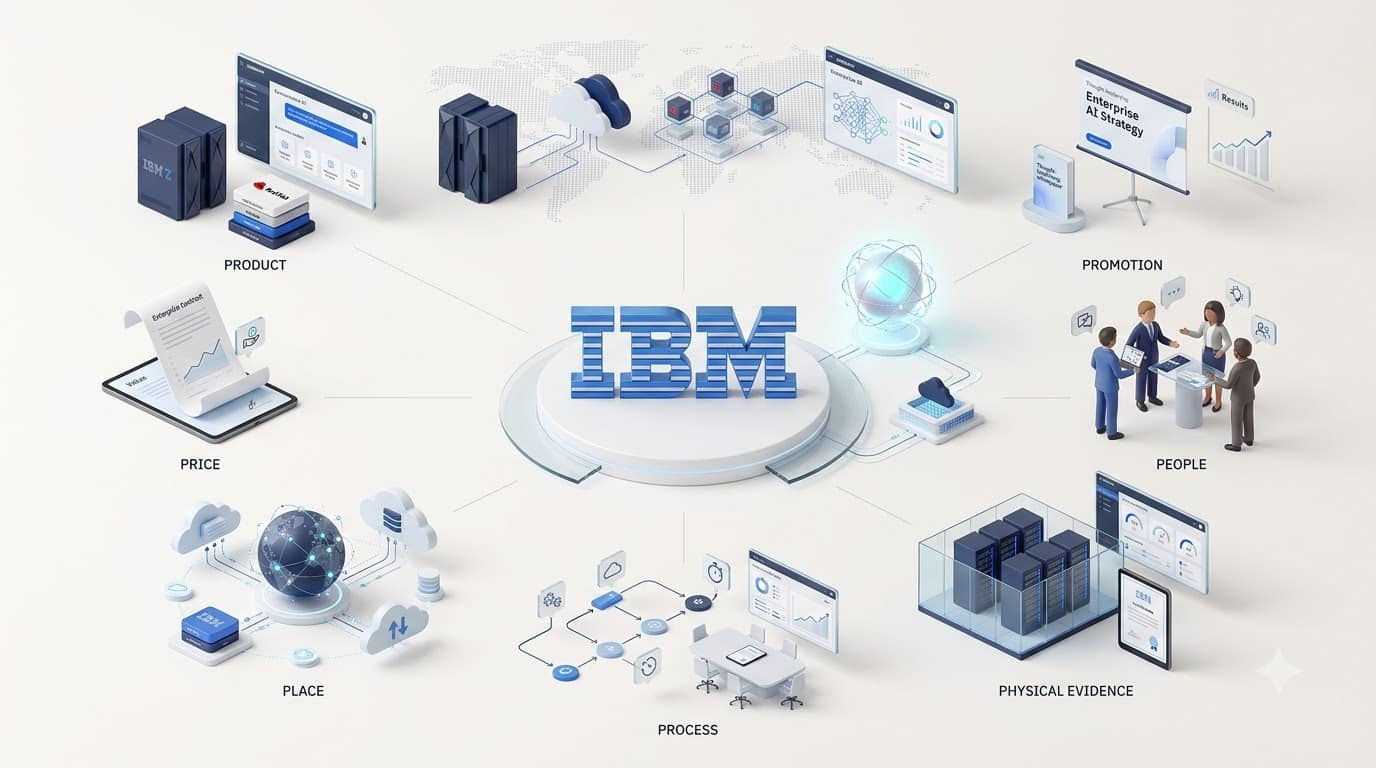
The Marketing Mix of IBM isn’t something you can lift straight from a textbook and apply cleanly, because IBM doesn’t operate like a typical product company. It sells hardware like mainframes and Power servers. It sells software like Red Hat OpenShift and watsonx. It sells consulting hours through IBM Consulting. And increasingly, it sells outcomes, meaning clients pay for a business result, not a specific tool. That blend forces IBM’s marketing team to think in layers instead of a single funnel.
What makes this genuinely interesting right now is the timing. IBM just closed out 2025 with $67.5 billion in revenue, up 6% at constant currency, and its generative AI book of business crossed more than $12.5 billion. That’s not a rounding error. That’s a company that pivoted hard into AI and hybrid cloud and is actually seeing the pivot show up in the numbers. Software and infrastructure both grew in double digits in Q4 2025, and consulting is sitting on a $32 billion backlog with generative AI now making up over a third of new bookings. So this isn’t a legacy company coasting on old contracts. Something in the marketing and go-to-market motion is actually working.
That’s the backdrop for everything below. IBM’s marketing mix isn’t chasing hype cycles. It’s built to convert a hundred-year reputation for reliability into relevance for an AI-first enterprise buyer who’s honestly a little skeptical of every vendor claiming to have “the answer” for their AI strategy.
Product Strategy in the Marketing Mix of IBM
A Portfolio Built on Hybrid, Not Hype
IBM’s product strategy over the last five or six years has centered on one word: hybrid. Not “cloud-first,” not “cloud-only,” but hybrid cloud, meaning a mix of on-premises systems, private cloud, and public cloud all working together. This wasn’t some brilliant marketing insight pulled out of thin air. It came from a hard truth IBM’s own enterprise clients kept telling them. Big banks, insurers, and governments were never going to dump every workload into AWS or Azure. Regulation, latency, legacy systems, and plain old risk aversion meant they needed something that bridged old and new. IBM built its entire product architecture, and its $34 billion Red Hat acquisition, around answering that specific need.
Hardware: The Mainframe Business Refuses to Die
Here’s something that surprises people who assume mainframes are dinosaurs. IBM’s infrastructure segment, largely driven by its Z-series mainframes, posted double-digit revenue growth in Q4 2025, with clients adopting the next generation of the mainframe platform at a strong pace. Banks still run core transaction systems on Z. Airlines still run reservation systems on it. The reason isn’t nostalgia. It’s that these machines process transactions at a volume and reliability level that cloud-native alternatives genuinely struggle to match for certain workloads. IBM leans into this in its marketing, not by pretending mainframes are trendy, but by positioning them as the backbone nobody sees but everybody depends on.
Software: Red Hat Changed the Whole Game
The Red Hat acquisition in 2019 was IBM’s single biggest bet in its modern history, and it’s paying off. Red Hat OpenShift, the container platform that lets companies run applications consistently across any cloud, is reportedly growing at around a 30% growth rate, according to CEO Arvind Krishna on the company’s most recent earnings call. That’s a genuinely fast growth number for a company IBM’s size. What this does for the marketing mix is huge. Red Hat gives IBM credibility with developers, a group that historically hated IBM’s stuffy, enterprise-sales-rep image. Suddenly IBM has open-source street cred, and that changes how the whole software portfolio gets positioned.
watsonx and the AI Product Line
IBM’s watsonx platform is the product line doing the most marketing heavy lifting right now. It’s built around three pillars, watsonx.ai for building and tuning models, watsonx.data for managing enterprise data, and watsonx.governance for keeping AI systems compliant and auditable. That last piece, governance, is IBM’s actual product differentiation and marketing angle. While other vendors race to ship the flashiest model, IBM’s pitch is “we’ll help you deploy AI you can actually explain to a regulator.” For banks, insurers, and government agencies, that message lands. It’s not exciting the way a chatbot demo is exciting, but it’s the message that closes seven and eight figure deals.
Consulting Products Are Products Too
IBM Consulting isn’t a separate business bolted onto the product side. It’s arguably the most important product line in the entire mix, because it’s how IBM actually gets its software and AI tools deployed inside massive, messy enterprise environments. IBM recently unveiled Project Bob, an AI-assisted development environment that automates coding tasks like building, refactoring and testing, and that kind of tool exists specifically to make consulting engagements faster and more scalable. Consulting isn’t just a services line anymore. It’s becoming a delivery mechanism for productized AI.
Price Strategy in the Marketing Mix of IBM
Why “It Depends” Is the Honest Pricing Answer
If you ask an IBM sales rep what watsonx costs, you won’t get a single number. You’ll get a conversation about your data volume, your compute needs, your existing infrastructure, and your industry’s compliance requirements. That drives some buyers crazy, especially ones used to SaaS pricing pages with three neat tiers. But it’s not laziness or opacity for its own sake. Enterprise deals at this scale genuinely vary too much for one-size pricing, and IBM’s whole pricing philosophy assumes the buyer wants a tailored deal more than a transparent list price.
Value-Based Pricing for Big, Messy Enterprise Deals
For large consulting and transformation engagements, IBM prices based on the business value delivered, not just hours billed. If a project promises to cut a bank’s fraud losses by tens of millions of dollars a year, the pricing conversation anchors around that outcome, not around a headcount times hourly rate calculation. This matters for the marketing mix because it reframes IBM from “vendor you pay” to “partner you invest in.” That’s a deliberate positioning choice, and it shows up constantly in IBM’s messaging around “outcomes” instead of “features.”
Subscription and Consumption Pricing for Software
On the software side, especially Red Hat and watsonx, IBM has moved hard toward subscription and consumption-based pricing, mirroring what the rest of the industry does. This is a real shift from IBM’s old-school model of massive upfront licensing fees followed by painful maintenance contracts. Clients pay based on usage or a subscription tier, which lowers the barrier to entry and lets smaller deployments grow into bigger ones over time. It’s a smarter pricing motion for winning developer trust early and expanding later, which is exactly the land-and-expand playbook that cloud-native companies proved works.
Enterprise Contract Pricing and the Power of Bundling
IBM is also aggressive about bundling. A client buying Red Hat OpenShift might get incentivized pricing to also adopt watsonx.governance, or a consulting engagement might come with discounted software licensing baked in. This isn’t unique to IBM, but at IBM’s scale, with a portfolio this wide, bundling becomes a genuine strategic weapon. It raises switching costs for clients and it lets sales teams close bigger deals by stacking value across multiple product lines instead of negotiating each one separately.
Free Cash Flow Tells You the Pricing Strategy Is Working
Here’s a number that matters more than people realize when judging pricing strategy. IBM delivered $14.7 billion in free cash flow for 2025, its highest in over a decade and highest free cash flow margin in reported history. For 2026 they’re guiding toward $15.7 billion. That kind of cash generation doesn’t happen by accident. It means the pricing model, subscription revenue plus high-margin software plus consulting backlog, is converting into real, collectable cash, not just impressive-sounding bookings that never materialize.
Place and Distribution Strategy in the Marketing Mix of IBM
Direct Sales Still Rules the Enterprise Relationship
Despite everything modern about IBM’s product line, the core of its distribution strategy is still old-fashioned direct enterprise sales. Named account executives own relationships with Fortune 500 clients, sometimes for years or decades. This isn’t inefficient legacy behavior, it’s a deliberate choice, because enterprise software and consulting deals worth tens of millions of dollars don’t get closed through a self-serve website checkout. They get closed through relationships, trust, and somebody who picks up the phone when a system goes down at 2am.
The Global Partner Ecosystem
IBM leans heavily on a network of resellers, systems integrators, and technology partners to extend its reach into markets and industries its direct sales force can’t cover alone. Partners like Deloitte, Accenture’s rivals in the systems integration space, and regional IT firms in Asia and Latin America all resell or implement IBM technology. This partner-first distribution approach lets IBM show up in deals it might never win on its own, especially in mid-market segments where a direct enterprise sales rep would be overkill.
Cloud Marketplaces and Digital Distribution
IBM also distributes software through cloud marketplaces, its own IBM Cloud, and increasingly through availability on AWS Marketplace and Azure Marketplace. Yes, you read that right, IBM sells some of its own software through its competitors’ platforms. That’s a pragmatic distribution decision. If a client already lives on AWS and doesn’t want to migrate infrastructure, IBM would rather sell watsonx into that environment than lose the deal entirely over cloud provider loyalty. It’s a “go where the client already is” mentality that a lot of legacy vendors resisted for too long.
Geographic Distribution and Local Presence
IBM operates in more than 175 countries, and its distribution strategy in emerging markets looks different from its strategy in North America and Western Europe. In markets like India, Brazil, and parts of Southeast Asia, IBM invests in local delivery centers, training programs, and partnerships with local governments and universities. This isn’t purely charitable. It builds a long-term talent pipeline for consulting delivery and creates local market credibility that a purely export-based sales approach never could.
Promotion Strategy in the Marketing Mix of IBM
Thought Leadership Over Mass Advertising
You don’t see IBM running Super Bowl ads anymore the way it did during the Watson Jeopardy era. That kind of consumer-facing brand advertising has mostly disappeared from the playbook. Instead, IBM pours resources into thought leadership: research reports, the IBM Institute for Business Value studies, executive bylines, and detailed technical content aimed squarely at CIOs, CTOs, and enterprise architects. The logic is simple. The people who decide on multi-million dollar tech contracts don’t get persuaded by a clever thirty-second spot. They get persuaded by evidence that IBM understands their industry’s specific problems better than the next vendor pitching them.
IBM Think and the Events Strategy
IBM Think, its flagship annual conference, functions as both a product showcase and a massive promotional and relationship-building event. Thousands of clients, partners, and prospects show up not for entertainment but to see roadmaps, hear customer case studies, and get facetime with IBM executives. Events like this matter enormously in B2B marketing because they compress months of sales nurturing into a few days of concentrated attention. It’s expensive to run, but for a company selling seven-figure consulting engagements, the ROI math works out fine if even a handful of major deals get influenced.
Sports Sponsorships as a Trust-Building Tool
IBM has sponsored Wimbledon, the US Open tennis championships, and the Masters golf tournament for years, and this sponsorship strategy isn’t about consumer brand awareness the way a beer or car company would use it. It’s about associating IBM’s name with precision, prestige, and high-stakes performance in front of exactly the demographic of senior executives who make enterprise buying decisions and also happen to watch tennis and golf. It’s subtle brand reinforcement aimed at decision-makers, not mass consumers, and honestly it’s one of the smarter long-game plays in IBM’s promotional mix.
Account-Based Marketing for the Biggest Deals
For its largest target accounts, IBM runs highly customized account-based marketing campaigns. This means content, executive outreach, and even custom research get built specifically for one target company, sometimes one specific buying committee within that company. It’s labor-intensive and doesn’t scale the way a broad digital campaign would, but for deals worth tens of millions of dollars, spending real effort to understand one client’s specific pain points before ever pitching them pays off far more than a generic campaign ever could.
Digital Marketing and the Developer Community
IBM has had to build genuine credibility with developers, a group it historically ignored in favor of courting IT executives. Through Red Hat’s open-source roots and IBM’s own developer relations programs, technical documentation, and community engagement, IBM now shows up where engineers actually look for tools, not just where CIOs look for vendors. This shift matters because in a lot of modern enterprise software deals, a developer champion inside the company can influence or even override what the CIO originally wanted to buy.
People Strategy in the Marketing Mix of IBM
Consultants Are the Brand, Whether IBM Likes It or Not
For a company where consulting is such a massive revenue driver, the people delivering that consulting essentially are the brand experience for a huge chunk of clients. A client doesn’t experience “IBM” as an abstract logo, they experience the specific consultant sitting across the table from them managing a transformation project. That means IBM’s hiring, training, and retention decisions function as marketing decisions in disguise. A poorly trained consultant on a high-profile account can do more brand damage than a bad ad campaign ever could.
Building AI Skills Internally
With generative AI bookings now making up over a third of new consulting business, IBM has had to rapidly reskill tens of thousands of consultants and technical staff. This isn’t just an HR initiative, it’s core to whether the marketing promise of “IBM can deliver enterprise AI” actually holds up once the contract gets signed. There’s a difference between marketing claiming AI expertise and consultants on the ground actually having it, and IBM has poured real investment into closing that gap through internal training programs and partnerships with universities.
Employee Advocacy and LinkedIn Presence
IBM actively encourages employees, from junior consultants to senior executives, to be visible on platforms like LinkedIn, sharing insights, project wins, and industry commentary. This distributed voice strategy extends IBM’s reach far beyond what the official corporate marketing team could produce alone. When a hundred IBM employees post thoughtful commentary about enterprise AI governance, that collectively reaches more of the right audience than one polished corporate blog post ever would, and it feels more credible because it’s coming from actual practitioners.
Diversity and Culture as a Recruiting and Client Trust Signal
IBM has long marketed its diversity initiatives and workplace culture, partly because talent recruitment in tech is brutally competitive, and partly because enterprise clients increasingly care about the values of the vendors they work with, especially in industries like government and public sector contracting where procurement processes explicitly weigh these factors. It’s not purely altruistic marketing, but it’s not purely cynical either. It genuinely affects who wants to work at IBM, which in turn affects the quality of consultants showing up on client accounts.
Process Strategy in the Marketing Mix of IBM
The Sales-to-Delivery Handoff Actually Matters
In most B2B tech companies, there’s a real risk that the sales team overpromises and the delivery team underdelivers, and clients feel the gap immediately. IBM’s process strategy focuses heavily on smoothing that handoff, using structured methodologies for how consulting engagements get scoped, staffed, and delivered. This matters for the marketing mix because a company’s actual delivery process becomes part of its reputation. Word travels fast among CIOs about which vendors deliver what they promised and which ones don’t.
Agile and Iterative Delivery for AI Projects
Unlike the old-school waterfall consulting projects IBM was once known for, dragging on for years with big-bang deliveries, IBM Consulting now markets and delivers AI and cloud transformation projects using agile, iterative methods. Smaller pilot projects prove value quickly before scaling to enterprise-wide rollouts. This process shift is itself a marketing message. It tells skeptical clients “we’re not going to disappear for eighteen months and come back with something that doesn’t work,” which addresses one of the biggest fears enterprise buyers have about big consulting engagements.
Governance and Compliance Built Into the Process
Given how much of IBM’s AI pitch centers on trustworthy, explainable AI, its actual delivery process for AI projects includes formal governance checkpoints, bias testing, and compliance documentation baked in from day one, not bolted on afterward. This operational discipline is what lets IBM’s marketing legitimately claim differentiation on AI governance, because the process backs up the promise instead of just repeating it in a slide deck.
Customer Success as an Ongoing Process, Not a One-Time Sale
IBM treats major accounts as long-term relationships requiring continuous engagement, not one-time transactions. Dedicated account teams, regular business reviews, and ongoing optimization work all form part of a process designed to keep renewal rates high and expand wallet share within existing accounts over time. In a business built around subscriptions and multi-year consulting relationships, retaining and expanding existing clients is far more profitable than constantly chasing new logos, and the entire customer success process reflects that priority.
Physical Evidence in the Marketing Mix of IBM
Data Centers and Cloud Infrastructure as Tangible Proof
For a company selling a lot of intangible services and cloud capacity, IBM’s physical data centers around the world function as tangible proof that the infrastructure behind the promises actually exists. Clients evaluating cloud and AI vendors care about where data physically resides, especially in regulated industries with data residency requirements. IBM’s global data center footprint becomes a literal, physical piece of evidence supporting its pitch about hybrid cloud reliability and compliance.
Case Studies and Client Reference Stories
Because so much of enterprise buying comes down to trust, IBM invests heavily in documented, detailed case studies showing exactly how a specific client used a specific IBM product or consulting engagement to achieve a specific measurable result. These aren’t vague testimonials. They’re detailed enough that a prospective client’s own team can map their situation onto the example and judge credibility for themselves. This kind of tangible proof matters enormously more in enterprise tech sales than flashy branding ever could.
The IBM Logo and a Century of Visual Consistency
IBM’s iconic striped “IBM” logo, designed by Paul Rand back in 1972, has barely changed in over fifty years. That kind of visual consistency is itself a form of physical evidence in the marketing mix, signaling stability and permanence in an industry where companies rebrand every few years chasing trends. When a CIO sees that logo, there’s an unspoken message: this company has survived every tech cycle since the mainframe era, and it’ll probably survive the next one too.
Offices, Innovation Labs, and Client Briefing Centers
IBM operates client briefing centers and innovation labs around the world where prospective clients can physically walk through demos, see quantum computing hardware, or sit through immersive workshops about their specific industry challenges. These physical spaces matter because abstract cloud and AI concepts become much easier to sell when a client can literally touch a piece of hardware or walk through a working demo environment instead of just watching a slide deck.
Competitive Position: How IBM’s Marketing Mix Stacks Up Against Microsoft, AWS, Oracle, and SAP
Look, IBM isn’t winning every fight here, and it would be dishonest to pretend otherwise. Against Microsoft Azure and AWS in raw cloud infrastructure market share, IBM Cloud is a distant player. Those two companies built cloud from the ground up as their core business, and IBM is still playing catch-up in pure infrastructure scale. Where IBM’s marketing mix wins is in hybrid environments, regulated industries, and situations where a client explicitly does not want to be locked into one hyperscaler.
Against Oracle, the fight looks different. Oracle still dominates in enterprise databases and has been aggressively pushing its own cloud infrastructure, often bundled tightly with its applications. IBM doesn’t try to out-Oracle Oracle on databases. Instead it positions Red Hat and watsonx as the neutral, open alternative for companies who don’t want to get locked into one vendor’s stack top to bottom. That message resonates with a specific type of buyer who’s been burned by vendor lock-in before.
Against SAP, the overlap is mostly in the consulting and enterprise transformation space, where both companies compete to be the systems integrator of choice for massive ERP and digital transformation projects. Here IBM Consulting’s scale and its AI governance positioning give it a real edge with clients who want a partner that isn’t also trying to sell them the underlying software platform, which creates a more neutral, trusted-advisor dynamic than SAP can easily offer when it’s often selling its own products through the same conversation.
The honest takeaway is that IBM’s marketing mix isn’t built to win every category. It’s built to win the specific, high-stakes, high-complexity enterprise deals where trust, governance, and hybrid flexibility matter more than raw scale or lowest price. That’s a narrower lane than Microsoft or AWS play in, but it’s a lane IBM can actually defend, and the 2025 numbers suggest that focus is paying off.
Why the Marketing Mix of IBM Actually Works in 2026
So does it all add up? Honestly, yeah, more than a lot of people expected five or six years ago when IBM looked like a company slowly fading into irrelevance. The product strategy correctly bet on hybrid cloud before it was obvious that was the winning model. The pricing strategy adapted from old-school licensing to modern subscription and consumption models without losing the value-based pricing power that big consulting deals depend on. Distribution stayed pragmatic, showing up wherever clients already were instead of demanding loyalty to one platform. Promotion shifted from consumer-facing spectacle to quiet, evidence-based trust building aimed at the actual decision-makers. People and process both got rebuilt around delivering on AI promises instead of just marketing them. And physical evidence, from data centers to case studies to that unchanged logo, kept reinforcing the core message of permanence and reliability.
None of this is flashy. IBM isn’t the company generating viral TikToks or Twitter threads about its latest product launch. But for a business built on multi-year, multi-million dollar enterprise relationships, flashy was never the right strategy anyway. The proof is in the numbers: $67.5 billion in revenue, record free cash flow, and a generative AI business that’s grown from nothing to over $12.5 billion in bookings in a remarkably short window. Whatever criticisms you can level at IBM, and there are plenty, the marketing mix behind that turnaround deserves a closer look than most people give it.
Frequently Asked Questions
What are the 7Ps in the Marketing Mix of IBM?
The 7Ps are Product, Price, Place, Promotion, People, Process, and Physical Evidence. IBM’s product spans hardware, software, and consulting, its pricing blends subscription, consumption, and value-based models, and the remaining Ps cover how it distributes, promotes, staffs, delivers, and proves its offerings to enterprise clients.
Why does IBM focus so much on hybrid cloud instead of just public cloud like AWS?
Because IBM’s core enterprise clients, banks, insurers, governments, can’t or won’t move everything to public cloud due to regulation, latency, and legacy system dependencies. Hybrid cloud lets IBM sell into that reality instead of forcing an all-or-nothing migration that most large enterprises simply won’t agree to.
Is IBM still relevant in 2026, or is it just living off old contracts?
The 2025 numbers say it’s genuinely relevant again. Revenue hit $67.5 billion with 6% constant currency growth, free cash flow hit a decade-high $14.7 billion, and the generative AI business crossed $12.5 billion in bookings. That’s not a company coasting, that’s active growth driven by new product lines like watsonx and Red Hat.
How does IBM price its AI products like watsonx?
Mostly through consumption and subscription-based models tied to usage, data volume, and compute needs, layered with value-based pricing for larger consulting-led deployments. There’s no single public price list because enterprise deployments vary too much in scale and complexity for flat pricing to work.
Does IBM still sell mainframes, and do companies actually still buy them?
Yes, and yes. IBM’s infrastructure segment, largely driven by Z-series mainframes, posted double-digit growth in Q4 2025 as clients adopted the newest generation of the platform. Banks and airlines especially still depend on mainframes for core transaction processing at a reliability level cloud alternatives haven’t fully matched for those specific workloads.
Why does IBM sponsor events like Wimbledon and the Masters instead of running mainstream ads?
Because IBM’s real audience isn’t the general consumer, it’s senior enterprise decision-makers who happen to watch prestige sporting events. The sponsorship reinforces qualities like precision and trust in front of exactly the demographic that influences multi-million dollar technology contracts.
What is IBM Consulting’s role in the overall marketing mix?
IBM Consulting is both a major revenue driver and the delivery mechanism that turns IBM’s software and AI promises into actual working deployments. It’s sitting on a $32 billion backlog, with generative AI now representing over a third of new bookings, making it central to how IBM converts product credibility into signed contracts.
How is IBM different from Microsoft and AWS in its marketing approach?
Microsoft and AWS largely compete on cloud scale, ecosystem breadth, and developer reach. IBM doesn’t try to match that scale directly. Instead it positions itself around hybrid flexibility, vendor neutrality, and AI governance for regulated industries, a narrower but defensible lane where trust matters more than raw infrastructure size.
What role did the Red Hat acquisition play in IBM’s marketing strategy?
Red Hat, acquired for $34 billion in 2019, gave IBM genuine open-source credibility and developer trust it had struggled to earn on its own. Products like OpenShift, reportedly growing around 30%, now anchor IBM’s hybrid cloud pitch and helped shift IBM’s image from stodgy enterprise vendor to a company developers actually respect.
Does IBM’s marketing target consumers at all, or only businesses?
Almost entirely businesses. Unlike the Watson Jeopardy era, which had genuine consumer visibility, IBM’s current marketing is squarely B2B, aimed at CIOs, CTOs, procurement teams, and enterprise architects rather than everyday consumers who don’t directly buy mainframes or consulting engagements.
How does IBM use case studies and client stories in its promotional strategy?
Heavily and specifically. Rather than vague testimonials, IBM documents detailed, measurable outcomes from real client engagements so prospective buyers can map their own situation onto a comparable example. In enterprise sales, this kind of concrete proof matters far more than broad brand advertising ever could.
What’s IBM’s biggest weakness in its current marketing mix?
Raw public cloud market share against AWS and Microsoft Azure. IBM Cloud remains a distant player in pure infrastructure scale, and no amount of positioning around hybrid flexibility fully closes that gap. IBM’s strategy works around this weakness rather than solving it directly, focusing on the segments where hybrid and governance actually matter more than scale.
Where can I find more detail on IBM’s official financial and strategic positioning?
IBM publishes its annual report and investor materials, including CEO letters and 10-K filings, directly through its investor relations site, which is the most reliable source for verified revenue, growth, and strategic commentary straight from leadership.