


Most people who type “marketing mix of HCL” into Google are expecting a textbook answer. Four Ps, a paragraph each, done. But that approach falls apart the moment you actually look at what HCLTech is doing in the real world. This is not a company selling soap or soft drinks. It is a $14.8 billion technology and engineering business with over 223,000 employees spread across 60 countries, and its marketing decisions look nothing like what you’d read in a standard Kotler chapter.

Look at what actually happens when a company like HCL wins a deal. There’s no shelf space, no retail packaging, no impulse buy. A single contract can take eighteen months to close, involve twelve stakeholders on the client side, and be worth hundreds of millions of dollars over its lifetime. That changes everything about how you think about product, price, place, and promotion. It also means the classic 4Ps model needs stretching into 7Ps, because in a service business, people, process, and physical evidence aren’t optional extras. They’re half the sale.
This guide breaks down the marketing mix of HCL the way it actually functions, not the way a slide deck presents it. We’ll go through what HCL actually sells, how it prices work that often has no fixed cost, how it delivers services from Noida to North Carolina, how it gets in front of Fortune 500 buyers who never see a TV ad, and why the “product” in a services company is really a promise backed by people. Along the way, expect real numbers, named service lines, and comparisons to competitors like TCS, Infosys, Wipro, and Cognizant, because you can’t understand HCL’s positioning without understanding who it’s positioned against.
What You Will Learn in This Guide
- How the marketing mix of HCL differs from a typical product company’s 4Ps and why the extended 7Ps model fits it better
- What HCL actually sells across its three core business lines: ITBS, ERS, and HCLSoftware
- How pricing works in a B2B services business where there’s no fixed price tag
- How HCL’s global delivery model functions as its “place” strategy
- How HCL promotes itself to enterprise buyers without traditional advertising
- Why people, process, and physical evidence matter as much as the original four Ps
- The mistakes people commonly make when analyzing HCL’s marketing mix
- A set of frequently asked questions covering the practical side of this topic
What is the Marketing Mix of HCL
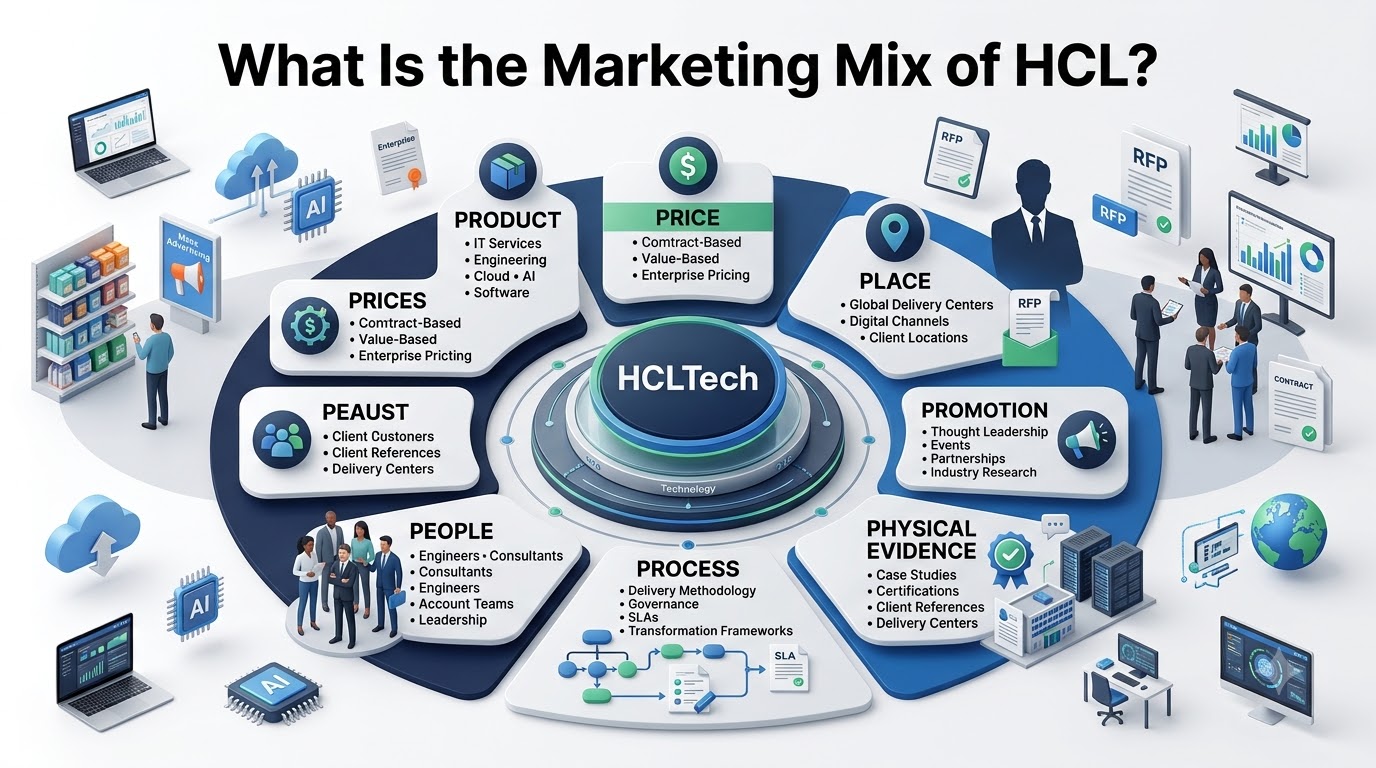
The marketing mix of HCL only makes sense once you understand what kind of business HCL actually is. It’s not a consumer brand competing for attention in fifteen-second ad slots. HCLTech, founded by Shiv Nadar in 1976 and headquartered in Noida, is one of India’s largest IT services and engineering companies, sitting alongside TCS, Infosys, and Wipro as part of the country’s tech services heavyweight class. Its business runs on long-term contracts with enterprises, not one-off purchases from individual consumers.
That single fact reshapes every P in the mix. A consumer goods company worries about shelf placement and impulse triggers. HCL worries about being shortlisted in a Request for Proposal that a bank’s procurement team spent eight months drafting. A consumer brand runs a Super Bowl ad. HCL sponsors an AI research paper co-authored with a university and gets cited in a Gartner report instead. The mechanics are completely different, even though the underlying goal, winning and keeping customers profitably, is the same.
Why an IT Services Giant Needs a Different Marketing Playbook
Here’s the thing most people miss: in a services business, the thing being sold doesn’t exist yet at the point of sale. When HCL bids on a cloud migration contract for a European insurance company, it isn’t handing over a finished product. It’s promising an outcome, backed by a delivery team, a methodology, and a track record. That’s a fundamentally different sale than buying a laptop off a shelf.
This is why services marketing scholars added three more Ps decades ago: people, process, and physical evidence. For a company like HCL, those three aren’t decoration. They’re often the deciding factor in a deal. A CIO comparing HCL against Infosys for a $200 million application modernization contract isn’t just comparing price sheets. They’re evaluating the actual delivery team they’ll be working with, the governance process for escalations, and whatever proof points (case studies, reference clients, audited SLAs) HCL can put on the table. Skip any one of those three Ps and the analysis of HCL’s marketing mix stays shallow.
Product Strategy
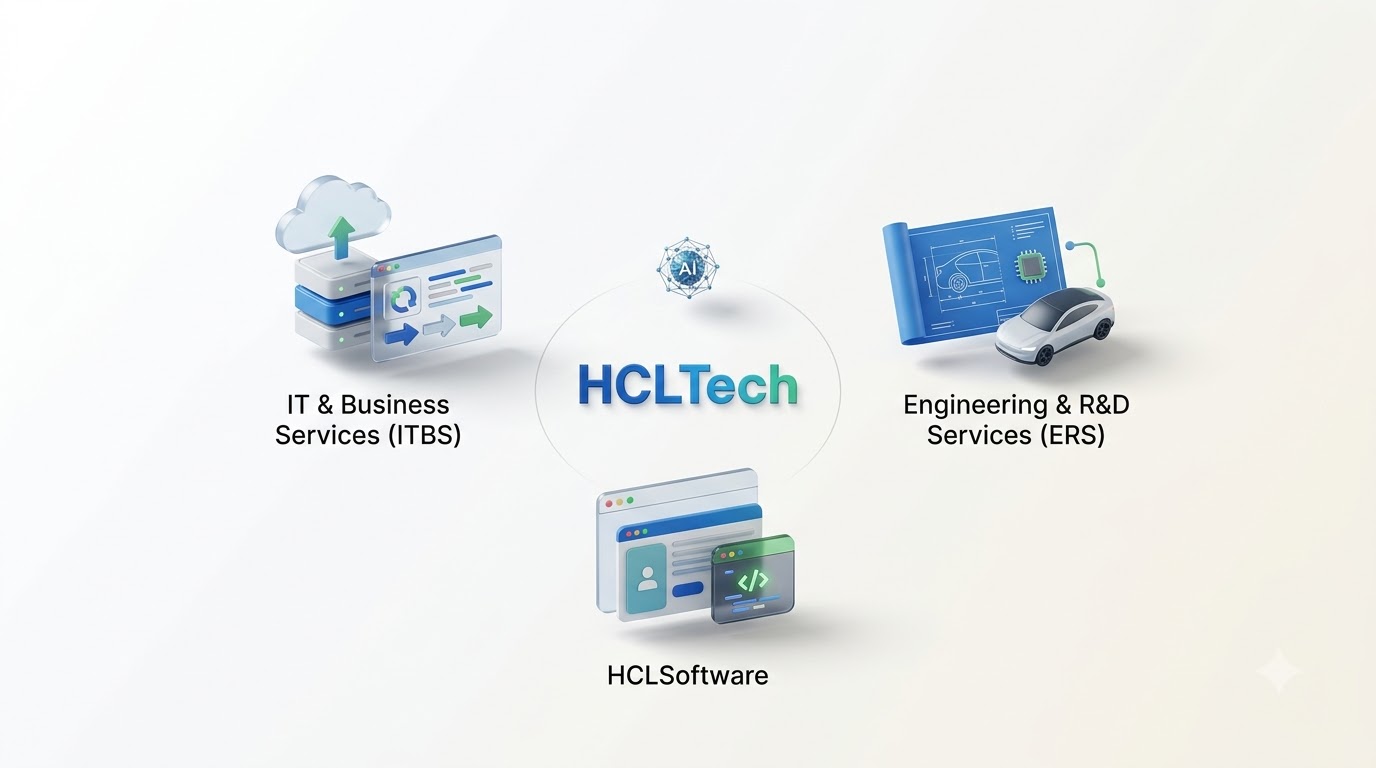
Product is usually the easiest P to explain and the hardest one to get right in a services company, because “product” here means a portfolio of capabilities, not a single item. HCLTech organizes its offerings into three main business lines, and understanding each one is the actual starting point for grasping the marketing mix of HCL.
The first is IT and Business Services, or ITBS, which is the biggest revenue contributor by a wide margin. This covers application development and management, infrastructure services, cloud transformation, cybersecurity, and digital process operations. Basically, this is the “keep the enterprise running and modernize it at the same time” business. The second is Engineering and R&D Services, or ERS, which is HCL’s more specialized arm working on product engineering for clients in aerospace, automotive, telecom, and medical devices. This is less “manage your servers” and more “help us design the next generation of our product.” The third is HCLSoftware, the company’s enterprise software arm, which crossed roughly $1 billion in annual recurring revenue and includes products acquired from IBM back in 2019, like the Notes, Domino, and Unica portfolios, alongside homegrown platforms.
Core Service Lines: ITBS, ERS, and HCLSoftware Explained
ITBS is where most of HCL’s headline deals get announced. Think of large multi-year application modernization contracts, cloud migrations to AWS or Azure, and managed cybersecurity services for banks and insurers. This segment behaves almost like a subscription business at enterprise scale: once a client signs a five-year infrastructure management deal, that revenue is largely locked in, which is exactly why services companies fight so hard over renewal and expansion within existing accounts rather than only chasing new logos.
ERS is the more technical, less talked-about engine. HCL doesn’t just write code for engineering clients, it embeds engineers into a client’s product development lifecycle. If a semiconductor company needs help validating a chip design, or an automaker needs software for an electric vehicle’s battery management system, that work sits inside ERS. This segment tends to carry better margins because it requires deeper domain expertise that fewer competitors can match, which is a real point of differentiation HCL leans on hard in its positioning against generalist competitors.
HCLSoftware deserves its own mention because it’s the part of the mix that looks the most like a traditional product business. Unlike ITBS and ERS, which are service-led, HCLSoftware sells licensed and subscription-based enterprise software: automation tools, marketing platforms like Unica, and DevOps products. This gives HCL a recurring revenue stream that behaves differently from project-based services revenue, and it’s a deliberate move to reduce dependency on the more cyclical, discretionary spending that dominates traditional IT services contracts.
Vertical-Specific Offerings and Why They Matter
Nobody buys “IT services” in the abstract. A hospital network buying data infrastructure has completely different regulatory, compliance, and integration needs than a telecom operator rolling out 5G infrastructure. That’s why HCL structures a huge part of its go-to-market around named industry verticals: financial services, manufacturing, life sciences and healthcare, technology, telecom and media, retail and CPG, and public services, among others.
This vertical structuring isn’t just an internal org chart decision, it’s a marketing decision. When HCL pitches to a pharmaceutical company, the sales team isn’t sending a generic cloud migration pitch. They’re sending a team that understands FDA validation requirements, GxP compliance, and clinical trial data management. That specificity is the actual product differentiation happening beneath the surface. Two competitors might both technically be able to migrate a workload to the cloud, but only one of them shows up already speaking the client’s regulatory language, and that’s often the tiebreaker in a competitive bid.
Product Innovation Through IP-Led Services and AI
Here’s where HCL has been pushing hardest lately, and it’s worth calling out specifically because it changes the shape of the “product” P entirely. HCL reported roughly $620 million in annualized Advanced AI revenue, becoming the first large-cap India-headquartered IT services company to report that figure as a distinct line item. That’s not a footnote, that’s a strategic signal that AI-related work (AI advisory, AI engineering, and what HCL calls “Physical AI” involving robotics) is being treated as its own product category rather than something folded quietly into existing service lines.
What this means practically is that HCL is shifting away from being purely a “we’ll execute what you ask for” services vendor toward selling pre-built accelerators, frameworks, and proprietary tools that clients license or use as part of a broader engagement. This is a smart move because pure labor arbitrage, billing by the hour for cheaper offshore talent, is a shrinking margin business as AI automates more coding and testing work. Owning intellectual property, even inside a services wrapper, is how a company like HCL protects its margins going forward.
Price Strategy
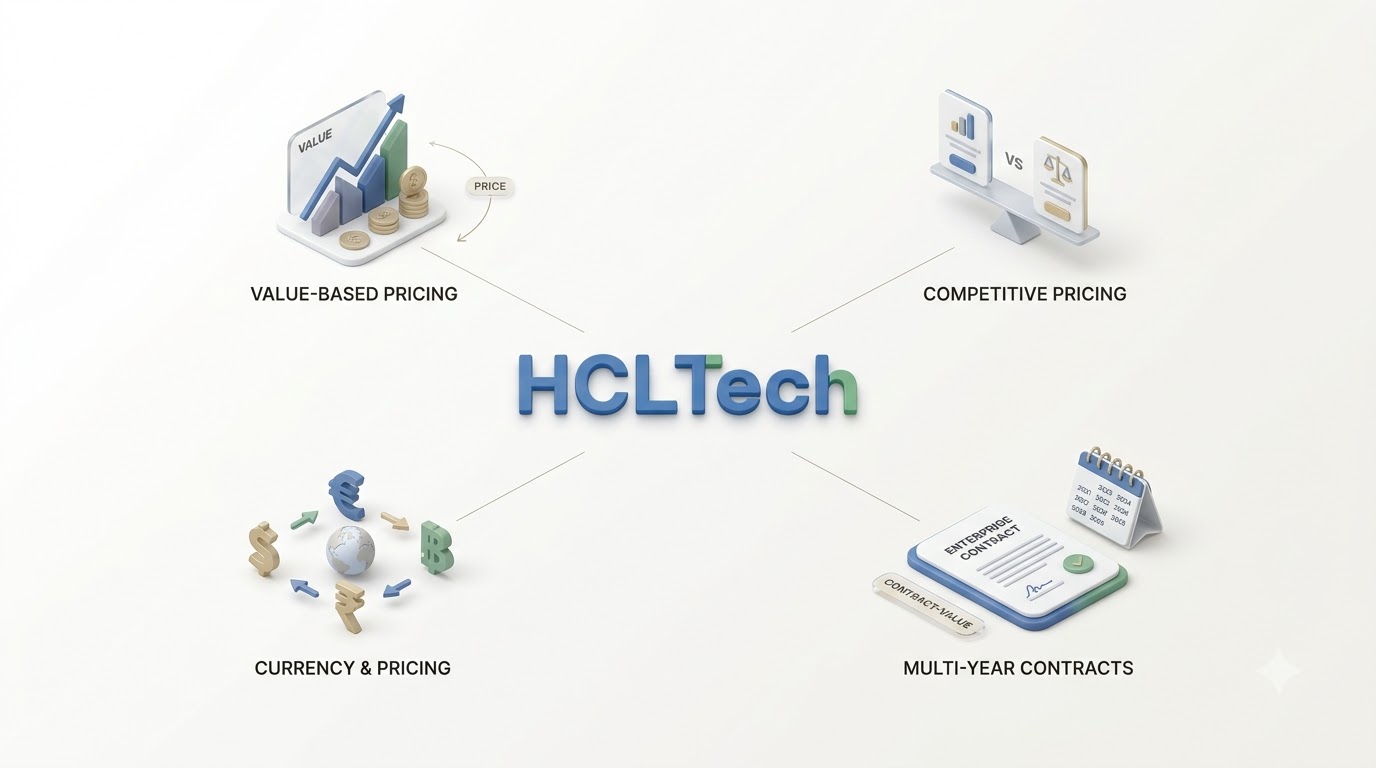
Pricing in the marketing mix of HCL doesn’t look anything like a price list. There’s no MRP sticker. Every major deal is negotiated, and the pricing model itself is often part of the competitive pitch. Getting this wrong, either by underpricing and eating margin, or overpricing and losing the deal to Infosys or TCS, can swing a company’s quarterly earnings call. That’s how material pricing decisions are at this scale.
HCL runs a mix of pricing models depending on the type of engagement, and honestly, understanding these models is more useful than memorizing any specific number, because the numbers change every quarter and the models don’t.
Outcome-Based and Value-Based Pricing Models
The industry has been moving away from pure time-and-materials billing (pay for hours worked, plain and simple) toward outcome-based pricing, where a chunk of the fee is tied to a measurable business result. If HCL is running a client’s IT helpdesk, an outcome-based contract might tie part of the payment to ticket resolution time or system uptime rather than just headcount hours logged. This is a deliberate pricing strategy shift because clients, especially CFOs, got tired of paying for effort instead of results.
Value-based pricing takes this further. Instead of anchoring the price to cost-plus-margin, HCL prices some engagements based on the value the client expects to realize. If a cloud modernization project is projected to save a client $50 million over five years through infrastructure consolidation, the pricing conversation shifts toward “what portion of that value is fair to capture as fees” rather than “how many consultant-hours did this take.” This is harder to execute because it requires trust and shared risk, but it commands better margins when it works, and HCL has been pushing this model especially hard on its AI-led engagements where the ROI story is easier to quantify.
Competitive Pricing Against TCS, Infosys, and Wipro
You cannot talk about HCL’s pricing without talking about its direct competitors, because in this industry, pricing is relative, not absolute. TCS, Infosys, Wipro, and Cognizant are all bidding on many of the same large enterprise deals, and price sensitivity in procurement-led RFPs is real. HCL’s EBIT margin has typically sat in the 18 to 19.5 percent range, which is competitive but not the highest in the sector, TCS often runs higher margins due to its scale advantages.
What HCL does instead of competing purely on the lowest bid is differentiate through what it calls, and has publicly used as messaging, being a partner willing to take on “non-linear” growth models, meaning growth that isn’t strictly tied to adding more billable heads. This matters in pricing conversations because a client evaluating vendors on cost-per-hour alone will always find someone cheaper. HCL’s pitch, especially in renewal and expansion conversations with existing accounts, leans on total cost of ownership and business outcomes rather than headline day-rates, which is a smarter pricing argument when you’re not the lowest bidder in the room.
Deal Structuring: Total Contract Value and Multi-Year Commitments
Most people outside the industry don’t realize how much of the “pricing” conversation in enterprise IT services actually happens at the contract-structuring level, not the per-unit level. HCL reports figures like total contract value, or TCV, for new deal wins, which recently hit around $9.3 billion in a single fiscal year and $2.1 billion in a strong individual quarter. These aren’t single transactions, they’re bundles of multi-year commitments, often three to seven years long, that get signed once and then billed incrementally.
This changes the pricing psychology entirely. A five-year, $500 million deal isn’t priced the way a $500 one-time purchase would be. There’s ramp-up pricing in year one while teams are onboarded, steady-state pricing through the middle years, and often built-in price step-downs in later years as automation and efficiency gains kick in, which HCL then has to absorb through cost efficiency to protect its margin. Getting this multi-year pricing architecture wrong is one of the fastest ways a services company destroys shareholder value, because you’re locked into a bad deal for half a decade.
Currency Risk and Geographic Pricing Adjustments
One layer of pricing that rarely makes it into student breakdowns of the marketing mix of HCL is currency exposure, and it genuinely deserves a mention because it shapes real pricing decisions every quarter. HCL bills clients in dollars, euros, and pounds while paying a large share of its workforce in Indian rupees, which means currency swings can quietly move margins up or down even when nothing about the underlying contract changed. That’s why HCL, like its peers, reports revenue growth in both reported currency and constant currency, stripping out the exchange rate noise so investors and clients can see the real underlying business performance.
This currency reality feeds directly into how new deals get priced. A contract signed with a European client during a period of rupee weakness against the euro can look more profitable on paper than the same deal signed a year later if the rupee strengthens, so pricing teams build in contractual protections, rate escalation clauses tied to currency movement, or annual repricing reviews, to avoid getting squeezed by exchange rate shifts over a five-year contract term. It’s a detail that never shows up in a client-facing pitch deck, but it’s constantly present in the actual commercial negotiation behind the scenes.
Place Strategy
Place doesn’t mean retail stores here, obviously. It means the delivery network, the physical and digital infrastructure through which HCL actually gets work done for a client sitting in Chicago while the delivery team sits in Chennai, Krakow, and Guadalajara simultaneously. This is arguably the most operationally complex P in the entire mix for a company like HCL.
The Global Delivery Model: Onshore, Offshore, and Nearshore
HCL runs what’s called a blended delivery model, mixing onshore staff (based in the client’s own country, often for client-facing and high-touch roles), offshore staff (largely based in India, handling the bulk of execution work at lower cost), and nearshore staff (based in countries close to the client, like Mexico for US clients or Poland for European clients, balancing cost with time-zone convenience). This isn’t a static ratio, it shifts deal by deal depending on what the client actually needs and, increasingly, depending on local data residency laws that require certain work to physically stay within a country’s borders.
The reason this matters for marketing, not just operations, is that “where the work gets done” has become an actual selling point in pitches. A European bank worried about GDPR compliance wants to hear specifically which HCL delivery centers will touch their data and under what legal jurisdiction. HCL operates across 60 countries with delivery centers strategically placed to answer exactly that question before a prospect even asks it, which is a place strategy doing double duty as a trust-building sales tool.
Partner Ecosystem and Cloud Marketplace Presence
The other half of “place” for a modern IT services company is digital distribution through partner ecosystems, not just physical office locations. HCL holds elite-tier partnerships with AWS, Microsoft Azure, Google Cloud, and Salesforce, and a chunk of its go-to-market now runs through these hyperscaler marketplaces. A client can, in some cases, procure certain HCL-built solutions directly through the AWS Marketplace rather than through a traditional sales cycle.
This is a genuinely modern twist on the “place” P. Twenty years ago, an IT services firm’s distribution channel was entirely relationship-driven, account managers flying out to meet CIOs in person. Now a portion of demand generation happens because a solutions architect at a client company searches the Azure Marketplace for a pre-built industry accelerator and finds one co-branded by HCL and Microsoft. That’s distribution happening through a digital storefront, not a sales rep, and it’s becoming a bigger share of how enterprise software-adjacent services get discovered.
Industry-Specific Delivery Hubs
HCL has also built what it calls dedicated innovation labs and industry-specific delivery hubs, physical locations built around a specific vertical’s needs rather than generic capacity. There are engineering-heavy hubs supporting automotive and aerospace clients where physical labs and hardware testing environments exist alongside software teams. This matters because for ERS-type engagements especially, you can’t just spin up a virtual team, some of this work genuinely requires physical lab access, testing rigs, and specialized equipment that can’t be replicated from a laptop in a co-working space.
This physical specialization is a deliberate place strategy: instead of one generic delivery center model applied everywhere, HCL builds location strategy around what a given vertical actually requires, which becomes part of the pitch when competing against a rival that only offers generic delivery capacity.
Promotion Strategy
Here’s where the marketing mix of HCL diverges most sharply from consumer marketing. There is no HCL commercial airing during a cricket match, at least not in the way a consumer brand would run one. Promotion in this business is almost entirely B2B, relationship-driven, and built around trust signals that a large enterprise buyer actually cares about.
Account-Based Marketing and Enterprise Sales Enablement
The core promotional engine at HCL’s scale is account-based marketing, or ABM, where instead of running broad campaigns to generic audiences, marketing teams build hyper-targeted campaigns aimed at named accounts, sometimes a single specific company, with content and outreach tailored to that account’s known priorities. If HCL is trying to expand its footprint inside a specific global bank, marketing might produce a custom point-of-view document on that bank’s regulatory pressures, distributed directly to that bank’s known decision-makers through LinkedIn and email, not a public ad campaign.
This matters because in enterprise deals worth hundreds of millions of dollars, the actual buying committee might be fewer than twenty people. Spending money on mass awareness advertising for that audience is close to wasted spend. ABM lets HCL concentrate promotional dollars exactly where the deal decisions get made, and it’s why you’ll rarely see HCL in a general consumer media buy but will constantly see it sponsoring niche, high-value industry events like Davos, Money20/20, or specific Gartner and IDC analyst summits where the room is full of exactly the buyers who matter.
Thought Leadership, Brand Campaigns, and the HCLTech Rebrand
HCL went through a notable rebrand in 2022, shifting its public identity from “HCL Technologies” to “HCLTech” with the tagline “Supercharging Progress.” This wasn’t cosmetic. It replaced the older, long-running “Relationship Beyond the Contract” positioning that had defined the brand for over a decade. The shift signaled a deliberate move away from being perceived as a low-cost delivery vendor toward being seen as a forward-looking, AI and engineering-led technology partner, which matches the product strategy shift toward Advanced AI revenue discussed earlier.
Thought leadership is the primary vehicle for this repositioning. HCL regularly publishes research reports, like industry-specific studies on AI adoption in telecom or manufacturing, co-authored or cited by firms like Gartner, IDC, and Forrester. These aren’t vanity projects. A CIO who reads an HCLTech-commissioned report on AI readiness in their specific industry, sees HCL’s name attached to credible, third-party-validated data, and remembers that name six months later during a vendor shortlisting conversation. That’s the entire mechanism: promotion through earned credibility rather than paid reach.
Digital Presence, Events, and Analyst Relations
LinkedIn is genuinely one of HCL’s most important promotional channels, more so than most people realize. Executive thought leadership posts from CEO C Vijayakumar and other senior leaders get significant engagement from exactly the enterprise buyer audience HCL cares about. This is a deliberate promotional choice: B2B buyers increasingly research vendors through executive visibility and peer commentary on platforms like LinkedIn before ever taking a sales call, so having senior leadership actively and consistently present there is now table stakes, not optional extra.
Analyst relations deserves a specific mention because it functions almost like a promotional channel of its own in this industry. Being named a “Leader” in a Gartner Magic Quadrant or an IDC MarketScape report, HCL was recently recognized as a Leader in the Gartner Magic Quadrant for Public Cloud Optimization and Transformation Services, carries enormous weight with enterprise buyers who often use these reports directly in their vendor shortlisting process. Getting that positioning right involves months of structured briefings with analyst firms, which is a promotional investment most consumer marketers never have to think about but which can single-handedly influence whether HCL even gets invited to bid on a deal.
People: The Human Capital Behind the Marketing Mix of HCL
In a services business, the product and the people delivering it are almost the same thing. You can’t separate “what HCL sells” from “who actually shows up to do the work.” That’s why people sit inside the marketing mix at all, rather than being purely an HR concern.
Talent Strategy, Hiring, and Fresher Programs
HCL employs over 223,000 people, and how it recruits, trains, and retains that workforce directly shapes what it can promise clients. The company runs large-scale fresher hiring programs, bringing in thousands of entry-level graduates each quarter (2,014 freshers were hired in a single recent quarter as one data point) and putting them through structured training academies before deploying them onto client accounts. This matters for marketing because client-facing sales teams have to be able to credibly promise delivery capacity and skill depth, and that promise only holds if the talent pipeline behind it is real and consistently replenished.
Attrition is another number that quietly shapes the marketing mix here. HCL’s attrition rate has hovered around 13 percent in recent periods, and this figure genuinely gets discussed in investor calls and, indirectly, in client conversations, because high attrition disrupts project continuity and knowledge transfer on long-running accounts. A client renewing a five-year contract is implicitly betting that the team they trust today will still mostly be there in year three, and attrition numbers are a real signal of whether that bet is safe.
Employer Branding and Its Effect on Client Trust
Employer branding, how HCL is perceived as a place to work, has become tangled up with client-facing brand perception in a way that didn’t used to matter as much. A prospective enterprise client doing due diligence on HCL will often check Glassdoor reviews, LinkedIn employee sentiment, and industry talent surveys as part of vendor evaluation, on the theory that a company with disengaged, high-turnover staff will deliver worse outcomes. HCL has invested specifically in initiatives around upskilling (its internal “TechBee” apprenticeship program, for instance, which recruits directly from high school and trains talent from the ground up) partly because this strengthens the talent pipeline, but also because it becomes a genuine marketing asset: proof that the company invests seriously in the people who will actually be doing a client’s work.
Diversity, Upskilling, and Long-Term Talent Investment
There’s another dimension to the people P worth calling out on its own: how HCL invests in reskilling its existing workforce rather than only hiring new talent for emerging skills like AI and cloud engineering. Large parts of HCL’s 223,000-plus workforce were originally trained in older technology stacks, mainframe systems, legacy application maintenance, traditional infrastructure support, and the company runs structured internal upskilling programs to move a meaningful share of that workforce into AI-adjacent and cloud-native roles rather than simply hiring an entirely new team from outside.
This matters for the marketing mix in a very practical way. When a sales team pitches an AI-led transformation program to a client, the credibility of that pitch depends partly on whether the client believes HCL genuinely has the depth of AI-skilled talent to deliver it, not just a handful of specialists trotted out for the sales call. Continuous internal upskilling is how HCL keeps that promise honest at scale, and it’s part of why the company talks publicly about workforce transformation initiatives alongside its AI revenue numbers rather than treating them as separate stories.
Process: How HCL Delivers on What It Promises
Process is the least visible P and the one that decides whether a client renews or walks. Everything else in the marketing mix, the product pitch, the pricing model, the promotional content, is essentially a promise. Process is where that promise either gets kept or breaks down.
Delivery Methodologies, Agile Frameworks, and Governance
HCL runs its delivery engagements through structured frameworks like agile and DevOps-driven delivery models, with formal governance layers, steering committees, escalation paths, and defined SLAs (service level agreements) that specify exactly what “good performance” looks like on paper. This sounds bureaucratic, and honestly, some of it is, but it’s also exactly what a Fortune 500 procurement team is scrutinizing line by line before signing a nine-figure contract. A vague promise of “we’ll do agile” doesn’t survive a serious vendor evaluation. What survives is a documented governance model showing exactly how issues get escalated, who’s accountable at each tier, and how performance gets measured against contractual SLAs.
This process rigor becomes a genuine competitive differentiator in pitches. When HCL is competing against a smaller, more agile-sounding boutique consultancy for a large enterprise deal, the boutique’s pitch might sound more exciting, but the enterprise buyer often picks HCL specifically because the process maturity reduces perceived delivery risk. That risk reduction is, in a very real sense, part of what’s being sold.
Customer Engagement and Account Management Process
Beyond delivery mechanics, there’s a whole layer of process around how HCL manages the ongoing client relationship itself, dedicated account management teams, quarterly business reviews, and structured feedback loops designed to catch problems before they escalate into a client deciding not to renew. This is where the old “Relationship Beyond the Contract” positioning actually lived operationally, even after the branding moved on to “Supercharging Progress.” The underlying process of proactively managing client relationships, not just executing contracted deliverables, remains a core part of how HCL retains its largest accounts, and account expansion within existing clients is consistently a bigger revenue driver than new logo acquisition in this industry.
Physical Evidence in the Marketing Mix of HCL
Physical evidence sounds like an odd fit for a company selling largely intangible services, but it’s arguably become more important, not less, as buyers get more skeptical of pure sales pitches.
Case Studies, Certifications, and Proof of Delivery
In the absence of a physical product to inspect, buyers lean heavily on proof points: published case studies with named or anonymized client outcomes, industry certifications like ISO and SOC 2 compliance, and analyst validation like the Gartner Magic Quadrant placement mentioned earlier. HCL publishes detailed case studies across its site showing specific, quantified outcomes (this account reduced infrastructure costs by a stated percentage, that account cut application deployment time by a stated number of weeks) because vague testimonials don’t move a skeptical enterprise buyer, specific numbers do.
Fortune Global 500 relationships function as a form of physical evidence too. HCL states it works with roughly half of the Fortune Global 500 and 40 percent of Global 2000 enterprises. That statistic gets repeated constantly in sales collateral because it does real work: a prospective client sees that a peer company, or a company they respect, already trusts HCL, and that lowers the perceived risk of becoming a client themselves.
Innovation Labs, Offices, and Digital Presence as Trust Signals
Physical spaces still matter, even in a mostly digital sale. HCL’s innovation labs, briefing centers, and executive offices in major hub cities serve a specific purpose: giving prospective clients somewhere to physically visit, see demos running, and meet delivery teams face to face before signing a large contract. A polished, well-run briefing center in New York or London can be the deciding factor in a close pitch, because it makes an abstract service promise feel concrete and real in a way a slide deck never fully can.
The digital equivalent matters just as much now. A prospect researching HCL will land on hcltech.com, look at the design quality, the clarity of the case studies, the professionalism of the investor relations section, and quietly form an impression of the company’s overall competence before a single sales call happens. In that sense, the website itself functions as physical evidence in the modern marketing mix, even though nothing about it is physically tangible.
Why the 4Ps Model Falls Short for the Marketing Mix of HCL
Textbooks still teach product, price, place, and promotion as if that’s the whole story, and for a company selling shampoo or sneakers, honestly, it mostly is. But apply that same four-box framework to the marketing mix of HCL and you’ll end up with an analysis that looks complete on paper and explains almost nothing about why HCL actually wins or loses a deal. This gap is worth sitting with for a minute, because it’s the exact spot where most student essays and even some professional case studies go wrong.
Where the Original Framework Breaks Down
The 4Ps model was built around physical goods moving through a supply chain to a buyer who can touch, inspect, and immediately use the product. None of that applies here. When HCL signs a contract, the client isn’t receiving a finished item, they’re receiving a commitment that unfolds over years, delivered by people who weren’t even hired yet when the deal was signed. Try mapping that onto “place” as shelf location or “product” as a fixed SKU and the model just doesn’t hold. That’s not a small technicality, it’s the reason services marketing had to invent three additional Ps in the first place.
There’s a second, quieter reason the 4Ps model breaks down for a company like HCL: the buyer and the user are often different people. The CIO who signs the contract is rarely the person whose daily workflow changes because of it. A helpdesk agent, a factory floor engineer, or a claims processor experiences the actual service delivery, while a completely different, more senior person made the purchasing decision. Consumer marketing frameworks assume buyer and user are the same person. B2B services marketing, and HCL’s mix specifically, has to account for the fact that they usually aren’t, which changes how promotion and even product design get approached internally.
Why 7Ps Fits Better and What Each Added P Actually Solves
People, process, and physical evidence weren’t added to sound academic, each one solves a real gap the original four Ps left open. People solves the “who is actually doing this work” question that matters enormously when the product is intangible and delivered by humans, not machines. Process solves the “how do we know this will be delivered reliably, not just once but for the next five years” question, which is exactly what a governance framework and SLA structure are built to answer. Physical evidence solves the trust problem that comes from selling something a buyer can’t inspect in advance, filling that gap with case studies, certifications, and named client relationships instead of a product sample.
Put together, the 7Ps framework doesn’t just add detail, it changes what counts as a “good” marketing decision. Under a 4Ps lens, a services company might look successful just by having competitive pricing and a strong product portfolio. Under 7Ps, that same company could still lose every competitive bid if its delivery process is undocumented or its talent pipeline is unstable, and that’s a far more accurate picture of how enterprise buyers actually evaluate a vendor like HCL.
Awards, Recognitions, and Sustainability Signals
Beyond case studies and analyst reports, HCL also leans on a steady stream of industry awards, sustainability disclosures, and governance recognitions as additional physical evidence in its marketing mix. Being named in ESG-focused indices, publishing detailed sustainability reports alongside its financial ones, and picking up recognitions for workplace practices all function the same way: they give a risk-averse enterprise buyer, particularly ones in Europe where ESG scoring genuinely affects vendor selection criteria, another concrete reason to trust HCL beyond the sales pitch itself.
This might sound like a minor detail, but in large procurement processes, especially government and regulated-industry contracts, ESG scoring and governance disclosures can be a mandatory scored criterion, not an optional nice-to-have. A vendor that can’t produce a clean sustainability report or governance disclosure can actually get disqualified from a bid regardless of how strong its technical proposal is, which is exactly why this kind of documentation now sits inside marketing and proposal teams’ toolkits rather than being purely a corporate affairs function.
How HCL’s Marketing Mix Compares to Global IT Giants Like Accenture
It’s worth zooming out for a second and asking how HCL’s marketing mix stacks up against a company like Accenture, which operates in a similar space but with a very different scale and heritage. Accenture, with revenue well above HCL’s, leans harder into management consulting positioning, its marketing mix has historically weighted “people” toward strategy consultants and brand-name partnerships with business schools, alongside its technology delivery arm. HCL’s mix, by comparison, has always leaned more toward engineering depth and execution muscle rather than boardroom strategy consulting, and its promotional messaging reflects that: less “we’ll redesign your business strategy,” more “we’ll build and run the technology that makes your strategy actually work.”
This distinction matters if you’re trying to apply lessons from HCL’s marketing mix elsewhere. Copying Accenture’s promotional playbook onto a company built around engineering delivery would be a mismatch, the proof points that matter (named clients, uptime statistics, delivery certifications) are different from the proof points a strategy-first firm would lean on (marquee executive relationships, published thought leadership on business transformation). The lesson generalizes: a services company’s marketing mix has to be built around what it’s genuinely strong at delivering, not what looks impressive on a slide next to a competitor’s positioning.
Key Takeaways From HCL’s Marketing Mix Strategy
Pull back from the details and a clear pattern emerges. HCL is deliberately shifting its entire marketing mix away from being seen as a low-cost, labor-arbitrage delivery vendor and toward being positioned as an AI-led, engineering-heavy technology partner. That shows up in the product strategy (Advanced AI as its own reported revenue line), in pricing (a push toward value-based models tied to outcomes rather than hours), in promotion (the 2022 rebrand to HCLTech and the shift toward thought leadership over transactional messaging), and in physical evidence (leaning harder on named Fortune 500 relationships and analyst recognition as proof points).
None of the seven Ps work in isolation here. A strong product pitch backed by weak process governance loses deals. Sharp promotion that oversells capability the delivery teams can’t actually match destroys client trust fast in an industry this relationship-dependent. The real skill in reading HCL’s marketing mix, or building something comparable for any large B2B services company, is seeing how tightly the seven pieces have to interlock, not analyzing each one as a standalone checkbox.
FAQ: Marketing Mix of HCL
What is the marketing mix of HCL?
The marketing mix of HCL refers to how HCLTech structures its product offerings, pricing models, delivery network, and promotional strategy to win and retain enterprise clients. Because HCL is a services and engineering business, the mix extends beyond the traditional 4Ps to include people, process, and physical evidence, making it a 7Ps model rather than a simple product marketing framework.
What are the main products or services in HCL’s marketing mix?
HCL’s core offerings sit across three business lines: IT and Business Services (ITBS), which covers application development, cloud, and infrastructure work; Engineering and R&D Services (ERS), focused on product engineering for industries like automotive and aerospace; and HCLSoftware, its enterprise software product arm with over $1 billion in annual recurring revenue.
How does HCL price its services?
HCL uses a mix of pricing models depending on the engagement type, including traditional time-and-materials billing, outcome-based pricing tied to measurable results, and value-based pricing tied to the business value a project is expected to generate. There is no fixed price list since nearly all major contracts are individually negotiated.
What is HCL’s place or distribution strategy?
HCL’s place strategy centers on a global delivery model blending onshore, offshore, and nearshore teams across 60 countries, supported by strategic partnerships with cloud providers like AWS, Microsoft Azure, and Google Cloud that allow certain solutions to be distributed through cloud marketplaces rather than only through direct sales.
Why doesn’t HCL run traditional advertising campaigns?
HCL’s buyers are enterprise decision-makers, often fewer than twenty people per major deal, not a mass consumer audience. Because of this, HCL invests in account-based marketing, thought leadership content, analyst relations, and executive presence on platforms like LinkedIn rather than broad-reach advertising, which would largely be wasted spend on an audience this narrow and specific.
What does the 2022 rebrand to HCLTech signify in its marketing strategy?
The 2022 rebrand from HCL Technologies to HCLTech, along with the new tagline “Supercharging Progress,” marked a shift in promotional positioning away from being seen as a traditional low-cost IT services vendor and toward being positioned as a modern, AI and engineering-led technology partner, replacing the older “Relationship Beyond the Contract” branding.
How important is people strategy in HCL’s marketing mix?
People strategy is central because HCL’s product is essentially inseparable from the talent delivering it. With over 223,000 employees, HCL’s hiring practices, training academies, and attrition rate directly affect the delivery quality it can promise clients, making talent management a genuine marketing consideration, not just an internal HR function.
What role do case studies and certifications play in HCL’s marketing?
Case studies, industry certifications, and analyst recognition like Gartner Magic Quadrant placements function as physical evidence in HCL’s marketing mix. Since services are intangible, these proof points give prospective clients concrete, quantified reasons to trust that HCL can deliver the outcomes it promises.
Is HCL’s marketing mix different from TCS or Infosys?
The overall framework is similar since all major Indian IT services firms operate in the same B2B, relationship-driven market, but the specific positioning differs. HCL has leaned harder into its Advanced AI revenue reporting and engineering-led differentiation, while competitors emphasize other strengths such as scale, vertical depth, or specific geographic dominance.
What is outcome-based pricing in HCL’s marketing mix?
Outcome-based pricing ties part of a contract’s fee to measurable business results rather than hours worked. For example, a managed services contract might tie payment to system uptime or ticket resolution speed instead of purely billing for staff hours, shifting risk and reward toward actual performance.
How does HCL use account-based marketing?
Account-based marketing at HCL means building highly targeted campaigns and content aimed at specific named client accounts rather than broad audiences. This might include custom research reports or LinkedIn outreach tailored to a single company’s known priorities, concentrating marketing spend where the actual buying decisions happen.
What is the significance of Advanced AI revenue in HCL’s product strategy?
HCL reporting around $620 million in annualized Advanced AI revenue signals a deliberate shift toward treating AI advisory, engineering, and related capabilities as a distinct, strategic product category rather than folding AI work quietly into existing service lines. This supports HCL’s broader repositioning as an AI-led technology partner rather than a traditional labor-arbitrage vendor.
What happens if HCL’s process governance fails on a client account?
Weak process governance, such as poor escalation handling or missed SLAs, typically results in damaged client trust, reduced likelihood of contract renewal, and can affect HCL’s reputation in future competitive bids, since enterprise buyers heavily weigh delivery risk based on a vendor’s demonstrated process discipline on existing accounts.
Is HCL’s marketing mix a 4Ps or 7Ps model?
HCL’s marketing mix is best understood through the extended 7Ps model: product, price, place, promotion, people, process, and physical evidence. The traditional 4Ps framework doesn’t fully capture how a services and engineering business operates, since talent, delivery methodology, and proof of past performance often matter as much as the core offering or its price.
What is HCL’s total contract value and why does it matter for its marketing mix?
Total contract value, or TCV, represents the value of new deals signed in a given period and recently reached around $9.3 billion in a fiscal year for HCL. It matters for the marketing mix because it reflects how effectively the combined product, pricing, and promotional strategy is converting enterprise prospects into signed, multi-year commitments rather than one-off transactions.
How does HCL’s global delivery model affect its pricing?
HCL’s blended onshore, offshore, and nearshore delivery model allows it to adjust the cost structure of a deal by shifting how much work is done in lower-cost offshore locations versus higher-cost onshore locations. This flexibility directly affects what pricing HCL can offer while still protecting its margins, especially on large multi-year contracts.
Does HCL sell directly to consumers?
No, HCL operates almost entirely in a business-to-business model, selling IT services, engineering services, and enterprise software to large organizations rather than individual consumers. This is why its promotional strategy relies on account-based marketing, thought leadership, and analyst relations instead of consumer advertising channels.