


Back in 1997, a small unit inside General Electric called GE Capital International Services was set up in Gurgaon with one job: handle GE’s own back-office work cheaper and better than GE could do it internally. Nobody outside GE cared about it. There was no brand, no external client, no marketing department worth the name. Fast forward to 2025 and that same company, now called Genpact, closed the year with net revenues of $5.08 billion, over 146,500 employees, operations across more than 35 countries, and a listing on the New York Stock Exchange under the ticker G. That is not a small jump. That is a company that had to figure out how to sell itself in a market crowded with Accenture, TCS, Infosys, Cognizant, WNS, and a dozen other players all chasing the same enterprise clients.

That journey is exactly why the marketing mix of Genpact is worth studying closely, and not just for MBA case study purposes. Genpact sells something genuinely hard to market: business process work, data and AI services, and outsourced operations for finance, insurance, healthcare, and manufacturing giants. Nobody buys this stuff on impulse. There is no shelf, no packaging, no “add to cart” moment. Every sale involves procurement teams, six-figure or seven-figure contracts, multi-year commitments, and a buyer who is putting their own job on the line by picking a vendor. So how does a company market something like that? That is the real question this guide answers, and it goes through Product, Price, Place, Promotion, and then the three extra Ps that matter enormously for a services business: People, Process, and Physical Evidence.
Most articles that cover the marketing mix of Genpact stop at surface level. They list “BPO services” under Product and “competitive pricing” under Price and call it done. That is not useful to anyone actually trying to understand how a B2B services giant builds a go-to-market strategy. This guide goes deeper into what Genpact actually sells, how it prices multi-year contracts, where it delivers work from, how it gets in front of Fortune 500 buyers, and why its own workforce is arguably the biggest marketing asset the company has.
What You Will Learn in This Guide
- How Genpact’s service portfolio evolved from basic outsourcing to AI-driven “Agentic Operations,” and why that shift matters for its Product strategy
- How a B2B services firm like Genpact actually prices multi-year, multi-million-dollar contracts
- Why Genpact’s global delivery network functions as its Place strategy, and how digital channels now sit alongside physical delivery centers
- How Genpact builds trust and demand through thought leadership, analyst relationships, and account-based marketing instead of ads
- Why People, Process, and Physical Evidence carry more weight in Genpact’s mix than in most product-based companies
- How Genpact stacks up against Accenture, Cognizant, TCS, and WNS, and where it wins or loses deals
- The common mistakes people make when they analyze the marketing mix of Genpact as if it were a consumer brand
Understanding Genpact Before Breaking Down Its Marketing Mix

Genpact’s marketing mix cannot be understood in isolation. A company selling toothpaste and a company selling enterprise finance-and-accounting outsourcing operate under completely different rules, and skipping this context is exactly where most breakdowns of Genpact’s strategy go wrong.
From a GE Captive Unit to an Independent Public Company
Genpact started as GE Capital International Services in 1997, a captive back-office arm built to run GE’s own transaction processing, accounting, and customer service work out of India using Lean Six Sigma discipline borrowed directly from GE’s own manufacturing playbook. In 2005, GE spun the unit off as an independent company under private equity ownership, and by 2007 Genpact had gone public on the NYSE. That single decision, spinning off instead of staying a captive unit, is the reason Genpact needed a marketing mix at all. A captive unit does not need to win clients. An independent public company competing against Accenture and IBM absolutely does.
By 2025, the company had grown to $5.08 billion in net revenue, up 6.6% year over year, split across two reporting segments: Advanced Technology Solutions, which grew 17% for the year and now includes data, AI, and technology-led work, and Core Business Services, the traditional operations and process work that made Genpact’s name in the first place. Under CEO Balkrishan “BK” Kalra, who took the role in January 2024, Genpact has been repositioning itself publicly as “the Agentic Operations company,” a phrase built around AI agents running enterprise processes with human oversight rather than humans running processes with software support. That single repositioning move touches every element of the marketing mix, from the language in the Product section down to how sales teams pitch prospects.
Why a Marketing Mix Analysis Actually Matters for a B2B Giant Like Genpact
Here is the thing most people miss: a company like Genpact does not “market” in the way a shampoo brand markets. There are no billboards for Genpact finance-and-accounting services on the highway. Nobody scrolls Instagram and impulse-buys a $40 million, five-year outsourcing contract. The marketing mix of Genpact exists to do three very specific jobs: build enough trust that a CFO or COO will even take a meeting, differentiate Genpact from a dozen near-identical competitors on paper, and shorten a sales cycle that can otherwise stretch past twelve months.
That changes what each of the classic 4Ps looks like in practice. Product becomes less about features and more about outcomes and risk reduction. Price becomes a negotiation built around business value, not a number on a shelf tag. Place becomes about where work physically gets delivered from and how digitally accessible the company is to a buyer doing due diligence. Promotion becomes about authority and proof, not slogans. And that is exactly why the extended 7P model, adding People, Process, and Physical Evidence, fits Genpact so much better than the basic 4Ps ever could. A services company’s biggest product IS its people and its process. Skip those two Ps and the analysis is incomplete.
Marketing Mix of Genpact
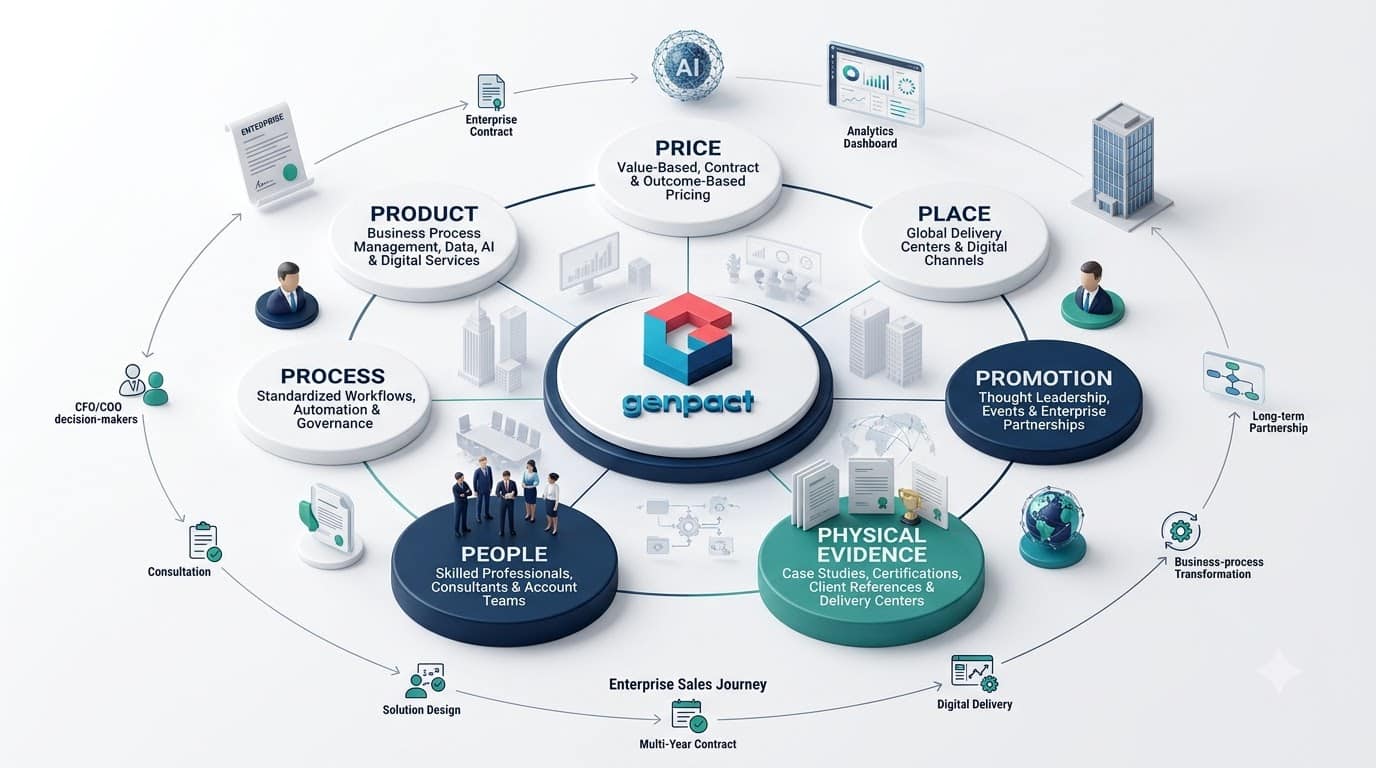
The marketing mix of Genpact is basically the answer to one question: how does a company that sells business process outsourcing, data and AI services, and back-office operations to Fortune 500 clients actually go out and win those clients? There’s no shelf for this stuff, no ad you’d see on TV, no “add to cart” button. Every deal is a multi-year, often multi-million-dollar commitment that a CFO or COO signs off on after months of due diligence. So the marketing mix has to be built for that reality.
That’s why the standard 4Ps (Product, Price, Place, Promotion) don’t fully cover it. For a services company like Genpact, three more Ps matter just as much: People, Process, and Physical Evidence.
Here’s the short version of each, applied to Genpact specifically:
Product Strategy in the Marketing Mix of Genpact
The Product element in the marketing mix of Genpact is not a single product at all. It is a layered portfolio: core operations services, a technology and AI layer sitting on top of those operations, and industry-specific solutions built for verticals like banking, insurance, healthcare, and manufacturing. Understanding this layering is the whole ballgame, because Genpact does not sell “outsourcing” anymore. It sells outcomes, and the technology is what makes those outcomes measurable and repeatable.
Core Service Lines: Finance, Supply Chain, Risk, and Customer Operations
Genpact’s foundation is still Core Business Services, the segment that generated $3.876 billion in 2025, up 3.7% year over year. This is the operational backbone: finance and accounting (accounts payable, accounts receivable, record-to-report, procure-to-pay), supply chain management, risk and compliance, sourcing and procurement, and customer operations. This is the part of the business that traces directly back to the GE Capital roots, and it is still where the bulk of the revenue sits even as the newer segment grows faster.
What makes this a real “product” and not a commodity is how Genpact packages it. Instead of selling raw headcount (which is what old-school BPO looked like), Genpact sells process ownership. A client does not just get people typing invoices into a system. They get an entire process redesigned using Lean Six Sigma methodology, benchmarked against Genpact’s own data from running the same process for dozens of other clients, and then run with defined service-level agreements around accuracy, turnaround time, and cost per transaction. That benchmarking data, built up over almost three decades of running these exact processes for other Fortune 500 companies, is a genuine moat. A newer entrant cannot replicate it without running the same processes for the same volume over the same number of years.
Genpact Cora: The AI and Automation Layer
Sitting on top of the core services is the technology layer, most visibly represented by Genpact Cora, the company’s proprietary AI and automation platform. Cora is not a single tool. It is a suite: Cora Sense for document and data intelligence, Cora Vision for computer vision on documents like invoices and claims, and various agentic AI modules that plug directly into the operations Genpact already runs for a client. The point of Cora is to let Genpact tell a client something along the lines of: “We already run your accounts payable process. Now we can automate 40% of the transaction volume using AI, and only escalate the exceptions to a human.”
This is the layer where the “Agentic Operations” repositioning actually shows up as product, not just marketing language. Advanced Technology Solutions revenue hit $1.204 billion in 2025, up 17% year over year, and by Q2 2026 it had climbed to 27% of total net revenues, growing north of 24% year over year that quarter. That is not a rounding error. That is a company visibly shifting its product mix away from pure labor arbitrage and toward technology-enabled, higher-margin work, and the numbers back up that the market is buying it.
What most competitors’ marketing does not admit out loud: pure labor cost arbitrage, the “we do it cheaper in India” pitch that built the entire BPO industry in the 2000s, has been shrinking as a differentiator for over a decade. Wages in India have risen, clients have gotten more sophisticated about total cost of ownership, and AI now threatens to do a chunk of the transactional work regardless of geography. Genpact’s product bet is that owning the AI layer on top of deep process knowledge is worth more than owning cheap labor. So far the revenue mix shift supports that bet.
Industry-Specific Solutions Built for Named Verticals
The third layer is vertical specialization. Genpact does not sell one generic “operations” product to every buyer. It builds named solutions for banking and financial services, insurance, healthcare and life sciences, consumer goods and retail, manufacturing, and high tech. A recent example: in September 2025, Genpact launched an agentic solution specifically for reinventing how insurance policies get bought, aimed directly at insurance carriers dealing with fragmented, paper-heavy underwriting workflows. That is not a generic product with an insurance label slapped on it. It is built around the specific regulatory and workflow reality of that one industry.
This vertical packaging matters for the marketing mix because it changes how sales conversations start. A generic pitch (“we do finance and accounting outsourcing”) competes on price. A vertical pitch (“we already automated underwriting document intake for three other insurance carriers your size, here is the before-and-after cycle time”) competes on proof and specificity. Genpact clearly understands that distinction, because nearly every piece of its external communication, from press releases to its own website, is organized by industry first, service line second.
Pricing Strategy in the Marketing Mix of Genpact
Nobody walks into Genpact’s website and sees a price list. That alone tells you the pricing element in the marketing mix of Genpact is built entirely around negotiated, value-based contracts rather than fixed rates. But “it’s negotiated” is a lazy answer. Look at what actually happens in these deals and the pricing logic gets a lot more interesting.
Outcome-Based and Hybrid Pricing Models
Traditional outsourcing used to run almost entirely on a full-time-equivalent (FTE) model: the client pays per headcount assigned to their account, full stop. Genpact still uses FTE pricing in parts of its Core Business Services work, but the bigger and more strategic deals have shifted toward outcome-based and transaction-based pricing. Under a transaction-based model, the client pays per invoice processed, per claim adjudicated, per call handled, rather than per person on the account. That shifts risk onto Genpact to keep costs down through automation, which is exactly why the Cora AI layer matters so much to pricing strategy, not just product strategy. Every process Genpact automates improves its own margin under a transaction-based contract without requiring a price hike from the client.
Genpact’s own reported gross margin of roughly 36% and adjusted operating margin near 17.4% to 17.7% for 2025 and 2026 outlook periods reflects this shift. Margins have been expanding for over a dozen consecutive quarters, and management points directly to the growth of higher-margin Advanced Technology Solutions work as the driver. In plain terms: Genpact is pricing its AI-enabled work at a premium relative to pure labor-based operations work, and clients are paying it because the total cost of running the process, including the labor Genpact no longer needs, still comes out lower for the client than doing it in-house or with a less tech-enabled vendor.
How Genpact Prices Against Accenture, TCS, Infosys, and WNS
Pricing in this industry is relative, not absolute. A CFO evaluating outsourcing vendors is not asking “is this cheap in general,” they are asking “is this cheap relative to the other three vendors in the room.” Genpact typically positions itself in a specific price band: more expensive than pure-play Indian BPO firms competing purely on labor cost, but generally more competitive than the big global consulting-led players like Accenture or IBM Consulting, who carry a heavier premium for brand and strategy work layered on top of execution.
What most competitor comparisons miss is that Genpact’s pricing advantage does not come from being the cheapest bidder. It comes from being able to bundle consulting-grade process redesign with execution-grade delivery in a single contract, at a price point below what it would cost to hire McKinsey or Accenture for the design work and then a separate BPO vendor for the execution. That bundling is the actual pricing lever, not a race to the bottom on hourly rates. Genpact wins deals where the buyer wants “one throat to choke” for strategy and delivery together, and loses deals where the buyer has already decided to unbundle strategy from execution and just wants the cheapest execution partner.
There is also a scale dynamic worth naming directly. Genpact new bookings, the total contract value of new and renewed deals signed in a period, hit record levels through 2025 and into 2026, described by leadership as the “largest-ever quarterly bookings” in Q2 2026. Rising bookings alongside rising margins is not something a company achieves by discounting aggressively. It is a sign Genpact has enough pricing power in its target accounts to grow both volume and margin at once, which is a genuinely strong position for a services company operating in a competitive, mature industry.
Place and Distribution Strategy in the Marketing Mix of Genpact
Place in a services business does not mean retail shelves. It means two very different things layered on top of each other: where the work physically and operationally gets delivered from, and how a buyer actually reaches, evaluates, and contracts with the company in the first place. Genpact has built both sides deliberately.
A Global Delivery Network Spanning 35+ Countries
Genpact runs delivery centers across India, the Philippines, Poland, Romania, Mexico, China, and a growing list of other locations, serving clients from more than 35 countries in total. This is not incidental. The location mix is a deliberate hedge against several risks at once: wage inflation in any single market, currency volatility, geopolitical disruption, and the need to deliver work in the client’s own time zone and, in some cases, native language for European and Latin American clients.
The India base remains the largest, tracing back to the original Gurgaon roots, but the diversification into Eastern Europe and Latin America over the past decade was a direct response to European and North American clients who wanted “nearshore” delivery options, meaning work delivered from a location closer in time zone and cultural context, even if the labor cost was somewhat higher than pure offshore delivery. That is Place strategy responding directly to buyer preference, not just cost optimization.
Direct Enterprise Sales as the Primary Go-to-Market Channel
Unlike a product company that might sell through retailers, distributors, or e-commerce, Genpact sells almost entirely through direct enterprise sales. There is a dedicated sales organization organized by industry vertical and by account tier, with named client partners assigned to the largest global accounts (often called “named accounts” or “strategic accounts” internally across the industry). This is a high-touch, relationship-driven channel, and it has to be, because the buyers are procurement teams, CFOs, and COOs making decisions that will affect their own operations for years.
Alongside direct sales sits a second channel that has grown significantly in importance: the partner and alliance ecosystem. Genpact holds partnerships with major technology platforms, most visibly with companies like ServiceNow, where Genpact was named a Leader in an ISG Provider Lens report on the ServiceNow ecosystem in 2026, and with cloud and AI platform providers whose technology Genpact implements as part of its own solutions. These partnerships function as a distribution channel in their own right: when a client is already buying ServiceNow or a major cloud platform, Genpact gets pulled into the deal as the implementation and operations partner, rather than having to win the client cold.
Regional Delivery Trade-Offs and Why Location Choice Is a Marketing Decision
It is worth slowing down on why delivery location counts as a marketing decision and not just an operations one. A European insurer evaluating vendors will often ask, directly in an RFP, where the work physically happens and who has access to the data. A location answer that includes GDPR-compliant delivery from a Poland or Romania hub, alongside offshore delivery from India for less sensitive work, answers a data residency and compliance concern before it ever becomes a blocker deep in procurement review. That is Place doing the work Promotion cannot do: removing a hard, factual objection rather than persuading around it.
The same logic applies to North American healthcare clients bound by HIPAA requirements or financial services clients bound by regional banking regulations. Genpact’s decision to keep expanding its footprint into Mexico, the Philippines, and Eastern Europe rather than concentrating everything in India was not simply about chasing lower wages in new markets. It was about building enough locational flexibility to say yes to compliance requirements that would otherwise disqualify the company from an RFP before a single sales call even happened.
Digital Channels: Website, LinkedIn, and Analyst Platforms as Discovery Points
The third piece of Place is digital discovery. Even in enterprise B2B sales with long cycles, buyers still research vendors online before ever taking a call. Genpact’s own website is organized to support due diligence, not casual browsing: deep resource libraries by industry, published points of view on AI adoption, and case studies with named or anonymized client results. LinkedIn functions as a major channel too, both for the corporate page and for individual leaders like CEO BK Kalra, who posts directly about quarterly results and strategy shifts, giving prospective clients and analysts a direct, unfiltered read on where the company is headed.
Analyst platforms deserve a specific mention here because they function almost like a “storefront” in this industry. Firms like Gartner, Forrester, ISG, and Everest Group publish comparative rankings of vendors like Genpact, Accenture, and TCS across specific service categories. A strong placement in an ISG Provider Lens report or a Gartner Magic Quadrant functions the same way a strong placement on a retail shelf functions for a consumer brand: it is where a huge share of qualified buyers actually go looking before they ever contact a vendor directly. Genpact invests heavily in briefing these analyst firms and citing favorable placements prominently in its own marketing, because that third-party validation carries more weight with a skeptical enterprise buyer than anything Genpact could say about itself.
Website Content and Search Visibility as a Quiet, Continuous Sales Channel
One channel that rarely gets credit in breakdowns of Genpact’s Place strategy is search visibility itself. Enterprise buyers researching vendors type surprisingly specific queries into Google long before they fill out a contact form: “AI in accounts payable case study,” “agentic operations insurance underwriting,” “Genpact vs Cognizant finance and accounting.” Genpact’s resource library, organized by industry and by service line with dozens of long-form articles, research reports, and client stories, exists to be sitting there answering those exact queries when a buyer starts looking.
This works because it front-loads trust before the first sales call happens. A prospective client who reads three or four Genpact-published pieces on agentic AI in insurance before ever speaking to a salesperson walks into that first call already primed, already familiar with Genpact’s point of view, and already past the basic “who are you and why should I care” stage. That shortens the sales cycle, which matters enormously in an industry where deals routinely take six to eighteen months to close. Every month shaved off that cycle is real money, and quiet, well-organized website content is one of the cheapest ways to shave it.
Promotion Strategy in the Marketing Mix of Genpact
Promotion is where the gap between B2C marketing and what Genpact actually does becomes most obvious. There is no ad campaign trying to make “Genpact” a household name, because Genpact does not need to be known by households. It needs to be known, trusted, and top of mind for a few thousand specific decision-makers inside large enterprises. Every promotional choice flows from that narrow, high-value target.
Thought Leadership as the Primary Trust-Building Tool
The single biggest lever in Genpact’s promotion strategy is published thought leadership: research reports, executive point-of-view pieces, and commissioned surveys of enterprise leaders on topics like AI adoption, agentic operations, and process transformation. This content is not written to rank on Google for casual searchers. It is written to be the exact document a COO’s team pulls up when researching “how are other companies approaching agentic AI in operations” before a board presentation.
What makes this effective rather than just noise is specificity. A generic “AI will transform business” piece gets ignored. A piece citing internal Genpact data on time-to-value across dozens of real automation deployments, or naming the specific mistake most companies make when scaling AI pilots (usually: treating data and process foundations as an afterthought, which is a point Genpact executives have made publicly and repeatedly), gets forwarded around in exactly the buying committees Genpact wants to reach. That specificity is also why Genpact leadership shows up quoted directly in trade press, warning enterprises against rushing AI deployment without fixing underlying data and process issues first, a message that positions Genpact as the adult in the room rather than a vendor hyping its own product.
Case Studies, Named Client Wins, and Proof Over Promises
Genpact leans heavily on case studies and named deal announcements as promotional content, and this matters more in B2B services than almost any other tactic. A buyer evaluating a multi-year, multi-million-dollar commitment is fundamentally risk-averse. What convinces them is not a claim, it is evidence that a comparable company already took the risk and it worked out. That is why press releases about specific engagements, like the XponentL Data acquisition in mid-2025 to strengthen data engineering and AI-readiness capabilities, or the insurance-focused agentic solution launched later that year, get pushed out publicly even though the dollar value of individual deals is rarely disclosed. The announcement itself is the marketing asset. It tells the market “Genpact is actively building and shipping in this specific area,” which matters enormously to a buyer trying to judge whether a vendor’s AI story is real or just slide-deck talk.
Industry Events, Award Recognitions, and Sustainability Positioning
Conferences and industry events remain a significant channel, both as a place to generate leads and as a stage to reinforce authority through speaking slots and panel appearances. Genpact executives regularly appear at events like the WSJ Leadership Institute CEO Council Summit, where BK Kalra has spoken directly about leading transformation, positioning the company’s leadership as peers to other Fortune 500 CEOs rather than as vendors pitching to them.
Award and recognition programs also play a real role. Being named to TIME magazine’s World’s Most Sustainable Companies list in 2026, for instance, is not just a nice mention. It gets cited directly in sales conversations with clients who have their own ESG commitments and need their vendors to align with those commitments, particularly in Europe where sustainability procurement requirements are stricter. This is promotion doing double duty: building general brand credibility while also removing a specific objection that could otherwise stall a deal in procurement review.
Digital and Social Presence Built Around Executive Voice
Genpact’s promotion also runs heavily through executive social presence, particularly LinkedIn, where leadership posts quarterly results commentary, strategic announcements, and points of view in near real time. This is a deliberate choice: rather than routing every message through a faceless corporate account, Genpact lets named executives, the CEO, the newly appointed Chief Product and Platform Officer, and various global business leaders, be the visible voice. For a B2B buyer doing diligence, seeing a company’s actual leadership articulate strategy directly and consistently over time builds more confidence than a polished corporate feed ever could. It also means competitors, analysts, and prospective clients get a continuous, low-cost stream of positioning content without Genpact needing a traditional ad budget at all.
Genpact’s Financial Performance and What It Signals About the Marketing Mix
Numbers rarely get discussed as part of a marketing mix breakdown, but for a publicly traded services company like Genpact, the quarterly earnings release functions as a promotional document in its own right. Every metric disclosed becomes ammunition for the sales team and a signal to the market about which parts of the mix are actually working.
Revenue Growth Split by Segment Tells the Real Product Story
Look at the segment split and the Product strategy becomes obvious without needing a single slide from Genpact’s own marketing team. Advanced Technology Solutions grew 17% for full year 2025 and accelerated further into 2026, while Core Business Services grew a much slower 3.7%. That gap is not a footnote. It is the clearest possible evidence that the market is rewarding Genpact’s shift toward AI-enabled, higher-value work over its legacy transactional business. Sales teams use exactly this data point in client conversations, essentially saying: look, this is not a story we are telling you, this is where our own revenue is actually growing fastest, and here is why.
Bookings Momentum as Proof of Demand, Not Just a Finance Metric
New bookings, the total contract value of new and renewed deals signed in a period, hit record levels through 2025 and into 2026, with leadership specifically calling out the “largest-ever quarterly bookings” in Q2 2026 alongside six new large deals signed in that quarter alone. This number matters to marketing because it is externally verifiable proof of demand. A prospective client can independently check that other large enterprises are actively signing new, sizable contracts with Genpact right now, not two years ago. That kind of momentum signal is worth more in a sales conversation than almost any testimonial, because it cannot be cherry-picked or staged. It is audited, disclosed, public data.
Dividend Growth and Margin Expansion Signal Long-Term Stability
Genpact raised its planned quarterly dividend by 10% heading into 2026, to $0.1875 per share, alongside 13 consecutive quarters of year-over-year gross margin expansion. Neither of those facts sounds like traditional marketing content, but both get referenced in vendor risk assessments during procurement review. A company raising dividends and expanding margins at the same time is signaling financial discipline and staying power, exactly the qualities a buyer wants confirmed before locking into a five-year operational dependency on a single vendor.
People, Process, and Physical Evidence in Genpact’s Extended Marketing Mix
For a services business, the classic 4Ps genuinely fall short. What the client is buying is not a physical object they can inspect before purchase. They are buying trust in a set of people, confidence in a defined process, and enough tangible proof to feel secure signing a multi-year contract. That is exactly why the extended 7P model matters this much for Genpact specifically.
People: Talent as the Actual Product Being Sold
In a services business, the workforce is not a cost center that supports the product. The workforce is the product. Genpact’s 146,500-plus employees, spread across every delivery location, are the literal thing the client is paying for when they sign a contract. That reality shapes how Genpact markets itself internally and externally as an employer, because talent quality and retention directly determine service quality, which directly determines client renewal rates.
Genpact invests visibly in training and career development messaging, including its shift toward what leadership has publicly called a “skill-first” approach, reorganizing how talent is developed and deployed around specific capabilities (like AI implementation or process design) rather than rigid job titles. This matters for marketing in a very direct way: when Genpact pitches a client on its AI capabilities, the client’s next question is almost always “who exactly will be doing this work, and do they actually know what they’re doing.” A visible, well-articulated talent strategy is the answer to that question before it even gets asked.
Process: Lean Six Sigma and Operational Discipline as a Sales Argument
Process is where Genpact’s GE Capital heritage becomes a genuine competitive advantage rather than just company history. The company was built from day one around Lean Six Sigma, a rigorous, data-driven methodology for eliminating waste and defects in operational processes, originally developed in manufacturing and adapted by GE across its businesses in the 1990s. Genpact did not adopt this methodology later as a marketing exercise. It was baked into the company’s DNA before it ever had an external client.
This matters commercially because process discipline is something a buyer can actually verify and compare, unlike vaguer claims about “quality” or “excellence.” Genpact can point to a defined, repeatable methodology, applied consistently across thousands of engagements over nearly three decades, with benchmarked data on outcomes. That is a fundamentally stronger sales argument than “trust us, we’re good at this,” and it shows up constantly in how Genpact describes itself publicly: “process intelligence” and “last mile expertise” are phrases used directly in the company’s own 10-K filing description of its business, not just marketing copy. When a company’s own regulatory filings use the same language as its sales pitch, that is a sign the process claim is structural, not decorative.
Physical Evidence: Offices, Certifications, and Verifiable Proof Points
Physical evidence in a B2B services context means the tangible signals a buyer can point to as proof the company is real, credible, and capable of delivering at scale. For Genpact, this includes its global office footprint (delivery centers across more than 35 countries), its public listing on the NYSE under ticker G with fully audited financial disclosures, its named industry certifications and quality standards, and its formal analyst rankings from firms like ISG, Gartner, and Forrester.
There is also a subtler form of physical evidence worth naming: the published financial results themselves. When Genpact reports 13 consecutive quarters of year-over-year gross margin expansion, or discloses that Advanced Technology Solutions grew 24.1% year over year in a specific quarter, that level of transparent, audited detail functions as proof of stability and competence to a buyer evaluating whether this vendor will still be a reliable partner five years into a contract. A private, unlisted competitor cannot offer that same level of verifiable transparency, and Genpact’s investor relations content gets referenced in enterprise sales conversations more often than most people realize, particularly by procurement and vendor risk teams doing financial due diligence before signing off on a large contract.
Competitive Positioning Within Genpact’s Marketing Mix
No marketing mix analysis means much without placing it against the field Genpact actually competes in. This industry is crowded, and the players are not interchangeable even though they often get lumped together in casual comparisons.
Genpact vs Accenture, Cognizant, TCS, and WNS
Accenture sits above Genpact on brand recognition and consulting-led positioning, generally winning deals where the client wants strategy and technology implementation bundled with a globally recognized name, and Accenture typically commands a price premium for that positioning. Cognizant and TCS compete more directly with Genpact on scale and technology delivery, both with far larger overall headcounts and broader IT services portfolios beyond pure business process work, which lets them bundle a wider range of services into single master agreements. WNS is probably Genpact’s closest direct competitor in terms of company size and specialization, another business process management pure-play with deep vertical focus, particularly in insurance and travel.
Where Genpact tends to win is in accounts that value deep process ownership combined with a credible, well-documented AI story, rather than either pure low-cost execution or pure high-end consulting. Where Genpact tends to lose is against the largest IT services players when a client wants one vendor to handle everything from infrastructure and application development through to business process operations under a single master contract, because Genpact’s core strength remains business process and data-AI work rather than broad enterprise IT services.
Common Mistakes People Make Analyzing the Marketing Mix of Genpact
Here is what most breakdowns of the marketing mix of Genpact get wrong. First, treating it like a consumer brand and forcing in concepts like packaging or retail distribution that simply do not apply. Second, describing the Product as “BPO services” without acknowledging the real shift toward Advanced Technology Solutions, which is now growing far faster than the traditional business and reshaping the entire company’s margin profile. Third, assuming Price means “cheap” the way outsourcing used to be understood in the 2000s, when Genpact’s actual pricing power today comes from bundling process redesign with execution at a competitive but not rock-bottom price. Fourth, ignoring People and Process entirely, which for a services company this size is close to ignoring the actual product. And fifth, underestimating how much of Genpact’s Promotion strategy runs through analyst relationships and executive thought leadership rather than anything resembling traditional advertising.
Get those five things right and the marketing mix of Genpact stops looking like a generic services company checklist and starts looking like what it actually is: a deliberate, evolving strategy built by a company that had to earn every enterprise client from scratch after leaving the safety of being GE’s captive back office.
There is also a timing mistake worth flagging on its own. A lot of the older writing on Genpact’s marketing mix still frames the company primarily as a labor-arbitrage BPO player, because that framing was accurate a decade ago and a lot of that content simply never got updated. Using an outdated framing today means missing the entire Advanced Technology Solutions story, missing why margins have expanded for over a dozen straight quarters, and missing the “Agentic Operations” repositioning that BK Kalra has pushed hard since taking over as CEO. A useful analysis of any company’s marketing mix has to be re-checked against the company’s current earnings releases and public statements, not just its Wikipedia page or a five-year-old case study, because a services company this size can genuinely reposition its entire product and pricing strategy within a two or three year window.
What Smaller Vendors Can Actually Learn from Genpact’s Marketing Mix
It is tempting to look at a $5 billion, 146,500-employee company and assume none of this applies to a smaller vendor. That is the wrong conclusion. The scale is different, but the underlying logic in Genpact’s marketing mix translates down to almost any B2B services business selling into skeptical, risk-averse buyers.
Build the Proof Before You Need It
Genpact did not build its case study library, its analyst relationships, or its benchmarking data overnight. Those assets took years to accumulate, and they were built by consistently documenting results on every engagement long before any single case study got published externally. A smaller services firm can start the exact same habit on day one: track before-and-after metrics on every client engagement, even the small ones, because that data becomes the proof asset that eventually replaces cold pitching with warm, evidence-backed conversations. Waiting until a company “needs” case studies to start collecting the underlying data is how most smaller vendors end up with nothing concrete to show years into operating.
Specialize Before Trying to Be Everything to Everyone
Genpact’s vertical-first structure, building named solutions for insurance or healthcare instead of one generic pitch for everyone, is available to a company of any size. A five-person consultancy can build a reputation as “the automation firm for regional insurance carriers” far faster than it can build a reputation as “an automation firm,” full stop. Specificity is not a luxury reserved for large companies with big marketing budgets. If anything, it matters more for a smaller vendor, because a narrow, well-proven specialty is the fastest way to compete against a giant that cannot realistically customize its pitch for every single niche.
Let Executives Be the Public Voice, Not Just the Brand
One of the more replicable pieces of Genpact’s Promotion strategy is how visible its own leadership is. That does not require a Fortune 500 marketing budget. It requires a founder or executive willing to consistently publish a real point of view, on LinkedIn or anywhere else the target audience actually spends time, instead of hiding behind a faceless company account. Buyers trust people, especially in high-stakes B2B decisions, more than they trust logos. A smaller company copying that one habit, consistent, specific, opinionated executive commentary, often sees a disproportionate return relative to the actual cost, which is close to zero beyond time.
Conclusion
The marketing mix of Genpact works because every element reinforces the others instead of operating in isolation. The Product shift toward AI-enabled Advanced Technology Solutions justifies premium pricing on the newer work. The global delivery network and partner ecosystem create the Place advantage that makes that Product deliverable at enterprise scale. Promotion built on proof, analyst validation, and executive credibility earns the trust needed to even start a sales conversation for contracts this large. And People, Process, and Physical Evidence tie the whole thing together by giving a risk-averse enterprise buyer something concrete to verify before they sign.
Anyone studying this as a case, whether for a business course or to understand how to position a B2B services company, should walk away with one core lesson: in enterprise services marketing, trust and proof matter more than any single tactic. Genpact did not build a $5 billion business through advertising. It built it through three decades of documented process discipline, a genuine technology shift backed by real revenue growth, and a go-to-market machine built entirely around earning credibility with a narrow, high-stakes audience.
That is also why copying Genpact’s tactics one by one rarely works for a company that has not done the underlying operational work first. A vendor can publish thought leadership content, build a LinkedIn presence, and chase analyst recognition, and none of it will land if the actual service delivery underneath is inconsistent. Genpact’s marketing mix is convincing because every promotional claim traces back to something real and checkable: audited revenue growth by segment, named partnerships, a Lean Six Sigma methodology applied consistently since 1997, and margin expansion that has held up for over a dozen consecutive quarters. Strip away the operational substance and the exact same marketing playbook would read as empty noise instead of credible proof. That distinction, substance first, promotion second, is the real takeaway sitting underneath every section of this guide.
Frequently Asked Questions
What is the marketing mix of Genpact?
The marketing mix of Genpact refers to how the company structures its Product, Price, Place, and Promotion strategies, extended with People, Process, and Physical Evidence since Genpact is a services business. It covers Genpact’s service portfolio spanning business process operations and AI-driven Advanced Technology Solutions, its value-based and transaction-based pricing models, its global delivery network across 35-plus countries, and its promotion strategy built on thought leadership, analyst relationships, and executive credibility rather than traditional advertising.
What products or services does Genpact actually sell?
Genpact sells business process operations across finance and accounting, supply chain, risk and compliance, and customer operations, along with AI and automation services delivered through its Cora platform, and industry-specific solutions built for banking, insurance, healthcare, and manufacturing clients. The company increasingly frames all of this under the umbrella of “Agentic Operations,” combining human process expertise with AI agents handling transactional work.
How does Genpact price its services?
Genpact uses a mix of pricing models depending on the deal, including full-time-equivalent (FTE) based pricing for traditional staffing-heavy work, transaction-based pricing where clients pay per unit of work processed, and outcome-based pricing tied to specific business results. Larger, more strategic contracts increasingly lean toward transaction and outcome-based models, which reward Genpact for automating processes efficiently rather than simply billing for headcount.
Is Genpact cheaper than Accenture or TCS?
Genpact generally sits in a middle price band: more expensive than pure low-cost BPO providers competing purely on labor arbitrage, but typically more competitive than Accenture, which commands a premium for its consulting-led brand positioning. Genpact’s real pricing advantage comes from bundling process redesign and execution into a single contract rather than being the absolute lowest bidder in the room.
Where does Genpact deliver its services from?
Genpact operates delivery centers across more than 35 countries, with major hubs in India (where the company originated as GE Capital International Services in Gurgaon), the Philippines, Poland, Romania, Mexico, and China. This geographic spread reduces wage and currency risk and lets Genpact offer nearshore delivery options to clients in Europe and North America who want work handled closer to their own time zone.
What is Genpact Cora and why does it matter to the marketing mix?
Genpact Cora is the company’s proprietary AI and automation platform, including modules for document intelligence, computer vision, and agentic AI that plug directly into the operations Genpact already runs for clients. Cora matters to the marketing mix because it is the product layer justifying Genpact’s shift toward higher-margin Advanced Technology Solutions work, which grew 17% in 2025 and became a larger share of total revenue.
How does Genpact promote itself without traditional advertising?
Genpact relies almost entirely on thought leadership content, published research and executive commentary, analyst relationships with firms like Gartner, Forrester, and ISG, named case studies and deal announcements, industry event speaking slots, and a strong executive presence on LinkedIn. Because the buyers are enterprise decision-makers doing extensive due diligence, proof and third-party validation work far better for Genpact than mass advertising ever could.
Why do People, Process, and Physical Evidence matter so much for Genpact specifically?
Genpact is a services business, so its workforce is literally the product a client is buying, which makes People a core marketing element rather than a background function. Process matters because Genpact’s Lean Six Sigma methodology, inherited from its GE Capital origins, is a verifiable, repeatable differentiator rather than a vague quality claim. Physical Evidence matters because enterprise buyers need tangible proof points, audited financials, analyst rankings, global office presence, before committing to a multi-year contract.
Who are Genpact’s biggest competitors?
Genpact’s main competitors include Accenture, Cognizant, TCS, Infosys, IBM Consulting, and WNS, with WNS being the closest match in terms of size and business process specialization. Accenture and the larger IT services firms tend to win deals requiring broad, bundled IT-plus-operations contracts, while Genpact competes strongest in accounts that specifically value deep process expertise combined with a credible AI and automation story.
How has Genpact’s marketing mix changed under CEO BK Kalra?
Since Balkrishan “BK” Kalra became President and CEO in January 2024, Genpact has repositioned itself publicly as “the Agentic Operations company,” shifting Product messaging toward AI agents running enterprise processes, accelerating investment and acquisitions like XponentL Data to strengthen data and AI capabilities, and putting more executive voice directly into Promotion through frequent public commentary on strategy and quarterly results.
Does Genpact only serve large Fortune 500 companies?
Genpact’s traditional client base skews heavily toward large global enterprises, but the company has been actively building out a “NextGen Enterprises” focus aimed at fast-growing, mid-market companies, backed by a dedicated leadership hire in late 2025 specifically tasked with building relationships in that segment. This signals a deliberate broadening of Genpact’s target market beyond only the largest global accounts.
What industries does Genpact focus on most?
Genpact organizes its go-to-market approach primarily around banking and financial services, insurance, healthcare and life sciences, consumer goods and retail, manufacturing, and high tech. Rather than selling one generic service to every industry, Genpact builds named, industry-specific solutions, such as its 2025 agentic solution built specifically for insurance policy buying workflows, which allows sales conversations to focus on proof and specificity rather than generic claims.
Is transaction-based pricing more common than FTE pricing at Genpact today?
Both models remain in active use, but the industry-wide trend, and Genpact’s own margin expansion, points to transaction-based and outcome-based pricing growing in share relative to pure FTE-based contracts. This shift rewards Genpact financially for successfully automating work through its Cora platform, aligning the company’s own profit incentive with delivering efficiency gains to the client rather than simply billing for more headcount hours.
Why does Genpact’s delivery location choice matter to buyers?
Delivery location directly affects data residency, regulatory compliance, and time zone alignment, all of which show up as hard requirements in enterprise RFPs rather than soft preferences. Genpact’s spread across India, Eastern Europe, the Philippines, and Latin America lets it meet region-specific compliance needs, such as GDPR in Europe or HIPAA-adjacent requirements in North American healthcare, without disqualifying itself before a sales conversation even starts.
How does Genpact use quarterly earnings results as a marketing tool?
Genpact’s quarterly earnings releases disclose segment-level growth, bookings momentum, and margin trends that sales teams reference directly in client conversations as independently verifiable proof of demand and financial stability. Record bookings, consistent margin expansion, and rising dividends all function as trust signals during vendor risk assessments, which matter enormously when a client is committing to a multi-year operational partnership.