


Try explaining to someone why Flipkart wins big during Diwali while a random regional e-commerce app selling the exact same phone at the exact same price barely gets noticed. Price isn’t the answer here, because the price is identical. The difference sits in everything around the price, how the product is packaged and trusted, how it’s delivered, and how loudly and cleverly the sale gets talked about before it even starts. That’s basically the whole idea behind the marketing mix, and Flipkart is honestly one of the cleanest real-world examples of it actually working at scale in India.

Most people who studied marketing in college remember the 4Ps as a textbook diagram, four boxes, a professor drawing arrows between them, and nothing that felt real. But when you actually map Flipkart onto that framework, product, price, place, promotion, it stops being an academic exercise and starts looking like a genuinely smart set of decisions made by a company that had to fight both Amazon’s global scale and dozens of local competitors at the same time. This piece walks through exactly how Flipkart built each of those four pillars, what choices it made, and honestly, where a couple of cracks still show even today.
What You Will Learn in This Guide
- What the marketing mix actually means and why it still matters for a company as big as Flipkart
- How Flipkart structures its product offering across a marketplace model instead of owning inventory directly
- The pricing tactics Flipkart uses to stay competitive without bleeding margin dry
- How Flipkart built a distribution and delivery network that reaches genuinely remote parts of India
- The promotional tactics, from TV ads to app notifications, that keep Flipkart top of mind
- Specific marketing tactics Flipkart runs day to day, not just during festive sales
- A grounded, honest look at what’s working and what still needs fixing
About Flipkart

Flipkart got started in 2007 when Sachin Bansal and Binny Bansal, both former Amazon employees, decided India needed its own homegrown online store instead of just waiting for a foreign company to do it properly. Books were the starting point, a low-risk category with no sizing issues, no quality inconsistency worries, and a customer base already comfortable buying from catalogs. From there, the company kept adding categories year after year until it became what it is today, a marketplace spanning more than 80 categories including electronics, fashion, home appliances, groceries, and lifestyle products.
Walmart bought a controlling stake of about 81.3 percent in Flipkart back in August 2018 for close to 16 billion dollars, valuing the company at around 20 billion dollars at the time. That kind of capital backing changed what Flipkart could do competitively, letting it match Amazon’s aggressive spending on logistics, warehousing, and marketing without constantly worrying about running out of runway. Today Flipkart isn’t just a shopping app, it’s practically a full retail ecosystem, with Myntra under its umbrella for fashion, Cleartrip for travel bookings, and a seller network that touches millions of small businesses across the country.
Marketing Mix of Flipkart
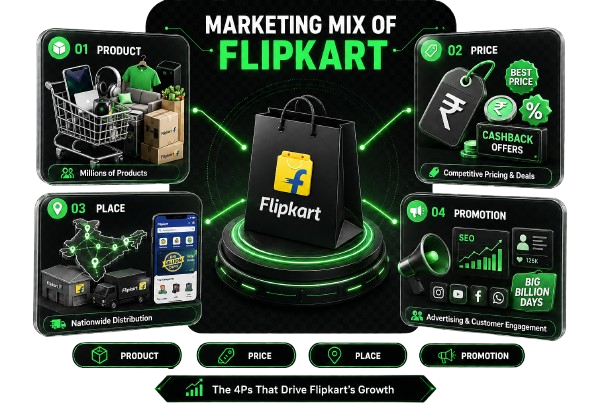
The marketing mix is basically a way of breaking down how a company creates and delivers value, split into four connected pieces: what you sell, what you charge, how customers get it, and how you tell people about it. Sounds simple written like that, but the real skill is in how these four pieces work together instead of existing as separate departments doing their own thing. Flipkart’s marketing mix works because each piece reinforces the other three, the pricing strategy depends on the distribution network being efficient enough to keep costs low, and the promotion strategy depends on product variety being wide enough to give people a reason to keep coming back beyond just one sale event.
Looking at Flipkart through this lens tells you more about why the company succeeded than just reading its revenue numbers ever could. A marketplace can have great numbers for a year or two off pure marketing spend, but sustaining leadership in a market as brutally price-sensitive as India requires all four Ps working in sync, not just one flashy campaign carrying the whole brand. That’s exactly what makes Flipkart worth studying closely instead of just admiring from a distance.
1. Product Strategy of Flipkart
Flipkart’s product strategy starts with an important structural decision most people don’t think about, it runs a marketplace model, not an inventory-owned retail model. Early on, Flipkart actually experimented with an inventory-based approach through a subsidiary called WS Retail, buying stock and holding it in warehouses before selling directly. Over time, that model got dropped in favor of what Flipkart runs today, where third-party sellers list and manage their own products while Flipkart provides the platform, the technology, and increasingly, the fulfillment support behind the scenes.
This shift matters a lot because it changes what “product” even means in Flipkart’s marketing mix. The product isn’t just the phone or the shirt or the mixer grinder someone buys. The actual product Flipkart sells to its sellers is the platform itself, the visibility, the seller dashboard showing sales data and profit margins, the tools to promote listings, and options like Flipkart Assured where products get stored in Flipkart-owned warehouses for faster, more reliable delivery. Sellers get analytics on what’s moving and what’s sitting unsold, along with recommendations on which logistics channel gives them better margins, and that kind of behind-the-scenes product support is a huge part of why smaller sellers stick with Flipkart instead of running their own standalone websites.
Product Categories and Variety
On the buyer-facing side, product strategy is about breadth and depth. Flipkart didn’t just add categories randomly, it built out entire verticals with dedicated teams, electronics, fashion, home and furniture, groceries through Flipkart Minutes and similar quick-commerce experiments, and lifestyle products. Each category gets its own merchandising strategy, its own seasonal push calendar, and its own set of preferred sellers who get more visibility because they’ve proven reliable over time. That structure means someone shopping for a washing machine gets a completely different browsing and recommendation experience than someone shopping for sneakers, even though both live inside the same app.
Flipkart Assured and Quality Control
Flipkart Assured deserves its own mention here because it’s one of the smarter product-layer decisions the company made. Products under this tag get stored and shipped from Flipkart-controlled warehouses rather than directly from third-party sellers, which means faster delivery and tighter quality checks before something reaches a customer’s door. This directly targets the trust problem that’s always haunted third-party marketplace models, where a buyer never really knows if a random seller will pack and ship things properly. By putting its own name and warehouse infrastructure behind select products, Flipkart essentially builds a quality guarantee into its product strategy without needing to own every single item being sold.
2. Price Strategy of Flipkart
Price is where Flipkart plays its most aggressive game, and honestly, this is the part most casual shoppers actually notice first even if they never think about it as a deliberate strategy. Flipkart runs a mix of everyday competitive pricing alongside deep, event-driven discounting, and the two work together rather than against each other. Everyday pricing keeps Flipkart in the consideration set for someone comparing prices across apps on a random Tuesday, while event pricing during Big Billion Days or end-of-season sales creates urgency spikes that pull in buyers who were on the fence for weeks.
Dynamic and Competitive Pricing
Flipkart runs pricing algorithms that constantly track competitor prices, mainly Amazon, and adjust listings to stay competitive without requiring a human to manually check prices all day. This kind of dynamic pricing isn’t unique to Flipkart, most large marketplaces do something similar, but the scale at which Flipkart runs it across millions of SKUs is genuinely impressive. Sellers benefit from this too since Flipkart’s tools often flag when a listing is priced too high relative to similar products, nudging sellers toward pricing that’s more likely to actually convert.
No Cost EMI and Flexible Payment Options
One pricing tactic that’s quietly done more for Flipkart’s growth than people give it credit for is the No Cost EMI option, letting buyers split a purchase into monthly installments without extra interest charges. For a country where a huge chunk of the population is price sensitive but not necessarily cash-poor in a way that blocks a purchase entirely, No Cost EMI removes the psychological barrier of paying a large amount upfront. Someone who wouldn’t buy a 40,000 rupee laptop outright will often say yes when it’s framed as a few thousand rupees a month, and Flipkart’s marketing leans on this framing constantly, especially around electronics and appliances.
Discount Events and Perceived Value
Big Billion Days and similar sale events aren’t really about Flipkart losing money on every item, even though that’s the popular assumption. A lot of the discounting is negotiated directly with brands and sellers who want the volume and visibility that comes with participating in a major event, meaning Flipkart isn’t always eating the discount alone. What Flipkart’s pricing strategy does really well here is create the perception of massive across-the-board savings, even when the actual average discount depth might be more moderate than the marketing suggests. That perception management, without crossing into outright misleading territory, takes real skill in how offers get framed and displayed.
3. Place and Distribution Strategy
This is the part of Flipkart’s marketing mix that genuinely surprised a lot of skeptics early on. India’s logistics infrastructure isn’t exactly known for being smooth, roads in rural areas can be rough, addressing systems are inconsistent, and last-mile delivery in places without proper street naming used to be a nightmare for any company trying to ship physical goods reliably. Flipkart built its own logistics arm, Ekart, specifically to solve this instead of relying entirely on third-party courier companies that weren’t built for e-commerce scale.
Ekart and Warehouse Network
Ekart handles a massive share of Flipkart’s deliveries directly, giving the company control over delivery timelines, tracking accuracy, and the return process, which is a huge deal for trust, since buyers who know returns are simple are far more willing to try new categories or unfamiliar sellers. Flipkart has also built out a dense network of fulfillment centers and warehouses across the country, positioned specifically to shorten the distance between inventory and the customer, which is exactly why delivery timelines in major cities have gotten so aggressive, sometimes same-day or next-day for popular products stored in nearby Flipkart Assured warehouses.
Reaching Tier 2, Tier 3, and Rural India
What really sets Flipkart’s distribution strategy apart is the deliberate push into tier 2, tier 3 cities, and rural areas that a lot of competitors either ignored or treated as an afterthought. Flipkart’s delivery network reportedly covers essentially all major towns across every tier along with a significant chunk of rural regions too, which matters enormously in a country where the majority of the population still lives outside the top eight or ten metro cities. Getting a package reliably to a small town in interior Odisha or rural Bihar isn’t glamorous work, but it’s exactly the kind of unglamorous infrastructure investment that turned Flipkart from a big-city app into a genuinely national brand.
Local Language and Regional Accessibility
Distribution isn’t just about physical delivery either. Flipkart made the app itself available in multiple regional languages, recognizing that a huge chunk of potential buyers in smaller towns were more comfortable browsing and buying in Hindi, Tamil, Telugu, or Bengali rather than English. This kind of accessibility work sits at the intersection of place and promotion, because it’s not enough to physically deliver a product somewhere if the buyer couldn’t comfortably navigate the app to order it in the first place.
4. Promotion Strategy of Flipkart
Promotion is where Flipkart’s marketing muscle gets the most visible, and it runs across a genuinely wide spread of channels rather than betting everything on one format. Television ads, print ads, word of mouth, bulk email and SMS campaigns, in-app push notifications, and heavy social media activity all run in parallel, each targeting a slightly different stage of the buying journey. TV and print build broad awareness during major festive windows, while push notifications and email work more like a nudge for people who already have the app installed but haven’t opened it in a while.
Celebrity and Influencer Campaigns
Flipkart’s promotional playbook leans hard into celebrity partnerships for its biggest campaigns, pulling in major Bollywood names and popular content creators to give Big Billion Days and similar events a cultural weight that a plain discount banner could never achieve on its own. Alongside the celebrity layer, Flipkart runs a broad influencer network across YouTube and Instagram, tech reviewers, fashion creators, and home decor accounts, who bring a kind of niche credibility that celebrities simply can’t replicate. Running both layers together means Flipkart gets mass reach from the famous faces and specific, trusted recommendations from the smaller creators, covering both ends of how people actually make buying decisions.
Contests and Engagement Campaigns
Flipkart also runs contests regularly, often tied directly to sale events, giving buyers extra incentives like bonus discounts, cashback, or exclusive early access in exchange for engaging with the app more actively. These contests aren’t just fun add-ons, they’re a deliberate tactic to increase app opens and session time during the critical days leading up to a big sale, since higher engagement in that window typically correlates with stronger conversion once the actual sale goes live. It’s a small mechanic, but it compounds meaningfully across millions of users.
Push Notifications and App-Based Promotion
The in-app and push notification strategy deserves a mention of its own because it’s one of the most cost-efficient promotional tools Flipkart has. Once someone has the app installed, Flipkart can reach them directly with zero media spend, alerting them about flash sales, price drops on items they viewed, or countdown reminders before a major event ends. This channel isn’t glamorous, nobody’s writing case studies praising a push notification, but the sheer volume and precision of this kind of targeting makes it one of the highest-return tools in Flipkart’s entire promotional mix.
Marketing Tactics of Flipkart
Beyond the structured 4Ps framework, Flipkart runs a handful of specific, repeatable tactics that show up across almost every campaign it runs, and these are worth calling out separately since they’re genuinely actionable for anyone studying the brand. First, there’s the deliberate use of urgency mechanics, countdown timers, limited stock indicators, and flash sale windows that push undecided shoppers toward faster action instead of letting them browse indefinitely and forget to come back.
Second, Flipkart uses aggressive multichannel advertising specifically timed around India’s festive calendar, Diwali being the biggest anchor point, but also smaller regional festivals depending on the market being targeted. Third, the company runs consistent bulk email and SMS campaigns aimed at reactivating dormant users, people who downloaded the app once, maybe bought something a year ago, and haven’t opened it since. These reactivation campaigns often carry personalized discount codes tied to categories that specific user previously browsed, which is a lot more effective than a generic blast to the entire user base.
Fourth, Flipkart has gotten increasingly creative with unconventional out-of-home advertising, including large-scale outdoor installations designed purely to generate media coverage and social conversation rather than direct clicks. Fifth, cross-promotion between Flipkart’s own properties, nudging a shopper buying electronics toward Myntra for fashion, or promoting travel deals through Cleartrip to someone who just booked a big-ticket electronics purchase, keeps users inside the broader Walmart-backed ecosystem instead of leaking attention to competitors.
Conclusion
Looking at Flipkart through the marketing mix framework makes it obvious that the company’s success was never about one single genius move. It’s the product strategy giving sellers real tools and buyers real variety, the pricing strategy balancing everyday competitiveness with event-driven urgency, the distribution strategy quietly solving India’s toughest logistics problems, and the promotion strategy spreading smart bets across celebrities, influencers, and unglamorous but effective channels like push notifications. Each piece props up the other three, and that’s exactly why pulling any one of them out would weaken the whole thing.
For anyone running an e-commerce business at a much smaller scale, the lesson isn’t to copy Flipkart’s budget, nobody’s matching a multi-billion dollar marketing spend overnight. The real lesson is in the discipline of treating product, price, place, and promotion as genuinely connected decisions rather than separate checkboxes. Get the product experience right, price it in a way that respects your buyer’s actual constraints, make delivery something people can trust, and promote it in a way that matches how your specific audience actually consumes information. That combination, done consistently over years, is what turned a small online bookstore into one of India’s most recognized retail brands.
Frequently Asked Questions
1. What are the 4Ps in Flipkart’s marketing mix?
The 4Ps are product, price, place, and promotion. For Flipkart, this covers its marketplace-based product offering, its blend of everyday and event-driven pricing, its Ekart-powered distribution network, and its multichannel promotional campaigns spanning TV, social media, and influencer marketing.
2. Does Flipkart own the products it sells?
Mostly no. Flipkart runs primarily on a marketplace model where third-party sellers list and manage their own inventory, though select products under Flipkart Assured are stored in Flipkart-owned warehouses for faster and more reliable delivery.
3. How does Flipkart keep its pricing competitive against Amazon?
Flipkart uses dynamic pricing tools that track competitor prices across millions of listings and nudge sellers toward more competitive pricing, alongside tactics like No Cost EMI that make higher-priced items feel more affordable through monthly installments.
4. What is Ekart and why does it matter for Flipkart’s strategy?
Ekart is Flipkart’s in-house logistics arm, built specifically to handle delivery and returns without depending entirely on third-party courier companies. It gives Flipkart tighter control over delivery timelines and return reliability, both of which are central to customer trust.
5. How does Flipkart reach customers in smaller towns and rural India?
Through a dense network of fulfillment centers positioned across tiers, a delivery network covering most towns and a large share of rural regions, and an app available in multiple regional languages so buyers outside big cities can navigate and shop comfortably.
6. What role do celebrities play in Flipkart’s promotion strategy?
Celebrities give major campaigns like Big Billion Days broad cultural visibility and mass appeal, while influencers running alongside them provide more specific, niche-level trust that celebrity endorsements alone can’t achieve.
7. Why does Flipkart run contests during sale events?
Contests increase app engagement and session time in the days leading up to a major sale, and higher engagement during that window tends to correlate with stronger conversion rates once the actual sale begins.
8. Is No Cost EMI actually interest-free for buyers?
Generally yes, the interest cost is typically absorbed by the seller, brand, or bank as part of the promotional arrangement rather than charged directly to the buyer, which is exactly why it’s framed prominently in Flipkart’s pricing messaging.
9. How does Flipkart use push notifications in its marketing mix?
Push notifications let Flipkart reach existing app users directly at essentially no media cost, alerting them to flash sales, price drops on previously viewed items, and countdown reminders, making it one of the most cost-efficient promotional tools available to the company.
10. What is Flipkart Assured and how does it affect the product strategy?
Flipkart Assured tags products that are stored and shipped from Flipkart-controlled warehouses instead of directly from third-party sellers, resulting in faster delivery and tighter quality checks, which strengthens buyer trust without requiring Flipkart to own every product itself.
11. How does Flipkart’s distribution strategy support its pricing strategy?
A dense and efficient logistics network keeps fulfillment costs lower, which gives Flipkart more room to offer competitive pricing and deep event discounts without the entire cost being absorbed as a loss.
12. What can smaller e-commerce brands learn from Flipkart’s marketing mix?
Treat product, price, place, and promotion as connected decisions instead of separate departments. A strong promotion campaign will underperform if the delivery experience is unreliable, and competitive pricing means little if the product itself lacks real variety or quality assurance.