


Walk into any hardware shop in a small town in Odisha or a paint counter in a Mumbai suburb, and there is a good chance the shopkeeper will point at one wall of tins before you even ask. That wall usually says Asian Paints. It is not an accident. Somebody spent decades making sure that when a customer walks in confused, tired, and wanting to just get the painting done before Diwali, the shopkeeper reaches for that tin first. That is what a marketing mix actually looks like when it works, not a slide in a boardroom but a habit built into a shopkeeper’s hand.

Most people who study marketing mix of Asian Paints in a classroom get a dry version of the story. Four Ps, maybe seven if the professor is feeling generous, a few bullet points, and a case study that reads like it was written by someone who has never actually bought a can of paint in their life. That is not how this company built itself into the largest paint company in India and one of the largest in Asia. The real story has price wars with Berger and Kansai Nerolac, a founder who literally went door to door, dealers who have stuck around for three generations, and a rival – Grasim’s Birla Opus – that is now trying to break into a market Asian Paints has controlled since the 1960s.
This piece breaks down the marketing mix of Asian Paints the way someone in the industry would explain it to a friend over chai, not the way a textbook would. Expect real numbers, real brand names, and some opinions about what is actually working and what looks shakier than the company’s investor decks suggest. Paint might sound like a boring category to some people. It is anything but boring once you see how much strategy sits behind every tin on that shelf.
And here is the thing that makes this brand worth studying in the first place. Paint is a low-frequency purchase. Most households repaint once every five to seven years, sometimes longer. That means Asian Paints cannot rely on habit or repeat purchase cycles the way a shampoo or biscuit brand can. Every single sale has to be won almost from scratch, against a customer who barely remembers what brand they used last time and a painter who has their own opinions about which tin to recommend. Building a business this dominant on top of a purchase cycle that slow is genuinely hard, and that difficulty is exactly why the marketing mix of Asian Paints rewards a closer look.
What You Will Learn in This Guide
- How Asian Paints turned a fragmented, unorganised paint market into something it controls with nearly 40 percent share
- The full breakdown of product, price, place, and promotion inside the marketing mix of Asian Paints
- Why the company treats painters, not just customers, as a core part of its strategy
- How Colour World and tinting machines changed retail paint forever
- What the Birla Opus entry actually threatens, and what it probably does not
- Answers to the most common questions people search about Asian Paints’ marketing approach
A Quick Look at Asian Paints Before Getting Into the Marketing Mix
Before picking apart the marketing mix of Asian Paints, it helps to know where this company actually came from, because the backstory explains a lot of the choices that still show up in its strategy today. This was not a company that inherited a market. It built one from a mess of unorganised, regional paint sellers who had no brand loyalty to speak of.
From a Garage in Mumbai to a Paint Giant
Asian Paints started in 1942, founded by four friends – Champaklal Choksey, Chimanlal Choksi, Suryakant Dani, and Arvind Vakil – who pooled together whatever money they had during the Second World War, when imported paint from Britain had become scarce. That scarcity was the opening. India needed paint, foreign supply had dried up, and these four men decided to make it locally instead of waiting for shipments that might never arrive. That single decision, made under wartime pressure rather than some grand vision statement, ended up shaping seventy plus years of strategy. From the very start, the company understood that being close to Indian conditions, Indian climate, Indian buying habits, mattered more than copying a foreign playbook.
By the 1960s Asian Paints had already overtaken the older, more established British paint companies operating in India at the time, including Shalimar Paints and Goodlass Nerolac. That overtaking did not happen because of a clever ad campaign alone. It happened because the founders went where the competition would not go – smaller towns, individual painters, local hardware shops that big companies treated as beneath their attention. The company built its distribution muscle first and let the brand follow, which is the opposite order of what a lot of modern consumer brands try to do.
Where Asian Paints Stands Today
Fast forward to now, and Asian Paints sits at the top of the Indian decorative paints market with a share that most analysts put somewhere between 35 and 40 percent, depending on the year and the segment being measured. Its revenue crosses well beyond twenty five thousand crore rupees annually, and the company operates not just in India but across more than fifteen countries, including Nepal, Sri Lanka, Bangladesh, several Gulf countries, and parts of Africa through acquisitions and joint ventures. It runs multiple manufacturing plants across India, in places like Ankleshwar, Patancheru, Rohtak, Kasna, and Vizag, plus newer capacity that keeps getting added as demand grows.
None of that scale happened by accident, and none of it survives without a marketing mix that gets reworked constantly to match how Indian households actually shop for paint, which, honestly, is very different from how they shop for most other things. Paint purchases are infrequent, emotionally loaded because they involve the home, and heavily influenced by a painter or contractor who the homeowner trusts more than any advertisement. Asian Paints figured that out decades before its competitors did, and a lot of what follows in this article comes back to that one insight again and again.
Understanding the Marketing Mix of Asian Paints
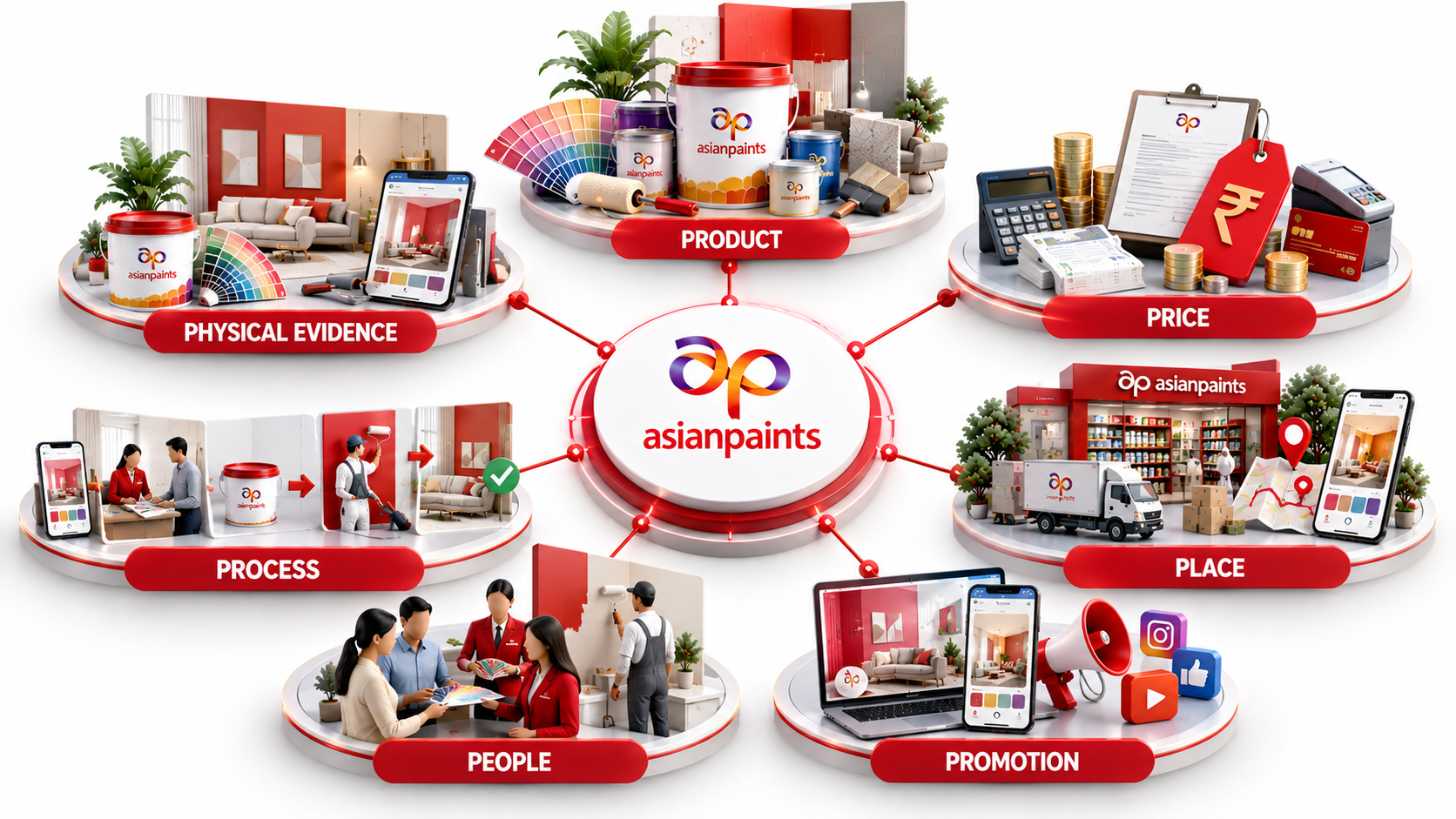
The marketing mix of Asian Paints is usually explained using the extended 7Ps model rather than the basic four, and that is not marketing jargon for the sake of it. A paint company sells a physical product, yes, but it also sells a service experience through colour consultants, painting contractors, and in-store visualisation tools. That service layer is big enough that leaving out People, Process, and Physical Evidence would miss half the actual strategy.
Why the 7Ps Framework Fits a Company Like This
Think about what actually happens when someone decides to repaint a three bedroom flat. They do not just pick a colour off a swatch card and order it online the way they would buy a t-shirt. They call a painter, argue with their spouse about whether the living room should be beige or a soft blue, visit a dealer, maybe use an app to see how the colour looks on their own wall, negotiate on labour cost, and only then commit to a can. Every single one of those touchpoints is something Asian Paints has deliberately built a strategy around, which is exactly why the seven-element version of the marketing mix fits this business so much better than the simplified four-element one taught in most intro courses. The rest of this guide goes through each of those seven elements one at a time, with real examples pulled from how the company actually operates rather than generic theory.
Product Strategy
Product sits at the centre of the marketing mix of Asian Paints, and the range here is wider than most people realise until they actually stand in front of a dealer’s price list. The company does not sell one paint. It sells dozens of sub-brands stacked across price points, use cases, and customer types, and each of those sub-brands is positioned with enough precision that they rarely cannibalise each other.
Decorative Paints – The Bread and Butter
Decorative paints, the ones used to paint homes, offices, and apartments, make up the bulk of Asian Paints’ revenue, somewhere around 80 to 85 percent depending on the year. Inside that category the company runs a deliberately tiered structure. Apex and Apex Ultima sit at the premium exterior end, built to handle Indian monsoons and harsh sun without peeling within a couple of years. Royale is the flagship interior emulsion, the one most upper middle class households in Tier 1 and Tier 2 cities reach for when they want a smooth, washable finish with a wide colour range. Tractor Emulsion sits lower down, aimed at value-conscious buyers who still want a branded product rather than an unbranded local mix. This is not random labelling. Each tier is priced and marketed to hit a specific income bracket without those brackets bleeding into each other and confusing the buyer.
What makes this tiering work is that Asian Paints never lets the lower tiers feel like a downgrade in trust, only a downgrade in finish level or price. A Tractor Emulsion buyer still trusts the Asian Paints name on the tin the same way a Royale buyer does. That trust transfer across price tiers is one of the harder things to pull off in FMCG-style categories, and it is a big reason competitors have struggled to dent the company’s dominance even when they undercut on price.
Industrial Paints and the B2B Side
Beyond decorative paints, Asian Paints runs a serious industrial and B2B paints business, though most consumers never think about this side at all. Through its joint venture with PPG Industries of the United States, the company supplies automotive coatings, protective coatings for factories and infrastructure, and powder coatings used in appliances and metal furniture. This segment is smaller in revenue terms compared to decorative paints but it matters strategically, because it keeps the company’s manufacturing and R&D capabilities sharp on the chemistry side, which then feeds back into better decorative products too. A company that only makes wall paint eventually falls behind on formulation science. Asian Paints avoided that trap by staying present in the tougher, more technical corners of the coatings industry.
Home Improvement and Beyond
Somewhere around 2017 onward, Asian Paints made a deliberate bet that home improvement, not just paint, would be the bigger opportunity. That is why the company pushed hard into waterproofing solutions under the SmartCare and Damp Proof ranges, wall textures and stencils under Royale Play, and even modular kitchens, bath fittings, and furnishings through acquisitions like Sleek and White Teak, and later a stake in Weatherseal for windows. This move looks a lot like what a lot of consumer brands try when their core category matures – stretch into adjacent categories where the existing customer relationship and distribution network can be reused rather than built from scratch. Whether this pays off as well as the core paint business is still an open question, and some analysts have been skeptical about how thin the margins are in furnishings and modular furniture compared to paint, where Asian Paints enjoys much stronger pricing power.
Colour Consultancy and Value-Added Services
The product strategy also includes something that never shows up in a can – colour consultancy. Asian Paints trains colour experts who visit homes, especially higher value projects, to help customers pick palettes, textures, and finishes that actually suit the light and layout of their specific rooms. This service used to be reserved mostly for large projects and premium customers, but the company has pushed it down market too through in-store consultants and digital tools. It sounds like a small addition, but for a category where customers are genuinely anxious about picking the wrong colour and living with it for years, this service closes the confidence gap that keeps people stuck at the “still deciding” stage for months. Reducing that hesitation directly converts into faster sales, which is exactly why this counts as product strategy and not just an afterthought.
Price Strategy
Price is where the marketing mix of Asian Paints gets genuinely interesting, because the company does not compete on being the cheapest option in the market. It has never tried to. Instead it runs a tiered pricing structure designed to capture value across income groups while protecting margins at the top, and it treats price cuts from rivals as something to respond to carefully rather than match automatically.
Tiered Pricing Across Brands
The tiering mentioned earlier under product strategy is really a pricing strategy wearing a product hat. Tractor Emulsion sits at the value end, priced to compete with regional and unbranded players who dominate rural and semi-urban markets on cost alone. Above that sits Apcolite, a mid-range interior and exterior option that most middle class households default to when repainting a flat. Above Apcolite comes Royale, positioned as the aspirational choice with better washability, sheen options, and a far wider shade card. At the very top, Royale Aspira and premium textured ranges under Royale Play target customers who see paint less as a functional purchase and more as an interior design decision, and price it accordingly, sometimes at three or four times the cost per litre of the entry-level range.
This layered approach means Asian Paints rarely loses a customer entirely just because their budget changed. A young couple stretching their first home renovation might start with Apcolite and later, five years down the line when they can afford it, trade up to Royale for their next home. The company keeps that customer inside its own ecosystem across their entire homeownership journey instead of losing them to a cheaper unbranded seller the moment budgets tighten.
Premium Pricing at the Top
At the top end, Asian Paints prices with real confidence, and that confidence is backed by decades of brand trust that competitors simply cannot buy overnight. Royale Aspira, some of the luxury textured finishes, and the higher-end waterproofing ranges are priced well above what regional players charge for comparable products, and customers still pay it. That is the payoff of brand equity built over eighty years – the company can charge a premium not because the paint chemistry is wildly different from a rival’s premium line, but because the customer trusts the brand enough to not want to risk an unfamiliar name on their newly built home. Few categories reward trust this directly, and Asian Paints has been disciplined about not undercutting its own premium positioning just to chase short term volume.
How Asian Paints Handles Price Wars
Price wars in the Indian paint industry are not rare, and the biggest one in recent memory came when Grasim Industries, part of the Aditya Birla Group, launched Birla Opus in 2024 and priced aggressively to grab share fast, reportedly undercutting established players by a noticeable margin on comparable products. Asian Paints did not respond by slashing prices across the board, which honestly would have been the easy, panicky move. Instead the company leaned harder into its distribution advantage, its dealer relationships, and its service layer, betting that a price-led entrant without decades of dealer trust would struggle to convert share as fast as its marketing budget suggested. That bet is still playing out at the time of writing, and Asian Paints has seen some margin pressure and a dip in market share estimates in certain reports, which shows this approach is not risk-free. But the company clearly decided that protecting brand value mattered more than winning a short-term price fight it did not start.
Place and Distribution
If there is one element of the marketing mix of Asian Paints that genuinely explains its dominance more than any advertisement ever could, it is distribution. The company’s dealer network is one of the widest and deepest in Indian retail, full stop, not just within the paint category, and this is the part of the strategy that rivals have found hardest to copy even with deep pockets behind them.
The Dealer Network Nobody Else Can Match
Asian Paints works with somewhere around 70,000 to 80,000 dealers and retail touchpoints across India, spread across metros, Tier 2 and Tier 3 towns, and increasingly into rural markets too. That number alone tells a story, but the depth of the relationship matters more than the count. Many of these dealerships have worked with Asian Paints for two or three generations, passed down within families, because the company built a reputation for treating dealers fairly on margins, stock support, and credit terms long before that became a standard industry practice. A dealer who has sold Asian Paints for thirty years is not going to switch loyalty overnight just because a new entrant offers a slightly better margin on paper, especially when that new entrant has no track record of standing by dealers during slow seasons or supply disruptions.
This dealer relationship is reinforced through the company’s supply chain, which is built around getting stock to even remote dealers quickly and predictably. A dealer running low on a popular shade cannot afford to send a frustrated customer elsewhere, and Asian Paints has invested heavily in logistics and regional warehousing specifically to avoid stockouts that would push dealers toward stocking a rival brand instead.
Colour World and Tinting Machines
One of the genuinely clever moves in the history of Indian retail was Asian Paints’ introduction of Colour World, a tinting machine system placed inside dealer stores that lets a shopkeeper mix a base paint with pigment on the spot to produce any one of thousands of exact shades in a matter of minutes. Before this, dealers had to stock hundreds of pre-mixed cans of different colours, tying up working capital and shelf space on shades that might sit unsold for months. With Colour World, a dealer stocks a handful of base paints and a set of colourants, and mixes to order right in front of the customer.
This single innovation changed the economics of paint retail. Dealers needed less inventory, wasted less money on slow-moving shades, and could offer customers an almost unlimited colour range without the risk of dead stock. For customers, it meant walking out with the exact shade they wanted rather than settling for whatever was already sitting on the shelf. Competitors eventually copied the tinting machine concept, because it clearly worked, but Asian Paints had a multi-year head start and used it to lock in dealer loyalty before rivals caught up.
Rural Reach and Tier 2/3 Penetration
A huge part of Asian Paints’ distribution strategy has focused on markets that bigger, more urban-focused companies used to ignore. Rural and semi-urban India accounts for a massive share of paint demand, partly because so much of the housing stock outside metros gets repainted regularly as part of festival preparation, especially before Diwali. Asian Paints built dedicated distribution routes, smaller pack sizes suited to lower disposable incomes, and dealer support tailored to these markets years before Birla Opus or other newer entrants took rural distribution seriously. This is exactly the kind of unglamorous, logistics-heavy work that never makes it into a flashy ad campaign, but it is arguably more responsible for the company’s market share than any single marketing decision.
Home Decor Stores and Direct Retail
On top of the dealer network, Asian Paints has also opened its own branded stores in select cities, offering not just paint but the full home decor and improvement range under one roof, including furnishings, modular kitchen consultations, and waterproofing solutions. These stores work less as a primary sales channel and more as a brand showcase, a place where the company can demonstrate the full breadth of its product ecosystem to customers who are undertaking a full home renovation rather than just repainting one wall. Online, the company also sells through its own website and app alongside marketplaces, though online sales still remain a small slice of overall volume compared to the dealer channel, largely because paint is a category where people still want to see the actual colour and texture before committing to a large purchase.
Promotion Strategy
Promotion is probably the most visible part of the marketing mix of Asian Paints to an ordinary consumer, and it is where the company has built some genuinely memorable advertising over the decades. But look closer and the promotion strategy is not just about catchy taglines. It is built around a consistent emotional thread that ties every campaign back to the idea of home.
“Har Ghar Kuch Kehta Hai” and Emotional Advertising
The tagline “Har Ghar Kuch Kehta Hai,” which translates roughly to “every home says something,” has anchored Asian Paints advertising for years, and it works because it sidesteps talking about paint chemistry or finish quality entirely. Instead the ads focus on the emotions tied to a home – family, celebration, memory, identity – and quietly position paint as the medium through which those emotions get expressed on the walls people live inside every day. This is smart positioning because paint, on its own, is a genuinely boring product to advertise. Nobody gets emotional about viscosity or drying time. But people do get emotional about their homes, their festivals, their family gatherings, and Asian Paints figured out early that the emotional hook had to come from the home, not the tin.
Festival-season advertising, especially around Diwali, has become almost a tradition in itself for the brand, with campaigns that show families repainting, redecorating, and preparing their homes for celebration. These ads run heavily on television and increasingly on digital platforms, timed deliberately to coincide with the period when Indian households are most likely to actually repaint, which is not an accident either.
Celebrity Endorsements and Brand Ambassadors
Asian Paints has used celebrity endorsements strategically rather than constantly, choosing faces that reinforce trust and mass appeal rather than just star power for its own sake. Over different periods the brand has worked with well known Bollywood and cricket personalities in campaigns aimed at building broad recall, while keeping more product-specific or regional campaigns fronted by relatable, everyday faces rather than always relying on a single national celebrity. This mixed approach lets the company run mass-reach campaigns during major seasons while still connecting with more localised audiences through regional language advertising and smaller-scale campaigns that a single national ambassador cannot always carry convincingly.
Digital Marketing and Social Media Push
Like most large Indian consumer brands, Asian Paints has shifted a growing share of its promotion budget into digital channels over the last decade. This includes running its own YouTube channel and social media pages that mix brand advertising with practical content, like home decor inspiration, colour trend reports, and do-it-yourself painting tips, content designed to keep the brand relevant to customers even outside the narrow window when they are actively planning a repaint. The company also runs performance marketing campaigns targeting people actively searching for renovation ideas, painters, or colour inspiration, converting search intent directly into dealer visits or app downloads. This digital push matters more now than it did ten years ago because younger, urban homeowners increasingly research colours and painting costs online before ever walking into a physical store, and a brand that is invisible in that research phase risks losing the customer before the in-store stage even begins.
Sponsorships, Events and On-Ground Activation
Beyond mainstream advertising, Asian Paints has also invested in sponsorships and design-focused events, including associations with interior design competitions, architecture events, and the long running Asian Paints Colour Next forecast, which predicts colour and design trends for the year ahead and gets picked up widely by architects, interior designers, and design media. This kind of activity does not sell paint directly, but it cements Asian Paints as a design authority rather than just a paint manufacturer, which matters a lot when architects and interior designers, who influence a huge number of paint purchase decisions on bigger projects, need to decide which brand to specify by default.
People
The People element in the marketing mix of Asian Paints goes further than most companies bother to go, because Asian Paints treats painters, the actual labourers who apply the paint, as a strategic stakeholder group almost as important as the end customer. This is one of the more underrated parts of the whole strategy and honestly deserves more attention than it usually gets in textbook coverage of the brand.
Painters as a Stakeholder Group
Think about how a typical paint purchase decision actually happens. A homeowner rarely picks the brand entirely on their own. They call a painter or contractor, ask for a quote, and that painter often has strong opinions, sometimes financial incentives, about which brand to recommend. Asian Paints recognised this dynamic decades before competitors treated it seriously, and built out programs specifically targeting painters, including training initiatives, loyalty programs that reward painters for recommending and using Asian Paints products, and even skill development courses that improve a painter’s technique, which in turn improves the finished result and reflects well on the brand. A painter who has been trained by Asian Paints, who earns loyalty points redeemable for real rewards through buying and using Asian Paints products, has a strong practical reason to keep recommending the brand to every customer they work with, not just an emotional or habitual one.
This painter-focused strategy is a genuinely smart way to influence a purchase decision at the exact point where the customer’s own knowledge is weakest. Most homeowners cannot tell the difference between paint brands just by looking at a can, so they lean heavily on whoever is actually going to apply it. By winning over that person first, Asian Paints effectively secures a huge chunk of purchase decisions before the customer ever compares brands consciously.
Dealers, Sales Staff and Customer-Facing Teams
On the customer-facing side, Asian Paints invests in training its dealer staff and in-store colour consultants to handle everything from basic product queries to full colour consultations using digital visualisation tools. The company runs regular training programs to keep dealer staff updated on new product launches, application techniques, and how to use tools like the Beautiful Homes app to help customers visualise colours before buying. This matters because a paint purchase involves a lot of hesitation and back-and-forth conversation, and a knowledgeable, well trained staff member at the point of sale can shorten that hesitation window considerably, converting browsers into buyers faster than a self-service retail experience ever could for a category this involved.
Process
Process, in the context of the marketing mix of Asian Paints, covers everything that happens between a customer deciding to repaint and the job actually getting finished, and the company has worked hard to make that journey smoother, because a messy, unpredictable process is one of the biggest reasons people put off repainting their homes in the first place.
Order to Delivery
The backend process for getting paint from factory to dealer to customer has been built for speed and reliability rather than just cost efficiency. Asian Paints uses advanced supply chain and demand forecasting systems to predict which shades and pack sizes will move fastest in different regions and seasons, reducing the chances of a dealer running out of a popular colour right before Diwali, historically the busiest painting season across most of India. The company was actually an early adopter of enterprise resource planning and supply chain technology in Indian manufacturing, investing in these systems back when many domestic competitors were still running largely manual, paper-based dealer ordering processes. That head start in operational technology quietly supports everything else in the marketing mix, because none of the promotion or distribution strategy matters if a dealer cannot actually get stock when a customer wants to buy.
Home Painting Services and Beautiful Homes App
Beyond just selling tins of paint, Asian Paints built out a full home painting services offering, where customers can book an entire painting job, including labour, materials, and project management, directly through the company rather than sourcing a painter independently. This addresses a genuine pain point, because finding a reliable painter, negotiating a fair price, and managing the mess and disruption of a painting job is stressful for most households, especially in cities where trust in unknown contractors runs low. The Beautiful Homes app ties into this process too, letting customers browse colour and design inspiration, use augmented reality tools to preview shades on their own walls through their phone camera, and then book a consultation or a full painting service directly, turning what used to be a fragmented, multi-week process involving several different phone calls into something that can start and largely run through a single app.
Physical Evidence
Physical Evidence refers to the tangible cues that reassure a customer they are dealing with a credible, quality brand, and in the marketing mix of Asian Paints this shows up clearly in store design, packaging, and the overall in-person experience the company has built around its retail presence.
Colour World Stores as Brand Experience
The Colour World branding does more than just enable tinting machines behind the counter. It creates a visually consistent, recognisable retail environment across tens of thousands of dealer stores nationwide, so a customer walking into a small paint shop in a Tier 3 town gets a similar branded shelf display, similar shade cards, and a similar overall look and feel as they would in a bigger city dealership. This consistency matters more than people give it credit for, because it signals scale and reliability, two things a nervous first-time home buyer desperately wants reassurance about before spending a meaningful chunk of their renovation budget.
Packaging and In-Store Displays
Packaging design across Asian Paints’ range has stayed distinctive enough to be recognisable from a distance, using consistent colour coding and branding across its different sub-brands so customers can tell Royale from Apcolite from Tractor Emulsion at a glance, even before reading the label closely. In-store, the company provides dealers with shade card displays, sample boards, and digital kiosks in bigger outlets that let customers browse the full colour range interactively rather than flipping through a worn paper booklet. All of this physical evidence works together to make the buying experience feel organised and trustworthy, which matters enormously in a category where the actual product, wet paint in a sealed tin, cannot really be inspected or tested by the customer before purchase.
Competitive Landscape and What Sets Asian Paints Apart
No breakdown of the marketing mix of Asian Paints is complete without looking honestly at the competition, because a lot of what Asian Paints does only makes sense when you see what it is defending against.
Berger Paints, Kansai Nerolac and the Rest
Berger Paints has long sat as the closest full-line competitor, running a similar tiered product strategy and a reasonably strong dealer network, though still smaller in reach than Asian Paints. Kansai Nerolac, backed by the Japanese Kansai Paint group, has historically been stronger in the industrial and automotive coatings segment while also competing in decorative paints, particularly in southern and western India. Akzo Nobel, through its Dulux brand, has carved out a smaller but genuine premium niche, especially among urban customers who associate the brand with international quality standards. None of these players has managed to seriously dent Asian Paints’ overall leadership, mostly because none of them matched the sheer depth of dealer relationships and rural distribution that Asian Paints built up over decades.
The Grasim/Birla Opus Threat
The most serious recent challenge comes from Birla Opus, launched by Grasim Industries in 2024 with backing from the Aditya Birla Group’s considerable financial resources. Unlike smaller regional challengers, Birla Opus entered with aggressive pricing, an unusually fast rollout of manufacturing capacity, and a determined push to sign up dealers quickly, in some cases reportedly offering better margins than established players to win shelf space. This entry did rattle the market for a bit, and Asian Paints has acknowledged pressure on both pricing and market share in various investor communications since. Whether Birla Opus can sustain that aggressive push once initial promotional pricing normalises, and whether it can build the kind of multi-generational dealer trust Asian Paints has, remains genuinely uncertain. Big balance sheets can buy shelf space fast. They cannot buy decades of a dealer’s grandfather having done fair business with your company, and that kind of trust is exactly what Asian Paints is leaning on to defend its position.
Segmentation, Targeting and Positioning Behind the Marketing Mix of Asian Paints
Before any of the seven Ps could be built out, Asian Paints had to answer a more basic question, who exactly is this paint for. That answer shaped every decision that followed, from which shades got prioritised in the colour catalogue to which towns got a dealer first. Segmentation, targeting, and positioning rarely get discussed alongside the marketing mix of Asian Paints, but honestly, none of the product or pricing decisions make sense without understanding this layer first.
How Asian Paints Segments the Market
Asian Paints slices its customer base along a few different lines at once, not just income. There is the obvious income-based segmentation that drives the Tractor Emulsion to Royale Aspira ladder discussed earlier. But there is also a use-case segmentation, separating homeowners repainting an existing space from builders and developers buying paint in bulk for new construction, and separating decorative retail customers from industrial buyers who need automotive or protective coatings entirely. Geography plays a role too, since a coastal home in Kochi dealing with humidity and salt air needs a very different exterior paint than a home in dry, dusty Jodhpur, and Asian Paints formulates and markets specific products, like weatherproof and anti-algal exterior ranges, with these regional differences in mind rather than selling one generic exterior paint nationwide.
Targeting Choices That Shaped the Business
Rather than trying to be everything to everyone from day one, Asian Paints targeted the broad middle of the Indian household market first, the families who wanted a trustworthy, branded product but could not stretch to imported European paint prices. That middle segment turned out to be enormous in a country India’s size, and dominating it gave the company the scale to later chase the premium segment with Royale and Apex, and the value segment with Tractor Emulsion, without looking like it was stretching itself thin. Builders and developers became a separate, deliberately targeted segment too, since bulk project sales offer volume and brand visibility in new homes right from the day families move in, effectively pre-seeding brand preference before the homeowner even starts thinking about their next repaint years later.
Positioning as the Trusted, Emotional Choice
On positioning, Asian Paints made a choice early on to be the brand associated with home and trust rather than the brand associated with the lowest price or the most technical formulation. Competitors like Kansai Nerolac sometimes lean harder into technical credibility, given their industrial coatings heritage, while Asian Paints leans into the emotional, aspirational side of home ownership. That positioning shows up consistently across advertising, in-store experience, and even the names chosen for sub-brands, Royale, Apex, Beautiful Homes, all of which suggest quality of life rather than technical specification sheets. It is a deliberate choice, and it is one of the reasons the brand can charge premium prices without customers feeling like they are being sold pure chemistry in a tin.
The Digital Transformation Layer in Asian Paints’ Marketing Mix
It is worth pulling out digital transformation as its own section, separate from the general promotion discussion earlier, because Asian Paints has quietly become far more of a technology-driven company than most people give it credit for, and this shift touches almost every element of the marketing mix at once rather than sitting neatly inside just one P.
Data-Driven Demand Forecasting
The company has invested heavily in analytics that predict paint demand at a granular, almost dealer-by-dealer level, factoring in seasonality, local weather patterns, festival calendars, and even construction activity in a given region. This kind of forecasting used to be closer to guesswork, based on a regional sales manager’s gut feeling built up over years of experience. Now it runs through dedicated systems that flag which dealer in which town is likely to need extra stock of which shade before the actual demand spike hits. That precision reduces the two worst outcomes in paint retail, a dealer stuck with unsold inventory tying up cash, or a dealer running out of stock right when a customer walks in ready to buy.
Augmented Reality and Visualisation Tools
The augmented reality feature inside the Beautiful Homes app deserves a closer look on its own, because it solves a problem that has quietly frustrated paint buyers for generations, the gap between a small colour swatch and what an entire wall actually looks like once painted. Customers can now point their phone camera at their own living room wall and see a reasonably accurate preview of different shades applied in real time, cutting down on the anxiety and second-guessing that used to stretch the decision-making phase out by weeks. This tool does not replace the in-store consultation experience, it works alongside it, often used by customers before they even step into a dealer store, meaning by the time they do walk in, they already have two or three shortlisted shades rather than starting from zero.
Sustainability’s Growing Role in the Marketing Mix of Asian Paints
Sustainability has slowly worked its way into how Asian Paints talks about itself, and it deserves a mention here because it now touches product formulation, promotion messaging, and even how the company talks to investors, not just a CSR page nobody reads.
Low-VOC and Safer Formulations
Over the last several years Asian Paints has pushed low volatile organic compound, or low-VOC, formulations across a good chunk of its interior range, responding to growing awareness among urban, health-conscious buyers about indoor air quality, especially in newly painted rooms where fumes can linger for days. This is not purely an altruistic move, it is also a competitive one, since premium customers increasingly ask dealers specifically about VOC content before buying, particularly for children’s rooms or homes with elderly residents. Getting ahead of that question with a genuinely reformulated product line, rather than just marketing language, protects the premium segment from losing ground to newer, wellness-focused challenger brands that might otherwise use this as their opening wedge into the market.
Water Management and Manufacturing Efficiency
On the manufacturing side, the company has invested in reducing water usage and improving energy efficiency across its plants, partly driven by regulatory pressure and partly by genuine cost savings, since water and energy are real line items on a factory’s balance sheet, not just talking points for a sustainability report. This operational efficiency rarely gets mentioned in customer-facing advertising directly, but it quietly supports the brand’s broader positioning as a responsible, long-term player in a category that, historically, has not always had a great reputation for environmental impact given the chemical-heavy nature of paint manufacturing.
Key Takeaways from the Marketing Mix of Asian Paints
Pulling this all together, a few things stand out clearly about how Asian Paints has run its strategy over the decades. The company never tried to win on price alone, choosing instead to build tiered products that capture value across income groups while protecting premium margins at the top. Distribution, more than advertising, is the real backbone of its dominance, built through a dealer network that took decades to earn and cannot be replicated quickly no matter how much money a new entrant throws at the problem. Painters and contractors get treated as a strategic audience in their own right, not just an afterthought, which quietly secures a huge share of purchase decisions before the end customer even compares brands. And the promotion strategy has stayed disciplined around one consistent emotional idea, home, rather than chasing every passing advertising trend. Put together, these choices explain why Asian Paints has remained the market leader even as aggressive, well funded competitors like Birla Opus have entered the fight.
Conclusion
Paint is one of those categories that looks simple from the outside and turns out to be layered once you actually study how a company like Asian Paints operates inside it. The marketing mix of Asian Paints works because every element reinforces every other element instead of standing alone. The product tiers support the pricing strategy. The pricing strategy protects the distribution relationships. The distribution network makes the promotion campaigns land with dealers who are ready to convert that attention into actual sales. And underneath all of it sits a decades-long bet that trust, built slowly through painters, dealers, and consistent brand experience, beats any single flashy campaign or aggressive price cut a competitor throws at the market. Birla Opus and other challengers might chip away at the edges for a while. Whether any of them can actually rebuild what Asian Paints spent eighty years constructing is a much harder question, and honestly, the answer will take years to become clear.
Frequently Asked Questions
What are the 7Ps in the marketing mix of Asian Paints?
The 7Ps are Product, Price, Place, Promotion, People, Process, and Physical Evidence. Asian Paints uses all seven because paint is not a simple, one-time transactional product. It involves ongoing service, consultation, and trust-building that the basic four Ps framework does not capture fully on its own.
Why does Asian Paints use tiered pricing instead of one standard price?
Tiered pricing lets the company serve budget-conscious buyers through ranges like Tractor Emulsion while still capturing premium value from customers willing to pay more for Royale or Royale Aspira. This way the brand keeps customers inside its own product family as their income and preferences change over time, rather than losing them to cheaper unbranded alternatives.
How big is Asian Paints’ dealer network?
Asian Paints works with somewhere around 70,000 to 80,000 dealers and retail touchpoints across India, one of the widest networks in the country’s retail sector, spanning metros down to small rural towns.
What is Colour World and why does it matter?
Colour World is the branded tinting machine system installed in dealer stores that lets shopkeepers mix custom shades on the spot rather than stocking pre-mixed cans of every possible colour. It reduced dealer inventory costs, cut down on dead stock, and let customers get the exact shade they wanted immediately, which changed how paint retail worked across the whole industry.
Why does Asian Paints focus so much on painters rather than just homeowners?
Painters and contractors heavily influence which brand a homeowner ends up buying, since most customers trust the applicator’s recommendation over their own limited product knowledge. Asian Paints built loyalty programs and training initiatives specifically for painters to win their recommendation before the customer even starts comparing brands.
What does the “Har Ghar Kuch Kehta Hai” campaign actually mean for the brand?
It translates to “every home says something,” and the campaign strategy behind it focuses on emotions tied to home and family rather than technical paint features. This approach makes paint advertising feel personal and relatable instead of dry and product-focused, which is much harder to achieve when talking about something as unglamorous as paint chemistry.
How is Birla Opus affecting Asian Paints’ market position?
Birla Opus, launched by Grasim Industries in 2024, entered with aggressive pricing and fast capacity rollout, putting some pressure on Asian Paints’ pricing and reported market share in recent quarters. However Asian Paints still holds a commanding lead built on decades of dealer trust and distribution depth that a new entrant cannot replicate overnight, so the long-term outcome of this competition is still unfolding.
Does Asian Paints only sell paint, or does it sell other products too?
Beyond decorative and industrial paints, Asian Paints has expanded into waterproofing solutions, wall textures, modular kitchens, bath fittings, and home furnishings through brands like SmartCare, Royale Play, Sleek, and White Teak, positioning itself as a broader home improvement company rather than just a paint manufacturer.
What role does the Beautiful Homes app play in Asian Paints’ strategy?
The app lets customers browse design inspiration, preview paint shades on their own walls using augmented reality through their phone camera, and book consultations or full painting services directly. It simplifies what used to be a fragmented, multi-step process into something customers can manage largely from one place.
How does Asian Paints use physical evidence in its marketing mix?
Physical evidence shows up through consistent Colour World store branding, distinctive and recognisable packaging across its sub-brands, in-store shade card displays, and digital visualisation kiosks. These elements reassure customers about quality and reliability in a category where the actual product cannot be tested before purchase.
Is Asian Paints present outside India?
Yes, the company operates in more than fifteen countries including Nepal, Sri Lanka, Bangladesh, several Gulf nations, and parts of Africa, through a mix of subsidiaries, joint ventures, and acquisitions built up over several decades of international expansion.
What makes the marketing mix of Asian Paints difficult for competitors to copy?
The hardest part to replicate is not the product range or even the advertising, it is the multi-generational dealer trust and the painter loyalty programs built up over decades. A competitor can match price or even copy a tinting machine concept fairly quickly, but earning the kind of relationship where a dealer’s grandfather trusted the brand and that trust carried down through the family takes far longer than any marketing budget can buy.
Who are Asian Paints’ main target customers?
The core target has always been middle class Indian households repainting or building a home, a segment large enough on its own to justify decades of investment. Around that core, the company also targets builders and developers buying in bulk for new construction, premium urban customers through Royale and Aspira, and value-conscious buyers in smaller towns through Tractor Emulsion, covering nearly the entire income spectrum without diluting the brand.
How does Asian Paints use its Colour Next trend forecast in its marketing strategy?
Colour Next is an annual design and colour trend report the company publishes, aimed mainly at architects, interior designers, and design media rather than everyday retail customers. By positioning itself as a source of design authority rather than just a manufacturer, Asian Paints strengthens its influence with the professionals who often get asked directly which paint brand to specify on a project, which quietly drives a meaningful chunk of premium and bulk sales.
Does Asian Paints sell directly to builders and construction companies?
Yes, and this bulk institutional channel runs somewhat separately from the retail dealer network discussed earlier in this guide. Builders and developers buying paint for entire housing projects get dedicated account management, project pricing, and technical support, and this channel matters strategically because it puts the Asian Paints name inside brand-new homes before the family that eventually lives there ever makes an independent purchase decision of their own.