


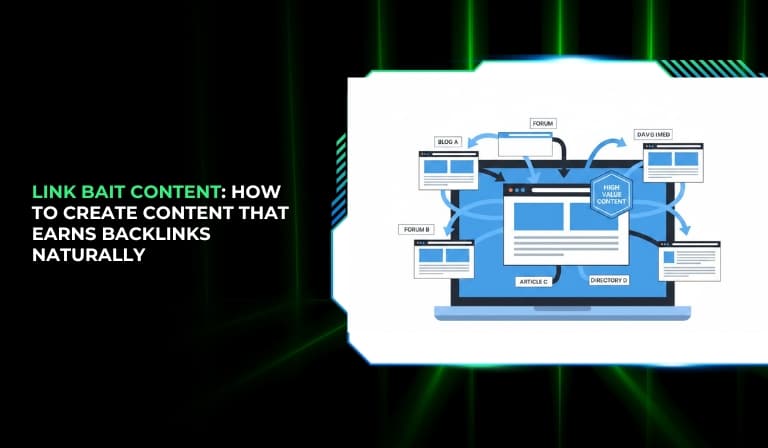
Backlinks continue to play a major role in search engine optimization because they act as trust signals. When one website links to another, it signals that the content is valuable, relevant, or credible. Search engines analyze these links to understand authority and topical relevance.

Many businesses try to build backlinks through manual outreach, guest posting, or paid placements. While these strategies can work, they require continuous effort and sometimes carry risks if done aggressively. A more sustainable method is creating content that naturally attracts links without forcing them.
This approach is known as link bait content. It focuses on creating high-quality, useful, and unique content that other websites want to reference. Instead of asking for links repeatedly, your content earns them organically because it provides real value.
In this guide, you will learn what link bait content is, why it matters, how it works psychologically, what types perform best, and how to create it step by step in a structured and practical way.
What Is Link Bait Content?
Link bait content refers to content specifically designed to attract backlinks naturally. It is created with the intention of being referenced, cited, or shared by other publishers, bloggers, journalists, or businesses.
The purpose is not manipulation but value creation.
It is important to understand the difference between link bait and clickbait.
- Clickbait focuses on sensational headlines that attract clicks but may not deliver strong value.
- Link bait focuses on delivering exceptional value that justifies a citation.
- Clickbait aims for traffic spikes.
- Link bait aims for authority growth and long-term backlinks.
- Clickbait often relies on exaggeration.
- Link bait relies on depth, originality, and usefulness.
Search engines reward natural editorial backlinks because they reflect voluntary recommendations. When another website links to your content without being paid or pressured, it signals credibility. That is why link bait is considered a sustainable and ethical SEO strategy.
Examples of link bait content include:
- Original industry research with unique statistics.
- Comprehensive guides that cover a topic fully.
- Interactive tools that solve specific problems.
- Data visualizations that simplify complex information.
- Detailed case studies with measurable results.
These formats naturally attract links because they add value to other content creators.
Why Link Bait Is Important for SEO
Link bait contributes to long-term SEO growth in multiple ways.
- It improves domain authority by attracting high-quality referring domains.
- It increases referral traffic from relevant websites.
- It strengthens brand credibility through citations.
- It helps rank competitive keywords by building authority signals.
- It reduces dependence on continuous manual link building campaigns.
Search engines evaluate both the quantity and quality of backlinks. When authoritative websites link to your content, your website gains trust signals. Over time, this authority helps multiple pages rank better.
Another advantage is compounding value. A strong piece of link bait can continue attracting links for years. For example, a well-structured industry report updated annually can become a reference resource.
Instead of constantly chasing links, link bait allows your content to work for you long term.
The Psychology Behind Link Bait
To create effective link bait, you must understand why people link to content.
Most content creators link for strategic reasons:
- To support a claim with credible data.
- To provide additional value to readers.
- To strengthen their own article’s authority.
- To reference a source of statistics.
- To recommend a useful tool or guide.
When someone links to your content, it often benefits them as much as it benefits you.
Emotional and psychological triggers also influence linking behavior:
- Awe: Unique findings or surprising insights.
- Surprise: Data that challenges assumptions.
- Usefulness: Practical solutions or tools.
- Authority: Expert-backed information.
- Controversy: Logical challenges to common beliefs.
For example, if you publish original survey results about industry trends, journalists may cite your statistics in their articles. They link because it strengthens their credibility.
Link bait works best when it supports other creators rather than competes with them.
Types of Link Bait Content That Work in 2026
Different formats attract links for different reasons. Below are the most effective types.
1. Original Research & Data Studies
Original research is one of the strongest forms of link bait because it creates new information.
- Conduct surveys within your industry.
- Publish annual benchmark reports.
- Analyze trends using collected data.
- Compare year-over-year performance metrics.
When content contains unique statistics, other writers cite it as a source. Data-driven content is often referenced in blogs, whitepapers, and media articles.
Original research builds authority because it cannot be easily copied.
2. Ultimate Guides & Pillar Content
Comprehensive guides attract links because they act as reference materials.
- Cover beginner to advanced concepts.
- Provide structured step-by-step explanations.
- Include frameworks and practical examples.
- Keep the content updated regularly.
When someone writes a related article, they may link to your guide instead of explaining everything from scratch.
Depth and clarity increase the likelihood of earning backlinks.
3. Infographics & Visual Assets
Visual content simplifies complex ideas.
- Create charts explaining processes.
- Design comparison tables.
- Build timeline visuals.
- Present statistics in graphic format.
When visuals are clear and informative, other websites embed them and credit the source.
Visual assets often earn backlinks because they save time for other content creators.
4. Free Tools & Calculators
Functional content attracts strong engagement.
- ROI calculators.
- SEO audit checkers.
- Content planning templates.
- Performance tracking sheets.
When a tool solves a specific problem efficiently, bloggers recommend it in their articles.
Tools generate backlinks because they provide immediate utility.
5. Controversial or Opinion-Based Content
Thought-provoking content can generate attention and discussion.
- Debunk common myths with evidence.
- Challenge outdated industry practices.
- Offer alternative strategies with reasoning.
- Present logical counterarguments.
However, controversy should always be supported by clear reasoning and data. Unsupported opinions rarely earn credible backlinks.
6. Expert Roundups & Interviews
Collaborative content expands reach.
- Interview recognized professionals.
- Collect expert opinions on a topic.
- Compile insights from industry leaders.
- Publish structured question-and-answer sessions.
Experts often share content they are featured in. Additionally, readers trust content supported by credible voices.
7. Case Studies & Real Results
Transparency increases authority.
- Show measurable results.
- Explain step-by-step strategies.
- Highlight challenges faced.
- Present data comparisons before and after implementation.
Case studies attract links because they demonstrate proof rather than theory.
They are especially effective in competitive industries where data-driven validation matters.
Step-by-Step Guide to Creating Link Bait Content
Creating link bait content requires planning, research, differentiation, and strategic promotion. Below is a practical framework you can follow.
Step 1: Identify Topics That Attract Links
The first step is choosing the right topic. Not every topic naturally earns backlinks. Some subjects are more citation-friendly than others.
Focus on topics that historically attract references.
- Analyze competitor websites and identify pages with the highest number of referring domains.
- Look for data-heavy articles, industry reports, or tools.
- Identify gaps where information is outdated or incomplete.
- Monitor industry discussions and frequently asked questions.
- Choose topics that solve common problems or provide statistics.
Topics that include data, research, tools, or in-depth education tend to earn more backlinks than opinion-based or promotional content.
Step 2: Analyze Why Existing Content Gets Links
Once you identify high-performing content, study it carefully.
Examine:
- The depth of information provided.
- Whether it includes original data or curated statistics.
- The clarity of structure and formatting.
- The use of visuals such as charts or diagrams.
- The uniqueness of perspective.
Understanding why content earns links helps you identify improvement opportunities. Instead of copying, focus on enhancing.
For example, if a guide is earning links but lacks updated statistics, you can create a more current and comprehensive version.
Step 3: Add a Unique Value Proposition
Differentiation is essential. If your content does not offer something new, it will not attract links.
You can add unique value by:
- Including updated or exclusive statistics.
- Conducting original surveys.
- Providing practical frameworks.
- Adding real-life examples.
- Simplifying complex topics into actionable steps.
- Offering downloadable templates.
The goal is to create a resource that stands out clearly from competitors.
Step 4: Make It Highly Shareable
Presentation influences how often content is referenced.
Ensure your content includes:
- Clear and descriptive headings.
- Logical section flow.
- Short, readable paragraphs.
- Well-structured bullet points where appropriate.
- Clean formatting.
- Visual elements that support explanations.
A strong headline also increases initial visibility. If the title clearly communicates value, more people are likely to read and reference the content.
Shareability increases when content is easy to understand and easy to reference.
Step 5: Optimize for SEO
Even the best link bait will not earn links if no one finds it.
SEO optimization includes:
- Targeting relevant primary and secondary keywords.
- Writing optimized meta titles and descriptions.
- Structuring content with proper heading hierarchy.
- Adding internal links to related content.
- Optimizing images with descriptive alt text.
- Using structured data where applicable.
SEO ensures discoverability. Link bait works best when it combines high value with strong visibility.
Step 6: Strategic Promotion (Without Being Spammy)
Link bait content should be promoted thoughtfully.
Effective strategies include:
- Sending personalized emails to relevant bloggers or journalists.
- Sharing key insights on social media platforms.
- Posting summarized insights in industry communities.
- Including the content in newsletters.
- Creating short posts highlighting key statistics.
Avoid mass, generic outreach emails. Personalization improves response rates and builds long-term relationships.
Promotion increases exposure, which increases the probability of natural backlinks.
How to Promote Link Bait Content Effectively
Promotion should focus on relevance rather than volume.
To improve results:
- Identify journalists or writers covering similar topics.
- Mention specific insights from your content in outreach emails.
- Highlight unique statistics or tools.
- Share short insight posts on LinkedIn.
- Convert key findings into social media threads.
- Repurpose content into smaller, shareable formats.
- Build relationships before requesting links.
When outreach is value-focused rather than link-focused, it is more effective.
Instead of asking directly for a backlink, explain how your content supports their existing article or audience needs.
Tools to Help You Create Link Bait Content
Various tools can assist in the creation and promotion process.
- SEO tools for analyzing competitor backlinks.
- Keyword research tools for identifying link-worthy topics.
- Survey tools for collecting original data.
- Graphic design software for creating visuals.
- Spreadsheet tools for organizing research data.
- Outreach management tools for tracking communication.
- Analytics platforms for monitoring traffic and backlinks.
While tools support execution, originality and value remain the foundation of link bait success.
How to Measure the Success of Link Bait Content
Success should be evaluated using measurable indicators.
Track:
- Number of referring domains.
- Authority level of linking websites.
- Growth in organic traffic.
- Improvement in keyword rankings.
- Referral traffic from backlinks.
- Engagement metrics such as time on page and bounce rate.
Long-term success is more important than short-term spikes. Sustainable backlink growth indicates that your content is being consistently referenced.
Link Bait vs Traditional Link Building
It is useful to compare both strategies.
Link bait focuses on earning links naturally through valuable content. Traditional link building often focuses on acquiring links through outreach or placement.
Key comparison points:
- Cost: Link bait requires investment in content creation. Traditional link building may require outreach resources or payments.
- Sustainability: Link bait can earn links for years. Traditional link building often requires continuous effort.
- Risk: Naturally earned links carry lower algorithmic risk.
- Scalability: A single strong asset can generate multiple backlinks.
- Long-term impact: Link bait builds authority gradually and consistently.
Both strategies can coexist, but link bait emphasizes organic growth.
Frequently Asked Questions (FAQs)
Is link bait still effective in 2026?
Yes. Search engines continue to value editorial backlinks because they represent voluntary trust signals.
How long does it take to earn backlinks naturally?
Time varies depending on topic competitiveness, promotion efforts, and industry demand. Results may take weeks or months.
Can small websites create link bait content?
Yes. Even smaller websites can earn backlinks by focusing on niche expertise or publishing original research.
How many backlinks should good content earn?
There is no fixed number. The number depends on industry size, topic demand, and promotion strategy.
Is link bait considered white-hat SEO?
Yes. When content earns backlinks organically through value creation, it aligns with ethical SEO practices.
Conclusion
Link bait content is a long-term, sustainable approach to earning backlinks naturally. Instead of focusing only on outreach, it emphasizes creating exceptional value. By understanding user psychology, selecting the right content formats, differentiating your work, and promoting strategically, you increase the likelihood of attracting authoritative backlinks.
The strategy requires effort in research, creativity, and execution, but the results compound over time. When your content becomes a trusted reference within your industry, backlinks follow naturally.